BiTAM: Bilingual Topic AdMixture Models for Word Alignment
Bing Zhao† and Eric P. Xing†‡
{bzhao,epxing}@cs.cmu.edu
Language Technologies Institute† and Machine Learning Department‡ School of Computer Science, Carnegie Mellon University
Abstract
We propose a novel bilingual topical ad-mixture (BiTAM) formalism for word alignment in statistical machine transla-tion. Under this formalism, the paral-lel sentence-pairs within a document-pair are assumed to constitute a mixture of hidden topics; each word-pair follows a topic-specific bilingual translation model. Three BiTAM models are proposed to cap-ture topic sharing at different levels of lin-guistic granularity (i.e., at the sentence or word levels). These models enable word-alignment process to leverage topical con-tents of document-pairs. Efficient vari-ational approximation algorithms are de-signed for inference and parameter esti-mation. With the inferred latent topics, BiTAM models facilitate coherent pairing of bilingual linguistic entities that share common topical aspects. Our preliminary experiments show that the proposed mod-els improve word alignment accuracy, and lead to better translation quality.
1 Introduction
Parallel data has been treated as sets of unre-lated sentence-pairs in state-of-the-art statistical machine translation (SMT) models. Most current approaches emphasize within-sentence dependen-cies such as the distortion in (Brown et al., 1993), the dependency of alignment in HMM (Vogel et al., 1996), and syntax mappings in (Yamada and Knight, 2001). Beyond the sentence-level, corpus-level word-correlation and contextual-corpus-level topical information may help to disambiguate translation candidates and word-alignment choices. For ex-ample, the most frequent source words (e.g., func-tional words) are likely to be translated into words which are also frequent on the target side; words of the same topic generally bear correlations and sim-ilar translations. Extended contextual information is especially useful when translation models are vague due to their reliance solely on word-pair co-occurrence statistics. For example, the word shot
in “It was a nice shot.” should be translated dif-ferently depending on the context of the sentence: a goal in the context of sports, or a photo within the context of sightseeing. Nida (1964) stated that sentence-pairs are tied by the logic-flow in a document-pair; in other words, the document-pair should be word-aligned as one entity instead of be-ing uncorrelated instances. In this paper, we pro-pose a probabilistic admixture model to capture latent topics underlying the context of document-pairs. With such topical information, the trans-lation models are expected to be sharper and the word-alignment process less ambiguous.
Previous works on topical translation models concern mainly explicit logical representations of semantics for machine translation. This include knowledge-based (Nyberg and Mitamura, 1992) and interlingua-based (Dorr and Habash, 2002) approaches. These approaches can be expen-sive, and they do not emphasize stochastic trans-lation aspects. Recent investigations along this line includes using word-disambiguation schemes (Carpua and Wu, 2005) and non-overlapping bilin-gual word-clusters (Wang et al., 1996; Och, 1999; Zhao et al., 2005) with particular translation mod-els, which showed various degrees of success. We propose a new statistical formalism: Bilingual Topic AdMixture model, or BiTAM, to facilitate topic-based word alignment in SMT.
Variants of admixture models have appeared in population genetics (Pritchard et al., 2000) and text modeling (Blei et al., 2003). Statistically, an object is said to be derived from an admixture if it consists of a bag of elements, each sampled inde-pendently or coupled in some way, from a mixture model. In a typical SMT setting, each document-pair corresponds to an object; depending on a chosen modeling granularity, all sentence-pairs or word-pairs in the document-pair correspond to the elements constituting the object. Correspondingly, a latent topic is sampled for each pair from a prior topic distribution to induce topic-specific transla-tions; and the resulting sentence-pairs and word-pairs are marginally dependent. Generatively, this
admixture formalism enables word translations to
be instantiated by topic-specific bilingual models
and/or monolingual models, depending on their contexts. In this paper we investigate three in-stances of the BiTAM model, They are data-driven and do not need hand-crafted knowledge engineer-ing.
The remainder of the paper is as follows: in sec-tion 2, we introduce notasec-tions and baselines; in section 3, we propose the topic admixture models; in section 4, we present the learning and inference algorithms; and in section 5 we show experiments of our models. We conclude with a brief discus-sion in section 6.
2 Notations and Baseline
In statistical machine translation, one typically uses parallel data to identify entities such as “word-pair”, “sentence-pair”, and “document-pair”. Formally, we define the following terms1:
• A word-pair(fj, ei)is the basic unit for word alignment, wherefj is a French word andei is an English word; j and iare the position
indices in the corresponding French sentence f and English sentencee.
• A sentence-pair (f,e) contains the source sentencefof a sentence length ofJ; a target sentenceeof lengthI. The two sentencesf andeare translations of each other.
• A document-pair (F,E) refers to two doc-uments which are translations of each other. Assuming sentences are one-to-one corre-spondent, a document-pair has a sequence of
N parallel sentence-pairs {(fn,en)}, where (fn,en)is then0thparallel sentence-pair. • A parallel corpusCis a collection ofM
par-allel document-pairs:{(Fd,Ed)}.
2.1 Baseline: IBM Model-1
The translation process can be viewed as opera-tions of word substituopera-tions, permutaopera-tions, and in-sertions/deletions (Brown et al., 1993) in noisy-channel modeling scheme at parallel sentence-pair level. The translation lexicon p(f|e) is the key component in this generative process. An efficient way to learnp(f|e)is IBM-1:
p(f|e) =
J Y
j=1
I X
i=1
p(fj|ei)·p(ei|e). (1)
1
We follow the notations in (Brown et al., 1993) for English-French, i.e.,e↔f, although our models are tested, in this paper, for English-Chinese. We use the end-user
ter-minology for source and target languages.
IBM-1 has global optimum; it is efficient and eas-ily scalable to large training data; it is one of the most informative components for re-ranking trans-lations (Och et al., 2004). We start from IBM-1 as our baseline model, while higher-order alignment models can be embedded similarly within the pro-posed framework.
3 Bilingual Topic AdMixture Model
Now we describe the BiTAM formalism that captures the latent topical structure and gener-alizes word alignments and translations beyond level via topic sharing across sentence-pairs:
E∗= arg max
{E}
p(F|E)p(E), (2)
where p(F|E) is a document-level translation model, generating the documentF as one entity. In a BiTAM model, a document-pair (F,E) is treated as an admixture of topics, which is induced by random draws of a topic, from a pool of topics, for each sentence-pair. A unique normalized and real-valued vectorθ, referred to as a topic-weight
vector, which captures contributions of different
topics, are instantiated for each document-pair, so that the sentence-pairs with their alignments are generated from topics mixed according to these common proportions. Marginally, a sentence-pair is word-aligned according to a unique bilin-gual model governed by the hidden topical assign-ments. Therefore, the sentence-level translations are coupled, rather than being independent as as-sumed in the IBM models and their extensions.
Because of this coupling of sentence-pairs (via topic sharing across sentence-pairs according to a common topic-weight vector), BiTAM is likely to improve the coherency of translations by treat-ing the document as a whole entity, instead of un-correlated segments that have to be independently aligned and then assembled. There are at least two levels at which the hidden topics can be sam-pled for a document-pair, namely: the
sentence-pair and the word-sentence-pair levels. We propose three
variants of the BiTAM model to capture the latent topics of bilingual documents at different levels.
3.1 BiTAM-1: The Frameworks
f a
J I
N
M e
B
θ z
α
β
J B
I
f e
a
α θ z
M N
a
J I
N
M e
B
θ z
α f
[image:3.595.49.546.61.167.2](a) (b) (c)
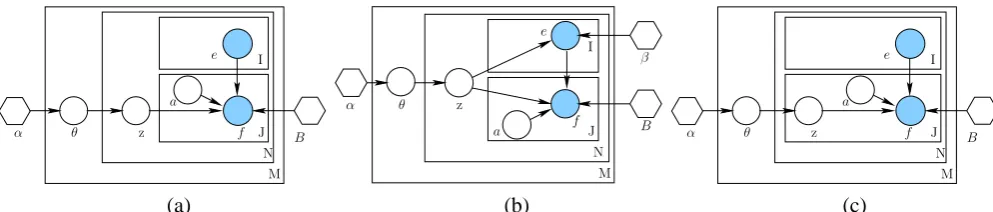
Figure 1: BiTAM models for Bilingual document- and sentence-pairs. A node in the graph represents a random variable, and a hexagon denotes a parameter. Un-shaded nodes are hidden variables. All the plates represent replicates. The outmost plate (M-plate) representsMbilingual document-pairs, while the innerN-plate represents theNrepeated choice of topics for each sentence-pairs in the document; the innerJ-plate representsJ word-pairs within each sentence-pair. (a) BiTAM-1 samples one topic (denoted byz) per sentence-pair; (b) BiTAM-2 utilizes the sentence-level topics for both the translation model (i.e.,
p(f|e, z)) and the monolingual word distribution (i.e.,p(e|z)); (c) BiTAM-3 samples one topic per word-pair.
a translation lexicon:Bi,j,k=p(f=fj|e=ei, z=k), where z is an indicator variable to denote the choice of a topic. Given a specific topic-weight
vectorθdfor a document-pair, each sentence-pair draws its conditionally independent topics from a mixture of topics. This generative process, for a document-pair(Fd,Ed), is summarized as below:
1. Sample sentence-numberNfrom a Poisson(γ). 2. Sample topic-weight vectorθdfrom a Dirichlet(α).
3. For each sentence-pair(fn,en)in thed0thdoc-pair ,
(a) Sample sentence-lengthJnfrom Poisson(δ);
(b) Sample a topiczdnfrom a Multinomial(θd);
(c) Sampleejfrom a monolingual modelp(ej);
(d) Sample each word alignment linkajfrom a
uni-form modelp(aj)(or an HMM);
(e) Sample each fj according to a topic-specific
translation lexiconp(fj|e, aj, zn,B).
We assume that, in our model, there areK pos-sible topics that a document-pair can bear. For each document-pair, a K-dimensional Dirichlet random variableθd, referred to as the topic-weight vector of the document, can take values in the (K−1)-simplex following a probability density:
p(θ|α) =Γ(
PK k=1αk) QK
k=1Γ(αk)
θα1−1
1 · · ·θ
αK−1
K , (3)
where the hyperparameter α is a K-dimension vector with each component αk>0, and Γ(x) is the Gamma function. The alignment is represented by a J-dimension vector a = {a1, a2,· · · , aJ}; for each French wordfj at the position j, an position variable aj maps it to an English wordeaj at the positionajin English
sen-tence. The word level translation lexicon probabil-ities are topic-specific, and they are parameterized by the matrixB={Bk}.
For simplicity, in our current models we omit the modelings of the sentence-numberN and the
sentence-length Jn, and focus only on the bilin-gual translation model. Figure 1 (a) shows the
graphical model representation for the BiTAM generative scheme discussed so far. Note that, the sentence-pairs are now connected by the nodeθd. Therefore, marginally, the sentence-pairs are not independent of each other as in traditional SMT models, instead they are conditionally
indepen-dent given the topic-weight vector θd. Specifi-cally, BiTAM-1 assumes that each sentence-pair has one single topic. Thus, the word-pairs within this sentence-pair are conditionally independent of each other given the hidden topic index z of the sentence-pair.
The last two sub-steps (3.d and 3.e) in the BiTam sampling scheme define a translation model, in which an alignment linkaj is proposed and an observation of fj is generated according to the proposed distributions. We simplify
align-ment model of a, as in IBM-1, by assuming that
aj is sampled uniformly at random. Given the pa-rameters α, B, and the English part E, the joint conditional distribution of the topic-weight vector
θ, the topic indicatorsz, the alignment vectorsA, and the documentFcan be written as:
p(F,A, θ,z|E, α,B) =
p(θ|α)
N Y
n=1
p(zn|θ)p(fn,an|en, α, Bzn), (4)
where N is the number of the sentence-pair. Marginalizing out θ and z, we can obtain the marginal conditional probability of generating F
fromEfor each document-pair:
p(F,A|E, α, Bzn) =
Z
p(θ|α)
³YN
n=1
X
zn
p(zn|θ)p(fn,an|en, Bzn)
´
dθ, (5)
where p(fn,an|en, Bzn) is a topic-specific
variables aj’s are independent of other variables and are uniformly distributed a priori. Therefore, the distribution for each sentence-pair is:
p(fn,an|en, Bzn) = p(fn|en,an, Bzn)p(an|en, Bzn)
= 1 IJn
n Jn
Y
j=1
p(fnj|eanj, Bzn). (6)
Thus, the conditional likelihood for the entire parallel corpus is given by taking the product of the marginal probabilities of each individual document-pair in Eqn. 5.
3.2 BiTAM-2: Monolingual Admixture
In general, the monolingual model for English can also be a rich topic-mixture. This is real-ized by using the same topic-weight vectorθdand the same topic indicator zdn sampled according toθd, as described in §3.1, to introduce not only dependent translation lexicon, but also topic-dependent monolingual model of the source lan-guage, English in this case, for generating each sentence-pair (Figure 1 (b)). Now eis generated from a topic-based language modelβ, instead of a uniform distribution in BiTAM-1. We refer to this model as BiTAM-2.
Unlike BiTAM-1, where the information ob-served inei is indirectly passed tozvia the node offj and the hidden variableaj, in BiTAM-2, the topics of corresponding English and French sen-tences are also strictly aligned so that the informa-tion observed inei can be directly passed toz, in the hope of finding more accurate topics. The top-ics are inferred more directly from the observed bilingual data, and as a result, improve alignment.
3.3 BiTAM-3: Word-level Admixture
It is straightforward to extend the sentence-level BiTAM-1 to a word-level admixture model, by sampling topic indicator zn,j for each word-pair (fj, eaj) in the n0th sentence-pair, rather than
once for all (words) in the sentence (Figure 1 (c)). This gives rise to our BiTAM-3. The conditional likelihood functions can be obtained by extending the formulas in§3.1 to move the variablezn,j in-side the same loop over each of thefn,j.
3.4 Incorporation of Word “Null”
Similar to IBM models, “Null” word is used for the source words which have no translation coun-terparts in the target language. For example, Chi-nese words “de” () , “ba” (r) and “bei” () generally do not have translations in English.
“Null” is attached to every target sentence to align the source words which miss their translations. Specifically, the latent Dirichlet allocation (LDA) in (Blei et al., 2003) can be viewed as a special case of the BiTAM-3, in which the target sentence contains only one word: “Null”, and the alignment linkais no longer a hidden variable.
4 Learning and Inference
Due to the hybrid nature of the BiTAM models, exact posterior inference of the hidden variables
A,zandθis intractable. A variational inference is used to approximate the true posteriors of these hidden variables. The inference scheme is pre-sented for BiTAM-1; the algorithms for BiTAM-2 and BiTAM-3 are straight forward extensions and are omitted.
4.1 Variational Approximation
To approximate: p(θ,z,A|E,F, α, B), the joint posterior, we use the fully factorized distribution over the same set of hidden variables:
q(θ,z,A)∝q(θ|γ, α)·
N Y
n=1
q(zn|φn) Jn
Y
j=1
q(anj, fnj|ϕnj, en,B),
(7)
where the Dirichlet parameter γ, the multino-mial parameters(φ1,· · ·, φn), and the parameters (ϕn1,· · · , ϕnJn)are known as variational
param-eters, and can be optimized with respect to the Kullback-Leibler divergence fromq(·)to the orig-inalp(·) via an iterative fixed-point algorithm. It can be shown that the fixed-point equations for the variational parameters in BiTAM-1 are as follows:
γk = αk+ Nd
X
n=1
φdnk (8)
φdnk ∝ exp ³
Ψ(γk)−Ψ( K X
k0=1
γk0)
´
·
exp
³JXdn
j=1
Idn X
i=1
ϕdnjilogBfj,ei,k
´
(9)
ϕdnji ∝ exp ³XK
k=1
φdnklogBfj,ei,k
´
, (10)
where the posterior estimations of the latent vari-ables are obtained. In the M-step, we update α andBso that they improve a lower bound of the log-likelihood defined bellow:
L(γ, φ, ϕ;α,B) =Eq[logp(θ|α)]+Eq[logp(z|θ)]
+Eq[logp(a)]+Eq[logp(f|z,a,B)]−Eq[logq(θ)]
−Eq[logq(z)]−Eq[logq(a)]. (11)
The close-form iterative updating formulaBis:
Bf,e,k∝ M X
d Nd X
n=1
Jdn X
j=1
Idn X
i=1
δ(f, fj)δ(e, ei)φdnkϕdnji (12)
Forα, close-form update is not available, and we resort to gradient accent as in (Sj¨olander et al., 1996) with re-starts to ensure each updatedαk>0.
4.2 Data Sparseness and Smoothing
The translation lexicons Bf,e,k have a potential size of V2K, assuming the vocabulary sizes for both languages are V. The data sparsity (i.e., lack of large volume of document-pairs) poses a more serious problem in estimating Bf,e,k than the monolingual case, for instance, in (Blei et al., 2003). To reduce the data sparsity problem, we introduce two remedies in our models. First:
Laplace smoothing. In this approach, the matrix
set B, whose columns correspond to parameters of conditional multinomial distributions, is treated as a collection of random vectors all under a sym-metric Dirichlet prior; the posterior expectation of these multinomial parameter vectors can be esti-mated using Bayesian theory. Second:
interpola-tion smoothing. Empirically, we can employ a
lin-ear interpolation with IBM-1 to avoid overfitting:
Bf,e,k∗ =λBf,e,k+(1−λ)p(f|e). (13)
As in Eqn. 1, p(f|e)is learned via IBM-1; λis estimated via EM on held out data.
4.3 Retrieving Word Alignments
Two word-alignment retrieval schemes are de-signed for BiTAMs: the uni-direction alignment (UDA) and the bi-direction alignment (BDA). Both use the posterior mean of the alignment indica-tors adnji, captured by what we call the
poste-rior alignment matrix ϕ ≡ {ϕdnji}. UDA uses a French word fdnj (at the j0th position of n0th sentence in thed0thdocument) to query ϕto get the best aligned English word (by taking the max-imum point in a row ofϕ):
adnj= arg max i∈[1,Idn]
ϕdnji. (14)
BDA selects iteratively, for each f, the best aligned e, such that the word-pair (f, e) is the maximum of both row and column, or its neigh-bors have more aligned pairs than the other combpeting candidates.
A close check of {ϕdnji} in Eqn. 10 re-veals that it is essentially an exponential model: weighted log probabilities from individual topic-specific translation lexicons; or it can be viewed as weighted geometric mean of the individual lex-icon’s strength.
5 Experiments
We evaluate BiTAM models on the word
align-ment accuracy and the translation quality. For
word alignment accuracy, F-measure is reported, i.e., the harmonic mean of precision and recall against a gold-standard reference set; for transla-tion quality, Bleu (Papineni et al., 2002) and its variation of NIST scores are reported.
Table 1: Training and Test Data Statistics
Train #Doc. #Sent. #Tokens
English Chinese
Treebank 316 4172 133K 105K
FBIS.BJ 6,111 105K 4.18M 3.54M
Sinorama 2,373 103K 3.81M 3.60M
XinHua 19,140 115K 3.85M 3.93M
Test 95 627 25,500 19,726
We have two training data settings with dif-ferent sizes (see Table 1). The small one consists of 316 document-pairs from Tree-bank (LDC2002E17). For the large training data setting, we collected additional document-pairs from FBIS (LDC2003E14, Beijing part), Sinorama (LDC2002E58), and Xinhua News (LDC2002E18, document boundaries are kept in our sentence-aligner (Zhao and Vogel, 2002)). There are 27,940 document-pairs, containing 327K sentence-pairs or 12 million (12M) English tokens and 11M Chinese tokens. To evaluate word alignment, we hand-labeled 627 sentence-pairs from 95 document-pairs sampled from TIDES’01 dryrun data. It contains 14,769 alignment-links. To evaluate translation quality, TIDES’02 Eval. test is used as development set, and TIDES’03 Eval. test is used as the unseen test data.
5.1 Model Settings
Topics-Lexicons Topic-1 Topic-2 Topic-3 Cooc. IBM-1 HMM IBM-4
p(ChaoXian (m)|Korean) 0.0612 0.2138 0.2254 38 0.2198 0.2157 0.2104
p(HanGuo (¸I)|Korean) 0.8379 0.6116 0.0243 46 0.5619 0.4723 0.4993
Table 2: Topic-specific translation lexicons are learned by a 3-topic BiTAM-1. The third lexicon (Topic-3) prefers to translate the word Korean into ChaoXian (m:North Korean). The co-occurrence (Cooc), IBM-1&4 and HMM only prefer to translate into HanGuo (¸I:South Korean). The two candidate translations may both fade out in the learned translation lexicons.
[image:6.595.336.497.220.326.2]Unigram-rank 1 2 3 4 5 6 7 8 9 10 Topic A. foreign china u.s. development trade enterprises technology countries year economic Topic B. chongqing companies takeovers company city billion more economic reached yuan Topic C. sports disabled team people cause water national games handicapped members Table 3: Three most distinctive topics are displayed. The English words for each topic are ranked according to p(e|z)
estimated from the topic-specific English sentences weighted by{φdnk}. 33 functional words were removed to highlight the
main content of each topic. Topic A is about Us-China economic relationships; Topic B relates to Chinese companies’ merging; Topic C shows the sports of handicapped people.
The interpolation smoothing in §4.2 is effec-tive, and it gives slightly better performance than Laplace smoothing over different number of topics for BiTAM-1. However, the interpolation lever-ages the competing baseline lexicon, and this can blur the evaluations of BiTAM’s contributions. Laplace smoothing is chosen to emphasize more on BiTAM’s strength. Without any smoothing, F-measure drops very quickly over two topics. In all our following experiments, we use both Null word and Laplace smoothing for the BiTAM models. We train, for comparison, IBM-1&4 and HMM models with 8 iterations of IBM-1, 7 for HMM and 3 for IBM-4 (18h743) with Null word and a maximum fertility of 3 for Chinese-English.
Choosing the number of topics is a model se-lection problem. We performed a ten-fold cross-validation, and a setting of three-topic is cho-sen for both the small and the large training data sets. The overall computation complexity of the BiTAM is linear to the number of hidden topics.
5.2 Variational Inference
Under a non-symmetric Dirichlet prior, hyperpa-rameter α is initialized randomly; B (K transla-tion lexicons) are initialized uniformly as did in IBM-1. Better initialization ofBcan help to avoid local optimal as shown in§5.5.
With the learnedBandαfixed, the variational parameters to be computed in Eqn. (8-10) are ini-tialized randomly; the fixed-point iterative updates stop when the change of the likelihood is smaller than10−5. The convergent variational parameters, corresponding to the highest likelihood from 20 random restarts, are used for retrieving the word alignment for unseen document-pairs. To estimate
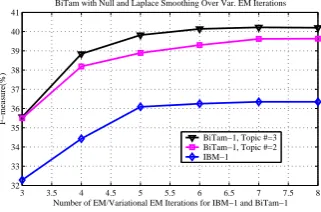
B, β (for BiTAM-2) and α, at most eight varia-tional EM iterations are run on the training data. Figure 2 shows absolute 2∼3%better F-measure over iterations of variational EM using two and three topics of BiTAM-1 comparing with IBM-1.
3 3.5 4 4.5 5 5.5 6 6.5 7 7.5 8 32
33 34 35 36 37 38 39 40 41
Number of EM/Variational EM Iterations for IBM−1 and BiTam−1
F−measure(%)
BiTam with Null and Laplace Smoothing Over Var. EM Iterations
BiTam−1, Topic #=3 BiTam−1, Topic #=2 IBM−1
Figure 2: performances over eight Variational EM itera-tions of BiTAM-1 using both the “Null” word and the laplace smoothing; IBM-1 is shown over eight EM iterations for comparison.
5.3 Topic-Specific Translation Lexicons
The topic-specific lexiconsBkare smaller in size than IBM-1, and, typically, they contain topic trends. For example, in our training data, North
Korean is usually related to politics and translated
into “ChaoXian” (m); South Korean occurs more often with economics and is translated as “HanGuo”(¸I). BiTAMs discriminate the two by considering the topics of the context. Table 2 shows the lexicon entries for “Korean” learned by a 3-topic BiTAM-1. The values are relatively sharper, and each clearly favors one of the candi-dates. The co-occurrence count, however, only fa-vors “HanGuo”, and this can easily dominate the decisions of IBM and HMM models due to their ignorance of the topical context. Monolingual topics learned by BiTAMs are, roughly speak-ing, fuzzy especially when the number of topics is small. With proper filtering, we find that BiTAMs do capture some topics as illustrated in Table 3.
5.4 Evaluating Word Alignments
We evaluate word alignment accuracies in vari-ous settings. Notably, BiTAM allows to test align-ments in two directions: English-to-Chinese (EC) and Chinese-to-English (CE). Additional
heuris-tics are applied to further improve the
SETTING IBM-1 HMM IBM-4 BITAM-1 BITAM-2 BITAM-3
UDA BDA UDA BDA UDA BDA
CE (%) 36.27 43.00 45.00 40.13 48.26 40.26 48.63 40.47 49.02
EC (%) 32.94 44.26 45.96 36.52 46.61 37.35 46.30 37.54 46.62
REFINED(%) 41.71 44.40 48.42 45.06 49.02 47.20 47.61 47.46 48.18 UNION(%) 32.18 42.94 43.75 35.87 48.66 36.07 48.99 36.26 49.35
INTER(%) 39.86 44.87 48.65 43.65 43.85 44.91 45.18 45.13 45.48
NIST 6.458 6.822 6.926 6.937 6.954 6.904 6.976 6.967 6.962
[image:7.595.104.491.60.161.2]BLEU 15.70 17.70 18.25 17.93 18.14 18.13 18.05 18.11 18.25
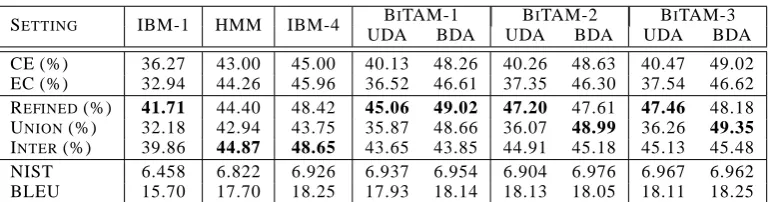
Table 4:Word Alignment Accuracy (F-measure) and Machine Translation Quality for BiTAM Models, comparing with IBM Models, and HMMs with a training scheme of18h743on the Treebank data listed in Table 1. For each column, the highlighted alignment (the best one under that model setting) is picked up to further evaluate the translation quality.
Union of two directions gives high-recall; Refined
grows the intersection with the neighboring word-pairs seen in the union, and yields high-precision and high-recall alignments.
As shown in Table 4, the baseline IBM-1 gives its best performance of 36.27% in the CE direc-tion; the UDA alignments from BiTAM-1∼3 give 40.13%, 40.26%, and 40.47%, respectively, which are significantly better than IBM-1. A close look at the three BiTAMs does not yield significant dif-ference. BiTAM-3 is slightly better in most set-tings; BiTAM-1 is slightly worse than the other two, because the topics sampled at the sentence level are not very concentrated. The BDA align-ments of BiTAM-1∼3 yield 48.26%, 48.63% and 49.02%, which are even better than HMM and IBM-4 — their best performances are at 44.26% and 45.96%, respectively. This is because BDA partially utilizes similar heuristics on the approx-imated posterior matrix {ϕdnji} instead of di-rect operations on alignments of two didi-rections in the heuristics of Refined. Practically, we also apply BDA together with heuristics for IBM-1, HMM and IBM-4, and the best achieved perfor-mances are at 40.56%, 46.52% and 49.18%, re-spectively. Overall, BiTAM models achieve per-formances close to or higher than HMM, using only a very simple IBM-1 style alignment model.
Similar improvements over IBM models and HMM are preserved after applying the three kinds of heuristics in the above. As expected, since BDA already encodes some heuristics, it is only slightly improved with the Union heuristic; UDA, similar to the viterbi style alignment in IBM and HMM, is improved better by the Refined heuristic.
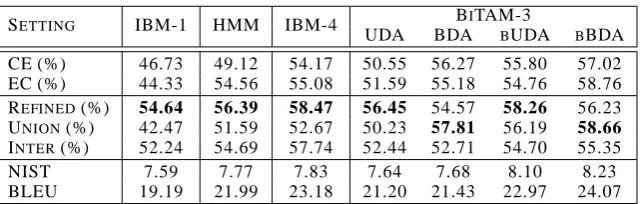
We also test BiTAM-3 on large training data, and similar improvements are observed over those of the baseline models (see Table. 5).
5.5 Boosting BiTAM Models
The translation lexicons of Bf,e,k are initialized uniformly in our previous experiments. Better
ini-tializations can potentially lead to better perfor-mances because it can help to avoid the unde-sirable local optima in variational EM iterations. We use the lexicons from IBM Model-4 to initial-ize Bf,e,k to boost the BiTAM models. This is one way of applying the proposed BiTAM mod-els into current state-of-the-art SMT systems for further improvement. The boosted alignments are denoted as BUDA and BBDA in Table. 5, cor-responding to the uni-direction and bi-direction alignments, respectively. We see an improvement in alignment quality.
5.6 Evaluating Translations
To further evaluate our BiTAM models, word alignments are used in a phrase-based decoder for evaluating translation qualities. Similar to the Pharoah package (Koehn, 2004), we extract phrase-pairs directly from word alignment to-gether with coherence constraints (Fox, 2002) to remove noisy ones. We use TIDES Eval’02 CE test set as development data to tune the decoder parameters; the Eval’03 data (919 sentences) is the unseen data. A trigram language model is built using 180 million English words. Across all the reported comparative settings, the key difference is the bilingual ngram-identity of the phrase-pair, which is collected directly from the underlying word alignment.
us-SETTING IBM-1 HMM IBM-4 BITAM-3
UDA BDA BUDA BBDA
CE (%) 46.73 49.12 54.17 50.55 56.27 55.80 57.02
EC (%) 44.33 54.56 55.08 51.59 55.18 54.76 58.76
REFINED(%) 54.64 56.39 58.47 56.45 54.57 58.26 56.23 UNION(%) 42.47 51.59 52.67 50.23 57.81 56.19 58.66
INTER(%) 52.24 54.69 57.74 52.44 52.71 54.70 55.35
NIST 7.59 7.77 7.83 7.64 7.68 8.10 8.23
[image:8.595.137.458.60.162.2]BLEU 19.19 21.99 23.18 21.20 21.43 22.97 24.07
Table 5: Evaluating Word Alignment Accuracies and Machine Translation Qualities for BiTAM Models, IBM Models, HMMs, and boosted BiTAMs using all the training data listed in Table. 1. Other experimental conditions are similar to Table. 4.
ing IBM-4 as the seed lexicon, outperform the
Re-fined IBM-4: from 23.18 to 24.07 on Bleu score,
and from 7.83 to 8.23 on NIST. This result sug-gests a straightforward way to leverage BiTAMs to improve statistical machine translations.
6 Conclusion
In this paper, we proposed novel formalism for statistical word alignment based on bilingual ad-mixture (BiTAM) models. Three BiTAM mod-els were proposed and evaluated on word align-ment and translation qualities against state-of-the-art translation models. The proposed mod-els significantly improve the alignment accuracy and lead to better translation qualities. Incorpo-ration of within-sentence dependencies such as the alignment-jumps and distortions, and a better treatment of the source monolingual model worth further investigations.
References
M. J. Beal and Zoubin Ghahramani. 2002. The variational bayesian em algorithm for incomplete data: with appli-cation to scoring graphical model structures. In Bayesian
Statistics 7.
David Blei, Andrew NG, and M.I. Jordan. 2003. Latent dirichlet allocation. In Journal of Machine Learning
Research, volume 3, pages 1107–1135.
P.F. Brown, Stephen A. Della Pietra, Vincent. J. Della Pietra, and Robert L. Mercer. 1993. The mathematics of statistical machine translation: Parameter estimation. In
Computational Linguistics, volume 19(2), pages 263–331.
Marine Carpua and Dekai Wu. 2005. Evaluating the word sense disambiguation performance of statistical machine translation. In Second International Joint Conference on
Natural Language Processing (IJCNLP-2005).
Bonnie Dorr and Nizar Habash. 2002. Interlingua approxi-mation: A generation-heavy approach. In In Proceedings
of Workshop on Interlingua Reliability, Fifth Conference of the Association for Machine Translation in the Ameri-cas, AMTA-2002, Tiburon, CA.
Heidi J. Fox. 2002. Phrasal cohesion and statistical machine translation. In Proc. of the Conference on Empirical
Methods in Natural Language Processing, pages 304–
311, Philadelphia, PA, July 6-7.
Philipp Koehn. 2004. Pharaoh: a beam search decoder for phrase-based smt. In Proceedings of the Conference of
the Association for Machine Translation in the Americans (AMTA).
Eugene A. Nida. 1964. Toward a Science of Translating:
With Special Reference to Principles Involved in Bible Translating. Leiden, Netherlands: E.J. Brill.
Eric Nyberg and Truko Mitamura. 1992. The kant system: Fast, accurate, high-quality translation in practical do-mains. In Proceedings of COLING-92.
Franz J. Och, Daniel Gildea, Sanjeev Khudanpur, Anoop Sarkar, Kenji Yamada, Alex Fraser, Shankar Kumar, Libin Shen, David Smith, Katherine Eng, Viren Jain, Zhen Jin, and Dragomir Radev. 2004. A smorgasbord of features for statistical machine translation. In HLT/NAACL:
Human Language Technology Conference, volume 1:29,
pages 161–168.
Franz J. Och. 1999. An efficient method for determining bilingal word classes. In Ninth Conf. of the Europ.
Chapter of the Association for Computational Linguistics (EACL’99), pages 71–76.
Kishore Papineni, Salim Roukos, Todd Ward, and Wei-Jing Zhu. 2002. Bleu: a method for automatic evaluation of machine translation. In Proc. of the 40th Annual Conf. of
the Association for Computational Linguistics (ACL 02),
pages 311–318, Philadelphia, PA, July.
J. Pritchard, M. Stephens, and P. Donnell. 2000. Inference of population structure using multilocus genotype data. In Genetics, volume 155, pages 945–959.
K. Sj¨olander, K. Karplus, M. Brown, R. Hughey, A. Krogh, I.S. Mian, and D. Haussler. 1996. Dirichlet mixtures: A method for improving detection of weak but significant protein sequence homology. Computer Applications in
the Biosciences, 12.
S. Vogel, Hermann Ney, and C. Tillmann. 1996. Hmm based word alignment in statistical machine translation. In Proc. The 16th Int. Conf. on Computational Lingustics,
(Coling’96), pages 836–841, Copenhagen, Denmark.
Yeyi Wang, John Lafferty, and Alex Waibel. 1996. Word clustering with parallel spoken language corpora. In
pro-ceedings of the 4th International Conference on Spoken Language Processing (ICSLP’96), pages 2364–2367.
K. Yamada and Kevin. Knight. 2001. Syntax-based statisti-cal translation model. In Proceedings of the Conference
of the Association for Computational Linguistics (ACL-2001).
Bing Zhao and Stephan Vogel. 2002. Adaptive parallel sentences mining from web bilingual news collection. In
The 2002 IEEE International Conference on Data Mining.
Bing Zhao, Eric P. Xing, and Alex Waibel. 2005. Bilingual word spectral clustering for statistical machine translation. In Proceedings of the ACL Workshop on Building and
Using Parallel Texts, pages 25–32, Ann Arbor, Michigan,