Munich Personal RePEc Archive
Analysis of the principles and methods of
construction control systems of
technological process. Basic terms and
definitions
Pihnastyi, Oleh and Tubychko, Kateryna
National Technical University "Kharkiv Polytechnic Institute", National Technical University "Kharkiv Polytechnic Institute"
4 May 2016
Online at https://mpra.ub.uni-muenchen.de/89120/
UDC 658.51.012
ANALYSIS OF THE PRINCIPLES AND METHODS OF CONSTRUCTION CONTROL SYSTEMS OF TECHNOLOGICAL
PROCESS. BASIC TERMS AND DEFINITIONS.
Pihnastyi Oleh Mikhailovych,
Doctor of Technical Sciences, professor,
Department of Computer Monitoring and logistics,
National Technical University “KhPI”, Kharkiv, Ukraine, Tubychko Kateryna Volodymyrivna,
Engineer,
Department of Computer Monitoring and logistics,
National Technical University “KhPI”, Kharkiv, Ukraine,
Annotation
The article analyzes the production and management systems, types of detail, considered
the structure of production. The characteristics of the process, classified by type of production,
calendar and planned ahead of the curve, the control of execution of production plans, control
system and so on. The definitions of the technological process, process step, the object of labor,
means of labor, property and parameters of the product, the type of production, organization
methods, PDE-model production lines, in-line production management systems, statistical
models of production systems.
Keywords: process, process operation, the subject of labor, means of labor, properties
and parameters of the product, the type of production, methods of organization, PDE-model
production lines, production management system, statistical models of manufacturing systems
Introduction
Manufacturing is a complex process of transformation of raw materials and
semi-manufactured goods into finished products [1-4]. The technological process -
part of the production processes sa containing targeted actions to change and (or)
the definition of the state of the object of labor (GOST 3.1109.82), [5]. The
actions to changing and (or) the definition of the state of the object of labor (GOST
3.1109.82), [5]. The main elements of the process are labor, means of labor and
objects of labor. The technological process can be attributed to the product, its part
or methods of processing, forming and assembly (GOST 3.1109.82), [5].
Manufacturing products with desired properties is provided by means of work -
equipment, tools, appliances, industrial buildings, by which a person works on the
subject of work. The subject of labor - something that human activity is directed to
the production process, namely, raw materials, semi-finished products, parts and
unfinished products (billets) [5]. The collection of objects of labor and means
constitute the means of production. Each product is characterized by the properties.
Product properties - an objective feature that appears when you create it. [6]
Symptom quantitatively characterizing the properties of the product or condition
called the parameters of the product [6]. The difference between the highest and
lowest limit values of the parameters of the product sets the tolerance on the
parameter. As the transformation into finished products items of work are separate,
clearly distinguishable in time and space processing step that allows them to be
regarded as objects of planning and management. Sequential changes in conditions
or the subjects of labor occurs during the transition from one technological process
to another. Technological operation - is a finished part of the process running on
one workplace (GOST 3.1109.82) [5], is divided into elements: transition,
auxiliary, fastening, work and support the course, receiving, commissioning [5].
Description of technological processes differ in the degree of detail. Standard route
are (short description of all operations in the route map in the sequence of their
execution without transitions and technological regimes) and operating (full
description of all operations in the sequence of their execution indicating
transitions and technological conditions) a description of the technological process
[5]. The subject of labor, to be produced, is a product [7]. Products in the
technological process according to GOST 2.101.68 depending on the availability
and use are divided into parts, complexes, sets, assembly units [7]. Products,
necessary for the elimination of asynchronous performance technology units within
the department and between departments directly [9]. Working [10], a minimum or
an insurance reserve characterize work in progress [10, 11].
The production structure of the enterprise. Analysis of the types of production and management systems.
Running technological processes are concentrated in the departments that
make up the industrial structure of the enterprise. In industry, there are three types
of industrial structure of companies - technology, subject and object-technology.
The main production unit of the enterprise is shop-detached part of the enterprise,
containing the finished process or logically completed part [12]. The organization,
planning and control of the production process iare a set of methods for the use of
labor, means and objects of labor. During the development of the relations of
production developed principles of effective organization of the process - the
specialization of sites and jobs; synchronize the rhythm of technological
operations; Parallel execution of technological operations; continuous process;
reduction in backlog interoperable. One measure of the level of the technological
process is the cycle time - time interval from the beginning to the end of the
manufacturing process manufacturing products [13,14]. By type of production is
understood as a set of organizational, technical and socio-economic characteristics
of the construction of the production process due to repeatable and continuous
processing of the object of labor, technology, manufacturing, technological and
organizational structure of production, and the kind of movement of objects of
labor (Table 1.1).
Table 1.Characteristics of the process
Characteristics Type of production
Single Serial Mass
Determining
the type of
production of small
series. Repeatability
product range is
stable, repeated; the
specialization in
production issue irregular. number of
transacti-ons is much higher
than the number of
jobs
stable for a long
period of time the
product range
System of
control
made-
to-order
Comple
te
group in the rate of
release
Initial data for
production
planning
start and
end dates
mile-stones
Tehnol. routes machining specifying the operations
performed, the equipment and work norms
securing parts operations for
machine tools
the rate of release
and backlogs
in-comeplete products
monthly production target for
the details of each item
quarterly, monthly,
ten-day plan
The main
mac-roeconomic
indicators
production
production cycle,
loading equipment
for the periods
size batches and
frequency of their
production
tempo (rhythm
cycle)
calendar and scheduled timing
the density of the works
for the production cycle
interoperable
The main
mic-ro indicators
production
production cycle the average standard of inter-operation
time of a workpiece
the rate of consumption of raw materials in separate operations
the percentage of
materials development at the
stage of execution of works
Replacement rate of
technological operations
The tasks of
operational
management
monitoring the implementation of production plans
Monitoring of
Implementation of
replacement jobs
control and operational groundwork
control equipment
production
motion control components along the
process route
There are a massive, serial and single types of production, determines the
coecient of consolidation of operations at the workplace (GOST 3.1121.84) [15].
Mass production is characterized by a type of highly specialized departments and
sections on output, limited and stable over a long period of time range of products.
The main objective of planning is to ensure the movement of workpieces for
operations at a given temp. A significant part of the calendar and the planned
regulations for the type of mass production is sustainable and just laid the basis for
the planned regulations of the production lines. Planning is based on the
calculation of the rate of release and details of the calculation of backlog
interoperable standards. When you type the serial production of the nomenclature
of manufactured products less stable, but still regularly repeated in the issuance
program, the number performed in detail shops operations far exceeds the number
of jobs that defines the manufacture of bulk [16].
The main task of planning for mass production, ensuring periodicity of
manufacturing of products in accordance with the scheduled task. Increasing
seriality achieved unification of parts and typed processes. Calendar-planned
regulations are a lot size of products with the expenditure of a single set-up times
and the frequency of their manufacture; the length of production cycles and
calendar, ahead of the planned; payment backlog. Determining the size of the party
is the normative basis for the regulation of periodicity changeovers. The parallel
production of different types of products that complement each other in the
structure of labor input, provides a full load of equipment. To reduce cycle time
using a parallel-sequential movement of parts that specifies the parallel execution
of technological operations. A single type of production is characterized by the
production of goods units or small series [12,16]. Repeatability issue absent or
irregular. Production planning problem is to manufacture products on time and
distinguishing feature of a single type of production is a strong link calendar and
planning standards with planning technical preparation of production. The products
together with original features are standard in the growth of the proportion of the
reserve which is laid to improve production efficiency. It increases the technical
level of unit production run parts group having a structural and technological
similarities that allows you to organize their joint application. Each type of
production can be organized in different ways. The main ones are in-line, single
party and methods of organization of production. The most effective line method.
When a large range of products and frequent changeovers effective party and
group methods. To organize the production method of the party is very important
factor in uniform working sections on schedule, reducing the range and increasing
the value of parties. When the group method of machining process developed by
the group and the group made a snap. The set of methods, tools and principles of
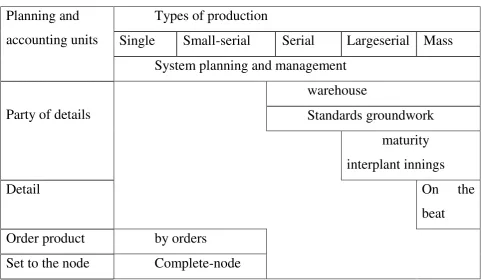
the process form the system of planning and management. The tasks of operational
planning and management is to ensure rhythmic, uniform operation of the
[image:7.595.79.561.485.765.2]enterprise with the plan (Table 1.2).
Table 2. Systems operational production management
Planning and
accounting units
Types of production
Single Small-serial Serial Largeserial Mass
System planning and management
Party of details
warehouse
Standards groundwork
maturity
interplant innings
Detail On the
beat
Order product by orders
Node set network planning
Cyclic set Complete-group
Kits machines complete
Day complete continuous
operational planning Conditional kit
The choice of planning and accounting units (Table 1.2) and periods of
planning and management is dependent on the choice of the control system.
Differential methods of construction of systems of planning and councils-ment
type used in mass production. Enlarged methods are used in the unit by Mr. and
small-scale production. From the main control systems stand out in detail the
system of management and planning used in mass production provides for the
issuance of the shoping in the detailed program production and loading jobs. To
the system's detailed operational control is touched on the control system, which
supports standard level of interplant storage backlog and are used in established
nomenclature. The system of continuous operational control makes it possible to
link the work of technological units with continuous output and identify the
structure of the work in progress [8]. Control systems in large-scale production,
and constructed for a specified period and start the release of batches of parts.
System planning and management of tact flow is used for operational process
control and automated continuous-flow lines, it is based on the definition of cycles
of operations, strictly associated with tact line. In serial production used a complete
system, providing the planning process to deliver the product in the package
details.
Cycle parts manufacturing, supplied, installed by leading parts. Enlarged
planning system is custom-system. Features common system of operational
planning and production management are presented in Table 2. Warehouse
planning and control system is used for planning, unifies bathrooms parts in series
production with short cycle times and broad applicability. Custom scheduling
process of the order, including technical training. Complete-node is used in the
production unit. This applies multiple supply parts to assemble a number of
rounds, which leads to a reduction in the time details. Disadvantages of the system
are expressed in the synchronous operation of the organization difficult, since the
kits include parts with different routes. Parking complete control system is used in
series production with sustained release of the product range, provides a simple
method of calculating the targets, but has the disadvantage - the release of parts of
the same is planned ahead, which entails details. Version of the machine, the
complete system is the system of continuous control. Planning and accounting unit
is a conditional package, which consists of units and details in an amount equal to
the average daily consumption. Considered planning and management system
using the corresponding model-driven production processes. The emergence of a
new class of PDE-models requires the construction of new and improvement of
existing systems of production planning and control.
Formalizing the process step.
The essence of the formalization process is dismembering it to the
elementary operations [17, s.235], which correspond to the planning and
management of the elements of a manufacturing process. The most important basic
operations of the process are the processing operations, or parts [5], [17, p.236].
Processing parts, assembly, quality control and packaging products are elementary
operations. The complexity process operation described by a set of formalized
parts of the operation. Co-operation is a simple aggregate of a formal operation in
the case where the pre-ditional information that could be obtained in a more
detailed description about the process, is not significant. The separation process
operations performed in many ways [5]. Due to the ambiguity problem of choosing
the optimal variant of the submission process as a set of operations.
Performing operations on the object of labor is associated with a change in
its properties. Changing the properties of the object of labor is shown clearly when
properties are described numerical characteristics. Performing operations on the
constructing a mathematical model of system operations selected parameters
describing the state (properties) products and equipment [18,19]. In this case, the
operation regarded as a stochastic process of resource transfer to the object of labor
that determines the continuous changing parameters values of products resulting
from the interaction with the hardware. Matematic model of the process as a set of
formal operations constitutes a pre-sequence of stochastic processes resource
transfer to the object of labor [3]. As the production process modeling experience
[1-5] in the construction of mathematical apparatus are limited to a small number
of set of abstract operations corresponding to a major class of formalized
operations [5.17].
To construct a mathematical model of operations required to choose values
of the system-defined parameters of state of fissionable objects of labor [17,
p.237], [3]. One of the essential parameters of the object of labor is the initial
processing time of the processing time and times j-th object to labor m-th
processing operation [20]. Moment of receipt tj,m−1of the j-th object of labor to
equipment to perform the m-th operation may be deterministic or random. In the
first case it is strictly determined by the laws of the individual synchronization
operations in the process, in the second case - stochastic volatility tj,m. For
deterministic sequences as formalized scheme used dependence is defined tj,min
terms of known quantities t(j−1),m or tj,(m−1). In the simplest case tj,m is given by
one of the relations [17,20]:
tj,m=t(j-1)m+∆τm, tj,m=tj,m-1+∆τm; (1)
where mis the effective technological labor object processing time for my
operation [21]. For random sequences tj,m are known two types of formalization.
The first is based on the random increments variables m with tj,m given
distribution laws, the second - on the description of the sequence tj,m as a random
stream of homogeneous events, similar to the flow of applications queuing theory
representation of values when accounting random variation does not changing the
meaning of the inequalities
tj,m≥ t(j-1)m. (2)
Inequality (2) corresponds to the motion of the object of labor on free flow
line when the following sequence of objects of labor within the considered time
interval is not violated, decreases or impairment is insignificant. If the order of the
objects of labor is essential, the use of homogeneous flow of events becomes
Difficult. In this case it is convenient to use for the distribution laws of random
deviations m [17]. In addition to the receipt, the subject of work is
characterized by a certain set of audio output governmental characteristics
described by continuous parameters qj,k, as well as qualitative characteristics
described by discrete parameters [6]. In general, continuous and discrete
parameters of the object of labor are random variables.
Simulation of processing operations.
Under the formal operation of the processing equipment is understood as the
result of exposure to the subject of work in order to transfer resources, at which the
value changes at least one of the parameters of the object of labor. By processing
transactions include transactions associated with changes in the labor dimensions
of the subject, its position in space, telling him additional parameters. Presentation
of the process sequence of operations is not uniquely. The complex, facilitating the
implementation of the processing operation is generalized-gap of the unit of
equipment [20], regardless of the actual structure and purpose. processing
operation is performed a certain generalized piece of equipment. For the
mathematical description of the processing steps necessary to establish the
relationship between the parameters is determined impact equipment on the subject
of work in the course of treatment, which may be represented by the relation:
(
j,1 j,2 j,k j,N m,1 m,2 mi, mi, m,I)
0mm t,q ,q ,...,q ,...q , , ,..., ,..., , =
Random parameters can be the objects of labor qj,k and hardware options m,i.
Regardless of the nature of the occurrence of disturbances applied the simplest
formalization of the process
(
)
m m0 I , m i , m i , m 2 , m 1 , m N j, k j, j,2 j,1
m t,q ,q ,...,q ,...q , , ,..., ,..., , = +
, (4)
where mdeviations are random values m from a random value m
0
.
Relationships (3) or (4) do not exhaust the mathematical description of the
processing operation. It should be added depending on defining equipment
operations. In addition to (1) use the value of: tpj,m - the time of receipt of the j-th
objects of labor to the machine, m
g
- the time spent on preparing the equipment
to perform the following operation [21]
m , j p
t
= j 1,m kt
− + gm (5)The operation may begin at any time, if the necessary conditions: the
equipment is ready for use and it arrived the next object of labor [17]. Downtime
associated with the peculiarities of the production cycle, including in gm [21].
There are examples of processes [17,20], which are characterized by centralized
management of production cycles. In the simplest case this type can specify the
flow line mode, when the processing of work items rigidly synchronized with the
mode of assembly of products on the conveyor. For such production processes are
used on the assumption that the processing operation is started only at time points
spaced apart by the length of stroke value max =max{1,2,....,m,...,M}. Time to
prepare the equipment for operation gm after the end of treatment of the subject
of the previous labor typically is a random variable with a given distribution law.
The most important characteristic is its processing operation duration m [21],
which depends on the properties of the equipment, and the properties of the work
items. When the equipment has a hard time with work, and random fluctuations in
the value insignificant, itm is non-random fixed value determined by the
parameters of the equipment. Many studies [17,22] mpresented a random
equipment. Quite often describe a random variable m with an accuracy of two
points [21]. Average value m depends on the parameters of the objects of labor
and equipment characteristics. Resolved transaction processing description can be
used in the formalization of a broad class of processes.
Modeling of operations of product assembly. [23]
Unlike processing operations term operation involves several pieces of
working [23]. Among them, the leading product is different (assemblage) and the
driven semi-finished products (parts, which are attached to the node). For many
production processes range of the object of labor as the lead is to a large extent
arbitrary. Under the operation of product assembly pony toils operation on the set
of the objects of labor, as a result of which changes the value of at least one of the
parameters of the subject of labor leading by acceding to the slave, and the
corresponding slave labor goods cease to exist. A significant parameter that
determines the modes of interaction of equipment over time is the duration of
treatment m. Characteristics associated with the interaction of the process
elements in time can be described by a formalized in constructing circuits in the
same manner as for processing operations.
Simulation control operation.
processing and assembly operations are the main technological operations,
part foundation of the production process. Formally, they are reduced to the
transformation of para-meters of objects of labor with the help of the form (3)
ratios. In contrast, the control operation by themselves do not change the
parameters of the objects of labor, have no effect on their physical properties, and
directly related to the processing and assembly are not. As a result, management
operations generated information necessary for coordinated work of individual
ele-ments. The control problem is to configure the equipment to a mode corresponding
to the parameters of the incoming pas object of labor. As examples of the control
operations can be called a regulation cycle of the production process, distribution
resuming supply of work items to the equipment, depending on the length of the
queue, as well as activities related to the supervision of the progress of production
and product quality. To control operations include operations effort control,
temperature or other basic parameters, specific to a particular operation. It is
believed that there is a set of equipment, called a control unit that provides
performance management operations. In general, in the simulation object control
processes involving people meet and some of the principal challenges that require
further research [24]. As a result, the control operation is extracted information
about the required changes in process conditions for this complex manufacturing
equipment with parameters m,i. This information is presented in the form of
amendments m,i to the parameters of the equipment m,i :
i , m
=m,i
(
t,qj,1,qj,2,...,qj,k,...qj,N,m,1,m,2,...,m,i,...,m,i,m,I)
. (6)Also relations (6) is necessary to describe the passage of time control
signals. An important factor is the binding management operations for the duration
of technological act associated with the operation. It may be that the control
operation is completed before the start of the operation, and starts after the receipt
of the corresponding object of labor. This scheme has advantages m,ias have the
greatest influence on the parameters before entering labor. If the control task is to
maintain a stable parameter values qj,k or modes of stable operation of the
equipment, it is convenient to assume that the control operation is started after the
operation. Do not exclude the possibility of simultaneous execution of the
operation and management of the operation, the ratio (6) turns into the equation for
the self-regulation m,i.
The formalization of violations of state regulatory process technology parameters.
Scheme formalization of operations are based on assumptions about the
normalized state parameters of the production process [5-7]. Under normalized
condition of process parameters refers to cases where all the controlled process
processes, accompanied phenomena are capable to bring the process parameters
exceed the limits. Violations mated state parameters object of labor, associated
with the disorder synchronization mode, the failure of hardware components,
repairs and periodic up and adjustment activities. Intervals that determine the
synchronization operations are often random variables. There have been instances
in the equipment employed education pre-objects with a labor queue, as well as
instances of downtime due to lack of work items . If enrolling the subject of
work-shy catches equipment to perform operations on the previous object of labor or are
in the stage of preparation for implementation of the operation, the object of labor
expects to start operations normalized during the production process is not
disturbed; semi-finished product may be expected during the operation time
interval prm. If j,m n
t tpj,m+prmthe technological process is normalized.
Otherwise, at time j,m
p
t
t + m pr
object of labor is eliminated from the process.
When hot working parts as a result of waiting the temperature can drop to such an
extent that the operation would be non-feasible. There is a breakdown of the
production process because of the long wait, incoming object of labor is excluded
from the process (go to the marriage). Excluded subject of work may not be
suitable for further use, or be able to restore is stored near the machine and enters
the processing when the machine is easy. Timeout, in general, a random variable
with a given law of distribution. Of the various cases parameters of manufacturing
processes downtime due to delays in receiving the objects of labor. The normalized
during the process in this case cannot be violated. Getting the wrong object of
labor in the operation is a random event, completely characterized by a probability
of bras on, which depends on the parameters of the object of labor, and on the
parameters of the equipment. Probably emergence of marriage is considered as a
function of the characteristics of the equipment describe his condition as a function
of the time interval has elapsed since the last adjustment. As the distance from the
moment of setting up the machine output quality deteriorates. The expediency of
different-regarded marriage as a result of the output of some product parameters
can be bra-forged with a certain probability. If the equipment failure the subject of
work proved to be fit, you need to keep track of his movements on the
technological route. In this treatment the subject of labor continues normalized.
There may be situations when the treatment stops working object and continues
after the commissioning of the equipment. In this treatment the subject of labor
must begin again. When equipment failure should be borne in mind two important
cases. In the first case, the failure of the unit is out of order and equipment. In
another case of failure of the unit or element of the equipment does not fail
completely, but the quality of his work is reduced, creases the likelihood of
marriage, reduced the time between successive commissioning of equipment,
increasing product deviations of parameters after the operation of their required
knowledge. One of the major issues of formalization of production processes is the
problem of the definition of pro-fault or equipment failure. The repair time is a
random mask with a known distribution law [6.25]. In the study of managed
production process have to deal with different kinds of impairments - gradual rows
of equipment failure. The consequence of wear and tear there is a noticeable
increase in the proportion of forged products. The fact of increasing the proportion
of marriages according to the time that has elapsed since the next adjustment of the
equipment can be described in terms of probability of occurrence of marriage.
Consider effects of wear and tear are common. Special measures taken for the
elimination of the last Business Plan depreciation of equipment, which are reduced
to periodic interruptions of the production process at the scheduled preventive
work for the replacement or repair of worn components. Setup time is considered
to be a random variable with a given Zuko Mr. distribution. For a formal
description of the laws relating to the commissioning of equipments, used the
appropriate types of queuing systems.
Conclusion
Analytical methods for the design of control systems, industrial production
lines are based on the construction of states in the phase space trajectories of
object-technology-driven production processes that describe the motion of objects on the
working party from the technological production line which are the foundation of
conservation laws that characterize resource transfer process on the subject of
work. Development of a detailed description of the subject-Technology managed
production process, based on the stochastic mechanism ne-transference of
technology resources on the subject of work as a result of the impact of the
equipment in the technological complements you-operation requires the
introduction of parameters characterizing the state of the object of labor in the
phase technological space. For the introduction of the parameters necessary to
determine the formalization of the process, as well as its constituent parts-
technology-cal operations. This description should be based on the already known
definitions, allowing you to use the existing methodology of process models for
the design of control systems with the use of PDE-models (1-4). Held in an article
and a brief overview of analys basic definitions used to describe the process,
allows us to formulate the basic terms of the known Standard to be used for the
projection of such management systems.
References
1. Pihnastyi O. M. O novom klasse dinamicheskih modelej potochnyh linij
proizvodstvennyh sistem / O. M. Pihnastyi // Nauchnye vedomosti Belgorodskogo
gosudarstvennogo universiteta. Belgorod: BGU. - 2014. - № 31/1. - S. 147-157 (in
Russian)
2. Pihnastyi O.M. Obzor modelej upravljaemyh proizvodstvennyh processov
potochnoj linii proizvodstvennyh sistem / O. M. Pihnastyi // Nauchnye vedomosti
Belgorodskogo gosudarstvennogo universiteta. Belgorod: BGU. - 2015. - № 354/1.
S.15 (in Russian)
3. Pihnastyi O.M. Statisticheskaja teorija proizvodstvennyh sistem /
O.M.Pihnastyi. - Harkіv: HNU, 2007. - 388 s. (in Russian)
4. Pihnastyi O.M. Analiz modelej perehodnyh upravljaemyh
Belgorodskogo gosudarstvennogo universiteta. Belgorod: BGU. - 2015. - № 35/1. -
S. 133-144 (in Russian)
5.GOST 3.1109.82. Terminy i opredelenija osnovnyh ponjatij. – M.:
Gosstandart Rossii, 2003. –15 s. (in Russian)
6. GOST 15467.79. Upravlenie kachestvom produkcii. Osnovnye ponjatija.
Terminy i opredelenija. – M.: Gosstandart Rossii, 2001. – 25 s. (in Russian)
7. GOST 2.101.68. Vidy izdelij. – M.: Gosstandart Rossii, 1995. – 3 s. (in
Russian)
8. Pihnastyi O.M. Zadacha optimal'nogo operativnogo upravlenija
makroparametrami proizvodstvennoj sistemy s massovym vypuskom produkcii /
O.M.Pihnastyi // Dopovіdі Nacіonal'noї akademії nauk Ukraїni. – Kiїv:
Vidavnichij dіm "Akademperіodika". – 2006. –№5 – S. 79 – 85. (in Russian)
9. Pihnastyi O.M. Statisticheskaja model' upravlenija tehnologicheskim
processom / O.M. Pihnastyi // Sistemnij analіz ta іnformacіjnі tehnologії: Tezi
dopovidej 14-ї Mіzhnarodnoї naukovo-praktichnoї konfe-rencії, (SAIT2012),
(Kiїv, 24 kvіtnja 2012). - Kiїv: NTU "KPI". - 2012. – S. 105 – 106. (in Russian)
10. GOST 3.1109.82. Terminy i opredelenija osnovnyh ponjatij. – M.:
Gosstandart Rossii, 2003. –15 s. (in Russian)
11. Demuckij V.P. Stohasticheskoe opisanie jekonomiko-proizvodstvennyh
sistem s massovym vypuskom produkcii / V.P.Demuckij, V.S.Pihnastaja,
O.M.Pihnastyi // Dopovіdі Nacіonal'noї akademії nauk Ukraїni. – Kiїv:
Vidavnichij dіm "Akademperіodika". – 2005. – N7. – S. 66 – 71. (in Russian)
12. Razumov I.M. Organizacija i planirovanie mashinostroitel'nogo
proiz-vodstva / I.M.Razumov, L. Ja. Shuhgalter – M.: Mashinostroenie, 1974. – 592 s.
(in Russian)
13. GOST 14.004-83. Tehnologicheskaja podgotovka proizvodstva. Terminy
i opredelenija osnovnyh ponjatij. – M.: Gosstandart Rossii, 2007. – 4 s. (in
Russian)
14. Pihnastyi O.M. Raschet proizvodstvennogo cikla s primeneniem
V.D.Hodusov // Dopovіdі Nacіonal'noї akademії nauk Ukraїni. – Kiev:
Vidavnichij dіm "Akademperіodika". – 2009. –№12. – S. 38 – 44. (in Russian)
15. GOST 3.1121.84. Obshhie trebovanija k komplektnosti i oformleniju na
tipovye i gruppovye tehnologicheskie processy (operacii). – M.: Gosstandart
Rossii, 2005. –48 s. (in Russian)
16. Letenko V.A. Organizacija, planirovanie i upravlenie
mashinostroitel'nym predprijatiem / V.A.Letenko, B.N.Rodionov.– M.: Vysshaja
shkola, 1979.–Ch.2. –232 s. (in Russian)
17. Buslenko N. P. Modelirovanie slozhnyh sistem / N. P. Buslenko. – M.:
Nauka, 1978. – 356 s. (in Russian)
18.Armbruster D. Kinetic and fluid model hierarchies for supply chains. /
D. Armbruster, D. Marthaler, C. Ringhofer // SIAM Multiscale Model Simul.–
2004. –№1. – P. 43 – 61.
19. Azarenkov N. A. O zakone vozrastanija jentropii tehnologicheskogo
processa. / N. A. Azarenkov, O.M.Pihnastyi, V.D.Hodusov // Dopovіdі
Nacіonal'noї akademії nauk Ukraїni. - Kiїv: Vidavnichij dіm "Akademperіodika".
– 2012. – N5 – S. 32–37. (in Russian)
20. Shkurba V. V. Planirovanie diskretnogo proizvodstva v uslovijah ASU /
V.V.Shkurba, V.A. Boldyreva, A.A.V'jun i dr. / pod red. V. M. Glushkova. – K.:
Tehnika, 1975. – 296 s. (in Russian)
21.Lefeber E. Modeling, Validation and Control of Manufacturing Systems /
E.Lefeber, R.A.Berg, J.E. Rooda // – Proceeding of the 2004 American Control
Conference. –Massa- chusetts. – 2004. – P. 4583 – 4588.
22. Pihnastyi O.M. Inzhenerno-proizvodstvennaja funkcija predprijatija s
serijnym ili massovym vypuskom produkcii / O.M.Pihnastyi // Voprosy
proektirovanija i proizvodstva konstrukcij letatel'nyh apparatov. – Har'kov:
NAKU. – 2005. –№ 42(3). – S. 111 – 117. (in Russian)
23.Zhang Liang. System-theoretic properties of Production Lines: A
dissertation submitted the degree of Doctor of Philosophy / Zhang Liang. –
24. Pervozvanskij A.A. Matematicheskie metody v upravlenii
proizvodstvom / A. A. Pervozvanskij. – M.: Nauka, 1975. – 616 s. (in Russian)
25. GOST 50779.10-2000(ISO 3534.1-93). Statisticheskie metody.
Verojatnost' i osnovy statistiki. Terminy i opredelenija.– M.: Gosstandart Rossii,