Dependency Tree Kernels for Relation Extraction
Aron CulottaUniversity of Massachusetts Amherst, MA 01002
USA
Jeffrey Sorensen
IBM T.J. Watson Research Center Yorktown Heights, NY 10598
USA
Abstract
We extend previous work on tree kernels to estimate the similarity between the dependency trees of sen-tences. Using this kernel within a Support Vector Machine, we detect and classify relations between entities in the Automatic Content Extraction (ACE) corpus of news articles. We examine the utility of different features such as Wordnet hypernyms, parts of speech, and entity types, and find that the depen-dency tree kernel achieves a 20% F1 improvement over a “bag-of-words” kernel.
1 Introduction
The ability to detect complex patterns in data is lim-ited by the complexity of the data’s representation. In the case of text, a more structured data source (e.g. a relational database) allows richer queries than does an unstructured data source (e.g. a col-lection of news articles). For example, current web search engines would not perform well on the query, “list all California-based CEOs who have social ties with a United States Senator.” Only a structured representation of the data can effectively provide such a list.
The goal of Information Extraction (IE) is to dis-cover relevant segments of information in a data stream that will be useful for structuring the data. In the case of text, this usually amounts to finding mentions of interesting entities and the relations that join them, transforming a large corpus of unstruc-tured text into a relational database with entries such as those in Table 1.
IE is commonly viewed as a three stage process: first, an entity tagger detects all mentions of interest; second, coreference resolution resolves disparate mentions of the same entity; third, a relation extrac-tor finds relations between these entities. Entity tag-ging has been thoroughly addressed by many statis-tical machine learning techniques, obtaining greater than 90% F1 on many datasets (Tjong Kim Sang and De Meulder, 2003). Coreference resolution is an active area of research not investigated here
(Pa-Entity Type Location
Apple Organization Cupertino, CA Microsoft Organization Redmond, WA
Table 1: An example of extracted fields
sula et al., 2002; McCallum and Wellner, 2003). We describe a relation extraction technique based on kernel methods. Kernel methods are non-parametric density estimation techniques that com-pute a kernel function between data instances, where a kernel function can be thought of as a sim-ilarity measure. Given a set of labeled instances, kernel methods determine the label of a novel stance by comparing it to the labeled training in-stances using this kernel function. Nearest neighbor classification and support-vector machines (SVMs) are two popular examples of kernel methods (Fuku-naga, 1990; Cortes and Vapnik, 1995).
An advantage of kernel methods is that they can search a feature space much larger than could be represented by a feature extraction-based approach. This is possible because the kernel function can ex-plore an implicit feature space when calculating the similarity between two instances, as described in the Section 3.
Working in such a large feature space can lead to over-fitting in many machine learning algorithms. To address this problem, we apply SVMs to the task of relation extraction. SVMs find a boundary be-tween instances of different classes such that the distance between the boundary and the nearest in-stances is maximized. This characteristic, in addi-tion to empirical validaaddi-tion, indicates that SVMs are particularly robust to over-fitting.
AT NEAR PART ROLE SOCIAL Based-In Relative-location Part-of Affiliate, Founder Associate, Grandparent
Located Subsidiary Citizen-of, Management Parent, Sibling
Residence Other Client, Member Spouse, Other-professional
[image:2.612.95.522.70.130.2]Owner, Other, Staff Other-relative, Other-personal
Table 2: Relation types and subtypes.
(e.g. part of speech) We choose this representation because we hypothesize that instances containing similar relations will share similar substructures in their dependency trees. The task of the kernel func-tion is to find these similarities.
We define a tree kernel over dependency trees and incorporate this kernel within an SVM to extract relations from newswire documents. The tree ker-nel approach consistently outperforms the bag-of-words kernel, suggesting that this highly-structured representation of sentences is more informative for detecting and distinguishing relations.
2 Related Work
Kernel methods (Vapnik, 1998; Cristianini and Shawe-Taylor, 2000) have become increasingly popular because of their ability to map arbitrary ob-jects to a Euclidian feature space. Haussler (1999) describes a framework for calculating kernels over discrete structures such as strings and trees. String kernels for text classification are explored in Lodhi et al. (2000), and tree kernel variants are described in (Zelenko et al., 2003; Collins and Duffy, 2002; Cumby and Roth, 2003). Our algorithm is similar to that described by Zelenko et al. (2003). Our contributions are a richer sentence representation, a more general framework to allow feature weighting, as well as the use of composite kernels to reduce kernel sparsity.
Brin (1998) and Agichtein and Gravano (2000) apply pattern matching and wrapper techniques for relation extraction, but these approaches do not scale well to fastly evolving corpora. Miller et al. (2000) propose an integrated statistical parsing tech-nique that augments parse trees with semantic la-bels denoting entity and relation types. Whereas Miller et al. (2000) use a generative model to pro-duce parse information as well as relation informa-tion, we hypothesize that a technique discrimina-tively trained to classify relations will achieve bet-ter performance. Also, Roth and Yih (2002) learn a Bayesian network to tag entities and their relations simultaneously. We experiment with a more chal-lenging set of relation types and a larger corpus.
3 Kernel Methods
In traditional machine learning, we are provided a set of training instances S = {x1. . . xN},
where each instancexi is represented by some d
-dimensional feature vector. Much time is spent on the task of feature engineering – searching for the optimal feature set either manually by consulting domain experts or automatically through feature in-duction and selection (Scott and Matwin, 1999). For example, in entity detection the original in-stance representation is generally a word vector cor-responding to a sentence. Feature extraction and induction may result in features such as part-of-speech, word n-grams, character n-grams, capital-ization, and conjunctions of these features. In the case of more structured objects, such as parse trees, features may include some description of the ob-ject’s structure, such as “has an NP-VP subtree.” Kernel methods can be particularly effective at re-ducing the feature engineering burden for structured objects. By calculating the similarity between two objects, kernel methods can employ dynamic pro-gramming solutions to efficiently enumerate over substructures that would be too costly to explicitly include as features.
Formally, a kernel function K is a mapping
K : X × X → [0,∞] from instance space X to a similarity scoreK(x, y) = P
iφi(x)φi(y) =
φ(x) ·φ(y). Here, φi(x) is some feature
func-tion over the instancex. The kernel function must be symmetric [K(x, y) = K(y, x)] and positive-semidefinite. By positive-semidefinite, we require that the ifx1, . . . , xn ∈ X, then the n×nmatrix
G defined by Gij = K(xi, xj) is positive
semi-definite. It has been shown that any function that takes the dot product of feature vectors is a kernel function (Haussler, 1999).
A simple kernel function takes the dot product of the vector representation of instances being com-pared. For example, in document classification, each document can be represented by a binary vec-tor, where each element corresponds to the presence or absence of a particular word in that document. Here, φi(x) = 1 if word ioccurs in document x.
num-ber of words in common betweenxandy. We refer to this kernel as the “bag-of-words” kernel, since it ignores word order.
When instances are more structured, as in the case of dependency trees, more complex kernels become necessary. Haussler (1999) describes con-volution kernels, which find the similarity between two structures by summing the similarity of their substructures. As an example, consider a kernel over strings. To determine the similarity between two strings, string kernels (Lodhi et al., 2000) count the number of common subsequences in the two strings, and weight these matches by their length. Thus,φi(x)is the number of times stringxcontains
the subsequence referenced byi. These matches can be found efficiently through a dynamic program, allowing string kernels to examine long-range fea-tures that would be computationally infeasible in a feature-based method.
Given a training set S = {x1. . . xN}, kernel
methods compute the Gram matrix G such that
Gij = K(xi, xj). Given G, the classifier finds a
hyperplane which separates instances of different classes. To classify an unseen instancex, the classi-fier first projectsxinto the feature space defined by the kernel function. Classification then consists of determining on which side of the separating hyper-planexlies.
A support vector machine (SVM) is a type of classifier that formulates the task of finding the sep-arating hyperplane as the solution to a quadratic pro-gramming problem (Cristianini and Shawe-Taylor, 2000). Support vector machines attempt to find a hyperplane that not only separates the classes but also maximizes the margin between them. The hope is that this will lead to better generalization perfor-mance on unseen instances.
4 Augmented Dependency Trees
Our task is to detect and classify relations between entities in text. We assume that entity tagging has been performed; so to generate potential relation instances, we iterate over all pairs of entities oc-curring in the same sentence. For each entity pair, we create an augmented dependency tree (described below) representing this instance. Given a labeled training set of potential relations, we define a tree kernel over dependency trees which we then use in an SVM to classify test instances.
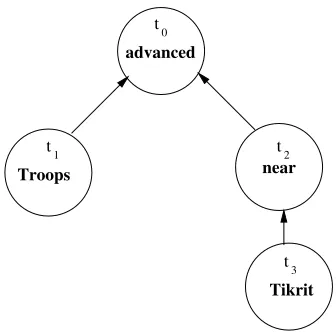
A dependency tree is a representation that de-notes grammatical relations between words in a sen-tence (Figure 1). A set of rules maps a parse tree to a dependency tree. For example, subjects are de-pendent on their verbs and adjectives are dede-pendent
Troops
Tikrit advanced
neart
t t
t0
1 2
[image:3.612.343.511.69.235.2]3
Figure 1: A dependency tree for the sentence Troops advanced near Tikrit.
Feature Example
word troops, Tikrit
part-of-speech (24 values) NN, NNP general-pos (5 values) noun, verb, adj
chunk-tag NP, VP, ADJP
entity-type person, geo-political-entity entity-level name, nominal, pronoun Wordnet hypernyms social group, city
relation-argument ARG A, ARG B
Table 3: List of features assigned to each node in the dependency tree.
on the nouns they modify. Note that for the pur-poses of this paper, we do not consider the link la-bels (e.g. “object”, “subject”); instead we use only the dependency structure. To generate the parse tree of each sentence, we use MXPOST, a maximum en-tropy statistical parser1; we then convert this parse tree to a dependency tree. Note that the left-to-right ordering of the sentence is maintained in the depen-dency tree only among siblings (i.e. the dependepen-dency tree does not specify an order to traverse the tree to recover the original sentence).
For each pair of entities in a sentence, we find the smallest common subtree in the dependency tree that includes both entities. We choose to use this subtree instead of the entire tree to reduce noise and emphasize the local characteristics of relations. We then augment each node of the tree with a fea-ture vector (Table 3). The relation-argument feafea-ture specifies whether an entity is the first or second ar-gument in a relation. This is required to learn asym-metric relations (e.g. XOWNSY).
Formally, a relation instance is a dependency tree
1
[image:3.612.314.552.294.396.2]T with nodes {t0. . . tn}. The features of node ti
are given by φ(ti) = {v1. . . vd}. We refer to the
jthchild of nodeti asti[j], and we denote the set
of all children of node ti asti[c]. We reference a
subsetjof children oftibyti[j]⊆ti[c]. Finally, we
refer to the parent of nodeti asti.p.
From the example in Figure 1, t0[1] = t2,
t0[{0,1}] ={t1, t2}, andt1.p=t0.
5 Tree kernels for dependency trees
We now define a kernel function for dependency trees. The tree kernel is a functionK(T1, T2) that
returns a normalized, symmetric similarity score in the range (0,1)for two trees T1 and T2. We
de-fine a slightly more general version of the kernel described by Zelenko et al. (2003).
We first define two functions over the features of tree nodes: a matching functionm(ti, tj) ∈ {0,1}
and a similarity functions(ti, tj)∈(0,∞]. Let the
feature vector φ(ti) = {v1. . . vd} consist of two
possibly overlapping subsets φm(ti) ⊆ φ(ti) and
φs(ti) ⊆ φ(ti). We use φm(ti) in the matching
function andφs(ti) in the similarity function. We
define
m(ti, tj) =
(
1 ifφm(ti) =φm(tj)
0 otherwise
and
s(ti, tj) =
X
vq∈φs(ti)
X
vr∈φs(tj)
C(vq, vr)
where C(vq, vr) is some compatibility function
between two feature values. For example, in the simplest case where
C(vq, vr) =
(
1 ifvq =vr
0 otherwise
s(ti, tj) returns the number of feature values in
common between feature vectorsφs(ti)andφs(tj).
We can think of the distinction between functions
m(ti, tj)ands(ti, tj)as a way to discretize the
sim-ilarity between two nodes. If φm(ti) 6= φm(tj),
then we declare the two nodes completely dissimi-lar. However, ifφm(ti) =φm(tj), then we proceed
to compute the similarity s(ti, tj). Thus,
restrict-ing nodes bym(ti, tj)is a way to prune the search
space of matching subtrees, as shown below. For two dependency treesT1,T2, with root nodes
r1 and r2, we define the tree kernelK(T1, T2) as
follows:
K(T1, T2) =
0 ifm(r1, r2) = 0
s(r1, r2)+
Kc(r1[c], r2[c]) otherwise
where Kc is a kernel function over children. Let
a and b be sequences of indices such that a is a sequencea1 ≤ a2 ≤. . . ≤an, and likewise forb.
Letd(a) =an−a1+ 1andl(a)be the length ofa.
Then we haveKc(ti[c], tj[c]) =
X
a,b,l(a)=l(b)
λd(a)λd(b)K(ti[a], tj[b])
The constant0 < λ < 1 is a decay factor that penalizes matching subsequences that are spread out within the child sequences. See Zelenko et al. (2003) for a proof thatKis kernel function.
Intuitively, whenever we find a pair of matching nodes, we search for all matching subsequences of the children of each node. A matching subsequence of children is a sequence of childrena andb such thatm(ai, bi) = 1 (∀i < n). For each matching
pair of nodes (ai, bi) in a matching subsequence,
we accumulate the result of the similarity function
s(ai, bj) and then recursively search for matching
subsequences of their childrenai[c],bj[c].
We implement two types of tree kernels. A contiguous kernel only matches children subse-quences that are uninterrupted by non-matching nodes. Therefore,d(a) = l(a). A sparse tree ker-nel, by contrast, allows non-matching nodes within matching subsequences.
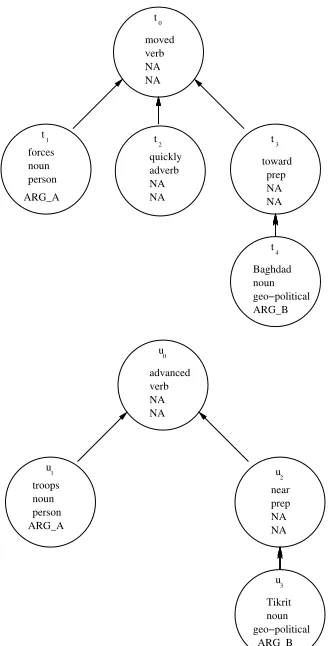
Figure 2 shows two relation instances, where each node contains the original text plus the features used for the matching function,φm(ti) ={
general-pos, entity-type, relation-argument}. (“NA” de-notes the feature is not present for this node.) The contiguous kernel matches the following substruc-tures: {t0[0], u0[0]}, {t0[2], u0[1]}, {t3[0], u2[0]}.
Because the sparse kernel allows non-contiguous matching sequences, it matches an additional sub-structure {t0[0,∗,2], u0[0,∗,1]}, where (∗)
indi-cates an arbitrary number of non-matching nodes. Zelenko et al. (2003) have shown the contiguous kernel to be computable inO(mn) and the sparse kernel inO(mn3), wherem andnare the number
of children in treesT1andT2respectively.
6 Experiments
person noun
NA NA verb
ARG_B geo−political
1
0
troops
advanced
noun Tikrit ARG_A
person noun forces
NA NA verb moved
NA NA prep toward
ARG_B t
t
t t
t
1
0
2 3
4
geo−political noun Baghdad quickly
adverb NA NA
ARG_A
near prep NA NA
2
3
u
u
u
[image:5.612.103.271.69.392.2]u
Figure 2: Two instances of the NEARrelation.
data consists of about 800 annotated text documents gathered from various newspapers and broadcasts. Five entities have been annotated (PERSON, ORGA
-NIZATION, GEO-POLITICALENTITY, LOCATION,
FACILITY), along with 24 types of relations (Table
2). As noted from the distribution of relationship types in the training data (Figure 3), data imbalance and sparsity are potential problems.
In addition to the contiguous and sparse tree kernels, we also implement a bag-of-words ker-nel, which treats the tree as a vector of features over nodes, disregarding any structural informa-tion. We also create composite kernels by combin-ing the sparse and contiguous kernels with the bag-of-words kernel. Joachims et al. (2001) have shown that given two kernels K1,K2, the composite
ker-nelK12(xi, xj) =K1(xi, xj) +K2(xi, xj)is also a
kernel. We find that this composite kernel improves performance when the Gram matrixGis sparse (i.e. our instances are far apart in the kernel space).
The features used to represent each node are shown in Table 3. After initial experimentation, the set of features we use in the matching func-tion isφm(ti) ={general-pos, entity-type,
relation-argument}, and the similarity function examines the
Figure 3: Distribution over relation types in train-ing data.
remaining features.
In our experiments we tested the following five kernels:
K0 = sparse kernel
K1 = contiguous kernel
K2 = bag-of-words kernel
K3 = K0+K2
K4 = K1+K2
We also experimented with the functionC(vq, vr),
the compatibility function between two feature val-ues. For example, we can increase the importance of two nodes having the same Wordnet hypernym2. Ifvq,vrare hypernym features, then we can define
C(vq, vr) =
(
α ifvq=vr
0 otherwise
When α > 1, we increase the similarity of
nodes that share a hypernym. We tested a num-ber of weighting schemes, but did not obtain a set of weights that produced consistent significant im-provements. See Section 8 for alternate approaches to settingC.
2
[image:5.612.321.479.102.360.2]Avg. Prec. Avg. Rec. Avg. F1
K1 69.6 25.3 36.8
K2 47.0 10.0 14.2
K3 68.9 24.3 35.5
[image:6.612.357.499.70.213.2]K4 70.3 26.3 38.0
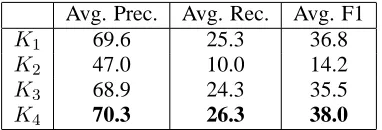
Table 4: Kernel performance comparison.
Table 4 shows the results of each kernel within an SVM. (We augment the LibSVM3 implementa-tion to include our dependency tree kernel.) Note that, although training was done over all 24 rela-tion subtypes, we evaluate only over the 5 high-level relation types. Thus, classifying a RESIDENCE re-lation as a LOCATED relation is deemed correct4.
Note also thatK0is not included in Table 4 because
of burdensome computational time. Table 4 shows that precision is adequate, but recall is low. This is a result of the aforementioned class imbalance – very few of the training examples are relations, so the classifier is less likely to identify a testing in-stances as a relation. Because we treat every pair of mentions in a sentence as a possible relation, our training set contains fewer than 15% positive rela-tion instances.
To remedy this, we retrain each SVMs for a bi-nary classification task. Here, we detect, but do not classify, relations. This allows us to combine all positive relation instances into one class, which pro-vides us more training samples to estimate the class boundary. We then threshold our output to achieve an optimal operating point. As seen in Table 5, this method of relation detection outperforms that of the multi-class classifier.
We then use these binary classifiers in a cascading scheme as follows: First, we use the binary SVM to detect possible relations. Then, we use the SVM trained only on positive relation instances to classify each predicted relation. These results are shown in Table 6.
The first result of interest is that the sparse tree kernel, K0, does not perform as well as the
con-tiguous tree kernel,K1. Suspecting that noise was
introduced by the non-matching nodes allowed in the sparse tree kernel, we performed the experi-ment with different values for the decay factorλ= {.9, .5, .1}, but obtained no improvement.
The second result of interest is that all tree ker-nels outperform the bag-of-words kernel,K2, most
noticeably in recall performance, implying that the
3
http://www.csie.ntu.edu.tw/˜cjlin/libsvm/
4This is to compensate for the small amount of training data
for many classes.
Prec. Rec. F1
K0 – – –
K0(B) 83.4 45.5 58.8
K1 91.4 37.1 52.8
K1(B) 84.7 49.3 62.3
K2 92.7 10.6 19.0
K2(B) 72.5 40.2 51.7
K3 91.3 35.1 50.8
K3(B) 80.1 49.9 61.5
K4 91.8 37.5 53.3
[image:6.612.90.281.71.136.2]K4(B) 81.2 51.8 63.2
Table 5: Relation detection performance. (B) de-notes binary classification.
D C Avg. Prec. Avg. Rec. Avg. F1
K0 K0 66.0 29.0 40.1
K1 K1 66.6 32.4 43.5
K2 K2 62.5 27.7 38.1
K3 K3 67.5 34.3 45.3
K4 K4 67.1 35.0 45.8
K1 K4 67.4 33.9 45.0
K4 K1 65.3 32.5 43.3
Table 6: Results on the cascading classification. D and C denote the kernel used for relation detection and classification, respectively.
structural information the tree kernel provides is ex-tremely useful for relation detection.
Note that the average results reported here are representative of the performance per relation, ex-cept for the NEARrelation, which had slightly lower results overall due to its infrequency in training.
7 Conclusions
We have shown that using a dependency tree ker-nel for relation extraction provides a vast improve-ment over a bag-of-words kernel. While the de-pendency tree kernel appears to perform well at the task of classifying relations, recall is still relatively low. Detecting relations is a difficult task for a ker-nel method because the set of all non-relation in-stances is extremely heterogeneous, and is therefore difficult to characterize with a similarity metric. An improved system might use a different method to detect candidate relations and then use this kernel method to classify the relations.
8 Future Work
[image:6.612.319.537.269.372.2]A first approach might use tf-idf to weight each fea-ture. Another approach might be to calculate the information gain for each feature and use that as its weight. A more complex system might learn a weight for each pair of features; however this seems computationally infeasible for large numbers of fea-tures.
One could also perform latent semantic indexing to collapse feature values into similar “categories” — for example, the words “football” and “baseball” might fall into the same category. Here, C(vq, vr)
might returnα1 ifvq =vr, andα2 ifvq andvr are
in the same category, where α1 > α2 > 0. Any
method that provides a “soft” match between fea-ture values will sharpen the granularity of the kernel and enhance its modeling power.
Further investigation is also needed to understand why the sparse kernel performs worse than the con-tiguous kernel. These results contradict those given in Zelenko et al. (2003), where the sparse kernel achieves 2-3% better F1 performance than the con-tiguous kernel. It is worthwhile to characterize rela-tion types that are better captured by the sparse ker-nel, and to determine when using the sparse kernel is worth the increased computational burden.
References
Eugene Agichtein and Luis Gravano. 2000. Snow-ball: Extracting relations from large plain-text collections. In Proceedings of the Fifth ACM In-ternational Conference on Digital Libraries. Sergey Brin. 1998. Extracting patterns and
rela-tions from the world wide web. In WebDB Work-shop at 6th International Conference on Extend-ing Database Technology, EDBT’98.
M. Collins and N. Duffy. 2002. Convolution ker-nels for natural language. In T. G. Dietterich, S. Becker, and Z. Ghahramani, editors, Advances in Neural Information Processing Systems 14, Cambridge, MA. MIT Press.
Corinna Cortes and Vladimir Vapnik. 1995. Support-vector networks. Machine Learning, 20(3):273–297.
N. Cristianini and J. Shawe-Taylor. 2000. An intro-duction to support vector machines. Cambridge University Press.
Chad M. Cumby and Dan Roth. 2003. On kernel methods for relational learning. In Tom Fawcett and Nina Mishra, editors, Machine Learning, Proceedings of the Twentieth International Con-ference (ICML 2003), August 21-24, 2003, Wash-ington, DC, USA. AAAI Press.
K. Fukunaga. 1990. Introduction to Statistical
Pat-tern Recognition. Academic Press, second edi-tion.
D. Haussler. 1999. Convolution kernels on dis-crete structures. Technical Report UCS-CRL-99-10, University of California, Santa Cruz.
Thorsten Joachims, Nello Cristianini, and John Shawe-Taylor. 2001. Composite kernels for hy-pertext categorisation. In Carla Brodley and An-drea Danyluk, editors, Proceedings of ICML-01, 18th International Conference on Machine Learning, pages 250–257, Williams College, US. Morgan Kaufmann Publishers, San Francisco, US.
Huma Lodhi, John Shawe-Taylor, Nello Cristian-ini, and Christopher J. C. H. Watkins. 2000. Text classification using string kernels. In NIPS, pages 563–569.
A. McCallum and B. Wellner. 2003. Toward con-ditional models of identity uncertainty with ap-plication to proper noun coreference. In IJCAI Workshop on Information Integration on the Web. S. Miller, H. Fox, L. Ramshaw, and R. Weischedel. 2000. A novel use of statistical parsing to ex-tract information from text. In 6th Applied Nat-ural Language Processing Conference.
H. Pasula, B. Marthi, B. Milch, S. Russell, and I. Shpitser. 2002. Identity uncertainty and cita-tion matching.
Dan Roth and Wen-tau Yih. 2002. Probabilistic reasoning for entity and relation recognition. In 19th International Conference on Computational Linguistics.
Sam Scott and Stan Matwin. 1999. Feature engi-neering for text classification. In Proceedings of ICML-99, 16th International Conference on Ma-chine Learning.
Erik F. Tjong Kim Sang and Fien De Meulder. 2003. Introduction to the CoNLL-2003 shared task: Language-independent named entity recog-nition. In Walter Daelemans and Miles Osborne, editors, Proceedings of CoNLL-2003, pages 142– 147. Edmonton, Canada.
Vladimir Vapnik. 1998. Statistical Learning The-ory. Whiley, Chichester, GB.