A Study on Convolution Kernels for Shallow Semantic Parsing
Alessandro Moschitti University of Texas at Dallas
Human Language Technology Research Institute Richardson, TX 75083-0688, USA
Abstract
In this paper we have designed and experi-mented novel convolution kernels for automatic classification of predicate arguments. Their main property is the ability to process struc-tured representations. Support Vector Ma-chines (SVMs), using a combination of such ker-nels and the flat feature kernel, classify Prop-Bank predicate arguments with accuracy higher than the current argument classification state-of-the-art.
Additionally, experiments on FrameNet data have shown that SVMs are appealing for the classification of semantic roles even if the pro-posed kernels do not produce any improvement.
1 Introduction
Several linguistic theories, e.g. (Jackendoff, 1990) claim that semantic information in nat-ural language texts is connected to syntactic structures. Hence, to deal with natural lan-guage semantics, the learning algorithm should be able to represent and process structured data. The classical solution adopted for such tasks is to convert syntax structures into flat feature representations which are suitable for a given learning model. The main drawback is that structures may not be properly represented by flat features.
In particular, these problems affect the pro-cessing of predicate argument structures an-notated in PropBank (Kingsbury and Palmer, 2002) or FrameNet (Fillmore, 1982). Figure 1 shows an example of a predicate annotation in PropBank for the sentence: "Paul gives a lecture in Rome". A predicate may be a verb or a noun or an adjective and most of the time Arg 0 is the logical subject, Arg 1 is the logical object and ArgM may indicate locations, as in our example.
FrameNet also describes predicate/argument structures but for this purpose it uses richer
semantic structures called frames. These lat-ter are schematic representations of situations involving various participants, properties and roles in which a word may be typically used. Frame elements or semantic roles are arguments of predicates called target words. In FrameNet, the argument names are local to a particular frame.
Predicate Arg. 0
Arg. M
S
N
NP
D N VP
V Paul
in gives
a lecture PP
IN N
Rome
[image:1.595.355.497.320.428.2]Arg. 1
Figure 1: A predicate argument structure in a parse-tree representation.
Several machine learning approaches for argu-ment identification and classification have been developed (Gildea and Jurasfky, 2002; Gildea and Palmer, 2002; Surdeanu et al., 2003; Ha-cioglu et al., 2003). Their common characteris-tic is the adoption of feature spaces that model predicate-argument structures in a flat repre-sentation. On the contrary, convolution kernels aim to capture structural information in term of sub-structures, providing a viable alternative to flat features.
In this paper, we select portions of syntactic trees, which include predicate/argument salient sub-structures, to define convolution kernels for the task of predicate argument classification. In particular, our kernels aim to (a) represent the relation between predicate and one of its argu-ments and (b) to capture the overall argument structure of the target predicate. Additionally, we define novel kernels as combinations of the above two with the polynomial kernel of stan-dard flat features.
of the state-of-the-art for PropBank argument classification. On the contrary, FrameNet se-mantic parsing seems to not take advantage of the structural information provided by our ker-nels.
The remainder of this paper is organized as follows: Section 2 defines the Predicate Argu-ment Extraction problem and the standard so-lution to solve it. In Section 3 we present our kernels whereas in Section 4 we show compar-ative results among SVMs using standard fea-tures and the proposed kernels. Finally, Section 5 summarizes the conclusions.
2 Predicate Argument Extraction: a
standard approach
Given a sentence in natural language and the target predicates, all arguments have to be rec-ognized. This problem can be divided into two subtasks: (a) the detection of the argument boundaries, i.e. all its compounding words and (b) the classification of the argument type, e.g. Arg0 orArgM in PropBank orAgent andGoal in FrameNet.
The standard approach to learn both detec-tion and classificadetec-tion of predicate arguments is summarized by the following steps:
1. Given a sentence from the training-set gene-rate a full syntactic parse-tree;
2. let P and A be the set of predicates and the set of parse-tree nodes (i.e. the potential arguments), respectively;
3. for each pair<p, a>∈ P × A:
• extract the feature representation set,Fp,a;
• if the subtree rooted in acovers exactly the words of one argument ofp, putFp,a inT+
(positive examples), otherwise put it in T− (negative examples).
For example, in Figure 1, for each combina-tion of the predicate give with the nodes N, S,
VP, V,NP, PP, DorIN the instancesF”give”,a are
generated. In case the node a exactly covers Paul, a lecture orin Rome, it will be a positive instance otherwise it will be a negative one, e.g. F”give”,”IN”.
To learn the argument classifiers the T+ set can be re-organized as positive Targi+ and neg-ative Targi− examples for each argument i. In this way, an individual ONE-vs-ALL classifier for each argumentican be trained. We adopted this solution as it is simple and effective (Ha-cioglu et al., 2003). In the classification phase, given a sentence of the test-set, all its Fp,a
are generated and classified by each
individ-ual classifier. As a final decision, we select the argument associated with the maximum value among the scores provided by the SVMs, i.e. argmaxi∈S Ci, whereSis the target set of
ar-guments.
-Phrase Type: This feature indicates the syntactic type of the phrase labeled as a predicate argument, e.g. NP forArg1.
- Parse Tree Path: This feature contains the path in the parse tree between the predicate and the argument phrase, expressed as a sequence of nonterminal labels linked by direction (up or down) symbols, e.g. V ↑ VP
↓NPforArg1.
-Position: Indicates if the constituent, i.e. the potential argument, appears before or after the predicate in the sentence, e.g. after forArg1 andbeforeforArg0. -Voice: This feature distinguishes between active or pas-sive voice for the predicate phrase, e.g. active for every argument.
-Head Word: This feature contains the headword of the evaluated phrase. Case and morphological information are preserved, e.g. lectureforArg1.
-Governing Category indicates if anNPis dominated by a sentence phrase or by a verb phrase, e.g. theNP asso-ciated with Arg1 is dominated by aVP.
-Predicate Word: This feature consists of two compo-nents: (1) the word itself, e.g. gives for all arguments; and (2) the lemma which represents the verb normalized to lower case and infinitive form, e.g. give for all argu-ments.
Table 1: Standard features extracted from the parse-tree in Figure 1.
2.1 Standard feature space
The discovery of relevant features is, as usual, a complex task, nevertheless, there is a common consensus on the basic features that should be adopted. These standard features, firstly pro-posed in (Gildea and Jurasfky, 2002), refer to a flat information derived from parse trees, i.e. Phrase Type,Predicate Word,Head Word, Gov-erning Category, Position and Voice. Table 1 presents the standard features and exemplifies how they are extracted from the parse tree in Figure 1.
pre-S
N
NP
D N VP
V Paul
in delivers
a talk PP
IN NP
jj
Fdeliver, Arg0
formal N
style Arg. 0
a) S
N
NP
D N VP
V Paul
in delivers
a talk PP
IN NP
jj
formal N
style
Fdeliver, Arg1
b) S
N
NP
D N VP
V Paul
in delivers
a talk PP
IN NP
jj
formal N
style Arg. 1
Fdeliver, ArgM
c)
[image:3.595.106.502.73.183.2]Arg. M
Figure 2: Structured features for Arg0, Arg1 and ArgM.
vents the learning algorithm to generalize well on unseen data. In order to address this prob-lem, the next section describes a novel kernel space for predicate argument classification.
2.2 Support Vector Machine approach
Given a vector space in <n and a set of
posi-tive and negaposi-tive points, SVMs classify vectors according to a separating hyperplane, H(~x) =
~
w×~x+b = 0, where w~ ∈ <n and b ∈ < are learned by applying the Structural Risk Mini-mization principle (Vapnik, 1995).
To apply the SVM algorithm to Predicate Argument Classification, we need a function φ : F → <n to map our features space F = {f1, .., f|F |} and our predicate/argument pair
representation, Fp,a = Fz, into <n, such that:
Fz →φ(Fz) = (φ1(Fz), .., φn(Fz))
From the kernel theory we have that:
H(~x) = X
i=1..l
αi~xi
·~x+b= X
i=1..l
αi~xi·~x+b=
= X
i=1..l
αiφ(Fi)·φ(Fz) +b.
where, Fi ∀i ∈ {1, .., l} are the training
in-stances and the product K(Fi, Fz) =<φ(Fi) ·
φ(Fz)> is the kernel function associated with
the mapping φ. The simplest mapping that we can apply is φ(Fz) = ~z = (z1, ..., zn) where
zi = 1 if fi ∈ Fz otherwise zi = 0, i.e.
the characteristic vector of the set Fz with
re-spect to F. If we choose as a kernel function the scalar product we obtain the linear kernel KL(Fx, Fz) =~x·~z.
Another function which is the current state-of-the-art of predicate argument classification is the polynomial kernel: Kp(Fx, Fz) = (c+~x·~z)d,
wherecis a constant and d is the degree of the polynom.
3 Convolution Kernels for Semantic
Parsing
We propose two different convolution kernels associated with two different predicate
argu-ment sub-structures: the first includes the tar-get predicate with one of its arguments. We will show that it contains almost all the standard feature information. The second relates to the sub-categorization frame of verbs. In this case, the kernel function aims to cluster together ver-bal predicates which have the same syntactic realizations. This provides the classification al-gorithm with important clues about the possible set of arguments suited for the target syntactic structure.
3.1 Predicate/Argument Feature
(PAF)
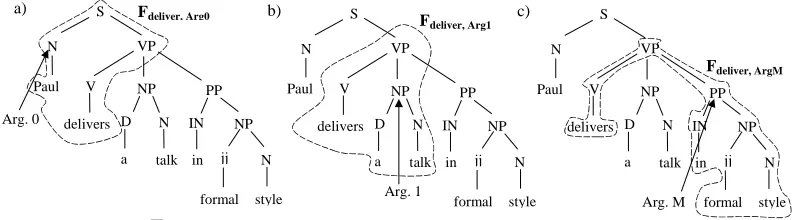
We consider the predicate argument structures annotated in PropBank or FrameNet as our se-mantic space. The smallest sub-structure which includes one predicate with only one of its ar-guments defines our structural feature. For example, Figure 2 illustrates the parse-tree of the sentence "Paul delivers a talk in formal style". The circled substructures in (a), (b) and (c) are our semantic objects associated with the three arguments of the verb to de-liver, i.e. <deliver, Arg0>, <deliver, Arg1> and <deliver, ArgM>. Note that each predi-cate/argument pair is associated with only one structure, i.e. Fp,a contain only one of the
cir-cled sub-trees. Other important properties are the followings:
(1) The overall semantic feature space F con-tains sub-structures composed of syntactic in-formation embodied by parse-tree dependencies and semantic information under the form of predicate/argument annotation.
(2) This solution is efficient as we have to clas-sify as many nodes as the number of predicate arguments.
(3) A constituent cannot be part of two differ-ent argumdiffer-ents of the target predicate, i.e. there is no overlapping between the words of two ar-guments. Thus, two semantic structures Fp1,a1
and Fp2,a2
1, associated with two different
ar-1F
p,a was defined as the set of features of the object
S
NP VP
VP CC VP
VBD NP
flushed DT NN
the pan
and VBD NP
buckled PRP$ NN
his belt PRP
He
Arg0
(flush and buckle)
Arg1
(flush) Arg1 (buckle)
Predicate 1 Predicate 2
Fflush
[image:4.595.84.283.70.194.2]Fbuckle
Figure 3: Sub-Categorization Features for two predicate argument structures.
guments, cannot be included one in the other. This property is important because a convolu-tion kernel would not be effective to distinguish between an object and its sub-parts.
3.2 Sub-Categorization Feature (SCF)
The above object space aims to capture all the information between a predicate and one of its arguments. Its main drawback is that im-portant structural information related to inter-argument dependencies is neglected. In or-der to solve this problem we define the Sub-Categorization Feature (SCF). This is the sub-parse tree which includes the sub-categorization frame of the target verbal predicate. For example, Figure 3 shows the parse tree of the sentence "He flushed the pan and buckled his belt". The solid line describes the SCF of the predicate flush, i.e. Ff lush whereas the
dashed line tailors the SCF of the predicate buckle, i.e. Fbuckle. Note that SCFs are features
for predicates, (i.e. they describe predicates) whereas PAF characterizes predicate/argument pairs.
Once semantic representations are defined, we need to design a kernel function to esti-mate the similarity between our objects. As suggested in Section 2 we can map them into vectors in<n and evaluate implicitly the scalar
product among them.
3.3 Predicate/Argument structure
Kernel (PAK)
Given the semantic objects defined in the previ-ous section, we design a convolution kernel in a way similar to the parse-tree kernel proposed in (Collins and Duffy, 2002). We divide our mappingφ in two steps: (1) from the semantic structure space F (i.e. PAF or SCF objects) to the set of all their possible sub-structures
element inFp,a with an abuse of notation we use it to
indicate the objects themselves.
NP
D N
a talk
NP
D N
NP
D N
a
D N
a talk NP
D N
NP
D N
VP
V
delivers
a talk
V
delivers NP
D N
VP
V
a talk NP
D N
VP
V
NP
D N
VP
V
a
NP
D VP
V
talk N
a
NP
D N
VP
V
delivers
talk NP
D N
VP
V
delivers
NP
D N
VP
V
delivers NP
VP
V
NP VP
V
[image:4.595.324.532.70.185.2]delivers talk
Figure 4: All 17 valid fragments of the semantic structure associated with Arg 1 of Figure 2.
F0 ={f10, .., f|F0 0|} and (2) fromF0 to<|F 0|
. An example of features in F0 is given
in Figure 4 where the whole set of frag-ments, Fdeliver,Arg0 1, of the argument structure Fdeliver,Arg1, is shown (see also Figure 2).
It is worth noting that the allowed sub-trees contain the entire (not partial) production rules. For instance, the sub-tree [NP [D a]] is excluded from the set of the Figure 4 since only a part of the production NP → D N is used in its gener-ation. However, this constraint does not apply to the productionVP→V NP PPalong with the fragment [VP[V NP]] as the subtree [VP [PP [...]]] is not considered part of the semantic structure. Thus, in step 1, an argument structureFp,ais
mapped in a fragment setFp,a0 . In step 2, this latter is mapped into~x = (x1, .., x|F0|) ∈ <|F
0| , where xi is equal to the number of times that
fi0 occurs in Fp,a0 2.
In order to evaluate K(φ(Fx), φ(Fz)) without
evaluating the feature vector ~x and ~z we de-fine the indicator functionIi(n) = 1 if the
sub-structureiis rooted at nodenand 0 otherwise. It follows thatφi(Fx) =Pn∈NxIi(n), whereNx
is the set of theFx’s nodes. Therefore, the
ker-nel can be written as:
K(φ(Fx), φ(Fz)) =
|F0| X
i=1
( X
nx∈Nx
Ii(nx))(
X
nz∈Nz
Ii(nz))
= X
nx∈Nx
X
nz∈Nz
X
i
Ii(nx)Ii(nz)
whereNxandNzare the nodes inFxandFz,
re-spectively. In (Collins and Duffy, 2002), it has been shown that P
iIi(nx)Ii(nz) = ∆(nx, nz)
can be computed in O(|Nx| × |Nz|) by the
fol-lowing recursive relation:
(1) if the productions atnx andnz are different
then ∆(nx, nz) = 0;
2A fragment can appear several times in a parse-tree,
thus each fragment occurrence is considered as a different element inF0
(2) if the productions at nx and nz are the
same, and nx and nz are pre-terminals then
∆(nx, nz) = 1;
(3) if the productions atnxandnzare the same,
and nx and nz are not pre-terminals then
∆(nx, nz) = nc(nx)
Y
j=1
(1 + ∆(ch(nx, j), ch(nz, j))),
wherenc(nx) is the number of the children ofnx
andch(n, i) is thei-th child of the noden. Note that as the productions are the samech(nx, i) =
ch(nz, i).
This kind of kernel has the drawback of assigning more weight to larger structures while the argument type does not strictly depend on the size of the argument (Moschitti and Bejan, 2004). To overcome this prob-lem we can scale the relative importance of the tree fragments using a parameter λ for the cases (2) and (3), i.e. ∆(nx, nz) =λ and
∆(nx, nz) =λQjnc=1(nx)(1 + ∆(ch(nx, j), ch(nz, j)))
respectively.
It is worth noting that even if the above equa-tions define a kernel function similar to the one proposed in (Collins and Duffy, 2002), the sub-structures on which it operates are different from the parse-tree kernel. For example, Figure 4 shows that structures such as [VP[V] [NP]], [VP
[V delivers ] [NP]] and [VP [V] [NP [DT] [N]]] are valid features, but these fragments (and many others) are not generated by a complete produc-tion, i.e. VP→ V NP PP. As a consequence they would not be included in the parse-tree kernel of the sentence.
3.4 Comparison with Standard
Features
In this section we compare standard features with the kernel based representation in order to derive useful indications for their use:
First, PAK estimates a similarity between two argument structures (i.e., PAF or SCF) by counting the number of sub-structures that are in common. As an example, the sim-ilarity between the two structures in Figure 2, F”delivers”,Arg0 and F”delivers”,Arg1, is equal to 1 since they have in common only the [V
delivers] substructure. Such low value
de-pends on the fact that different arguments tend to appear in different structures.
On the contrary, if two structures differ only for a few nodes (especially terminals or near terminal nodes) the similarity remains quite high. For example, if we change the tense of
the verb to deliver (Figure 2) in delivered, the
[VP [V delivers] [NP]] subtree will be
trans-formed in [VP[VBD delivered] [NP]], where the
NP is unchanged. Thus, the similarity with the previous structure will be quite high as: (1) the NP with all sub-parts will be matched and (2) the small difference will not highly af-fect the kernel norm and consequently the fi-nal score. The above property also holds for the SCF structures. For example, in Figure 3, KP AK(φ(Ff lush), φ(Fbuckle)) is quite high as
the two verbs have the same syntactic realiza-tion of their arguments. In general, flat features do not possess this conservative property. For example, the Parse Tree Path is very sensible to small changes of parse-trees, e.g. two predi-cates, expressed in different tenses, generate two different Path features.
Second, some information contained in the standard features is embedded in PAF: Phrase Type,Predicate Word andHead Word explicitly appear as structure fragments. For example, in Figure 4 are shown fragments like [NP[DT] [N]] or [NP [DT a] [N talk]] which explicitly encode the Phrase Type feature NP for the Arg 1 in Fig-ure 2.b. The Predicate Word is represented by the fragment [V delivers] and the Head Word is encoded in [Ntalk]. The same is not true for SCF since it does not contain information about a specific argument. SCF, in fact, aims to char-acterize the predicate with respect to the overall argument structures rather than a specific pair <p, a>.
Third, Governing Category, Position and Voice features are not explicitly contained in both PAF and SCF. Nevertheless, SCF may allow the learning algorithm to detect the ac-tive/passive form of verbs.
Finally, from the above observations follows that the PAF representation may be used with PAK to classify arguments. On the contrary, SCF lacks important information, thus, alone it may be used only to classify verbs in syntactic categories. This suggests that SCF should be used in conjunction with standard features to boost their classification performance.
4 The Experiments
with the standard features. For this purpose we adopted two ways to combine kernels3: (1)
K =K1·K2 and (2) K =γK1 +K2. The re-sulting set of kernels used in the experiments is the following:
• Kpd is the polynomial kernel with degree d
over the standard features.
•KP AF is obtained by using PAK function over
the PAF structures. • KP AF+P = γ
KP AF
|KP AF| + Kpd
|Kpd|, i.e. the sum
be-tween the normalized4 PAF-based kernel and the normalized polynomial kernel.
• KP AF·P = KP AF·Kpd
|KP AF|·|Kpd|, i.e. the normalized
product between the PAF-based kernel and the polynomial kernel.
• KSCF+P = γ|KSCFKSCF| + Kpd
|Kpd|, i.e. the
summa-tion between the normalized SCF-based kernel and the normalized polynomial kernel.
• KSCF·P = KSCF·Kpd
|KSCF|·|Kpd|, i.e. the
normal-ized product between SCF-based kernel and the polynomial kernel.
4.1 Corpora set-up
The above kernels were experimented over two corpora: PropBank (www.cis.upenn.edu/∼ace) along with Penn TreeBank5 2 (Marcus et al., 1993) and FrameNet.
PropBank contains about 53,700 sentences and a fixed split between training and test-ing which has been used in other researches e.g., (Gildea and Palmer, 2002; Surdeanu et al., 2003; Hacioglu et al., 2003). In this split, Sec-tions from 02 to 21 are used for training, section 23 for testing and sections 1 and 22 as devel-oping set. We considered all PropBank argu-ments6 from Arg0 to Arg9, ArgAandArgM for a total of 122,774 and 7,359 arguments in train-ing and testtrain-ing respectively. It is worth nottrain-ing that in the experiments we used the gold stan-dard parsing from Penn TreeBank, thus our ker-nel structures are derived with high precision.
For the FrameNet corpus (www.icsi.berkeley
3It can be proven that the resulting kernels still
sat-isfy Mercer’s conditions (Cristianini and Shawe-Taylor, 2000).
4
To normalize a kernel K(~x, ~z) we can divide it by p
K(~x, ~x)·K(~z, ~z).
5We point out that we removed from Penn TreeBank
the function tags likeSBJ andTMP as parsers usually are not able to provide this information.
6We noted that only
Arg0 to Arg4 and ArgM con-tain enough training/testing data to affect the overall performance.
.edu/∼framenet) we extracted all 24,558 sen-tences from the 40 frames of Senseval 3 task (www.senseval.org) for the Automatic Labeling of Semantic Roles. We considered 18 of the most frequent roles and we mapped together those having the same name. Only verbs are se-lected to be predicates in our evaluations. More-over, as it does not exist a fixed split between training and testing, we selected randomly 30% of sentences for testing and 70% for training. Additionally, 30% of training was used as a validation-set. The sentences were processed us-ing Collins’ parser (Collins, 1997) to generate parse-trees automatically.
4.2 Classification set-up
The classifier evaluations were carried out using the SVM-light software (Joachims, 1999) avail-able atsvmlight.joachims.orgwith the default polynomial kernel for standard feature evalu-ations. To process PAF and SCF, we imple-mented our own kernels and we used them in-side SVM-light.
The classification performances were evalu-ated using thef1 measure7 for single arguments and the accuracy for the final multi-class clas-sifier. This latter choice allows us to compare the results with previous literature works, e.g. (Gildea and Jurasfky, 2002; Surdeanu et al., 2003; Hacioglu et al., 2003).
For the evaluation of SVMs, we used the de-fault regularization parameter (e.g., C = 1 for normalized kernels) and we tried a few cost-factor values (i.e., j ∈ {0.1,1,2,3,4,5}) to ad-just the rate between Precision and Recall. We chose parameters by evaluating SVM usingKp3
kernel over thevalidation-set. Both λ(see Sec-tion 3.3) andγ parameters were evaluated in a similar way by maximizing the performance of SVM using KP AF and γ|KSCFKSCF|+ Kpd
|Kpd|
respec-tively. These parameters were adopted also for all the other kernels.
4.3 Kernel evaluations
To study the impact of our structural kernels we firstly derived the maximal accuracy reachable with standard features along with polynomial kernels. The multi-class accuracies, for Prop-Bank and FrameNet usingKpd withd= 1, ..,5,
are shown in Figure 5. We note that (a) the highest performance is reached for d = 3, (b) for PropBank our maximal accuracy (90.5%)
7f
is substantially equal to the SVM performance (88%) obtained in (Hacioglu et al., 2003) with degree 2 and (c) the accuracy on FrameNet (85.2%) is higher than the best result obtained in literature, i.e. 82.0% in (Gildea and Palmer, 2002). This different outcome is due to a ent task (we classify different roles) and a differ-ent classification algorithm. Moreover, we did not use the Frame information which is very im-portant8.
0.82 0.83 0.84 0.85 0.86 0.87 0.88 0.89 0.9 0.91
1 2 d 3 4 5
A
cc
u
ra
cy FrameNet PropBank
Figure 5: Multi-classifier accuracy according to dif-ferent degrees of the polynomial kernel.
It is worth noting that the difference between linear and polynomial kernel is about 3-4 per-cent points for both PropBank and FrameNet. This remarkable difference can be easily ex-plained by considering the meaning of standard features. For example, let us restrict the classi-fication functionCArg0to the two featuresVoice andPosition. Without loss of generality we can assume: (a) Voice=1 if active and 0 if passive, and (b) Position=1 when the argument is af-ter the predicate and 0 otherwise. To simplify the example, we also assume that if an argu-ment precedes the target predicate it is a sub-ject, otherwise it is an object9. It follows that a constituent is Arg0, i.e. CArg0 = 1, if only one feature at a time is 1, otherwise it is not an Arg0, i.e. CArg0 = 0. In other words,CArg0 =Position XORVoice, which is the classical ex-ample of a non-linear separable function that becomes separable in a superlinear space (Cris-tianini and Shawe-Taylor, 2000).
After it was established that the best ker-nel for standard features isKp3, we carried out
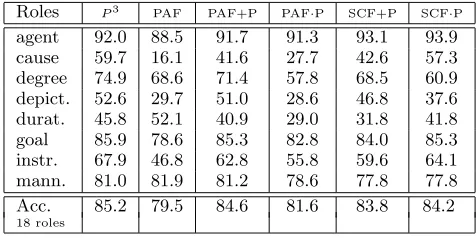
all the other experiments using it in the kernel combinations. Table 2 and 3 show the single class (f1 measure) as well as multi-class classi-fier (accuracy) performance for PropBank and FrameNet respectively. Each column of the two tables refers to a different kernel defined in the
8
Preliminary experiments indicate that SVMs can reach 90% by using theframefeature.
9Indeed, this is true in most part of the cases.
previous section. The overall meaning is dis-cussed in the following points:
First, PAF alone has good performance, since in PropBank evaluation it outperforms the lin-ear kernel (Kp1), 88.7% vs. 86.7% whereas in
FrameNet, it shows a similar performance 79.5% vs. 82.1% (compare tables with Figure 5). This suggests that PAF generates the same informa-tion as the standard features in a linear space. However, when a degree greater than 1 is used for standard features, PAF is outperformed10.
Args P3
[image:7.595.74.300.211.321.2]PAF PAF+P PAF·P SCF+P SCF·P Arg0 90.8 88.3 90.6 90.5 94.6 94.7 Arg1 91.1 87.4 89.9 91.2 92.9 94.1 Arg2 80.0 68.5 77.5 74.7 77.4 82.0 Arg3 57.9 56.5 55.6 49.7 56.2 56.4 Arg4 70.5 68.7 71.2 62.7 69.6 71.1 ArgM 95.4 94.1 96.2 96.2 96.1 96.3 Acc. 90.5 88.7 90.2 90.4 92.4 93.2
Table 2: Evaluation of Kernels on PropBank.
Roles P3 PAF PAF+P PAF·P SCF+P SCF·P agent 92.0 88.5 91.7 91.3 93.1 93.9 cause 59.7 16.1 41.6 27.7 42.6 57.3 degree 74.9 68.6 71.4 57.8 68.5 60.9 depict. 52.6 29.7 51.0 28.6 46.8 37.6 durat. 45.8 52.1 40.9 29.0 31.8 41.8 goal 85.9 78.6 85.3 82.8 84.0 85.3 instr. 67.9 46.8 62.8 55.8 59.6 64.1 mann. 81.0 81.9 81.2 78.6 77.8 77.8 Acc. 85.2 79.5 84.6 81.6 83.8 84.2 18 roles
Table 3: Evaluation of Kernels on FrameNet se-mantic roles.
Second, SCF improves the polynomial kernel (d = 3), i.e. the current state-of-the-art, of about 3 percent points on PropBank (column SCF·P). This suggests that (a) PAK can mea-sure the similarity between two SCF structures and (b) the sub-categorization information pro-vides effective clues about the expected argu-ment type. The interesting consequence is that SCF together with PAK seems suitable to au-tomatically cluster different verbs that have the same syntactic realization. We note also that to fully exploit the SCF information it is necessary to use a kernel product (K1·K2) combination rather than the sum (K1 +K2), e.g. column SCF+P.
Finally, the FrameNet results are completely different. No kernel combinations with both PAF and SCF produce an improvement. On
10Unfortunately the use of a polynomial kernel on top
[image:7.595.313.551.342.461.2]the contrary, the performance decreases, sug-gesting that the classifier is confused by this syntactic information. The main reason for the different outcomes is that PropBank arguments are different from semantic roles as they are an intermediate level between syntax and se-mantic, i.e. they are nearer to grammatical functions. In fact, in PropBank arguments are annotated consistently with syntactic alterna-tions (see the Annotation guidelines for Prop-Bank atwww.cis.upenn.edu/∼ace). On the con-trary FrameNet roles represent the final seman-tic product and they are assigned according to semantic considerations rather than syntactic aspects. For example, Cause andAgent seman-tic roles have idenseman-tical syntacseman-tic realizations. This prevents SCF to distinguish between them. Another minor reason may be the use of auto-matic parse-trees to extract PAF and SCF, even if preliminary experiments on automatic seman-tic shallow parsing of PropBank have shown no important differences versus semantic parsing which adopts Gold Standard parse-trees.
5 Conclusions
In this paper, we have experimented with SVMs using the two novel convolution kernels PAF and SCF which are designed for the se-mantic structures derived from PropBank and FrameNet corpora. Moreover, we have com-bined them with the polynomial kernel of stan-dard features. The results have shown that:
First, SVMs using the above kernels are ap-pealing for semantically parsing both corpora.
Second, PAF and SCF can be used to improve automatic classification of PropBank arguments as they provide clues about the predicate argu-ment structure of the target verb. For example, SCF improves (a) the classification state-of-the-art (i.e. the polynomial kernel) of about 3 per-cent points and (b) the best literature result of about 5 percent points.
Third, additional work is needed to design kernels suitable to learn the deep semantic con-tained in FrameNet as it seems not sensible to both PAF and SCF information.
Finally, an analysis of SVMs using poly-nomial kernels over standard features has ex-plained why they largely outperform linear clas-sifiers based-on standard features.
In the future we plan to design other struc-tures and combine them with SCF, PAF and standard features. In this vision the learning will be carried out on a set of structural features instead of a set of flat features. Other studies
may relate to the use of SCF to generate verb clusters.
Acknowledgments
This research has been sponsored by the ARDA AQUAINT program. In addition, I would like to thank Professor Sanda Harabagiu for her advice, Adrian Cosmin Bejan for implementing the feature extractor and Paul Mor˘arescu for processing the FrameNet data. Many thanks to the anonymous re-viewers for their invaluable suggestions.
References
Michael Collins and Nigel Duffy. 2002. New ranking algorithms for parsing and tagging: Kernels over discrete structures, and the voted perceptron. In proceeding ofACL-02.
Michael Collins. 1997. Three generative, lexicalized models for statistical parsing. In proceedings of the ACL-97, pages 16–23, Somerset, New Jersey. Nello Cristianini and John Shawe-Taylor. 2000. An
introduction to Support Vector Machines. Cam-bridge University Press.
Charles J. Fillmore. 1982. Frame semantics. In Lin-guistics in the Morning Calm, pages 111–137. Daniel Gildea and Daniel Jurasfky. 2002.
Auto-matic labeling of semantic roles. Computational Linguistic.
Daniel Gildea and Martha Palmer. 2002. The neces-sity of parsing for predicate argument recognition. Inproceedings of ACL-02, Philadelphia, PA. R. Jackendoff. 1990. Semantic Structures, Current
Studies in Linguistics series. Cambridge, Mas-sachusetts: The MIT Press.
T. Joachims. 1999. Making large-scale SVM learn-ing practical. In Advances in Kernel Methods -Support Vector Learning.
Paul Kingsbury and Martha Palmer. 2002. From treebank to propbank. In proceedings of LREC-02, Las Palmas, Spain.
M. P. Marcus, B. Santorini, and M. A. Marcinkiewicz. 1993. Building a large anno-tated corpus of english: The penn treebank.
Computational Linguistics.
Alessandro Moschitti and Cosmin Adrian Bejan. 2004. A semantic kernel for predicate argu-ment classification. In proceedings of CoNLL-04, Boston, USA.
Kadri Hacioglu, Sameer Pradhan, Wayne Ward, James H. Martin, and Daniel Jurafsky. 2003. Shallow Semantic Parsing Using Support Vector Machines. TR-CSLR-2003-03, University of Col-orado.
Mihai Surdeanu, Sanda M. Harabagiu, John Williams, and John Aarseth. 2003. Using predicate-argument structures for information ex-traction. In proceedings of ACL-03, Sapporo, Japan.