Ordering Prenominal Modifiers with a Reranking Approach
Jenny Liu
MIT CSAIL
Aria Haghighi
MIT CSAIL
Abstract
In this work, we present a novel approach to the generation task of ordering prenomi-nal modifiers. We take a maximum entropy reranking approach to the problem which ad-mits arbitrary features on a permutation of modifiers, exploiting hundreds of thousands of features in total. We compare our error rates to the state-of-the-art and to a strong Google n-gram count baseline. We attain a maximum error reduction of 69.8% and average error re-duction across all test sets of 59.1% compared to the state-of-the-art and a maximum error re-duction of 68.4% and average error rere-duction across all test sets of 41.8% compared to our Googlen-gram count baseline.
1 Introduction
Speakers rarely have difficulty correctly ordering modifiers such as adjectives, adverbs, or gerunds when describing some noun. The phrase “beau-tiful blue Macedonian vase” sounds very natural, whereas changing the modifier ordering to “blue Macedonian beautiful vase” is awkward (see Table 1 for more examples). In this work, we consider the task of ordering an unordered set of prenomi-nal modifiers so that they sound fluent to native lan-guage speakers. This is an important task for natural language generation systems.
Much linguistic research has investigated the se-mantic constraints behind prenominal modifier or-derings. One common line of research suggests that modifiers can be organized by the underlying semantic property they describe and that there is
a. the vegetarian French lawyer b. the French vegetarian lawyer a. the beautiful small black purse b. the beautiful black small purse c. the small beautiful black purse d. the small black beautiful purse
Table 1: Examples of restrictions on modifier orderings from Teodorescu (2006). The most natural sounding or-dering is in bold, followed by other possibilities that may only be appropriate in certain situations.
an ordering on semantic properties which in turn restricts modifier orderings. For instance, Sproat and Shih (1991) contend that thesizeproperty pre-cedes thecolorproperty and thus “small black cat” sounds more fluent than “black small cat”. Using
> to denote precedence of semantic groups, some
commonly proposed orderings are: quality > size > shape >color > provenance (Sproat and Shih, 1991), age > color > participle > provenance > noun >denominal (Quirk et al., 1974), and value >dimension>physical property>speed>human propensity>age>color(Dixon, 1977). However,
correctly classifying modifiers into these groups can be difficult and may be domain dependent or con-strained by the context in which the modifier is being used. In addition, these methods do not specify how to order modifiers within the same class or modifiers that do not fit into any of the specified groups.
There have also been a variety of corpus-based, computational approaches. Mitchell (2009) uses
a class-based approach in which modifiers are grouped into classes based on which positions they prefer in the training corpus, with a predefined or-dering imposed on these classes. Shaw and Hatzi-vassiloglou (1999) developed three different ap-proaches to the problem that use counting methods and clustering algorithms, and Malouf (2000) ex-pands upon Shaw and Hatzivassiloglou’s work.
This paper describes a computational solution to the problem that uses relevant features to model the modifier ordering process. By mapping a set of features across the training data and using a maxi-mum entropy reranking model, we can learn optimal weights for these features and then order each set of modifiers in the test data according to our features and the learned weights. This approach has not been used before to solve the prenominal modifier order-ing problem, and as we demonstrate, vastly outper-forms the state-of-the-art, especially for sequences of longer lengths.
Section 2 of this paper describes previous compu-tational approaches. In Section 3 we present the de-tails of our maximum entropy reranking approach. Section 4 covers the evaluation methods we used, and Section 5 presents our results. In Section 6 we compare our approach to previous methods, and in Section 7 we discuss future work and improvements that could be made to our system.
2 Related Work
Mitchell (2009) orders sequences of at most 4 mod-ifiers and defines nine classes that express the broad positional preferences of modifiers, where position 1 is closest to the noun phrase (NP) head and posi-tion 4 is farthest from it. Classes 1 through 4 com-prise those modifiers that prefer only to be in posi-tions 1 through 4, respectively. Class 5 through 7 modifiers prefer positions 1-2, 2-3, and 3-4, respec-tively, while class 8 modifiers prefer positions 1-3, and finally, class 9 modifiers prefer positions 2-4. Mitchell counts how often each word type appears in each of these positions in the training corpus. If any modifier’s probability of taking a certain position is greater than a uniform distribution would allow, then it is said to prefer that position. Each word type is then assigned a class, with a global ordering defined over the nine classes.
Given a set of modifiers to order, if the entire set has been seen at training time, Mitchell’s sys-tem looks up the class of each modifier and then or-ders the sequence based on the predefined ordering for the classes. When two modifiers have the same class, the system picks between the possibilities ran-domly. If a modifier was not seen at training time and thus cannot be said to belong to a specific class, the system favors orderings where modifiers whose classes are known are as close to their classes’ pre-ferred positions as possible.
Shaw and Hatzivassiloglou (1999) use corpus-based counting methods as well. For a corpus with
w word types, they define a w × w matrix where
Count[A, B] indicates how often modifier A
pre-cedes modifier B. Given two modifiers a and b to order, they compare Count[a, b]and Count[b, a]in their training data. Assuming a null hypothesis that the probability of either ordering is 0.5, they use a binomial distribution to compute the probability of seeing the ordering< a, b > forCount[a, b] num-ber of times. If this probability is above a certain threshold then they say thataprecedesb. Shaw and Hatzivassiloglou also use a transitivity method to fill out parts of the Counttable where bigrams are not actually seen in the training data but their counts can be inferred from other entries in the table, and they use a clustering method to group together modifiers with similar positional preferences.
These methods have proven to work well, but they also suffer from sparsity issues in the training data. Mitchell reports a prediction accuracy of 78.59% for NPs of all lengths, but the accuracy of her ap-proach is greatly reduced when two modifiers fall into the same class, since the system cannot make an informed decision in those cases. In addition, if a modifier is not seen in the training data, the system is unable to assign it a class, which also limits accu-racy. Shaw and Hatzivassiloglou report a highest ac-curacy of 94.93% and a lowest acac-curacy of 65.93%, but since their methods depend heavily on bigram counts in the training corpus, they are also limited in how informed their decisions can be if modifiers in the test data are not present at training time.
ap-proaches have faced.
3 Model
We treat the problem of prenominal modifier or-dering as a reranking problem. Given a set B of
prenominal modifiers and a noun phrase head H
whichBmodifies, we defineπ(B)to be the set of all possible permutations, or orderings, ofB. We
sup-pose that for a setBthere is somex∗ ∈π(B)which represents a “correct” natural-sounding ordering of the modifiers inB.
At test time, we choose an orderingx∈π(B) us-ing a maximum entropy rerankus-ing approach (Collins and Koo, 2005). Our distribution over orderings
x∈π(B)is given by:
P(x|H, B, W) = exp{W
Tφ(B, H, x)}
�
x�∈π(B)exp{WTφ(B, H, x�)}
whereφ(B, H, x)is a feature vector over a particu-lar ordering ofB andW is a learned weight vector
over features. We describe the set of features in sec-tion 3.1, but note that we are free under this formu-lation to use arbitrary features on the full orderingx
ofB as well as the head nounH, which we
implic-itly condition on throughout. Since the size of the set of prenominal modifiersB is typically less than
six, enumeratingπ(B)is not expensive.
At training time, our data consists of sequences of prenominal orderings and their corresponding nom-inal heads. We treat each sequence as a training ex-ample where the labeled orderingx∗ ∈π(B)is the one we observe. This allows us to extract any num-ber of ‘labeled’ examples from part-of-speech text. Concretely, at training time, we select W to
maxi-mize:
L(W) =
�
(B,H,x∗)
P(x∗|H, B, W)
−�W�2
2σ2
where the first term represents our observed data likelihood and the second the �2 regularization, whereσ2is a fixed hyperparameter; we fix the value
ofσ2 to0.5throughout. We optimize this objective using standard L-BFGS optimization techniques.
The key to the success of our approach is us-ing the flexibility afforded by havus-ing arbitrary fea-turesφ(B, H, x) to capture all the salient elements
of the prenominal ordering data. These features can be used to create a richer model of the modifier or-dering process than previous corpus-based counting approaches. In addition, we can encapsulate previ-ous approaches in terms of features in our model. Mitchell’s class-based approach can be expressed as a binary feature that tells us whether a given permu-ation satisfies the class ordering constraints in her model. Previous counting approaches can be ex-pressed as a real-valued feature that, given all n
-grams generated by a permutation of modifiers, re-turns the count of all thesen-grams in the original
training data.
3.1 Feature Selection
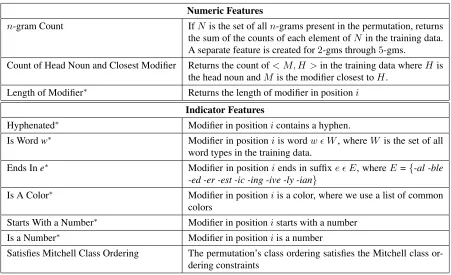
Our features are of the formφ(B, H, x)as expressed in the model above, and we include both indica-tor features and real-valued numeric features in our model. We attempt to capture aspects of the modifier permutations that may be significant in the ordering process. For instance, perhaps the majority of words that end with-lyare adverbs and should usually be positioned farthest from the head noun, so we can define an indicator function that captures this feature as follows:
φ(B, H, x) =
1 if the modifier in positioni of orderingxends in-ly
0 otherwise
We create a feature of this form for every possible modifier positionifrom 1 to 4.
We might also expect permutations that containn
-grams previously seen in the training data to be more natural sounding than other permutations that gener-aten-grams that have not been seen before. We can
express this as a real-valued feature:
φ(B, H, x) =
�
count in training data of all n-grams present inx
Numeric Features
n-gram Count IfN is the set of alln-grams present in the permutation, returns the sum of the counts of each element ofNin the training data. A separate feature is created for2-gms through5-gms.
Count of Head Noun and Closest Modifier Returns the count of< M, H >in the training data whereHis the head noun andMis the modifier closest toH.
Length of Modifier∗ Returns the length of modifier in positioni
Indicator Features
Hyphenated∗ Modifier in positionicontains a hyphen.
Is Wordw∗ Modifier in positioniis wordw � W, whereW is the set of all
word types in the training data.
Ends Ine∗ Modifier in positioniends in suffixe � E, whereE={-al -ble
-ed -er -est -ic -ing -ive -ly -ian}
Is A Color∗ Modifier in positioniis a color, where we use a list of common
colors
Starts With a Number∗ Modifier in positionistarts with a number
Is a Number∗ Modifier in positioniis a number
[image:4.612.81.532.57.332.2]Satisfies Mitchell Class Ordering The permutation’s class ordering satisfies the Mitchell class or-dering constraints
Table 2: Features Used In Our Model. Features with an asterisk (*) are created for all possible modifier positionsi from 1 to 4.
4 Experiments
4.1 Data Preprocessing and Selection
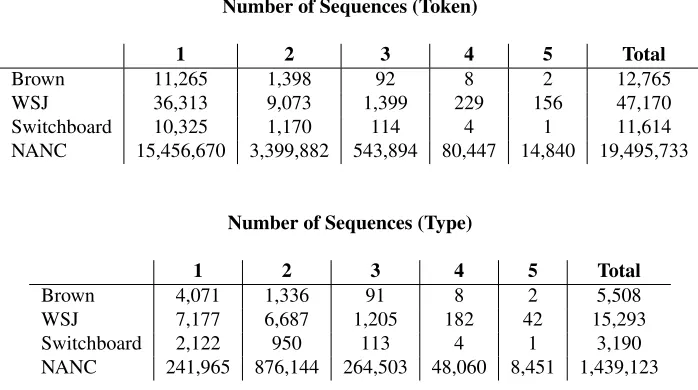
We extracted all noun phrases from four corpora: the Brown, Switchboard, and Wall Street Journal cor-pora from the Penn Treebank, and the North Amer-ican Newswire corpus (NANC). Since there were very few NPs with more than 5 modifiers, we kept those with 2-5 modifiers and with tagsNN orNNS
for the head noun. We also kept NPs with only 1 modifier to be used for generating<modifier, head noun>bigram counts at training time. We then
fil-tered all these NPs as follows: If the NP contained a PRP, IN, CD, or DT tag and the corresponding modifier was farthest away from the head noun, we removed this modifier and kept the rest of the NP. If the modifier was not the farthest away from the head noun, we discarded the NP. If the NP contained a
POStag we only kept the part of the phrase up to this tag. Our final set of NPs had tags from the following list: JJ,NN, NNP, NNS,JJS,JJR,VBG, VBN,RB,
NNPS,RBS. See Table 3 for a summary of the num-ber of NPs of lengths 1-5 extracted from the four
corpora.
Our system makes several passes over the data during the training process. In the first pass, we collect statistics about the data, to be used later on when calculating our numeric features. To collect the statistics, we take each NP in the training data and consider all possible 2 -gms through 5-gms that are present in the NP’s modifier sequence, allowing for non-consecutive
n-grams. For example, the NP “the beautiful
blue Macedonian vase” generates the following bi-grams: <beautiful blue>, <blue Macedonian>,
and <beautiful Macedonian>, along with the 3 -gram <beautiful blue Macedonian>. We keep a
table mapping each unique n-gram to the number
of times it has been seen in the training data. In addition, we also store a table that keeps track of bigram counts for < M, H >, where H is the
head noun of an NP and M is the modifier
clos-est to it. In the example “the beautiful blue Mace-donian vase,” we would increment the count of <
M acedonian,vase >in the table. Then-gram and
fea-Number of Sequences (Token)
1 2 3 4 5 Total
Brown 11,265 1,398 92 8 2 12,765
WSJ 36,313 9,073 1,399 229 156 47,170
Switchboard 10,325 1,170 114 4 1 11,614
NANC 15,456,670 3,399,882 543,894 80,447 14,840 19,495,733
Number of Sequences (Type)
1 2 3 4 5 Total
Brown 4,071 1,336 91 8 2 5,508
WSJ 7,177 6,687 1,205 182 42 15,293
Switchboard 2,122 950 113 4 1 3,190
[image:5.612.131.480.62.257.2]NANC 241,965 876,144 264,503 48,060 8,451 1,439,123
Table 3: Number of NPs extracted from our data for NP sequences with 1 to 5 modifiers.
ture values.
4.2 Googlen-gram Baseline
The Googlen-gram corpus is a collection ofn-gram
counts drawn from public webpages with a total of one trillion tokens – around 1 billion each of unique 3-grams,4-grams, and5-grams, and around 300,000 unique bigrams. We created a Googlen-gram
base-line that takes a set of modifiersB, determines the Googlen-gram count for each possible permutation
inπ(B), and selects the permutation with the high-est n-gram count as the winning ordering x∗. We will refer to this baseline as GOOGLE N-GRAM.
4.3 Mitchell’s Class-Based Ordering of Prenominal Modifiers (2009)
Mitchell’s original system was evaluated using only three corpora for both training and testing data: Brown, Switchboard, and WSJ. In addition, the evaluation presented by Mitchell’s work considers a prediction to be correct if the ordering of classes in that prediction is the same as the ordering of classes in the original test data sequence, where a class refers to the positional preference groupings defined in the model. We use a more stringent evaluation as described in the next section.
We implemented our own version of Mitchell’s system that duplicates the model and methods but
allows us to scale up to a larger training set and to apply our own evaluation techniques. We will refer to this baseline as CLASSBASED.
4.4 Evaluation
To evaluate our system (MAXENT) and our
base-lines, we partitioned the corpora into training and testing data. For each NP in the test data, we gener-ated a set of modifiers and looked at the predicted orderings of the MAXENT, CLASS BASED, and
GOOGLE N-GRAMmethods. We considered a
pre-dicted sequence ordering to be correct if it matches the original ordering of the modifiers in the corpus. We ran four trials, the first holding out the Brown corpus and using it as the test set, the second hold-ing out the WSJ corpus, the third holdhold-ing out the Switchboard corpus, and the fourth holding out a randomly selected tenth of the NANC. For each trial we used the rest of the data as our training set.
5 Results
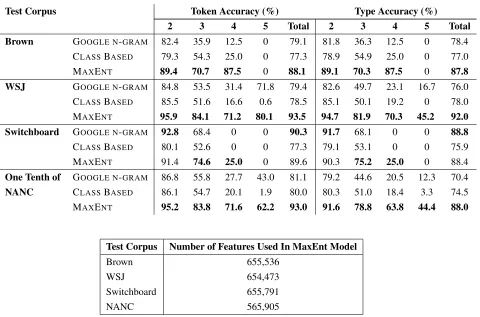
The MAXENT model consistently outperforms
CLASS BASEDacross all test corpora and sequence
Test Corpus Token Accuracy (%) Type Accuracy (%)
2 3 4 5 Total 2 3 4 5 Total
Brown GOOGLE N-GRAM 82.4 35.9 12.5 0 79.1 81.8 36.3 12.5 0 78.4
CLASSBASED 79.3 54.3 25.0 0 77.3 78.9 54.9 25.0 0 77.0
MAXENT 89.4 70.7 87.5 0 88.1 89.1 70.3 87.5 0 87.8
WSJ GOOGLE N-GRAM 84.8 53.5 31.4 71.8 79.4 82.6 49.7 23.1 16.7 76.0
CLASSBASED 85.5 51.6 16.6 0.6 78.5 85.1 50.1 19.2 0 78.0
MAXENT 95.9 84.1 71.2 80.1 93.5 94.7 81.9 70.3 45.2 92.0
Switchboard GOOGLE N-GRAM 92.8 68.4 0 0 90.3 91.7 68.1 0 0 88.8
CLASSBASED 80.1 52.6 0 0 77.3 79.1 53.1 0 0 75.9
MAXENT 91.4 74.6 25.0 0 89.6 90.3 75.2 25.0 0 88.4
One Tenth of GOOGLE N-GRAM 86.8 55.8 27.7 43.0 81.1 79.2 44.6 20.5 12.3 70.4
NANC CLASSBASED 86.1 54.7 20.1 1.9 80.0 80.3 51.0 18.4 3.3 74.5
MAXENT 95.2 83.8 71.6 62.2 93.0 91.6 78.8 63.8 44.4 88.0
Test Corpus Number of Features Used In MaxEnt Model
Brown 655,536
WSJ 654,473
Switchboard 655,791
[image:6.612.73.553.68.385.2]NANC 565,905
Table 4: Token and type prediction accuracies for the GOOGLE N-GRAM, MAXENT, and CLASSBASEDapproaches for modifier sequences of lengths 2-5. Our data consisted of four corpuses: Brown, Switchboard, WSJ, and NANC. The test data was held out and each approach was trained on the rest of the data. Winning scores are in bold. The number of features used during training for the MAXENTapproach for each test corpus is also listed.
MAXENT also outperforms the GOOGLE N-GRAM
baseline for almost all test corpora and sequence lengths. For the Switchboard test corpus token and type accuracies, the GOOGLE N-GRAM
base-line is more accurate than MAXENT for sequences
of length 2 and overall, but the accuracy of MAX
-ENTis competitive with that of GOOGLE N-GRAM.
If we examine the error reduction between MAX
-ENTand CLASSBASED, we attain a maximum error
reduction of 69.8% for the WSJ test corpus across modifier sequence tokens, and an average error re-duction of 59.1% across all test corpora for tokens. MAXENTalso attains a maximum error reduction of
68.4% for the WSJ test corpus and an average error reduction of 41.8% when compared to GOOGLE N -GRAM.
It should also be noted that on average the MAX
-ENT model takes three hours to train with several
hundred thousand features mapped across the train-ing data (the exact number used durtrain-ing each test run is listed in Table 4) – this tradeoff is well worth the increase we attain in system performance.
6 Analysis
MAXENT seems to outperform the CLASS BASED
baseline because it learns more from the training data. The CLASS BASED model classifies each
modifier in the training data into one of nine broad categories, with each category representing a differ-ent set of positional preferences. However, many of the modifiers in the training data get classified to the same category, and CLASSBASEDmakes a random
0 20 40 60 80 100 0
10 20 30 40 50 60 70 80 90 100
Sequences of 2 Modifiers
Portion of NANC Used in Training (%)
Correct Predictions (%)
MaxEnt ClassBased
(a)
0 20 40 60 80 100
0 10 20 30 40 50 60 70 80 90 100
Sequences of 3 Modifiers
Portion of NANC Used in Training (%)
Correct Predictions (%)
MaxEnt ClassBased
(b)
0 20 40 60 80 100
0 10 20 30 40 50 60 70 80 90 100
Sequences of 4 Modifiers
Portion of NANC Used in Training (%)
Correct Predictions (%)
MaxEnt ClassBased
(c)
0 20 40 60 80 100
0 10 20 30 40 50 60 70 80 90 100
Sequences of 5 Modifiers
Portion of NANC Used in Training (%)
Correct Predictions (%)
MaxEnt ClassBased
(d)
0 20 40 60 80 100
0 10 20 30 40 50 60 70 80 90 100
All Modifier Sequences
Portion of NANC Used in Training (%)
Correct Predictions (%)
MaxEnt ClassBased
(e)
0 20 40 60 80 100
0 1 2 3 4 5 6 7 x 10
5 Features Used by MaxEnt Model
Portion of NANC Used in Training (%)
Number of Features Used
[image:7.612.92.518.54.636.2](f)
to WSJ as the test data and training on the other cor-pora, 74.7% of the incorrect predictions contained at least 2 modifiers that were of the same positional preferences class. In contrast, MAXENT allows us
to learn much more from the training data. As a re-sult, we see much higher numbers when trained and tested on the same data as CLASSBASED.
The GOOGLE N-GRAM method does better than
the CLASS BASEDapproach because it containsn
-gram counts for more data than the WSJ, Brown, Switchboard, and NANC corpora combined. How-ever, GOOGLE N-GRAMsuffers from sparsity issues
as well when testing on less common modifier com-binations. For example, our data contains rarely heard sequences such as “Italian, state-owned, hold-ing company” or “armed Namibian nationalist guer-rillas.” While MAXENT determines the correct
or-dering for both of these examples, none of the per-mutations of either example show up in the Google
n-gram corpus, so the GOOGLE N-GRAMmethod is
forced to randomly select from the six possibilities. In addition, the Googlen-gram corpus is composed
of sentence fragments that may not necessarily be NPs, so we may be overcounting certain modifier permutations that can function as different parts of a sentence.
We also compared the effect that increasing the amount of training data has when using the CLASS
BASED and MAXENT methods by initially
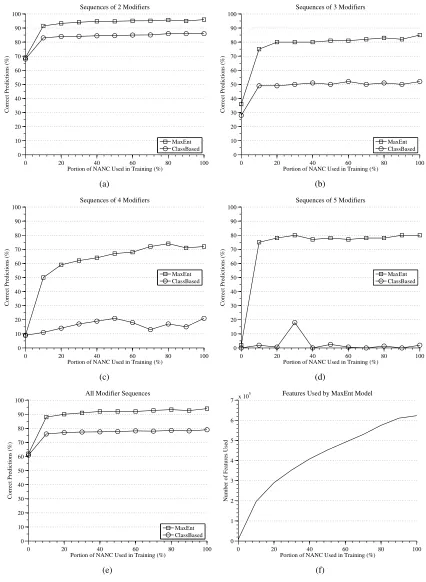
train-ing each system with just the Brown and Switch-board corpora and testing on WSJ. Then we incre-mentally added portions of NANC, one tenth at a time, until the training set included all of it. The re-sults (see Figure 1) show that we are able to benefit from the additional data much more than the CLASS
BASEDapproach can, since we do not have a fixed
set of classes limiting the amount of information the model can learn. In addition, adding the first tenth of NANC made the biggest difference in increasing accuracy for both approaches.
7 Conclusion
The straightforward maximum entropy reranking approach is able to significantly outperform previous computational approaches by allowing for a richer model of the prenominal modifier ordering process. Future work could include adding more features to
the model and conducting ablation testing. In addi-tion, while many sets of modifiers have stringent or-dering requirements, some variations on oror-derings, such as “former famous actor” vs. “famous former actor,” are acceptable in both forms and have dif-ferent meanings. It may be beneficial to extend the model to discover these ambiguities.
Acknowledgements
Many thanks to Margaret Mitchell, Regina Barzilay, Xiao Chen, and members of the CSAIL NLP group for their help and sug-gestions.
References
M. Collins and T. Koo. 2005. Discriminative reranking for natural language parsing. Computational Linguis-tics, 31(1):25–70.
R. M. W. Dixon. 1977. Where Have all the Adjectives Gone? Studies in Language, 1(1):19–80.
A. Dunlop, M. Mitchell, and B. Roark. 2010. Prenomi-nal modifier ordering via multiple sequence alignment.
InHuman Language Technologies: The 2010 Annual
Conference of the North American Chapter of the
As-sociation for Computational Linguistics, pages 600–
608. Association for Computational Linguistics. R. Malouf. 2000. The order of prenominal adjectives
in natural language generation. In Proceedings of the 38th Annual Meeting on Association for
Computa-tional Linguistics, pages 85–92. Association for
Com-putational Linguistics.
M. Mitchell. 2009. Class-based ordering of prenominal modifiers. InProceedings of the 12th European
Work-shop on Natural Language Generation, pages 50–57.
Association for Computational Linguistics.
R. Quirk, S. Greenbaum, R.A. Close, and R. Quirk. 1974.
A university grammar of English, volume 1985.
Long-man London.
J. Shaw and V. Hatzivassiloglou. 1999. Ordering among premodifiers. InProceedings of the 37th annual meet-ing of the Association for Computational Lmeet-inguistics
on Computational Linguistics, pages 135–143.
Asso-ciation for Computational Linguistics.
R. Sproat and C. Shih. 1991. The cross-linguistic dis-tribution of adjective ordering restrictions.
Interdisci-plinary approaches to language, pages 565–593.
A. Teodorescu. 2006. Adjective Ordering Restrictions Revisited. InProceedings of the 25th West Coast
Con-ference on Formal Linguistics, pages 399–407. West