Joint Processing and Discriminative Training for
Letter-to-Phoneme Conversion
Sittichai Jiampojamarn† Colin Cherry‡ Grzegorz Kondrak†
†Department of Computing Science ‡Microsoft Research
University of Alberta One Microsoft Way Edmonton, AB, T6G 2E8, Canada Redmond, WA, 98052
{sj,kondrak}@cs.ualberta.ca [email protected]
Abstract
We present a discriminative structure-prediction model for the letter-to-phoneme task, a crucial step in text-to-speech process-ing. Our method encompasses three tasks that have been previously handled separately: input segmentation, phoneme prediction, and sequence modeling. The key idea is online discriminative training, which updates parameters according to a comparison of the current system output to the desired output, allowing us to train all of our components together. By folding the three steps of a pipeline approach into a unified dynamic programming framework, we are able to achieve substantial performance gains. Our results surpass the current state-of-the-art on six publicly available data sets representing four different languages.
1 Introduction
Letter-to-phoneme (L2P) conversion is the task of predicting the pronunciation of a word, repre-sented as a sequence of phonemes, from its or-thographic form, represented as a sequence of let-ters. The L2P task plays a crucial role in speech synthesis systems (Schroeter et al., 2002), and is an important part of other applications, including spelling correction (Toutanova and Moore, 2001) and speech-to-speech machine translation (Engel-brecht and Schultz, 2005).
Converting a word into its phoneme represen-tation is not a trivial task. Dictionary-based ap-proaches cannot achieve this goal reliably, due to unseen words and proper names. Furthermore, the
construction of even a modestly-sized pronunciation dictionary requires substantial human effort for each new language. Effective rule-based approaches can be designed for some languages such as Spanish. However, Kominek and Black (2006) show that in languages with a less transparent relationship be-tween spelling and pronunciation, such as English, Dutch, or German, the number of letter-to-sound rules grows almost linearly with the lexicon size. Therefore, most recent work in this area has focused on machine-learning approaches.
In this paper, we present a joint framework for letter-to-phoneme conversion, powered by online discriminative training. By updating our model pa-rameters online, considering only the current system output and its feature representation, we are able to not only incorporate overlapping features, but also to use the same learning framework with increasingly complex search techniques. We investigate two on-line updates: averaged perceptron and Margin In-fused Relaxed Algorithm (MIRA). We evaluate our system on L2P data sets covering English, French, Dutch and German. In all cases, our system outper-forms the current state of the art, reducing the best observed error rate by as much as 46%.
2 Previous work
Letter-to-phoneme conversion is a complex task, for which a number of diverse solutions have been pro-posed. It is a structure prediction task; both the input and output are structured, consisting of sequences of letters and phonemes, respectively. This makes L2P a poor fit for many machine-learning techniques that are formulated for binary classification.
The L2P task is also characterized by the exis-tence of a hidden structure connecting input to out-put. The training data consists of letter strings paired with phoneme strings, without explicit links con-necting individual letters to phonemes. The subtask of inserting these links, called letter-to-phoneme alignment, is not always straightforward. For ex-ample, consider the word “phoenix” and its corre-sponding phoneme sequence [f i n I k s], where we encounter cases of two letters generating a sin-gle phoneme (ph→f), and a single letter generat-ing two phonemes (x→k s). Fortunately, align-ments between letters and phonemes can be discov-ered reliably with unsupervised generative models. Originally, L2P systems assumed one-to-one align-ment (Black et al., 1998; Damper et al., 2005), but recently many-to-many alignment has been shown to perform better (Bisani and Ney, 2002; Jiampoja-marn et al., 2007). Given such an alignment, L2P can be viewed either as a sequence of classification problems, or as a sequence modeling problem.
In the classification approach, each phoneme is predicted independently using a multi-class classi-fier such as decision trees (Daelemans and Bosch, 1997; Black et al., 1998) or instance-based learn-ing (Bosch and Daelemans, 1998). These systems predict a phoneme for each input letter, using the letter and its context as features. They leverage the structure of the input but ignore any structure in the output.
L2P can also be viewed as a sequence model-ing, or tagging problem. These approaches model the structure of the output, allowing previously pre-dicted phonemes to inform future decisions. The supervised Hidden Markov Model (HMM) applied by Taylor (2005) achieved poor results, mostly be-cause its maximum-likelihood emission probabili-ties cannot be informed by the emitted letter’s con-text. Other approaches, such as those of Bisani and Ney (2002) and Marchand and Damper (2000), have shown that better performance can be achieved by pairing letter substrings with phoneme substrings, allowing context to be captured implicitly by these groupings.
Recently, two hybrid methods have attempted to capture the flexible context handling of classification-based methods, while also mod-eling the sequential nature of the output. The
constraint satisfaction inference (CSInf) ap-proach (Bosch and Canisius, 2006) improves the performance of instance-based classification (Bosch and Daelemans, 1998) by predicting for each letter a trigram of phonemes consisting of the previous, current and next phonemes in the sequence. The final output sequence is the sequence of predicted phonemes that satisfies the most unigram, bigram and trigram agreement constraints. The second hybrid approach (Jiampojamarn et al., 2007) also extends instance-based classification. It employs a many-to-many letter-to-phoneme alignment model, allowing substrings of letters to be classified into substrings of phonemes, and introducing an input segmentation step before prediction begins. The method accounts for sequence information with post-processing: the numerical scores of possible outputs from an instance-based phoneme predictor are combined with phoneme transition probabili-ties in order to identify the most likely phoneme sequence.
3 A joint approach
By observing the strengths and weaknesses of previ-ous approaches, we can create the following priori-tized desiderata for any L2P system:
1. The phoneme predicted for a letter should be informed by the letter’s context in the input word.
2. In addition to single letters, letter substrings should also be able to generate phonemes. 3. Phoneme sequence information should be
in-cluded in the model.
Figure 1: Collapsing the pipeline.
strictly to the pipeline approach illustrated in Fig-ure 1a. It applies in succession three separately trained modules for input segmentation, phoneme prediction, and sequence modeling. Similarly, the CSInf approach modifies independent phoneme pre-dictions (#1) in order to assemble them into a cohe-sive sequence (#3) in post-processing.
The pipeline approaches are undesirable for two reasons. First, when decisions are made in sequence, errors made early in the sequence can propagate for-ward and throw off later processing. Second, each module is trained independently, and the training methods are not aware of the tasks performed later in the pipeline. For example, optimal parameters for a phoneme prediction module may vary depending on whether or not the module will be used in con-junction with a phoneme sequence model.
We propose a joint approach to L2P conversion, grounded in dynamic programming and online dis-criminative training. We view L2P as a tagging task that can be performed with a discriminative learn-ing method, such as the Perceptron HMM (Collins, 2002). The Perceptron HMM naturally handles phoneme prediction (#1) and sequence modeling (#3) simultaneously, as shown in Figure 1b. Fur-thermore, unlike a generative HMM, it can incor-porate many overlapping sourcen-gram features to represent context. In order to complete the conver-sion from a pipeline approach to a joint approach, we fold our input segmentation step into the ex-act search framework by replacing a separate seg-mentation module (#2) with a monotone phrasal de-coder (Zens and Ney, 2004). At this point all three of our desiderata are incorporated into a single module,
Algorithm 1Online discriminative training.
1: α=~0
2: forKiterations over training setdo
3: for all letter-phoneme sequence pairs (x, y)
in the training setdo
4: yˆ= arg maxy0∈Y [α·Φ(x, y0)]
5: update weightsαaccording toyˆandy 6: end for
7: end for 8: return α
as shown in Figure 1c.
Our joint approach to L2P lends itself to several refinements. We address an underfitting problem of the perceptron by replacing it with a more robust Margin Infused Relaxed Algorithm (MIRA), which adds an explicit notion of margin and takes into ac-count the system’s currentn-best outputs. In addi-tion, with all of our features collected under a unified framework, we are free to conjoin context features with sequence features to create a powerful linear-chain model (Sutton and McCallum, 2006).
4 Online discriminative training
In this section, we describe our entire L2P system. An outline of our discriminative training process is presented in Algorithm 1. An online process re-peatedly finds the best output(s) given the current weights, and then updates those weights to make the model favor the correct answer over the incorrect ones.
The system consists of the following three main components, which we describe in detail in Sections 4.1, 4.2 and 4.3, respectively.
1. A scoring model, represented by a weighted linear combination of features (α·Φ(x, y)). 2. A search for the highest scoring phoneme
se-quence for a given input word (Step 4).
3. An online update equation to move the model away from incorrect outputs and toward the correct output (Step 5).
4.1 Model
representing the evidence for the sequencey found in x, and α to be a feature weight vector provid-ing a weight for each component of Φ(x, y). We assume that both the input and output consist ofm
substrings, such thatxi generates yi, 0 ≤ i < m.
At training time, these substrings are taken from a many-to-many letter-to-phoneme alignment. At test time, input segmentation is handled by either a seg-mentation module or a phrasal decoder.
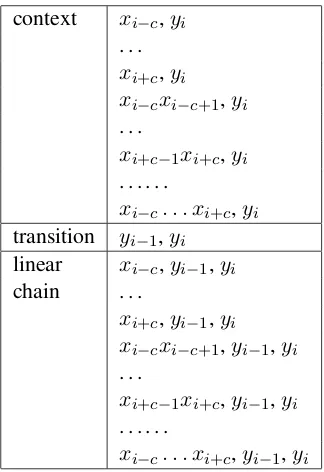
Table 1 shows our feature template that we in-clude in Φ(x, y). We use only indicator features; each feature takes on a binary value indicating whether or not it is present in the current (x, y)
pair. The context features express letter evidence found in the input string x, centered around the generator xi of each yi. The parameter c
estab-lishes the size of the context window. Note that we consider not only letter unigrams but alln-grams that fit within the window, which enables the model to assign phoneme preferences to contexts contain-ing specific sequences, such as ing and tion. The transition features are HMM-like sequence features, which enforce cohesion on the output side. We in-clude only first-order transition features, which look back to the previous phoneme substring generated by the system, because our early development exper-iments indicated that larger histories had little im-pact on performance; however, the number of previ-ous substrings that are taken into account could be extended at a polynomial cost. Finally, the linear-chain features (Sutton and McCallum, 2006) asso-ciate the phoneme transitions between yi−1 andyi
with each n-gram surrounding xi. This
combina-tion of sequence and context data provides the model with an additional degree of control.
4.2 Search
Given the current feature weight vectorα, we are in-terested in finding the highest-scoring phoneme se-quence yˆ in the setY of all possible phoneme se-quences. In the pipeline approach (Figure 1b), the input word is segmented into letter substrings by an instance-based classifier (Aha et al., 1991), which learns a letter segmentation model from many-to-many alignments (Jiampojamarn et al., 2007). The search for the best output sequence is then effec-tively a substring tagging problem, and we can com-pute thearg maxoperation in line 4 of Algorithm 1
context xi−c,yi
. . .
xi+c,yi
xi−cxi−c+1,yi
. . .
xi+c−1xi+c,yi
. . . .
xi−c. . . xi+c,yi
transition yi−1,yi
linear xi−c,yi−1,yi
chain . . .
xi+c,yi−1,yi
xi−cxi−c+1,yi−1,yi
. . .
xi+c−1xi+c,yi−1,yi
. . . .
[image:4.612.346.508.58.294.2]xi−c. . . xi+c,yi−1,yi
Table 1: Feature template.
with the standard HMM Viterbi search algorithm. In the joint approach (Figure 1c), we perform seg-mentation and L2P prediction simultaneously by ap-plying the monotone search algorithm developed for statistical machine translation (Zens and Ney, 2004). Thanks to its ability to translate phrases (in our case, letter substrings), we can accomplish the arg max
operation without specifying an input segmentation in advance; the search enumerates all possible seg-mentations. Furthermore, the language model func-tionality of the decoder allows us to keep benefiting from the transition and linear-chain features, which are explicit in the previous HMM approach.
The search can be efficiently performed by the dynamic programming recurrence shown below. We define Q(j, p) as the maximum score of the phoneme sequence ending with the phonemep gen-erated by the letter sequence x1. . . xj. Since we are no longer provided an input segmentation in ad-vance, in this framework we viewxas a sequence of
J letters, as opposed to substrings. The phonemep0
is the phoneme produced in the previous step. The expressionφ(xjj0+1, p0, p)is a convenient way to
ex-press the subvector of our complete feature vector
Φ(x, y) that describes the substring pair(xi, yii−1),
where xi = xjj0+1, yi−1 = p0 and yi = p. The
substrings. We use N = 2, which reflects a simi-lar limit in our many-to-many aligner. The special symbol $ represents a starting phoneme or ending phoneme. The value inQ(I + 1,$)is the score of highest scoring phoneme sequence corresponding to the input word. The actual sequence can be retrieved by backtracking through the tableQ.
Q(0,$) = 0
Q(j, p) = max
p0,p,
j−N≤j0<j
{α·φ(xjj0+1, p0, p) +Q(j0, p0)}
Q(J + 1,$) = max
p0 {α·φ($, p
0,$) +Q(J, p0)}
4.3 Online update
We investigate two model updates to drive our online discriminative learning. The simple perceptron up-date requires only the system’s current output, while MIRA allows us to take advantage of the system’s currentn-best outputs.
Perceptron
Learning a discriminative structure prediction model with a perceptron update was first proposed by Collins (2002). The perceptron update process is relatively simple, involving only vector addition. In line 5 of Algorithm 1, the weight vectorαis up-dated according to the best output yˆunder the cur-rent weights and the true output y in the training data. If yˆ = y, there is no update to the weights; otherwise, the weights are updated as follows:
α=α+ Φ(x, y)−Φ(x,yˆ) (1)
We iterate through the training data until the system performance drops on a held-out set. In a separable case, the perceptron will find anαsuch that:
∀yˆ∈Y − {y}:α·Φ(x, y)> α·Φ(x,yˆ) (2)
Since real-world data is not often separable, the av-erage of allαvalues seen throughout training is used in place of the finalα, as the average generalizes bet-ter to unseen data.
MIRA
In the perceptron training algorithm, no update is derived from a particular training example so long as the system is predicting the correct phoneme se-quence. The perceptron has no notion of margin: a
slim preference for the correct sequence is just as good as a clear preference. During development, we observed that this lead to underfitting the training ex-amples; useful and consistent evidence was ignored because of the presence of stronger evidence in the same example. The MIRA update provides a princi-pled method to resolve this problem.
The Margin Infused Relaxed Algorithm or MIRA (Crammer and Singer, 2003) updates the model based on the system’sn-best output. It em-ploys a margin update which can induce an update even when the1-best answer is correct. It does so by finding a weight vector that separates incorrect se-quences in then-best list from the correct sequence by a variable width margin.
The update process finds the smallest change in the current weights so that the new weights will sep-arate the correct answer from each incorrect answer by a margin determined by a structured loss func-tion. The loss function describes the distance be-tween an incorrect prediction and the correct one; that is, it quantifies just how wrong the proposed se-quence is. This update process can be described as an optimization problem:
minαn kαn−αok
subject to∀yˆ∈Yn:
αn·(Φ(x, y)−Φ(x,yˆ))≥`(y,yˆ)
(3)
whereYnis a set ofn-best outputs found under the
current model,yis the correct answer,αois the
cur-rent weight vector,αnis the new weight vector, and
`(y,yˆ)is the loss function.
Since our direct objective is to produce the cor-rect phoneme sequence for a given word, the most intuitive way to define the loss function `(y,yˆ) is binary: 0 if yˆ = y, and 1 otherwise. We refer to this as 0-1loss. Another possibility is to base the loss function on the phoneme error rate, calculated as the Levenshtein distance between y and yˆ. We can also compute a combined loss function as an equally-weighted linear combination of the0-1and phoneme loss functions.
MIRA training is similar to averaged perceptron training, but instead of finding the single best an-swer, we find the n-best answers (Yn) and update
0.0 10.0 20.0 30.0 40.0 50.0 60.0 70.0 80.0 90.0
0 1 2 3 4 5 6 7 8
Context size
W
o
rd
a
c
c
u
ra
c
y
(
%
[image:6.612.319.531.60.204.2])
Figure 2: Perceptron update with different context size.
each cell of the dynamic programming matrix. The optimization in Equation 3 is a standard quadratic programming problem that can be solved by us-ing Hildreth’s algorithm (Censor and Zenios, 1997). The details of our implementation of MIRA within the SVMlightframework (Joachims, 1999) are given
in the Appendix A. Like the perceptron algorithm, MIRA returns the average of all weight vectors pro-duced during learning.
5 Evaluation
We evaluated our approach on English, German and Dutch CELEX (Baayen et al., 1996), French Brulex, English Nettalk and English CMUDict data sets. Except for English CELEX, we used the data sets from the PRONALSYL letter-to-phoneme conver-sion challenge1. Each data set is divided into 10
folds: we used the first one for testing, and the rest for training. In all cases, we hold out 5% of our training data to determine when to stop perceptron or MIRA training. We ignored one-to-one align-ments included in the PRONALSYL data sets, and instead induced many-to-many alignments using the method of Jiampojamarn et al. (2007).
Our English CELEX data set was extracted di-rectly from the CELEX database. After removing duplicate words, phrases, and abbreviations, the data set contained 66,189 word-phoneme pairs, of which 10% was designated as the final test set, and the rest as the training set. We performed our development experiments on the latter part, and then used the final
1Available at http://www.pascal-network.org/
Challenges/PRONALSYL/. The results have not been
an-nounced.
83.0 84.0 85.0 86.0 87.0 88.0 89.0
0 10 20 30 40 50
n-best list size
W
o
rd
a
c
c
u
ra
c
y
(
%
)
Figure 3: MIRA update with different size ofn-best list.
test set to compare the performance of our system to other results reported in the literature.
We report the system performance in terms of word accuracy, which rewards only completely cor-rect phoneme sequences. Word accuracy is more demanding than phoneme accuracy, which consid-ers the number of correct phonemes. We feel that word accuracy is a more appropriate error metric, given the quality of current L2P systems. Phoneme accuracy is not sensitive enough to detect improve-ments in highly accurate L2P systems: Black et al. (1998) report 90% phoneme accuracy is equivalent to approximately 60% word accuracy, while 99% phoneme accuracy corresponds to only 90% word accuracy.
5.1 Development Experiments
We began development with a zero-order Perceptron HMM with an external segmenter, which uses only the context features from Table 1. The zero-order Perceptron HMM is equivalent to training a multi-class perceptron to make independent substring-to-phoneme predictions; however, this framework al-lows us to easily extend to structured models. We in-vestigate the effect of augmenting this baseline sys-tem in turn with larger context sizes, the MIRA up-date, joint segmentation, and finally sequence fea-tures. We report the impact of each contribution on our English CELEX development set.
[image:6.612.75.289.61.204.2]Perceptron MIRA Separate segmentation 84.5% 85.8% Phrasal decoding 86.6% 88.0%
Table 2: Separate segmentation versus phrasal decoding in terms of word accuracy.
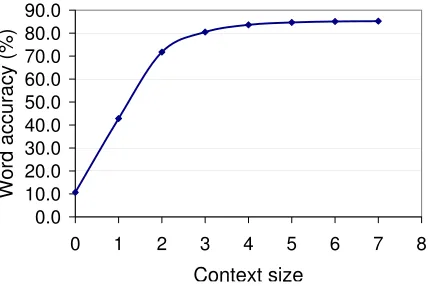
results with context sizec= 5.
Figure 3 illustrates the effect of varying the size of
n-best list in the MIRA update.n= 1is equivalent to taking into account only the best answer, which does not address the underfitting problem. A large
n-best list makes it difficult for the optimizer to sep-arate the correct and incorrect answers, resulting in large updates at each step. We settle onn = 10for the subsequent experiments.
The choice of MIRA’s loss function has a min-imal impact on performance, probably because our baseline system already has a very high phoneme ac-curacy. We employ the loss function that combines
0-1and phoneme error rate, due to its marginal im-provement over0-1loss on the development set.
Looking across columns in Table 2, we observe over 8% reduction in word error rate when the per-ceptron update is replaced with the MIRA update. Since the perceptron is a considerably simpler algo-rithm, we continue to report the results of both vari-ants throughout this section.
Table 2 also shows the word accuracy of our sys-tem after adding the option to conduct joint segmen-tation through phrasal decoding. The 15% relative reduction in error rate in the second row demon-strates the utility of folding the segmentation step into the search. It also shows that the joint frame-work enables the system to reduce and compensate for errors that occur in a pipeline. This is particu-larly interesting because our separate instance-based segmenter is highly accurate, achieving 98% seg-mentation accuracy. Our experiments indicate that the application of joint segmentation recovers more than 60% of the available improvements, according to an upper bound determined by utilizing perfect segmentation.2
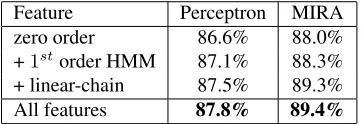
Table 3 illustrates the effect of our sequence fea-tures on both the perceptron and MIRA systems.
2Perfect with respect to our many-to-many alignment
(Ji-ampojamarn et al., 2007), but not necessarily in any linguistic sense.
Feature Perceptron MIRA zero order 86.6% 88.0% +1storder HMM 87.1% 88.3%
+ linear-chain 87.5% 89.3% All features 87.8% 89.4%
Table 3: The effect of sequence features on the joint sys-tem in terms of word accuracy.
Replacing the zero-order HMM with the first-order HMM makes little difference by itself, but com-bined with the more powerful linear-chain features, it results in a relative error reduction of about 12%. In general, the linear-chain features make a much larger difference than the relatively simple transition features, which underscores the importance of us-ing source-side context when assessus-ing sequences of phonemes.
The results reported in Tables 2 and 3 were cal-culated using cross validation on the training part of the CELEX data set. With the exception of adding the 1st order HMM, the differences between
ver-sions are statistically significant according to McNe-mar’s test at 95% confidence level. On one CPU of AMD Opteron 2.2GHz with 6GB of installed mem-ory, it takes approximately 32 hours to train the MIRA model with all features, compared to 12 hours for the zero-order model.
[image:7.612.84.289.60.98.2]5.2 System Comparison
Corpus MIRA Perceptron M-M HMM Joint n-gram∗ CSInf∗ PbA∗ CART∗
Eng. CELEX 90.51% 88.44% 84.81% 76.3% 84.5% -
-Dutch CELEX 95.32% 95.13% 91.69% - 94.5% -
-German CELEX 93.61% 92.84% 90.31% 92.5% - - 89.38% Nettalk 67.82% 64.87% 59.32% 64.6% - 65.35%
-CMUDict 71.99% 71.03% 65.38% - - - 57.80%
Brulex 94.51% 93.89% 89.77% 89.1% - -
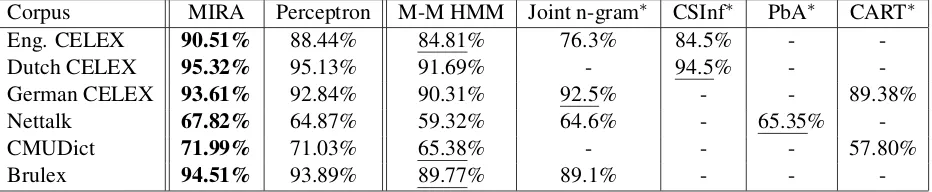
-Table 4: Word accuracy on the evaluated data sets. MIRA,Perceptron: our systems. M-M HMM: Many-to-Many HMM system (Jiampojamarn et al., 2007). Joint n-gram: Joint n-gram model (Demberg et al., 2007). CSInf: Con-straint satisfaction inference (Bosch and Canisius, 2006). PbA: Pronunciation by Analogy (Marchand and Damper, 2006).CART: CART decision tree system (Black et al., 1998). The columns marked with * contain results reported in the literature. “-” indicates no reported results. We have underlined the best previously reported results.
6 Conclusion
We have presented a joint framework for letter-to-phoneme conversion, powered by online discrimi-native training. We introduced two methods to con-vert multi-letter substrings into phonemes: one rely-ing on a separate segmenter, and the other incorpo-rating a unified search that finds the best input seg-mentation while generating the output sequence. We investigated two online update algorithms: the per-ceptron, which is straightforward to implement, and MIRA, which boosts performance by avoiding un-derfitting. Our systems employ sourcen-gram fea-tures and linear-chain feafea-tures, which substantially increase L2P accuracy. Our experimental results demonstrate the power of a joint approach based on online discriminative training with large feature sets. In all cases, our MIRA-based system advances the current state of the art by reducing the best reported error rate.
Appendix A. MIRA Implementation
We optimize the objective shown in Equation 3 using the SVMlight framework (Joachims, 1999),
which provides the quadratic program solver shown in Equation 4.
minw,ξ12 kwk2 +CP
iξi
subject to∀i, w·ti ≥rhsi−ξi
(4)
In order to approximate a hard margin using the soft-margin optimizer of SVMlight, we assign a very
large penalty value toC, thus making the use of any slack variables (ξi) prohibitively expensive. We
de-fine the vectorwas the difference between the new
and previous weights: w =αn−αo. We constrain
wto mirror the constraints in Equation 3. Since each
ˆ
yin then-best list(Yn)needs a constraint based on
its feature difference vector, we define atifor each:
∀yˆ∈Yn:ti = Φ(x, y)−Φ(x,yˆ)
Substituting that equation along with the inferred equationan =ao+winto our original MIRA
con-straints yields:
(αo+w)·ti ≥`(y,yˆ)
Movingαoto the right-hand-side to isolatew·tion
the left, we get a set of mappings that implement MIRA in SVMlight’s optimizer:
w αn−αo
ti Φ(x, y)−Φ(x,yˆ)
rhsi `(y,yˆ)−αo·ti
The output of the SVMlight optimizer is an update
vectorwto be added to the currentαo.
Acknowledgements
This research was supported by the Alberta Ingenu-ity Fund, and the Natural Sciences and Engineering Research Council of Canada.
References
David W. Aha, Dennis Kibler, and Marc K. Albert. 1991. Instance-based learning algorithms. Machine Learn-ing, 6(1):37–66.
[image:8.612.75.541.61.157.2]Maximilian Bisani and Hermann Ney. 2002. Investi-gations on joint-multigram models for grapheme-to-phoneme conversion. InProceedings of the 7th Inter-national Conference on Spoken Language Processing, pages 105–108.
Alan W. Black, Kevin Lenzo, and Vincent Pagel. 1998. Issues in building general letter to sound rules. InThe Third ESCA Workshop in Speech Synthesis, pages 77– 80.
Antal Van Den Bosch and Sander Canisius. 2006. Improved morpho-phonological sequence processing with constraint satisfaction inference. Proceedings of the Eighth Meeting of the ACL Special Interest Group in Computational Phonology, SIGPHON ’06, pages 41–49.
Antal Van Den Bosch and Walter Daelemans. 1998. Do not forget: Full memory in memory-based learn-ing of word pronunciation. In Proceedings of NeM-LaP3/CoNLL98, pages 195–204, Sydney, Australia. Yair Censor and Stavros A. Zenios. 1997. Parallel
Opti-mization: Theory, Algorithms, and Applications. Ox-ford University Press.
Michael Collins. 2002. Discriminative training meth-ods for Hidden Markov Models: theory and experi-ments with perceptron algorithms. In EMNLP ’02: Proceedings of the ACL-02 conference on Empirical methods in natural language processing, pages 1–8, Morristown, NJ, USA.
Koby Crammer and Yoram Singer. 2003. Ultraconser-vative online algorithms for multiclass problems. The Journal of Machine Learning Research, 3:951–991. Walter Daelemans and Antal Van Den Bosch. 1997.
Language-independent data-oriented grapheme-to-phoneme conversion. InProgress in Speech Synthesis, pages 77–89. New York, USA.
Robert I. Damper, Yannick Marchand, John DS. Marsters, and Alexander I. Bazin. 2005. Aligning text and phonemes for speech technology applications using an EM-like algorithm. International Journal of Speech Technology, 8(2):147–160.
Vera Demberg, Helmut Schmid, and Gregor M¨ohler. 2007. Phonological constraints and morphological preprocessing for grapheme-to-phoneme conversion. InProceedings of the 45th Annual Meeting of the As-sociation of Computational Linguistics, pages 96–103, Prague, Czech Republic.
Herman Engelbrecht and Tanja Schultz. 2005. Rapid development of an afrikaans-english speech-to-speech translator. InInternational Workshop of Spoken Lan-guage Translation (IWSLT), Pittsburgh, PA, USA. Sittichai Jiampojamarn, Grzegorz Kondrak, and Tarek
Sherif. 2007. Applying many-to-many alignments and hidden markov models to letter-to-phoneme con-version. InHuman Language Technologies 2007: The
Conference of the North American Chapter of the As-sociation for Computational Linguistics; Proceedings of the Main Conference, pages 372–379, Rochester, New York, USA.
Thorsten Joachims. 1999. Making large-scale support vector machine learning practical. pages 169–184. MIT Press, Cambridge, MA, USA.
John Kominek and Alan W Black. 2006. Learning pronunciation dictionaries: Language complexity and word selection strategies. InProceedings of the Hu-man Language Technology Conference of the NAACL, Main Conference, pages 232–239, New York City, USA.
Yannick Marchand and Robert I. Damper. 2000. A multistrategy approach to improving pronunciation by analogy. Computational Linguistics, 26(2):195–219. Yannick Marchand and Robert I. Damper. 2006. Can
syl-labification improve pronunciation by analogy of En-glish? Natural Language Engineering, 13(1):1–24. Juergen Schroeter, Alistair Conkie, Ann Syrdal, Mark
Beutnagel, Matthias Jilka, Volker Strom, Yeon-Jun Kim, Hong-Goo Kang, and David Kapilow. 2002. A perspective on the next challenges for TTS research. InIEEE 2002 Workshop on Speech Synthesis.
Charles Sutton and Andrew McCallum. 2006. An in-troduction to conditional random fields for relational learning. In Lise Getoor and Ben Taskar, editors,
Introduction to Statistical Relational Learning. MIT Press.
Paul Taylor. 2005. Hidden Markov Models for grapheme to phoneme conversion. In Proceedings of the 9th European Conference on Speech Communication and Technology.
Kristina Toutanova and Robert C. Moore. 2001. Pro-nunciation modeling for improved spelling correction. InACL ’02: Proceedings of the 40th Annual Meeting on Association for Computational Linguistics, pages 144–151, Morristown, NJ, USA.