Automatic Image Annotation Using Auxiliary Text Information
Yansong Feng and Mirella Lapata School of Informatics, University of Edinburgh
2 Buccleuch Place, Edinburgh EH8 9LW, UK [email protected],[email protected]
Abstract
The availability of databases of images labeled with keywords is necessary for developing and evaluating image annotation models. Dataset collection is however a costly and time con-suming task. In this paper we exploit the vast resource of images available on the web. We create a database of pictures that are natu-rally embedded into news articles and propose to use their captions as a proxy for annota-tion keywords. Experimental results show that an image annotation model can be developed on this dataset alone without the overhead of manual annotation. We also demonstrate that the news article associated with the picture can be used to boost image annotation perfor-mance.
1 Introduction
As the number of image collections is rapidly grow-ing, so does the need to browse and search them. Recent years have witnessed significant progress in developing methods for image retrieval1, many of which are query-based. Given a database of images, each annotated with keywords, the query is used to retrieve relevant pictures under the assumption that the annotations can essentially capture their seman-tics.
One stumbling block to the widespread use of query-based image retrieval systems is obtaining the keywords for the images. Since manual annotation is expensive, time-consuming and practically infea-sible for large databases, there has been great
in-1The approaches are too numerous to list; we refer the inter-ested reader to Datta et al. (2005) for an overview.
terest in automating the image annotation process (see references). More formally, given an image I with visual features Vi={v1,v2, . . . ,vN} and a set
of keywords W={w1,w2, . . . ,wM}, the task
con-sists in finding automatically the keyword subset WI ⊂W, which can appropriately describe the
im-age I. Indeed, several approaches have been pro-posed to solve this problem under a variety of learn-ing paradigms. These range from supervised clas-sification (Vailaya et al., 2001; Smeulders et al., 2000) to instantiations of the noisy-channel model (Duygulu et al., 2002), to clustering (Barnard et al., 2002), and methods inspired by information retrieval (Lavrenko et al., 2003; Feng et al., 2004).
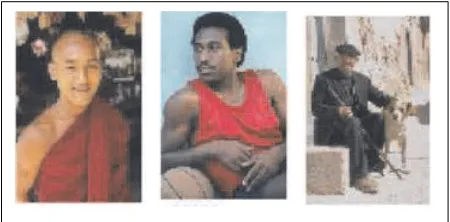
Obviously in order to develop accurate image an-notation models, some manually labeled data is re-quired. Previous approaches have been developed and tested almost exclusively on the Corel database. The latter contains 600 CD-ROMs, each contain-ing about 100 images representcontain-ing the same topic or concept, e.g., people, landscape, male. Each topic is associated with keywords and these are assumed to also describe the images under this topic. As an example consider the pictures in Figure 1 which are classified under the topicmaleand have the descrip-tion keywordsman, male, people, cloth, andface.
Current image annotation methods work well when large amounts of labeled images are available but can run into severe difficulties when the number of images and keywords for a given topic is rela-tively small. Unfortunately, databases like Corel are few and far between and somewhat idealized. Corel contains clusters of many closely related images which in turn share keyword descriptions, thus al-lowing models to learn image-keyword associations
Figure 1: Images from the Corel database, exemplifying the conceptmale with keyword descriptionsman, male, people, cloth, andface.
reliably (Tang and Lewis, 2007). It is unlikely that models trained on this database will perform well out-of-domain on other image collections which are more noisy and do not share these characteristics. Furthermore, in order to develop robust image anno-tation models, it is crucial to have large and diverse datasets both for training and evaluation.
In this work, we aim to relieve the data acquisition bottleneck associated with automatic image annota-tion by taking advantage of resources where images and their annotations co-occur naturally. News arti-cles associated with images and their captions spring readily to mind (e.g., BBC News, Yahoo News). So, rather than laboriously annotating images with their keywords, we simply treat captions as labels. These annotations are admittedly noisy and far from ideal. Captions can be denotative (describing the objects the image depicts) but also connotative (describ-ing sociological, political, or economic attitudes re-flected in the image). Importantly, our images are not standalone, they come with news articles whose con-tent is shared with the image. So, by processing the accompanying document, we can effectively learn about the image and reduce the effect of noise due to the approximate nature of the caption labels. To give a simple example, if two words appear both in the caption and the document, it is more likely that the annotation is genuine.
In what follows, we present a new database con-sisting of articles, images, and their captions which we collected from an on-line news source. We then propose an image annotation model which can learn from our noisy annotations and the auxil-iary documents. Specifically, we extend and mod-ify Lavrenko’s (2003) continuous relevance model
to suit our task. Our experimental results show that this model can successfully scale to our database, without making use of explicit human annotations in any way. We also show that the auxiliary docu-ment contains important information for generating more accurate image descriptions.
2 Related Work
Automatic image annotation is a popular task in computer vision. The earliest approaches are closely related to image classification (Vailaya et al., 2001; Smeulders et al., 2000), where pictures are assigned a set of simple descriptions such as indoor, out-door, landscape, people, animal. A binary classifier is trained for each concept, sometimes in a “one vs all” setting. The focus here is mostly on image pro-cessing and good feature selection (e.g., colour, tex-ture, contours) rather than the annotation task itself. Recently, much progress has been made on the image annotation task thanks to three factors. The availability of the Corel database, the use of unsu-pervised methods and new insights from the related fields of natural language processing and informa-tion retrieval. The co-occurrence model (Mori et al., 1999) collects co-occurrence counts between words and image features and uses them to predict anno-tations for new images. Duygulu et al. (2002) im-prove on this model by treating image regions and keywords as a bi-text and using the EM algorithm to construct an image region-word dictionary.
Another way of capturing co-occurrence informa-tion is to introduce latent variables linking image features with words. Standard latent semantic anal-ysis (LSA) and its probabilistic variant (PLSA) have been applied to this task (Hofmann, 1998). Barnard et al. (2002) propose a hierarchical latent model in order to account for the fact that some words are more general than others. More sophisticated graphical models (Blei and Jordan, 2003) have also been employed including Gaussian Mixture Models (GMM) and Latent Dirichlet Allocation (LDA).
Finally, relevance models originally developed for information retrieval, have been successfully applied to image annotation (Lavrenko et al., 2003; Feng et al., 2004). A key idea behind these models is to find the images most similar to the test image and then use their shared keywords for annotation.
important respects. Firstly, our ultimate goal is to de-velop an image annotation model that can cope with real-world images and noisy data sets. To this end we are faced with the challenge of building an ap-propriate database for testing and training purposes. Our solution is to leverage the vast resource of im-ages available on the web but also the fact that many of these images are implicitly annotated. For exam-ple, news articles often contain images whose cap-tions can be thought of as annotacap-tions. Secondly, we allow our image annotation model access to knowl-edge sources other than the image and its keywords. This is relatively straightforward in our case; an im-age and its accompanying document have shared content, and we can use the latter to glean informa-tion about the former. But we hope to illustrate the more general point that auxiliary linguistic informa-tion can indeed bring performance improvements on the image annotation task.
3 BBC News Database
Our database consists of news images which are abundant. Many on-line news providers supply pic-tures with news articles, some even classify news into broad topic categories (e.g., business, world, sports, entertainment). Importantly, news images of-ten display several objects and complex scenes and are usually associated with captions describing their contents. The captions are image specific and use a rich vocabulary. This is in marked contrast to the Corel database whose images contain one or two salient objects and a limited vocabulary (typically around 300 words).
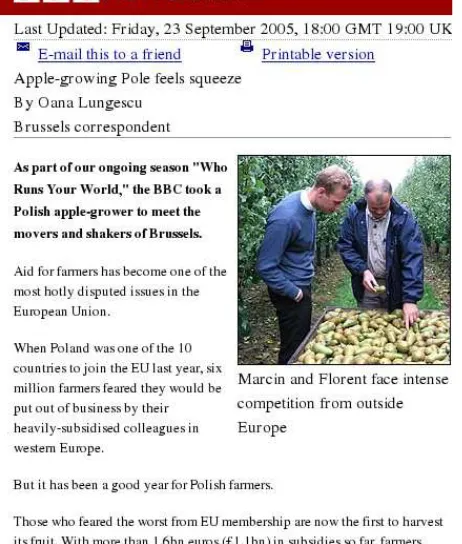
We downloaded 3,361 news articles from the BBC News website.2 Each article was accompa-nied with an image and its caption. We thus created a database of image-caption-document tuples. The documents cover a wide range of topics including national and international politics, advanced tech-nology, sports, education, etc. An example of an en-try in our database is illustrated in Figure 2. Here, the image caption isMarcin and Florent face intense competition from outside Europe and the accompa-nying article discusses EU subsidies to farmers. The images are usually 203 pixels wide and 152 pix-els high. The average caption length is 5.35 tokens, and the average document length 133.85 tokens. Our
[image:3.612.320.551.78.350.2]2http://news.bbc.co.uk/
Figure 2: A sample from our BBC News database. Each entry contains an image, a caption for the image, and the accompanying document with its title.
captions have a vocabulary of 2,167 words and our documents 6,253. The vocabulary shared between captions and documents is 2,056 words.
4 Extending the Continuous Relevance Annotation Model
therefore parameters can be estimated without EM. Indeed, Lavrenko et al. achieve competitive perfor-mance with latent variable models. Secondly, the generation of feature vectors is modeled directly, so there is no need for quantization. Thirdly, as we show below the model can be easily extended to in-corporate information outside the image and its key-words.
In the following we first lay out the assumptions underlying our model. We next describe the contin-uous relevance model in more detail and present our extensions and modifications.
Assumptions Since we are using a non-standard database, namely images embedded in doc-uments, it is important to clarify what we mean by image annotation, and how the precise nature of our data impacts the task. We thus make the following assumptions:
1. The caption describes the content of the image directly or indirectly. Unlike traditional image annotation where keywords describe salient ob-jects, captions supply more detailed informa-tion, not only about objects, and their attributes, but also events. In Figure 2 the caption men-tions Marcin and Florent the two individuals shown in the picture but also the fact that they face competition from outside Europe.
2. Since our images are implicitly rather than ex-plicitly labeled, we do not assume that we can annotate all objects present in the image. In-stead, we hope to be able to model event-related information such as “what happened”, “who did it”, “when” and “where”. Our annotation task is therefore more semantic in nature than traditionally assumed.
3. The accompanying document describes the content of the image. This is trivially true for news documents where the images convention-ally depict events, objects or people mentioned in the article.
To validate these assumptions, we performed the following experiment on our BBC News dataset. We randomly selected 240 image-caption pairs and manually assessed whether the caption content words (i.e., nouns, verbs, and adjectives) could de-scribe the image. We found out that the captions express the picture’s content 90% of the time. Fur-thermore, approximately 88% of the nouns in
sub-ject or obsub-ject position directly denote salient picture objects. We thus conclude that the captions contain useful information about the picture and can be used for annotation purposes.
Model Description The continuous relevance image annotation model (Lavrenko et al., 2003) generatively learns the joint probability distribu-tionP(V,W)of wordsW and image regionsV. The key assumption here is that the process of generating images is conditionally independent from the pro-cess of generating words. Each annotated image in the training set is treated as a latent variable. Then for an unknown imageI, we estimate:
P(VI,WI) =
∑
s∈DP(VI|s)P(WI|s)P(s), (1)
where D is the number of images in the training database,VIare visual features of the image regions
representingI,WI are the keywords ofI, s is a
la-tent variable (i.e., an image-annotation pair), and P(s) the prior probability ofs. The latter is drawn from a uniform distribution:
P(s) = 1 ND
(2)
where ND is number of the latent variables in the
training databaseD.
When estimating P(VI|s), the probability of
im-age regions and words, Lavrenko et al. (2003) rea-sonably assume a generative Gaussian kernel distri-bution for the image regions:
(3) P(VI|s) =
NVI
∏
r=1
Pg(vr|s)
=
NVI
∏
r=1 1 nsv
nsv
∑
i=1
exp{(vr−vi)TΣ−1(vr−vi)}
p
2kπk|Σ|
whereNVI is the number of regions in imageI,vrthe feature vector for regionrin imageI,nsvthe number of regions in the image of latent variables,vithe
fea-ture vector for regioniins’s image,kthe dimension of the image feature vectors andΣthe feature
covari-ance matrix. According to equation (3), a Gaussian kernel is fit to every feature vectorvicorresponding
to regioniin the image of the latent variables. Each kernel here is determined by the feature covariance matrix Σ, and for simplicity, Σis assumed to be a
diagonal matrix:Σ=βI, whereI is the identity
the kernel whose value is optimized on the develop-ment set.
Lavrenko et al. (2003) estimate the word prob-abilities P(WI|s) using a multinomial distribution.
This is a reasonable assumption in the Corel dataset, where the annotations have similar lengths and the words reflect the salience of objects in the image (the multinomial model tends to favor words that appear multiple times in the annotation). However, in our dataset the annotations have varying lengths, and do not necessarily reflect object salience. We are more interested in modeling the presence or absence of words in the annotation and thus use the multiple-Bernoulli distribution to generate words (Feng et al., 2004). And rather than relying solely on annotations in the training database, we can also take the accom-panying document into account using a weighted combination.
The probability of sampling a set of words W given a latent variablesfrom the underlying multiple Bernoulli distribution that has generated the training setDis:
P(W|s) =
∏
w∈W
P(w|s)
∏
w∈/W
(1−P(w|s)) (4)
where P(w|s) denotes the probability of the w’th component of the multiple Bernoulli distribution. Now, in estimatingP(w|s)we can include the docu-ment as:
Pest(w|s) =αPest(w|sa) + (1−α)Pest(w|sd) (5)
whereαis a smoothing parameter tuned on the
de-velopment set,sais the annotation for the latent
vari-ablesandsdits corresponding document.
Equation (5) smooths the influence of the annota-tion words and allows to offset the negative effect of the noise inherent in our dataset. Since our images are implicitly annotated, there is no guarantee that the annotations are all appropriate. By taking into accountPest(w|sd), it is possible to annotate an
im-age with a word that appears in the document but is not included in the caption.
We use a Bayesian framework for estimat-ingPest(w|sa). Specifically, we assume a beta prior
(conjugate to the Bernoulli distribution) for each word:
Pest(w|sa) =
µ bw,sa+Nw
µ+D (6)
whereµis a smoothing parameter estimated on the development set,bw,sais a Boolean variable denoting whetherw appears in the annotation sa, and Nw is
the number of latent variables that containwin their annotations.
We estimate Pest(w|sd) using maximum
likeli-hood estimation (Ponte and Croft, 1998):
Pest(w|sd) =
numw,sd numsd
(7)
wherenumw,sd denotes the frequency ofwin the ac-companying document of latent variablesandnumsd the number of all tokens in the document. Note that we purposely leavePestunsmoothed, since it is used
as a means of balancing the weight of word frequen-cies in annotations. So, if a word does not appear in the document, the possibility of selecting it will not be greater thanα(see Equation (5)).
Unfortunately, including the document in the es-timation ofPest(w|s)increases the vocabulary which
in turn increases computation time. Given a test image-document pair, we must evaluateP(w|VI)for
every w in our vocabulary which is the union of the caption and document words. We reduce the search space, by scoring each document word with its tf∗idf weight (Salton and McGill, 1983) and adding then-best candidates to our caption vocabu-lary. This way the vocabulary is not fixed in advance for all images but changes dynamically depending on the document at hand.
Re-ranking the Annotation Hypotheses It is easy to see that the output of our model is a ranked word list. Typically, the k-best words are taken to be the automatic annotations for a test image I (Duygulu et al., 2002; Lavrenko et al., 2003; Jeon and Manmatha, 2004) wherekis a small number and the same for all images.
So far we have taken account of the auxiliary doc-ument rather naively, by considering its vocabulary in the estimation of P(W|s). Crucially, documents are written with one or more topics in mind. The im-age (and its annotations) are likely to represent these topics, so ideally our model should prefer words that are strong topic indicators. A simple way to imple-ment this idea is by re-ranking ourk-best list accord-ing to a topic model estimated from the entire docu-ment collection.
represents documents as a mixture of topics and has been previously used to perform document classi-fication (Blei et al., 2003) and ad-hoc information retrieval (Wei and Croft, 2006) with good results. Given a collection of documents and a set of latent variables (i.e., the number of topics), the LDA model estimates the probability of topics per document and the probability of words per topic. The topic mix-ture is drawn from a conjugate Dirichlet prior that remains the same for all documents.
For our re-ranking task, we use the LDA model to infer them-best topics in the accompanying doc-ument. We then select from the output of our model those words that are most likely according to these topics. To give a concrete example, let us assume that for a given image our model has produced five annotations,w1,w2,w3,w4, andw5. However, according to the LDA model neither w2 nor w5 are likely topic indicators. We therefore removew2 andw5and substitute them with words further down the ranked list that are topical (e.g., w6 and w7). An advantage of using LDA is that at test time we can perform inference without retraining the topic model.
5 Experimental Setup
In this section we discuss our experimental design for assessing the performance of the model pre-sented above. We give details on our training pro-cedure and parameter estimation, describe our fea-tures, and present the baseline methods used for comparison with our approach.
Data Our model was trained and tested on the database introduced in Section 3. We used 2,881 image-caption-document tuples for training, 240 tu-ples for development and 240 for testing. The docu-ments and captions were part-of-speech tagged and lemmatized with Tree Tagger (Schmid, 1994).Words other than nouns, verbs, and adjectives were dis-carded. Words that were attested less than five times in the training set were also removed to avoid unre-liable estimation. In total, our vocabulary consisted of 8,309 words.
Model Parameters Images are typically seg-mented into regions prior to training. We impose a fixed-size rectangular grid on each image rather than attempting segmentation using a general purpose al-gorithm such as normalized cuts (Shi and Malik,
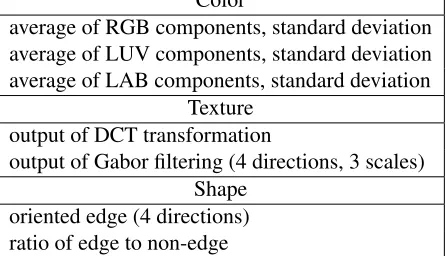
Color
average of RGB components, standard deviation average of LUV components, standard deviation average of LAB components, standard deviation
Texture output of DCT transformation
output of Gabor filtering (4 directions, 3 scales) Shape
[image:6.612.315.538.67.195.2]oriented edge (4 directions) ratio of edge to non-edge
Table 2: Set of image features used in our experiments.
2000). Using a grid avoids unnecessary errors from image segmentation algorithms, reduces computa-tion time, and simplifies parameter estimacomputa-tion (Feng et al., 2004). Taking the small size and low resolu-tion of the BBC News images into account, we av-eragely divide each image into 6×5 rectangles and extract features for each region. We use 46 features based on color, texture, and shape. They are summa-rized in Table 2.
The model presented in Section 4 has a few pa-rameters that must be selected empirically on the development set. These include the vocabulary size, which is dependent on then words with the high-est tf∗idf scores in each document, and the num-ber of topics for the LDA-based re-ranker. We ob-tained best performance withnset to 100 (no cutoff was applied in cases where the vocabulary was less than 100). We trained an LDA model with 20 top-ics on our document collection using David Blei’s implementation.3We used this model to re-rank the output of our annotation model according to the three most likely topics in each document.
Baselines We compared our model against three baselines. The first baseline is based ontf∗idf (Salton and McGill, 1983). We rank the document’s content words (i.e., nouns, verbs, and adjectives) ac-cording to theirtf∗idf weight and select the top k to be the final annotations. Our second baseline sim-ply annotates the image with the document’s title. Again we only use content words (the average title length in the training set was 4.0 words). Our third baseline is Lavrenko et al.’s (2003) continuous rel-evance model. It is trained solely on image-caption
3Available fromhttp://www.cs.princeton.edu/˜blei/
Model Top 10 Top 15 Top 20
Precision Recall F1 Precision Recall F1 Precision Recall F1
tf∗idf 4.37 7.09 5.41 3.57 8.12 4.86 2.65 8.89 4.00
DocTitle 9.22 7.03 7.20 9.22 7.03 7.20 9.22 7.03 7.20
Lavrenko03 9.05 16.01 11.81 7.73 17.87 10.71 6.55 19.38 9.79
[image:7.612.72.548.60.143.2]ExtModel 14.72 27.95 19.82 11.62 32.99 17.18 9.72 36.77 15.39
Table 1: Automatic image annotation results on the BBC News database.
pairs, uses a vocabulary of 2,167 words and the same features as our extended model.
Evaluation Our evaluation follows the exper-imental methodology proposed in Duygulu et al. (2002). We are given an un-annotated image I and are asked to automatically produce suitable anno-tations for I. Given a set of image regionsVI, we
use equation (1) to derive the conditional distribu-tionP(w|VI). We consider thek-best words as the
an-notations forI. We present results using the top 10, 15, and 20 annotation words. We assess our model’s performance using precision/recall and F1. In our task, precision is the percentage of correctly anno-tated words over all annotations that the system sug-gested. Recall, is the percentage of correctly anno-tated words over the number of genuine annotations in the test data. F1 is the harmonic mean of precision and recall. These measures are averaged over the set of test words.
6 Results
Our experiments were driven by three questions: (1) Is it possible to create an annotation model from noisy data that has not been explicitly hand labeled for this task? (2) What is the contribution of the auxiliary document? As mentioned earlier, consid-ering the document increases the model’s compu-tational complexity, which can be justified as long as we demonstrate a substantial increase in perfor-mance. (3) What is the contribution of the image? Here, we are trying to assess if the image features matter. For instance, we could simply generate an-notation words by processing the document alone.
Our results are summarized in Table 1. We com-pare the annotation performance of the model pro-posed in this paper (ExtModel) with Lavrenko et al.’s (2003) original continuous relevance model (Lavrenko03) and two other simpler models which
do not take the image into account (tf∗idf and Doc-Title). First, note that the original relevance model performs best when the annotation output is re-stricted to 10 words with an F1 of 11.81% (recall is 9.05 and precision 16.01). F1 is marginally worse with 15 output words and decreases by 2% with 20. This model does not take any document-based in-formation into account, it is trained solely on image-caption pairs. On the Corel test set the same model obtains a precision of 19.0% and a recall of 16.0% with a vocabulary of 260 words. Although these re-sults are not strictly comparable with ours due to the different nature of the training data (in addition, we output 10 annotation words, whereas Lavrenko et al. (2003) output 5), they give some indication of the decrease in performance incurred when using a more challenging dataset. Unlike Corel, our images have greater variety, non-overlapping content and employ a larger vocabulary (2,167 vs. 260 words).
When the document is taken into account (see ExtModel in Table 1), F1 improves by 8.01% (re-call is 14.72% and precision 27.95%). Increasing the size of the output annotations to 15 or 20 yields better recall, at the expense of precision. Eliminat-ing the LDA reranker from the extended model de-creases F1 by 0.62%. Incidentally, LDA can be also used to rerank the output of Lavrenko et al.’s (2003) model. LDA also increases the performance of this model by 0.41%.
Finally, considering the document alone, without the image yields inferior performance. This is true for the tf∗idf model and the model based on the document titles.4Interestingly, the latter yields pre-cision similar to Lavrenko et al. (2003). This is prob-ably due to the fact that the document’s title is in a sense similar to a caption. It often contains words that describe the document’s gist and expectedly
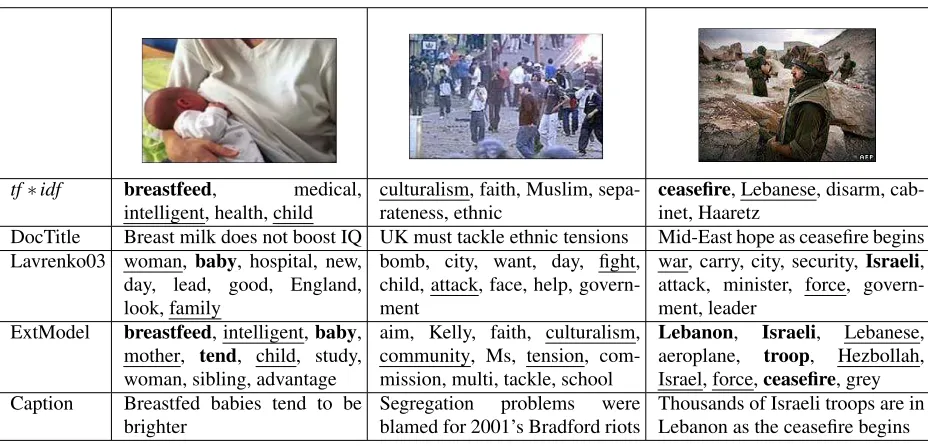
tf∗idf breastfeed, medical, intelligent, health, child
culturalism, faith, Muslim, sepa-rateness, ethnic
ceasefire, Lebanese, disarm, cab-inet, Haaretz
DocTitle Breast milk does not boost IQ UK must tackle ethnic tensions Mid-East hope as ceasefire begins Lavrenko03 woman,baby, hospital, new,
day, lead, good, England, look, family
bomb, city, want, day, fight, child, attack, face, help, govern-ment
war, carry, city, security,Israeli, attack, minister, force, govern-ment, leader
ExtModel breastfeed, intelligent,baby, mother, tend, child, study, woman, sibling, advantage
aim, Kelly, faith, culturalism, community, Ms, tension, com-mission, multi, tackle, school
Lebanon, Israeli, Lebanese, aeroplane, troop, Hezbollah, Israel, force,ceasefire, grey Caption Breastfed babies tend to be
brighter
Segregation problems were blamed for 2001’s Bradford riots
[image:8.612.74.538.57.280.2]Thousands of Israeli troops are in Lebanon as the ceasefire begins
Figure 3: Examples of annotations generated by our model (ExtModel), the continuous relevance model (Lavrenko03), and the two baselines based ontf∗idf and the document title (DocTitle). Words in bold face indicate exact matches, underlined words are semantically compatible. The original captions are in the last row.
some of these words will be also appropriate for the image. In fact, in our dataset, the title words are a subset of those found in the captions.
Examples of the annotations generated by our model are shown in Figure 3. We also include the annotations produced by Lavrenko et. al’s (2003) model and the two baselines. As we can see our model annotates the image with words that are not always included in the caption. Some of these are synonyms of the caption words (e.g.,childand intel-ligentin left image of Figure 3), whereas others ex-press additional information (e.g.,mother,woman). Also note that complex scene images remain chal-lenging (see the center image in Figure 3). Such im-ages are better analyzed at a higher resolution and probably require more training examples.
7 Conclusions and Future Work
In this paper, we describe a new approach for the collection of image annotation datasets. Specifically, we leverage the vast resource of images available on the Internet while exploiting the fact that many of them are labeled with captions. Our experiments show that it is possible to learn an image annotation model from caption-picture pairs even if these are not explicitly annotated in any way. We also show that the annotation model benefits substantially from
additional information, beyond the caption or image. In our case this information is provided by the news documents associated with the pictures. But more generally our results indicate that further linguistic knowledge is needed to improve performance on the image annotation task. For instance, resources like WordNet (Fellbaum, 1998) can be used to expand the annotations by exploiting information about is-a relationships.
References
K. Barnard, P. Duygulu, D. Forsyth, N. de Freitas, D. Blei, and M. Jordan. 2002. Matching words and pictures. Journal of Machine Learning Research, 3:1107–1135.
D. Blei and M. Jordan. 2003. Modeling annotated data. InProceedings of the 26th Annual International ACM SIGIR Conference, pages 127–134, Toronto, ON. D. Blei, A. Ng, and M. Jordan. 2003. Latent
Dirich-let allocation. Journal of Machine Learning Research, 3:993–1022.
R. Datta, J. Li, and J. Z. Wang. 2005. Content-based im-age retrieval – approaches and trends of the new im-age. InProceedings of the International Workshop on Mul-timedia Information Retrieval, pages 253–262, Singa-pore.
P. Duygulu, K. Barnard, J. de Freitas, and D. Forsyth. 2002. Object recognition as machine translation: Learning a lexicon for a fixed image vocabulary. In
Proceedings of the 7th European Conference on Com-puter Vision, pages 97–112, Copenhagen, Danemark. C. Fellbaum, editor. 1998. WordNet: An Electronic
Database. MIT Press, Cambridge, MA.
S. Feng, V. Lavrenko, and R. Manmatha. 2004. Mul-tiple Bernoulli relevance models for image and video annotation. InProceedings of the International Con-ference on Computer Vision and Pattern Recognition, pages 1002–1009, Washington, DC.
T. Hofmann. 1998. Learning and representing topic. A hierarchical mixture model for word occurrences in document databases. In Proceedings of the Con-ference for Automated Learning and Discovery, pages 408–415, Pittsburgh, PA.
J. Jeon and R. Manmatha. 2004. Using maximum en-tropy for automatic image annotation. In Proceed-ings of the 3rd International Conference on Image and Video Retrieval, pages 24–32, Dublin City, Ireland. V. Lavrenko, R. Manmatha, and J. Jeon. 2003. A model
for learning the semantics of pictures. InProceedings of the 16th Conference on Advances in Neural Infor-mation Processing Systems, Vancouver, BC.
Y. Mori, H. Takahashi, and R. Oka. 1999. Image-to-word transformation based on dividing and vector quantiz-ing images with words. InProceedings of the 1st In-ternational Workshop on Multimedia Intelligent Stor-age and Retrieval ManStor-agement, Orlando, FL.
J. M. Ponte and W. Bruce Croft. 1998. A language modeling approach to information retrieval. In Pro-ceedings of the 21st Annual International ACM SIGIR Conference, pages 275–281, New York, NY.
G. Salton and M.J. McGill. 1983. Introduction to Mod-ern Information Retrieval. McGraw-Hill, New York.
H. Schmid. 1994. Probabilistic part-of-speech tagging using decision trees. In Proceedings of the Interna-tional Conference on New Methods in Language Pro-cessing, Manchester, UK.
J. Shi and J. Malik. 2000. Normalized cuts and image segmentation. IEEE Transactions on Pattern Analysis and Machine Intelligence, 22(8):888–905.
A. W. Smeulders, M. Worring, S. Santini, A. Gupta, and R. Jain. 2000. Content-based image retrieval at the end of the early years. IEEE Transactions on Pat-tern Analysis and Machine Intelligence, 22(12):1349– 1380.
J. Tang and P. H. Lewis. 2007. A study of quality is-sues for image auto-annotation with the Corel data-set.
IEEE Transactions on Circuits and Systems for Video Technology, 17(3):384–389.
A. Vailaya, M. Figueiredo, A. Jain, and H. Zhang. 2001. Image classification for content-based indexing. IEEE Transactions on Image Processing, 10:117–130. X. Wei and B. W. Croft. 2006. LDA-based document