E x p e r i m e n t i n g with the Interaction b e t w e e n Aggregation and
Text Structuring
H u a C h e n g Division of I n f o r m a t i c s University of E d i n b u r g h
80 S o u t h Bridge, E d i n b u r g h EH1 1HN, U K Email: h u a c O d a i , e d . a c . uk
A b s t r a c t
In natural language generation, different gener- ation tasks often interact with each other in a complex way, which is hard to capture in the pipeline architecture described by Reiter (Re- iter, 1994). This paper focuses on the interac- tion between a specific type of aggregation and text planning, in particular, maintaining local coherence, and tries to explore what preferences exist among the factors related to the two tasks. The evaluation result shows that it is these pref- erences that decide the quality of the generated text and capturing t h e m properly in a genera- tion system could lead to coherent text.
1 I n t r o d u c t i o n
In automatic natural language generation (NLG), various versions of the pipeline archi- tecture specified by Reiter and Dale ((Reiter, 1994) and (Reiter and Dale, 1997)) are usually adopted. They successfully modularise the gen- eration problem, but fail to capture the complex interactions between different modules. Take aggregation as an example. It combines simple representations to form a complex one, which in the mean time leads to a shorter text as a whole. There is no consensus as to where aggre- gation should h a p p e n and how it is related to other generation processes ((Wilkinson, 1995) and (Reape and Mellish, 1999)).
We think that the effect of aggregation spreads from text planning to sentence reali- sation. The task of text planning is to se- lect the relevant information to be expressed in the text and organise it into a hierarchi- cal structure which captures certain discourse preferences such as preferences for global co- herence (e.g. the use of R S T relations (Mann and Thompson, 1987)) and local coherence (e.g. center transitions as defined in Centering The-
ory (Grosz et al., 1995)). Aggregation affects text planning by taking away facts from a se- quence featuring preferred center movements for subordination. As a result, the preferred cen- ter transitions in the sequence are cut off. For example, comparing the two descriptions of a necklace in Figure 1, 2 is less coherent than 1 because of the shifting from the description of the necklace to that of the designer. To avoid this side effect, aggregation should be consid- ered in text planning, which might produce a different planning sequence.
Aggregation is also closely related to the task of referring expression generation. A referring expression is used not only for identifying a ref- erent, but also for providing additional infor- mation about the referent and expressing the speaker's emotional attitude toward the refer- ent (Appelt, 1985). T h e syntactic form of a re- ferring expression affects how much additional information can be expressed, but it can only be determined after sentence planning, when the ordering between sentences and sentence com- ponents has been decided. This demands that the factors relevant to referring expression gen- eration and aggregation be considered at the same time rather than sequentially to generate referring expressions capable of serving multiple goals.
I. This necklace is in the Arts and Crafts style. Arts and Crafts style jewels usually have an elaborate design. They tend to have floral motifs. For instance, this necklace has floral motifs. It was designed by Jessie King. King once lived in Scotland.
2. This necklace, which was designed by Jessie King, is in the Arts and Crafts style. Arts and Crafts style jewels usually have an elaborate design. They tend to have floral motifs. For instance, this necklace has floral motifs. King once lived in Scotland.
Figure 1: An aggregation example
in an experimental generation system based on a Genetic Algorithm to p r o d u c e m u s e u m de- scriptions, which describe m u s e u m objects on display. T h e result shows t h a t t h e system can generate a n u m b e r texts of similar qualities to h u m a n w r i t t e n texts.
2 E m b e d d i n g i n a G A T e x t P l a n n e r
To experiment with the interaction between maintaining local coherence and embedding, we adopt the text planner based on a Genetic Al- gorithm (GA) as described in (Mellish et al., 1998). T h e task is, given a set of facts a n d a set of relations between facts, to p r o d u c e a le- gal rhetorical s t r u c t u r e tree using all t h e facts and some relations. A fragment of the possible input is given in Figure 2.
A genetic algorithm is suitable for such a problem because the n u m b e r of possible com- binations is huge, t h e search space is not per- fectly s m o o t h and unimodal, a n d the genera- tion task does not require a global o p t i m u m to be found. T h e algorithm of (Mellish et al., 1998) is basically a r e p e a t e d two step process - first sequences of facts are generated by apply- ing GA operators (crossover and mutation) and t h e n the RS trees built from these sequences are evaluated. This provides a mechanism to inte- grate various planning factors in t h e evaluation function and search for the best combinations of them.
To explore the whole space of embedding, we did not p e r f o r m e m b e d d i n g on s t r u c t u r e d facts or on adjacent facts in a linear sequence be- cause these might restrict the possibilities and even miss out good candidates. Instead, we de- fined an operator called embedding mutation. It r a n d o m l y selects two units (say Ui and Uk) mentioning a c o m m o n entity from a sequence [U1,U2,...,Ui,...,Uk,...,Uu] to form a list [Ui,Uk] representing an embedding. T h e list substitutes
the original unit Ui to p r o d u c e a new sequence [U1,U2,...,[Ui,Uk],...,Un], which is t h e n evalu- ated and ordered in the population.
3 C a p t u r i n g t h e I n t e r a c t i o n s a s P r e f e r e n c e s
A key requirement of t h e GA approach is t h e ability to evaluate t h e quality of a possible so- lution. We claim t h a t it is t h e relative prefer- ences a m o n g factors r a t h e r t h a n each individ- ual factor t h a t play the crucial role in deciding the quality. Therefore, if we can c a p t u r e these preferences in a generation s y s t e m properly, we would be able to p r o d u c e coherent text. In this section, we first discuss t h e preferences among factors related to text planning, based on which those for e m b e d d i n g can be introduced.
3.1 P r e f e r e n c e s f o r global c o h e r e n c e Following the assumption of RST, a text is glob- ally coherent if a hierarchical s t r u c t u r e like an R S T tree can be c o n s t r u c t e d from the text. In addition to t h e semantic relations and t h e Joint relation 1 used in (Mellish et al., 1998), we as- sume a Conjunct or Disjunct relation between two facts with at least two identical compo- nents, so t h a t semantic parataxis can be t r e a t e d as a combining operation on two subtrees con- nected by the relation.
E m b e d d i n g a Conjunct relation inside an- other semantic relation is not preferred because this could convey wrong information, for exam- ple, in Figure 3, 2 cannot be used to substitute 1. Also a semantic relation is preferred to be used whenever possible. Here is t h e preferences concerning the use of relations, where " A > B " means t h a t A is preferred over B:
fact (choker, is, broad, fact_no de- 1 ).
fact('Queen Alexandra',wore,choker,fact_node-2). fact (choker,'can cover',scar,fact_node-3).
fact(band,'might be m a d e of',plaques,fact_node-4). f a c t ( b a n d / m i g h t be m a d e of',panels,fact_node-5). fact(scar,is/on her neck',fact_node-6).
rel(in_that_reln,fact_node-2,fact_node-3, ~). rel(conjunct,fact_node-4,fact_node-5,[]).
Figure 2: A fragment of the input to the GA text planner
1. The necklace is set with jewels in that it features cabuchon stones. Indeed, an Arts and Crafts style jewel usually uses cabuchon stones. A n Arts and Crafts style jewel usually uses oval stones.
2. The necklace is set with jewels in that it features cabuchon stones. Indeed, an Arts and Crafts style jewel usually uses cabuchon stones and oval stones.
Figure 3: Conjunct and semantic relations
H e u r i s t i c 1 Preferences among features for global coherence:
a semantic relation > Conjunct > Joint > parataxis in a semantic relation
3.2 P r e f e r e n c e s for local c o h e r e n c e In Centering Theory, Rule 2 specifies prefer- ences among center transitions in a locally co- herent discourse segment: sequences of continu- ation are preferred over sequences of retaining, which are t h e n preferred over sequences of shift- ing. Instead of claiming t h a t this is the best model, we use it simply as an example of a lin- guistic model being used for evaluating factors for text planning.
A n o t h e r type of center transition t h a t ap- pears frequently in m u s e u m descriptions is asso- ciate shifting, where the description starts with an object and then moves to a closely associated object or perspectives of that object. Our ob- servation from m u s e u m descriptions shows t h a t associate shifting is preferred by h u m a n writ- ers to all other types of movements except for center continuation.
Oberlander et al. (1999) define yet a n o t h e r type of transition called resuming, where an ut- terance mentions an entity not in the immedi- ate previous utterance, but in the previous dis- course. The following is the preferences among features for local coherence:
H e u r i s t i c 2 Preferences among center transi- tions and semantic relations:
Continuation > Associate shifting > Retain- ing > Shifting > Resuming
a semantic relation > Joint + Continuation
3.3 P r e f e r e n c e s for e m b e d d i n g
For a r a n d o m l y p r o d u c e d embedding, we must be able to judge its quality. We distinguish be- tween a good, normal and bad embedding based on the features it bears 2. A good embedding is one satisfying all following conditions:
1. The referring expression is an indefinite, a demonstrative or a bridging description (as defined in (Poesio et al., 1997)).
2. T h e e m b e d d e d part can be realised as an adjective or a prepositional phrase (Scott and de Souza, 1990) 3.
3. The e m b e d d e d part does not lie between text spans connected by semantic parataxis or hypotaxis (Cheng, 1998).
4. T h e r e is an available syntactic slot to hold the e m b e d d e d part.
2We do not claim that the set of features is complete. In a different context, more criteria might have to be considered.
A good embedding is highly preferred and should be performed whenever possible. A nor- mal embedding is one satisfying condition 1, 3 and 4 and the e m b e d d e d p a r t is a relative clause. A bad embedding consists of all those left.
To decide the preferences among e m b e d d i n g s and center transitions, let's look at the para- graphs in Figure 1 again. T h e only difference between t h e m is the position of the sentence "This necklace was designed by Jessie King", which can b e represented in terms of features of local coherence and e m b e d d i n g as follows:
the last three sentences in 1: Joint + Continuation + Joint + Shifting the last two sentences plus embedding
in 2: Joint + Resuming + Normal embedding
Since 1 is preferred over 2, we have the fol- lowing heuristics:
H e u r i s t i c 3 Preferences among features for embedding and center transition:
Continuation + Shifting + Joint > Resuming + Normal embedding
Good embedding > Normal embedding > Joint > Bad embedding
Good embedding > Continuation + Joint
4 J u s t i f y i n g t h e E v a l u a t i o n F u n c t i o n We have illustrated the linguistic theories that can be used to evaluate a text. However, t h e y only give evidence in qualitative terms. For a G A - b a s e d planner to work, we have to come up with actual numbers t h a t can be used to evaluate an RS tree.
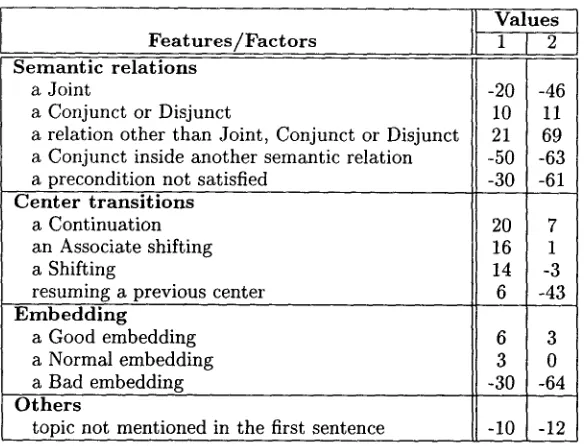
We e x t e n d e d the existing scoring scheme of (Mellish et al., 1998) to account for features for local coherence, e m b e d d i n g and semantic parataxis. This resulted in the rater 1 in Ta- ble 14 , which satisfied all the heuristics intro- duced in Section 3.
We manually broke down four h u m a n w r i t t e n m u s e u m descriptions into individual facts and relations and reconstructed sequences of facts with the same orderings and aggregations as in 4The table only shows the features we are concerned with in this paper.
the original texts. We then used the evaluation function of the GA planner to score the RS trees built from these sequences. In the meantime, we ran the GA algorithm for 5000 iterations on the facts and relations for 10 times. All h u m a n texts were scored among the highest and ma- chine generated texts can get scores very close to h u m a n ones sometimes (see Table 2 for the actual scores of the four texts). Since the four h u m a n texts were w r i t t e n and revised by mu- s e u m experts, t h e y can be t r e a t e d as "nearly b e s t texts". T h e result shows t h a t the evalu- ation function b a s e d on our heuristics can find good combinations.
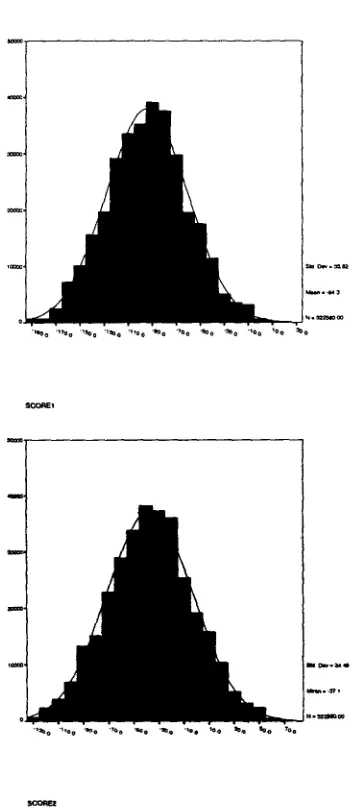
To justify our claim t h a t it is the preferences among generation factors t h a t decide the co- herence of a text, we fed the heuristics into a constraint-based program, which p r o d u c e d a lot of raters satisfying the heuristics. One of t h e m is given in Table 1 as the rater 2. We then gen- erated all possible combinations, including em- bedding, of seven facts from a h u m a n text and used the two raters to score each of them. T h e two distributions are shown in Figure 4.
T h e qualities of the generated texts are nor- mally d i s t r i b u t e d according to b o t h raters. T h e two raters assign different scores to a text as the means of the two distributions are quite dif- ferent. There is also slight difference in stan- d a r d deviations, where the deviation of R a t e r 2 is bigger and therefore it has more distin- guishing power. Despite these differences, the behaviours of the two raters are indeed very similar as the two histograms are of roughly the same shape, including the two right halves which tell us how m a n y g o o d texts there are and if t h e y can be distinguished from the rest. T h e difference in s t a n d a r d deviations is not signifi- cant at all. So the distributions of the scores from the two raters show t h a t t h e y behave very similarly in distinguishing the qualities of texts from the same population.
Features/Factors
I Values 1 1 2 Semantic relations
a Joint -20 -46
a Conjunct or Disjunct 10 11
a relation other than Joint, Conjunct or Disjunct 21 69 a Conjunct inside another semantic relation -50 -63 a precondition not satisfied -30 -61 Center transitions
a Continuation 20 7
an Associate shifting 16 1
a Shifting 14 -3
resuming a previous center 6 -43
E m b e d d i n g
a Good embedding a Normal embedding a Bad embedding Others
topic not mentioned in the first sentence
6 3
3 0 -30 -64 -10 -12
Table 1: T w o different raters satisfying the same constraints
scores of the human texts
l~ighest scores of the generated texts average scores of the generated texts
text 1 t e x t 2 t e x t 3 t e x t 4
170 22 33 24
167 24 31 25
125.7 18.9 26.1 9.3
Table 2: T h e scores of
lation was .9567. So we can claim t h a t for this data, the scores from rater 1 and rater 2 corre- late, and we have fairly good chance to believe our hypothesis that the two raters, r a n d o m l y p r o d u c e d in a sense, agree with each other on evaluating the text and they measure basically the same thing.
Since the two raters are derived from the heuristics in Section 3, the above result partially validates our claim that it is the relevant pref- erences among factors that decide the quality of the generated text.
5 S u m m a r y a n d F u t u r e w o r k
This p a p e r focuses on the complex interac- tions between e m b e d d i n g and planning local co- herence, and tries to capture the interactions as preferences among related features. These interactions cannot be easily modelled in a pipeline architecture, b u t the G A - b a s e d archi- tecture offers a mechanism to coordinate t h e m in the planning of a coherent text. The result shows to some extent that capturing the inter-
four h u m a n written texts
actions properly in an N L G system is important to the generation of coherence text.
Our experiment could be extended in many aspects, for example, validating the evaluation function through empirical analysis of h u m a n assessments of the generated texts, and experi- menting with the interaction between aggrega- tion and referring expression generation. The architecture based on the Genetic Algorithm can also be used for testing interactions between or within other text generation modules. To generalise our claim, a larger scale experiment is needed.
A c k n o w l e d g e m e n t This research is sup- p o r t e d by a University of Edinburgh Stu- dentship.
R e f e r e n c e s
Douglas Appelt. 1985. Planning english refer- ring expressions.
Artificial Intelligence,
26:1- 33. [image:5.612.165.457.73.296.2]Figure 4: Histogram of the scores from rater 1 (top) and rater 2 (bottom)
of COLING-ACL'98,
pages 1478-1480, Mon- treal, Canada.Barbara Grosz, Aravind Joshi, and Scott We- instein. 1995. Centering: A framework for modelling the local coherence of discourse.
Computational Linguistics,
21 (2):203-226. William Mann and Sandra Thompson. 1987.Rhetorical Structure Theory: A Theory of Text Organization. Technical Report ISI/RR-87-190, Information Sciences Insti- tute, University of Southern California. Chris Mellish, Alistair Knott, Jon Oberlander,
and Mick O'Donnell. 1998. Experiments us-
ing stochastic search for text planning. In
Proceedings o] the 9th International Work-
shop on Natural Language Generation,
On- tario, Canada.Marie Meteer. 1992.
Expressibility and The
Problem of Efficient Text Planning.
Commu- nication in Artificial Intelligence. Pinter Pub- lishers Limited, London.Jon Oberlander, Alistair Knott, Mick O'Don- nell, and Chris Mellish. 1999. Beyond elabo- ration: Generating descriptive texts contain- ing it-clefts. In T Sanders, J Schilperoord, and W Spooren, editors,
Text Representation:
Linguistic and Psycholinguistic Aspects.
Ben- jamins, Amsterdam.Massimo Poesio, Renata Vieira, and Simone Teufel. 1997. Resolving bridging references in unrestricted text. Research paper hcrc-rp87, Centre for Cognitive Science, University of Edinburgh.
Michael Reape and Chris Mellish. 1999. Just what is aggregation anyway? In
Proceedings
of the 7th European Workshop on Natural
Language Generation,
pages 20-29, Toulouse, France.Ehud Reiter and Robert Dale. 1997. Building applied natural language generation systems.
Natural Language Engineering,
3(1):57-87. Ehud Reiter. 1994. Has a consensus nl gen-eration architecture appeared, and is it psy- cholinguistically plausible? In
Proceedings of
the 7th International Workshop on Natural
Language Generation.
Donia Scott and Clarisse Sieckenius de Souza. 1990. Getting the Message Across in RST- based Text Generation. In R. Dale, C. Mel- lish, and M. Zock, editors,