P r a c t i c a l I s s u e s i n A u t o m a t i c
D o c u m e n t a t i o n
G e n e r a t i o n
K a t h l e e n M c K e o w n
450 Computer Science Building Columbia University New York, NY 10027 kathy@ca, columbia, odu
K a r e n
Kukich
Bell Communication ResearchMorristown, NJ 07960-6438 kukich@bellcore, com
J a m e s S h a w
450 Computer Science Building Columbia University
N e w York, N Y 10027
shaw@cs, columbia, edu
Abstract
P L A N D o c , a system under joint devel- opment by Columbia and Bellcore, docu- ments the activity of planning engineers as they study telephone routes. It takes as input a trace of the engineer's inter- action with a network planning tool and produces 1-2 page summary. In this pa- per, we describe the user needs analysis we performed and how it influenced the devel- opment of P L A N D o c . In particular, we show how it pinpointed the need for a sub- language specification, allowing us to iden- tify input messages and to characterize the different sentence paraphrases for realiz- ing them. We focus on the systematic use of conjunction in combination with para- phrase that we developed for P L A N D o c , which allows for the generation of sum- maries that are both concise-avoiding rep- etition of similar information, and fluent- avoiding repetition of similar phrasing.
1
M o t i v a t i o n
In a collaborative effort between academics and in- dustry, we have embarked on a project that uses text generation research in service of an industrial appli- cation. Bellcore and Columbia are jointly developing a system, P L A N D o c , that will document the ac- tivity of planning engineers as they study telephone routes I. Telephone planning engineers currently use a software tool, the Bellcore L E I S 2 - P L A N system, that helps them derive 20-year capacity expansion plans based on growth forecasts and economic con- straints. P L A N D o c takes as input a trace of the en- gineer's interaction with L E I S - P L A N and produces
I P L A N D o c is being developed collaboratively by Karen Kukich and Neal Morgan of Bellcore and Kathy McKeown, James Shaw, Jacques Robin, and Jong Lim of Columbia University.
~LEIS is a registered trademark of Bell Communica- tions Research, Piscataway, NJ.
a 1-2 page summary. The P L A N D o c prototype is currently being tested by development teams and will move into use by regional planners sometime this Fall.
The role of documentation has gained increasing importance as businesses attempt to achieve higher levels of productivity, often with fewer employees. In such environments, work must be carefully doc- umented, both to make previous business decisions readily available to current employees, and to pro- vide management with information needed to autho- rize major expenditures, in the willlon dollar range. Network planning managers need justification for w h y a proposed plan is best and whether alterna- tives were investigated. Until recently this informa- tion was provided orally, if at all, due to time con- straints. But internal auditors and public regulators have increased the d e m a n d for formal documenta- tion. Indeed, lawsuits have made the lack of docu- mentation extremely costly. In a recent settlement, Pacific Bell promised to provide increased documen- tation in lieu of an 80 million dollar rebate to rate payers. P L A N D o c documentation also promises to be useful in training new planning engineers; it pro- vides a record of how experienced planning engineers arrive at their decisions, information which is not currently available.
Because telephone network planning is currently done with an automated software system that pro- duces a trace, albeit cryptic, of the actions of both the system and the user, development of an au- tomated documentation system is quite practical; input to a report generator is automatically pro- duced and readily available. Our approach makes use of existing text generation tools; we adopted the F U F / S U R G E package(FUF5; Elhadad 93), devel- oped and widely used at Columbia (Robin 93; M c K - eown et al. 90; M c K e o w n & Feiner 90; Elhadad 93; Paris 87; Wolz 92), which handles the genera- tion of individual sentences. Given the P L A N trace and the F U F / S U R G E sentence generation tools, de- velopment of P L A N D o c requires bridging the gap between the two. The main research problems in- clude:
• organizing the content of the report, i.e., content planning,
• mapping facts in the trace to sen- tence structures and choosing appropri- ate words, i.e., lexicalization.
To handle these appropriately, we performed a user needs analysis to gather details about the kinds of reports that users would find helpful. Our analysis revealed two overriding practical considerations for the design and implementation of the P L A N D o c automatic documentation generator:
• the need for user-centered design, and • the need for a bounded sublanguage.
The first of these was motivated by the fact that the system would eventually be used in a live pro- duction setting. The second was mandated by the need for a concise, but fluent report. The analysis showed that reports must avoid repeating similar in- formation which occurs across input facts, while at the same time avoiding repeating exact phrasing.
In this paper, we show how P L A N D o c uses a systematic combination of conjunction and para- phrasing power to achieve these goals. Further, we show how we bounded their different combinations to avoid a combinatoric explosion of possible phras- ings, while still maintaining fluency and conciseness in the generated reports. The systematic use of conjunction and ellipsis to achieve conciseness, com- bined with paraphrasing power, is a unique feature of the PLANDoc system.
In the following sections, we first describe the user needs analysis, then turn to a description of the sub- language and the constrained use of conjunction and paraphrasing. We close with a discussion of our cur- rent directions.
2 U s e r - C e n t e r e d D e s i g n
User-needs analysis is a c o m m o n practice in the de- velopment of computer-human interface systems and other end-user software. Particularly in developing a large scale, practical system, the needs of the user must be studied if the resulting system is to be ac- cepted and effectively used by the users. In this sec- tion, we describe the user-needs analysis and system development methodology that we are using in our ongoing development of P L A N D o c .
Our analysis combined two complementary ap- proaches. First, we interviewed a variety of different groups of people involved in the telephone network planning task. Our goal was to identify potential users of P L A N D o c and to solicit their views on how such a system could be most helpful. Second, we collected a set of manually-written narratives to inform the development of the generator, providing insights on report form and content, vocabulary and sentence structure. In this section we describe how
user interviews and corpus analysis shaped the de- sign of the documentation generator. But first we provide some brief background information on the problem domain.
2.1 P r o b l e m S e t t i n g
Voice and data service is carried to telephone cus- tomers through a complex network of routes con- sisting of copper or fiber cables supplemented by additional equipment such as Digital Loop Carrier (DLC) systems and fiber multiplexors. It is the tele- phone network planning engineer's job is to derive a capacity expansion (relief) plan specifying when, where, and how much new copper, fiber, multiplex- ing and other equipment to install in a route to avoid facilities exhaustion. This activity is an integral part of telephone operations. New installations are costly, but at the same time facilities exhaustion can lead to a disruption in telephone service. Currently, about 1,000 planning engineers in 8 regional and indepen- dent telephone companies produce a total of about 15,000 route studies per year.
The engineer uses PLAN to compute an optimum, cost-effective base relief plan needed to meet forecast demand over the next twenty years. The base plan, however, may not always be realizable or desirable due to political, economical, practical and other fac- tors known to the engineer but not to the computer. The engineer uses PLAN's Interactive Refinement Module that allows 'what-if' modeling to explore the effects of various changes to the base plan. For ex- ample, an engineer might explore requesting a DLC activation for a given site, or changing a fiber acti- vation time. After comparing the effects of different refinement scenarios, the engineer ultimately decides on a realizable relief plan to recommend to manage- ment for project authorization.
Overall interaction with PLAN thus includes an automatically generated base plan, a sequence of re- finements to explore the effects of different changes to the base, and a final proposed plan which may in- dude elements of the base plan along with a selected set of refinements.
2.2 I n t e r v i e w s
With the help of Bencore Planning and Engineering staff 3 we formulated an initial proposal for P L A N - D o c and drafted preliminary target narratives. We then conducted a series of interviews with plan- ning engineers, managers, auditors and PLAN sup- port staff from several regional telephone compa- nies in their home offices and at two PLAN train- ing courses 4. The work experience of the engineers we interviewed ranged from beginner to expert. Our
3Many thanks to M. Horwath, D. Imhoff and L. Tenet.
goal was to determine how engineers actually used the PLAN system, whether they would find an au- tomated documentation facility to be helpful, and, if so, what the form and content of the narratives should be.
We learned that novice planners often run 'bozo' refinements just to develop a feel for the process, while experienced planners sometimes run refine- ments they know will be suboptimal just for the record, i.e., for the benefit of managers, auditors and regulators who might ask "did you try such and such?". More critical to the need for documenta- tion, we also learned that experienced planners keep handwritten notes on paper, listing their refinements and why they tried them; they asked for a way to enter their notes on-line to keep track of their reason- ing. Inexperienced planners asked to see narratives written by experienced planners in order to learn from them; unfortunately few such narratives exist. Finally, all planners welcomed the idea of having the computer generate narratives that they could include in their documentation packages, especially if they could add to the narratives themselves.
These findings shaped the content of P L A N D o c narratives and the design of the system. Specifically, they indicated that planners may not want all re- finements that they tried to appear in the narrative. For example, novice planners do not want to include their 'bozo' refinements, while experienced planners do want to include the suboptimal refinements they ran to show that their final refinements were supe- rior. Thus, P L A N D o c includes a facility that lets the planner select a subset of refinements to be in- cluded in the final narrative. Planners made it clear that they use knowledge not included in PLAN to make their decisions (e.g., corporate strategies) and they wanted a way to record that knowledge on-line, while they were working. This gave rise to PLAN- Doc's facility to prompt for manually-written engi- neer's notes at crucial points. We instituted only two user-visible changes to PLAN's original, successful interface, one to prompt for engineering notes and another to allow the engineer to request a narrative and select a subset of refinements to be included. Both options are presented using familiar PLAN in- terface commands and screen formats. Reports are generated off-line.
2.3 Corpus Analysis
We also arranged for an experienced retired planning engineer, Jim Phillips, who is also a PLAN expert, to write a corpus of target narratives based on PLAN runs of actual routes. Based on the findings from our interviews and on the target narratives, we arrived
all from Pacific Bell, R. Riggs, D. Spiegel, S. Sweat, L. Doane, R. Tufts, and R. Ott, all from Southwestern Bell, S. Wasalinko from NYNEX, and C. Lazette from Ameritech.
PART 1 Route Input Data Summary (Tabular)
PART 2 Narrative (Text) • Base Plan Summary
• Refinements Summary with Engineer's Notes
• Proposed Plan Summary
Figure 1: PLANDoc Report Format
at the report format shown in Figure 1. It consists of two parts, a tabular summary of route input data and a narrative that integrates machine-generated text with the engineer's manually-entered notes.
Our corpus of target narratives provided informa- tion on what should be included in the report and its overall structure. Thus, it directly influenced de- velopment of both the Lexicalizer and Content Plan- ner modules of P L A N D o o . An analysis of PLAN's menu of refinement actions and the sentences in the target narratives allowed us to specify a set of 31 different possible message types for refinement sen- tences including, for example, fiber extensions to CSAs (Carrier Serving Areas), or DLC (Digital Loop Carrier) equipment activations or denials for CSAs. We then systematically categorized the sentences in our corpus to reveal all the different phrasings for each message type. This categorization showed that there was tremendous variety in the possible sen- tences for each message type with respect to sentence structure and lexical choice. Indeed, our first imple- mentation of P L A N D o c ' s sentence generator 5, re- suited in more than 150 paraphrases for some mes- sage classes.
The target narratives also informed the design of P L A N D o o ' s Content Planner. Our analysis re- vealed that choosing a specific paraphrase for use in a summary depends on what has already been mentioned (i.e., the choice is based on previous dis- course). Furthermore, the narratives provided ex- amples of how multiple messages were frequently combined to form complex compound sentences. In order to avoid a combinatorial explosion from com- bining many different sentences forms, we needed to specify a bounded sublanguage for PLAN's domain that ensured the sentence variety needed to main- tain discourse coherence and fluency while enabling the construction of complex sentences. Before dis- cussing this problem, we provide an actual sample of some P L A N D o c output in Figure 2.
2.4 S a m p l e P L A N D o c O u t p u t
At present, the tabular Input Summary generator 6 and the textual Refinements Summary generator of the P L A N D o c system are fully implemented. Fig-
5written in FUF by J. Lira 6written in C by N. Morgan
[image:3.612.334.559.79.184.2]RUNID: REG1
Run-ID REG1 started at the BASE plan. This saved re- finement activated DLC for CSAs 3122, 3130, 3134, 3208 and 3420 in the third quarter of 1994. It demanded that PLAN use DLC system IDLC272 for all placements in CSA 3122. The 20 year PWE was $2110.1K, a $198.6K savings over the BASE plan and the 5 year IFC was $1064.0K, a $64.5K penalty over the BASE plan. Engineer's note:
These CSA's are beyond 28 kf and need range extenders to provide service on copper. Moving them to 1994 will negate a job adding a reg bay to the office.
RUNID: 3234-2
This saved refinement included all DLC changes in Run- ID REG1E. It requested the activation of DLC for CSA 3234 in the second quarter of 1994 and for CSA 3233 in the fourth quarter of 1994. DLC systems DLC96SS and DLC96M2 were used for all placements in CSAs 3233 and 3234. For this refinement, the 20 year route PWE was $1925.3K, a $383.4K savings over the BASE plan and the 5 year IFC was $833.9K, a $165.6K savings over the BASE plan.
Engineer's note:
I didn't need to demand the activation of these systems in the refinement as they were activated at this time in the BASE plan. The 'idlc272' was demanded because of the high demand. The non-integrated systems in CSA 3234 because it is a business area.
° . .
Figure 2: P L A N D o c Refinements S u m m a r y
ure 2 is an a b b r e v i a t e d sample of a Refinements S u m m a r y generated by P L A N D o c . T h e incorpo- r a t e d Engineering Notes were entered m a n u a l l y by the Planning Engineer at r u n t i m e a n d a u t o m a t i - cally integrated into the narrative by P L A N D o c .
3 Sublanguage Specification
In this section we first provide a brief overview of P L A N D o c ' s architecture a n d functioning. We t h e n illustrate the large n u m b e r of possible sentence com- binations, describe the sublanguage specification so- lution a n d P L A N D o c ' s p a r a p h r a s i n g and conjunc- tion capabilities.
3.1
P L A N D o c System
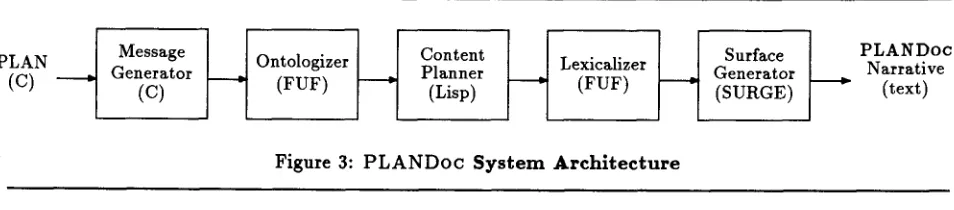
O v e r v i e wP L A N D o c ' s architecture, which is shown in Fig- ure 3, draws on our previous t e x t generation a n d report generation work (McKeown 85; Kukich 83).
T h e P L A N D o c s y s t e m consists of five sequen- tial modules: a Message Generator, an Ontologizer, a Content Planner, a Lexicalizer, a n d a Surface Generator. Since P L A N itself is i m p l e m e n t e d in C a n d P L A N D o c ' s text generation modules are im- plemented in Lisp, a Message G e n e r a t o r module ~ serves as an interface between P L A N a n d P L A N - D o c . I n p u t to the Message G e n e r a t o r comes from
~written in C by N. Morgan
RUNID re81DLC 5/7/93 act yes CSU 3122 idlc272 idlc272
SAT 3122 3 1994 3 1994 SAT 3•30 3 1994 3 1994 SAT 3134 3 1994 3 1994 SAT 3208 3 1994 3 1994 SAT 3420 3 1994 3 1994
END. 2110.1 1064.0
Figure 4: A portion of tracking file
((cat message)
(admtn ((PLANDoc-message-name RDA)
(track-tag
SAT)(seq-num 3)
(runid r - r e g l )
(prev-runid BASE)
(status act)
(saved yes)))
(class refinement)
(tel-type DLC) (action activation) (equipment-type all-dlc) (csa-site 3122)(date ((year 1994) (quarter 3))))
Figure 5: Output oftheMessage Generator
P L A N tracking files which record the user's actions during a planning session. Figure 4 is a p o r t i o n of a tracking file; it corresponds to the p a r a g r a p h la- beled R U N I D R E G 1 in the sample P L A N D o c nar- rative above. Shown below it (Figure 5) is a Lisp representation, ie., a message in a t t r i b u t e - v a l u e for- m a t , for one refinement action in the tracking file p r o d u c e d by the Message Generator. O u t p u t mes- sages are first passed to an Ontologizer s. T h e com- plete set of enriched messages is t h e n passed to a C o n t e n t Planner 9 whose j o b is to determine which information in the messages should a p p e a r in the various p a r a g r a p h s a n d to organize the overall nar- rative. This involves combining individual messages to produce the input for complex sentences, choosing cue words a n d determining p a r a p h r a s i n g forms t h a t m a i n t a i n focus a n d ensure coherence. T h e o u t p u t of the Content Planner is a ' c o n d e n s e d ' set of complex messages, each still in hierarchical a t t r i b u t e - v a l u e f o r m a t .
We are using the F U F / S U R G E package (FUF5; E l h a d a d 93; K a y 79; Halliday 85) for the Lexical- izer and Surface G e n e r a t o r modules of P L A N D o c . We used F U F to write a lexicalization 8 r a m m a z for P L A N ' s sublanguage. T h e t a s k of the Lexical-
SThe Ontologizer simply enriches each message with semantic knowledge from PLAN's domain of discourse.
[image:4.612.339.565.73.388.2]PLAN
(c)
Message Generator
(c)
Ontologizer Content I J Surface P L A N D o c
Planner Lexicalizer Generator Narrative
(FUF) (Lisp) (FUF) 1 1 (SURGE) ~ (text)
Figure 3: P L A N D o c S y s t e m A r c h i t e c t u r e
izer module 1° is twofold: 1) to map the attributes of the messages into systemic/semantic case roles, such as agent, beneficiary, process, circumstance, etc., and 2) to select content words to express the values of the attributes, all the while maintaining constraints imposed by the Content Planner. Fi- nally, the F U F / S U R G E Surface Generator takes the lexicalized messages, maps case roles into syn- tactic roles, builds the constituent structure of the sentence, fills in function words such as pronouns, prepositions, conjunctions, etc., ensures agreement, and ultimately realizes the structure as a linear sur- face sentence.
8.2 C o m b i n a t o r i a l E x p l o s i o n
Two of the most salient characteristics of the text in our corpus are the great degree of paraphrasing found and the frequent use of conjunction and ellip- sis. Both characteristics arise from the fact t h a t the domain of discourse is limited to 31 message types, but user interactions include m a n y variations and combinations of those message types. Paraphrasing is used to avoid repetition and to maintain focus; conjunction and ellipsis are used to combine mes- sages with similar attributes to form concise sum- mary sentences. While the number of paraphrase combinations actually occurring in the target narra- tives was small, the different combinations the user might invoke was beyond our control and potentially quite large.
T h e scope of naturally occurring paraphrasing is illustrated by the sentences derived for one mes- sage class in terms of their mapping of semantic at- tributes to lexical roles n (such as
agent, beneficiary,
location, etc.)
and syntactic roles (such assubject,
direct object, object of preposition, etc.)
It is the job of the P L A N D o c lexicalizer to chose lexical roles for semantic attributes; the SURGE surface generator then maps lexical roles into syntactic roles.The main semantic attributes of the fiber-service- extension message are:
(class refinement) (tel-type fiber)
1°written in FUF by J. Shaw with input from J. Lim. J. Robin, M. Elhadad, D. Radev and D. Horowitz
11Lexical roles are often referred to as semantic roles of a sentence, where sentence semantic roles are distinct from domain semantic attributes. We use "lexical roles" to avoid confusion.
(action service-extension) (extension-type T-l) (from-fiber-hub 2113)
(to-csa 211S)
Some of the paraphrases derived from our corpus for this message are:
1. "This refinement extended T-1 service from fiber hub 2113 to CSA 2115."
2. "This refinement demanded that PLAN extend T-1 service from fiber hub 2113 to CSA 2115." 3. "This refinement called for PLAN to extend T-
1 service from fiber hub 2113 to
CSA
2115." 4. "This refinement requested a T-1 service exten-sion from fiber hub 2113 to CSA 2115." 5. "This refinement called for a T-1 service exten-
sion from fiber hub 2113 to CSA 2115." 6. "This refinement served
CSA
2115 by T-1 ex-tension from fiber hub 2113."
7. "This refinement demanded that PLAN serve CSA 2115 by T-1 extension from fiber hub 2113."
8. "This refinement called for
PLAN
to serve CSA 2115 by T-1 extension from fiber hub 2113." 9. "This refinement demanded service to CSA2115 by T-1 extension from fiber hub 2113." 10. "This refinement called for service to CSA 2115
by T-1 extension from fiber hub 2113."
Note that the lexical and syntactic roles filled by the semantic attributes in the message vary across paraphrases. For example, although the semantic attribute to-csa is most often realized in the lexi- cal role
location
which gets m a p p e d to the syntac- tic roleobject of preposition
(e.g., 1, 2, 3), in some paraphrases (e.g., 6, 7, 8) it appears in the lexical rolebeneficiary
which gets m a p p e d to the syntactic roledirect object.
More dramatically, two main lex- ical variants occur for the semantic attributeaction,
namely the head verbs ' e x t e n d ' and 'serve'. These in turn give rise to a variety of syntactic constructions, e.g., simple sentences, nominalizations of the head verbs in participial clauses, infinitive clauses, etc. Since passive is sometimes needed to maintain focus or coherence within a paragraph(McKeown 85), the number of possible paraphrases doubles.When paraphrasing is combined with conjunction, the problems compound. Complex messages arise because it is often necessary to combine multiple
[image:5.612.79.556.79.184.2]1) "This refinement activated DLC for CSAs 2111, 2112, 2113, 2114, 2115 and 2116 in 1996 QI." 2) "This refinement activated DLC for CSA 2111 in
1995 Q3, for CSAs 2112 and 2113 in 1995 Q4, and for CSAs 2114, 2115 and 2116 in 1996 QI." 3) "It requested the placement of a 48-fiber cable from
the CO to section 1103 and the placement of 24- fiber cables from section 1201 to section 1301 and from section 2201 to section 2301 in the second quarter of 1995."
Figure 6: Conjunction E x a m p l e s
messages with some c o m m o n and other distinct at- tributes into a single message in order to avoid re- peating similar information. For example, if a user activates six C S A sites for D L C in one refinement scenario, those six messages, with four c o m m o n at- tributes and one distinct attribute,
csa-slte,
can be expressed succinctly using conjunction and ellipsis (example 1 Figure 6). Messages with two distinct attributes can also be easily conjoined depending on where in the sentence they occur (example 2). A group of messages with more than two distinct attributes results in a complex c o m p o u n d sentence (example 3).Each of P L A N D o c ' s 31 message types has five or more semantic features; six of those 31 message types are stand-alone messages; all of the remain- ing 25 messages can be combined to form c o m p o u n d messages with at least one distinct feature, half of those with at least two distinct features, and a few with three or four distinct features. Recall that there were at least ten active and ten passive sentence forms for the fiber-service-extension message, which is typical of most of the 31 message types. Given the n u m b e r of possible message combinations multi- plied by the n u m b e r of possible paraphrases for each message, the need to limit the paraphrasing power of the P L A N D o c generator should be clear.
3.3 S u b l a n g u a g e Solution
Since m a n y of the naturally occurring paraphrases involved minor variations in syntax or substitution of synonyms that formed valid collocations in some contexts but a w k w a r d phrases in others, we chose to constrain P L A N D o c ' s paraphrasing power to the following four active sentence forms for most of the 31 message types and their four corresponding pas- sive forms:
1. simple sentence: "This refinement <verb-ed> <object-np>."
2. nomlnalization: "This refinement requested the <action-nominalization> of <object-np>."
3. participial: "This refinement demanded that P L A N <verb> <object-np>."
4. infinitive: "This refinement called for P L A N to <verb> <object-np>."
So, for example, the active and passive nominaliza- tion forms of the fiber-activation message are:
• "This refinement requested the activation of fiber for CSA 2115 in 1996 QI."
• "The activation of fiber for CSA 2115 in 1996 Q1 was requested."
Recall t h a t the j o b of the P L A N D o c Lexicalizer is to m a n a g e the m a p p i n g of semantic a t t r i b u t e s to lexical roles for all possible combinations of com- m o n and distinct a t t r i b u t e s in c o m p o u n d a n d com- plex messages. Constraining the sublanguage to at most eight p a r a p h r a s e s greatly reduces the complex- ity of t h a t m a p p i n g . It also eliminates the need to specify a complex set of collocation constraints for s y n o n y m substitutions. At the s a m e time, eight po- tential p a r a p h r a s e s provide enough flexibility for the Lexicalizer to make choices t h a t m a i n t a i n focus a n d coherence a n d t h a t avoid repetition. Similar sublan- guage specifications related to the use of names, pro- nouns a n d deictic expressions for subsequent refer- ences, modifier constructions for noun phrases (e.g., "This saved DLC refinement . . . ' ) , a n d discourse cue words (e.g., "also, finally", etc.), provide the same m a n a g e a b i l i t y a n d flexibility benefits.
3 . 4 C o n j u n c t i o n a n d P a r a p h r a s i n g
Determining when conjunction is to be used and w h a t type of p a r a p h r a s i n g is required are b o t h han- dled by the Content Planner. T h e Content P l a n n e r is given as input a list of messages which form the full content of the report. Its task is to use knowledge of the overall semantic content to determine how to order messages a n d where to form sentence bound- aries. While it could generate a s e p a r a t e sentence for each input message, a c o m m o n solution in m a n y lan- guage generators, this would result in a verbose a n d repetitive report. In order to avoid r e p e a t i n g simi- lar information, P L A N D o c uses conjunction, group- ing together semantically related a t t r i b u t e s , to con- trol how messages are ordered in the r e p o r t a n d to form sentence boundaries. Note t h a t this a p p r o a c h to content planning, relying on o p p o r t u n i s t i c group- ing of information based on how it can be realized in concise linguistic form, is quite different f r o m other s y s t e m s which t e n d to use either rhetorical (McKe- own 85; Moore & Paris; H o v y 91; Wahlster et al. 89) or domain d e p e n d e n t ( P a r i s 87; R ~ m b o w & Korelsky 92) strategies to order information.
1. "This refinement used a cutover strategy of ALL for CSAs 1111, 1112 and 1113, of MIN for CSAs 2221 and 2222 and of GROWTH for CSA 3331."
2. *"A cutover strategy of ALL was used for CSAs 1111, 1112 and 1113, of MIN for CSAs 2221 and 2222 and of GROWTH for CSA 3331."
Figure 7: Paraphrasing and Conjunction
a list and the Lexicalizer selects conjunction for the lexical role. Examples 1 and 2 in Figure 6 illustrate these cases.
However, the more messages that are grouped to- gether, the greater the number of potentially distinct attributes. P L A N D o c groups such long compound messages into several separate sentences, where each sentence has a different common partition. It then combines these compound sentences together into a single conjunction. Example 3, Figure 6, illustrates this case. To generate these complex forms, the Content Planner indicates for each message which attributes are common and which are distinct. It then indicates which common attributes should be gapped; depending on the attribute and its position, sometimes only the first reference is ungapped, while in other cases all but the last is gapped. S U R G E generates the full sentence for each message, but sup- presses the gapped constituents when linearizing the syntactic tree representing the sentence. While this approach is less efficient, it is highly general since it can handle any combination of attributes without specifically anticipating it.
Conjunction and ellipsis cannot be generated blindly, however. When conjunction is used for certain paraphrases, ambiguity a n d / o r invalid sen- tences can result. T h e examples in Figure 7 show how conjunction using one paraphrase form (active with verb "use") is appropriate for conjunction with two distinct attributes (cutover strategy and CSA site), but a passive paraphrase for the same in- put produces an infelicitous result. This is because one distinct a t t r i b u t e occurs to the left of the verb ("ALL" in the first clause) and the other (CSA site) to the right of the verb. Unless no ellipsis at all is used (in which case there is no point in using con- junction), it is impossible to generate a reasonable sentence. Thus, while we have implemented a gen- eral algorithm, there are still cases that are excep- tions to our approach. By limiting paraphrasing we have also limited the number of these cases to a man- ageable amount.
4
R e l a t e d W o r k
Other natural language text generation systems designed to summarize quantitative d a t a include:
13
A N A (Kukich 83), S E M T E X (Roesner87), L F S (Iordanskaja et al. 92), G O S S I P (Iordanskaja et al. 91), S T R E A K (Robin 93), and F o G (Bourbeau et al. 90). All were influenced by early work on sub- language definition (Kittredge et al. 83). A N A , a stock market report generator, achieves a high de- gree of fluency for complex sentences by relying on a phrasal lexicon; S E M T E X and L F S each gen- erate bilingual summaries of labor force statistics, French/English by the former, G e r m a n / E n g l i s h by the latter; G O S S I P generates paragraph-length re- ports describing operating system usage using a se- mantic net formalism; S T R E A K generates basket- ball summaries, packing as much information into a single sentence as possible, using complex sentence structures such as multiple modifiers of a noun or verb, conjunction and ellipsis; F o G generates ma- rine weather forecasts from meteorological d a t a and remains to date the only generator in everyday in- dustrial use. However, none of these systems make extensive use of conjunction and paraphrasing in a systematic way.
5
F u t u r e w o r k
P L A N D o c will move into actual use in Fall 1994. At this point, we will be able to fully evaluate how well its o u t p u t meets user needs. Furthermore, we plan to augment the system so that it can produce summaries of b o t h the base plan and the proposed plan. Of these, the proposed plan s u m m a r y presents somewhat more of a challenge. It should be about a paragraph in length but succinctly summarize the recommendations made by the planning engineer. Thus, the system must work within tighter space constraints to include all information. A second problem for this s u m m a r y is t h a t it must include information from multiple sources. T h e proposed plan will include elements of the base plan as well as a subset of the refinements the engineer carried out. P L A N D o c must determine how to integrate these different pieces of information, with emphasis on the resulting plan and less information on how it was derived. While we can use some of the same techniques currently used to make the refinements s u m m a r y b o t h more concise and more fluent (i.e., the combined use of conjunction and paraphrase), more research will be required in discourse planning and selection of textual focus.
6
C o n c l u s i o n
of information and of phrasing. The ability to sys- tematically combine and group together related sen- tences in a wide variety of ways is a unique feature of our automated documentation system. Finally, through a user needs analysis we identified and im- plemented features to improve usability of the result- ing system. In particular, by allowing engineers to add their own refinements notes and to modify sys- tem generated text, PLANDoc can also be viewed as an aid to documentation that will help engineers more quickly create needed justification of why in- creased expenditures are necessary.
R e f e r e n c e s
Hourbeau, L. and Caxcagno, D. and Goldber8, E. and Kittredge, R. and A. Polguere. 1990. Bilin- gual generation of weather forecastes in an oper-
ations environment. In Proceedings of the 13th
International Conference on Computational Lin- guistics, COLING.
Dale, R. 1992. Generating Referring Ezpressions.
ACL-MIT Press Series in Natural Language Pro- cessing, Cambridge, Ma.
Elhadad, Michael 1991. FUF: The universal unifier
- user manual, version 5.0. Tech Report CUCS-
038-91, Columbia University.
Elhadad, Michael 1993. Using argumentation to control lexical choice: a unification-based imple- mentation. Ph.D. thesis, Computer Science De- partment, Columbia University.
Halliday, M.A.K. 1985. An introduction to func-
tional grammar. Edward Arnold, London. Hovy, Edward 1991. Approaches to the planning of
coherent text. In Paris, C. and Swartout, W. and
Mann. W.C. (editors), Natural Language Genera-
tion in Artificial Intelligence and Computational Linguistics, Kluwer Academic Publishers.
Iordanskaja, L., R. Kittredge and A. Polguere
1991. Lexical Selection and Prarphrase in a
Meaning-TextGeneration Model. In Paris, C.
and Swartout, W. and Mann. W.C. (editors), Natural Language Generation in Artificial Intel- ligence and Computational Linguistics, Kluwer Academic Publishers, pp. 293-312.
Iordanskaja, L., M. Kim, R. Kittredge, B. Lavoie and A. Polguere 1992. Generation of Extended
Biligual Statistical Reports. In Proceedings of
COLING-94, COLING, pp. 1019-1023.
Kay, Martin 1979. Functional Grammar In Pro- ceedings of the 5th Annual Meeting of the Berkeley Linguistic Society.
Kittredge, Richard and John Lehrberger 1983. Sub.
languages: Studies of Language in Restricted Se- mantic Domains, Walter DeGruyter, New York.
Kukich, Kaxen 1983. The design of a knowledge-
based text generator. In Proceedings of the ~lst
Conference of the Association for Computational Linguistics, Massachusetts Institute of Technol- ogy, Cambridge, Mass., pp 145-150.
McKeown, K.R. 1985. Using Discourse Strate-
gies and Focus Constraints to Generate Natu- ral Language Tezt, newblock Studies in Natural Language Processing series, Cambridge Univer- sity Press.
McKeown, K., Elhadad, M., Fukumoto, Y., Lim, J., Lombardi, C., Robin, J., and Smadja, F. 1990.
Text generation in COMET In Dale, R. and
Mellish, C.S. and Zock, M. (editors), Current
Research in Natural Language Generation. Aca- demic Press.
McKeown, K.R., and Feiner, S. 1990. Interactive Multimedia Explanation for Equipment Mainte-
nance and Repair. In Proceedings of the DARPA
Speech and Natural Language Workshop, DARPA, Hidden Valley, Pa.
Moore, J.D. and C.L. Paris 1989. Planning Text for
Advisory Dialogues. In Proceedings of the £7th
Annual Meeting of the Association for Computa- tional Linguistics, Association for Computational Linguistics, Vancouver, B.C., pp. 203-11.
Paris, C.L. 1987. The Use of Explicit User Models in Text Generation: Tailoring to a User's Level of Expertise. Columbia University.
Rainbow, O. and Korelsky, T. 1992. Applied Text
Generation. In Proceedings of the $rd Conference
on Applied Natural Language Processing. As- sociation for Computational Linguistics, Ttento, Italy, pp. 40-47.
Robin, Jacques 1993. A Revision-Based Generation Architecture for Reporting Facts in their Histor- ical Context. In Horacek, H. and Zock, M. (edi-
tors), New Concepts in Natural Language Genera-
tion: Planning, Realization and Systems. Frances Pinter, London and New York.
Roesner, D. 1987. SEMTEX: A Text Generator
for German. In Geraxd Kempen (editor), Natural
Language Generation: New Results in Artificial Intellligence, Psychology and Linguistics. Marti- nus Ninjhoff Publishers, pp. 133-148.
Wahlster, W., Andre, E., Hecking, M., and T. Rist
1989. WIP: Knowledge-based Presentation of In-
formation. German Research Center for Artificial Intelligence, Saarbruecken, FRG.