Multilingual Coreference Resolution
S a n d a M . H a r a b a g i u S o u t h e r n M e t h o d i s t U n i v e r s i t y
D a l l a s , T X 75275-0122
sanda@seas, smu. edu
S t e v e n J . M a i o r a n o I P O
W a s h i n g t o n , D . C . 20505 maiorano@cais, com
A b s t r a c t
In this paper we present a new, multi- lingual data-driven method for coreference resolution as implemented in the SWIZZLE system. The results obtained after training this system on a bilingual corpus of English and Romanian tagged texts, outperformed coreference resolution in each of the indi- vidual languages.
1 I n t r o d u c t i o n
The recent availability of large bilingual corpora has spawned interest in several areas of multilingual text processing. Most of the research has focused on bilingual terminology identification, either as par- allel multiwords forms (e.g. the
ChampoUion
sys- tem (Smadja et a1.1996)), technical terminology (e.g.the
Termight
system (Dagan and Church, 1994) orbroad-coverage translation lexicons (e.g. the
SABLE
system (Resnik and Melamed, 1997)). In addition, the Multilingual Entity Task (MET) from the TIP- STER program 1(http://www-nlpir.nist.gov/related-
projeets/tipster/met.htm)
challenged the partici-pants in the Message Understanding Conference (MUC) to extract named entities across several for- eign language corpora, such as Chinese, Japanese and Spanish.
In this paper we present a new application of aligned multilinguai texts. Since coreference reso- lution is a pervasive discourse phenomenon causing performance impediments in current IE systems, we considered a corpus of aligned English and Roma- nian texts to identify coreferring expressions. Our task focused on the same kind of coreference as considered in the past MUC competitions, namely
1The TIPSTER Text Program was a DARPA-Ied government effort to advance the state of the art in text processing technologies.
the
identity
coreference. Identity coreference linksnouns, pronouns and noun phrases (including proper names) to their corresponding antecedents.
We created our bilingual collection by translating the MUC-6 and MUC-7 coreference training texts into Romanian using native speakers. The train- ing data set for Romanian coreference used, wher- ever possible, the same coreference identifiers as the English data and incorporated additional tags as needed. Our claim is that by adding the wealth of coreferential features provided by multilingual data, new powerful heuristics for coreference resolu- tion can be developed that outperform monolingual coreference resolution systems.
For both languages, we resolved coreference by using SWIZZLE, our implementation of a bilingual coreference resolver. SWIZZLE is a multilingual en- hancement of COCKTAIL (Harabagiu and Maiorano, 1999), a coreference resolution system that operates on a mixture of heuristics that combine semantic and textual cohesive information 2. When COCKTAIL was applied separately on the English and the Ro- manian texts, coreferring links were identified for each English and Romanian document respectively. When aligned referential expressions corefer with non-aligned anaphors, SWIZZLE derived new heuris- tics for coreference. Our experiments show that SWIZZLE outperformed COCKTAIL on both English and Romanian test documents.
The rest of the paper is organized as follows. Sec- tion 2 presents COCKTAIL, a monolingnai coreference resolution system used separately on both the En- glish and Romanian texts. Section 3 details the data-driven approach used in SWIZZLE and presents some of its resources. Section 4 reports and discusses the experimental results. Section 5 summarizes the
2The name of COCKTAIL is a pun on CogNIAC be- cause COCKTAIL combines a larger number of heuristics than those reported in (Baldwin, 1997). SWIZZLE, more- over, adds new heuristics, discovered from the bilingual aligned corpus.
conclusions.
2
C O C K T A I L
Currently, some of the best-performing and most robust coreference resolution systems employ knowledge-based techniques. Traditionally, these techniques have combined extensive syntactic, se- mantic, and discourse knowledge. T h e acquisition of such knowledge is time-consuming, difficult, and error-prone. Nevertheless, recent results show t h a t knowledge-poor methods perform with amazing ac- curacy (cf. (Mitkov, 1998), (Kennedy and Boguraev, 1996) (Kameyama, 1997)). For example, CogNIAC (Baldwin, 1997), a system based on seven ordered heuristics, generates high-precision resolution (over 90%) for some cases of pronominal reference. For this research, we used a coreference resolution sys- tem ((Harabagiu and Malorano, 1999)) t h a t imple- ments different sets of heuristics corresponding to various forms of coreference. This system, called COCKTAIL, resolves coreference by exploiting several textual cohesion constraints (e.g. t e r m repetition) combined with lexical and textual coherence cues (e.g. subjects of communication verbs are more likely to refer to the last person mentioned in the text). These constraints are implemented as a set of heuristics ordered by their priority. Moreover, the COCKTAIL framework uniformly addresses the prob- lem of interaction between different forms of coref- erence, thus making the extension to multilingual coreference very natural.
2.1 D a t a - D r i v e n C o r e f e r e n c e R e s o l u t i o n
In general, we define a data-driven methodology as a sequence of actions that captures the d a t a pat- terns capable of resolving a problem with both a high degree of precision and recall. Our data-driven methodology reported here generated sets of heuris- tics for the coreference resolution problem. Precision is the number of correct references out of the total number of coreferences resolved, whereas the recall measures the number of resolved references out of the total number of keys, i.e., the a n n o t a t e d coref- erence data.
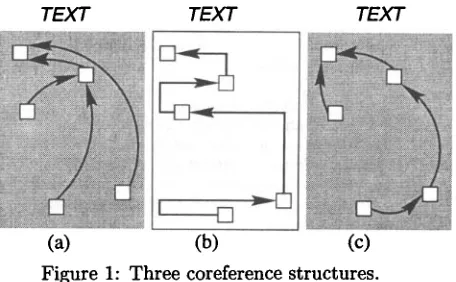
T h e data-driven methodology used in COCKTAIL is centered around the notion of a coreference chain. Due to the transitivity of coreference relations, k coreference relations having at least one common ar- gument generate k + 1 core/erring expressions. T h e text position induces an order among coreferring ex- pressions. A coreference structure is created when a set of coreferring expressions are connected in an oriented graph such t h a t each node is related only to one of its preceding nodes. In turn, a corefer-
ence chain is the coreference structure in which ev- ery node is connected to its immediately preceding node. Clearly, multiple coreference structures for the same set of coreferring expressions can be m a p p e d to a single coreference chain. As an example, both coreference structures illustrated in Figure l(a) and (c) are cast into the coreference chain illustrated in Figure l(b).
TEXT TEXT TEXT
i
[]
(a)
(b)
(c)
Figure 1: T h r e e coreference structures.
[image:2.612.335.563.188.329.2]Heuristics for 3rd person pronouns
oHeuristie 1-Pronoun(H1Pron)
Search in the same sentence for the s a m e
3rd person pronoun Pros'
if (Pron' belongs to coreference chain CC)
a n d there is an element from CC which is closest to Pron in Text, Pick that element.
else Pick Pron'.
oHeuristic 2-Pronoun(H2Pron)
Search for PN, the closest proper name from Pron
if (PN agrees in number and gender with Pros)
if (PN belongs to coreference chain CC)
t h e n Pick the element from CC which is closest to Pros in Text.
e l s e Pick PN.
o Heuristic 3- Pronoun( H3Pron )
Search for Noun, the closest noun from Pros
if (Noun agrees in number and gender with Pros)
i f (Noun belongs to coreference chain CC)
and there is an element from CC which is
closest to Pros in Text, Pick that element.
else Pick Noun
Heuristics for nominal reference
o Heuristic 1-Nominal(HINom )
if (Noun is the head of an appositive)
t h e n Pick the preceding NP.
oHeuristic 2-Nominal(H2Nom)
if (Noun belongs to an NP, Search for N P '
such that Noun'=same_name(head(NP),head(NP'))
o r
Noun'--same_name(adjunct(NP), adjunct(NP')))
t h e n if (Noun' belongs to coreference chain CC)
t h e n Pick the element from CC which is closest to Noun in Text.
e l s e Pick Noun'.
oHeuristic 3-Nominal(H3Nom)
if Noun is the head of an N P
t h e n Search for proper name P N such that head(PN)=Noun
if (PN belongs to coreference chain CC)
and there is an element from CC which is
closest to Noun in Text, Pick that element. else Pick PN.
Table 1: Best performing heuristics i m p l e m e n t e d in COCKTAIL
2 . 2 K n o w l e d g e - P o o r C o r e f e r e n c e R e s o l u t i o n
T h e result of our data-driven m e t h o d o l o g y is the set of heuristics implemented in COCKTAIL which cover b o t h nominal and pronoun coreference. Each heuristic represents a p a t t e r n of coreference t h a t was mined from the large set of coreference data. COCKTAIL uses knowledge-poor m e t h o d s because (a) it is based only on a limited n u m b e r of heuristics and (b) text processing is limited to part-of-speech tagging, n a m e d - e n t i t y recognition, and a p p r o x i m a t e phrasal parsing. T h e heuristics from COCKTAIL can be classified along two directions. First of all, they can be grouped according to the t y p e of corefer- ence they resolve, e.g., heuristics t h a t resolve the anaphors of reflexive pronouns o p e r a t e differently t h a n those resolving bare nominals. Currently, in COCKTAIL there are heuristics t h a t resolve five types of pronouns (personal, possessive, reflexive, demon- strative and relative) and three forms of nominals (definite, bare and indefinite).
Secondly, for each t y p e of coreference, there are three classes of heuristics categorized according to their suitability to resolve coreference. T h e first class is comprised of strong indicators of coreference. This class resulted from the analysis of the distribu- tion of the antecedents in the M U C a n n o t a t e d data. For example, repetitions of n a m e d entities and ap- positives account for the m a j o r i t y of the nominal coreferences, and, therefore, represent anchors for the first class of heuristics.
T h e second class of coreference covers cases in
which the a r g u m e n t s are recognized to be seman- tically consistent. COCKTAIL's test of semantic con- sistency blends t o g e t h e r information available from WordNet a n d statistics g a t h e r e d from Treebank. Different consistency checks are modeled for each of the heuristics.
Example of the application of heuristic H2Pron
Mr. Adams1, 69 years old, is the retired chairman
of Canadian-based Emco Ltd., a maker of plumbing
and petroleum equipment; he1 has served on the Woolworth board since 1981.
Example of the application of heuristic H3Pron
"We have got to stop pointing our fingers at these
kids2 who have no future," he said, "and reach our
hands out to them2.
Example of the application of heuristic H2Nom
The chairman and the chief executive officer3
of Woolworth Corp. have temporarily relinquished their posts while the retailer conducts its investi- gation into alleged accounting irregularities4.
Woolworth's board named John W. Adams, an outsider, to serve as interim chairman and executive
officer3, while a special committee, appointed by
the board last week and led by Mr. Adams, investigates the alleged irregularities4.
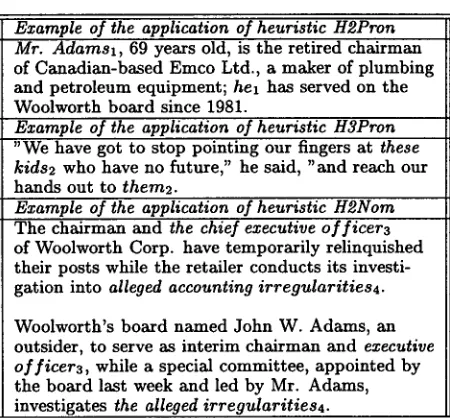
Table 2: E x a m p l e s of coreference resolution. T h e same a n n o t a t e d index indicates coreference.
T h e third class of heuristics resolves coreference by coercing nominals. Sometimes coercions involve only derivational m o r p h o l o g y - linking verbs with their nominalizations. On other occasions, coercions are obtained as p a t h s of m e r o n y m s (e.g. is-part re- lations) and h y p e r n y m s (e.g. is-a relations). Con-
[image:3.612.103.551.81.304.2] [image:3.612.338.563.410.619.2]sistency checks implemented for this class of coref- erence are conservative: either the adjuncts must be identical or the adjunct of the referent must be less specific than the antecedent. Table 1 lists the top performing heuristics of COCKTAIL for pronominal and nominal coreference. Examples of the heuristics operation on the MUC data are presented presented in Table 2. Details of the top performing heuris- tics of COCKTAIL were reported in (Harabagiu and Maiorano, 1999).
2.3 B o o t s t r a p p i n g for C o r e f e r e n e e
R e s o l u t i o n
One of the major drawbacks of existing corefer- ence resolution systems is their inability to recog- nize many forms of coreference displayed by many real-world texts. Recall measures of current systems range between 36% and 59% for both knowledge- based and statistical techniques. Knowledge based- systems would perform better if more coreference constraints were available whereas statistical meth- ods would be improved if more annotated data were available. Since knowledge-based techniques out- perform inductive methods, we used high-precision coreference heuristics as knowledge seeds for ma- chine learning techniques that operate on large amounts of unlabeled data. One such technique
is bootstrapping, which was recently presented in
(Riloff and Jones 1999), (Jones et a1.1999) as an ideal framework for text learning tasks that have knowledge seeds. The method does not require large training sets. We extended COCKTAIL by using meta-
bootstrapping of both new heuristics and clusters of
nouns that display semantic consistency for corefer- ence.
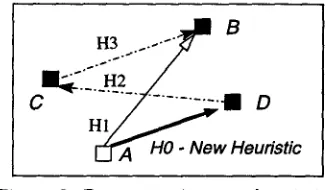
The coreference heuristics are the seeds of our bootstrapping framework for coreference resolution. When applied to large collections of texts, the heuristics determine classes of coreferring expres- sions. By generating coreference chains out of all these coreferring expressions, often new heuristics are uncovered. For example, Figure 2 illustrates the application of three heuristics and the generation of data for a new heuristic rule. In COCKTAIL, after a heuristic is applied, a new coreference chain is cal- culated. For the example illustrated in Figure 2, if the reference of expression A is sought, heuristic H1 indicates expression B to be the antecedent. When the coreference chain is built, expression A is di- rectly linked to expression D, thus uncovering a new heuristic H0.
As a rule of thumb, we do not consider a new heuristic unless there is massive evidence of its cov- erage in the data. To measure the coverage we use
the FOIL_Gain measure, as introduced by the FOIL
inductive algorithm (Cameron-Jones and Quinlan 1993). Let Ho be the new heuristic and/-/1 a heuris- tic that is already in the seed set. Let P0 be the num- ber of positive coreference examples of Hn~w (i.e. the number of coreference relations produced by the heuristic that can be found in the test data) and no the number of negative examples of/-/new (i.e. the number of relations generated by the heuristic which cannot be found in the test data). Similarly, Pl and nl are the positive and negative examples of Ha. The new heuristics are scored by their FOIL_Gain
distance to the existing set of heuristics, and the best scoring one is added to the COCKTAIL system. The
FOIL_Gain formula is:
l o g 2 - - - ~ )
F O I L _ G a i n ( H 1 , Ho) = k(log2 Pl n l Po -k no
where k is the number of positive examples cov- ered by b o t h / / 1 and Ho. Heuristic Ho is added to the seed set if there is no other heuristic providing larger FOIL_Gain to any of the seed heuristics.
H 3 . j . . . ~ I B B
[ ~ HO - New Heuristic
Figure 2: Bootstrapping new heuristics.
Since in COCKTAIL, semantic consistency of core- ferring expressions is checked by comparing the sim- ilarity of noun classes, each new heuristic deter- mines the adjustment of the similarity threshold of all known coreferring noun classes. The steps of the bootstrapping algorithm that learns both new heuristics and adjusts the similarity threshold of coreferential expressions is:
MUTUAL B O O T S T R A P P I N G LOOP
1. Score all candidate heuristics with FOIL_Gain 2. Best_h--closest candidate to heuristics(COCKTAIL) 3. Add Best_h to heuristics(COCKTAIL)
,f. Adjust semantic similarity threshold for semantic consistency o[ coreferring nouns
5. Goto step 1 if the precision and recall did n o t
degrade under minimal performance.
[image:4.612.354.517.350.445.2]recta-bootstrapping compiles the results of the inner (mutual) b o o t s t r a p p i n g process and identifies the k most reliable heuristics, where k is a n u m b e r de- termined experimentally. These k heuristics are re- tained and the rest of t h e m are discarded.
3
S W I Z Z L E
3 . 1 M u l t i H n g u a l C o r e f e r e n c e D a t a
To s t u d y the performance of a d a t a - d r i v e n multi- lingual coreference resolution system, we p r e p a r e d a corpus of R o m a n i a n texts by t r a n s l a t i n g the MUC-6 and MUC-7 coreference training texts. T h e transla- tions were performed by a group of four R o m a n i a n native speakers, and were checked for style by a cer- tified translator from Romania. In addition, the Ro- m a n i a n texts were a n n o t a t e d with coreference keys. T w o rules were followed when the annotations were done:
o 1: W h e n e v e r an expression ER represents a trans- lation of an expression EE from the corresponding English text, if E s is tagged as a coreference key with identification n u m b e r ID, then the R o m a n i a n expression ER is also tagged with t h e same ID num- ber. This rule allows for translations in which the textual position of the referent and the antecedent have been swapped.
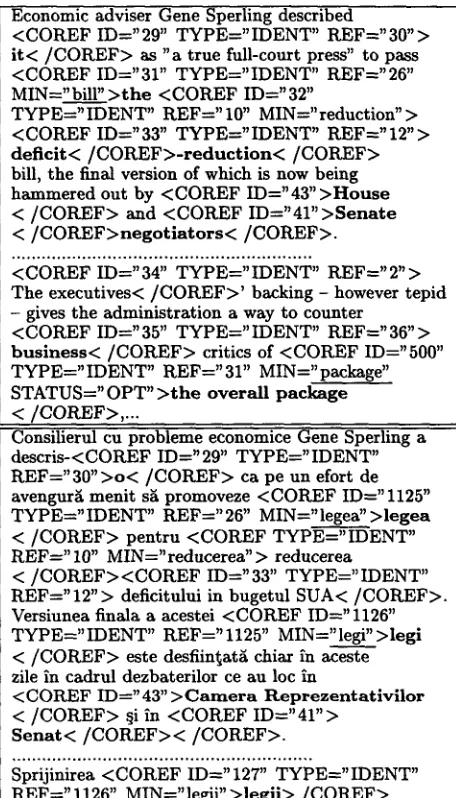
o2: Since the translations often introduce new coreferring expressions in the s a m e chain, the new expressions are given new, unused ID numbers. For example, Table 3 lists corresponding English a n d R o m a n i a n fragments of coreference chains from the original MUC-6 Wall Street J o u r n a l d o c u m e n t D O C N O : 930729-0143.
Table 3 also shows the original M U C coreference S G M L annotations. Whenever present, the R E F t a g indicates the ID of the antecedent, whereas the MIN t a g indicates the minimal reference expression.
3 . 2 L e x i c a l R e s o u r c e s
T h e multilingual coreference resolution m e t h o d im- plemented in SWIZZLE incorporates t h e heuristics de- rived from COKCTAIL's monolingual coreference res- olution processing in b o t h languages. To this end, COCKTAIL required b o t h sets of texts to be tagged for part-of-speech and to recognize the noun phrases. T h e English texts were parsed with Brill's part-of- speech tagger (Brill 1992) and the noun phrases were identified by the g r a m m a r rules implemented in the phrasal parser of FASTUS (Appelt et al., 1993). Cor- responding resources are not available in R o m a n i a n . To minimize COCKTAIL's configuration for process- ing R o m a n i a n texts, we implemented a R o m a n i a n part-of-speech rule-based tagger t h a t used the same
Economic adviser Gene Sperling described
<COREF ID="29" T Y P E = ' I D E N T " R E F - " 3 0 " > i t < / C O R E F > as "a true full-court press" to pass <COREF ID="31" T Y P E = " I D E N T " REF="26" M I N = ' b i l r ' > t h e <COREF ID="32"
T Y P E = " I D E N T " REF---"10" MIN="reduction"> <COREF ID="33" T Y P E = " I D E N T " R E F = " 1 2 " > d e f i c i t < / C O R E F > - r e d u c t i o n < / C O R E F > bill, the final version of which is now being hammered out by < C O R E F ID=" 43" > H o u s e < / C O R E F > and < C O R E F ID="41" > S e n a t e < / C O R E F > n e g o t i a t o r s < / C O R E F > .
<COREF ID=" 34" T Y P E = " IDENT" R E F - " 2" > The e x e c u t i v e s < / C O R E F > ' backing - however tepid
- gives the administration a way to counter
<COREF ID="35" T Y P E = " I D E N T " R E F = " 3 6 " >
b u s i n e s s < / C O R E F : > critics of <COREF ID="500" T Y P E = " I D E N T " REF="31" MIN="package" STATUS=" OPT" > t h e o v e r a l l p a c k a g e < / C O R E F > , . . .
Consilierul cu probleme economice Gene Sperling a descris-<COREF I D = " 29" T Y P E = " I D E N T " REF="30" > o < / C O R E F > ca pe un efort de avengur~ menit s~ promoveze <COREF ID=" 1125" T Y P E = " I D E N T " REF="26" MIN="legea">legea < / C O R E F > pentru < C O R E F T Y P E = " I D E N T " R E F = " 10" MIN="reducerea" > reducerea
< / C O R E F > <COREF ID=" 33" T Y P E = " IDENT" REF=" 12"> deficitului in bugetul S U A < / C O R E F > . Versiunea finals a acestei < C O R E F ID="1126" T Y P E = " I D E N T " REF="l125" MIN="legi">legi < / C O I ~ E F > este desfiin~at~ chiax in aceste zile in cadrul dezbaterilor ce au loc in
<COREF ID="43" > C a m e r a R e p r e z e n t a t l v i l o r < / C O R J ~ F > §i in < C O R E F I D = " 4 1 " >
S e n a t < / C O R E F > < / C O R E F > .
Sprijinirea < C O R E F ID="127" T Y P E = " I D E N T " REF=" 1126" MIN="legii" > l e g i i > / C O R E F > de c~tre speciali~ti in economic - de§i
in manier~ moderat~ - ofer~ administra~iei o modalitate de a contrabalansa criticile aduse <COREF ID="500" T Y P E = " I D E N T " REF="31" MIN=" legii" STATUS=" OPT" > l e g i i < / C O R E F > de c~tre companiile americane,...
Table 3: E x a m p l e of parallel English and R o m a n i a n text a n n o t a t e d for coreference. T h e elements from a coreference chain in the respective texts are under- lined. T h e English t e x t has only two elements in the coreference chain, whereas the R o m a n i a n t e x t con- tains four different elements. T h e two additional ele- ments of the R o m a n i a n coreference chain are derived due to (1) the need to t r a n s l a t e the relative clause from the English f r a g m e n t into a separate sentence in Romanian; and (2) the reordering of words in the second sentence.
[image:5.612.345.573.104.503.2]tags as generated by the Brill tagger. In addition, we implemented rules that identify noun phrases in Romanian.
To take advantage of the aligned corpus, SWIZZLE also relied on bilingual lexical resources that help translate the referential expressions. For this purpose, we used a core Romanian WordNet (Harabagiu, 1999) which encoded, wherever possi- ble, links between the English synsets and their Ro- manian counterparts. This resource also incorpo- rated knowledge derived from several bilingual dic- tionaries (e.g. (Bantam, 1969)).
Having the parallel coreference annotations, we can easily identify their translations because they have the same identification coreference key. Look- ing at the example given in Table 3, the expres- sion "legii', with ID=500 is the translation of the expression "package", having the same ID in the English text. However, in the test set, the R E F fields are intentionally voided, entrusting COCKTAIL to identify the antecedents. The bilingual corefer- ence resolution performed in SWIZZLE, however, re- quires the translations of the English and Romanian antecedents. The principles guiding the translations of the English and Romanian antecedents (A E - R and A R-E, respectively) are:
• Circularity: Given an English antecedent, due to semantic ambiguity, it can belong to several English WordNet sysnsets. For each such sysnset S/~ we con- sider the Romanian corresponding sysnet(s) Sff. We filter out all Sff that do not contain A E-R. If only one Romanian sysnset is left, then we identified a translation. Otherwise, we start from the Roma- nian antecedent, find all synsets S R to which it be- longs, and obtain the corresponding English sysnets S F. Similarly, all English synsets not containing the English antecedent are filtered out. If only one synset remains, we have again identified a transla- tion. Finally, in the last case, the intersection of the multiple synsets in either language generates a legal translation. For example, the English synset S E ={bill, measure} translates into the Romanian synset S R ={lege}. First, none of the dictionary translations of bill into Romanian (e.g. politE, bac- notE, afi~) translate back into any of the elements of S E. However the translation of measure into the Romanian lege translates back into bill, its synonym. • Semantic density: Given an English and a Roma- nian antecedent, to establish whether they are trans- lations of one another, we disambiguate them by first collapsing all sysnsets that have common elements. Then we apply the circularity principle, relying on the semantic alignment encoded in the Romanian WordNet. When this core lexical database was first
implemented, several other principles were applied. In our experiment, we were satisfied with the qual- ity of the translations recognized by following only these two principles.
3.3 M u l t i l i n g u a l C o r e f e r e n c e R e s o l u t i o n
The SWIZZLE system was run on a corpus of 2335 referential expressions in English (927 from MUC- 6 and 1408 from MUC-7) and 2851 Romanian ex- pressions (1219 from MUC-6 and 1632 from MUC- 7). Initially, the heuristics implemented in COCKTAIL were applied separately to the two textual collec- tions. Several special cases arose.
English Text
.... :rr-Z, la ,on ...
Translation
Romanian
Text
" ~ e f e r e n c e
Figure 3: Case 1 of multilingual coreference
Case 1, which is the ideal case, is shown in Fig- ure 3. It occurs when two referential expressions have antecedents that are translations of one an- other. This situation occurred in 63.3% of the refer- ential expressions from MUC-6 and in 58.7% of the MUC-7 references. Over 50% of these are pronouns or named entities. However, all the non-ideal cases are more interesting for SWIZZLE, since they port knowledge that enhances system performance.
Coref.
English Text
chainsE . . .
H 4 ~ ...
Translation
ER ~ . . . Translation
[image:6.612.325.554.249.348.2] [image:6.612.325.553.485.653.2]Romanian Text
• ~... RA
' ~
¥(R)RR
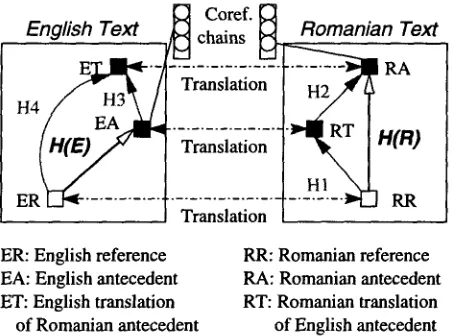
ER: English reference RR: Romanian reference EA: English antecedent RA: Romanian antecedent ET: English translation RT: Romanian translation of Romanian antecedent of English antecedent
Figure 4: Case 2 of multilingual coreference
closer to its referent. Figure 4 illustrates the case when the English antecedent is closer to the referent than the Romanian one.
SWIZZLE Solutions:
(1) If the heuristicH(E)
used to resolve the reference in the English text has higher priority thanH(R),
which was used to resolve the reference from the Romanian text, then we first search forRT,
the Romanian translation ofEA,
the English antecedent. In the next step, we add heuris- ticH1
that resolvesRR
intoRT,
and give it a higher priority thanH(R).
Finally, we also add heuristic H2 that linksR T t o RA
when there is at least one trans- lation between the elements of the coreference chains containingEA
andE T
respectively.(2) If
H(R)
has higher priority thanH(E),
heuris- ticH3
is added whileH(E)
is removed. We also add //4 that relatesER
toET,
the English translation ofRA.
Case 3
occurs when at least one of the antecedents starts a new coreference chain (i.e., no coreferring antecedent can be found in the current chains).SWIZZLE Solution:
If one of the antecedentscorefers with an element from a coreference chain, then the antecedent in the opposite language is its translation. Otherwise, SNIZZLE chooses the an- tecedent returned by the heuristic with highest pri- ority.
4 R e s u l t s
The foremost contribution of SWIZZLE was that it improved coreference resolution over both English and Romanian texts when compared to monolingual coreference resolution performance in terms of preci- sion and recall. Also relevant was the contribution of SNIZZLE to the process of understanding the cultural differences expressed in language and the way these differences influence coreference resolution. Because we do not have sufficient space to discuss this issue in detail here, let us state, in short, that English is more economical than Romanian in terms of referen- tial expressions. However the referential expressions in Romanian contribute to the resolution of some of the most difficult forms of coreference in English.
4.1 P r e c i s i o n a n d R e c a l l
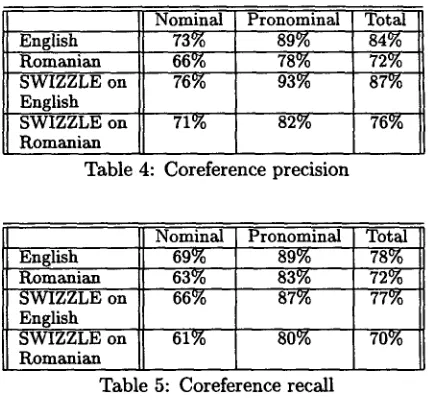
Table 4 summarizes the precision results for both English and Romanian coreference. The results in- dicate that the English coreference is more pre- cise than the Romanian coreference, but SNIZZLE improves coreference resolution in both languages. There were 64% cases when the English coreference was resolved by a heuristic with higher priority than the corresponding heuristic for the Romanian coun-
terpart. This result explains why there is better pre- cision enhancement for the English coreference.
English Romanian S W I Z Z L E on English SWIZZLE o n Romanian
Nominal Pronominal
73% 89%
66% 78%
76% 93%
71°/o 82%
Table 4: Coreference precision Total
84% 72% 87%
76%
English Romanian S W I Z Z L E o n English SWIZZLE o n Romanian
Nominal 69% 63% 66%
61%
Pronominal Total
89% 78%
83% 72%
87% 77%
80% 70%
Table 5: Coreference recall
Table 5 also illustrates the recall results. The advantage of the data-driven coreference resolution over other methods is based on its better recall per- formance. This is explained by the fact that this method captures a larger variety of coreference pat- terns. Even though other coreference resolution sys- tems perform better for some specific forms of refer- ence, their recall results are surpassed by the data- driven approach. Multilingual coreference in turn improves more the precision than the recall of the monolingual data-driven coreference systems.
In addition, Table 5 shows that the English coref- erence results in better recall than Romanian coref- erence. However, the recall shows a decrease for both languages for SNIZZLE because imprecise coreference links are deleted. As is usually the case, deleting data lowers the
recall.
All results were obtained by using the automatic scorer program developed for the MUC evaluations.5
C o n c l u s i o n s
We have introduced a new data-driven method for multilingual coreference resolution, implemented in the SWIZZLE system. The results of this method are encouraging since they show clear improvements over monolingual coreference resolution. Currently, we are also considering the effects of a bootstrap- ping algorithm for multilingual coreference resolu- tion. Through this procedure we would learn con- currently semantic consistency knowledge and bet- ter performing heuristic rules. To be able to de- velop such a learning approach, we must first develop a method for automatic recognition of multilingual referential expressions.
[image:7.612.347.561.115.316.2]We also believe t h a t a b e t t e r performance evalu- ation of SidIZZLE can be achieved by measuring its i m p a c t on several complex applications. We intend to analyze the p e r f o r m a n c e of SIdIZZLE when it is used as a module in an I E system, and separately in a Question/Answering system.
A c k n o w l e d g e m e n t s This p a p e r is dedicated to the m e m o r y of our friend Megumi K a m e y a m a , who in- spired this work.
R e f e r e n c e s
Douglas E. Appelt, Jerry R. Hobbs, John Bear, David Israel, Megumi Kameyama and Mabry Tyson. 1993. The SRI MUC-5 JV-FASTUS Information Extraction System. In Proceedings of the Fifth Message Under- standing Conference (MUC-5).
Brack Baldwin. 1997. CogNIAC: high precision corefer- ence with limited knowledge and linguistic resources.
In Proceedings of the ACL '97/EACL '97 Workshop on
Operational factors in practical, robust anaphora res-
olution, pages 38-45, Madrid, Spain.
Andrei Bantam. 1969. Dic~ionar Rom£n-Englez, Enlgez- Romfi~. Editura ~tiin~ific~, Bucure~ti.
David Bean and Ellen Riloff. 1999. Corpus-Based Iden- tification of Non-Anaphoric Noun Phrases. In Pro- ceedings of the 37th Conference of the Assosiation for
Computatioanl Linguistics (A CL-99), pages 373-380.
Eric Brill. A simple rule-based part of speech tagger. In
Proceedings of the Third Conference on Applied Nat-
ural Language Processing, pages 152-155, 1992.
Joseph F. Cameron-Jones and Ross Quinlan. 1993. Avoiding Pitfalls When Learning Recursive Theories.
In Proceedings of the 13th International Joint Confer-
ence on Artificial Intelligence (IJCAI-93), pages 1050-
1055.
Claire Cardie and Kiri Wagstaff. 1999. Noun phrase coreference as clustering. In Proceedings of the Joint Conference on Empirical Methods in NLP and Very
Large Corpora, pages 82-89.
Niyu Ge, John Gale and Eugene Charniak. 1998. Anaphora Resolution: A Multi-Strategy Approach. In
Proceedings of the 6th Workshop on Very Large Cor- pora, (COLING/A CL '98).
Ido Dagan and Ken W. Church. 1994. TERMIGHT: Identifying and translating technical terminology. In
Proceedings of the ~th ACL Conference on Applied Natural Language Processing (ANLP-94).
Sanda M. Harabagiu. 1999. Lexical Acquisition for a Romanian WordNet. Proceeding of the 3rd European Summer School on Computational Linguistics.
Sanda M. Harabagiu and Steve J. Maiorano. 1999. Knowledge-Lean Coreference Resolution and its Re- lation to Textual Cohesion and Coherence. In Pro- ceedings of the Workshop on the Relation of Dis- course/Dialogue Structure and Reference, ACL'98,
pages 29-38.
Jerry R. Hobbs. Resolving pronoun references. Lingua,
44:311-338.
Andrew Kehler. 1997. Probabilistic Coreference in In- formation Extraction. In Proceedings of the Second Conference on Empirical Methods in Natural Lan-
guage Processing (SIGDAT), pages 163-173.
Shalom Lappin and Herbert Leass. 1994. An algorithm for pronominal anaphora resolution. Computational
Linguistics, 20(4):535-562.
Rosie Jones, Andrew McCallum, Kevin Nigam and Ellen Riloff. 1999. Bootstrapping for Text Learning Tasks.
In Proceedings of the IJCAI-99 Workshop on Text
Mining: Foundations, Techniques, and Applications.
Megumi Kameyama. 1 9 9 7 . Recognizing Referential Links: An Information Extraction Perspective. In
Proceedings of the Workshop on Operational Factors in Practical, Robust Anaphora Resolution for Un-
restricted Texts, (ACL-97/EACL-97), pages 46-53,
Madrid, Spain.
Christopher Kennedy and Branimir Bogureav. 1996. Anaphora for everyone: Pronominal anaphora reso- lution without a parser. In Proceedings of the 16th International Conference on Computational Linguis- tics (COLING-96).
George A. Miller. 1995. WordNet: A Lexical Database.
Communication of the A CM, 38(11):39-41.
Ruslan Mitkov. 1 9 9 8 . Robust pronoun resolution with limited knowledge. In Proceedings of COLING-
ACL'98, pages 869-875.
1996. Proceedings of the Sixth Message Understanding
Conference (MUC-6),Morgan Kaufmann, San Mateo,
CA.
1998. Proceedings of the Seventh Message Understand-
ing Conference (MUC-7) ,Morgan Kaufmann, San
Mateo, CA.
Philip Resnik and I. Dan Melamed. 1 9 9 7 . Semi- Automatic Acquisition of Domain-Specific Translation Lexicons. In Proceedings of the 5th ACL Conference on Applied Natural Language Processing (ANLP-97).
Ellen Riloff and Rosie Jones. 1999. Learning Dictionar- ies for Information Extraction by Multi-Level Boot- strapping. In Proceedings of the Sixteenth National
Conference on Artificial Intelligence (AAAI-99).
Frank Smadja, Katheleen R. McKeown and Vasileios Hatzivassiloglou. 1996. Translating collocations for bilingual lexicons: A statistical approach. Computa-