Noun Phrase Recognition by System Combination
E r i k F . T j o n g K i m S a n g
C e n t e r for D u t c h L a n g u a g e a n d
S p e e c hU n i v e r s i t y of A n t w e r p
e r i k t @ u i a , ua. ac. be
A b s t r a c t
T h e performance of machine learning algorithms can be improved by combining the o u t p u t of different systems. In this paper we apply this idea to the recognition of noun phrases. We generate different classifiers by using different representations of the data. By combining the results with voting tech- niques described in (Van Halteren et al., 1998) we manage to improve the best reported performances on standard d a t a sets for base noun phrases and ar- bitrary noun phrases.
1
I n t r o d u c t i o n
(Van Halteren et al., 1998) and (Brill and Wu, 1998) describe a series of successful experiments for im- proving the performance of part-of-speech taggers. Their results have been obtained by combining the o u t p u t of different taggers with system combination techniques such as majority voting. This approach cancels errors t h a t are made by the minority of the taggers. With the best voting technique, the com- bined results decrease the lowest error rate of the component taggers by as much as 19% (Van Hal- teren et al., 1998). The fact t h a t combination of classifiers leads to improved performance has been reported in a large body of machine learning work.
We would like to know what improvement combi- nation techniques would cause in noun phrase recog- nition. For this purpose, we apply a single memory- based learning technique to d a t a t h a t has been rep- resented in different ways. We compare various com- bination techniques on a part of the Penn Treebank and use the best m e t h o d on standard d a t a sets for base noun phrase recognition and arbitrary noun phrase recognition.
2
M e t h o d s a n d e x p e r i m e n t s
In this section we start with a description of our task: recognizing noun phrases. After this we introduce the different d a t a representations we use and our machine learning algorithms. We conclude with an outline of techniques for combining classifier results.
2.1 Task description
Noun phrase recognition can be divided in two tasks: recognizing base noun phrases and recognizing arbi- t r a r y noun phrases. Base noun phrases (baseNPs) are noun phrases which do not contain another noun phrase. For example, the sentence
In [ early trading ] in [ Hong Kong ] [ Monday ] , [ gold ] was quoted at [ $ 366.50 ] [ an ounce ] .
contains six baseNPs (marked as phrases between square brackets). T h e phrase $ 366.50 an o u n c e is a noun phrase as well. However, it is not a baseNP since it contains two other noun phrases. Two baseNP d a t a sets have been put forward by (Ramshaw and Marcus, 1995). The main d a t a set consist of four sections (15-18) of the Wall Street Journal (WSJ) part of the Penn Treebank (Marcus et al., 1993) as training material and one section (20) as test material 1. T h e baseNPs in t h i s data are slightly different from the ones that can be derived from the Treebank, most notably in the attachment of genitive markers.
The recognition task involving arbitrary noun phrases a t t e m p t s to find b o t h baseNPs and noun phrases that contain other noun phrases. A stan- dard d a t a set for this task was put forward at the CoNLL-99 workshop. It consist on the same parts of the Penn Treebank as the main baseNP data set: WSJ sections 15-18 as training d a t a and section 20 as test d a t a 2. T h e noun phrases in this data set are the same as in the Treebank and therefore the baseNPs in this d a t a set are slightly different from the ones in the (Ramshaw and Marcus, 1995) d a t a sets.
In both tasks, performance is measured with three scores. First, with the percentage of detected noun phrases t h a t are correct (precision). Second, with the percentage of noun phrases in the d a t a that were found by the classifier (recall). And third,
1This
(Ramshaw and Marcus, 1995) baseNP data set is available via ftp://ftp.cis.upenn.edu/pub/chunker/with the FZ=I rate which is equal to (2*preci- sion*recall)/(precision+recall). The latter rate has been used as the target for optimization.
2.2 D a t a r e p r e s e n t a t i o n
In our example sentence in section 2.1, noun phrases are represented by bracket structures. Both (Mufioz
et al., 1999) and (Tjong K i m Sang and Veenstra, 1999) have s h o w n h o w classifiers can process bracket structures. O n e classifier can be trained to recog- nize open brackets (O) while another will process close brackets (C). Their results can be converted to b a s e N P s by m a k i n g pairs of open and close brackets with large probability scores (Mufioz et al., 1999) or by regarding only the shortest phrases between open and close brackets as b a s e N P s (Tjong K i m Sang and Veenstra, 1999). W e have used the bracket repre- sentation ( O + C ) in combination with the second b a s e N P construction method.
A n alternative representation for b a s e N P s has been put forward by ( R a m s h a w and Marcus, 1995). T h e y have defined b a s e N P recognition as a tagging task: words can be inside a b a s e N P (1) or outside of b a s e N P s (O). In the case that one b a s e N P immedi- ately follows another baseNP, the first word in the second b a s e N P receives tag B. Example:
Ino earlyi tradingr ino Hongl Kongz MondayB ,o goldz waso q u o t e d o a t o $r 366.50z anB ounce/ -o
This set of three tags is sufficient for encoding baseNP structures since these structures are non- recursive and nonoverlapping.
(Tjong Kim Sang and Veenstra, 1999) have pre- sented three variants of this tagging representation. First, the B tag can be used for the first word of every noun phrase (IOB2 representation). Second, instead of the B tag an E tag can be used to mark the last word of a baseNP immediately before another baseNP (IOE1). And third, the E tag can be used for every noun phrase final word (IOE2). T h e y have used the (Ramshaw and Marcus, 1995) representa- tion as well (IOB1). We will use these four tagging representations as well as the O + C representation.
2.3 M a c h i n e l e a r n i n g a l g o r i t h m s
We have used the memory-based learning algorithm IBI-IG which is part of T i M B L package (Daelemans et al., 1999b). In memory-based learning the train- ing data is stored and a new item is classified by the most frequent classification among training items which are closest to this new item. Data items are represented as sets of feature-value pairs. In IBI-IG each feature receives a weight which is based on the amount of information which it provides for com- puting the classification of the items in the training data. These feature weights are used for computing
the distance between a pair of d a t a items (Daele- mans et al., 1999b). m l - I G has been used success- fully on a large variety of natural language process- ing tasks.
Beside I B I - I G , we have used IGTREE in the combi- nation experiments. IGTREE is a decision tree vari- ant of II31-IG (Daelemans et al., 1999b). It uses the same feature weight m e t h o d as IBI-IG. Data items are stored in a tree with the most important features close to the root node. A new item is classified by traveling down from the root node until a leaf node is reached or no branch is available for the current feature value. T h e most frequent classification of the current node will be chosen.
2.4 C o m b i n a t i o n t e c h n i q u e s
Our experiments will result in different classifica- tions of the d a t a and we need to find out how to combine these. For this purpose we have evaluated different voting mechanisms, effectively the voting methods as described in (Van Halteren et al., 1998). All combination methods assign some weight to the results of the individual classifier. For each input to- ken, they pick the classification score with the high- est total score. For example, if five classifiers have weights 0.9, 0.4, 0.8, 0.6 and 0.6 respectively and they classify some token as npstart, null, npstart, null and null, then the combination m e t h o d will pick npstart since it has a higher total score (1.7) than null (1.6). T h e values of the weights are usually es- timated by processing a part of the training data, the tuning data, which has been kept separate as training d a t a for the combination process.
In the first voting method, each of the five classi- tiers receives the same weight (majority). The sec- ond method regards as the weight of each individual classification algorithm its accuracy on the tuning d a t a (TotPrecision). T h e third voting method com- putes the precision of each assigned tag per classifier and uses this value as a weight for the classifier in those cases t h a t it chooses the tag (TagPrecision). The fourth m e t h o d uses the tag precision weights as well but it subtracts from them the recall val- ues of the competing classifier results. Finally, the fifth m e t h o d uses not only a weight for the current classification but it also computes weights for other possible classifications. T h e other classifications are determined by examining the tuning d a t a and reg- istering the correct values for every pair of classifier results (pair-wise voting).
train All correct Majority correct Minority correct All wrong
0 C
96.21% 96.66% 1.98% 1.64% 0.88% 0.75% 0.93% 0.95%
Table 1: Token classification agreement between the five classifiers applied to the baseNP training data after conversion to the open bracket (O) and the close bracket representation (C).
For the latter purpose we have used the part-of- speech tag of the current word.
3
R e s u l t s
Our first goal was to find out whether system combi- nation could improve performance of baseNP recog- nition and, if this was the fact, to select the best combination technique. For this purpose we per- formed a 10-fold cross validation experiment on the baseNP training data, sections 15-18 of the WSJ part of the Penn Treebank (211727 tokens). Like the d a t a used by (Ramshaw and Marcus, 1995), this d a t a was retagged by the Brill tagger in or- der to obtain realistic part-of-speech (POS) tags 3. T h e d a t a was segmented into baseNP parts and non- baseNP parts in a similar fashion as the d a t a used by (Ramshaw and Marcus, 1995).
The d a t a was converted to the five d a t a represen- tations (IOB1, IOB2, IOE1, IOE2 and O + C ) and IBI-IG was used to classify it by using 10-fold cross validation. This means t h a t the d a t a was divided in ten consecutive parts of about the same size af- ter which each part was used as test data with the other nine parts as training data. T h e standard pa- rameters of IBI-IG have been used except for k, the number of examined nearest neighbors, which was set to three. Each word in the d a t a was represented by itself and its POS tag and additionally a left and right context of four word-POS tag pairs. For the first four representations, we have used a second pro- cessing stage as well. In this stage, a word was repre- sented by itself, its POS tag, a left and right context of three word-POS tag pairs and a left and right context of two classification results of the first pro- cessing stage (see figure 1). T h e second processing stage improved the FZ=I scores with almost 0.7 on average.
T h e classifications of the IOB1, IOB2, IOE1 and IOE2 representations were converted to the open bracket (O) and close bracket (C) representations.
aNo perfect P e n n T r e e b a n k P O S t a g s will be available for novel t e x t s . If we w o u l d h a v e u s e d t h e T r e e b a n k P O S t a g s for N P r e c o g n i t i o n , o u r p e r f o r m a n c e r a t e s w o u l d have b e e n u n r e a l i s t i c a l l y high.
train
Representation IOB1
IOB2 IOE1 IOE2 O + C
Simple Voting Majority TotPrecision TagPrecision Precision-Recall
0
98.01% 97.8O% 97.97% 97.89% 97.92%
98.19% 98.19% 98.19% 98.19%
C
98.14% 98.08% 98.04% 98.08% 98.13%
98.30% 98.30% 98.30% 98.30% Pairwise Voting
TagPair 98.19% 98.30%
M e m o r y - B a s e d
Tags 98.19% 98.34%
Tags + POS 98.19% 98.35% Decision Trees
Tags 98.17% 98.34%
Tags + P O S 98.17% 98.34%
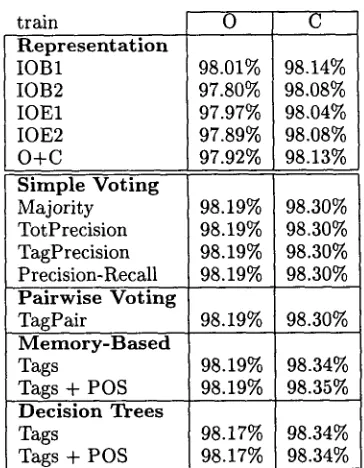
Table 2: Open and close bracket accuracies for the baseNP training d a t a (211727 tokens). Each com- bination performs significantly b e t t e r than any of the five individual classifiers listed under Represen- tation. The performance differences between the combination methods are not significant.
After this conversion step we had five O results and five C results. In the bracket representations, to- kens can be classified as either being the first token of an NP (or the last in the C representation) or not. T h e results obtained with these representations have been measured with accuracy rates: the percentage of tokens t h a t were classified correctly. Only about one in four tokens are at a baseNP boundary so guessing t h a t a text does not contains baseNPs will already give us an accuracy of 75%. Therefore the accuracy rates obtained with these representations are high and the room for improvement is small (see table 1). However, because of the different treatment of neighboring chunks, the five classifiers disagree in about 2.5% of the classifications. It seems useful to use combination methods for finding the best classi- fication for those ambiguous cases.
T h e five O results and the five C results were pro- cessed by the combination techniques described in section 2.4. The accuracies per input token for the combinations can be found in table 2. For both d a t a representations, all combinations perform sig- nificantly b e t t e r t h a n the best individual classifier (p<0.001 according to a X 2 test) 4. Unlike in (Van
[image:3.612.367.549.78.312.2] [image:3.612.127.303.81.141.2]trading/NN in/IN Hong/NNP Kong/NNP Monday/NNP ,/, gold/NN was/VBD quoted/VBN in/IN Hong/NNP/I Kong/NNP/I Monday/NNP ,/,/O gold/NN/I was/VBD
Figure 1: Example of the classifier input features used for classifying
Monday
in the example sentence. The first processing stage (top) contains a word and POS context of four left and four right while the second processing stage (bottom) contains a word and POS context of three and a chunk tag context of two.section 20 Majority voting (Mufioz et al., 1999)
(Tjong Kim Sang and Veenstra~ 1999) (Ramshaw and Marcus, 1995)
(Argarnon et al., 1998)
accuracy precision O:98.10% C:98.29% 93.63%
O:98.1% C:98.2% 93.1%
97.58% 92.50%
97.37% 91.80%
91.6%
recall FZ=I 92.89% 93.26
92.4% 92.8 92.25% 92.37 92.27% 92.03 91.6% 91.6
section 00 accuracy precision
Majority voting 0:98.59% C:98.65% 95.04%
r (Tjong Kim Sang and Veenstra, 1999) 98.04% 93.71%
(Ramshaw and Marcus, 1995) 97.8% 93.1%
recall FB=I 94.75% 94.90 93.90% 93.81
93.5% 93.3
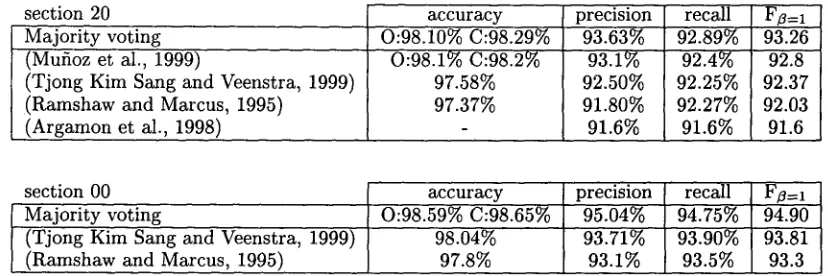
Table 3: The results of majority voting of different data representations applied to the two standard data sets put forward by (Ramshaw and Marcus, 1995) compared with earlier work. The accuracy scores indicate how often a word was classified correctly with the representation used (O, C or IOB1). The training data for WSJ section 20 contained 211727 tokens while section 00 was processed with 950028 tokens of training data. Majority voting outperforms all earlier reported results for the two data sets.
Halteren et al., 1998), the best voting technique did not outperform the best stacked classifier. Further- more the performance differences between the com- bination methods are not significant (p>0.05). To our surprise the five voting techniques performed the same. We assume that this has happened because the accuracies of the individual classifiers do not dif- fer much and because the classification involves a binary choice.
Since there is no significant difference between the combination methods, we can use any of them in the remaining experiments. We have chosen to use ma- jority voting because it does not require tuning data. We have applied it to the two data sets mentioned in (Ramshaw and Marcus, 1995). The first data set uses WSJ sections 15-18 as training data (211727 tokens) and section 20 as test data
(47377
tokens). The second one uses sections 02-21 of the same cor- pus as training data (950028 tokens) and section 00 as test data (46451 tokens). All data sets were pro- cessed in the same way as described earlier. The results of these experiments can be found in table 3. With section 20 as test set, we managed to reduce the error of the best result known to us with 6% with the error rate dropping from 7.2% to 6.74%, and for section 00 this difference was almost 18% with theFB= 1 rates.
error rate dropping from 6.19% to 5.10% (see table
3).
We have also applied majority voting to the NP data set put forward on the CoNLL-99 workshop. In this task the goal is to recognize all NPs. We have approached this as repeated baseNP recogni- tion. A first stage detects the baseNPs. The recog- nized NPs are replaced by their presumed head word with a special POS tag and the result is send to a second stage which recognizes NPs with one level of embedding. The output of this stage is sent to a third stage and this stage finds NPs with two levels of embedding and so on.
In the first processing stage we have used the five data representations with majority voting. This ap- proach did not work as well for other stages. The O+C representation outperformed the other four representations by a large margin for the valida- tion data 5. This caused the combined output of all five representations being worse than the O+C result. Therefore we have only used the O+C repre- sentation for recognizing nombaseNPs. The overall system reached an F~=I score of 83.79 and this is slightly better than the best rate reported at the
[image:4.612.109.523.185.323.2]CoNLL-99 workshop (82.98 (CoNLL-99, 1999), an error reduction of 5%).
4 R e l a t e d w o r k
(Abney, 1991) has proposed to approach parsing by starting with finding correlated chunks of words. The chunks can be combined to trees by a sec- ond processing stage, the attacher. (Ramshaw and Marcus, 1995) have build a chunker by apply- ing transformation-based learning to sections of the Penn Treebank. Rather than working with bracket structures, they have represented the chunking task as a tagging problem. POS-like tags were used to account for the fact that words were inside or out- side chunks. They have applied their method to two segments of the Penn Treebank and these are still being used as benchmark data sets.
Several groups have continued working with the Ramshaw and Marcus data sets for base noun phrases. (Argamon et al., 1998) use Memory-Based Sequence Learning for recognizing both NP chunks and VP chunks. This method records POS tag se- quences which contain chunk boundaries and uses these sequences to classify the test data. Its per- formance is somewhat worse than that of Ramshaw and Marcus (F~=1=91.6 vs. 92.0) but it is the best result obtained without using lexical information 6. (Cardie and Pierce, 1998) store POS tag sequences that make up complete chunks and use these se- quences as rules for classifying unseen data. This approach performs worse than the method of Arga- mon et al. (F~=1=90.9).
Three papers mention having used the memory- based learning method IBI-IG. (Veenstra, 1998) in- troduced cascaded chunking, a two-stage process in which the first stage classifications are used to im- prove the performance in a second processing stage. This approach reaches the same performance level as Argamon et al. but it requires lexical informa- tion. (Daelemans et al., 1999a) report a good per- formance for baseNP recognition but they use a dif- ferent data set and do not mention precision and recall rates. (Tjong Kim Sang and Veenstra, 1999) compare different data representations for this task. Their baseNP results are slightly better than those of Ramshaw and Marcus (F~=1=92.37).
(XTAG, 1998) describes a baseNP chunker built from training data by a technique called supertag- ging. The performance of the chunker was an improvement of the Ramshaw and Marcus results (Fz=I =92.4). (Mufioz et al., 1999) use SNOW, a net- work of linear units, for recognizing baseNP phrases
6We have applied majority voting of five data represen- tations to the Ramshaw and Marcus data set without using lexical information and the results were: accuracy O: 97.60%, accuracy C: 98.10%, precision: 92.19%, recall: 91.53% and F~=I: 91.86.
and SV phrases. They compare two data representa- tions and report that a representation with bracket structures outperforms the IOB tagging representa- tion introduced by (Ramshaw and Marcus, 1995). SNoW reaches the best performance on this task (Fz=I =92.8).
There has been less work on identifying general noun phrases than on recognizing baseNPs. (Os- borne, 1999) extended a definite clause grammar with rules induced by a learner that was based upon the maximum description length principle. He pro- cessed other parts of the Penn Treebank than we with an F~=I rate of about 60. Our earlier effort to process the CoNLL data set was performed in the same way as described in this paper but with- out using the combination method for baseNPs. We obtained an F~=I rate of 82.98 (CoNLL-99, 1999).
5 C o n c l u d i n g r e m a r k s
We have put forward a method for recognizing noun phrases by combining the results of a memory-based classifier applied to different representations of the data. We have examined different combination tech- niques and each of them performed significantly bet- ter than the best individual classifier. We have cho- sen to work with majority voting because it does not require tuning data and thus enables the indi- vidual classifiers to use all the training data. This approach was applied to three standard data sets for base noun phrase recognition and arbitrary noun phrase recognition. For all data sets majority voting improved the best result for that data set known to
US.
Varying data representations is not the only way for generating different classifiers for combination purposes. We have also tried dividing the training data in partitions (bagging) and working with artifi- cial training data generated by a crossover-like oper- ator borrowed from genetic algorithm theory. With our memory-based classifier applied to this data, we have been unable to generate a combination which improved the performance of its best member. An- other approach would be to use different classifica- tion algorithms and combine the results. We are working on this but we are still to overcome the prac- tical problems which prevent us from obtaining ac- ceptable results with the other learning algorithms.
A c k n o w l e d g e m e n t s
We would like to thank the members of the CNTS group in Antwerp, Belgium, the members of the ILK group in Tilburg, The Netherlands and three anony- mous reviewers for valuable discussions and com- ments. This research was funded by the European TMR network Learning Computational Grammars ~.
R e f e r e n c e s
Steven Abney. 1991. Parsing by chunks. In Principle- Based Parsing. Kluwer Academic Publishers.
Shlomo Argamon, Ido Dagan, and Yuval Krymolowski. 1998. A memory-based approach to learning shal- low natural language patterns. In Proceedings of COLING-ACL '98. Association for Computational Linguistics.
Eric Brill and Jun Wu. 1998. Classifier combination for improved lexical disambiguation. In Proceedings of COLING-ACL '98. Association for Computational Linguistics.
Claire Cardie and David Pierce. 1998. Error-driven pruning of treebank grammars for base noun phrase identification. In Proceedings of COLING-ACL '98.
Association for Computational Linguistics.
CoNLL-99. 1999. Conll-99 home page. http://lcg- www.uia.ac.be/conl199/.
Walter Daelemans, Antal van den Bosch, and Jakub Za- vrel. 1999a. Forgetting exceptions is harmful in lan- guage learning. Machine Learning, 34.
Walter Daelemans, Jakub Zavrel, Ko van der Sloot, and Antal van den Bosch. 1999b. TiMBL: Tilburg Mem- ory Based Learner, version 2.0, Reference Guide.
ILK Technical Report 99-01. http://ilk.kub.nl/-ilk/ papers/ilk9901.ps.gz.
Mitchell P. Marcus, Beatrice Santorini, and Mary Ann Marcinkiewicz. 1993. Building a large annotated cor- pus of English: the Penn Treebank. Computational Linguistics, 19.
Marcia Mufioz, Vasin Punyakanok, Dan Roth, and Day Zimak. 1999. A learning approach to shallow parsing. In Proceedings of EMNLP-WVLC'99. Association for Computational Linguistics.
Miles Osborne. 1999. MDL-based DCG induction for NP identification. In Miles Osborne and Erik Tjong Kim Sang, editors, CoNLL-99 Computational Natural Language Learning. Association for Compu- tational Linguistics.
Lance A. Ramshaw and Mitchell P. Marcus. 1995. Text chunking using transformation-based learning. In Proceedings of the Third ACL Workshop on Very Large Corpora. Association for Computational Lin- guistics.
Erik F. Tjong Kim Sang and Jorn Veenstra. 1999. Rep- resenting text chunks. In Proceedings of EACL '99. As- sociation for Computational Linguistics.
Hans van Halteren, Jakub Zavrel, and Walter Daele- mans. 1998. Improving data driven wordclass tagging by system combination. In Proceedings of COLING- A CL'98. Association for Computational Linguistics. Jorn Veenstra. 1998. Fast NP chunking using memory-
based learning techniques. In BENELEARN-98: Pro- ceedings of the Eighth Belgian-Dutch Conference on Machine Learning. ATO-DLO, Wageningen, report 352.