Response Generation in Collaborative Negotiation*
J e n n i f e r C h u - C a r r o l l and S a n d r a C a r b e r r y D e p a r t m e n t o f C o m p u t e r and I n f o r m a t i o n S c i e n c e s
U n i v e r s i t y o f D e l a w a r e N e w a r k , D E 19716, U S A E-marl: { j c h u , c a r b e r r y } @ c i s . u d e l . e d u
A b s t r a c t
In collaborative planning activities, since the agents are autonomous and heterogeneous, it is inevitable that conflicts arise in their beliefs during the planning process. In cases where such conflicts are relevant to the t~t~k at hand, the agents should engage in collaborative ne- gotiation as an attempt to square away the dis- crepancies in their beliefs. This paper presents a computational strategy for detecting conflicts regarding proposed beliefs and for engaging in collaborative negotiation to resolve the con- flicts that warrant resolution. Our model is capable of selecting the most effective aspect to address in its pursuit of conflict resolution in cases where multiple conflicts arise, and of se- lecting appropriate evidence to justify the need for such modification. Furthermore, by cap- turing the negotiation process in a recursive Propose-Evaluate.Modify cycle of actions, our model can successfully handle embedded ne- gotiation subdialogues.
1 I n t r o d u c t i o n
In collaborative consultation dialogues, the consultant and the executing agent collaborate on developing a plan to achieve the executing agent's domain goal. Since agents are autonomous and heterogeneous, it is inevitable that conflicts in their beliefs arise during the planning pro- cess. In such cases, collaborative agents should attempt to square away (Joshi, 1982) the conflicts by engaging in collaborative negotiation to determine what should con- stitute their shared plan of actions and shared beliefs. Collaborative negotiation differs from non-collaborative negotiation and argum_entation mainly in the attitude of the participants, since collaborative agents are not self- centered, but act in a way as to benefit the agents as This material is based upon work supported by the National Science Foundation under Grant No. IRI-9122026.
a group. Thus, when facing a conflict, a collaborative agent should not automatically reject a belief with which she does not agree; instead, she should evaluate the belief and the evidence provided to her and adopt the belief if the evidence is convincing. On the other hand, if the evalua- tion indicates that the agent should maintain her original belief, she should attempt to provide sufficient justifica- tion to convince the other agent to adopt this belief if the belief is relevant to the task at hand.
This paper presents a model for engaging in collabo- rative negoa~ion to resolve conflicts in agents' beliefs about domain knowledge. Our model 1) detects con- flicts in beliefs and initiates a negotiation subdialogue only when the conflict is relevant to the current
ta.~k, 2)
selects the most effective aspect to address in its pursuit of conflict resolution when multiple conflicts exist, 3) selects appropriate evidence to justify the system's pro- posed modification of the user's beliefs, and 4) captures the negotiation process in a recursive Propose-Evaluate- Mod/fy cycle of actions, thus enabling the system to han- dle embedded negotiation sulxlialognes.2
R e l a t e d W o r k
Researchers have studied the analysis and generation of arguments (Birnbaum et al., 1980; Reichman, 1981; Co- hen, 1987; Sycara, 1989; Quilici, 1992; Maybury, 1993); however, agents engaging in argumentative dialogues are solely interested in winning an argument and thus ex- hibit different behavior from collaborative agents. Sidner (1992; 1994) formulated an artificial language for mod- eling collaborative discourse using propo~acceptance and proposal/rejection sequences; however, her work is descriptive and does not specify response generation strategies for agents involved in collaborative interac- tions.
Walker (1994) described a method of determining when to include optional warrants to justify a claim based on factors such as communication cost, inference cost, and cost of memory retrieval. However, her model focuses on determining when to include informationally redundant utterances, whereas our model determines whether or not justification is needed for a claim to be convincing and, ff so, selects appropriate evidence from the system's private beliefs to support the claim.
Caswey et al. (Cawsey et al., 1993; Logan et al., 1994) introduced the idea of utilizing a belief revision mechanism (Galliers, 1992) to predict whether a set of evidence is sufficient to change a user's existing belief and to generate responses for information retrieval di- alogues in a library domain. They argued that in the library dialogues they analyzed, "in no cases does ne- gotiation extend beyond the initial belief conflict and its immediate resolution:' (Logan et al., 1994, page 141). However, our analysis of naturally-occurring consultation dialogues (Columbia University Transcripts, 1985; SRI Transcripts, 1992) shows that in other domains conflict resolution does extend beyond a single exchange of con- flicting befiefs; therefore we employ a re, cursive model for collaboration that captures extended negotiation and represents the structure of the discourse. Furthermore, their system deals with a single conflict, while our model selects a focus in its pursuit of conflict resolution when multiple conflicts arise. In addition, we provide a process for selecting among multiple possible pieces of evidence.
3 F e a t u r e s o f C o l l a b o r a t i v e N e g o t i a t i o n
Collaborative negoti~ion occurs when conflicts arise among agents developing a shared plan 1 during collab- orative planning. A collaborative agent is driven by the goal of developing a plan that best satisfies the interests of all the agents as a group, instead of one that maximizes his own interest. This results in several distinctive features of collaborative negotiation: 1) A collaborative agent does not insist on winning an argument, and may change his beliefs ff another agent presents convincing justification for an opposing belief. This differentiates collaborative negotiation from argumentation (Birnbaum et al., 1980; Reichman, 1981; Cohen, 1987; Quilici, 1992). 2) Agents involved in collaborative negotiation are open and hon- est with one another; they will not deliberately present false information to other agents, present information in such a way as to mislead the other agents, or strategi- cally hold back information from other agents for later use. This distinguishes collaborative negotiation from non-collaborative negotiation such as labor negotiation (Sycara, 1989). 3) Collaborative agents are interested in
1The notion of shared plan has been used in (Grosz and Sidner, 1990; Allen, 1991).
others' beliefs in order to decide whether to revise their own beliefs so as to come to agreement (Chu-Carroll and Carberry, 1995). Although agents involvedin argumenta- tion and non-collaborative negotiation take other agents' beliefs into consideration, they do so mainly to find weak points in their opponents' beliefs and attack them to win the argument.
In
our earlier work, we built on Sidner's pro- posal/acceptance and proposal/rejection sequences (Sit- net, 1994) and developed a model tha¢ captures collabo- rative planning processes in a Propose-Evaluate-Modify cycle of actions (Chu-Carroll and Carberry, 1994). This model views c o l l ~ t i v e planning as agent A propos- ing a set of actions and beliefs to be i ~ t e d into the plan being developed, agent B evaluating the pro- posal to determine whether or not he accepts the proposal and, ff not, agent B proposing a set of modifications to A's original proposal. The proposed modifications will again be evaluated by A, and if conflicts arise, she may propose modifications to B's previously proposed modifications, resulting in a recursive process. However, our research did not specify, in cases where multiple conflicts arise, how an agent should identify which p m of an unaccept~ proposal to address or how to select evidence to support the proposed modification. This paper extends that work by i ~ t i n g into the modification process a slrategy to determine the aspect of the proposal that the agent will address in her pursuit of conflict resolution, as well as a means of selecting appropriate evidence to justify the need for such modification.4 Response Generation in Collaborative
Negotiation
4.1 Evaluating Proposed Beliefs
Our system maintains a set o f beliefs about the domain and about the user's beliefs. Associated with each be- lief is a strength that represents the agent's confidence in holding that belief. We model the strength of a belief using endorsements, which are explicit records of factors that affect one's certainty in a hypothesis (Cohen, 1985), following (Galliers, 1992; Logan et al., 1994). Our en- dorsements are based on the semantics of the utterance used to convey a befief, the level of expertise of the agent conveying the belief, stereotypical knowledge, etc.
The belief level o f the dialogue model consists of mu- tual beliefs proposed by the agents' discourse actions. When an agent proposes a new belief and gives (optional) supporting evidence for it, this set of proposed beliefs is represented as a belief tree, where the belief represented by a child node is intended to support that represented by its parent. The root nodes of these belief trees (rap-level beliefs) contribute to problem-solving actions and thus affect the domain plan being developed. Given a set of newly proposed beliefs, the system must decide whether to accept the proposal or m initiate a negotiation dialogue to resolve conflicts. The evaluation of proposed beliefs starts at the leaf nodes of the proposed belief trees since acceptance of a piece of proposed evidence may affect ac- ceptance of the parent belief it is intended to support. The process continues until the top-level proposed beliefs are evaluated. Conflict resolution strategies are invoked only if the top-level proposed beliefs are not accepted because if collaborative agents agree on a belief relevant to the domain plan being constructed, it is irrelevant whether they agree on the evidence for that belief (Young et al., 1994).
In determining whether to accept a proposed befief or evidential relationship, the evaluator first constructs an evidence set containing the system's evidence thin supports or attacks _bcl and the evidence accepted by the system that was proposed by the user as support for -bel. Each piece of evidence contains a belief _beli, and an evidential relationship supports(.beli,-bel). Follow- ing Walker's weakest link assumption (Walker, 1992) the strength of the evidence is the weaker of the strength of the belief and the strength of the evidential relationship. The evaluator then employs a simplified version of Gal- liers' belief revision mechanism 2 (Galliers, 1992; Logan et al., 1994) to compare the strengths of the evidence that supports and attacks _bel. If the strength of one set of evi- dence strongly outweighs that of the other, the decision to accept or reject.bel is easily made. However, if the differ- ence in their strengths does not exceed a pre-determined
2For details on how our model determines the acceptance of a belief
using
the ranking of endorsements proposed by GaUiers, see (Chu-Carroll, 1995)...v.~ ..e~...n.~q.h..x~ ... .,
~." -~ MB~3tSt-Teaches(Smith~I)) ]
a ; 1 ~ q .
, i[MB~J,S,O.-S~,~KS,~th,n~,a ~ ) ) ~, - . . -.
Dlsc~rse Level ", i
... : ... ". "d "" "[ l n f ~ J , S , ~ T e a c h e ~ ( S m i ~ I i ,',
[Tell('O,S,-Teaches(Smith,AI))] [Address-Acceplance ~i ~'
[ I~°'m(U,S,O"-S~ic~(Smith,~= Ye'O) k~"
[ TeU(U,S,On-S~,t,~(Smith,~xt y~0) I
, . . . . J
Dr. Smith is not teaching AL
Dr. Smith is going on sablmutical next year.
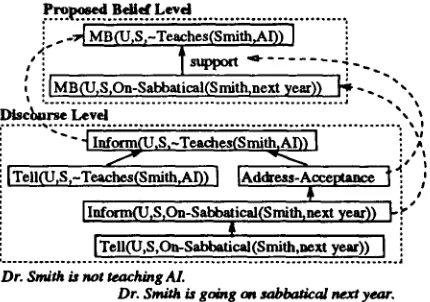
Figure 1: Belief and Discourse Levels for (2) and (3)
threshold, the evaluator has insufficient information to determine whether to adopt _bel and therefore will ini-
tiate an information-sharing subdialogue (Cho-Carmll
and Carberry, 1995) to share information with the user so that each of them can knowiedgably re-evaluate the user's original proposal. If, during infommtion-sharing, the user provides convincing support for a belief whose negation is held by the system, the system may adopt the belief after the re-evaluation process, thus resolving the conflict without negotiation.
4.1.1 Example
To illustrate the evaluation of proposed beliefs, con- sider the following uttermmes:
(1) S: 1 think Dr. Smith is teaching A I next semester.
(2) U: Dr. Smith is not teaching AL
(3) H e is going on sabbatical next year.
Figure 1 shows the belief and discourse levels of the dialogue model that captures utterances (2) and (3). The belief evaluation process will start with
the belief at the leaf node of the proposed belief
txee, On.Sabbatical(Smith,
next year)).
The system will first gather its evidence pe~aining to the belief, which includes I) a warranted belief ~ that Dr. Smith has postponed his sabbatical until 1997(Postponed-
Sabbatical(Smith,
J997)),
2) a warranted belief that Dr. Smith postponing his sabbatical until 1997 sup-ports the belief that he is not going on sabbatical next year (supports(Postponed-Sabbatical(Smith,1997),
-~On-SabbaticaI(Smith, next year)), 3) a strong belief
that Dr. Smith will not be a visitor at IBM next year
(-~visitor(Smith, IBM, next year)), and 4) a warranted
belief that Dr. Smith not being a visitor at IBM next
aThe strength of a belief is classified as: warranted, strong,
[image:3.612.329.544.62.213.2]year supports the belief that he is not going on sab- batical next year (supports(-~visitor(Smith, IBM, next year), -,On-Sabbatical(Smith, next year)), perhaps be- cause Dr. Smith has expressed his desire to spend his sab- batical only at IBM). The belief revision mechanism will then be invoked to determine the system's belief about On-Sabbatical(Smith, next year) based on the system's own evidence and the user's statement. Since beliefs (1) and (2) above constitute a warranted piece of evidence against the proposed belief and beliefs (3) and (4) consti- tute a strong piece of evidence against it, the system will not accept On-Sabbatical(Smith, next year).
The system believes that being on sabbatical implies a faculty member is not teaching any courses; thus the pro- posed evidential relationship will be accepted. However, the system will not accept the top-level proposed belief, -,Teaches(Smith, A/), since the system has a prior belief to the contrary (as expressed in utterance ( 1 )) and the only evidence provided by the user was an implication whose antecedent was not accepted.
4.2 Modifying Unaccepted Proposals
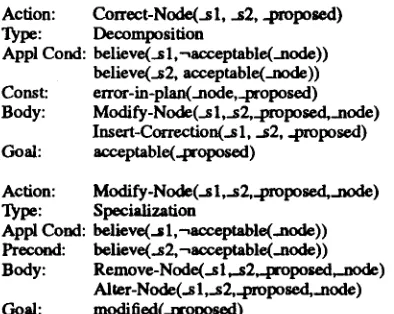
The collaborative planning principle in (Whittak~ and Stenton, 1988; Walker, 1992) suggests that "conversants must provide evidence of a detected discrepancy in belief as soon as possible." Thus, once an agent detects a rele- vant conflict, she must notify the other agent of the con- flict and initiate a negotiation subdialogne to resolve i t - - to do otherwise is to fail in her responsibility as a collab- orative agent. We capture the attempt to resolve a con- flict with the problem-solving action Modify-Proposal, whose goal is to modify the proposal to a form that will potentially be accepted by both agents. When applied to belief modification, Modify-Proposal has two specializa- tions: Correct-Node, for when a proposed belief is not accepted, and Correct-Relation, for when a proposed ev- idential relationship is not accepted. Figure 2 shows the problem-solving recipes 4 for Correct-Node and its subac- tion, Modify-Node, that is responsible for the actual mod- ification o f the proposal. The applicability conditions 5 of Correct-Node specify that the action can only be invoked when _sl believes that _node is not acceptable while _s2 believes that it is (when _sl and _s2 disagree about the proposed belief represented by ..node). However, since this is a collaborative interaction, the actual modification can only be performed when both ..sl and _s2 believe that _node is not acceptable w that is, the conflict between _sl and .s2 must have been resolved. This is captured by
4A recipe (Pollack,
1986) is a template for performing ac- tions. It contains the applicabifity conditions for performing an action, the subactions comprising the body of an action, etc.SApplicabflity conditions are conditions that must already be satisfied in order for an action to be reasonable to pursue, whereas an agent can try to achieve unsatisfied preconditions.
Action: ~y~: Appl Cond:
Const: Body:
Goal:
Action: ~ype: Appi Cond: Precond: Body:
[image:4.612.307.504.64.221.2]Goal:
Figure 2:
Correct-Node(_s I, .s2, .propow, d) Decomposition
believe(_s 1,--acceptable(..node)) believe(_s2, acceptable(_node)) error-in-plan(_node,..proposed) Modify-Node(..s l,_s2,_proposed,..node) Insert-Correction(.s 1, ..s2, _proposed) accoptable(_proposed)
Modify-Node(..s I ,..s2,.4noposed,.suxle) Specialization
believe( .s 1, .-,acceptable( ...node ) ) believe(.s2,-,acceptable(_node)) Remove-Node(_sl,_s2,_proposed,..node) Alter-Node(.s l,_s2,.proposed,.node) mod~ed(.proposed)
The Correct-Node and Modify-Node Recipes
the applicability condition and precondition o f Mod/fy- Node. ~ attempt to satisfy the precondition causes the system to post as a mutual belief to be achieved the belief that ..node is not acceptable, leading the system to adopt discourse actions to change _s2's beliefs, thus initiating a collaborative negotiation subdialogne, e
4.2,1 Selecting the Focus of Modification
When multiple conflicts arise between the system and the user regarding the user's proposal, the system must identify the aspect of the proposal on which it should fo- cus in its pursuit of conflict resolution. For example, in the case where Correct-Node is selected as the specializa- tion of Modify-Proposal, the system must determine how the parameter node in Correct-Node should be instanti- ated. The goal of the modification process is to resolve the agents' conflicts regarding the unaccepted top-level proposed beliefs. For each such belief, the system could provide evidence against the befief itself, address the un- accepted evidence proposed by the user to eliminate the user's justification for the belief, or both. Since collab- orative agents are expected to engage in effective and efficient dialogues, the system should address the unac- cepted belief that it predicts will most quickly resolve the top-level conflict. Therefore, for each unaccepted top-level belief, our process for selecting the focus of modificatkm involves two steps: identifying a candidate foci tree from the proposed belief tree, and selecting a
focus from the candidate foci tree using the heuristic "at- tack the belief(s) that will most likely resolve the conflict about the top-level belief." A candidate loci tree contains the pieces of evidence in a proposed belief tree which, if disbelieved by the user, might change the user's view of the unaccepted top-level proposed belief (the root node of that belief tree). It is identified by performing a depth- first search on the proposed belief tree. When a node is visited, both the belief and the evidential relationship between it and its parent are examined. I f both the be- lief and relationship were accepted by the evaluator, the search on the current branch will terminate, since once the system accepts a belief, it is irrelevant whether it accepts the user's support for that belief (Young et al., 1994). Otherwise, this piece o f evidence will be included in the candidate loci tree and the system will continue to search through the evidence in the belief tree proposed as support for the unaccepted belief and/or evidential relationship.
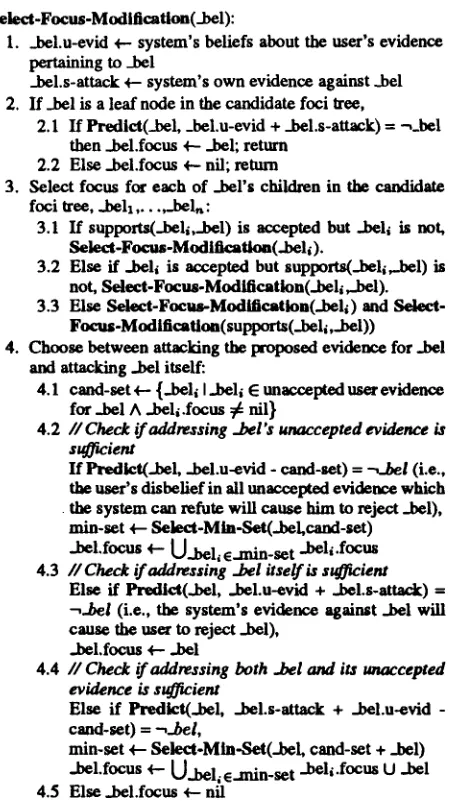
Once a candidate foci tree is identified, the system should select the focus of modification based on the like- lihood of each choice changing the user's belief about the top-level belief. Figure 3 shows our algorithm for this selection process. Given an u n a c c e p t ~ belief (.bel) and the beliefs proposed to support it, Select-Focus. Modification will annotate_bel with 1) its focus of mod- ification (.bel.focus), which contains a set o f beliefs (.bel and/or its descendents) which, if disbelieved by the user, are predicted to cause him to disbelieve _bel, and 2) the system's evidence against_bel itself (_hel.s-attack).
Select-Focus-Modification determines whether to at- tack _bel's supporting evidence separately, thereby elim- inating the user's reasons for holding ..b¢l, to a t t a ~ ..bel itself, or both. However, in evainating the effectiveness of attacking the proposed evidence for.bel, the system must determine whether or not it is possible to successfully re- fute a piece o f evidence (i.e., whether or not the system believes that sufficient evidence is available to convince the user that a piece of proposed evidence is invalid), and if so, whether it is m o t e effective to attack the evidence it- self or its support. Thus the algorithm recursively applies itself to the evidence proposed as support for _bel which was not accepted by the system (step 3). In this recursive process, the algorithm annotates each unaccepted belief or evidential relationship proposed to support _bel with its focus of modification (-beli.focus) and the system's evidence against it (_beli.s-attack). _bell.focus contains the beliefs selected to be addressed in order to change the user's belief about ..beli, and its value will be nil if the system predicts that insufficient evidence is available to change the user's belief about -bell.
Based on the information obtained in step 3, Select. Focus-Modification decides whether to attack the evi- dence proposed to support _bel, or _bel itself (step 4). Its preference is to address the unaccepted evidence, be-
S e l e c t . F o c u s - M o d l f l c a t l o n ( _ b e l ) :
1. _bel.u-evid +-- system's beliefs about the user's evidence pertaining to _bel
_bel.s-attack 4 - s y s t e m ' s own evidence against _bel 2. If _bel is a leaf node in the candidate foci tree,
2.1 If Predict(_bel, _bel.u-evid + _bel.s-attack) = -~_bel then _bel.focus ,-- .bel; return
2.2 Else .bel.focus t - nil; return
3. Select focus for each of .bel's children in the candidate foci tree, .belx ... ..bel,~:
3.1 If supports(_beli,_bel) is accepted but .beli is not, Select-Focus-Modlficatioa(.bel~ ).
3.2 Else if .beli is accepted but supports(_beli,.bel) is not, Sdect-Focus-Modlficatlon(.beli,.bel). 3.3 Else Select-Focu-Modificatioa(.bel~) and Select-
Focus-Modification( supports(_beli ,.bel))
4. Choose between attacking the Woposed evidence for .bel and attacking ..bel itself:
4.1 eand-set ~-- {..beli I .beli E unaccepted user evidence for _bel A ..beli.focus ~ nil}
4.2 //Check if addressing _bol's unaccepted evidence is suffu:ient
If Predkt(.bel, _bel.u-evid - cand-set) = --,.~l (i.e., the user's disbelief in all unaecepted evidence which . the system can refute will cause him to reject _bel),
m i n - s e t ~- Select-Mtu-Set(_bel,cand-set) ..bel.focus ~- U_bel~ ¢_min-set ..beli.focus 4.3 //Check if addressing .bel itself is s~fcient
Else if Predlct(.bel, ..bel.u-evid + .bel.s-attack) = -,.bel (i.e., the system's evidence against .bel will cause the user to reject _bel),
.bel.focus ~-- .bel
4.4 //Check if addressing both .l~el and its unaccepted evidence is s~Ofcient
E l s e if Predkt(..bel, _bel.s-attaek + .bel.u-evid - canal-set) = -,_bet,
rain-set +-- Select-Mln-Set(.beL cand-set + _bel) .bel.focus +-- U.beli~dnin-set ..beli.focus U .bel 4.5 Else _bel.focus +-- nil
Figure 3: Selecting the Focus of Modification
[image:5.612.329.554.57.462.2]the focus for each of the beliefs in this minimum subset. If attacking the evidence for _bel does not appear to be sufficient to convince the user of -~_bel, the algorithm checks whether directly attacking _bel will accomplish this goal. If providing evidence directly against _bel is predicted to be successful, then the focus of modifica- tion is _bcl itself (step 4.3). If directly attacking _bel is also predicted to fail, the algorithm considers the ef- fect of attacking both ..bel and its unaccepted proposed evidence by combining the previous two prediction pro- cesses (step 4.4). If the combined evidence is still pre- dicted to fail, the system does not have sufficient evidence to change the user's view of_bel; thus, the focus o f mod- ification for .bel is nil (step 4.5). 7 Notice that steps 2 and 4 of the algorithm invoke a function, Predict, that makes use of the belief revision mechanism (Galliers, 1992) dis- cussed in Section 4.1 to predict the user's acceptance or unacceptance of..bel based on the system's knowledge of the user's beliefs and the evidence that could be presented to him (Logan et al., 1994). The result of Select-Focus- Modification is a set of user beliefs (in _bel.focus) that need to be modified in order to change the user's belief about the unaccepted top-level belief. Thus, the negations of these beliefs will be posted by the system as mutual beliefs to be achieved in order to perform the Mod/fy actions.
4.2.2 Selecting Justification for a Claim
Studies in communication and social psychology have shown that evidence improves the persuasiveness of a message (Luchok and McCroskey, 1978; Reynolds and Burgoon, 1983; Petty and Cacioppo, 1984; Hampie, 1985). Research on the quantity of evidence indicates that there is no optimal amount of evidence, but that the use of high-quality evidence is consistent with persua- sive effects (Reinard, 1988). On the other hand, Cn'ice's maxim of quantity (Grice, 1975) specifies that one should not contribute more information than is required, s Thus, it is important that a collaborative agent selects suffmient and effective, but not excessive, evidence to justify an intended mutual belief.
To convince the user o f a belief,_bel, our system selects appropriate justification by identifying beliefs that could
7In collaborative dialogues, an agent should reject a pro- posal only ff she has strong evidence against it. When an agent does not have sufficient information to determine the accep- tance of a proposal, she should initiate an
information-sharing
subdialogue
to share information with the other agent and re- evaluate the proposal (Chu-Carroll and Carberry, 1995). Thus, further research is needed to determine whether or not the focus of modification for a rejected belief will ever be nil in collabo- rative dialogues.sWalker (1994) has shown the importance of IRU's Odor- mationally Redundant Utterances) in efficient discourse. We leave including appropriate IRU's for future work.
be used to support_bel and applying filtering heuristics to them. The system must first determine wbether justifica- tion for_bel is needed by predicting whether or not merely informing the user o f _bel will be sufficient to convince him of _bel. If so, no justification will be presented. If justification is predicted to be necessary, the system will first construct the justification chains that could be used to support _bel. For each piece of evidence t ~ t could be used to directly support ..bel, the system first predicts whether the user will accept the evidence without justi- fication. If the user is predicted not to accept a piece of evidence (evidi), the system will augment the evidence to be presented to the user by posting evidi as a mutual be- lief to be achieved, and selecting propositions that could serve as justification for it. This results in a recursive process that returns a chain of belief justifications that
could be used to support.bel.
Once a set of beliefs forming justification chains is identified, the system must then select from this set those belief chains which, w h e n presented to the user, are pre- dicted to convince the user of .bel. Our system will first
construct a singleton set for each such justification chain and select the sets containing justification which, when presented, is predicted to convince the user o f _bel. If no single justification chain is predicted to be sufficient to change the nser's beliefs, new sets will be constructed by combining the single justification chains, and the se- lection ~ is repeated. This will produce a set of possible candidate justification chains, and three heuris- tics will then be applied to select from among them. The first heuristic prefers evidence in which the system is most confident since high-quality evidence produces more at- titude change than any other evidence form (Luchok and McCroskey, 1978). Furthermore, the system can better justify a belief in which it has high confidence should the user not accept it. The second heuristic prefers evidence that is novel to the user, since studies have shown that ev- idence is most persuasive ff it is previously unknown to the hearer (Wyer, 1970; Morley, 1987). The third heuris- tic is based on C.nice's maxim of quantity and prefers justification chains that contain the fewest beliefs.
4.2.3 Example
or On-Sabbatical(Smith, next year) (since the evidential relationship between them was accepted). When Select- Focus-Modification is applied to --,Teaches(Smith,Al), the algorithm will first be recursively invoked on On- Sabbatical(Smith, next year) to determine the focus for modifying the child belief (step 3.1 in Figure 3). Since the system has two pieces of evidence against On- Sabbatical(Smith, next year), 1) a warranted piece of evidence containing Postponed-Sabbatical(Smittg1997) and supports( Postponed-Sabbatical(Smith,1997),-,On- Sabbatical(Smith, next year)), and 2) a strong piece of evidence containing --,visitor(Smith, IBM, next year) and supports(-,visitor(Smith, IBM, next year),-,On- Sabbatical(Smith, next year)), the evidence is pre- dicted to be sufficient to change the user's be- lief in On-Sabbatical(Smith, next year), and hence -,Teaches(Smith, A1); thus, the focus of modification will be On-Sabbatical(Smith, next year). The Correct-Node specialization of Modify-Proposal will be invoked since the focus of modification is a belief, and in order to sat- isfy the precondition of Modify.Node (Figure 2), MB( S, U, -~ On-Sabbatical(Smith, next year)) will be posted as a mu- tual belief to be achieved.
Since the user has a warranted belief in On- Sabbatical(Smith, next year) ('indicated by the seman- tic form of utterance (3)), the system will predict th~ merely informing the user of the intended mutual belief is not sufficient to change his belief; therefore R will select justificatkm from the two available pieces of evi- dence supporting -,On.Sabbatical(Smith, next year) pre- sented earlier. The system will predict that either piece of evidence combined with the proposed mutual belief is sufficient to change the user's belief; thus, the filter- ing heuristics are applied. The first heuristic will cause the system to select Postponed.Sabbatical(Smith, 1997) and supports(Postponed-Sabbatical(Smith, 1997),-,On- Sabbatical(Smith, next year)) as support, since it is the evidence in which the system is more confident.
The system will try to establish the mutual beliefs 9 as an attempt to satisfy the precondition of Modify-Node. This will cause the system to invoke Inform cKscourse actions to generate the following utterances:
(4) S: Dr. Smith is not going on sabbatical next year.
(5) He postponed his sabbatical until 199Z
If the user accepts the system's utterances, thus satisfy- ing the precondition that the conflict be resolved, Modify- Node can be performed and changes made to the original proposed beliefs. Otherwise, the user may propose mod-
9Only MB( S, U, Postponed-Sabbatical( Smith, 1997)) will be proposed as justification because the system believes that the evidential relationship needed to complete the inference is held by a stereotypical user.
ifications to the system's proposed modifications, result- ing in an embedded negotiation sub4iaJogue.
5 C o n c l u s i o n
This paper has presented a computational strategy for en- gaging in collaborative negotiation to square away con- flicts in agents' beliefs. The model captures features specific to collaborative negotiation. It also suppom ef- fective and efficient dialogues by identifying the focus of modification based on its predicted success in resolving the conflict about the top-level belief and by using heuris- tics motivated by research in social psychology to select a set of evidence to justify the proposed modification of beliefs. Furthermore, by capturing collaborative negoti- ation in a cycle of Propose-Evaluate-Modify actions, the evaluation and modification processes can be applied re, cursively to capture embedded negotiation subdialogues.
A c k n o w l e d g m e n t s
Discussions with Candy Sidner, Stephanie Elzer, and Kathy McCoy have been very helpful in the development of this work. Comments from the anonymous reviewers have also been very useful in preparing the final version of this paper.
R e f e r e n c e s
James Allen. 1991. Discourse structure in the TRAINS project. In Darpa Speech and Natural Language Work- shop.
Lawrence Birnb~nm; Margot Flowexs, and Rod McGuire. 1980. Towards an AI model of argumentation. In Proceedings of the National Conference on Artificial Intelligence, pages 313-315.
Alison Cawsey, Julia Galliers, Brian Logan, Steven Reec.e, and Karen Sparck Jones. 1993. Revising be- fiefs and intentions: A unified framework for agent interaction. In The Ninth Biennial Conference of the Society for the Study of Artificial Intelligence and Sim- ulation of Behaviour, pages 130-139.
Jennifer Chu-Carroll and Sandra Carberry. 1994. A plan- based model for response generation in collaborative task-oriented dialogues. In Proceedings of the Twelfth National Conference on Artificial Intelligence, pages 799-805.
Jennifer Chu-Carroll and Sandra Carberry. 1995. Gener- ating information-sharing subdialognes in expert-user consultation. In Proceedings of the 14th International Joint Conference on Artificial Intelligence. To appear. Jennifer Chu-Carroll. 1995. A Plan-BasedModelforRe-
sponse Generation in Collaborative Consultation Di. alogues. Ph.D. thesis, University of Delaware. Forth- coming.
Robin Cohen. 1987. Analyzing the structure of argu- mentative discourse.
ComputationalLinguistcis,
13(1- 2): 11-24, January-June.Columbia University Transcripts. 1985. Transcripts de- rived from audiotape conversations made at Columbia University, New York, NY. Provided by Kathleen McKeown.
Julia R. Galliers. 1992. Autonomous belief revision and communication. In Gardenfors, editor,
BeliefRevision.
Cambridge University Press.
H. Paul Grice. 1975. Logic and conversation. In Peter Cole and Jerry L. Morgan, editors,
Syntax and Seman-
tics 3: Speech Acts,
pages 41-58. Academic Press,Inc., New York.
Barbara J. Grosz and Caadace L. Sidner. 1990. Plans for discourse. In Cohen, Morgan, and Pollack, editors,
Intentions in Communication,
chapter 20, pages 417-444. MIT Press.
Dale Hample. 1985. Refinements on the cognitive model of argument: Concreteness, involvement and group
scores. The Western Journal of Speech Communica-
tion,
49:267-285.Aravind K. Joshi. 1982. Mutual beliefs in question- answer systems. In N.V. Smith, editor,
Mutual Knowl-
edge,
chapter 4, pages 181-197. Academic Press.Lynn Lambert and Sandra Carberry. 1991. A tripartite plan-based model of dialogue. In
Proceedings of the
29th Annual Meeting of the Association for Computa-
tional Linguistics,
pages 47-54.Brian Logan, Steven Reece, Alison Cawsey, Julia Gal- tiers, and Karen Sparck Jones. 1994. Belief revision and dialogue management in information retrieval. Technical Report 339, University of Cambridge, Com- puter Lalx)ratory.
Joseph A. Luchok and James C. McCroskey. 1978. The effect of quality of evidence on attitude change and source credibility. The
Southern Speech Communica-
tion Journal,
43:371-383.Mark T. Maybury. 1993. Communicative acts for gen- erating natural language arguments. In
Proceedings
of the National Conference on Artificial Intelligence,
pages 357-364.
Kathleen R. McKeown. 1985.
Text Generation : Using
Discourse Strategies and Focus Constraints to Gen-
erate Natural Language Text.
Cambridge UniversityPress.
DonaldD. Morley. 1987. Subjective message constructs: A theory of persuasion.
Conmmnication Monographs,
54:183-203.
Richard E. Petty and John T. Cacioppo. 1984. The ef- fects of involvement on responses to argument quantity and quality: Central and peripheral routes to persua- sion.
Journal of Personality and Social Psychology,
46(1):69-81.
Martha E. Pollack. 1986. A model of plan inference that distinguishes between the beliefs of actors and ob- servers. In
Proceedings of the 24th Annual Meeting of
the Association for Computational Linguistics,
pages207-214.
Alex Quilici. 1992. Arguing about planning alternatives.
In
Proceedings of the 14th International Conference
on Computational Linguistics,
pages 906-910.Rachel Reichman. 1981. Modeling informal debates. In
Proceedings of the 7th International Joint Conference
on Artificial Intelligence,
pages 19-24.John C. Reinard. 1988. The empirical study of the per- suasive effects of evidence, the status after fifty years of research.
Human Communication Research,
15(1):3- 59.Rodaey A. Reynolds and Michael Burgoon. 1983. Be- lief processing, reasoning, and evidence. In Bostrom,
editor, Communication Yearbook 7,
chapter 4, pages83-104. Sage Publications.
Candace L. Sidner. 1992. Using discourse to negotiate in collaborative activity: An artificial language. In
AAA-92 Workshop: Cooperation Among Heteroge-
neous Intelligent Systems,
pages 121-128.Candace L. Sidner. 1994. An artificial discourse lan- guage for collaborative negotiation. In
Proceedings of
the Twelfth National Conference on Artificial Intelli-
gence,
pages 814-819.SKI Transcripts. 1992. Transcripts derived from audio- tape conversations made at SRI International, Menlo Park, CA. Prepared by Jacqueline Kowtko under the direction of Patti Price.
Katia Sycara. 1989. Argumentation: Planning other agents' plans. In
Proceedings of the l l th International
Joint Conference on Artificial Intelligence,
pages 517-523.
Marflyn Walker and Steve Whinak~. 1990. Mixed ini- tiative in dialogue: An investigation into discourse seg- mentation. In
Proceedings of the 28th Annual Meet-
ing of the Association for Computational Linguistics,
pages 70-78.
Marilyn A. Walker. 1992. Redundancy in collaborative dialogue. In
Proceedings of the 15th International
Conference on Computational Linguistics,
pages 345-351.
Marilyn A. Walker. 1994. Discourse and deliberation: Testing a collaborative strategy. In
Proceedings of
the 15th International Conference on Computational
Linguistics.
Bonnie Webber and Atavind Joshi. 1982. Taking the initiative in natural language data base interactions: Justifying why. In
Proceedings of COLING-82, pages
413-418.
Steve Whittaker and Phil Stenton. 1988. Cues and con- trol in expert-client dialogues. In
Proceedings of the
26th Annual Meeting of the Association for Computa-
tional Linguistics,
pages 123-130.Robert S. Wyer, Jr. 1970. Information redundancy, in- consistency, and novelty and their role in impression formation.
Journal of Experimental Social Psychol-
ogy,
6:111-127.R. Michael Young, Johanna D. Moore, and Martha E. Pollack. 1994. Towards a principled representation of discourse plans. In
Proceedings of the Sixteenth