A Pattern Matching M e t h o d for Finding N o u n and Proper N o u n
Translations from Noisy Parallel Corpora
Pascale
F u n gC o m p u t e r S c i e n c e D e p a r t m e n t C o l u m b i a U n i v e r s i t y N e w Y o r k , N Y 10027
pascale©cs, columbia, edu
Abstract
We present a pattern matching method for compiling a bilingual lexicon of nouns and proper nouns from unaligned, noisy paral- lel texts of Asian/Indo-European language pairs. Tagging information of one lan- guage is used. Word frequency and posi- tion information for high and low frequency words are represented in two different vec- tor forms for pattern matching. New an- chor point finding and noise elimination techniques are introduced. We obtained a 73.1% precision. We also show how the results can be used in the compilation of domain-specific noun phrases.
1
Bilingual lexicon compilation
w i t h o u t s e n t e n c e a l i g n m e n tAutomatically compiling a bilingual lexicon of nouns and proper nouns can contribute significantly to breaking the bottleneck in machine translation and machine-aided translation systems. Domain-specific terms are hard to translate because they often do not appear in dictionaries. Since most of these terms are nouns, proper nouns or noun phrases, compiling a bilingual lexicon of these word groups is an impor- tant first step.
We have been studying robust lexicon compilation methods which do not rely on sentence alignment. Existing lexicon compilation methods (Kupiec 1993; Smadja & McKeown 1994; Kumano & Hirakawa 1994; Dagan et al. 1993; Wu & Xia 1994) all attempt to extract pairs of words or compounds that are translations of each other from previously sentence- aligned, parallel texts. However, sentence align- ment (Brown et al. 1991; Kay & RSscheisen 1993; Gale & Church 1993; Church 1993; Chen 1993; Wu 1994) is not always practical when corpora have unclear sentence boundaries or with noisy text seg- ments present in only one language.
Our proposed algorithm for bilingual lexicon ac- quisition bootstraps off of corpus alignment proce- dures we developed earlier (Fung & Church 1994;
Fung & McKeown 1994). Those procedures at- tempted to align texts by finding matching word pairs and have demonstrated their effectiveness for Chinese/English and Japanese/English. The main focus then was accurate alignment, but the proce- dure produced a small number of word translations as a by-product. In contrast, our new algorithm per- forms a minimal alignment, to facilitate compiling a much larger bilingual lexicon.
The paradigm for Fung ~: Church (1994); Fung & McKeown (1994) is based on two main steps - find a small bilingual p r i m a r y lexicon, use the text segments which contain some of the word pairs in the lexicon as anchor points for alignment, align the text, and compute a better secondary lexicon from these partially aligned texts. This paradigm can be seen as analogous to the Estimation-Maximization step in Brown el al. (1991); Dagan el al. (1993); Wu & Xia (1994).
For a noisy corpus without sentence boundaries, the primary lexicon accuracy depends on the robust- ness of the algorithm for finding word translations given no a priori information. The reliability of the anchor points will determine the accuracy of the sec- ondary lexicon. We also want an algorithm that bypasses a long, tedious sentence or text alignment step.
2 A l g o r i t h m o v e r v i e w
We treat the bilingual lexicon compilation problem as a pattern matching problem - each word shares some common features with its counterpart in the translated text. We try to find the best repre- sentations of these features and the best ways to match them. We ran the algorithm on a small Chi- nese/English parallel corpus of approximately 5760 unique English words.
The outline of the algorithm is as follows:
2. C o m p u t e t h e p o s i t i o n a l d i f f e r e n c e v e c t o r o f e a c h w o r d . Each of these nouns or proper nouns is converted from their positions in the text into a vector.
3. M a t c h p a i r s o f p o s i t i o n a l d i f f e r e n c e vec- tors~ g i v i n g s c o r e s . All vectors from English and Chinese are matched against each other by Dynamic Time Warping ( D T W ) .
4. S e l e c t a p r i m a r y l e x i c o n u s i n g t h e s c o r e s . A threshold is applied to the D T W score of each pair, selecting the most correlated pairs as the first bilingual lexicon.
5. F i n d a n c h o r p o i n t s u s i n g t h e p r i m a r y lex- i c o n . T h e algorithm reconstructs the D T W paths of these positional vector pairs, giving us a set of word position points which are filtered to yield anchor points. These anchor points are used for compiling a secondary lexicon.
6. C o m p u t e a p o s i t i o n b i n a r y v e c t o r f o r e a c h w o r d u s i n g t h e a n c h o r p o i n t s . T h e re- maining nouns and proper nouns in English and all words in Chinese are represented in a non- linear segment binary vector form from their po- sitions in the text.
7. M a t c h b i n a r y v e c t o r s t o y i e l d a s e c o n d a r y l e x i c o n . These vectors are matched against each other by mutual information. A confidence score is used to threshold these pairs. We ob- tain the secondary bilingual lexicon from this stage.
In Section 3, we describe the first four stages in our algorithm, cumulating in a primary lexicon. Sec- tion 4 describes the next anchor point finding stage. Section 5 contains the procedure for compiling the secondary lexicon.
3 F i n d i n g h i g h f r e q u e n c y b i l i n g u a l w o r d p a i r s
When the sentence alignments for the corpus are un- known, standard techniques for extracting bilingual lexicons cannot apply. To make m a t t e r s worse, the corpus might contain chunks of texts which appear in one language but not in its translation 1, suggest- ing a discontinuous mapping between some parallel texts.
We have previously shown that using a vector rep- resentation of the frequency and positional informa- tion of a high frequency word was an effective way to match it to its translation (Fung & McKeown 1994). Dynamic Time Warping, a pattern recognition tech- nique, was proposed as a good way to match these
1This was found to be the case in the Japanese trans- lation of the AWK manual (Church
et al.
1993). The Japanese AWK was also found to contain different pro- gramming examples from the English version.vectors. In our new algorithm, we use a similar po- sitional difference vector representation and D T W matching techniques. However, we improve on the matching efficiency by installing tagging and statis- tical filters. In addition, we not only obtain a score from the D T W matching between pairs of words, but we also reconstruct the D T W paths to get the points of the best paths as anchor points for use in later stages.
3.1 T a g g i n g t o i d e n t i f y n o u n s
Since the positional difference vector representation relies on the fact t h a t words which are similar in meaning appear fairly consistently in a parallel text, this representation is best for nouns or proper nouns because these are the kind of words which have con- sistent translations over the entire text.
As ultimately we will be interested in finding domain-specific terms, we can concentrate our ef- fort on those words which are nouns or proper nouns first. For this purpose, we tagged the English part of the corpus by a modified POS tagger, and apply our algorithm to find the translations for words which are tagged as nouns, plural nouns or proper nouns only. This produced a more useful list of lexicon and again improved the speed of our program.
3.2 P o s i t i o n a l d i f f e r e n c e v e c t o r s
According to our previous findings ( F u n g & McK- eown 1994), a word and its translated counterpart usually have some correspondence in their frequency and positions although this correspondence might not be linear. Given the position vector of a word
p[i]
where the values of this vector are the positions at which this word occurs in the corpus, one can compute a positional difference vectorV[i-
1] whereV i i -
1] =p[i]- p [ i -
1]. dim(V) is the dimension of the vector which corresponds to the occurrence count of the word.For example, if positional difference vectors for the word
Governor
and its translation in Chinese . ~ are plotted against their positions in the text, they give characteristic signals such as shown in Figure 1. T h e two vectors have different dimensions because they occur with different frequencies. Note that the two signals are shifted and warped versions of each other with some minor noise.3.3 M a t c h i n g p o s i t i o n a l d i f f e r e n c e v e c t o r s
16G00
140Q0
12000
10000
800O
6OOO
4O0O
200O
0
50 1OO ~ 150 200 250
word p o s ~ M text
"govemor.ch.vec.diff" - -
T4000
10000
300 80QO
20O0
50 100 150 200
word positiorl in text
• govem~.en.vec.diff" - -
250
Figure 1: Positional difference signals showing similarity between
Governor
in English and ChineseFor a given pair of vectors V1, V2, we a t t e m p t to discover which point in V1 corresponds to which point in V2 . I f the two were not scaled, then po- sition i in V1 would correspond to position j in V2 where
j / i
is a constant. If we plot V1 against V2, we can get a diagonal line with slopej/i.
If they occurred the same number of times, then every po- sition i in V1 would correspond to one and only one position j in V2. For non-identical vectors, D T W traces the correspondences between all points in V1 and V2 (with no penalty for deletions or insertions). Our D T W algorithm with path reconstruction is as follows:• I n i t i a l i z a t i o n
where
~oz(1,1) = ( ( 1 , 1 )
¢pl(i, 1) = ¢(i, 1) + ~o(i - 1, 1]) toz(1,j) = f f ( 1 , j ) + ~ o ( 1 , j - a )
9~(a, b) = m i n i m u m cost of moving from a to b
((c,d) = IVl[c]- V2[aq[
for i = 1 , 2 , . . . , N j = 1 , 2 , . . . , M g = dim(V1) M = dim(V2)
• R e c u r s i o n
~on+l (i, m) min [~(l,
m) + ~o.(i,/)]
1</<3
for n and m
= a r g m i n [ ~ ( / ,
m) + ~n(i,
1)]1<1<3
= 1 , 2 , . . . , N - 2 = 1 , 2 , . . . , M
• T e r m i n a t i o n
~ON(i, j) =
1 < / < 3 [ I ( 1 , rt2) + min ~oN-1 (i,/)](N(j)
= argmin[~(l,m) + ~oN-x(i,j)]1_</_<3
• P a t h r e c o n s t r u c t i o n
In our algorithm, we reconstruct the D T W path and obtain the points on the path for later use. T h e D T W path for
Governor/~d~,~
is as shown in Figure 2.optimal path - (i, i l , i 2 , . . . , i m - 2 , j ) where in = ~ n + l ( i n + l ) ,
n -- N - 1 , N - 2 , . . . ,1 with
iN = j
We thresholded the bilingual word pairs obtained from above stages in the algorithm and stored the more reliable pairs as our p r i m a r y bilingual lexicon.
3.4 S t a t i s t i c a l f i l t e r s
If we have to exhaustively m a t c h all nouns and proper nouns against all Chinese words, the match- ing will be very expensive since it involves comput- ing all possible paths between two vectors, and then backtracking to find the optimal path, and doing this for all English/Chinese word pairs in the texts. T h e complexity of D T W is
@(NM)
and the complexity of the matching isO ( I J N M )
where I is the number of nouns and proper nouns in the English text, J is the number of unique words in the Chinese text, N is the occurrence count of one English word and M the occurrence count of one Chinese word. [image:3.612.94.540.44.229.2]W
500000
1001~
path
f
| i i i i100otm ~ 300~o 40o00o 50000o
Figure 2: Dynamic T i m e Warping path for
Governor
in English and Chinesenumber of the pairs of vectors to be compared by D T W . For example, low frequency words are not considered since their positional difference vectors would not contain much information. We also ap- ply these constraints in our experiments. However, there is still m a n y pairs of words left to be compared. To improve the computation speed, we constrain the vector pairs further by looking at the Euclidean distance g of their means and standard deviations:
E = ~ / i m l - m2) 2 + (~1 - ~2)~
If their Euclidean distance is higher than a cer- tain threshold, we filter the pair out and do not use D T W matching on them. This process eliminated most word pairs. Note that this Euclidean distance function helps to filter out word pairs which are very different from each other, but it is not discriminative enough to pick out the best translation of a word. So for word pairs whose Euclidean distance is below the threshold, we still need to use D T W matching to find the best translation. However, this Euclidean distance filtering greatly improved the speed of this stage of bilingual lexicon compilation.
4 F i n d i n g a n c h o r p o i n t s a n d e l i m i n a t i n g n o i s e
Since the primary lexicon after thresholding is rela- tively small, we would like to compute a secondary lexicon including some words which were not found by DTW. At stage 5 of our algorithm, we try to find anchor points on the D T W paths which divide the texts into multiple aligned segments for compil- ing the secondary lexicon. We believe these anchor points are more reliable than those obtained by trac- ing all the words in the texts.
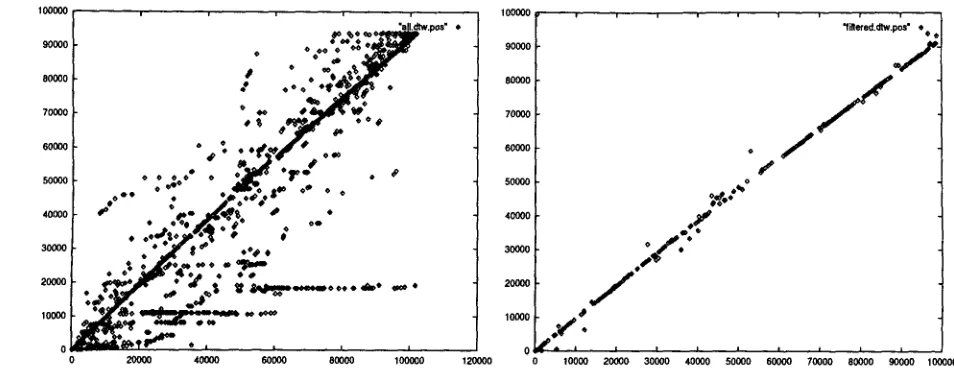
For every word pair from this lexicon, we had ob- tained a D T W score and a D T W path. If we plot the points on the D T W paths of all word pairs from the
lexicon, we get a graph as in the left hand side of Fig- ure 3. Each point (i, j ) on this graph is on the D T W
path(vl, v2)
where vl is from English words in thelexicon and
v2
is from the Chinese words in the lexi- con. The union effect of all these D T W paths shows a salient line approximating the diagonal. This line can be thought of the text alignment path. Its de- parture from the diagonal illustrates that the texts of this corpus are not identical nor linearly aligned. Since the lexicon we computed was not perfect, we get some noise in this graph. Previous align- ment methods we used such as Church (1993); Fung & Church (1994); Fung & McKeown (1994) would bin the anchor points into continuous blocks for a rough alignment. This would have a smoothing ef- fect. However, we later found that these blocks of anchor points are not precise enough for our Chi- nese/English corpus. We found that it is more ad- vantageous to increase the overall reliability of an- chor points by keeping the highly reliable points and discarding the rest.From all the points on the union of the D T W paths, we filter out the points by the following con- ditions: If the point (i, j ) satisfies
(slope constraint)
j/i
> 600 * N[0](window size constraint)
i
> = 25 -t-iprevious
(continuity constraint)
j
> =Jpreviou,
(offset constraini)
j
- - j p r e v i o u s > 5 0 0 [image:4.612.188.416.50.235.2]IO00(X)
90OO0
8O000
70000
6O00O
5O000
40000
3O00O
2C000
10OOO
0
, , , , v
~ e c e "a I.dlw.pos" • ~ o e
• $ ,t , , ~ J " O ' ~ * ¢
o * % • • ° * , ~ * r ' * *
4 ' * ~ o , ~ 4 ! P t s ° - - • ' ° " ~.4R " ~ " ¢ . o e
. .5,,,=:~. ~-¢ • , ° " . , ~ " t . ° e .
20000 40000 600(]0 80000 100000 120000
100000 v
I
90ooo i-
80000 k
7o~o
o
6OOO0 F
5 0 0 O O F ~ ¢ e ee~o
3OOOO F
1o000 F
.'f,
•0 - - ~ = i i
0 10000 20000 30000 40000 50000
d' ; v
"finered.dtw,pos" e ¢ •
,7.
I t l I
66000 70000 80000 90000 100000
Figure 3: D T W path reconstruction o u t p u t and the anchor points obtained after filtering
The constants in the above conditions are cho- sen roughly in proportion to the corpus size so that the filtered picture looks close to a clean, diagonal line. This ensures that our development stage is still unsupervised. We would like to emphasize that if they were chosen by looking at the lexicon o u t p u t as would be in a supervised training scenario, then one should evaluate the o u t p u t on an independent test corpus.
Note that if one chunk of noisy data appeared in text1 but not in text2, this part would be segmented between two anchor points (i, j ) and (u, v). We know point i is matched to point j , and point u to point v, the texts between these two points are matched but we do not make any assumption about how this segment of texts are matched. In the extreme case where i -- u, we know that the text between j and v is noise. We have at this point a segment-aligned parallel corpus with noise elimination.
5 F i n d i n g l o w f r e q u e n c y b i l i n g u a l w o r d p a i r s
Many nouns and proper nouns were not translated in the previous stages of our algorithm. T h e y were not in the first lexicon because their frequencies were too low to be well represented by positional difference vectors.
5.1 N o n - l i n e a r s e g m e n t b i n a r y v e c t o r s
In stage 6, we represent the positional and frequency information of low frequency words by a binary vec- tor for fast matching.
T h e 388 anchor points (95,10), ( 1 3 9 , 1 3 1 ) , . . . , (98809, 93251) divide the two texts into 388 non- linear segments. T e x t l is segmented by the points ( 9 5 , 1 3 9 , . . . , 98586, 98809) and text2 is segmented by the points ( 1 0 , 1 3 1 , . . . , 90957, 93251).
For the nouns we are interested in finding the translations for, we again look at the position vectors. For example, the word
prosperity
oc- curred seven times in the English text. Its posi- tion vector is (2178, 5 3 2 2 , . . . ,86521,95341) . We convert this position vector into a binary vector V1 of 388 dimensions where VI[i] = 1 ifpros-
perity
occured within theith
segment, VI[i] -- 0 otherwise. Forprosperity,
VI[i] -- 1 where i = 20, 27, 41, 47,193,321,360. T h e Chinese trans- lation for prosperity is ~ ! . Its p o s i t i o n vec- tor is ( 1 9 5 5 , 5 0 5 0 , . . . ,88048). Its binary vector isV2[i]
= 1 where i = 14, 29, 41, 47,193,275,321,360. We can see that these two vectors share five segments in common.We compute the segment vector for all English nouns and proper nouns not found in the first lex- icon and whose frequency is above two. Words oc- curring only once are extremely hard to translate although our algorithm was able to find some pairs which occurred only once.
5.2 " B i n a r y v e c t o r c o r r e l a t i o n m e a s u r e
To match these binary vectors V1 with their coun- terparts in Chinese V2, we use a m u t u a l information score m.
P r ( V 1 , V2)
m = log2 P r ( V l ) Pr(V2)
freq(Vl[i] = 1) P r ( V 1 ) --
L freq(V2[i] = 1)
Pr(V2) =
L
freq(Vl[i] -- V2[i] - 1) P r ( V I , V 2 ) =
L
[image:5.612.62.539.49.234.2]If prosperity and ~ occurred in the same eight segments, their m u t u a l information score would be 5.6. If they never occur in the s a m e segments, their m would be negative infinity. Here, for prosperity/~
~ , m = 5.077 which shows t h a t these two words are indeed highly correlated.
T h e t-score was used as a confidence measure. We keep pairs of words if their t > 1.65 where
t ~ P r ( Y l , Y2) - Pr(V1) Pr(Y2)
For prosperity/~.~]~, t = 2.33 which shows t h a t their correlation is reliable.
6 R e s u l t s
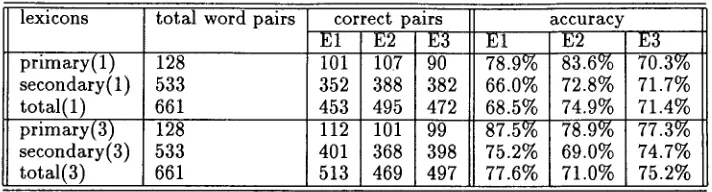
T h e English half of the corpus has 5760 unique words containing 2779 nouns and proper nouns. Most of these words occurred only once. We carried out two sets of evaluations, first counting only the best m a t c h e d pairs, then counting top three Chinese translations for an English word. T h e top N candi- date evaluation is useful because in a machine-aided translation system, we could propose a list of up to, say, ten candidate translations to help the transla- tor. We obtained the evaluations of three h u m a n judges (El-E3). Evaluator E1 is a native Cantonese speaker, E2 a Mandarin speaker, and E3 a speaker of b o t h languages. T h e results are shown in Figure 6.
T h e average accuracy for all evaluators for b o t h sets is 73.1%. This is a considerable i m p r o v e m e n t from our previous algorithm (Fung & McKeown 1994) which found only 32 pairs of single word trans- lation. Our p r o g r a m also runs much faster t h a n other lexicon-based alignment methods.
We found t h a t m a n y of the mistaken transla- tions resulted f r o m insufficient d a t a suggesting t h a t we should use a larger size corpus in our future work. Tagging errors also caused some translation mistakes. English words with multiple senses also tend to be wrongly translated at least in p a r t (e.g.,
means). There is no difference between capital let- ters and small letters in Chinese, and no difference between singular and plural forms of the same term. This also led to some error in the vector represen- tation. T h e evaluators' knowledge of the language and familiarity with the domain also influenced the results.
A p a r t from single Word to single word transla- tion such as G o v e r n o r / ~ and prosperity/~i~fl¢~,
we also found m a n y single word translations which show potential towards being translated as com- pound domain-specific t e r m s such as follows:
• f i n d i n g C h i n e s e w o r d s : Chinese texts do not have word boundaries such as space in English, therefore our text was tokenized into words by a statistical Chinese tokenizer (Fung & Wu 1994). Tokenizer error caused some Chinese characters
to be not grouped together as one word. Our p r o g r a m located some of these words. For ex- ample, Green was aligned to ,~j~,/~ and -~ which suggests t h a t , ~ j ~ could be a single Chinese word. It indeed is the n a m e for Green P a p e r - a government document.
• c o m p o u n d n o u n t r a n s l a t i o n s : carbon could be translated as ]i~, and monoxide as ~ . If
carbon monoxide were translated separately, we would get ~ --~K4h . However, our algorithm found b o t h carbon and monoxide to be m o s t likely translated to the single Chinese word - - ~ 4 h ~ which is the correct translation for carbon monoxide.
T h e words Legislative and Council were b o t h m a t c h e d to ~-¢r~ and similarly we can de- duce t h a t Legislative Council is a c o m p o u n d noun/collocation. T h e interesting fact here is,
Council is also m a t c h e d to ~J. So we can deduce t h a t ~-'r_~j should be a single Chinese word cor- responding to Legislative Council.
• s l a n g : Some word pairs seem unlikely to be translations of each other, such as collusion and its first three candidates ~ ( i t pull), ~t~(cat), F~ (tail). Actually pulling the cat's tail is Can- tonese slang for collusion.
T h e word gweilo is not a conventional English word and cannot be found in any dictionary b u t it appeared eleven times in the text. It was m a t c h e d to the Cantonese characters ~ , ~ , ~ , and ~ which separately m e a n vulgar/folk, name/litle, ghost and male. ~ means
the colloquial term gweilo. Gweilo in Cantonese is actually an idiom referring to a male west- erner t h a t originally had pejorative implica- tions. This word reflects a certain cultural con- text and cannot be simply replaced by a word to word translation.
• c o l l o c a t i o n s : Some word pairs such as projects
and ~ ( h o u s e s ) are not direct translations. However, they are found to be constituent words of collocations - the Housing Projects (by the Hong Kong G o v e r n m e n t ) . B o t h Cross and
Harbour are translated to 'd~Yff.(sea bottom), and then to Pi~:i(tunnel), not a very literal transla- tion. Yet, the correct translation for ~ J - ~ l l ~ is indeed the Cross Harbor Tunnel and not the Sea Bottom Tunnel.
T h e words Hong and Kong are b o t h translated into ~i4~, indicating Hong Kong is a c o m p o u n d name.
Basic and Law are b o t h m a t c h e d to ~ : ~ 2 ~ , so we know the correct translation for ~ 2 g ~ is
Basic Law which is a c o m p o u n d noun.
lexicons
primary(l) secondary(l) total(l) primary(3) secondary(3) total(3)
total word pairs
128 533 661 128 533 661
correct pairs accuracy
E1 E2 E3 E1 E2 E3
101 107 90 78.9% 83.6% 70.3% 352 388 382 66.0% 72.8% 71.7% 453 495 472 68.5% 74.9% 71.4% 112 101 99 87.5% 78.9% 77.3% 401 368 398 75.2% 69.0% 74.7% 513 469 497 77.6% 71.0% 75.2%
Figure 4: Bilingual lexicon compilation results
rithm found a handful of these such as Fung/~g, Wong/~, Poon/~, Hui/ iam/CY¢, Tam/--~, etc.
7
C o n c l u s i o n
Our algorithm bypasses the sentence alignment step to find a bilingual lexicon of nouns and proper nouns. Its output shows promise for compilation of domain- specific, technical and regional compounds terms. It has shown effectiveness in computing such a lexicon from texts with no sentence boundary information and with noise; fine-grain sentence alignment is not necessary for lexicon compilation as long as we have highly reliable anchor points. Compared to other word alignment algorithms, it does not need a pri- ori information. Since EM-based word alignment algorithms using random initialization can fall into local maxima, our output can also be used to pro- vide a better initializing basis for EM methods. It has also shown promise for finding noun phrases in English and Chinese, as well as finding new Chinese words which were not tokenized by a Chinese word tokenizer. We are currently working on identifying full noun phrases and compound words from noisy parallel corpora with statistical and linguistic infor- mation.
R e f e r e n c e s
BROWN, P., J. LAI, L: R. MERCER. 1991. Aligning sentences in parallel corpora. In Proceedings of the 29th Annual Conference of the Association for Computational Linguistics.
CHEN, STANLEY. 1993. Aligning sentences in bilin- gual corpora using lexical information. In Pro- ceedings of the 31st Annual Conference of the Association for Computational Linguistics, 9-
16, Columbus, Ohio.
CHURCH, K., I. DAGAN, W. GALE, P. FUNG,
J. HELFMAN, ~ B. SATISH. 1993. Aligning par-
allel texts: Do methods developed for English- French generalize to Asian languages? In Pro- ceedings of Pacific Asia Conference on Formal and Computational Linguistics.
CHURCH, KENNETH. 1993. Char_align: A program for aligning parallel texts at the character level. In Proceedings of the 31st Annual Conference of
the Association for Computational Linguistics,
1-8, Columbus, Ohio.
DAGAN, I D O , KENNETH W. CHURCH, ~:;
WILLIAM A. GALE. 1993. Robust bilingual word alignment for machine aided translation. In Proceedings of the Workshop on Very Large Corpora: Academic and Industrial Perspectives,
1-8, Columbus, Ohio.
FUNG, PASCALE & KENNETH CHURCH. 1994. Kvec: A new approach for aligning parallel texts. In
Proceedings of COLING 94, 1096-1102, Kyoto, Japan.
FUNG, PASCALE & KATHLEEN McKEOWN. 1994. Aligning noisy parallel corpora across language groups: Word pair feature matching by dy- namic time warping. In Proceedings of the First Conference of the Association for Machine Translation in the Americas, 81-88, Columbia, Maryland.
FUNC, PASCALE & DEKAI WU. 1994. Statistical augmentation of a Chinese machine-readable dictionary. In Proceedings of the 2nd Annual Workshop on Very Large Corpora, 69-85, Ky- oto, Japan.
GALE, WILLIAM A. & KENNETH W. CHURCH.
1993. A program for aligning sentences in bilingual corpora. Computational Linguistics,
19(1):75-102.
KAY, MARTIN ~; MARTIN ROSCHEISEN. 1993. Text-
Translation alignment. Computational Linguis- tics, 19(1):121-142.
KUMANO, AKIRA ~ HIDEKI HIRAKAWA. 1994.
Building an mt dictionary from parallel texts based on linguistic and statistical information. In Proceedings of the 15th International Con- ference on Computational Linguistics COLING
94, 76-81, Kyoto, Japan.
KUPIEC, JULIAN. 1993. An algorithm for finding noun phrase correspondences in bilingual cor- pora. In Proceedings of the 31st Annual Confer- ence of the Association for Computational Lin- guistics, 17-22, Columbus, Ohio.
[image:7.612.125.481.52.148.2]Language Technology Workshop 94,
Plainsboro, New Jersey.Wu, DEKAI. 1994. Aligning a parallel English- Chinese corpus statistically with lexical criteria. In
Proceedings of the 32nd Annual Conference
of the Association for Computational Linguis-
tics,
80-87, Las Cruces, New Mexico.