As the globalization process continues and be-comes ever more complex, question of the global governance efficiency rises. in order to rationalize the global decision making process, international institutions are being created on the basis of the political demand or emerge as a product of globaliza-tion trends. internaglobaliza-tional instituglobaliza-tions exist on various levels – subregional, regional, interregional or global. Such institutions aim to decrease transactional costs
of negotiations in cooperation, because on certain issues it is easier to reach an agreement within a limited group of countries e.g. a region than to deal with all the matters globally. When such international institutions are efficient, division of labor will occur among the above mentioned levels.
The following article attempts to explain some reasons why regions on the interregional level may experience difficulties cooperating with each other
SCIENTIFIC INFORMATION
Utility function applied to interregional cooperation:
case of the ASEM
Aplikace užitkové funkce v interregionální spolupráci: případ
ASEM
M. Fejfarová
Faculty of International Relations, University of Economics, Prague,
Czech Republic
Abstract: This article presents one possible point of view on the interregional cooperation through the optic of neorealist and neoliberal international relation theories. Applying the constructivist approach to utility function and creating utility function of regions, the author aims to explain the reasons of difficulties of interregional cooperation from the two above mentioned rational points of view. The conclusions are drawn on the case of the Asia Europe Meeting cooperation showing that a low integration of a participating region may hamper an interregional cooperation, and that the current economic policy of the EU towards the Asian region is on the right track.
Key words: interregionalism, regional integration, the ASEM, the EU, utility function
Abstrakt: Článek předkládá jeden z možných pohledů na interregionální spolupráci nahlíženou optikou neorealistické a neoliberalistické teorie mezinárodních vztahů. Pomocí konstruktivistického přístupu k užitkové funkci a vytvořením regionálních užitkových funkcí se autorka pokouší vysvětlit důvody problémů v interregionální spolupráci z pohledu dvou uvedených racionálních teorií. na příkladu ASEM je ukázáno, že mělká integrace jednoho z účastnících se regionů může omezit spolupráci na interregionální úrovni a že současná ekonomická strategie EU vůči Asii se orientuje správným směrem.
Klíčová slova: interregionalismus, regionální integrace, ASEM, EU, užitková funkce
even after a rather long period of time. i shall try to identify the obstacles of cooperation and the prereq-uisites to possible future improvement.
in my analysis, i start with the theory of international relations, then i apply the cardinal utility function. More specifically, i use the neoliberal and neorealist approach of international relations to set up the basic framework, then employing the constructivist theory i define the variables of the utility function and trans-form it into the two above mentioned frameworks characterizing cooperative interactions between countries. By creating the common regional utility function, i further examine cooperation between regions. The analysis is presented on the case of the Asia Europe Meeting (ASEM) as an interregional institution.
INTERREGIONAL COOPERATION AND REGIONALIST HYPOTHESIS
Using the definition of regionalism according to Van Langenhove and costea (2005), the three generations of regionalism are as follows:
– First generation (time period of 50’s–60’s): national economies integrate into a regional economic unit such as free trade area or customs union.
– Second generation – new regionalism (beginning of 80’s): regional integration takes place in various dimensions, economic but also political and/or socio-cultural.
– Both the above mentioned types of integration are more inward oriented. The next phase, that can be called interregional or transregional, is considered to be a reaction to global tendencies. it occurs when the region is ready to play an independent role in the international arena. it requires the countries of the region to pool their resources and negotiation power in order to act together as a unit. regions than interact with other regions, international or-ganizations or states. The empirical cases show that better integrated regions are more likely to engage in relations with other international agents in the global environment.
External relations of regions thus differ according to various levels of regionalization. rüland (2001) defines the above mentioned relations in two inter-regional forms:
– Bilateral interregionalism – two or more regional groups meet more or less regularly in order to exchange information and to cooperate in the par-ticular areas. The level of institutialization is low, usually taking the form of ministerial or
ambassado-rial meetings, sometimes assisted by a permanent or ad hoc expert task force. There are no common institutions being created and both parties are using their existing institutional structures (e.g. the EU-ASEAn).
– Transregional institutions – they have more diverse membership that does not necessarily correspond to regional organization and may include members from other regions. new participants of regional organizations will not become members automati-cally. As the agenda expands, transregional fora tend to create their own institutional structure (e.g. secretariat).
When comparing the older bilateral form of inter-regionalism with the new transregional institutions, we can see they are not only platforms for discus-sion between the two regions but because of their institutional structures, they are gradually gaining an independent player status in the international system. Furthermore, typically the cooperation goes beyond economic relations in the area of political, cultural or other fields of cooperation (Loewen 2007, p. 25). Similarly we can apply the three generations of regionalism on interregional organizations. At the beginning, the interregional forum is inward oriented with limited fields of cooperation. As the cooperation enhances in its scope and the coordination of regions increases during time, interregional organizations begin to find easier common viewpoints and positions. These common standpoints can be then presented in the international arena and thanks to the previ-ous interregional coordination, the development in global organization can by efficiently affected, thus strengthening the global role of the interregional organization. Taking into account the actual low level of inner coordination of interregional organi-zations, it may be an explanation of their restricted role in the global forum. We can also argue, that a low integration of one of the participating regions in an interregional institution may hinder the com-mon stance of the region in question consequently restraining an interregional agreement and preventing the interregional institution from speaking with one voice at the global forum.
institution that represent a region on the outside. The EU has both at its disposal. The EU is represented by the Presidency and the commission that also plays the coordination role. The decision making process in external relations (also in case ofthe ASEM issues) takes place in the council of the EU starting at the level of working groups, over the corEPEr to the level of foreign ministers. on the Asian side, there is a regional organization, the ASEAn, that functions on the basis of intergovernmental cooperation and decisions are made consensually, mostly ad hoc. Furthermore, there is a heterogeneous group of coun-tries of East and newly also north and South Asia, that does not have a coordination mechanism of positions or standpoints of the region towards the European partner. Although the ASEAn has been organizing summits with china, South Korea and Japan (and it is expected that the communication will intensify with the new ASEM members – india, Pakistan and Mongolia), the integration of the whole Asia region is on a very low level, mainly based on bilateral trade agreements. Following the above mentioned argument about integration of a region, we may conclude that the Asian side of the ASEM process may hinder the interregional cooperation due to its low intraregional integration level.
CONSTRUCTIVIST APPROACH
now, i will further test the above mentioned hypoth-esis of the integrations level as a possible restriction for cooperation in an interregional organization. First i will concentrate on the interregional cooperation according to rational theories of international relations that emphasize the material benefits of cooperation and consider utility functions of the cooperating play-ers as given. The rational neorealistic and neoliberal approach compares the utility of players. While the neorealists evaluate the achieved level of relative util-ity, so the player constantly balances his utility against the other players’ utility, neoliberalists compare the absolute utilities as the players maximize their utility functions. According to the neoliberalist theory as long as his utility increases, the player is willing to cooperate. The neorealist theory is based on rivalry between the players balancing power, thus the increase in utility of one player, if not balanced, is potentially threatening to the other player as the higher utility level gives the first player an advantage over the other. The rational theories can explain the problems of
in-terregional cooperation only partially. if we presume that regions tend to create interregional organiza-tions in order to deal with interregional or global issues and the regions are still open to cooperation outside the interregional body, the neorealist balanc-ing of power game seems to be of minor relevance. Also the neoliberal approach is unable to explain the present obstacles in interregional cooperation and the inefficient role these organizations play on the global level. Why is it so difficult for the participating regions to find common positions and present them to the rest of the world, when apparently addressing the issues would increase the participants’ utility from cooperation? in both cases the utility function is exogenous, therefore the cooperative behavior depends on the achieved utility assessment of the players. going beyond the utility function allows a deeper analysis of the subject.
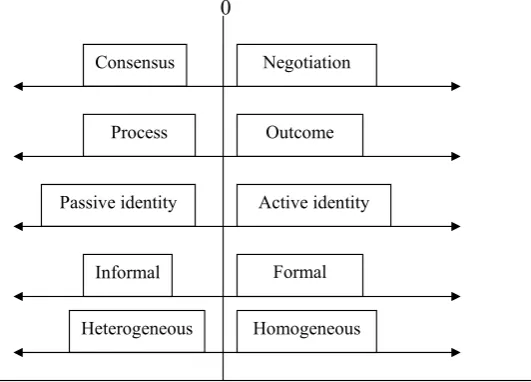
The constructivist theory considers the variables of the utility function of the players, the preferences forming the utility function are endogenous and therefore dynamic. on the contrary to the rational theories, constructivists argue that material factors do not fully define the behavior of the players and regard the non-material characteristics – shared values and principles, solidarity and identity – as decisive. Basic variables affecting the constructivist utility function are membership, rules, identities and ways of cooperation. My following analysis is based on the constructivist approach using the utility func-tion with the above variables that are continuous and dynamic in time. i will now define the variables for regional cooperation.
(A) Membership influences the homogeneity of an interregional institution, thus indirectly the level of possible integration. From the constructivist point of view, membership can be present in any form along the continuum between homogeneity and hetero-geneity. At the same time, it can develop in time: rather heterogeneous, with the gradual convergence of participating economies moving towards homoge-neity; or rather homogeneous, that with the further enlargement of the regional group becomes more heterogeneous1.
in case of a strongly heterogeneous membership, the national interests of participating economies are relatively distant, the pace of integration of the region is slow or a number of smaller groups with different integration level within the region can occur (e.g. in the ASEAn AFTA vs. the group of indochina coun-tries + Myanmar). Such heterogeneous region tends
to cooperate on the multilateral basis among all the participation countries of interregional institution rather than between the two regional groupings as two units.
(B) Rules define the ways of operation of interna-tional organizations, they can be formal or informal or any combination of both. Formal rules are binding and create clear guidelines, but they also produce ad-ministration costs for their implementation, control, enforcement or eventual amendment. informal rules allow for more creativity and being inherently not binding, they do not pose the question of enforce-ment. To follow such non-binding rules, economies are motivated by benefits reaping from cooperation based on these rules, prestige or peer pressure.
(c) Identity is strengthened by sharpening differ-ences between self and the other and thus help to galvanize regional solidarity on the basis of shared norms. in cases of highly asymmetrical relationships, inter- and transregionalism may, however, also gen-erate the unintended collective identity building. it occurs, if the relationship is perceived by one side as a device in the hands of the other to establish or consolidate superiority. Such perceptions, which tends to denounce the behavior of the superior organiza-tion in terms of paternalism or even neocolonialism, inevitably produces backslashes by encouraging the weaker (region) to develop its own set of collective symbols and mythology in opposition to the other side (rüland 2002, pp. 8–9).
(D) The way of cooperation – result or proc-ess oriented cooperation. cooperation oriented to achieving results pursues predefined goals, which it rationally attempts to reach. on the other hand, process oriented cooperation is informal, through repeated contacts and communication it focuses on trust building and networking, that may later be
used to achieve the common, often particular and ad hoc, goals.
(E) The way of cooperation – consensus seeking or negotiation and majority voting preference. Majority voting and negotiations may function efficiently in organizations, where membership is large, where reaching a consensus inadequately increases the transaction costs and the heterogeneity of members and the national interest diffuse the output. Majority voting, however, may lead to the dissatisfaction of those that voted against or abstained from voting, and therefore they may boycott or try to outweigh their losses in the next voting. Furthermore, major-ity voting is in risk of swaying the outcome by the program altering in case of intransitive preferences (for details see Frank 1994, pp. 712–717). consensus seeking, although being transactional costs intensive, provides for the outcome that satisfies all participants to some extent. The risk remains that consensus may not be reached at all and the cooperation will stall.
The above defined variables will be used further in utility functions of regions, focusing on the princi-ple of comparing the level of utility of both rational approaches, the neorealistic and the neoliberalistic, thus assessing interregional cooperation from the neoliberalist and neoliberal point of view using the tools of the constructivist approach applied on the utility theory.
UTILITY THEORY APPLICATION
The utility theory will be used to assess the bottle-necks of interregional cooperation in the case of the Asia Europe Meeting, explaining the benefits from cooperation of both participating regions – Europe and Asia. Both regions are regarded as more or less
0
Heterogeneous Homogeneous Informal Formal Passive identity Active identity
[image:4.595.72.338.574.765.2]Process Outcome Negotiation Consensus
integrated, that benefit from cooperation with the other region and are able to quantify their utility from the level of cooperation. i presume a fictional price unit “benefit”, which is a sum of political, economic and socio-cultural benefits from cooperation that would not be otherwise achieved. cooperation is in this case treated as a state value, a good, not a process.
Based on the presumption that participants are able to quantify their benefits from cooperation explicitly, they are also able to at least estimate the benefits of the counterpart2. i therefore dare to use a cardinal utility function. regions evaluate their utility in ben-efit’s units, the more benefit’s units from coopera-tion, the higher level of utility U. As cooperation is regarded as a scarce good, the utility function will be increasing in cooperation C3. no cooperation yields
no benefits, each further unit of cooperation will yield additional benefits, thus additional utility. Utility function is a sum of these additional utilities. i also assume that with the growing level of cooperation, participants value each additional unit of coopera-tion less than the previous, i thus assume decreasing marginal utility (MU). if the cooperation reaches very high levels requiring the transfer of the part of national sovereignty to a supranational body, some participants may perceive it as unacceptable and thus evaluate the higher level of cooperation as yielding lower benefits, therefore a lower level of utility U. hence U is a concave function of cooperation. Such utility function is determined by the preferences of participants; the preferences are continuous, perfect and transitive.
2 This is a very important presumption that allows me to compare the utilities of both regions, which would not be possible when using an ordinary utility function as it is not possible to compare the ordinary levels of utility. 3 It may not apply to hegemonic powers, where the cooperation in the particular fields is a inferior good; in this case,
hegemonic, power prefers a unilateral action (e.g. war in Iraq or economic sanction against Myanmar).
U
C C2= C*
U1* U2*
U1
U2
dU1 = 0
dU2 = 0
C1
C C2= C*
U1*
U2*
U1
U2
dU1 = 0
dU2 = 0
C1
U
Figure 2. Utility functions of two cooperating players – neoliberalist equilibrium
A
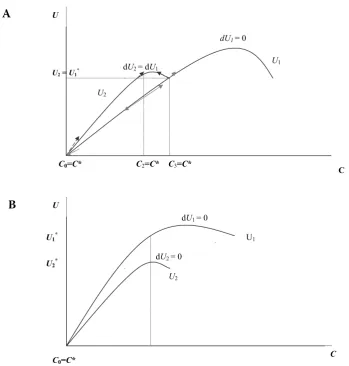
Utility functions of two cooperating players – neoliberalist equilibrium (Figure 2)
U1 and U2 are two utility functions that comply with the above defined presumptions, on the axis x, there is the level of cooperation C and on the axis y,
the level of utility U quantified in benefits.
Neoliberalists compare the absolute change in utility of participating players. if there is an increase in cooperation and the utility of the economy X
grows, it will cooperate further. So as long as the increment of utility gained by an increase of coop-eration is positive, MUX > 0 (MU being the marginal utility, thus dUX > 0, where d stands for derivation) the economy X cooperates. on the contrary, if the utility declines with the increased cooperation and
MUX < 0, the economy stops cooperating, in other words, it will not increase the cooperation further. The optimum of cooperation for the economy is therefore dUX = 0. in the above chart 2, the opti-mum of the economy 1 with U1 is in C1* and for the economy 2 v C2*, which is at the same time equilib-rium of cooperation of the system. in the interval
〈0, C2*) dU
1 > 0 is and dU2 > 0 and both players are willing to cooperate. on the contrary, in the interval of (C2*, C
1*〉 only the player 1 tends to cooperate but not player 2 because dU2 < 0. Starting from the C1*, where dU1 = 0, the player 1 also stops cooperating because he is past his optimum. The Figure 2A and 2B show two general cases that may occur when two utility functions encounter. in both cases, the area of cooperation is the interval 〈0, C2*) and the opti-mum C2*. if there are more players interacting, from the neoliberalist point of view the system optimum will be in dUX = 0 of the player with the peak of his utility function closest to 0. We may conclude that the system equilibrium of cooperation and thus the level of cooperation depends on the player that has dUX = 0 closest to the beginning, to 0.
Utility functions of two cooperating players – neo-realistic equilibrium (Figure 3)
Neorealists compare the relative utility achieved in cooperation. if the economy 1 reaps from a coopera-tion more benefits (or at least the same), thus a higher utility (or the same level) than the economy 2, it will cooperate. in the case that the increment of the utility of cooperation is positive but lower than the incre-ment of the utility of the economy 2, the economy 1 will be reluctant to cooperate. The higher relative utility of the economy 2 may in the long-term lead to an increase of power or advantage of the economy 2 over the economy 1, therefore the economy 1 may assess the higher increment of the achieved utility
of the economy 2 as threatening to the balance of power (more e.g. Waltz 1979, p. 105).
Economy 1 cooperates, if:
U1/U2 ≤ U1´/U2´ d(U1/U2) ≥ 0 dU1/dU2 ≥ U1/U2
Economy 2 cooperates, if:
U2/U1 ≤ U2´/U1´ d(U2/U1) ≥ 0 dU2/dU1 ≥ U2/U1
According to the neorealistic theory, the optimum points of cooperation will be:
1) dU1 = dU2 ….C2
2) utilities of cooperation are equal U1 = U2 ….. C3
These optimal points of cooperation for each economy will be, however, unstable, because the higher or lower level of cooperation will lead to an improvement of a situation of one of the players, reaping the higher utility and thus strengthening his position. C0, C2 and C3 are the local optimal unstable system. C0 is also an equilibrium, where both players are not cooperating but not fighting against each other. in the interval (0, C2), there is dU2 < dU1 and player 1 is interested in increasing cooperation, but the player 2 is aware of the potential advantage that the player 1 can acquire from hav-ing the higher marginal utility from cooperation. in the interval (C2, C3) the situation turns into the opposite, dU1 < dU2 and therefore the player 2 is more interested in increasing cooperation but the other one is not. The interval (C3, ∞) has basically the same characteristics dU1 < dU2. The chart 3B shows a case here the only equilibrium finds itself in 0. in case of more players participating, the number of the unstable cooperation equilibria points grows, under the condition that the local equilibrium ap-plies to the two interacting players (e.g. their utility function intersection) but the other player or players will be unsatisfied with the situation as they do not take part in the equilibrium. The unsatisfied players will seek their own equilibrium with the two players. Thus instability of the system with the continuous balance of power persists.
Variables of the utility function and variables af-fecting the utility function
– (In)formality of rules – we can generalize that shallow forms of cooperation are more often based on informal rules. With the growing intensity of cooperation, rules are becoming more formal. The utility function of players preferring less formal co-operation is steeper with its peak closer to the left, because at higher levels cooperation formalization increases and their utility therefore decreases.
better defined targets and easier measurable out-comes. Players stressing the process of coopera-tion, when the cooperation itself is the desired outcome, reap higher benefits at lower cooperation levels, thus their utility function is steeper than in the case of players stressing the importance of outcome.
– Consensus vs. negotiations – finding a consensus is a more difficult, but consequently less conflicting way of cooperation, unfortunately it can also hamper the cooperation because the consensus may not be reached at all. At lower levels of cooperation it is easier to find a consensus, but as the cooperation increases, the complexity of bargaining a consen-sus creates transactional costs at the prohibiting levels, then the negotiation and majority voting can become a useful instrument. The utility function of players favoring consensus will reach its climax at the lower levels of cooperation.
– Identity building – cooperation through the inter-action of different players enhances each particular
identity as one defines himself against the other. With the growing interest on identity building, the utility of cooperation (increasing the frequency and quality of interaction of players) increases. The player with the defined identity and the aim to foster it further will have the peak of his utility function farther from the 0 to the right side as he is aware of the positive effect of cooperation. Players not taking interest in identity building will have a steeper utility function because higher levels of cooperation are not important in this sense as the identity is being enhanced unintentionally, as a by-product of cooperation.
– Homogeneity/heterogeneity – the more homogenic the unit is, the partial interest and preferences of the parts of the unit are more similar, the more the player acts like one entity on the outside and thus he allows for higher cooperation. if the player inside is heterogeneous, the difference in inner preferences may prevent him from acquiring higher levels of cooperation with the other players.
U
C U1*
U2*
U1
U2
dU1= 0
dU2= 0
C0=C* U
C0=C* C2=C*
U1
U2
dU1= 0
dU2= dU1
C
C3=C* U2 = U1*
U
C U1*
U2*
U1
U2
dU1= 0
dU2= 0
C0=C* U
C0=C* C2=C*
U1
U2
dU1= 0
dU2= dU1
C
[image:7.595.100.450.372.739.2]C3=C* U2 = U1*
Figure 3. Utility functions of two cooperating players – neorealistic equilibrium
A
Variables that affect the utility function indi-rectly
– Economy size – large economies posses enough of economic power to achieve their target even without cooperation. They have hegemonic power. With the growing size of the economy, the peak of the utility function moves closer to the left.
– Development level of the economy – developing economies yield usually a lower utility when coop-erating with developed economies, as the benefits of cooperation are asymmetrical often in favor of the latter (developing economies receive develop-ment aid, technology transfers etc., the developed countries gain an access to unsaturated markets, investment opportunities, stable environment etc.). The developing countries also tend to protect their fragile economy from competitive pressures from the rest of the world, thus cooperating less. Therefore, i presume that with a higher level of development the optimum point of the utility function moves further from the beginning.
– Solidarity/peer pressure – in order to boost further cooperation, one player may want to help the other (weaker). So that a higher level of cooperation may then be achieved (e.g. the EU development aid to the ASEAn countries, tied with the achievement of a closer integration). Also one player may exercise political power to make the desired level of coop-eration more attractive for the other player.
THE ASEM AND THE SOCIAL UTILITY FUNCTION
The above outlined theory defined for players = econ-omies will be now applied on players = regions. As set forth at the beginning of this paper, the aim is to analyze the cooperation of the Asian and European re-gions with the ASEM process. Both rere-gions have their specifics that are crucial for their mutual cooperation in the interregional ASEM. Europe is represented by the European Union and Asia by the ASEAn++4.
Using the social constructivism from the previous chapter and the preliminary outcomes of neoliberal-ist and neorealneoliberal-ist arguments, i try to work these on the regional level, first creating the regional utility function. Player 1 is the EU. The EU being an inte-grated entity with the functioning internal market, the
convergence of member economies further continues even after enlargement (based on convergence crite-ria for monetary union). it coordinates its external actions and is represented by common institutions (the Presidency and the commission). The EU can be thus considered as a rather homogeneous entity with a relatively homogeneous economy (single market). This allows me to simplify the regional utility func-tion of the EU as an approximafunc-tion of an aggregate regional utility function. it is a social utility function of developed economy. European countries in general prefer the outcome oriented formal cooperation, that is achieved through negotiations and supports the identity of the region (in interregional organization the identity of the participants is enhanced, this brings prestige at home inside the region and the motivation of member countries to identify them-selves more with the region, which fosters the identity even further). The EU utility function is defined as
Usocial(C) = ∑Ui(C), where i = 1. UE stands for the social utility function of the European region in the ASEM framework UE = ∑Ui(C).
in the Asian case, it is not possible to approximate the social utility function as an aggregate utility func-tion for the whole region. The Asian side of the ASEM process is much more heterogeneous than the EU. We may nevertheless, with a high degree of simplification, regard the AFTA5 participating countries as being integrated in two groups the “old ASEAn” members and the new ASEAn members that need yet to adjust their economies to become fully integrated in the AFTA. other participants of the Asian region do not coordinate their economic policies, although there is e.g. an increasing number of the FTA between South Korea and the ASEAn countries. nevertheless, the rest of the Asian members will be represented each by their own utility function – Japan (large developed economy), middle size economy of South Korea, china and india (large developing economies) and two rather smaller developing economies of Pakistan and Mongolia. Therefore, there will appear 8 utility functions in the chart of the Asian region.
however, it is possible to identify the common features of cooperation of Asian partners. Asian countries tend to prefer the informal, process ori-ented cooperation, where identity building is rather a by-product. They favor consensus seeking and as the national interests of the countries of the region
4 ASEAn++ is a group of Asian countries around the center ASEAn (Brunei, cambodia, indonesia, Laos, Malaysia, Myanmar, the Philippines, Singapore, Thailand and Vietnam), East Asian countries (china, Japan and South Korea) and the new members of South and north Asia (india, Pakistan and Mongolia).
differ, the heterogeneity of the region is at a high level, thus mostly preventing the region from speak-ing with one voice.
As i concluded previously based on the neoliberal theory, the level of cooperation depends on the player with the peak of his utility function dU = 0 closest to the 0. Therefore, using the neoliberal approach, we may apply the rawls social utility function. it is a utility function of wealth and it is defined by the util-ity function of the poorest participant of the society
Usocial(M) = min.∑Ui(M), i = n. in our case, the social utility function is a function of cooperation and is defined by the utility function of the Asian economy least tending to cooperate Usocial(C)=min∑Ui(C) , where i = 1,…, 8. UA = min∑Ui(C) is the social utility function of Asia.
Regional social utility functions – the EU and the Asian region (Figure 4)
The above transformation of 8 utility curves into one according to rawls can be applied in the neolib-eral approach only. if assessing the situation in the neorealistic theory, the particular cooperation points are essential and each economy attains its optimal cooperation in interactions with all the other par-ticipants, with one EU economy and other 7 Asian economies.
Neoliberalist: Using a neoliberalist approach on two regional utility functions defined through the constructivist variables, we may deduce the rea-sons why the ASEM is not being efficient from the European point of view. The cooperation will take place to the extent of the cooperation optimum of the participant with the utility function maximum closest
to the left. The utility function of the Asian region is defined as minimum of the 8 Asian utility functions. The Asian regional utility function is more likely to reach its climax at a lower level of cooperation than the European utility function. Although at the niveau of the peak of Asian utility function European utility function still demonstrates increasing MU and Europe its thus ready to increase cooperation, the Asian region will prevent further growth of cooperation. This argument also explains why Europe is playing according to the Asian rules of cooperation at the ASEM forum. if the EU forced e.g. formal rules on the Asian region or shift from consensus seeking to majority voting (abstracting now of the smaller number of Asian participants if voting), it will block up the cooperation, because it will shift the coopera-tion point along its utility curve into the area where the Asian regional utility function has MU < 0. As the social utility function of Asia is UA = min.∑Ui(C) it is in the interest of the EU to influence the Asian economy with the minimal utility function, so that its optimum will shift further to the right.
The crucial questions remain:
(1) how to influence the utility function of this econ-omy in order to shift the optimum to the right? (2) Which one of the Asian economies has the mini-mum utility function, thus being the utility func-tion of the whole region?
Ad (1). From the above analysis of the utility function variables, we may conclude that the shift of the peak of the utility function occurs, when the preference change in following manner:
(a) reorientation from process towards outcome, (b) towards more formal rules of cooperation, (c) interest in identity building,
U
C
CA= C*
UE*
UA*
UE
UA = minUi(C)
dUE = 0
dUA = 0
[image:9.595.133.455.554.741.2]CE
(d) in case of small economies, (e) in case of developed countries.
As the preferences of the Asian countries are cul-turally based, it is unlikely to influence (a) and (b), also (d) is not possible to change. The EU can try to motivate the Asian region to take the active stance towards enhancement of its identity building and/or the EU may also influence the level of development of the Asian economies. This conclusion correlates with the present target of the economic policy of the EU towards Asia. The EU is one of the major donors in the region and it indirectly and unintentionally succeeded in identity building of the Asian ASEM partner when it tried to introduce “European values” to Asian countries at the end of the 90’s.
Ad (2). Again based on the variable analysis, we may state that the steep utility function with MU = 0 close to the left side of the graph have large econo-mies, Japan, china and india. Such function is also typical for the least developed economies such as cambodia, Laos, Mongolia and Myanmar, but these economies are at the same time very small, therefore the benefits from cooperation are higher, which pos-sibly outweighs the low development. other Asian countries having this type of utility function are those that are not interested in enhancing the regional identity, in other words the hegemonic powers out-side the ASEAn zone, Japan, china and india. This conclusion stresses the need of “special treatment” of the large economies, i particular the developing ones china and india. Again the actual EU economic policy respecting both regional hegemonic powers is in line with this finding.
Neorealist: The area of cooperation is restricted on points, where the participants will attain the same level of utility and where the derivations of their util-ity functions equal. cooperation culminates in points were the powers are balanced. nevertheless, the shift from one point to the other is complicated and ne-cessitates the ax ante agreement on the cooperation conditions in the new local optimum, thus balancing the powers. The neorealistic approach explains why it is not possible to increase cooperation between Asia and Europe in the ASEM framework. The shift between the old and new equilibrium is complicated in terms of transaction costs needed to reach the agreement on the new conditions of cooperation ax ante. As the density of the net of the bilateral points of
cooperation increases, the shift among them becomes easier. it means de facto creating ad hoc coalitions with various partners and the constant struggle to balance the benefits of cooperation among each other. There is no conclusion regarding the stability and optimum of the system.
At the same time, the above mentioned situation may explain, why neorealists are sceptical to inter-regional cooperation and consider it only as another forum to balance power between the regions and among the participating countries. it also can help to shed a bit of light on the question of stability of multipolar systems and the systems under the lead of a hegemonic power, which the neorealists see as a more stable (grieco 1997, p. 173) states, that “regionalism is less advanced in areas, where the presence of local hegemony is less obvious”. So it is in the situation of various utility functions of vari-ous economies that are trying to reach an optimum cooperation. With increasing the number of partici-pants and thus points of cooperation, the probability of reaching an optimum limitary verges 0.
on the contrary in the presence of hegemonic power in the system, the other economies concentrate on reaching optimum cooperation with the hegemony bal-ancing primarily its relationship to one economy = one utility function, the one hegemonic power. Keohane (1984) further argues, that in presence of hegemony the transactional costs are lower as the hegemony applies its power in negotiations. Therefore, hege-mony is important to maintaining institutionalized cooperation regimes. Although neoliberalism more than neorealism emphasizes the interdependency and cooperation among countries in the global economy, both theories agree that hegemony can provide better conditions for stable regionalism6.
The neorealistic approach in case of the interre-gional forum ASEM points out that the complicated multilateral consensus seeking on intergovernmental level persists. The ASEM does not decrease transac-tion costs nor leads to the division of labor among the various hierarchy levels of global governance system. The neorealitic theory also explains reasons of problems in increasing cooperation in the ASEM framework, but it does not offer alternative solutions. The culmination of single points of cooperation can be reached only by diminishing the number of utility functions, therefore only by a greater integration of the Asian region.
CONCLUSIONS
Although in its inaugural documents the ASEM states the ambition to play a role on the global level, it has not reached the sufficient cooperation inside this interregional forum and also one of the partici-pating regions is not integrated enough to attain a higher degree of regionalization and to be effective in its external relations.
The neorealists see the only possible solution of the present stage of slow cooperation in the above mentioned regional integration. From the neoliberal-ist point of view, the solution seems to be the EU’s encouragement of interest of Asia in enhancing its regional identity and the support of economic de-velopment in Asia.
REFERENCES
Frank r.h. (1994): Microeconomics and behaviour. Mc-graw-hill inc., London.
grieco J. (1997): Systemic Sources of Variation in regional institutionalization in Western Europe,
East Asia and the Americas. in: Milner h., Mans-field E. (eds.): The Political Economy of region-alism, pp. 164–168. columbia University Press, new York.
Keohane r.o. (1984): After hegemony: coopera-tion and Discord in the World Political Economy. Princeton University Press, Princeton.
Loewen h. (2007): East Asia and Europe – part-ners in global politics? Asia Europe Journal, 5
(1): 23–31.
rüland J. (2001): ASEAn and the European Union: A Bumpy inter-regional relationship. Discussion Paper 95c, zentrum für Europäische integrations-forschung, Bonn.
rüland J. (2002): interregionalism and international relations. conference Summary, Freiburg, 11. 04. 2002.
Van Langenhove L., costea A-c. (2005): inter-region-alism and the future of multilaterinter-region-alism. UnU-criS occasional Papers 0_2005/13.
Waltz K. (1979): Theory of international Politics. Addison Wesley, reading, M.A.
Arrived on 13th March 2008
Contact address:
Michaela Fejfarová, University of Economics, Department of World Economy, Winston churchill Sq. 4, 130 67 Prague 3, czech republic.