State of contamination of agricultural soils after floods
in August 2002
R. Vácha, O. Poláček, V. Horváthová
Research Institute for Soil and Water Conservation, Prague, Czech Republic
ABSTRACT
Sixteen soil samples from agriculturally used soils flooded in August 2002 were taken because new information about the state of soil contamination was required. The area in the Vltava river basin from Prague to Mělník and in the Labe river basin from Neratovice to Děčín was investigated. The samples were taken in September 2002 and analysed for the con-tents of potentially risky elements and persistent organic pollutants, including persistent dibenzodioxins and dibenzo-furans. The results were compared with the data from the project Labe 1992. The findings show a low soil load of potentially risky elements and a slight reduction of their contents in soil in comparison with the state in 1992 (except for vanadium). The same situation was observed in the case of persistent organic pollutants. Only the content of DDT was increased in the soils of most localities after floods in August 2002. This finding needs further observations on a larger collection of samples. The dreads resulting from expected soil contamination by dibenzodioxins from Spolana Neratovice factory were not confirmed and their contents in the soils of observed localities meet the requirements for plant produc-tion without any reducproduc-tion.
Keywords: floods; potentially risky elements; persistent organic pollutants; dibenzodioxins and dibenzofurans
This project was actually included in a research pro-gram of the Research Institute of Soil and Water Conser-vation in Prague The Contamination of the Soil and Other Ecological Media through the Soil by Risky Sub-stances in Interaction with the Other Degradation Pro-cesses after floods in the basins of the Vltava and Labe rivers in August 2002. The need of the solution to the problem resulted from the hazard of potential soil con-tamination on flooded areas by many risky substances. Increased loads of risky elements and persistent organic pollutants in Fluvisols were reported in the same areas in 1992 (Podlešáková et al. 1994). The situation after floods could change in many ways. Increased attention was paid especially to the chemical factory Spolana Neratovice, where the old load of extremely increased content of 2,3,7,8 tetrachlorodibenzodioxin (2,3,7,8 TCDD) in some not sufficiently protected facilities is known very well. The risk of leakage of high concentrations of 2,3,7,8 TCDD into the water of the Labe river could not be prevented. The aim of the project was to examine the state of soil con-tamination in observed areas and possibly to recommend the reduction of plant production at contaminated sites.
MATERIAL AND METHODS
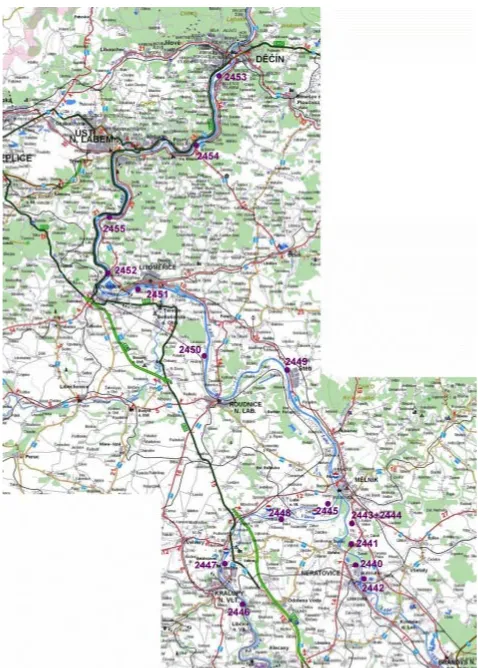
Soil samples from Ap horizons (5–15 cm) of selected localities of the flooded area were taken. The observed area covered the basin of Vltava river from north of Pra-gue to Mělník and the basin of Labe river from Neratovice (Mlékojedy locality) to Děčín (Boletice nad Labem local-ity). The amount of 16 samples from 15 localities was analysed. One sample of soil and one sample of top layer
sediment (thickness 5 mm) were taken in Kelské Vinice locality. The map of the observed area is presented in Figure 1.
A methodological approach was developed for the compatibility with the information resulting from the project Labe 1992. The choice of the localities mostly followed this aim. The contents of risky elements and persistent organic pollutants (POPs) were analysed in the samples. The list of analyses is presented in Table 1. Total contents (extract of mixture of the acids, Hg by AMA method) of 12 risky elements (As, Be, Cd, Co, Cr, Cu, Hg, Mn, Ni, Pb, V and Zn) in the samples were analysed in central laboratories of the Research Institute of Soil and Water Conservation in Prague. The concentrations of POPs (monoaromatic, polyaromatic and chlorinated hy-drocarbons, residues of pesticides and petroleum hydro-carbons) were analysed in the laboratory of AQUATEST Praha by the methods reported in the papers of Němeček et al. (1994) and Podlešáková et al. (1998). The analyses of the content of persistent dibenzo-p-dioxins and diben-zofurans (PCDD/F) in the samples were carried out in the laboratory of AXYS VARILAB in Vrané nad Vltavou by the methods reported in the paper of Jech et al. (1999) and summarised in the paper of Podlešáková et al. (2000).
The evaluation of the PCDD/F in samples was made by the use of I-TEQ factors, the principle is reported by Podlešáková et al. (2000). Only three samples from the period before the floods were available for the compari-son of PCDD/F concentrations in soils.
RESULTS AND DISCUSSION
RISKY ELEMENTS
The soil load of potentially risky elements after floods is presented in Table 3. The number of exceeded values over prevention limit (limit A) and indication limit (limit B) is
[image:3.595.56.525.74.409.2]reported in the table. The used limit values were proposed for the amendment of Czech Regulation No. 13/1994 to Soil Protection Act (Sáňka et al. 2002). Prevention limit was derived from background values of risky elements in the soil. Indication limit gives the information about the risk of exceeding of safety concentrations of risky elements
Table 1. List of the analyses
Analyses Laboratory Samples
pH, Cox RISWC Praha 1 6
As, Be, Cd, Co, Cr, Cu, Hg, Mn, Ni, Pb, V, Zn – total contents RISWC Praha 1 6
Monoaromatic hydrocarbons
benzene, toluene, xylene, ethylbenzene Aquatest Praha, a.s. 1 6
Polyaromatic hydrocarbons
naphthalene, anthracene, pyrene, fluoranthene, fenanthrene, chrysene, benzo(b)fluoranthene, benzo(k)fluoranthene,
benzo(a)anthracene, benzo(a)pyrene, indeno(c,d)pyrene, benzo(ghi)perylene
Chlorinated hydrocarbons
PCB, HCB, α-HCH, β-HCH, γ-HCH
Pesticides
DDT, DDD, DDE
Petroleum hydrocarbons
PCDF
2,3,7,8 TeCDF, 1,2,3,7,8 PeCDF, 2,3,4,7,8 PeCDF,
1,2,3,4,7,8 HxCDF, 1,2,3,6,7,8 HxCDF, 1,2,3,7,8,9 HxCDF, 2,3,4,6,7,8 HxCDF,
1,2,3,4,6,7,8 HpCDF, 1,2,3,4,7,8,9 HpCDF, OCDF PCB 189, PCB 170, PCB 180 Axys Varilab, s.r.o. 1 6
PCDD
2,3,7,8 TeCDD, 1,2,3,7,8 PeCDD, 1,2,3,4,7,8 HxCDD, 1,2,3,6,7,8 HxCDD, 1,2,3,7,8,9 HxCDD, 1,2,3,4,6,7,8 HpCDD, OCDD
P C B
PCB 77, PCB 126, PCB 169, PCB 105, PCB 114, PCB 118 + 123, PCB 156, PCB 157, PCB 167
Cox = organic carbon
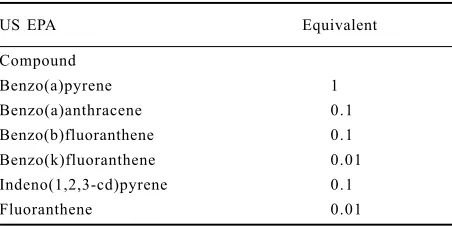
Table 2. Toxic equivalents of PAHs
US EPA Equivalent
Compound
Benzo(a)pyrene 1
Benzo(a)anthracene 0.1 Benzo(b)fluoranthene 0.1 Benzo(k)fluoranthene 0.01 Indeno(1,2,3-cd)pyrene 0.1
[image:3.595.295.526.569.759.2]Fluoranthene 0.01
Table 3. The numbers of values exceeding the proposed limit values of risky elements in soil
Element Sediment Soil Soil 92
A B A B A B
As 1 0 3 0 3 0
Be 1 – 1 – 7 –
Cd 1 1 8 0 8 2
Co 0 0 0 0 0 0
Cr 0 0 3 0 3 0
Cu 0 0 0 0 2 0
Hg 1 0 2 0 8 1
M n 0 – 0 – 1 –
Ni 0 0 0 0 1 0
Pb 1 0 0 0 4 0
V 0 – 1 – 0 –
[image:3.595.57.283.647.760.2]in the plants. The concentrations of risky elements in the soil from 1992 are reported for comparison (soil 92). The values for the top layer sediment are reported individually. Increased concentrations of As, Be, Cd, Hg, Pb and Zn were detected in the top layer sediment from Kelské Vi-nice locality. The values higher than the prevention limit were detected in all cases. The value of indication limit was exceeded in the case of Cd only. The concentrations of all elements except As, Cr and V reached the maximum in the top layer sediment. In the soils of all localities the value of indication limit was not achieved. The risk of the contamination of crops planted at the observed sites by risky elements is not imminent.
[image:4.595.120.452.54.283.2]An increase in V concentrations was detected only in the soil in comparison with the state before the floods. The concentrations of most elements in the soils are in-creased after floods (in comparison with the state before the floods) in the localities of the river basin from Prague to Kelské Vinice. Decreased concentrations of these ele-ments in the soils (in comparison with the state before the floods) were detected on most localities of the river basin from Štětí to Boletice nad Labem where the industrial towns of Lovosice and Ústí nad Labem are situated. The contamination of Fluvisols by many risky elements (Cd > Hg, Zn > Cu > Pb and Cr) was found in the past mostly in the vicinity of these towns (Podlešáková et al. 1994).
Figure 2. The sum of PAHs in soil after flood and in the past
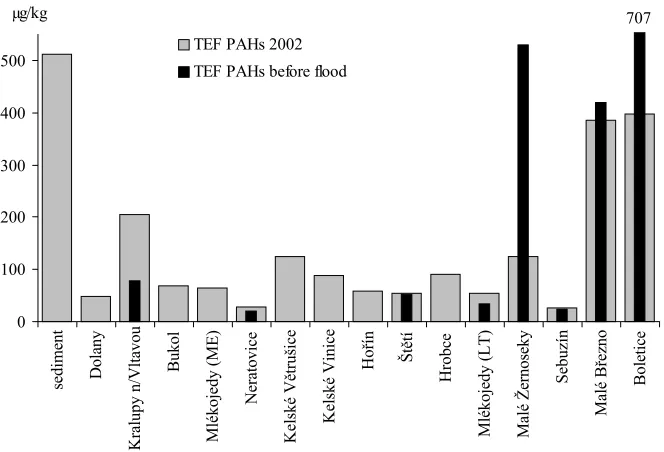
Figure 3. TEF values of PAHs in soil after flood and in the past
707
0 100 200 300 400 500
sediment Dolany
Kralupy n/Vltavou
Bukol
Mlékojedy (ME)
Neratovice
Kelské V
ě
trušice
Kelské Vinice
Ho
ř
ín
Št
ě
tí
Hrobce
Mlékojedy (LT) Malé Žernoseky
Sebuzín
Malé B
ř
ezno
Boletice
TEF PAHs 2002 TEF PAHs before flood µg/kg
11298 9566 8100
0 500 1000 1500 2000 2500 3000 3500 4000 4500
sediment Dolany
Kralupy n/Vltavou
Bukol
Mlékojedy (ME)
Neratovice
Kelské V
ě
trušice
Kelské Vinice
Ho
ř
ín
Št
ě
tí
Hrobce
Mlékojedy (LT) Malé Žernoseky
Sebuzín
Malé B
ř
ezno
Boletice
? PAHs 2002 ? PAHs before flood µg/kg
[image:4.595.125.457.515.741.2]PERSISTENT ORGANIC POLLUTANTS
Polyaromatic hydrocarbons (PAHs)
The values of the concentrations of the sum of polyar-omatic hydrocarbons are presented in Figure 2. The high-est load of PAHs was found in the top layer sediment from Kelské Vinice locality. We can draw a conclusion about an increased input of PAHs into the water of the Labe river from different sources. The concentration of PAHs in the top layer sediment exceeds the prevention limit of PAHs in agriculturally used soils three times. But the influence of increased concentrations of PAHs in
water on their concentrations in soil is limited. In the soils of the basin of Vltava and Labe rivers from Prague to Ústí nad Labem the concentrations of PAHs are below the value of prevention limit for agricultural soils. The in-crease in the concentration of PAHs in the soils in the basin of Labe river from Ústí nad Labem to the north (the influence of industrial towns) is evident. Therefore all the concentrations of PAHs in Fluvisols reach lower values in comparison with the state ten years ago. The trend of decrease in high PAHs concentrations in Fluvisols in the basin of Labe river (Podlešáková et al. 1994) very proba-bly relates with the increase in water quality in Labe dur-ing the last ten years. The risk for plant production
94 63 123
0 5 10 15 20 25 30 35 40 45
sediment Dolany
Kralupy n/Vltavou
Bukol
Mlékojedy (ME)
Neratovice
Kelské V
ě
trušice
Kelské Vinice
Ho
ř
ín
Št
ě
tí
Hrobce
Mlékojedy (LT) Malé Žernoseky
Sebuzín
Malé B
ř
ezno
Boletice
[image:5.595.129.459.60.282.2]PCBs 2002 PCBs before flood µg/kg
Figure 4. The sum of PCBs in soil after flood and in the past
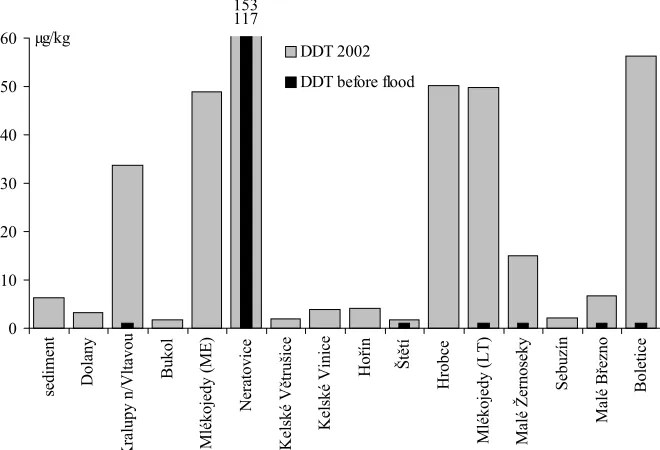
Figure 5. DDT in soil after flood and in the past 153 117
0 10 20 30 40 50 60
sediment Dolany
Kralupy n/Vltavou
Bukol
Mlékojedy (ME)
Neratovice
Kelské V
ě
trušice
Kelské Vinice
Ho
ř
ín
Št
ě
tí
Hrobce
Mlékojedy (LT) Malé Žernoseky
Sebuzín
Malé B
ř
ezno
Boletice
[image:5.595.129.459.513.738.2]resulting from the concentrations of PAHs in the soil is lower after floods than ten years ago.
A similar result follows from a comparison of the val-ues of toxic equivalent factors (TEF) of carcinogenic compounds from the group of PAHs (Figure 3). In-creased persistence of these compounds in the soil re-sults from the comparison of recent and older values (1992). The differences between these values are not so opposed as the differences between the values of the sum of PAHs.
Chlorinated hydrocarbons (ClHs)
The concentrations of the sum of six PCB compounds are presented in Figure 4. The concentration in the top layer sediment exceeds the proposed prevention limit for agricultural soils only slightly. PCB concentrations in the soils do not reach (except for Boletice nad Labem locality) the value of the proposed prevention limit for agricultural soils. A decrease in PAH concentration in Fluvisols of Labe in comparison with the situation in the past could be observed. The load of PCBs in the soils of the observed localities was not significant after floods.
DDT shows converse trends of occurrence in the Flu-visols of the Labe river contrary to other POPs (Figure 5). While the low concentrations of DDT were established in Fluvisols in recent past, the values exceeding the pro-posed prevention limit of DDT in agricultural soils of five localities were recorded after floods. DDT concentra-tions mostly exceed the prevention limit twice (three times in Boletice nad Labem locality). The leakage of a higher amount of DDT in floodwater from old loads or wrongly liquidated reserves could be assumed.
Petroleum hydrocarbons (PHs)
The leakage of petroleum hydrocarbons into floodwa-ter documents their increased content in the top layer sediment where the concentration is 180 multiple of the proposed prevention limit for agricultural soils. The in-fluence of this leakage of PHs on their concentration in the soils is limited. An increase in PH concentrations was detected in the Fluvisol of the Vltava river basin in Kra-lupy nad Vltavou locality only. In the Fluvisols of the Labe river basin the PH concentrations reached the same or markedly lower level (from Štětí locality to the north) in comparison with the state in recent past. The deterio-ration of the hygienic state of soils caused by the leak-age of PHs into floodwater was not found.
Persistent dibenzo-p-dioxins and dibenzofurans (PCDD/F)
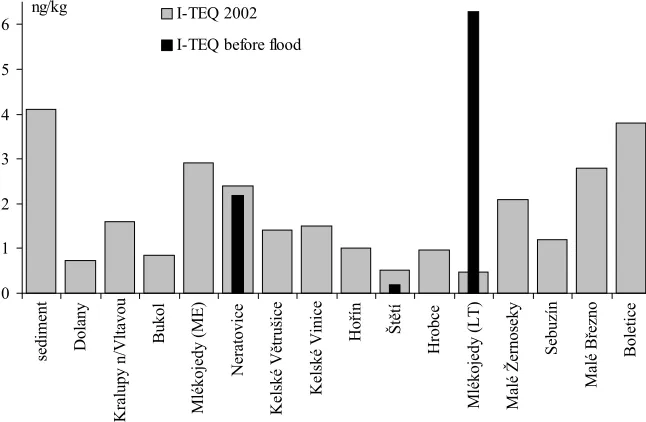
PCDD/F are a group of compounds that attract atten-tion after the floods, first of all thanks to the Spolana Neratovice factory (2,3,7,8 TeCDD was produced in the factory as a by-product in the past). It could be conclud-ed from Figure 6 that the maximum of the I-TEQ PCDD/F value was reached after floods in the top layer horizon in Kelské Vinice locality. This maximum value (4.1 ng/kg) of I-TEQ PCDD/F does not exceed for example the German limit for unlimited agriculture. The maximum value of I-TEQ PCDD/F in the soil (3.8 ng/kg) was detected in Boletice nad Labem locality. The value of I-TEQ PCDD/F did not exceed the background value (1.0 ng/kg) proposed for agriculturally used soils in the Czech Republic (Vácha et al. 2001) in seven localities (out of their total number fif-teen). It is very presumptive that the massive leakage of
0 1 2 3 4 5 6
sediment Dolany
Kralupy n/Vltavou
Bukol
Mlékojedy (ME)
Neratovice
Kelské V
ě
trušice
Kelské Vinice
Ho
ř
ín
Št
ě
tí
Hrobce
Mlékojedy (LT) Malé Žernoseky
Sebuzín
Malé B
ř
ezno
Boletice
I-TEQ 2002
[image:6.595.133.456.57.268.2]I-TEQ before flood ng/kg
PCDD/F from the Spolana Neratovice factory into flood-water could not lead to so low values of I-TEQ PCDD/F in the soil. The obvious leakage of PCDD/F from the Spo-lana Neratovice factory into floodwater was not estab-lished by the comparison of individual PCDD isomers in Fluvisols, either. The prevailing content of OCDD and OCDF isomers and very low content of 2,3,7,8 TeCDD confirm other sources of PCDD/F in soils than the Spola-na factory. Besides, a markedly higher value of I-TEQ PCDD/F was detected in Mlékojedy locality before the flood. The concentrations of PCDD/F in the soils of the observed localities do not pose any risk for plant produc-tion on flooded soils.
REFERENCES
Jech L. et al. (1999): The study of the presence of persistent organic pollutants in the atmosphere and their deposition on the area of Czech Republic. [Final Rep. VaV 520/6/99.] Vrané nad Vltavou: AXYS Varilab. (In Czech)
Němeček J., Podlešáková E., Firýt P. (1994): Contamination of the soils of north bohemian region by persistent organic xenobiotic compounds. Rostl. Výr., 40: 113–121.
Podlešáková E., Němeček J., Hálová G. (1994): The load of fluvisols of Labe by risk compounds. Rostl. Výr., 40: 69–80. Podlešáková E., Němeček J., Vácha R. (2000): Contamination of agriculturally used soils with polychlorinated dibenzo-p-dioxins and dibenzofurans. Rostl. Výr., 46: 349–354. Podlešáková E., Němeček J., Vácha R., Pastuszková M.
(1998): Contamination of soils with persistent organic xe-nobiotic substances in the Czech Republic. Toxicol. Envi-ron. Chem., 66: 91–103.
Sáňka M., Němeček J., Podlešáková E., Vácha R., Beneš S. (2002): The elaboration of limit values of the concentra-tions of risky elements and organic persistent compounds in the soil and their uptake by plants from the viewpoint of the protect of quantity and quality of plant production. [Rep. Minist. Environ. CR.] (In Czech)
Vácha R., Podlešáková E., Němeček J., Poláček O. (2001): The state of the load of agriculturally used soils by persistent or-ganic pollutants. Chem. Listy, 95: 590–593. (In Czech)
Received on February 20, 2003
ABSTRAKT
Stav kontaminace zemědělských půd po povodních v srpnu 2002
Bylo analyzováno šestnáct vzorků zemědělských půd z ploch postižených povodněmi v srpnu 2002 s cílem získat první údaje o hygienickém stavu půd. Sledovaná oblast zahrnovala povodí Vltavy v úseku od Prahy k Mělníku a povodí Labe v úseku od Neratovic k Děčínu. Vzorky půd byly odebrány v září 2002 a byl v nich stanoven obsah potenciálně rizikových prvků a obsah perzistentních organických polutantů, včetně perzistentních dibenzodioxinů a dibenzofuranů. Výsledky roz-borů byly porovnány s výsledky získanými v rámci projektu Labe 1992. Závěry potvrdily nízkou úroveň zátěže půd sle-dovaných lokalit rizikovými prvky a mírný pokles jejich obsahů při srovnání se stavem v roce 1992 (kromě vanadu). Podobná situace byly zjištěna v případě perzistentních organických polutantů. Pouze obsahy DDT dosahovaly po povodních v srpnu 2002 ve srovnání se stavem v nedávné minulosti zvýšených hodnot v půdách z většiny lokalit. Toto zjištění vyžaduje po-drobnější šetření na rozšířeném souboru vzorků. Obavy vyplývající z kontaminace půd dibenzodioxiny ze Spolany Nerato-vice nebyly potvrzeny a jejich obsah v půdách sledovaných lokalit vyhovuje požadavkům na pěstování zemědělských plodin bez omezení.
Klíčová slova: povodně; potenciálně rizikové prvky; perzistentní organické polutanty; dibenzodioxiny a dibenzofurany
Corresponding author: