A part of starch exists in forms that are not hydro-lysed by human digestive enzymes (resistant starch, RS) within the small intestine and passes into the colon and therefore RS could be regarded as a part of dietary fibre. The fermentation of RS increases the formation of short-chain fatty acids (SCFAs) and, for various types of resistant starch, a different proportion of butyrate. The principal SCFAs produced via bacterial fermentation are acetate, propionate, and butyrate, present in the colon at the approximate molar ratio of 60 : 20 : 20 (Cummings et al. 1987). This improves the blood cholesterol level, assists in the control of diabetes glucose tolerance, and causes lower blood lipid levels (Björck & Asp 1994; Shih et al. 2007; Zhou et al. 2014), properties in common with other dietary fibres. The average intake of RS in European countries is approximately 4 g/day (Asp et al. 1996).
Resistant starch is classified into several categories; among them, the RS3 group is retrograded amylose, and RS4 includes some chemically modified starches (Jane et al. 2010). The transformation of starchy materials into RS3 is the re-association of amylose chains into a form of double helices which are loosely arranged into a partially crystalline system; this hinders the diffu-sion and binding of hydrolytic enzymes (Eerlingen et al. 1993). Resistant starch RS3 is formed easily from starches having a high content of amylose; hence, there are RS products based on amylomaize on the market, e.g. Hi-maize® and Amylomaize N-400. Smrčková et al. (2014) and Šárka et al. (2015) observed higher RS3 in extruded food containing either added legume flours or simply amylose. Zhou et al. (2014) found that starch from high-amylose wheat has a markedly slower digestion rate than normal and waxy partners.
Two Resistant Starches Applied in Bread
Evžen Šárka1*, Miroslava kubová1, Iva WIEgE1, Pavel Horák2, Petra SMrčková1,
václav DvořáčEk3 and David CHEna1
1Department of Carbohydrates and Cereals, Faculty of Food and biochemical Technology,
university of Chemistry and Technology Prague, Prague, Czech republic;
2Institute of Macromolecular Chemistry, Czech academy of Sciences, Prague, Czech republic; 3Crop research Institute, Prague, Czech republic
*Corresponding author: [email protected]
Abstract
Šárka E., Kubová M., Wiege I., Horák P., Smrčková P., Dvořáček V., Chena D. (2017): Two resistant starches ap-plied in bread. Czech J. Food Sci., 35: 67–72.
Resistant starch (RS), which is inaccessible to human digestive enzymes, is fermented in the colon, producing short-chain fatty acids which have beneficial effects on the human health. Both laboratory-prepared acetylated starch (AS) (degree of substitution 0.82) and Hi-maize commercial starch were tested as additives to bread formulations (recipes). The quality of composites prepared from commercial wheat flour and 5–25% of the added starch was identified by an RVA analyser and the Mixolab rheological test. The bread volume, stiffness (durability), and sensory parameters were evaluated. The addition of 15% Hi-maize®caused a worse appearance, lower volume, and a light colour of the crust. On the other hand, it increased RS content to 5%. The substitution of 5% wheat flour with AS proved to be the most suitable, as the bread was highly appraised by consumers, the retrogradation of starch decreased, and RS content was 2.4%, approximately twice that of the bread without any starch addition.
Keywords: bread; additives; Mixolab; baking quality; acetylated starch; high-amylose starch; starch digestion
Food Technology and Economy, Engineering and Physical Properties Czech J. Food Sci., 35, 2017 (1): 67–72
doi: 10.17221/343/2016-CJFS Chemical modifications of starch are used to alter
physicochemical properties in order to obtain desired functional properties in food and non-food applications. Resistant starch RS4 includes e.g. hydrophobic starch derivatives (Sha et al. 2012) or cross-linked starches having a high degree of substitution (Zhang et al. 2014).
Acetates with a low degree of substitution (DS) 0.01–0.2 have a low gelatinisation temperature, high solubility, good cooking and storage stabilities, and provide thickness, body, and texture in foods (Miya- zaki et al. 2006). By contrast, starch acetates of high DS(AS) have amorphous character, hydrophobicity, and melt processability (Šárka et al. 2012).
Bread is considered a basic component of the hu-man diet. High fibre breads have certain negative attributes such as reduced loaf volume, dark colour, poor mouthfeel, and masking of flavour, all of which have paved the way for the use of resistant starch (Ashwar et al. 2016). A reduction in the dough matrix gluten content and the chemical structure of added starch can influence bread properties negatively; therefore, the bread-making potential of modified starches is limited (Defloor et al. 1993). Another negative influence is that RS is often less prone to pasting, which can affect the quality of the resulting loaves (Miyazaki et al. 2006). Ziobro et al. (2012) reported that modified starches could be used with up to 20% substitution for wheat flour without de-terioration of bread quality.
The aim of the paper was to test two types of RS as food additives in bread to verify impacts on proper-ties of the dough, RS content, and the physical and sensory attributes of the bread.
MATeRiAl And MeThodS
Material and preparation of acetylated starch.
Hi-maize® resistant starch (DM 88%) was purchased from REJ s.r.o., Planá nad Lužnicí and wheat flour (DM 86.7%) from Malitas s.r.o., Slatinice. Acetylation of wheat A-starch by acetic anhydride was performed in a microwave reactor at 118°C (Horák et al. 2014).
NaOH solution was added as a catalyst. DS 0.82 was determined by the 1H NMR method (Šárka et al. 2010).
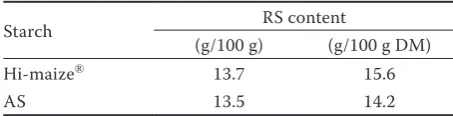
Resistant starch contents in starches are in Table 1.
Preparation of the bread. The fermentation and
baking (Table 2) were done in a Kenwood BM 450 bread machine (program No. 1) (United Kingdom). Acetylated starch (proportion 0, 5, 10, 15%) or Hi-maize® (proportion 0, 5, 15, 25%) were substituted for a part of the flour.
Methods. Total starch content was quantified by
a Megazyme total starch assay kit (AACC 76-13 method) and RS content using a Megazyme kit by the AACC 32-40 (2002) method.
Rheological properties of the wheat flour and blends were tested by an RVA 4500 analyser (Perten Instru-ments, Sweden). The profile was as follows: idle and hold at 50°C, 0:00–1:00 min; ramp up to 95°C, 1:00 to 4:45 min; hold at 95°C, 4:45–9:12 min; cooling at 50°C, 9:12–15:00 min; hold at 50°C, 15:00–21:00 minutes. The water absorption capacity and dough proper-ties were determined by Mixolab (Chopin, France). The time for the first plateau at 30°C was 6 min, the second plateau was at 90°C over 7 min, and the third plateau had 5 min at 55°C.
The volume of the loaf was measured according to the AACC (2000) method 10–05.01 and the shelf-life with a PNR 10 penetrometer (Petrotest Instruments, Germany). The appearance, elasticity, taste, and smell of the fresh bread were tested by 12 non-professional consumers (6 men and 6 women) according to an internal method having the scale of 0–10 points for each feature. Every analysis and every baking were done in duplicate.
ReSulTS And diScuSSion
RVA measurement. After the addition of
[image:2.595.305.530.123.224.2]acety-lated starch (AS) to the wheat flour, the viscosity peak, breakdown, and final viscosity decreased rapidly (Figure 1A). The pasting temperature of the wheat Table 2. The basic formulation of the dough
Weight (g) Ratio (%)
Mixture flour/starch 300.0 100.0
Water 200.0 66.7
Sugar 7.0 2,7
Oil 5.6 2.3
Salt 8.0 1.9
Yeast 5.0 1.7
Table 1. Resistant starch (RS) content in Hi-maize® and
acetylated starch (AS)
Starch RS content
(g/100 g) (g/100 g DM)
Hi-maize® 13.7 15.6
[image:2.595.62.289.709.767.2]flour was 67°C and increased slightly with increasing AS content. The viscosity peak decreased with AS addition in contrast to Miyazaki et al. (2006), who tested the addition of low DS acetylated tapioca starch to wheat flour. Colussi et al. (2015) reported that high DS acetylated starches showed a lower swelling power compared to native starch. This was confirmed in our experiment, where higher AS content decreased the breakdown of viscosity; nevertheless, only a small dif-ference was found between individual AS additions. Holding strength was almost the same for all AS con-tents. The higher the AS, the lower the final viscosity. The decrease in pasting properties was found to be greater for Hi-maize® compared with the AS (Figure 1B). The results indicate that the addition of Hi-maize® had a greater influence on viscos-ity peak, pasting temperature, breakdown, holding strength, and final viscosity compared to that of AS. According to Witczak et al. (2012, 2016) pasting properties decreased when RS addition increased. The highest fall of viscosity was found for propor-tions between 5 and 15% of Hi-maize®. The viscosity peak, breakdown, and final viscosity decreased with an increase in Hi-maize® content in the blends, which is in agreement with Fu et al. (2008). The pasting
temperature increased significantly after the addition of Hi-maize®, approximately 1°C per dose.
The addition of Hi-maize® resulted in a fall of breakdown. This result indicates that the blend with the 25% Hi-maize® addition had lower peak viscos-ity caused by higher crystallinviscos-ity or denser starch structure; this blend was also more resistant to heat and shear forces compared to those containing only wheat flour or small Hi-maize® additions. The final viscosity showed an increase after the cooling period due to the re-association of amylose and amylopec-tin and because of gel formation. The final viscos-ity additionally showed run-down with increasing Hi-maize® addition: this result was in accordance with the study of Fu et al. (2008). The highest final viscosity was found for wheat flour, suggesting that the highest amylose retrogradation occurred therein.
Mixolab measurements. The flour had high
ab-sorption (73%), long duration of the 1st plateau (C1 =
7.25 min), middle gluten weakening [C2 = 0.51 N·m; near the data of Švec and Hrušková (2015)], and pro-longed stability (10.5 min). The area (C3¸ C5) showed the high viscosity of starch undamaged by enzymes. The stability of the starch gel (C3-C4) was found to be 0.42 N·m [Banu et al. (2011) – 0.40 N·m; Dvořáček
45 50 55 60 65 70 75 80 85 90 95 100 0 400 800 1200 1600 2000 2400 2800
0 100 200 300 400 500 600 700 800 900 1000 1100 1200 1300
Temperature (°C) Vi sc os ity (m Pa ·s) Time (s) 0% 5% 10% 15% Temperature profile 45 50 55 60 65 70 75 80 85 90 95 100 0 400 800 1200 1600 2000 2400 2800
0 100 200 300 400 500 600 700 800 900 1000 1100 1200 1300
Te m pera tu re ( ° C ) Vi sc os ity (m Pa ·s) Time (s) 3.5 3.0 2.5 2.0 1.5 1.0 0.5 0
0 500 1000 1500 2000 2500 Time (s)
25% Hi-maize®
15% Hi-maize®
5% Hi-maize®
0% Hi-maize®
Tor
[image:3.595.65.532.106.230.2]que (Nm)
Figure 1. Viscogram of viscometric analysis of the (A) mixture flour/AS and (B) mixture flour/Hi-maize® performed by RVA
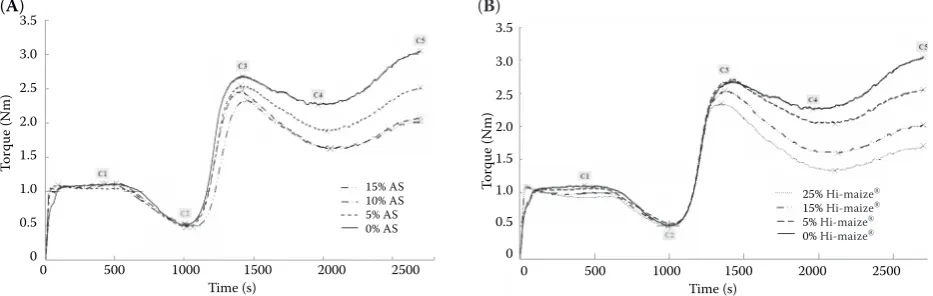
Figure 2. MixolabTM curves and analysed parameters for (A) acetylated starch and (B) Hi-maize® addition
Tor
que (Nm)
0 500 1000 1500 2000 2500 Time (s) 15% AS 10% AS 5% AS 0% AS 3.5 3.0 2.5 2.0 1.5 1.0 0.5 0
(A) (B)
[image:3.595.64.531.600.748.2]Food Technology and Economy, Engineering and Physical Properties Czech J. Food Sci., 35, 2017 (1): 67–72
doi: 10.17221/343/2016-CJFS
et al. (2011) – 0.41 Nm]. Retrogradation (C5 = 3.05 Nm) was comparable with Banu et al. (2011).
When AS was added, the stability of the dough was practically the same (Figure 2A); gluten weakening was nearly the same as for the flour alone. The viscosities (C3) for 0, 5, 10, and 15% AS were 2.68, 2.54, 2.47, and 2.33, respectively. The respective retrogradation (C5-C4) was in the range of 0.79, 0.63, 0.46, and 0.37. The 10% AS addition caused changes (in C5-C4) similar to wheat flour with a serious Fusarium infec-tion, having only 0.45 Nm (Papoušková et al. 2011). The stability of the dough and gluten weakening for the additions of Hi-maize® were saved (Figure 2B). C3 for 0, 5, 15, and 25% Hi-maize® were 2.68, 2.72, 2.54, and 2.35, respectively. The diastatic activities (C3-C4) were 0.42, 0.68, 0.94, and 1.02, respectively. The retrogradation (C5-C4) was in the range of 0.79, 0.52, 0.43, and 0.37, respectively.
Influence of added starches on the volume of bread.
Figure 3 illustrates the influence of Hi-maize® and AS
additions on the volume of loaves. The addition of Hi-maize® decreased the volume less drastically; the amount of 15% seems to be acceptable. A similar de-crease by Hi-maize® was found by Korus et al. (2009).
Impact of added starches on the stiffness of bread
crumb. The stiffness of the bread crumb at 15%
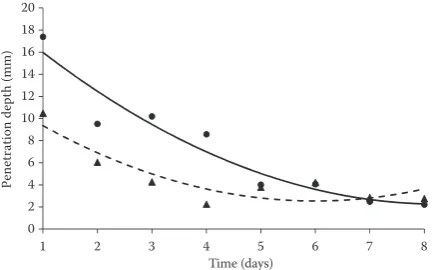
Hi-maize® addition was worse when compared with the normal stiffness for the first three days; after that, the breads were softer (Figure 4). The data for 10% AS were comparable with the normal bread only after 5 days of storage (Figure 5).
Influence of added starches on RS content. The
bread without any starch addition contained approxi-mately 1% RS without significant changes during stor-age (Figure 6). When AS was added, the RS contents were twice as high. Between the 4th and 8th day, the
bread’s RS content increased to 2.5–3.0% as a result of bread ageing. The addition of Hi-maize® increased the RS content to 5%. All in all, a synergic effect may be assumed.
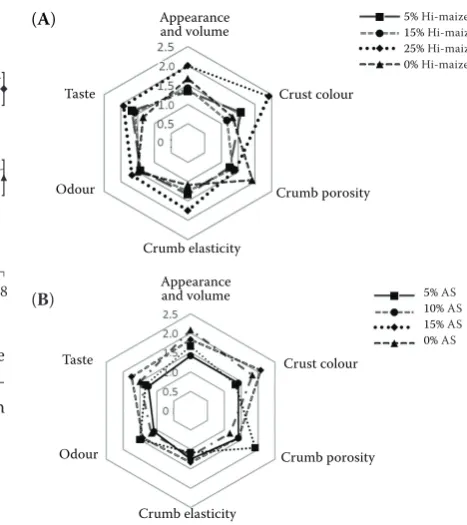
Sensory evaluation. The average results of sensory
evaluation by panellists for both starch additions are surveyed in Figure 7. The shape and volume of the bread with 15% Hi-maize® was slightly worse when compared with a 0 or 5% addition. The bread had an irregular crust on the top. When pressed, the crust cracked but its colour was lighter than that of the reference bread. The crumb was elastic and porosity was better than that of the reference bread. The smell was somewhat like popcorn. The bite was slightly stickier and less chewable than in the breads with 5% addition.
As to the shape and volume of breads with 10% AS additions, they had an irregular shape and low volume. The crust at the top was light. The poros-ity of the crumb was regular, with places of larger pores. The bread with 10% AS had a good cereal smell and a pleasant acid odour, the bite slightly stuck to the teeth.
1810
1663 1678
1308 1575
1425 1140
0 400 800 1200 1600 2000
0% 5% 10% 15% 5% 10% 15% Hi-maize AS
5% AS 10% AS 15% AS
Vo
lu
m
e
(c
m
3)
0 2 4 6 8 10 12 14 16 18 20
1 2 3 4 5 6 7 8
Pe
net
ra
tion
d
epth
(m
m
)
Time (days)
0 2 4 6 8 10 12 14 16 18 20
1 2 3 4 5 6 7 8
Penetration depth (mm)
[image:4.595.65.288.109.210.2]Time (days)
Figure 5. Dependence of the bread stiffness on storage time; ● – bread without acetylated starch addition (r = 0.96); ▲ – acetylated starch addition 10% (r = 0.90) Figure 3. Influence of resistant starch addition on the
[image:4.595.67.287.576.721.2]bread volume
Figure 4. Dependence of the bread stiffness on storage time; ● – bread without Hi-maize®addition (correlation
[image:4.595.309.527.584.719.2]concluSionS
Resistant starch has been recognised as a dietary fibre and provides various health benefits, e.g. it prevents the colon cancer, reduces risk of diabetes, reduces cholesterol in blood, and helps the growth of favour-able microbiome in the colon. Two promising starches were tested – Hi-maize® and acetylatedstarch (AS) – as carriers of RS and additives for bread preparation. Hi-maize® had a great influence on viscosity peak, pasting temperature, breakdown, holding strength, and final viscosity in RVA curves compared to the AS addition. There was not a large difference in the fall of viscosity between the wheat flour and the blend with 5% Hi-maize®. The increased concentration of both starches worsened the rheological quality and hence produced a negative effect on protein, mainly on the starch part of the Mixolab curves. Higher starch addition caused lower viscosity at C3. 10% AS and 15% Hi-maize® addition caused changes in C5-C4, 0.46 and 0.43 Nm, respectively.
The addition of 15% Hi-maize® caused worse ap-pearance, lower volume, and a light colour of the crust. On the other hand, it increased the RS content to 5%. The substitution of 5% wheat flour with AS proved to be the most suitable and the bread was highly evaluated by panellists, retrogradation of starch decreased, and RS content was 2.4%.
The best shelf-life of bread was achieved for 5 or 15% Hi-maize® or 5% AS addition.
Both the starches offer an exciting new potential as food ingredients, as their resistance is not influ-enced by temperature.
References
Ashwar B.A., Gani A., Shah A., Wani I.A., Masoodi F.A. (2016): Preparation, health benefits and applications of resistant starch – a review. Starch, 68: 287–301. Asp N.-G., van Amelsfoort J.M.M., Hautvast J.G.A.J. (1996):
Nutritional implications of resistant starch. Nutrition Research Reviews, 9: 1–31.
Banu I., Stoenescu G., Ionescu V., Aprodu I. (2011): Estima-tion of the baking quality of wheat flours based on rheo-logical parameters of the Mixolab curve. Czech Journal of Food Sciences, 29: 35–44.
Björck I., Asp N.-G. (1994): Controlling the nutritional properties of starch in foods – a challenge to the food industry. Trends in Food Science and Technology, 5: 213–218.
Colussi R., El Halal S.L.M., Pinto V.Z., Barzt J., Gutkoski L.C., Zavareze E.R., Dias A.R.G. (2015): Acetylation of rice starch in an aqueous medium for use in food. LWT-Food Science and Technology, 62: 1076–1082.
Cummings J.H., Pomare E., Branch W., Naylor C., Mac-farlane G. (1987): Short chain fatty acids in human large intestine, portal, hepatic and venous blood. Gut, 28: 1221–1227.
Defloor I., Nys M., Delcour J.A. (1993): Wheat starch, cassava starch, and cassava flour impairment of the bread making potential of wheat flour. Cereal Chemistry, 70: 526–530. 0
1 2 3 4 5 6 7
1 2 3 4 5 6 7 8
RS
co
nt
ent
(g
/1
00
g )
[image:5.595.65.533.98.364.2]Time (days)
Figure 6. Dependence of resistant starch content in the bread on storage time; ● – bread without additions; – Hi-maize® addition 15% (r = 0.66), ▲ – acetylated starch
addition 10% (r = 0.69)
Figure 7. Sensory parameters for (A) Hi-maize® addition and (B) acetylated starch addition
5% Hi-maize®
15% Hi-maize®
25% Hi-maize®
0% Hi-maize®
5% AS
10% AS
15% AS
0% AS
(A)
(B)
Appearance and volume
Appearance and volume Crumb elasticity
Crumb elasticity
Crumb porosity Crumb porosity
Crust colour Crust colour Taste
Taste
[image:5.595.288.522.102.365.2]Food Technology and Economy, Engineering and Physical Properties Czech J. Food Sci., 35, 2017 (1): 67–72
doi: 10.17221/343/2016-CJFS
Dvořáček V., Papoušková L., Prohasková A., Riljáková B. (2011): Effect of technological parameters of grain poly-saccharide complex on final backing value of wheat, In: Proceedings 7th International Conference on
Polysac-charides-Glycoscience, Nov 2–4, 2011, Prague, Czech Republic: 89–93.
Eerlingen R. C., Crombez M., Delcour J.A. (1993): Enzyme-resistant starch. I. Quantitative and qualitative influence of incubation time and temperature of autoclaved starch on resistant starch formation. Cereal Chemistry, 70: 339–344.
Fu L., Tian J., Sun C., Li Ch. (2008): RVA and farinograph properties study on blends of resistant starch and wheat flour. Agricultural Sciences in China, 7: 812–822. Horák P., Kruliš Z., Šárka E., Kobera L. (2014): Polymers
based on chemically modified starch. In: Proceedings 10th
International Conference on Polysaccharides-Glycosci-ence, Oct 22–24, 2014, Prague, Czech Republic: 88–90. Jane J.-L., Jiang H., Hasjim J. (2010): Resistant starch and its
health benefits. In: Proceedings 6th International
Confer-ence on Polysaccharides-GlycosciConfer-ence, Sept 29–Oct 1, 2010, Prague, Czech Republic: 9–11.
Korus J., Witczak M., Ziobro R., Juszczak L. (2009): The impact of resistant starch on characteristics of gluten-free dough and bread. Food Hydrocolloids, 23: 988–995. Miyazaki M., Hung P.V., Maeda T., Morita N. (2006): Re-cent application of modified starches for bread-making. Trends in Food Science and Technology, 17: 591–599. Papoušková L., Capouchová I., Kostelanská M., Škeříková
A., Prokinová E., Hajšlová J., Salava J., Faměra O. (2011): Changes in baking quality of winter wheat with different intensity of Fusarium spp. contamination detected by means of new rheological system Mixolab. Czech Journal of Food Sciences, 29: 420–429.
Šárka E., Koláček J., Sikora A., Hrušková K., Prokopová D., Hrabal R., Maixner J., Bubník Z. (2010): In: Effect of reaction time on the acetylation of wheat B-starch and characterization of the product. In: Proceedings 6th
In-ternational Conference on Polysaccharides-Glycoscience, Sep 29–Oct 1, 2010, Prague, Czech Republic: 200–205. Šárka E., Kruliš Z., Kotek J., Růžek L., Voříšek K., Koláček
J., Hrušková K., Růžková M., Ekrt O. (2012): Composites containing acetylated wheat B-starch for agriculture applications. Plant Soil and Environment, 58: 354–359.
Šárka E., Moravcová L., Smrčková P., Chena Aldao D.A., Škorpilová T. (2015): Verification of a model for process parameters, resistant starch content and sensory proper-ties of maize extrudates prepared from maize grits with or without amylose addition. In: Proceedings 11th
Inter-national Conference on Polysaccharides-Glycoscience, Oct 7–9, 2015, Prague, Czech Republic: 179–182. Sha X.S., Xiang Z.J., Bin L., Jing L., Bin Z., Jiao Y.J., Kun
S.R. (2012): Preparation and physical characteristics of resistant starch (type 4) in acetylated indica rice. Food Chemistry, 134: 149–154.
Shih C.-K., Chen S.-H., Hou W.-C., Cheng H.-H. (2007): A high-resistance-starch rice diet reduces glycosylated hemoglobin levels and improves the antioxidant status in diabetic rats. Food Research International, 40: 842–847. Smrčková P., Saglamtas M., Hofmanová T., Koláček J.,
Chena D., Šárka E. (2014): Effect of process parameters on slowly digestible and resistant starch content in ex-trudates. Czech Journal of Food Sciences, 32: 503–508. Švec I., Hrušková M. (2015): The Mixolab parameters of
composite wheat/hemp flour and their relation to qual-ity features. LWT-Food Science and Technology, 60: 623–629.
Witczak M., Juszczak L., Ziobro R., Korus J. (2012): In-fluence of modified starches on properties of gluten-free dough and bread. Part I: Rheological and thermal properties of gluten-free dough. Food Hydrocolloids, 28: 353–360.
Witczak M., Ziobro R., Juszczak L., Korus J. (2016): Starch and starch derivatives in gluten-free systems – a review. Journal of Cereal Science, 67: 46–57.
Zhang J., Liu Y., Chen C., Wang Z., Lv J. (2014): Method for preparing resistant starch/soluble dietary fiber compos-ite. Patent CN 103583953, 2014.
Zhou Z., Zhang Y., Chen X., Zhang M., Wang Z. (2014): Multi-scale structural and digestion properties of wheat starches with different amylose contents. International Journal of Food Science and Technology, 49: 2619–2627. Ziobro R., Korus J., Witczak M., Juszczak L. (2012): Influ-ence of modified starches on properties of gluten-free dough and bread. Part II: Quality and staling of gluten-free bread. Food Hydrocolloids, 29: 68–74.