in the past period, the average meat consumption underwent significant changes. regarding the shifts in the consumer food demand patterns, meat has an outstanding position. The research interest has stemmed not only from the fact that meat constitutes a major item in the national food spending (accounting for more than 24% of the national food expenditure in 2009), but also from a series of significant devel-opments in the meat industry due to the changing dietary patterns and health awareness.
Slovakia counts among the states with the pre-dominant poultry meat consumption (in 2009 more than 28% of the expenditures of the private house-holds for food and non-alcoholic beverages). Pork meat presents a considerable proportion of the meat consumption per inhabitant and per year (more than 26% in the year 2009).
Krasnodębski and cieślik (2003) observed that the meat market in Poland traditionally belongs to the most important segments of the food sector and food market. it is due to the fact that meat purchases account for c.a. 10% of the population’s expenditure (almost 30% of the expenditure on food), the pro-duction of pork and beef constitutes 30% of the final agricultural production.
The high coefficients of price demand elasticity say that the demand for meat, meat products, eggs and fish of the Slovak households is elastic with respect to price. There was displayed a negative correlation between the
level of monetary income and the value of elasticities. As the monetary income is higher, the coefficients of price elasticity and income elasticity (sensibility) are lower (zentková and hošková 2009).
We have aimed at examining the determinants of the demand for the meat panel (or longitudinal) data, the econometrics of which is comprehensively discussed by hsiao (2003) and Baltagi (2005), among others.
Using the panel data, which represent a hybrid of both cross- section and time series data, makes it possible to capture both the dynamic (time series) and static (cross-section) aspects of the determinants of consumption of a particular meat sort. Panel data also make it possible to control some variables that influence the consumption of meat but which may not be observable or measurable.
Because the panel data have both cross-sectional and time series dimensions, the application of regression models to fit econometric models is more complex than those for the simple cross-sectional data sets. nevertheless, they are increasingly being used in the applied work and the aim of this chapter is to provide a brief introduction. For comprehensive treatments see Wooldridge (2002), hsiao (2003) and Baltagi (2005).
Fraser and Moosa (2002) determined for the UK the meat demand elasticity coefficients. According to their results, the compensated cross-price elastic-ity estimates show that all meat types – beef, pork, and poultry – are net substitutes with some marked
Modelling structural changes in the poultry meat
demand – the case of Slovakia
Peter BIELIK, Daniela HUPKOVÁ
Faculty of Economics and Management, Slovak University of Agriculture,
Nitra, Slovak Republic
Abstract: The main objective of this paper is to investigate the determinants of the households’ poultry meat consumption using the main economic factors. The price, income and cross-price elasticities of the poultry meat demand were estimated. The impact of the BSE disease occurrence and the accession of Slovakia into the EU are incorporated into the modelling. The household Budget Survey of the Slovak Statistical office was used for the period 1993–2009; the general fixed effects panel data model was applied. With respect to the modelling results, the significant variables that the affect poultry meat consumption are the pork meat price, the poultry meat price, the trend and occurrence of the BSE disease. The poultry meat demand is inelastic with respect to its price. During the analysed period, the poultry meat demand increased by 8.05% yearly. Pork meat and poultry meat are the substitutes in consumption.
differences between specifications. There are also dif-ferences between the expenditure elasticity estimates that are particularly pronounced for beef and chicken. For beef, the expenditure elasticity estimates fall when moving to the stochastic trend and seasonality mod-els, but for all other meats they increase. Although all the models yield sensible elasticity estimates, the different specifications impact the magnitude of the elasticity estimates.
Poultry meat is produced more rapidly and uses a less space and natural resources than other livestock and from the early 1990s, the market share of poultry meat benefited from the growing view of the ‘white meat’ as healthier than red meats and the increased use of poultry in frozen processed products and ready-meals. An additional factor in the 1990s was the shift away from beef due to the concerns related to the BSE. The evolution of the poultry meat consumption over the period since 1995 shows that both the total and per capita consumption of poultry meat have only risen due to the increase in the number of consumers (after the enlargements in 2004 and 2007). The biggest growth occurred between 1995 and 2001, when the total consumption went up from 7.4 million tonnes to 9.0 million tonnes, with the biggest increase per capita being 8.2% between 2000 and 2001 (from 22.1 to 23.9 kg/head) (European Parliament 2010).
The average household income elasticity coefficients in Slovakia characterized beef and pork demand as income inelastic. The poultry demand is income elastic and its consumption is continuously increas-ing (hupkova and Bielik 2010).
DATA AND METHODOLOGY
The data set is obtained from the Slovak Statistical office and consists of the yearly observations of beef, pork and poultry per capita consumption, the average annual consumer prices of beef, pork and poultry meat and the net income per capita.
The interest is aimed at the individual household categories. The household Budget Survey of the Slovak Statistical office was used for period 1993 to 2009. All prices and income data are deflated by the harmonised index of consumer Prices (hicP). Values in the period 1993–2008 are re-calculated using the currency foreign exchange rates of the relevant year obtained from the statistics of the national Bank of Slovakia.
As a consequence of the survey methodology change in the year 2004, where five individual social household categories were transformed into four, we employed the time series of the years 1993 till 2003 for the
individual households demand analysis in pursuit of the data consistence preservation according to the individual households’ categories level. The data set was applied in the econometric modelling and we unified in the period 1993–2003 the social household categories of Farmers and Workers into the category others to preserve the data set.
The use of the household level data offers the po-tential of providing a richer dataset that may offer an additional insight into the underlying economic relationships.
in the estimation process, the fixed effect speci-fication of the panel data is used. The fixed effect specification is preferred in the case of the omitted variable problems in the regressions, by means of capturing the idiosyncratic factors that might affect the demand and meat consumption. The White Period robust coefficient Variance Estimator was applied to accommodate the arbitrary serial correlation and the time-varying variances in the disturbances.
When using fixed effects, we assume that some-thing within the individual may impact or bias the predictor or outcome variables and we need to con-trol this fact.
The fixed effect model assumes that the individual specific time invariant effects should be treated as the intercept term of the regression. This presents opportunities for a number of transformations of the data, which eliminate this effect. Essentially, any transformation that rids the model of the fixed effect produces a fixed effect estimator (Baltagi 2005).
By far the most extensively discussed and used fixed effects estimator is the least squares dummy variable estimator, also referred to as the within estimator (greene 2000; hsiao 2003).
The fixed effects estimation method is regarded as ridden with the problems in theoretical literature. The least squares dummy variable (LSDV) approach has been widely criticized. Less importantly, the LSDV approach presents a loss in the degrees of freedom, due to the large number of parameters be-ing estimated, which may or may not be a problem in practice, depending on the number of observations available (Wooldridge 2002).
More importantly, the fixed effects approach rids the regression of all fixed effects, regardless if they are contained as unobservable within the intercept term, or as observables in the matrix of regressors. Thus the effects of the individual specific regres-sors, such as sex or place of birth, on the dependent variable cannot be estimated under the fixed effects approach (Baltagi 2005).
coef-ficients are estimated with the ordinary Least Square Method (oLS method).
The meat demand equation was specified as fol-lows:
ln (Yi)= β0 + β1 × ln (PBi) + β2 × ln (PPKi) + β3 × ln (PPLi) + β4 × ln (Ii) + β5 × (t) + β6 × (d1) + β7 × (d2)+ln ε
where:
Yi = per capita meat consumption of meat PB = real price of beef meat (EUr/kg) PPK = real price of pork meat (EUr/kg) PPL = real price of poultry meat (EUr/kg) I = real income per capita (EUr) t = trend
d1 = dummy variable that measures the impact of the BSE (Bovine Spongiform Encephalopathy) was. The variable takes the value 1 if the BSE was observed in the Slovak republic and 0 otherwise
d2 = dummy variable that measures the impact of the EU membership. The variable takes the value 1 if the Slovak republic is a member of the European Union and 0 otherwise
RESULTS
Meat consumption development in Slovakia
While the global meat consumption in the EU-27 has been negatively impacted by the world economic crisis, poultry meat was among the less affected ones among the food commodities. The analyses showed that while the average consumer preferred poultry meat to beef or pork meat, the lower income consum-ers simply reduced their meat consumption. Sales of the cheaper cuts and parts also increased to the
detriment of more expensive parts. The poultry price increase was noticed in the second half of 2010. in April 2011, the poultry meat price set a new record, exceeding the level achieved in August 2008 by 5% and reaching the highest price in the last 14 years (194 EUr/100 kg). According to the change in the EU agricultural commodity prices for all the commodities, the April 2011 prices were above the levels observed one year before: beef (+8%), pork (+16%) and poultry meat (+19%). in Slovakia, meat prices increased as well – beef (6%), pork (10%) and poultry (7%).
The past ten years in the countries of the former Eastern Block were connected with dramatic changes as a consequence of the transformation. The decline in the purchasing power of the population and the reduction in consumer subsidies has resulted in a significant drop in the meat consumption in the early 1990s. in the year 1991, there occurred in Slovakia the price liberalization which affected 85% of prices.
The determinants and effects of the changes in meat consumption patterns are income and the related ef-fects of the out-of-home consumption and the growing convenience, prices (especially for poultry), health consciousness and, to a lesser extent, environmen-tal consciousness. The change in the demographic structure is a wide field and comprises the change of age structure, the change of the household size and marital structures, migration from rural to urban areas and many other variables.
[image:3.595.63.535.564.752.2]however, the meat consumption of Slovak inhabit-ants does not exceed the consumption in the indi-vidual EU countries, its structure is not convenient for well-balanced diet principles. it is caused by the customary eating habits and on the other hand, by the worsened economic situation of the major part of the Slovak population as well.
Table 1. Meat expenditures share of net household expenditures (per person and year) in %
Year Workers Self-Employed Employees Farmers Pensioners
1993 8.28 6.14 6.79 5.87 11.08
1994 8.74 7.46 7.27 6.62 11.94
1995 8.25 7.38 6.98 6.46 11.62
1996 7.94 7.46 6.49 6.30 11.34
1997 7.82 6.72 6.48 6.25 10.47
1998 7.73 6.24 6.23 6.30 10.49
1999 7.32 6.10 5.65 6.59 9.62
2000 7.02 5.67 5.40 6.27 9.47
2001 6.57 6.00 5.10 6.05 9.27
2002 6.43 5.29 5.16 6.28 8.66
2003 6.02 4.86 4.89 5.64 8.18
Decreasing the domestic beef meat production affects the increase of consumer prices what indi-cates a declining consumption by the stagnated pur-chasing power. contrariwise, poultry consumption keeps a growing trend. The consumption of fish is not satisfactory in the long term. The poultry meat consumption has a long term increasing course and in spite of this fact, it still did not reach the level of the average consumption of EU-27. We suppose that the annual rise of the poultry meat consumption in Slovakia will continue.
The highest decrease of the meat expenditures share – by 4.21% achieved the household category Pensioners. in spite of this, the households of pen-sioners are the category with the highest share of
meat expenditures. This fact was connected with the customary eating habits. We cannot omit an impor-tant fact that in these households, there do not live any children, which are decreasing the average meat consumption in other categories. The households of Self-Employed and Employees have the lowest share of expenditures for meat. According to the income level, these households’ categories are the categories with the highest level of income (Tables 1 and 2).
After the accession into the EU, the meat con-sumption rose in the households of Employees and others. Meat expenditures share in the net household expenditures of the households Self-Employed and Pensioners slightly declined.
in the Figures 1 and 2, there is illustrated the development of net expenditures in total and the percentage share of meat expenditures in the to-tal household expenditures in Slovakia during the period 2000–2001, and for comparison the period 2008–2009. The households of pensioners are dur-ing the analysed period permanently the group with the highest percentage share of meat expenditures, however, their meat expenditures declined by 2.6%. no significant decline was observed in the case of the groups of others.
Poultry meat consumption development in Slovakia
[image:4.595.64.290.95.264.2]The poultry meat counts as the most consumed meat in Slovakia. The increasing consumption is af-fecting by the fact that poultry is considered as the economically most attractive. Poultry is increasing its
Figure 1. net expenditures in total and percentage share of meat expenditures on total household expenditures in Slovakia during the period 2000–2001
[image:4.595.72.528.528.719.2]Source: household Budget Survey, Slovak Statistical office; authors’ calculations Table 2. Meat expenditures share of net household
expen-ditures (per person and year)
Year
Em
pl
oy
ee
Se
lf-Em
pl
oy
ed
Pe
ns
io
ne
rs
o
th
er
2004 5.45 5.51 8.06 7.34
2005 5.47 5.07 7.71 7.92
2006 5.33 5.14 7.03 6.73
2007 4.99 4.78 7.08 7.91
2008 4.86 5.04 6.75 6.60
2009 4.74 4.81 6.87 5.85
Source: household Budget Survey, Slovak Statistical office; authors’ calculations
6.43% 5.40% 5.67%
9.47%
6.64%
6.02% 5.10%
6.00% 9.27%
6.31%
0% 1% 2% 3% 4% 5% 6% 7% 8% 9% 10%
0 500 1000 1500 2000 2500 3000
TOTAL Employee Self-Empl. Pensioner Other
2000 Net incomes total (EUR) 2001 Net incomes total (EUR)
2000 Proportion of expenditures for meat (%) 2001 Proportion of expenditures for meat (%)
10 9 8 7 6 5 4 3 2 1 0
perceived share in the meat basket of the consumer. The relative success of poultry can be related to its favourable perception regarding most attributes, giving poultry the image of the safest fresh meat alternative at present.
The future trend for the poultry production remains relatively positive with respect to other meats, the strong consumer preference and the increased use in food preparations should continue to play in favour of poultry. The per capita poultry consumption is projected to increase because of its benefits from a growing consumer preference.
rising food commodity prices during last decade tend to negatively affect the lower income consumers more
than the higher income consumers. First, the lower income consumers spend a larger share of their income on food. Second, fundamental food commodities such as meat, corn, wheat and rice account for a larger share of food expenditures in the low-income families.
The increased poultry consumption is influenced mainly by the bargain price and also the quick, com-fortable preparation and the wide assortment of poultry products and semi-products.
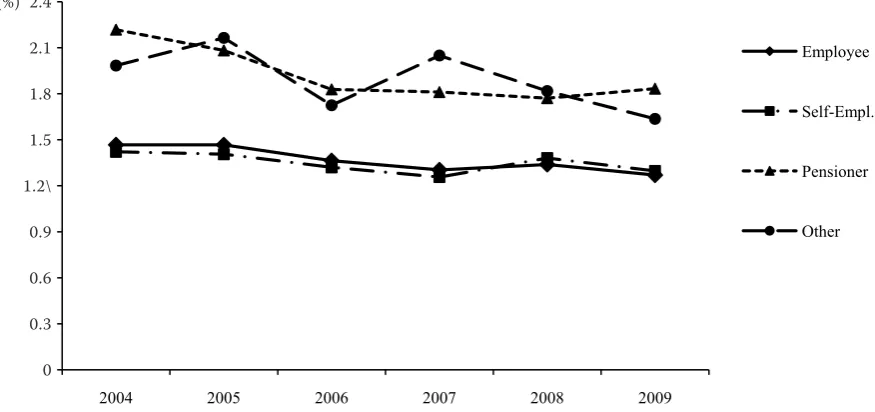
During the years 1993–2009, there did not occur any significant divergence in poultry expenditures. The possible reason is that its price level presented during the whole period a bargain for consumers. A moderate decline of the poultry meat consumption was recorded
4.88%
4.44% 4.53%
6.46%
%
5.18% 4.74% 4.81%
6.87%
5.85%
0% 1% 2% 3% 4% 5% 6% 7% 8%
0 500 1000 1500 2000 2500 3000 3500 4000 4500 5000
TOTAL Employee Self-Empl. Pensioner Other
2008 Net incomes total (EUR) 2009 Net incomes total (EUR)
[image:5.595.74.528.70.278.2]2008 Proportion of expenditures for meat (%) 2009 Proportion of expenditures for meat (%)
Figure 2. net expenditures in total and percentage share of meat expenditures on total household expenditures in Slovakia during the period 2008–2009
Source: household Budget Survey, Slovak Statistical office; authors’ calculations
(%)
Figure 3. Poultry meat expenditures share of total household expenditures in Slovakia during the period 1993–2003 Source: household Budget Survey, Slovak Statistical office; authors’ calculations
0 0,003 0,006 0,009 0,012 0,015 0,018 0,021 0,024 0,027 0,03
1993 1994 1995 1996 1997 1998 1999 2000 2001 2002 2003
Employee
Self-empl.
Pensioner
Workers
Farmers
3.0 2.7 2.4 2.1 1.8 1.5 1.2 0.9 0.6 0.3 0 (%)
Employee
Self-Empl.
Pensioner
Workers
[image:5.595.68.525.550.730.2]during the period 2008–2009 due to the global food price crisis. rising food prices contributed to a significant decline of the overall food consumption.
POULTRY MEAT DEMAND MODELLiNG
The significant variables that affect the poultry meat consumption are pork meat price, poultry meat price, the trend and occurrence of the BSE disease. The price elasticities were statistically significant except beef meat. The income of households is not a statistically significant factor.
The poultry price elasticity indicates that a 10% increase in the price of poultry would cause 8.37%
de-cline in per capita poultry purchases. The poultry meat demand is inelastic with respect to its own price.
According to the model results, the price of beef meat has no effect on the poultry consumption (Table 3).
During the analysed period, the poultry meat demand increased by 8.05% yearly. The increased poultry con-sumption is influenced mainly by the bargain price and also the quick, comfortable preparation and the wide assortment of poultry products and semi products.
Pork meat and poultry meat are substitutes in con-sumption. This is indicated by the positive cross- price elasticity of poultry with respect to the pork price: a 10% increase in the pork price reduces poultry consump-tion by 5.2%. The occurrence of the BSE in 2000–2001 reduced poultry consumption by 5.97%. The accession into the European Union did not significantly affect the poultry meat consumption; it rose by 4.95%.
CONCLUSiON
The main impact factors affecting food consump-tion are the consumers’ income and food prices. The food patterns development in Slovakia during the past two decades has undergone rapid structural changes. changes in tastes, preferences, lifestyles and economic transformation have also strongly influenced food demand. Slovakia counts among the states with the predominant pork and poultry meat consumption.
While the global meat consumption in the EU-27 has been negatively impacted by the world economic crisis, poultry meat was among the less affected food commodities. The analyses showed that while the
0 0,003 0,006 0,009 0,012 0,015 0,018 0,021 0,024
2004 2005 2006 2007 2008 2009
Employee
Self-Empl.
Pensioner
Other
(%) 2.4
2.1
1.8
1.5
1.2\
0.9
0.6
0.3
[image:6.595.82.520.72.278.2]0
Figure 4. Poultry meat expenditures share of total household expenditures in Slovakia during the period 2004–2009 Source: household Budget Survey, Slovak Statistical office; authors’ calculations
Table 3. Estimation results, dependent variable ln (Yi) – per capita meat consumption for poultry meat
Poultry
conSTAnT –154.7**
ln (PB) 0.145
ln (PPK) 0.524***
ln (PPL) –0.837***
ln (I) –0.490
t 0.0805**
d1 0.0597**
d2 0.0495
adjusted R-squared 0.898 significant at ** α = 0.05; *** α = 0.01
[image:6.595.64.291.577.732.2]age consumer preferred poultry meat to beef or pork meat, the lower income consumers simply reduced their meat consumption. The decreasing domestic beef meat production affects the increase of consumer prices what indicates a declining consumption by the stagnated purchasing power. contrariwise, the poultry consumption keeps a growing trend.
The highest decrease of the meat expenditures share – by 4.21% – was achieved by the household category Pensioners. in spite of this, the households of pensioners are the category with the highest share of meat expenditures. This fact was connected with the customary eating habits. We cannot omit an im-portant fact that in these households, there do not live any children, which are decreasing the average meat consumption in other categories. The households of Self-Employed and Employees have the lowest share of expenditures for meat. According to the income level, these households’ categories are the categories with the highest level of income.
The significant variables that affect the poultry meat consumption are pork the meat price, the poul-try meat price, the trend and the occurrence of the BSE disease. The poultry meat demand is inelastic with respect to its own price. During the analysed period, the poultry meat demand increased by 8.05% yearly. Pork meat and poultry meat are substitutes in consumption.
REFERENCES
Baltagi B.h. (2005): Econometric Analysis of Panel Data. 3rd ed. John Wiley & Sons, Ltd., chichester; iSBn
978-0-470-01456-1.
European Parliament (2010): The poultry and egg sectors: evaluation of the current market situation and future
prospects. Directorate – general for internal Policies Agriculture, Brussels, iP/B/Agri/ic2009-045. Available at http://www.europarl.europa.eu/studies (accessed 06.03.2011).
Fraser i., Moosa i.A. (2002): Demand estimation in the presence of stochastic trend and seasonality: The case of meat demand in the United Kingdom. American Journal of Agricultural Economics, 84: 83–89
greene W. (2000): Econometric Analysis. Prentice hall, new Jersey; iSBn 0130661899.
hupková D., Bielik P. (2010): Estimating demand elasticities of meat demand in Slovakia. Food Economics – Acta Agriculturae Scandinavica, Section c, 2: 82–86. hsiao ch. (2003): Analysis of Panel Data. 2nd ed. cambridge
University Press, cambridge, United Kingdom; iSBn 0-521-81855-9.
Krasnodębski A., cieślik J. (2003): Situation in the meat sector in Poland and directions for its restructuring. in: zborník vedeckých prác Kolíňany október 2003 – Ak-tuálne problémy manažmentu a marketingu vo výučbe na vysokých školách. SPU, nitra, pp. 111–114, iSBn 80-8069-284-X.
The Slovak Statistical office (1993–2009): incomes, expen-ditures and consumption of private households in Sr. The household Budget Survey of the Slovak Statistical office. Statistical office of the Slovak republic. Wooldridge J. M. (2002): Econometric Analysis of cross
Section and Panel Data. MiT Press, London.
zentková i., hošková E. (2009): The estimation of the Marshallian demand functions for the selected foodstuff groups according to the households income quartiles. Agricultural Economics – czech, 55: 406–413.
Arrived on 31th May 2011
Contact address:
Peter Bielik, Daniela hupková, Slovak University of Agriculture in nitra, Tr. A. hlinku 2, 949 76 nitra, Slovak republic