JOURNAL OF FOREST SCIENCE, 56, 2010 (7): 323–332
At present yield tables are used very broadly in for-est practices and as stated by Eckmüllner (1992) with regard to all restrictions, positive as well as neg-ative aspects of their use, it is necessary to consider their use also in future. As the last author Pretzsch (2001) summarized the issues of their history and construction for about the last four generations. On an example of mostly German authors he analysed in detail the most important methodical issues sepa-rately for each generation. Based on his classification
we can consider the 3rd generation of yield tables,
constructed on the basis of regression fitting of stand data from research plots by mathematical functions, the most distributed. A basis of their high value and reliability is, in addition to appropriate methodology, especially reliable empirical material. Yield tables constructed from lifetime repeated measurements of permanent research plots would surely be ideal but at present they are rather an exception than the rule. Lower reliability or possibly no trust in yield tables that were constructed from single or repeated meas-urements of research plots of shorter-time periods is
relatively high but it could be eliminated by their cur-rent verification on further repeated measurements of the same research plots on the basis of which they were constructed. Assmann (1959) can be a classical example when he compared the development of top heights of yield tables of Wiedemann and Zimmerle with their development on permanent research plots of Bavaria. In Switzerland Keller (1978) also performed similar verification of height yield curves for several tree species.
Czechoslovakia was not an exception to the de-scribed course, where in 1965 a long-term research programme of the construction of domestic yield ta-bles of main tree species started. Its aim was to work out national uniform yield tables for spruce, fir, pine, oak and beech from domestic experimental mate-rial. The programme continued to 1990, when their
3rd publishing was realized (Halaj, Petráš 1998).
Empirical material was used for the construction of yield tables, though with a high number of research plots, located all over whole Czechoslovakia, but with a small number of their repeated
measure-Stability of the development of basic stand parameters
of beech yield tables constructed on the basis
of short-term observations on research plots
R. Petráš, J. Mecko
National Forest Centre – Forest Research Institute in Zvolen, Zvolen, Slovakia
ABSTRACT: We compared the development of yield curves of mean and top height and development of mean diam-eter according to yield tables of beech which were constructed on the basis of short-term investigations with empirical data of repeated measurements on permanent research plots. We performed our study on 86 permanent research plots with 550 repeated measurements. The length of the interval of repeated measurements on the research plots is in the range of 10–43 years. We quantified differences in the development of model and empirical curves by help of basic statistical characteristics. The results show that the actual growth of mean heights is more intensive than in models of yield tables. An opposite situation is for mean diameters. The development of top heights corresponds to the actual growth of beech stands.
ments were available for beech, which were only 15 or maximally 20 years of continual monitoring with 5-year interval. Repeated measurements from short-time periods forced the constructors of yield tables to modify the methodology, mainly derivation of height yield curves. Instead of the methodology of fitting lifetime height curves, which was impossible to carry out, or inappropriate methodology of fitting average curves from the set of single measurements (Cantiani, Baroni 1975), the methodology of fit-ting envelope curves from these sets was adopted (Halaj et al. 1987a,b). In connection with the model of yield curves a model for the derivation of yield classes of stands from top heights was derived by means of differences between mean and top heights. A model of the development of mean diameters was derived in dependence on the age and yield class of stand, which was determined separately for each measurement. Halaj et al. (1981) presented detailed construction of the complete mathematical model of yield tables. Yield tables were verified already during their construction and putting into practice and their accuracy was evaluated, particularly in determination of stand parameters (Šmelko 1988). The development of stand parameters was evalu-ated only in the case of spruce (Petráš et al. 2006).
Though after the 3rd publishing of yield tables in 1990
their construction and verification did not continue, permanent research plots that were established for their construction by Forest Research Institute in Zvolen were measured repeatedly.
The aim of the work on the example of Czechoslo-vak yield tables of beech is to compare and evaluate the development of their basic growth character-istics such as yield curves of mean and top height and curves of mean diameter with their empirical development according to repeated measurements on permanent research plots.
MATeRiAl And MeThodS
Experimental material is in fact repeated measure-ments of tree diameters and heights on 46 produc-tion permanent research plots that were established for the construction of yield tables (hereinafter re-ferred to as ‘production research plots’) as well as on 40 permanent research plots which were established at about the same time for the research of thinning (hereinafter referred to as ‘thinning research plots’) (Štefančík 1971; Sedmák et al. 2000; Réh 2000). In total it is 86 research plots with 550 repeated measurements. After repeated measurements thin-ning was performed on all research plots mostly in a
v v
and top height hv10% were calculated for the total
stand. They were all calculated from the volume of mean stem in volume unit stem overbark. Accord-ing to the mean height and age of stand site index
q (mean height at standard age of 100 years) was
determined to the nearest 2 decimal numbers in each repeated measurement. For each research plot average site index was calculated as the arithmetic mean of its repeated measurements. For average site index its standard deviation was also calculated. According to average site index on research plot and age of stand for concrete repeated measurement all
3 studied parameters dv, hv and hv10% were calculated
from mathematical models of yield tables. Their de-velopment was compared with actual dede-velopment on the research plots and differences were quanti-fied as relative errors of yield tables according to the formula:
x
a – xYT
e = ––––––– × 100 (1)
xYT
Where:
e – error of yield tables (%),
xa – actual value of studied parameter,
xYT – model value of studied parameter according to yield tables.
These statistical characteristics were calculated to evaluate errors in more detail:
Root mean square error:
∑e2
i
me=
√
–––––– (2)n
Arithmetic mean of errors:
∑ei
e– = –––––– (3)
n
Standard deviation of errors:
∑ (ei – e– )2
se=
√
––––––––– (4)n
Value of t-test:
| e– |
t = –––––– (5)
se
√ n – 1
Where:
n – number of measurements.
Experimental material was arranged for each research plot into age development orders of re-peated measurements for mean heights, top heights and mean diameters. In total there are available 86 development orders with 3–10 repeated measure-ments, which represents an interval of 10–43 years of their continual monitoring. The lowest age is 15 and the highest 190 years. Production research plots have average site index within 12–32, thinning plots within 24–37. We must note at the end of this part that the presented empirical material comprises all measurements, it means also those that were used for the construction of yield tables in 1980. Of the total number of all 550 repeated measurements 70% of them were used for the construction of yield ta-bles and the remaining 30% are new measurements. With regard to the principal aim of this work to evaluate the development and not the static status of growth parameters it was necessary to include all repeated measurements in the evaluation, it means also those that were used for the construction of yield tables.
ReSulTS And diSCuSSion
The development of all three growth parameters
dv, hv, and hv10% was evaluated in a graphical and
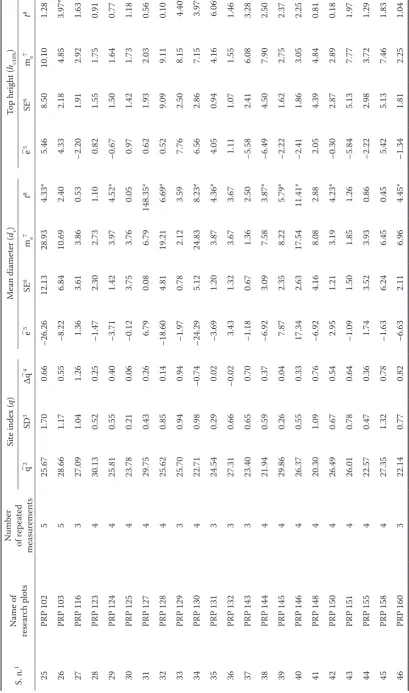
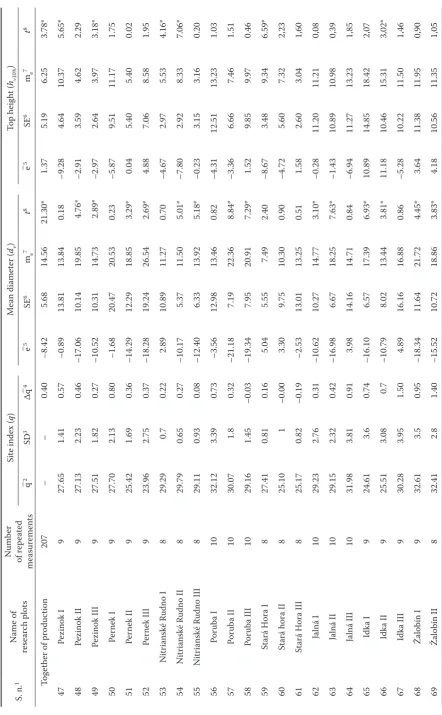
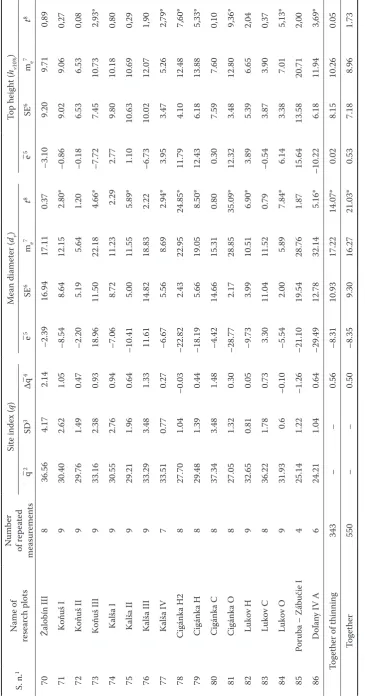
numerical way separately for the set of production and thinning as well as all research plots together. The numerical evaluation of relative errors of yield tables according to formulas (2)–(5) is given in Table 1.
development of mean height
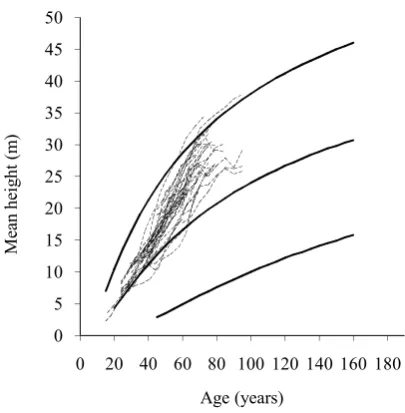
Development of mean heights of beech stands from production research plots is illustrated in Fig. 1 and from thinning research plots in Fig. 2. Bold lines illustrate height yield curves of yield tables for site in-dexes 10, 24 and 38. We can see in Fig. 1 that though measurements of production research plots have a greater proportion in the upper half of the site class range lower yield classes are not missing either. The age range is very large, about 30–190 years. Most research plots, especially at the age over 70 years, have about the same trends of the development of empirical values as model ones. It is obvious in Fig. 2, which illustrates the comparison for thinning research plots, that most plots, mainly at the age over 40 years, have the steeper development of mean heights than it is given in the model of yield tables. We must stress that the below-average yield classes are practically missing in this set.
Site indexes with repeated measurements of re-search plots more precisely quantified the errors of yield tables in the development of mean heights. If it is valid that the actual height growth of the stand on research plot is the same as the development of the respective yield curve, then the same site index will be determined with its repeated measurements. In the case of different height growth site indexes of repeated measurements will increase or decrease. After determination of the exact site index for each repeated measurement the average change in site
in-dexes ∆q was calculated separately on each research
0 5 10 15 20 25 30 35 40 45 50
0 20 40 60 80 100 120 140 160 180
M
ea
n
he
ig
ht
(m
)
Age (years)
0 5 10 15 20 25 30 35 40 45 50
0 20 40 60 80 100 120 140 160 180
M
ea
n
he
ig
ht
(m
)
Age (years)
[image:3.595.306.509.506.713.2]Fig. 1. Development of mean heights according to repeated measurements of production research plots and yield tables for site indexes 10, 24 and 38
Ta
ble 1. S
ta tistic al c harac ter istic
s of er
rors of r
ep ea te d me asur emen
ts of r
es ear ch plot s f or sit e inde x ( q ), me an di ame ter ( dv
) and t
op heig
ht (
hv10%
) S. n. 1 N ame of re se ar ch plot s N umb er of r ep ea te d me asur emen ts Sit e inde x ( q ) M ean di ame ter ( dv ) Top heig ht (
hv10%
)
q
_ 2
SD
3
Δ
q
_ 4
e
_ 5
SE 6 me 7 t 8 e
_ 5
Ta
ble 1 t
o b e c on tin ue d S. n. 1 N ame of re se ar ch plot s N umb er of r ep ea te d me asur emen ts Sit e inde x ( q ) M ean di ame ter ( dv ) Top heig ht (
hv10%
)
q
_ 2
SD
3
Δ
q
_ 4
e
_ 5
SE 6 me 7 t 8 e
_ 5
S. n. 1 N ame of re se ar ch plot s N umb er of r ep ea te d me asur emen ts Sit e inde x ( q ) M ean di ame ter ( dv ) Top heig ht (
hv10%
)
q
_ 2
SD
3
Δ
q
_ 4
e
_ 5
SE 6 me 7 t 8 e
_ 5
SE 6 me 7 To ge
ther of pr
oduc tion 207 – – 0.40 –8.42 5.68 14.56 21.30* 1.37 5.19 6.25 3.78* 47 Pez inok I 9 27.65 1.41 0.57 –0.89 13.81 13.84 0.18 –9.28 4.64 10.37 5.65* 48 Pez inok I I 9 27.13 2.23 0.46 –17.06 10.14 19.85 4.76* –2.91 3.59 4.62 2.29 49 Pez inok I II 9 27.51 1.82 0.27 –10.52 10.31 14.73 2.89* –2.97 2.64 3.97 3.18* 50 Per ne k I 9 27.70 2.13 0.80 –1.68 20.47 20.53 0.23 –5.87 9.51 11.17 1.75 51 Per ne k I I 9 25.42 1.69 0.36 –14.29 12.29 18.85 3.29* 0.04 5.40 5.40 0.02 52 Per ne k I II 9 23.96 2.75 0.37 –18.28 19.24 26.54 2.69* 4.88 7.06 8.58 1.95 53 Nitr ians ké R udno I 8 29.29 0.7 0.22 2.89 10.89 11.27 0.70 –4.67 2.97 5.53 4.16* 54 Nitr ians ké R udno I I 8 29.79 0.65 0.27 –10.17 5.37 11.50 5.01* –7.80 2.92 8.33 7.06* 55 Nitr ians ké R udno I II 8 29.11 0.93 0.08 –12.40 6.33 13.92 5.18* –0.23 3.15 3.16 0.20 56 Por ub a I 10 32.12 3.39 0.73 –3.56 12.98 13.46 0.82 –4.31 12.51 13.23 1.03 57 Por ub a I I 10 30.07 1.8 0.32 –21.18 7.19 22.36 8.84* –3.36 6.66 7.46 1.51 58 Por ub a I II 10 29.16 1.45 –0.03 –19.34 7.95 20.91 7.29* 1.52 9.85 9.97 0.46 59 St ará H ora I 8 27.41 0.81 0.16 5.04 5.55 7.49 2.40 –8.67 3.48 9.34 6.59* 60 St
ará hora I
[image:6.595.77.520.49.765.2]I 8 25.10 1 –0.00 3.30 9.75 10.30 0.90 –4.72 5.60 7.32 2,23 61 St ará H ora I II 8 25.17 0.82 –0.19 –2.53 13.01 13.25 0.51 1.58 2.60 3.04 1,60 62 Jalná I 10 29.23 2.76 0.31 –10.62 10.27 14.77 3.10* –0.28 11.20 11.21 0,08 63 Jalná I I 10 29.15 2.32 0.42 –16.98 6.67 18.25 7.63* –1.43 10.89 10.98 0,39 64 Jalná I II 10 31.98 3.81 0.91 3.98 14.16 14.71 0.84 –6.94 11.27 13.23 1,85 65 Idk a I 9 24.61 3.6 0.74 –16.10 6.57 17.39 6.93* 10.89 14.85 18.42 2,07 66 Idk a I I 9 25.51 3.08 0.7 –10.79 8.02 13.44 3.81* 11.18 10.46 15.31 3,02* 67 Idk a I II 9 30.28 3.95 1.50 4.89 16.16 16.88 0.86 –5.28 10.22 11.50 1,46 68 Žalobín I 9 32.61 3.5 0.95 –18.34 11.64 21.72 4.45* 3.64 11.38 11.95 0,90 69 Žalobín I I 8 32.41 2.8 1.40 –15.52 10.72 18.86 3.83* 4.18 10.56 11.35 1,05 Ta
ble 1 t
Ta
ble 1 t
o b e c on tin ue d S. n. 1 N ame of re se ar ch plot s N umb er of r ep ea te d me asur emen ts Sit e inde x ( q ) M ean di ame ter ( dv ) Top heig ht (
hv10%
)
q
_ 2
SD
3
Δ
q
_ 4
e
_ 5
SE 6 me 7 t 8 e
_ 5
SE 6 me 7 t 8 70 Žalobín I II 8 36.56 4.17 2.14 –2.39 16.94 17.11 0.37 –3.10 9.20 9.71 0,89 71 Koň uš I 9 30.40 2.62 1.05 –8.54 8.64 12.15 2.80* –0.86 9.02 9.06 0,27 72 Koň uš I I 9 29.76 1.49 0.47 –2.20 5.19 5.64 1.20 –0.18 6.53 6.53 0,08 73 Koň uš I II 9 33.16 2.38 0.93 18.96 11.50 22.18 4.66* –7.72 7.45 10.73 2,93* 74 Kal ša I 9 30.55 2.76 0.94 –7.06 8.72 11.23 2.29 2.77 9.80 10.18 0,80 75 Kal ša I I 9 29.21 1.96 0.64 –10.41 5.00 11.55 5.89* 1.10 10.63 10.69 0,29 76 Kal ša I II 9 33.29 3.48 1.33 11.61 14.82 18.83 2.22 –6.73 10.02 12.07 1,90 77 Kal ša I V 7 33.51 0.77 0.27 –6.67 5.56 8.69 2.94* 3.95 3.47 5.26 2,79* 78 Cig ánk a H2 8 27.70 1.04 –0.03 –22.82 2.43 22.95 24.85* 11.79 4.10 12.48 7,60* 79 Cig ánk a H 8 29.48 1.39 0.44 –18.19 5.66 19.05 8.50* 12.43 6.18 13.88 5,33* 80 Cig ánk a C 8 37.34 3.48 1.48 –4.42 14.66 15.31 0.80 0.30 7.59 7.60 0,10 81 Cig ánk a O 8 27.05 1.32 0.30 –28.77 2.17 28.85 35.09* 12.32 3.48 12.80 9,36* 82 Luk ov H 9 32.65 0.81 0.05 –9.73 3.99 10.51 6.90* 3.89 5.39 6.65 2,04 83 Luk ov C 8 36.22 1.78 0.73 3.30 11.04 11.52 0.79 –0.54 3.87 3.90 0,37 84 Luk ov O 9 31.93 0.6 –0.10 –5.54 2.00 5.89 7.84* 6.14 3.38 7.01 5,13* 85 Por ub
a – Z
ábuč ie I 4 25.14 1.22 –1.26 –21.10 19.54 28.76 1.87 15.64 13.58 20.71 2,00 86 D oľ an y I V A 6 24.21 1.04 0.64 –29.49 12.78 32.14 5.16* –10.22 6.18 11.94 3,69* To ge
ther of t
hinning 343 – – 0.56 –8.31 10.93 17.22 14.07* 0.02 8.15 10.26 0.05 To ge ther 550 – – 0.50 –8.35 9.30 16.27 21.03* 0.53 7.18 8.96 1.73 1Se ri al n um be ri ng , 2ar ith m et ic m ea n,
3 st
culated from the pairs of consecutive measurements. To exclude the effect of different interval of repeated measurements the difference in site indexes between two neighbouring measurements was calculated to a constant 5-year interval.
According to Table 1 average changes in site
indexes ∆q for production research plots range
from – 0.74 to +1.39. Average change for all plots is +0.40 m. It means the site index of the stand on production plots increases after repeated measure-ments in 5-year intervals by 0.40 m on average. Calculated to longer age intervals we can expect that already after five intervals, which is 25 years, the site index of the stand on research plots would increase by 2.00 m, it means one yield class. For thin-ning research plots the 5-year change in yield classes ranges from –1.26 to +2.14 m, +0.56 m on average. It means already for 18 years the site index of these research plots will increase by 2.00 m, which is one yield class. Together for all research plots of beech the average change in site index for 5-year repeated measurements is +0.50 m. It means on average for 20 years the yield class of the stand will increase by one yield class. A more detailed analysis of the yield class changes showed that within thinning research plots the differences depend mainly on the type of thinning. Plots with crown thinning have the lowest 5-year change in site index +0.34 m, followed by control plots with natural mortality of trees, which have the average change in site index +0.48 m and the plots with low thinning have the highest change of site index +0.96 m. The plots with crown thinning have the closest development of mean heights with models of yield tables. Low thinning on research plots will result in a strong mechanical (calcula-tion) increase in mean diameters as well as in mean heights.
deviation for each research plot calculated accord-ing to formula (3) and (4). Standard deviations in the range of ±0.21 to ±2.23 m for production plots and from ±0.60 to ±4.17 m for thinning research plots show about double variability of site indexes on thinning research plots. Based on these analyses we can conclude that the development curves of mean heights of beech stands are steeper on research plots than in model yield tables mainly due to thinning research plots, particularly those with low thinning that have the steepest curves. Without these research plots we could accept an average increase in site index by 0.34 to 0.40 m for 5 years for practical use of yield tables.
development of top height
Errors of yield tables in the development of top height according to formula (1) are about ±20% and they are illustrated in Fig. 3 for both groups of research plots. Their distributions with age indicate that in the interval of 30–70 years, where measure-ments from thinning research plots prevail, the er-rors are the greatest. Negative erer-rors prevail at the age of 30–50 years and positive ones in the interval of 50–80 years. Their statistical characteristics given in Table 1 document that out of 86 research plots aver-age errors are significantly different from zero with 95% probability for 19 plots. Average error +1.37% for all production research plots is equally statisti-cally significantly different from zero. Neither the average error +0.02% for thinning research plots nor +0.53% for all plots has this characteristic. The mean
quadratic error me of all research plots is ±8.96%
and by comparing with the average error +0.53% we can state that it is mainly formed of random errors. In top height the yield tables for beech do not have
–30 –20 –10 0 10 20 30 40
0 20 40 60 80 100 120 140 160 180 200
Er
ro
r (
%
)
Age (years)
Production research plots
Fig. 3. Relative errors of top heights of yield tables
–50 –40 –30 –20 –10 0 10 20 30 40
0 20 40 60 80 100 120 140 160 180 200
Er
ro
r (
%
)
Age (years)
[image:8.595.61.538.577.756.2]a systematic error in the development despite the fact that in production research plots the systematic error was confirmed by a statistical test. In compari-son with the development of mean heights the top heights have an advantage of development stability without a possibility of its stronger influencing after tending treatments.
development of mean diameter
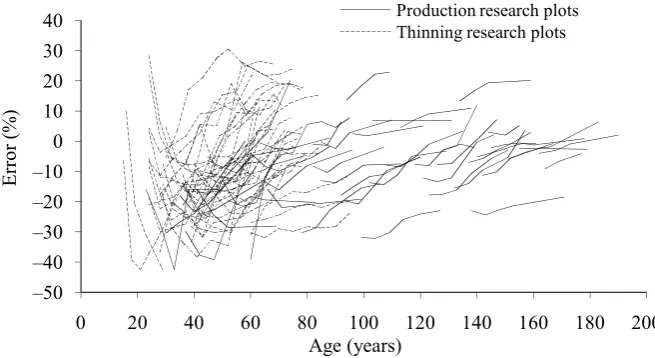
Errors of yield tables in the development of mean diameters of all research plots calculated together according to formula (1) are illustrated in Fig. 4 and demonstrate their higher and asymmetric distribu-tion around zero in a relatively great range, about –40% up to +30%. This range is mainly at the age of 20–70 years, where thinning research plots prevail. Their statistical characteristics according to research plots (Table 1) document that mean errors are sig-nificantly different from zero with 95% probability on 53 research plots. Also the average error of yield tables –8.35%, calculated from all research plots, is equally statistically significantly different from zero. Average errors of yield tables calculated from both sets of research plots –8.42% and –8.31% are very close to the error from all research plots. The mean square error of all research plots is ±16.27%. It is higher than for the mean and top height as it comprises particularly a higher systematic error of –8.35%, which forms about one half of its value.
The finding that according to the models of yield tables the mean diameter of beech stands is higher by about 8% than on research plots is surprising, as up to now opposite results have been expected in forestry practice. In a more detailed analysis we found that it could be explained by the empirical material of thinning research plots which was used for the construction of yield tables. When we divided
it according to the type of thinning, we found that while plots with crown thinning or control plots, where the loss of trees is due to natural mortality only, have the mean error –12.2% and –13.5%, the plots with low thinning have the mean error +3.2%. It indicates that for low thinning, with a heavy reduc-tion of subdominant trees, the mean diameter may be a little larger than for the models of yield tables. For crown thinning and on control plots, where subdominant trees are preserved during the stand lifetime, the actual mean diameters are smaller than in the models of yield tables. It means that the diam-eter structure of experimental plots, from which we constructed the yield tables, has a character of the stands tended by low thinning, i.e. stands without subdominant trees or only with a small proportion of subdominant trees.
ConCluSionS
The used methodology of verification of the devel-opment of three basic growth parameters, namely mean height, top height and mean diameter, is based on the quantification of their differences between the values from repeated measurements on permanent research plots and according to the models of yield tables. Assmann (1961) was convinced that the cor-rect representation of the growth and production of stands in yield tables depends mainly on how their height growth corresponds to the growth of the mean or top height of actual stands. The results of our research are as follows:
− Development curves of mean heights are steeper
on permanent research plots than model curves in yield tables. The mean change in site index with the cycle of 5-year repeated measurements is +0.50 m, which means that the site index of the stand will improve by one yield class within 20 years. –50
–40 –30 –20 –10 0 10 20 30 40
0 20 40 60 80 100 120 140 160 180 200
Er
ro
r (
%
)
Age (years)
[image:9.595.66.394.58.237.2]Production research plots Thinning research plots
Average error of top heights in yield tables 0.53% is statistically insignificant.
− Average error of mean diameters in yield tables
–8.35% is statistically significantly different from zero and it indicates that mean diameters on re-search plots are smaller than in yield tables. We can seek the reasons for these differences par-tially in the methodology of construction but mainly in the composition of empirical material which was used for the construction of yield tables. We are aware of the fact that not even the current empiri-cal material, which was used for the verification of yield tables, is sufficient though the interval of its continual age growth orders was almost doubled. Keller (1978) analysed in great detail the problems of height yield curves of growth tables in Switzer-land. For beech he compared the development of top heights from yield tables of Badoux (1967) with the measurements on 32 permanent research plots and his conclusions were the same as ours. The height growth of real beech stands is more intensive in the whole age range than in the models of yield tables.
References
Assmann E. (1959): Höhenbonität und wirkliche Ertragsleis-tung. Forstwissenschaftliches Centralblatt, 78: 1–20. Assmann E. (1961): Waldertragskunde. Organische
Produk-tion, Struktur, Zuwachs und Ertrag von Waldbeständen. München, Bonn, Wien, BLV Verlagsgesellschaft: 490. Badoux E. (1967): Ertragstafeln für die Buche in der Schweiz.
Birmensdorf ZH, Eidgenössische Anstalt für das forstliche Versuchswesen: 48.
Cantiani M., Baroni A. (1975): The Maritine Pine in Tus-cany. Experimental research into dendrometry and aux-ometry. Fascicolo VI, Universita di Firenze: 42. (in Italian) Eckmüllner O. (1992): Problematik der Anwendung von
Ertragstafeln. Österreichische Forstzeitung, 103: 54–55.
of the second edition of yield tables for spruce, fir, oak and beech. Lesnictví, 27: 867–878. (in Slovak)
Halaj J., Grék J., Pánek F., Petráš R., Řehák J. (1987a): Yield Tables of Main Tree SpeciesČSSR. Bratislava, Príroda: 361. (in Slovak)
Halaj J., Pánek F., Petráš R. (1987b): Height growth of spruce trees according to new growth tables (1980). Les-nictví, 33: 905–918. (in Slovak)
Halaj J., Petráš R. (1998): Yield Tables of Main Tree Species. Bratislava. Slovac Academic Press: 325. (in Slovak) Keller W. (1978): Einfacher ertragskundlicher
Bonitätss-chlüssel für Waldbestände in der Schweiz. Mitt. Eidgenöss. Anstalt für das forstliche Versuchswesen, 54: 3–98. Petráš R., Brezina L., Mecko J. (2006): Development of the
primary values of yield tables of spruce in comparison with their development on permanent research plots. Journal of Forest Science, 52: 172–180.
Pretzsch H. (2001): Modellierung des Waldwachstums. Berlin-Wien, Parey: 341.
Réh J. (2000): The development of the spatial structure of the systematic and delayed cultivated beech saplings. Lesnícky časopis–Forestry Journal, 46: 69–86. (in Slovak)
Sedmák R., Hladík M., Brezina L. (2000):Tree distribution modelling in pure beech stands. Lesnícky časopis–Forestry Journal, 46: 145–153. (in Slovak)
Šmelko Š. (1988): Accuracy of new growth tables of the ČSSR in the determination of growing stocks. Acta Facultatis Forestalis Zvolen, 30: 143–158. (in Slovak)
Štefančík L. (1971): Partial results of the research on the thinning of pure beech stands in Slovakia. Acta Instituti Forestalis Zvolenensis, 2: 149–177. (in Slovak)
Received for publication September 5, 2009 Accepted after corrections May 21, 2010
Corresponding author:
Ing. Julian Mecko, CSc., Národné lesnícke centum – Lesnícky výskumný ústav Zvolen, T. G. Masaryka 22, 960 92 Zvolen, Slovensko