JOURNAL OF FOREST SCIENCE, 54, 2008 (6): 245–254
In spite of the fact that Norway spruce is a climax species of higher and mountain altitudes, it pres-ently occurs in all forest altitudinal vegetation zones and in most forest sites of the Czech Republic, its spread having been induced by the purpose-oriented and artificial cultivation by humans. At the present time, spruce stands take up over 40,000 ha in FAVZs 1 and 2, and over 500,000 ha only in water-unaf-fected sites in FAVZs 3 and 4.
Although the spruce was planted up to the very boundary of its ecovalence, its emergence did not bring any serious problems until the end of the last century. In the case of large-scale disasters (wind, snow, insects), the spruce stands did not exhibit any decline and the disasters were ascribed to the mo-noculture forest management system. At the end of the last century, the spruce stands were affected by
a large-scale decline and dieback, namely at higher elevations. Although the grounds of this situation have not been explained exactly, the health condition of stands evidently turned better after the change in the emission situation. Therefore, it can be deduced realistically that the cause of spruce decline was the impact of air pollution in the broadest sense of the word. After the period of certain optimism, however, foresters have to face a new serious problem. The decline and dieback of spruce forest stands occurs again – and much more severe (nearly on the whole area) in spruce stands situated in lower altitudinal vegetation zones (up to FAVZ 5) than in the higher situated FAVZs.
Damage to spruce in lower FAVZs does not show any acute symptoms but clearly those of chronic damage – the trees are dying individually after
hav-Supported by the Ministry of Education, Youth and Sports of the Czech Republic, Research Programme No. MSM 6215648902, and the Ministry of Agriculture of the Czech Republic, Project QG 60060.
Response of the Norway spruce (
Picea abies
[L.] Karst.)
root system to changing humidity and temperature
conditions of the site
O. Mauer, R. Bagár, E. Palátová
Faculty of Forestry and Wood Technology, Mendel University of Agriculture and Forestry in Brno,
Brno, Czech Republic
ABSTRACT:The Bohemian-Moravian Upland shows a large-scale decline and dieback of Norway spruce up to the forest altitudinal vegetation zone (FAVZ) 5. This phenomenon has been observed in the last 7 years and its progress is rapid. Healthy, declining and standing dry trees of equal height were mutually compared in nine forest stands (aged 3–73 years). These parameters were measured: increment dynamics, root system architecture, biomass, fine root vital-ity and mycorrhiza, infestation by biotic and abiotic agents. Analyses were done for 414 trees, soil characteristics and weather course data coveredthe period 1961–2004. Warming and precipitation deficit are the predisposition factors. Weakened trees are aggressively infested by the honey fungus (Armillaria mellea), and they die from root rots. In this paper we describe the mechanism of damage to and dieback of the spruce trees concerned.
ing exceeded their individual stress limit. A number of surveys (Murach 1991; Persson et al. 1995; Murach, Parth 1999; Hruška, Cienciala 2001; Palátová, Mauer 2004, etc.) indicate that the root system (changes in architecture, rots, affected func-tionality of fine roots and mycorrhizal links)is the tree part which is in general affected first and mostly without any regard to the stress source.
Work objectives and methods
The authors analyzed causes of the decline of spruce stands in five selected regions of the Czech Republic – from FAVZ 2 to FAVZ 5 in nutrient-rich and acidic sites. With respect to the size of the pa-per and to the fact that the results from all analyzed regions are consistent, for further handling in this paper we decided to study more closely the two fol-lowing localities situated in the Bohemian-Moravian Upland where 414 root systems in 62 forest stands were analyzed:
– Moravec (Forest Administration Forests of the Czech Republic [LČR] Nové Město na Moravě), 480–520 m a.s.l., forest types 4B1, 4B4, 4H1, air pol-lution damage zone C, age of analyzed forest stands 13–74 years, Norway spruce outside the optimum of its ecovalence. Decline has been evident in the last eight years, the course of dieback is very rapid. The visual symptom is yellowing of needles which quickly turn into rusty-brown. At this stage, the needles are shed. The colour change and the defoliation need not affect simultaneously all branches of the 1st or higher
orders. Namely in older trees, the injury proceeds from the crown base to the crown top.
– Radiměř (Forest Administration LČR Svitavy), 560–570 m a.s.l., forest types 5K1, 5K2, air pollu-tion damage zone C, age of analyzed forest stands 3–37 years, Norway spruce at the boundary of its ecovalence. The decline has been recorded in the last 2 years. The visual symptom of the injury in all the analyzed stands is yellowing of needles which rapidly turn into rusty-brown in older stands. At this stage the needles are shed. The colour change and the defoliation do not affect all branches of the 1st or higher orders. Namely in older trees the injury
proceeds from the crown base to the crown top and from the stem to the branch tip. The two analyzed localities exhibit the following common features: declining trees are present in all age classes and one stand includes healthy and injured trees growing side by side (in Moravec even dead standing trees).
The primary objective of the survey was to com-pare within one forest stand the emergence and health condition of the root system and aboveground
part in declining and healthy trees of the same height with healthy trees as a control. Forest stands subjected to analyses were monocultures with equal stocking growing on a plain or on a mild slope (up to 5%). For partial analyses co-dominant trees from the stand inside were selected, not injured by game. In each stand, analyses included 12 healthy trees, 12 injured trees and 12 snags up to an aboveground part height of 3 m, and always aboveground parts of minimally 6 trees were also examined to a height exceeding 3 m. For an easy orientation and a better review, in the following text, the individual forest stands are designated by this 3-figure code: the first figure in the code (letter) expresses the locality (M – Forest district Moravec, R – Forest district Radiměř), the second figure in the code (numeral) expresses the height of the aboveground part of the analyzed trees, the third figure in the code (letter) expresses the health condition of the analyzed tree (Z – healthy, P – injured, S – snag). (Example: M-23-Z = Forest district Moravec, aboveground part height 23 cm, healthy tree).
Analyses of root system architecture and health condition. All roots were manipulated by hand. We measured up to 36 parameters and characteristics on each root system while we measured 9 parameters on aboveground parts. Tables of the results contain only conclusive parameters. The parameter of Index
p calls for an explanation: it is a calculated parameter defining the relation between the size of the root system and size of the aboveground part. It was calculated as the ratio of the cross-sectional areas of all horizontal skeletal (HKK) and anchor roots (anchors) at the place of measurement (in mm2) to
the length of the aboveground part of tree in cm. The greater the Index p value, the larger the root system of the tree.
Fine roots (< 1 mm) were also analyzed as they have a decisive significance in nutrient uptake. These parameters were analyzed: biomass (weigh-ing), vitality (vital dye(weigh-ing), mycorrhizal infection (quantitatively – using a chemical method and by measuring the hyphal mantle thickness), type of mycorrhiza (anatomically after the fungus coloura-tion in aniline blue).
The trees at the two analyzed localities were con-sidered in a similar way: controls were trees with de-foliation (or with colour changes in the assimilatory tissues) not exceeding 10%, injured were trees with defoliation (or with the changed colour of assimila-tory tissues) of 40–60%.
Ta
ble 1. C
harac
ter
istic
s of a
bove gr ound p ar t g row th, r oot s yst em de ve lopmen
t and he
alt
h c
ondition – M
ora ve c lo cality St and de sig na tion Ter minal inc remen t ( cm) H one y f ung us inc idenc e
(% of tr
ee
s)
Rot
s
(% of tr
ee s) Ma x. ang le be twe en hor izon tal sk ele tal ro ot s (de gr ee s) D ef or ma tion in to t ang le
(% of tr
ee s) Inde x p Whole r oot s yst em (w
ith and w
ithout r ot) O pera ting r oot s yst em (r oot s w ithout r ot) 2005 2004 ro ot s st
em base
ro
ot
s
st
em base
bole
Ip HKK Ip HKK
+ anc hors % s har e of anc hors
Ip HKK
Ip H K K + anc hors % s har e of anc hors M -3-Z 31 41 100 17 100 0 0 55 33 4.4 7.6 38 4.2 7.2 36 M -3-P 55 41 100 100 100 50 0 90 50 3.0 4.4 30 2.4 3.1 23 M -3-S 47 60 100 100 100 100 0 160 100 1.8 2.2 15 – – – M -5-Z 41 71 50 50 67 0 0 76 67 5.5 6.7 19 5.2 6.5 20 M -5-P 33 67 83 83 100 50 0 111 83 3.8 4.6 3.6 3.7 4 M -5-S do
es not a
pply
do
es not a
pply
do
es not a
pply
do
es not a
pply
do
es not a
pply
do
es not a
to reveal the possible infestation of the former by parasitic fungi (resin exudation is always induced by the honey fungus).
Tree damage by biotic and abiotic agents was assessed visually.
The two analyzed localities were subjected to chemical soil analyses and for both of them a record on the “Development of climatic con-ditions in 1961–2004” was elaborated. Values of global radiation were taken over from the Czech Hydrometeorological Institute (ČHMÚ) station in Znojmo-Kuchařovice, all other meas-urements were provided by the ČHMÚ station in Velké Meziříčí (the station is situated at an altitude of 452 m and at a distance of 13 km from the analyzed forest stands in Moravec and 30 km from the analyzed forest stands in Radiměř). The presented data are the values aligned to the regression line.
RESULTS
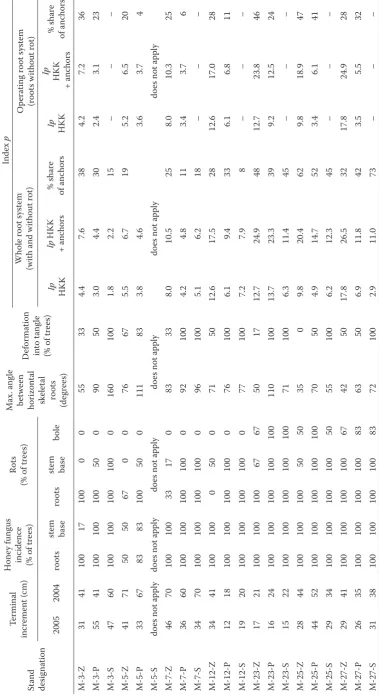
Results of the root system analysis – Moravec (Tables 1 and 3)
Suppressed terminal increment was observed neither in the injured trees nor in the trees that became snags in the same year – this was true of all analyzed forest stands. Resin exudations on the roots and on the stem base were observed in nearly all healthy trees, in all injured trees and in snags – this was true of all analyzed fo-rest stands. Rots on roots and stem base were observed occurring nearly in all healthy trees and in all injured trees; bole rots were recorded nearly in all trees over 20 m in height – this was true of all analyzed forest stands. Injured trees and snags with aboveground parts not ex-ceeding 5 m always exhibited much worse root system patterns than healthy trees. No essential differences, however, were found with respect to this parameter in older trees (see the max. angle between HKK). All the analyzed stands exhibi-ted an intolerably high occurrence of tangles – always smallest in healthy trees and showing a 100% presence in snags. All snags and nearly all injured trees (with the exception of stand M-23-P) developed weaker root systems than the healthy trees; snags have a weaker root sys-tem than injured trees; both snags and injured trees exhibit a decreasing number of anchors in total Ip value (this applies to all stands – see Whole root system). Injury has a conspicuous link to root rots (applies to all stands – see
[image:4.595.81.311.49.762.2]Ta
ble 2. C
harac
ter
istic
s of a
bove gr ound p ar t g row th, r oot s yst em de ve lopmen
t and he
alt
h c
ondition – R
adiměř lo cality St and de sig na tion Ter minal inc remen t (c m) H one y fung us inc idenc e
(% of tr
ee
s)
Rot
s
(% of tr
ee s) Ma x. ang le be twe en hor izon tal sk ele tal ro ot s ( de gr ee s) D ef or ma tion in to t ang le
(% of tr
ee s) Inde x p Ro oting de pt h ( cm) Whole r oot s yst em (w
ith and w
ithout r ot) O pera ting r oot s yst em (r oot s w ithout r ot) 2005 2004 ro ot s st
em base
ro
ot
s
st
em base
bole
Ip HKK Ip HKK
+ an ch or s % s har e of anc hors
Ip HKK Ip HKK
+ an ch or s % s har e of anc hors
whole root syst
Operating root system). Ip value of the whole root system decreased by 30–60% in all injured trees, in older trees it was more than in younger trees. Rots affect anchors more than horizontal skeletal roots (the Ip value decrease in HKK is smaller in all injured trees than the Ip value decrease for the whole root system; decreased was also the share of anchors in the Ip value for the whole root system). Rots also af-fected healthy trees; younger trees were observed to have both HKK and anchors affected by rots, older trees only the anchors. All injured trees and snags created the root system with smaller rooting depth than the healthy trees; snags exhibited a smaller rooting depth than injured trees. In general, the rooting depth is given by the tree age – older trees reach deeper soil horizons with their roots than younger trees. The disqualification of anchors (due to rots) considerably affected the original rooting depth in the injured trees (see Rooting depth of the operating root system). All injured trees exhibited an up to 50% decrease in fine root biomass. Younger injured trees showed an evidently decreased vital-ity of fine roots while the fine root vitalvital-ity in older injured trees showed an increase. Mycorrhizal infec-tion in younger injured trees was not affected while older injured trees exhibited an increased
mycor-rhiza infection. The injury had no influence on the type of mycorrhiza. Operating mycorrhiza is a light ectomycorrhiza; neither ectendomycorrhiza nor pseudomycorrhiza was detected. As compared with healthy trees, however, an about 8% occurrence of black ectomycorrhiza was recorded.
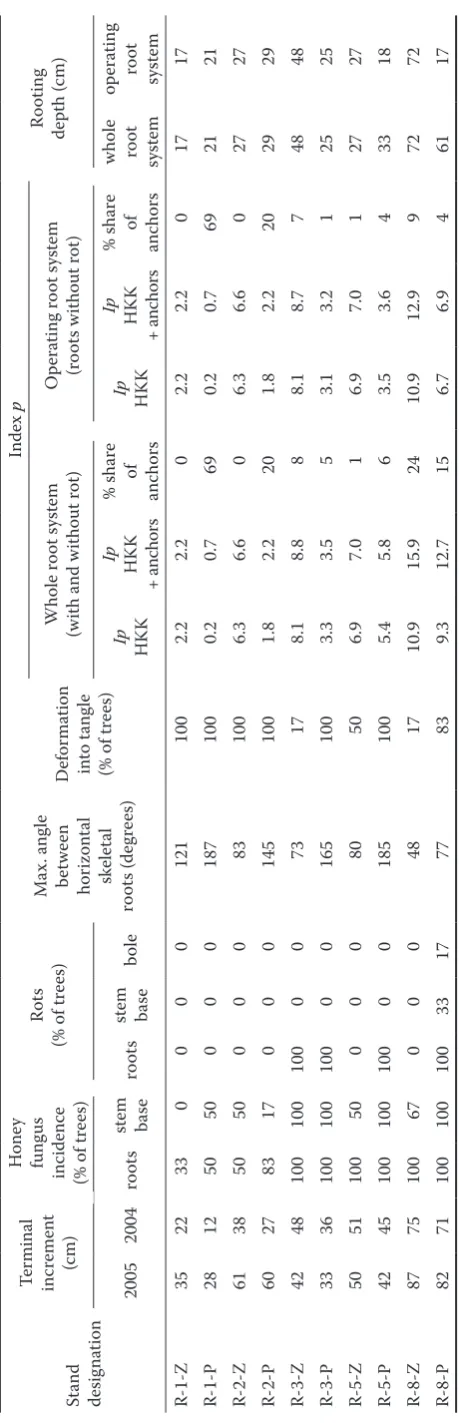
Results of the root system analysis – Radiměř (Tables 2 and 3)
[image:5.595.66.531.439.732.2]Injured trees did not exhibit an essential decrease in the terminal increment – this was true of all ana-lyzed stands. All anaana-lyzed trees with aboveground parts higher than 3 m exhibited resin exudations on roots and all injured trees had them also on the stem base. Higher than 50% occurrence of resin exudations on the stem base was found also in all healthy trees. Nearly all analyzed injured trees with aboveground parts higher than 3 m exhibited root rots. Root rots (up to 100%) were also detected in some healthy trees. Stem base rots and bole rots were recorded in trees taller than 8 m. No trees were affected by rots up to the aboveground part height of 2 m. All analyzed injured trees with aboveground parts higher than 3 m exhibited an evidently worse root distribution (see max. angle between HKK)
Table 3. Biomass, vitality, mycorrhizal infection of fine roots and the type of mycorrhiza
Stand designation Biomass (%) Vitality (%)* Mycorrhizal infection (%) Type of mycorrhiza
M-3-Z 100 100 100 ecto
M-3-P 56 86 96 ecto
M-5-Z 100 100 100 ecto
M-5-P 43 56 96 ecto
M-7-Z 100 100 100 ecto
M-7-P 62 64 149 ecto
M-12-Z 100 110 100 ecto
M-12-P 40 112 121 ecto
M-23-Z 100 100 100 ecto
M-23-P 58 125 134 ecto
M-25-Z 100 100 100 ecto
M-25-P 57 137 122 ecto
R-3-Z 100 100 100 ecto
R-3-P 49 142 140 ecto
R-5-Z 100 100 100 ecto
R-5-P 46 126 130 ecto
R-8-Z 100 100 100 ecto
R-8-P 40 163 174 ecto
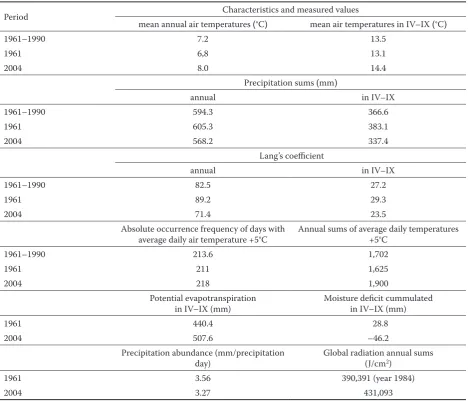
Table 4. Climatic data in 1961–2004 and comparison with normal values in 1961–1990
Period Characteristics and measured values
mean annual air temperatures (°C) mean air temperatures in IV–IX (°C)
1961–1990 7.2 13.5
1961 6,8 13.1
2004 8.0 14.4
Precipitation sums (mm)
annual in IV–IX
1961–1990 594.3 366.6
1961 605.3 383.1
2004 568.2 337.4
Lang’s coefficient
annual in IV–IX
1961–1990 82.5 27.2
1961 89.2 29.3
2004 71.4 23.5
Absolute occurrence frequency of days with
average daily air temperature +5°C Annual sums of average daily temperatures +5°C
1961–1990 213.6 1,702
1961 211 1,625
2004 218 1,900
Potential evapotranspiration
in IV–IX (mm) Moisture deficit cummulated in IV–IX (mm)
1961 440.4 28.8
2004 507.6 –46.2
Precipitation abundance (mm/precipitation
day) Global radiation annual sums (J/cm2)
1961 3.56 390,391 (year 1984)
2004 3.27 431,093
and a nearly 100% occurrence of tangle. Intolerable root pattern distribution and 100% tangle incidence were recorded in all analyzed trees (both healthy and injured ones) with aboveground parts higher than 2 m. All analyzed injured trees developed weaker root systems than healthy trees; the difference was getting smaller with increasing tree age. The injured trees in the analyzed younger stands showed higher shares of anchors in the Ip value than the healthy trees; the situation was opposite in the older stands (see Whole root system). The injury has a linkage to root rots (see Operating root system). The Ip value of the whole root system decreased by 10–15% in all injured trees with root rot, in the older trees more than in younger ones. Rots affected the anchors more than horizontal skeletal roots (the decrease in
Ip values in HKK was lower in all injured trees than the decrease in Ip values for the whole operating root system; the share of anchors in the Ip value for the whole operating root system also decreased). Rots
DISCUSSION
Symptoms of injury, detected tendencies and root system parameters of both injured and non-injured trees were nearly identical in the two localities whose site conditions (altitude and amount of nutrients) are not very favourable (Radiměř) or they are even unfavourable (Moravec) for the Norway spruce. This is in accordance with the condition of stands which has been less affected until now in Radiměř than in Moravec.
The basic predisposition factor of tree injury is a feeble root system; all healthy trees developed larger root systems than injured trees, snags had even smaller root systems than injured trees (compared to the original root system – whole root system with rots and without them). Differences in the root sys-tem size resulted from the method of planting (see Root system deformations into a tangle) and forest stand tending.
In trees with aboveground parts not exceeding 2 m and exceptionally also in some older trees, the dif-ferences in the size of the operating root system are induced only by the planting method (root system rots were not detected). Nearly all these trees have their root systems deformed into tangle – the most serious deformation; the injured trees have mark-edly poorer root systems with deformations cor-responding in their severity to development of the root system with a lower amount of lower-diameter root branches.
Although it also holds good that the trees “natu-rally” developed weaker root systems with increas-ing degree of injury when their aboveground parts were higher than 3 m, the root system size was still impacted by rots on its individual root branches. The values of the originally developed root system (whole root system with rots and without rots) began to differ markedly from those of the operating root system (root system without rots).
Rots of individual roots affected all injured trees and a major partof healthy trees (with the injured trees showing much larger amounts of affected roots than the healthy trees); dead standing trees exhibited all or nearly all root pattern branches affected by rots. Rots on roots, stem base and bole were evoked by the honey fungus. As indicated by resin exuda-tions, trees with aboveground parts about 2 m in height exhibited the presence of the honey fungus on their roots or stem base; there were, however, no rots detected. In trees with aboveground parts high 2–8 m, the honey fungus induced – apart from the resin exudations – also rotting of individual root branches. In trees with aboveground parts higher
than 8 m, the rot induced by the honey fungus was detected – apart from resin exudations and rots of individual roots – also on the stem base and on the bole itself. (It can be deduced that the impact of the honey fungus is of a long-term character in the con-cerned localities, particularly in Moravec.)
The massive spread of the honey fungus in the ana-lyzed forest stands can be indirectly corroborated by the occurrence of a great number of trees with swol-len stem bases, by resin exudations on the bole (e.g. the percentage of trees with stem resin exudations in Stand M-25 was visually estimated at 80%) or by the occurrence of sporocarps (e.g. in the immediate vicinity of analyzed forest stands in the Radiměř forest district a 100-year old spruce stand showing no visual symptoms of injury was felled in winter; however, at the end of the next growing season all the stumps exhibited a massive occurrence of honey fungus fruit bodies).
The analyses were only carried out on trees un-damaged by game. However, there are also trees damaged by wildlife occurring in the two localities, which are subsequently aggressively infested by red heart rot (Stereum sanguinolenteum). The synergic action of the two aggressive fungal pathogens accel-erates the tree decline (25% rot of the girth provokes an expressive decline also in trees with the Ip value decreased by 20%).
A scheme of the gradual damage to trees: the honey fungus infests the root system and gradually deactivates individual root branches whereas the operating root system, and also the rooting depth, are reduced. Responses to the deactivation of indi-vidual root branches are the increased performance of healthy roots with energy being concentrated to height increment – the assimilatory tissues begin to show symptoms of injury. After breaking “certain bounds” the remaining operating root system is not capable to supply nutrition and water any more – the honey fungus infests with rot very rapidly also the remaining parts of the operating root system and the tree dies. The principle of damage is identical in trees with aboveground parts of about 2 m – the injured trees have a small operating root system; the size of the operating root system, however, is not affected by root rots but rather by root system deformations (development of a feeble root system).
The question is: what the predisposing factor for the aggressive attack by the honey fungus is like and why trees with small operating root systems without rots die soon after the plantation. Considering the following facts – the analyzed localities have not been affected by air-pollution, the supply of soil nutrients is sufficiently high and acidity of soils is appropriate, the spruce occurs on the very margin of its species ecovalence in both localities, the tree injury has been observed in the several last years and its progression is rapid, we can hypothesise about the presence of another stress factor participating in the tree injury.
It is not only forestry that is influenced by climatic fluctuations and changes in the concerned locali-ties. The analyses showed that gradual changes oc-curring in these localities since 1961 are as follows (Table 4): annual sums of global radiation in 2005 were by 40,702 J/cm2 higher in comparison with
1984. This increase approximately represents the monthly sum of global radiation in April. Mean an-nual temperatures were gradually growing, and their final increase in comparison with the year 1961 was 1.2°C, mean air temperatures in April–September were gradually growing, and their increase was 1.3°C as compared with the year 1961 (with the highest
temperature increase in July and August). Annual solar radiation increased by 210 hours in the aligned series, the onset date of mean air temperatures of 0°C was gradually shifted backwards up to 18 days, and the ending date was shifted towards by 7 days. Aligned annual total precipitation amounts are lower by 37 mm, being strongly affected by tor-rential rains in recent years, the number of days without precipitation is considerably increasing (esp. in May–August) and annual Lang’s coefficient was rapidly falling (difference of 17.8). Examining the annual precipitation sums (as compared with the average values of evapotranspiration for spruce in FAVZ 4) we can conclude that the precipitation does not provide enough moisture for the success-ful growth of Norway spruce stands. The aligned water balance values for 1984–2004 exhibit a passive moisture balance for the period I–IX.
From the bioclimatic measurements and from the response of Norway spruce stands it can be deduced that a triggering factor for the injury is the change in climatic conditions (“drought”). The least injured are trees with large root systems capable of assuring more water and nutrients than a small root system can. After the tree weakening by drought the root system is infested by the honey fungus, rots of in-dividual roots reduce the root system size and the “preferred” disqualification of anchors cuts the tree from groundwater, which further deepens the water deficit. According to Petráš et al. (1985), the spruce has a higher foliage biomass as compared e.g. with the beech or pine, and the difference is ever more pronounced with the increasing tree diameter. This may be another reason why the species is consider-ably endangered by drought.
Although the causes, the symptoms and the course of injury are identical in the two localities, it can be assumed (on the basis of the root system analysis, with the persisting current climatic situ-ation) that the course of damage should be more expressive in Moravec (worse site conditions) than in Radiměř. In both localities the injury will affect young plantations and young stands whose root system is weaker than in older stands and reaches lesser rooting depths. In general, it is necessary to take in account increased sanitary felling in the al-ready injured (weakened) older stands.
A question is to be answered what forestry measures should be applied with the aim to reduce (eliminate) the injury. Considering the following two basic facts that there exist no direct methods protecting from the honey fungus, only indirect procedures supporting vigorous tree vitality, for-esters cannot affect the course of climate, one of the possibilities is to grow a large root system – by using the high-quality material for careful planting (hole planting), submerging the plants, supplying organic substances to their roots – in such a way that it is possible to increase the root system size up to three times. Since the early age, it is neces-sary to apply radical tending measures in order to strengthen the root system. After the canopy enclosure (at a height of min. 4 m), the number of trees should be reduced to 1,200 ha (after four years from the intervention, the size of the root system of released trees would increase by up to 60%). It is, however, a risky procedure since the survey demonstrated that the honey fungus can also colonize healthy trees and induce rots of some of their roots, i.e. that the suggested procedure can (with the progressing climate change) only mitigate the damage and the subsequent disintegration of forest stands.
The changed species composition is the only effec-tive and long-term solution. Norway spruce is to be entirely eliminated from regeneration targets up to FAVZ 3 and it should also be eliminated from regen-eration targets in nutrient-rich and extreme sites of FAVZs 4 and 5. In acidic and water-enriched sites of FAVZs 4 and 5, Norway spruce should be used only as an admixture up to 30%. Similar conclusions were obtained by Kantor et al. (2002). In case that it has been decided to maintain Norway spruce at a higher proportion (even in lower FAVZs), it is necessary to switch to planting the spruce ecotype of wooded hills (only one seed orchard has been established up to now). It is necessary to minimize the incidence of solar radiation on the soil in the existing Norway spruce groups of stands.
CONCLUSION
The Norway spruce decline and dieback in lower forest altitudinal vegetation zones has become one of the most serious problems of our forestry. It has been induced by two factors – planting of spruce on the very boundaries of its ecovalence and the climate change (weather course) over the recent years. The weather course affects the condition of forest stands in the individual years and in various aspects (with higher precipitation – a wet year – the symptoms
of injury are less conspicuous, and so is the dam-age to stands at sheltered aspects). Nevertheless, the fact that the stands are infested by the honey fungusat nearly 100% is undisputable – the same conclusions were also published by Jankovský and Cudlín (2002), and, consequently, it is only a question of time when the parasitic fungus triggers the tree death (in the last 7 years we have analyzed among others 2,600 Norway spruce root systems up to FAVZ 5 before the establishment of young plantations, 84% of the young trees were infested by the honey fungus, and losses in Norway spruce after the planting were higher by 25% than in FAVZ 6). In this situation, it does not matter to foresters whether the climate change has been induced by anthropo-genic activities or by objective factors. If we agree with the principle of “preliminary caution” – which should be assigned a high priority in forestry, we can expect that the current situation will be answered in correspondence with the essence of the problem. The climate deviations in the several last years can induce the total disintegration not only of spruce stands.
References
HRUŠKA J., CIENCIALA E. (eds.), 2001. Dlouhodobá acidi-fikace a nutriční degradace lesních půd – limitující faktor současného lesnictví. Praha, MŽP ČR: 1–159.
JANKOVSKÝ L., CUDLÍN P., 2002. Dopad klimatických změn na zdravotní stav smrkových porostů středohor. Lesnická práce, 81: 106–108.
KANTOR P. et al., 2002. Produkční potenciál a stabilita smíšených lesních porostů. Brno, MZLU v Brně: 1–86. MURACH D., 1991. Feinwurzelumsätze auf bodensaueren
Fichtenstandorten. Forstarchiv, 62: 12–17.
MURACH D., PARTH A., 1999. Feinwurzelwachstum von Fichten beim Dach-Projekt im Solling. AFZ Der Wald, 54: 58–60.
PALÁTOVÁ E., MAUER O., 2004. Reakce jemných kořenů smrku ztepilého na zvýšené depozice síry, dusíku, působení sucha a hnojení hořečnatými hnojivy. In: Kořenový systém – základ stromu. Brno, MZLU v Brně: 49–63.
PERSSON H., FIRCKS Y., MAJDI H., NILSSON L.O., 1995. Root distribution in Norway spruce (Picea abies /L./ Karst.) stand subjected to drought and ammonium-sulphate ap-plication. Plant and Soil, 168–169: 161–165.
PETRÁŠ R., KOŠÚT M., OSZLANYI J., 1985. Listová bio-masa stromov smreka, borovice a buka. Lesnícky časopis, 31: 121–136.
Odezva kořenového systému smrku ztepilého (
Picea abies
[L.] Karst.)
na měnící se vlhkostní a teplotní podmínky stanoviště
ABSTRAKT: Na Českomoravské vrchovině dochází až do 5. lesního vegetačního stupně k plošnému chřadnutí a odumírání smrku. Projevuje se v posledních sedmi letech a jeho průběh je rychlý. V devíti porostech (věk 3 až 73 let) byly vzájemně srovnávány stromy zdravé, chřadnoucí a souše. Byla zjišťována: dynamika přírůstu, architek-tonika kořenového systému, biomasa a životnost jemných kořenů, mykorhiza a napadení biotickými a abiotickými činiteli. Analyzováno bylo 414 stromů, byly zhodnoceny půdní charakteristiky a průběh počasí v letech 1961 až 2004. Predispozičními faktory jsou oteplování a nedostatek srážek. Oslabené stromy agresivně napadá václavka (Armilaria melea), stromy odumírají na hniloby kořenů. V příspěvku je popsán mechanismus poškození a odumírání stromů.
Klíčová slova: smrk ztepilý; chřadnutí; změny klimatu; kořenový systém; hniloby
Corresponding author:
Prof. Ing. Oldřich Mauer, DrSc., Mendelova zemědělská a lesnická univerzita v Brně, Lesnická a dřevařská fakulta, Lesnická 37, 613 00 Brno, Česká republika