JOURNAL OF FOREST SCIENCE, 54, 2008 (3): 125–130
Production processes used in the implementation of silvicultural and logging operations in forestry bring about large amounts of gaseous and liquid emissions of extraneous substances. Many of them cause the pollution of atmosphere and/or soil, sur-face and ground water (leakages of oils, fuels, etc.). The emissions particularly worsen the situation in forest stands endangered by air-pollution (Skoupý 2000).
The amount of emissions produced by forest technologies was studied by Athanasiadis (2000) and by Berg and Karjalainen (2003). The authors determined the amount of emissions by the
con-sumption of fuels in the individual forest operations and by the specific emission factor of individual fuel types. Dias et al. (2007) published a method of assessing the amount of emissions based on fuel consumption and on effective work time both for motor-manual and fully mechanized logging and transport technology.
The engine adjustment including the injection tim-ing, the injection pressure and the fuel pump plunger diameter to achieve the lowest possible emissions was studied by Lejny et al. (2006). The problem of injection timing adjustment was also solved by Parlak et al. (2005), who arrived at a conclusion
Supported by the Ministry of Education, Youth and Sports of the Czech Republic, Project No. MSM 6215648902, and the Ministry of Agriculture of the Czech Republic, Project No. QH71159.
Rationalization of the performance of a mobile off-road
system working in the forest environment with respect
to its emission load
A. Janeček
1, A. Skoupý
2, R. Klvač
21
Faculty of Forestry and Wood Sciences, Czech University of Life Sciences Prague, Prague,
Czech Republic
2
Faculty of Forestry and Wood Technology, Mendel University of Agriculture and Forestry in Brno,
Brno, Czech Republic
AbStRAct:This paper deals with the possibilities of minimizing the emissions of heterogeneous substances/pollut-ants (SO2, NOx and NCx) per volume unit of processed timber, based on measurements of the design and operating performance of a mobile off-road system working in the forest environment. The forest production system is taken to mean the production system into which the material and resource flow and/or even the workforce flow enter. During the production process the material, power and/or workforce flow is transformed into the final product (processed timber, soil preparation, afforestation, etc.). Operating and/or design capacity is the control variable optimizing the operating mode of the forest production system. The quantities of emitted pollutants related to the work unit done by the production system represent the criterional function specifying the optimization of parameters of the mobile off-road system working in the forest sector. The conditions for the operating mode (performance) of the mobile off-off-road system working in the forest environment under which the minimum emitted pollutants related to the unit of done work are reached have been determined. The theoretical conclusions have been verified experimentally.
that NOx emissions could be effectively reduced by proper injection timing. The authors’ focus was however the engine design.
None of the above-mentioned authors has been engaged with a possibility of affecting the amount of emissions through the regime of work or by using the technique of rational performance and by specifying the work regime at which emissions are the lowest. Only Berg and Lindholm (2005) studied a pos-sibility of fuel-related (CO2, SOx) or engine-related (hydrocarbons, NOx) emissions decreased by the use of renewable fuels and through the improvement of the engine design and better adjustment of engines designed for operations in the forest.
Nevertheless, should the machine (system) be already made, emissions can be optimized by its suitable rational performance. The most important measures compensating the environment con-tamination by extraneous substances are preventive measures that can be applied on a larger part of the area of endangered forest ecosystems. According to Janeček (1992), the measures consist in the selec-tion of appropriate and environment-friendly tech-nologies including the choice of suitable machinery, and in using acceptable methods for the employment of machines with the rational performance. Pos-sibilities to determine the rational performance of machines are further discussed in this paper.
The objective of this paper was to present some results from the analysis and from the determina-tion of mathematic condidetermina-tions required for reaching minimum specific emissions from logging and trans-port operations in the forest in relation to extracted mass unit.
MAteRiAlS And MethodS
The outline of deduction of the criterional function of specific heterogeneous substance emissions relat-ed to the timber yield volume unit was carrirelat-ed out in view of the objective mentioned above. Mathematical conditions for determination of the local extreme of the function of specific heterogeneous substance emissions were determined in dependence on the performance and physical significance of the terms of inequalities or equations specifying the above-men-tioned extreme of specific heterogeneous substance emissions were expressed. The papers published by Janeček et al. (1991), Bellman (1956), Wiener (1954), Skoupý (2000) and Janeček and Mikleš (2003) represented the methodological basis.
Theoretical conclusions were verified experimen-tally by monitoring the emissions of a Swedish-made TERRi 20-40 forwarder.
Qualitative specification of factors affecting emissions of heterogeneous substances
Logging and transport systems of different design performance, reaching different specific amount of material consumption, are used in the field of forest management. The specific heterogeneous substance emissions are proportional to the different used systems.
Factors affecting specific resource and material consumption:
– The change in all assemblies of logging and transport systems affecting the consumption of resources, material and/or labour is not directly proportional to an increase in the design performance;
– The changed investment intensity of logging and transport systems is not proportional to the change in performance. Such a situation arises due to the use of different unified assemblies manufactured in different typified sizes, i.e. their use usually leads to a certain oversize;
– Dimensional changes in stages (material flows processed by the logging and transport systems), resulting from the changed performance of the system, do not always cause a change in power and material consumption and thus a change in heterogeneous substance emissions proportional to the changed performance, which is in general the function of material flow velocity and cross section.
When analyzing these effects in greater detail, not only the kind of the logging and transport system but also particularly the method of reaching its design performance have to be considered.
Possibilities of increasing the design performance of forest systems:
– increased material flow range
By increasing the number of working assemblies (e.g. cutting mechanisms – used particularly for silvicultural operations);
By extending the working assembly (e.g. extension of the cutting mechanism length – cutter bars); – By extending the cross sections within roads
where the material is transported;
– By increasing the maximum working capacity (performance).
determination of the optimum regime of the logging and transport system from the aspect of specific heterogeneous substance emissions
related to the performance unit
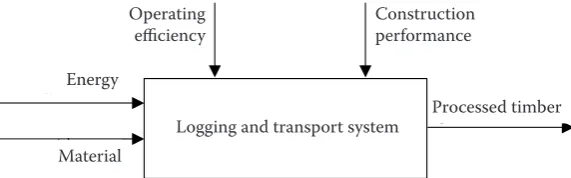
material are transformed during the production process, thus creating the resultant product, i.e. processed timber. The intensity of labour is con-trolled by the controllers specifying the design and operating performance (Fig. 1).
Emissions of heterogeneous substances, reflecting losses of energy during the process of production depend on the rate of work of the logging and trans-port system.
Janeček and Mikleš (2003) show that the follow-ing equation is valid for the expression of quantities of emissions of heterogeneous substances from tim-ber logging and transport occurring due to energy transformation:
mE × QE
MEE = –––––––––––– × SE (WK , WP) (kg) (1) ηCE (WK , WP)
where: MEE – quantities of emissions from timber logging and transport generated by the work of the logging and transport system as a conse-quence of energy transformation (kg), mE – the quantity of energy resources (Diesel
fuel, petrol) necessary for logging and production (kg),
Wp – the operating performance of the system (m3/s),
Wk – the design performance of the system (m3/s),
SE(Wp,Wk) – specific inherent emissions generated by energy and material transformation during the production process depend-ing on design and operatdepend-ing performance (kg/kJ),
QE – the specific energy of the resource (kJ/kg), ηCE (Wk, Wp) – the efficiency of resource
transforma-tion into the resultant product depending on design and operating performance. The following relation is valid for the total volume produced by the logging and transport system during the transformation of energy quantum QE
mE × QE
WCE = ––––––––––––––––– (m3) (2) QV × ηCE (WK, WP)
where: WCE – the total production volume of the system produced due to energy transformation (m3),
QV – the specific production energy which has to be supplied to the logging and transport system per unit of production (kJ/m3).
The time derivations of equation (1) can be ex-pressed in the following form, provided that the values QE, SE and ηCE are constants for the analyzed time:
∂mE ∂MEE ∂t × Qe
–––––– = –––––––––––– × SE (kg/s) (3) ∂t ηCE (WK , WP)
According to Janeček and Mikleš (2003) the following relation can be applied to quantities of heterogeneous substance emissions related to the performance unit of the mobile off-road system
∂mE
∂MEE 1 ∂t × QE ×SE
Q = –––––– × ––––––––––– = ––––––––––––––– ×
∂t WC(WK , WP) ηCE (WK , WP)
1
× ––––––––––– (kg/m3) (4) WC(WK, WP)
where: Q – specific heterogeneous substance emissions generated per volume unit (kg/m3),
t – the time (s), ∂MEE
––––– – ∂t ∂m
E
––––– – ∂t
The following equation is valid for the system performance
∂WCE
WC = –––––– (m3/s) (5) ∂t
The necessary conditions shown below are valid for the extreme of the function of specific hetero-geneous substance emissions, related to the volume unit of processed mass as the function of design and operating performance:
∂2M
EE (WK , WP)
–––––––––––––– = 0 (kg/m3) (6) ∂t × ∂WK
∂2M
EE
––––––––– = 0 (kg/m3) (7) ∂t, ∂Wp
logging and transport system energy
material
operating efficiency
construction performance
processed timber
Logging and transport system Processed timber Construction
performance Operating
efficiency
Material Energy
Fig. 1. Flow sheet of the logging and transport system
[image:3.595.70.356.60.149.2]After realization of all operations as mentioned above and after modifications (Janeček, Mikleš 2003) we derive the expressions deciding the sign of partial derivations in the form
∂ƒE (WK , WP) ƒE ∂ηC (WK , WP)
––––––––––––– – ––––––––––– × –––––––––––– –
∂WK ηCE (WK , WP) ∂WK ƒE ∂WC (WK , WP)
– –––––––––––– × ––––––––––––– > 0 (8)
WC (WK , WP) ∂WK
(relation (8) is valid for the field of higher design performance)
∂ƒE (WK , WP) ƒE ∂ηC (WK , WP)
–––––––––––– – ––––––––––– × –––––––––––– –
∂WP ηCE (WK , WP) ∂WP ƒE ∂WC (WK , WP)
– –––––––––––– × ––––––––––––– < 0 (9)
WC (WK , WP) ∂WP
(relation (9) is valid for the field of lower design performance)
where ∂MEE
ƒE = ––––– × QE × SE (WK , WP) (kg/s) (10)
∂t
fE – the emission flow caused by energy transformation in the production process.
By a similar analysis we can find the relations specifying the behaviour of the function of specific emissions in view of the control parameter WP, i.e. operating efficiency (Janeček, Mikleš 2003).
ReSUltS
Basic mathematical analyses of the problem in question were carried out in the scope of our work with the objective to determine the optimum oper-ating efficiency of logging and transport production systems with minimizing heterogeneous substances generated by the energy flow conversion during its transformation to the resulting product.
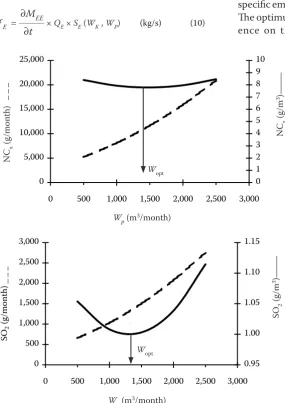
The constructed models were verified by the operation of a TERRi 20-40 forwarder (Figs. 2 to 4). Specifications of the conditions of work of the forwarder TERRi 20-40 and its technical parameters were presented in Janeček and Mikleš (2003).
The experiments have shown that the function of specific emission values always creates the minimum. The optimum operating efficiency ranges in depend-ence on the minimized emission constituents,
0 5,000 10,000 15,000 20,000 25,000
0 500 1,000 1,500 2,000 2,500 3,000
WP (m3/month)
NCx
(g/month)
_ _
_
0 1 2 3 4 5 6 7 8 9 10
Specific
NCx
(g/m
3 ) _
__
__
0 500 1,000 1,500 2,000 2,500 3,000
0 500 1,000 1,500 2,000 2,500 3,000
WP (m3/month)
SO
2
(g/month)
_
_
_
0.95 1.00 1.05 1.10 1.15
Specific
SO
2
(g/m
3 ) _
__
[image:4.595.64.290.110.181.2]__
[image:4.595.66.352.351.755.2]Fig. 2. Dependence of specific NCx on operating efficiency – TERRi 20-40
Fig. 3. Dependence of specific SO2 on operating efficiency – TERRi 20-40
Wp (m3/month)
N
Cx
(g/mon
th)
N
Cx
(g/m
3)
Wp (m3/month)
SO
2
(g/m
3)
Wopt
namely: NCx – 1,470 m3/month, SO
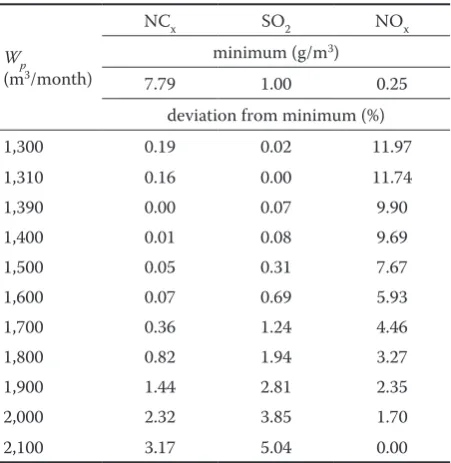
2 – 1,310 m3 per monthand NOx – 2,100 m3/month. Selection of the optimum efficiency of the forwarder depends on the mathematical weight of emission constituents which can be determined by the significance of their impacts on the environment (Skoupý 2000). Ranges of produced emissions with the changing operating efficiency are shown in Table 1.
it follows from relations (8) and (9) that the design of the mobile off-road system affects both the flow of heterogeneous substance emissions, i.e. it affects the inherent emission, and the efficiency of energy transformation to the resulting product, i.e. it affects the efficiency of combustion. Similarly, the value of operating efficiency at which the mobile off-road sys-tem works affects the transformation efficiency and
intensity of production of heterogeneous substances. The thesis (Duvigneaud 1980) that the quantity of dissipative energy is the measure of the environmen-tal purity (emissions of heterogeneous substances) of work of the production system is valid in general. The thesis has been confirmed by the practical analysis of work of the mobile system mentioned above in dependence on the rate of its work.
diScUSSion
The mathematical formulation of the production system behaviour (in logging and transport op-erations, but also valid for silvicultural operations) shown in this paper has confirmed that it can repre-sent a basis for the determination of conditions the fulfilment of which leads to the optimization based on the determination of the minimum heterogene-ous substance emissions related to the performance unit.
Thus, the solution provides an optimization of production system operations from the aspect of the minimum level of produced heterogeneous sub-stances related to the production unit and the mini-mum costs related to the production unit, necessary for the transformation of production system into an environmentally cleaner method of production. The general thesis (Duvigneaud 1980) has been confirmed: by minimizing the dissipative energies produced by the production system, we can reach the operating mode of the production system character-ized by the optimum work of the system with respect to environmental cleanness of the work.
Experimental measurements carried out on the TERRi 20-40 forwarder have revealed and substanti-ated that the upper limit of the operating efficiency recommended by the manufacturer (Wp ÷ 2,000 m3 per month) is too high with respect to the emissions of heterogeneous substances.
0 100 200 300 400 500 600 700
0 500 1,000 1,500 2,000 2,500 3,000
WP (m3/month)
N
Ox
(g/month)
_
_
_
0.0 0.1 0.2 0.3 0.4
Specific
NO
x
(g/m
3 ) _
__
[image:5.595.65.353.55.216.2]__
Fig. 4. Dependence of specific NO× on operating efficiency – TERRi 20-40
Table 1. Sensitivity analysis of the dependence of hetero- geneous substance emissions on the operating performan-ce of TERRi 20-40 system
Wp
(m3/month)
NCx SO2 NOx
minimum (g/m3)
7.79 1.00 0.25
deviation from minimum (%)
1,300 0.19 0.02 11.97
1,310 0.16 0.00 11.74
1,390 0.00 0.07 9.90
1,400 0.01 0.08 9.69
1,500 0.05 0.31 7.67
1,600 0.07 0.69 5.93
1,700 0.36 1.24 4.46
1,800 0.82 1.94 3.27
1,900 1.44 2.81 2.35
2,000 2.32 3.85 1.70
2,100 3.17 5.04 0.00
Wp (m3/month)
N
Ox
(g/m
3)
[image:5.595.65.291.525.757.2]it has been proved that the optimum operating efficiency of the TERRi 20-40 system ranges from 1,000 to 1,500 m3/month.
References
ATHANASSiADiS D., 2000. Energy consumption and ex-haust emissions in mechanised timber harvesting opera-tions in Sweden. Science of the Total Environment, 255: 135–143.
BELLMAN R., GLiCKSBERG O., GROSS O., 1956. On the bang-bang control problem. Quarterly of Applied Mathe-matics, 14: 11–18.
BERG S., KARJALAiNEN T., 2003. Comparison of green-house gas emissions from forest operations in Finland and Sweden. Forestry, 73: 271–284.
BERG S., LiNDHOLM E., 2005. Energy use and environmen-tal impact of forest operations in Sweden. Journal of Cleaner Production, 13: 33–42.
DiAS A.C., ARROJA L., CAPELA i., 2007. Carbon dioxide emissions from forest operations in Portuguese eucalypt and maritime pine stands. Scandinavian Journal of Forest Research, 22: 422–432.
DuviGNEAuD P., 1980. La synthèse écologique. Paris, Doin Éditeurs: 296.
JANEčEK A., MiKLEš M., 2003. Ecological aspects of mobile systems operated in terrain conditions. Research Agricul-ture Engineering, 49: 119–193.
JANEčEK A. et al., 1991. Úvodní systémová analýza mo-delování negativního působení lesní techniky na ekosys-témy. Strnady, vÚLHM: 143.
JANEčEK A. et al., 1992. Úvodní systémová analýza mo-delování negativního působení lesní techniky na ekosys-témy. Strnady, vÚLHM: 155.
LEJNY D., LuO Y., CHAN T., 2006. Optimization of exhaust emissions of a diesel engine fuelled with biodiesel. Energy and Fuels, 20: 1015–1023.
PARLAK A., YASAR H., HASiMOGLu C. et al., 2005. The effects of injection timing on NOx emissions of a low heat rejection indirect diesel injection engine. Applied Thermal Engineering, 25: 3042–3052.
SKOuPý A., 2000. Quality of Technologies for Sustainable Forest Management. in: KADLEC J., KLvAč R., vOJÁčEK A. (eds), Forest and Wood Technology vs. Environment. Brno, MZLu: 327–333.
WiENER N., 1954. The Human use of Human Beings. Cyber-netics and Society. 2nd Ed. New York, Garden City: 199.
Received for publication October 23, 2007 Accepted after corrections January 10, 2008
Racionalizace výkonnosti mobilního terénního systému pracujícího v lesním
prostředí z hlediska jeho zátěže emisemi
AbStRAKt:článek se zabývá možnostmi minimalizace emise cizorodých látek (SO2, NOx a NCx), vztahujících se na jednotku objemu zpracovaného dříví, a to na základě měření konstrukční a provozní výkonnosti mobilního terénního systému pracujícího v lesním prostředí. Lesní výrobní systém je zde chápán jako výrobní systém, do něhož vstupují materiálový a energetický tok a případně i tok pracovních sil. v době probíhajícího výrobního procesu je tok mate-riálu, energie nebo pracovní síly transformován na konečný produkt (zpracované dříví, příprava půdy, zalesňování atd.). Řídící veličinou optimalizující pracovní režim lesního výrobního systému je provozní, případně konstrukční výkonnost. Kriteriální funkcí specifikující optimalizaci parametrů mobilního terénního systému pracujícího v lesním hospodářství je množství emitovaných cizorodých látek, vztahujících se na jednotku práce vykonané výrobním sys-témem. Jsou stanoveny podmínky pro režim práce (výkonnosti) mobilního terénního systému pracujícího v lesním prostředí, za kterých je dosaženo minima emitovaných cizorodých látek, vztahujících se na jednotku vykonané práce. Teoretické závěry jsou experimentálně verifikovány.
Klíčová slova:lesnická technologie; SO2, NOx, NCx; optimalizace; minimalizace
Corresponding author:
ing. Radomír Klvač,Mendelova zemědělská a lesnická univerzita v Brně, Lesnická a dřevařská fakulta, Lesnická 37, 613 00 Brno, česká republika