Effects of pre- and postharvest factors on browning
in Braeburn
D. Hatoum
1, K. Buts
1, M.L.A.T.M. Hertog
1, A.H. Geeraerd
1, A. Schenk
3,
J. Vercammen
2, B.M. Nicolai
1, 31
Division of Mechatronics, Biostatistics and Sensors, Department of Biosystems,
Faculty of Bioscience Engineering, University of Leuven, Leuven, Belgium
2
RSF-PCFruit vzw, Sint-Truiden, Belgium
3
Flanders Centre of Postharvest Technology, Leuven, Belgium
Abstract
Hatoum D., Buts K. , Hertog M.L.A.T.M., Geeraerd A.H., Schenk A., Vercammen J., Nicolai B.M., 2014.
Ef-fects of pre- and postharvest factors on browning in Braeburn. Hort. Sci. (Prague), 41: 19–26.
The effects of several pre- and postharvest factors on apple cv. Braeburn browning disorder (BBD) incidence using a nine-factor experimental design has been investigated. The design allowed the determination of the effects of single fac-tors as well as their interaction with growing season and storage time. BBD increased in severity with storage duration. BBD incidence was reduced with calcium and potassium fertilizers application, while it was increased when triazoles were used. Delayed controlled atmosphere (DCA) application resulted in less BBD in storage, while treatment with 1-methylcyclopropene (1-MCP) increased BBD incidence. More BBD was observed in fruit stored at above optimal CO2 levels. BBD incidence was increased when O2 concentration in CA was increased from 1 kPa to 3 kPa (optimum CA) or 6 kPa. Finally, the various factors showed a different effect for different growing seasons and storage time. These findings suggest a possible mechanism for the development of BBD. Further work should focus on extending the experimental design to include the interactions between the different pre- and postharvest factors.
Keywords: Braeburn browning disorder; fertilizers; triazoles; controlled atmosphere; 1-methylcyclopropene
Malus domestica Borkh., cv. Braeburn is a popular apple cultivar worldwide. To facilitate year-round availability of fruit, apples are stored at low tempera-ture under controlled atmosphere (CA) conditions. Under the commercial storage conditions, apples can be stored well as a result of their reduced meta-bolic rate. The storability of cv. Braeburn is, howev-er, limited by the development of internal browning (Elgar et al. 1999). Affected fruit show patches of brown tissue which can result in cavity formation
(Elgar et al. 1998). The combination of brown flesh and off flavours makes brown apples unacceptable in the market, resulting in economic losses.
Different apple varieties vary in their susceptibil-ity to browning (Streif 2008). Cv. Braeburn has a high skin resistance (Rajapakse et al. 1990) turn-ing the skin into a stronger diffusion barrier as com-pared to some other apple cultivars. Together with a dense cellular organization this results in relative high internal CO2 concentration (Herremans et
al. 2013). These factors contribute to the sensitivity of cv. Braeburn to browning in storage (Lau 1998).
Preharvest factors influencing browning include seasonal changes and the application of agrochemi-cals. Cv. Braeburn fruit grown in cold seasons show more browning incidence than fruit from warmer seasons, and this might be attributed to increased respiration rate and reduced skin and tissue diffu-sivity in fruit from cold seasons (Lau 1998). Cal-cium plays an important role in maintaining the postharvest quality of fruit. It stabilizes the cell membranes and delays fruit senescence (Marinos 1962). More browning was observed in cv. Brae-burn fruit grown in soils with low calcium levels (Rabus, Streif 2000). Potassium is also an impor-tant nutrient associated with browning in apple. Johnson (2009) showed that triazole application induced browning in cv. Cox apples.
Postharvest factors that affect the quality of pome fruit include picking date, gas levels, temperature and delayed controlled atmosphere (DCA) appli-cation (Blanpied 1975; Lammertyn et al. 2000). Late season apples show more browning incidence (Elgar et al. 1999). This can be explained by the high metabolic rate and fast ripening in addition to increased skin and tissue resistance to gas ex-change in late season fruit (Lau 1998). Elgar et al. (1998) showed that delaying the CA application reduces browning incidence in cv. Braeburn apples. This is perhaps due to higher energy levels in fruit subjected to delayed CA (Saquet et al. 2003). Dur-ing CA storage, O2 concentration is decreased to reduce cellular respiration while avoiding fermen-tation. Depending on the fruit’s tissue properties local hypoxic regions might still arise inducing fer-mentation providing insufficient energy to repair damage to cellular membranes (on cv. Conference pear: Franck et al. 2007; on apple: Ho et al. 2011, 2013). As a result of de-compartmentalization, phenolic compounds come into contact with poly-phenol oxidase and are oxidized to brown pigments (Mayer 2006). During CA storage CO2 concentra-tion is often slightly increased to further reduce the fruit’s metabolic rate (McGlasson, Wills 1972). However, care should be taken as too high CO2 concentration is a strong trigger of browning in cv. Braeburn apples (Elgar et al. 1998). Cold stor-age ensures that metabolic reactions are reduced (Bohling, Hansen 1983), yet, too low tempera-tures are to be avoided as they can lead to cold-related fruit injuries. The postharvest application of the ethylene action inhibitor,
1-methylcyclo-propene (1-MCP) is often used to preserve fruit firmness and total acid content (DeEll et al. 2003). Lafer (2008) showed that 1-MCP treated cv. Brae-burn apples had an increased incidence of brown-ing compared to the untreated group.
Previous research has often focused on the ef-fect of individual factors on browning develop-ment; however, it is more likely that the occurrence of browning is the result of complex interactions among those factors. Verlinden et al. (2002) showed that the probability of core breakdown in cv. Conference pears depended on several vari-ables in a more complicated way than assumed be-fore. Reviewing the browning disorders in pears, Franck et al. (2007) suggested that it is unsatisfac-tory to evaluate the effect of single factors individu-ally.
In this study, we aimed to investigate the effects of several pre- and postharvest factors, and their interactions with the growing season and the stor-age duration, on the development of BBD. For this purpose, a balanced experimental design consist-ing of different combinations of optimal and sub-optimal levels of the chosen factors was applied.
MATERIAL AND METHODS
Experimental design. In this work, a two-level,
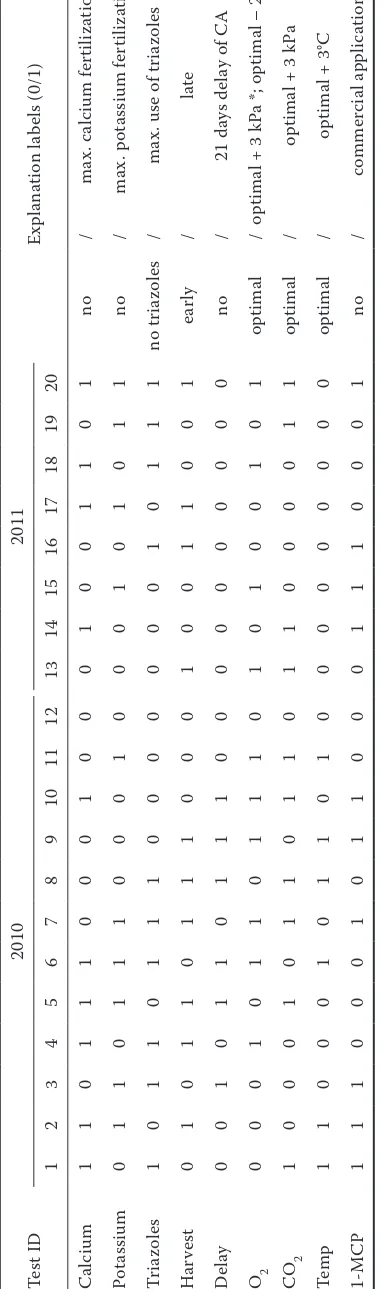
nine-factor, fractional factorial design was utilized. A fractional factorial design was important to duce the number of possible combinations that re-sults from full factorial designs. As a result, only information about the effects of single factors in addition to the interaction with storage time and growing season could be deduced. The experimen-tal design as depicted in Table 1, consisted in 2010 of 12 combinations of 3 preharvest factors (cal-cium, potassium and triazoles), harvest date and 5 postharvest factors (DCA, O2, CO2, temperature and 1-MCP). In 2011, storage conditions were cho-sen based on the results of 2010; no delayed CA was used and the storage temperature was kept at 1°C for all tests, resulting in a total of 8 different combinations. The levels of the nine factors used were coded as 0 and 1.
Fruit growing and harvesting. Braeburn, a
con-ditions, as defined by the fertilization regimes for calcium and potassium and the use of triazoles and growth regulators. Calcium and potassium were applied in a minimal or maximal amount of ferti-lizer, both in the soil and on the leaves. Maximal triazole application was used for some fruit, while fruit without triazole treatment received other fun-gicides and growth regulators.
Cv. Braeburn apples (Hillwell rootstock, 9th and 10th growth year) were harvested on two different dates (early – 19/10/2010 and late – 08/11/2010) in 2010 and in 2011 (early – 07/10/2011 and late – 26/10/2011). Jonagold apples (Novajo rootstock, 7th growth year) were harvested on two different dates (early – 10/09/2010 and late – 08/10/2010) only in 2010. Early and late harvest dates of both cultivars were determined by the Flanders Centre of Posthar-vest Technology based on a combination of firm-ness, starch, sugars and acids measurements.
Controlled atmosphere storage. Five different
postharvest factors were considered in the experi-mental design for season 2010. These factors were: time of DCA application, O2, CO2, temperature and 1-MCP treatment (Table 1). The commercial stor-age conditions for Jonagold (1°C, 1 kPa O2 and 2.5 to 3 kPa CO2 with 1 day DCA) and for cv. Braeburn apples (1°C, 2.5–3 kPa O2 and 0.7 kPa CO2 with 21 days DCA) were used as optimal conditions. Dif-ferent combinations of the optimal and suboptimal levels of these factors were applied. Some fruits were directly stored at CA, while others were kept in air at 1°C prior to CA application. Suboptimal levels were as follows: in the case of O2,3 kPa above optimum in 2010 and 2 kPa below optimum in 2011; in the case of CO2, suboptimal level was 3 kPa above the optimum; for storage temperature, suboptimal level consisted of raising the temperature from 1°C to 4°C. In the case of 1-MCP, some fruit received commer-cial application, while others were stored without previous treatment with 1-MCP.
Internal browning assessment. In 2010, cvs
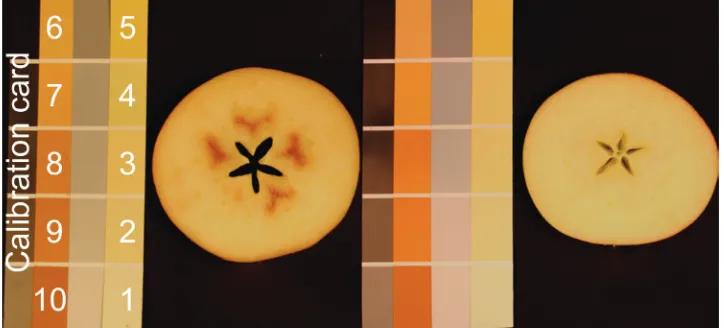
Braeburn and Jonagold apples were rated for browning at harvest and after three and six months of storage using 30 apples per condition. As in 2010 browning was already detected early in storage, as-sessments in 2011 were done more frequently: at harvest, after two and four weeks, and after two, four and six months of storage. Slices (~1 cm thick) were cut from the middle of the fruit perpendicular to the longitudinal axis, and pictures were taken. Included in the pictures was a colour-calibration card that was used for correcting for light
[image:3.595.81.274.112.760.2]differ-Ta
ble 1. O
ver
vie
w of t
he diff er en t tr ea tmen t c ombina tions u se d f or t he g row
ing and st
orage of c
vs Brae
bur
n and J
onagold a pple s dur ing t he st orage s ea
sons 2010 and 2011
Te st I D 2010 2011 Ex pl ana tion l ab el s (0/1) 1 2 3 4 5 6 7 8 9 10 11 12 13 14 15 16 17 18 19 20 C alc ium 1 1 0 1 1 1 0 0 0 1 0 0 0 1 0 0 1 1 0 1 no / ma x. c alc ium f er tili za tion Pot assium 0 1 1 0 1 1 1 0 0 0 1 0 0 0 1 0 1 0 1 1 no / ma x. p ot assium f er tili za tion Tr ia zole s 1 0 1 1 0 1 1 1 0 0 0 0 0 0 0 1 0 1 1 1 no tr ia zole s / ma x. u
se of tr
ia zole s H ar ve st 0 1 0 1 1 0 1 1 1 0 0 0 1 0 0 1 1 0 0 1 ear ly / lat e D el ay 0 0 1 0 1 1 0 1 1 1 0 0 0 0 0 0 0 0 0 0 no / 21 d ay s de la
y of C
A O2 0 0 0 1 0 1 1 0 1 1 1 0 1 0 1 0 0 1 0 1 optimal /
optimal + 3 kP
a *; optimal – 2 kP
a ** CO 2 1 0 0 0 1 0 1 1 0 1 1 0 1 1 0 0 0 0 1 1 optimal /
optimal + 3 kP
a Te m p 1 1 0 0 0 1 0 1 1 0 1 0 0 0 0 0 0 0 0 0 optimal /
optimal + 3
°C 1-MC P 1 1 1 0 0 0 1 0 1 1 0 0 0 1 1 1 0 0 0 1 no / commer ci al a pplic ation *2010 s ea
son; **2011 s
ea
ences between images (Fig. 1). Browning was rat-ed by using an in-house developrat-ed Matlab R2010 (Mathworks, Natick, USA) program in which the colour of each pixel of the cortex (excluding the core, the skin, and the reddish coloured outer layer directly underneath the skin) was compared to the yellow to brown colours from the calibration card. A brown index (BI) was calculated as the average of the squared colour indices of all pixels from the cortex, so that the contribution of any brown spot in the apple slice to the average BI is increased. As the colour scale is based on 10 classes (yellow = 1 to brown = 10) the calculated BI ranges from 1 to 100.
Data analysis. To determine the effects of the
factors as well as the interactions between them, data was subjected to ANOVA. Only differences (between treatment levels) for which the mod-el was significant (P < 0.05) were considered for further analysis. For browning analysis, only the 10 brownest apples from each condition were con-sidered. By choosing the average of the 10 brownest apples instead of the complete 30 fruit replicates per treatment, the analysis was made more sensi-tive to small changes in browning incidence, and thus the difference between the treatments was ac-centuated.
RESULTS AND DISCUSSION
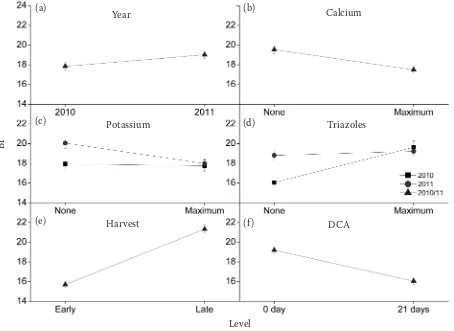
The effects of the various pre- and postharvest factors on browning in cv. Braeburn apples are shown in Figs 2 and 3. The figures only present the results that showed statistically significant differ-ences (P < 0.05) between the different treatment levels. When a factor showed no significant year
effect, it was represented by the overall average of the two seasons.
Cultivar effect
Under all pre- and postharvest treatment combi-nations used, cv. Jonagold did not develop browning during storage (data not shown). This is consistent with previous research that showed cv. Jonagold to be resistant to the development of internal browning during storage (Saquet et al. 2000). Braeburn cv., on the other hand, developed browning during storage with higher incidence in 2011 than in 2010 (Fig. 2a).
Fertilization effects
[image:4.595.108.470.85.249.2]Fruit that received max. calcium treatment devel-oped less BBD as compared to those without cal-cium (Fig. 2b). Rabus and Streif(2000) showed that the use of calcium fertilizers resulted in a low-er susceptibility of cv. Braeburn apples to browning in storage. As calcium stabilizes the membranes (Marinos 1962), the risk of decompartmentalisa-tion, potentially bringing phenolic compounds in contact with polyphenol oxidases, is reduced. Be-sides, calcium was also shown to be a necessary factor for the process of membrane repair (Stein-hardt et al. 1994).Potassium competes with cal-cium absorption from the soil which might there-fore lead to higher browning incidence (Neilsen, Neilsen 2009). However, in our study, max. po-tassium treatment resulted in decreased BBD inci-dence in 2011 fruit, while 2010 fruit showed only a slight decrease (Fig. 2c).
Triazole effects
In 2010, treatment with max. triazole resulted in fruit with more BBD (Fig. 2d). This is consistent with a study by Johnson(2009) on Cox’s Orange Pippin apples, where triazoles resulted in higher browning incidence. Triazoles inhibit brassinoster-oids(Tadao et al. 2003), which are plant hormones that induce ethylene synthesis (Arteca et al. 1988). Reduced ethylene levels result in lower ATP levels which can lead to the impairment of the mem-brane repair mechanism; thus contributing to more browning incidence. On the other hand, the higher respiration rate upon ethylene action is responsi-ble for decreased O2 concentration in the internal fruit tissue with a subsequent increase in browning incidence (Ho et al. 2011). In 2011, however, fruit that received max. triazole treatment only showed a slight increase in BBD incidence (Fig. 2d).
Harvest date effects
Late harvest apples showed more BBD than early harvest apples (Fig. 2e). This is similar to the in-creased incidence of browning in cv. Braeburn ap-ples reported by Rabus and Streif (2000). This might be due to the high respiration rate and the increased resistance to gas transport in late harvest fruit, thus resulting in decreased O2 and increased CO2 concentration in the internal tissue (Lau 1998; Ho et al. 2011).
CA effects
[image:5.595.67.521.83.414.2]Delaying the CA application resulted in less BBD incidence (Fig. 2f). This is in line with previous re-search on cv. Braeburn (Elgar et al. 1998). This de-crease in browning incidence might be due to the
Fig. 2. Effects of the different growing treatments, harvest date, delayed application of controlled atmoshpere (DCA), and season on browning index (BI) in cv. Braeburn apples in 2010 and 2011
Measurements were done at harvest and after CA storage. Values are means ± standard error. Only statistically significant dif-ferences (P < 0.05) between the 2 treatment levels are shown
BI
Level
(a) (b)
(d) (c)
(e) (f)
Year
Potassium
Harvest
Calcium
Triazoles
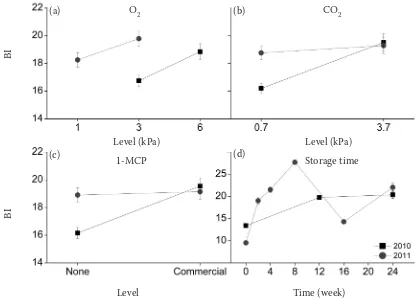
increased energy level after delaying the CA applica-tion (Saquet et al. 2003).Increasing the concentra-tion of O2 from 3 to 6 kPa in 2010 season resulted in increased BBD incidence. Reduction in BBD inci-dence was observed in 2011 when the O2 concentra-tion was lowered from 3 kPa to 1 kPa (Fig. 3a). This might be due to the fact that although the increased O2 level in the range studied (1–6 kPa) leads to high-er respiration rates, and thus more explain adeno-sine triphosphate (ATP) production, the potential production of ROS (a respiration by-product) also increases. The net balance between the two process-es is of such nature that the incidence of BBD was higher when the O2 concentration was increased.
More BBD incidence was observed in both seasons when CO2 concentration was raised (0.7 to 3.7 kPa). This increase, however, was less pronounced in 2011 (Fig. 3b). These results are in agreement with pre-vious reports that showed more internal browning in cv. Braeburn apples when CO2 concentration was increased to 3 kPa (Lau 1998; Argenta, Mattheis 2010). High CO2 levels shift the metabolism from the
Krebs cycle to fermentation resulting in inadequate energy for the maintenance of membranes which eventually might lead to browning development. Fermentation also produces acetaldehyde and etha-nol which were found to be associated with higher internal browning in apples (Lee et al. 2012b).
1-MCP effects
[image:6.595.74.492.84.385.2]1-MCP treatment resulted in fruit with higher BBD incidence in 2010. However, in 2011 the browning incidence was similar in both treated and untreated apples (Fig. 3c). The increased BBD incidence with 1-MCP treatment is similar to the results reported by Lafer (2008) on cv. Braeburn apples. 1-MCP in-hibits ethylene production resulting in lower energy levels, thus leading to impairment of the mainte-nance of cellular membranes. Besides, 1-MCP treat-ed fruit show increastreat-ed polyphenol oxidase (PPO) activity(Jung, Watkins 2011), which is the main enzyme responsible for browning reactions.
Fig. 3. Effects of O2, CO2, 1-MCP and storage time on browning index (BI) in cv. Braeburn apples in 2010 and 2011
(a) – O2 concentration in the storage atmosphere (1.3 and 6 kPa); (b) – CO2 concentration in the storage atmosphere (0.7 and 3.70 kPa); (c) – 1-MCP treatment (untreated/commercial application); (d) – storage duration (2, 4, 8, 12, 16 and 24 weeks of CA stor-age). Values are means ± standard error. Only statistically significant differences (P < 0.05) between the 2 treatment levels are shown
(a) (b)
(c) (d)
BI
BI
Level Time (week)
O2 CO2
Level (kPa) Level (kPa)
Storage time effects
BBD was observed in cv. Braeburn fruit early in storage, and the incidence increased with storage time reaching the highest level after 8 weeks of storage. Surprisingly, the fruits that were analysed after 12 and 16 weeks showed less browning as compared to those after 8 weeks of storage. After 24 weeks of storage, a further increase in BBD in-cidence was observed (Fig. 3d). This compares to previous reports which showed that browning in-cidence increased with storage duration (Clark, Burmeister 1999; Lee et al. 2012a).
CONCLUSION
The objective of this work was to study the effects of several pre- and postharvest factors on browning in cv. Braeburn apples. Treatments with calcium and potassium reduced the incidence of BBD, while the incidence was increased when triazoles were applied. Reduced BBD incidence was also observed when the application of CA was delayed. On the other hand, 1-MCP treatment increased the risk of BBD development. The concentration of gases in the storage atmosphere played an important role, increasing BBD incidence when higher concentra-tions of O2 or CO2 were applied. Finally, the re-sponse of fruit to the various pre- and postharvest treatments varied between the growing seasons and with the storage duration. These findings could suggest a possible mechanism for the development of internal browning in cv. Braeburn apples. Fur-ther work should focus on extending the experi-mental design to include more factors (e.g., crop load, different orchards), and the interaction terms between the different pre- and postharvest factors.
References
Argenta L.C., Mattheis J.P., 2010. Interactive effects of CA storage, 1-methylcyclopropene and methyl jasmonate on quality of apple fruit. Acta Horticulturae (ISHS), 857: 259–265.
Arteca R.N., Bachman J.M., Mandava N.B., 1988. Effects of indole-3-acetic acid and brassinosteroid on ethylene biosynthesis in etiolated mung bean hypocotyl segments. Journal of Plant Physiology, 133: 430–435.
Blanpied G.D., 1975. Core breakdown of New York ‘Bartlett’ pears. Journal of the American Society for Horticultural Science, 100: 198–200.
Bohling H., Hansen H., 1983. Respiration of apples during storage as a function of different atmospheres and tempera-tures. Acta Horticulturae (ISHS), 138: 93–105.
Clark C.J., Burmeister D.M., 1999. Magnetic resonance imaging of browning development in ‘Braeburn’ apple during controlled-atmosphere storage under high CO2. HortScience, 34: 915–919.
DeEll J.R., Murr D.P., Wiley L., Porteous M.D., 2003. 1-methylcyclopropene (1-MCP) increases CO2 injury in apples. Acta Horticulturae (ISHS), 600: 277–280. Elgar H.J., Burmeister D.M., Watkins C.B., 1998. Storage
and handling effects on a CO2-related internal browning disorder of ‘Braeburn’ apples. HortScience, 33: 719–722. Elgar H.J., Watkins C.B., Lallu N., 1999. Harvest date and
crop load effects on a carbon dioxide-related storage injury of ‘Braeburn’ apple. HortScience, 34: 305–309.
Franck C., Lammertyn J., Ho Q.T., Verboven P., Ver-linden B., Nicolai B.M., 2007. Browning disorders in pear fruit. Postharvest Biology and Technology, 43: 1–13. Herremans E., Verboven P., Bongaers E., Estrade P.,
Verlinden B.E., Wevers M., Hertog M.L.A.T.M., Nico-lai B.M., 2013. Characterisation of ‘Braeburn’ browning disorder by means of X-ray micro-CT. Postharvest Biology and Technology, 75: 114–124.
Ho Q.T., Verboven P., Verlinden B.E., Herremans E., Wevers M., Carmeliet J., Nicolai B.M., 2011. A three-dimensional multiscale model for gas exchange in fruit. Plant Physiology, 155: 1158–68.
Ho Q.T., Verboven P., Verlinden B.E., Schenk A., Nico-lai B.M., 2013. Controlled atmosphere storage may lead to local ATP deficiency in apple. Postharvest Biology and Technology, 78: 103–112.
Johnson D.S., 2009. Triazole sprays induce diffuse brown-ing disorder in ‘Cox’s Orange Pippin’ apples in controlled atmosphere storage. Postharvest Biology and Technology,
52: 202–206.
Jung S.K., Watkins C.B., 2011. Involvement of ethylene in browning development of controlled atmosphere-stored ‘Empire’ apple fruit. Postharvest Biology and Technology,
59: 219–226.
Lafer G., 2008. Storability and fruit quality of ‘Braeburn’ apples as affected by harvest date, 1-MCP treatment and different storage conditions. Acta Horticulturae (ISHS), 796: 179–184.
Lammertyn J., Aerts M., Verlinden B.E., Schotsmans W., Nicolai B.M., 2000. Logistic regression analysis of factors influencing core breakdown in ‘Conference’ pears. Postharvest Biology and Technology, 20: 25–37.
Lau O., 1998. Effect of growing season, harvest maturity, wax-ing, low O2 and elevated CO2 on flesh browning disorders in ‘Braeburn’ apples. Postharvest Biology and Technology,
Lee J., Cheng L., Rudell D.R., Watkins C.B., 2012a. An-tioxidant metabolism of 1-methylcyclopropene (1-MCP) treated ‘Empire’ apples during controlled atmosphere storage. Postharvest Biology and Technology, 65: 79–91. Lee J., Mattheis J.P., Rudell D.R., 2012b. Antioxidant
treat-ment alters metabolism associated with internal browning in ‘Braeburn’ apples during controlled atmosphere storage. Postharvest Biology and Technology, 68: 32–42.
Marinos N.G., 1962. Studies on submicroscopic aspects of mineral deficiencies. I. Calcium deficiency in the shoot apex of barley. American Journal of Botany, 49: 834–841. Mayer A.M., 2006. Polyphenol oxidases in plants and fungi:
going places? A review. Phytochemistry, 67: 2318–2331. McGlasson W.B., Wills R.B.H., 1972. Effects of oxygen
and carbon dioxide on respiration, storage life, and organic acids of green bananas. Australian Journal of Biological Sciences, 25: 35–42.
Neilsen D., Neilsen G., 2009. Nutritional effects on fruit quality for apple trees. New York Fruit Quarterly, 17: 21–24. Rabus C., Streif J., 2000. Effect of various preharvest treat-ments on the development of internal browning in ‘Brae-burn’ apples. Acta Horticulturae (ISHS), 518: 151–157. Rajapakse N.C., Banks N.H., Hewett E.W., Cleland D.J.,
1990. Development of oxygen concentration gradients in flesh tissues of bulky plant organs. Journal of the American Society of Horticultural Science, 115: 793–797.
Saquet A.A., Streif J., Bangerth F., 2000. Changes in ATP, ADP and pyridine nucleotide levels related to the incidence
of physiological disorders in ‘Conference’ pears and ‘Jona-gold’ apples during controlled atmosphere storage. Journal of Horticultural Science and Biotechnology, 75: 243–249. Saquet A.A., Streif J., Bangerth F., 2003. Reducing
internal browning disorders in ‘Braeburn’ apples by de-layed controlled atmosphere storage and some related physiological and biochemical changes. Acta Horticulturae (ISHS), 628: 453–458.
Steinhardt R.A., Bi G., Alderton J.M., 1994. Cell mem-brane resealing by a vesicular mechanism similar to neu-rotransmitter release. Science, 263: 390–393.
Streif J., 2008. Internal browning disorders in stored pip fruit. Acta Horticulturae (ISHS), 804: 315–320.
Tadao A., Masaharu M., Yukihisa S., Hideki G., Nobu- taka K., Katsuhiko S., Sun-Young H., Shozo F., Su-guru T., Kanzo S., Shigeo Y., 2003. Triadimefon, a fungi-cidal triazole-type P450 inhibitor, induces brassinosteroid deficiency-like phenotypes in plants and binds to DWF4 protein in the brassinosteroid biosynthesis pathway. Bio-chemical Journal, 369: 71–76.
Verlinden B.E., Jager A.D., Lammertyn J., Schotsmans W., Nicolai B.M., 2002. Effect of harvest and delaying con-trolled atmosphere storage conditions on core breakdown incidence in ‘Conference’ pears. Biosystems Engineering,
83: 339–347.
Received for publication August 19, 2013 Accepted after corrections October 30, 2013
Corresponding author:
Dr. Maarten L.A.T.M. Hertog, University of Leuven, Biostatistics and Sensors, Department of Biosystems, Division of Mechatronics, Willem de Croylaan 42, 3001 Leuven, Belgium