The apple (Malus × domestica Borkh.) is one of the most valuable fruit species in the world (Han-cock et al. 2008). Since apples play an important role in human health and diet, study on molecu-lar and cellumolecu-lar mechanisms of regulation of fruit ripening and fruit storage ability became essential (Seo, Taek 2009; Shi et al. 2013).
Fruit ripening is characterized by physiologi-cal and biochemiphysiologi-cal processes. For apple, it takes
about 150 days from pollination to full ripeness, and is generally described as a genetically pro-grammed event regulated by expression of specific genes (Giovannoni 2004; Tanksley et al. 2004; Park et al. 2006; Goulao, Oliveira 2007; Lee et al. 2007; Janssen et al. 2008; Soglio et al. 2009; Malladi, Johnson 2011; Bai et al. 2014).
The pollination, taking place typically several days after bloom, results in seed sets and
gener-Changes in gene expression profile during fruit
development determine fruit quality
S.E. Keller-Przybyłkowicz
1, K.P. Rutkowski
2, D.E. Kruczyńska
3,
K. Pruski
41
Department of Plant Breeding, Research Institute of Horticulture, Skierniewice, Poland
2Department of Fruit and Vegetables Storage and Processing, Research Institute
of Horticulture, Skierniewice, Poland
3
Department of Gene Resources of Horticultural Plants, Research Institute of Horticulture,
Skierniewice, Poland
4
Department of Plant & Animal Sciences, Faculty of Agriculture, Dalhousie University,
Truro, Canada
Abstract
Keller-Przybyłkowicz S., Rutkowski K.P., Kruczyńska D.E., Pruski K. (2016): Changes in gene expression
profile during fruit development determine fruit quality. Hort. Sci (Prague), 43: 1–9.
Climacteric fruit maturation is polygenic, complex process. Gene activity has a significant effect on the quality char-acteristics of the fruit for harvest and storage. Existing methods generally allow determining the degree of ripeness at harvest (point ‘0’). Since there is no method defining onset of the climacteric stage of the fruits, an attempt to identify the functional molecular marker that would determine a physiological ripeness of the fruit several days in advance before harvest was conducted. The analysis of changes in transcript of ten selected genes, and evaluation of the cor-relation of these genes with changes in fruits quality of two apple varieties Golden Delicious (winter cv.) and McIntosh (autumn cv.), allowed to identify a potential marker, activated a few days before harvesting the fruits. Overexpression of the starch glucosidase gene (StG) in the late fruits has been observed prior to the onset of ethylene production. The results confirm that it could be a potential functional marker useful for assessment of physiological ripeness status of cvs Golden Delicious and McIntosh.
Keywords: fruit ripening; fruit maturation; gene transcript level
ates the signal initiating fruit growth (Malladi, Johnson 2011). Then, the specific components re-sponsible for the physiological condition of fruits such as: starch and simple sugars, ethylene, volatile compounds including pigments and aroma compo-nents etc. are produced (Park et al. 2006; Lee et al. 2007; Goulao, Oliveira 2007; Janssen et al. 2008; Cevik et al. 2010). Moreover, due to accel-eration of cell prolifaccel-eration processes the structural changes occur that are responsible for fruit forma-tion such as carpel tube growth, fruit set, early and late stages of fruit growth (Seo, Taek 2009; Mal-ladi, Johnson 2011).
Global expression analysis of genes performed by Janssen et al. (2008) revealed numerous genes acti-vated in different fruit developmental stages, start-ing from flower buds (0 days after anthesis (DAA)), of cv. Royal Gala. By analysis of microarray plot, the genes were divided into several clusters. The main clusters are associated with the early fruit devel-opment genes (EFD), mid fruit develdevel-opment genes (MD) and ripening genes (R) (Janssen et al. 2008).
The major role in fruit maturation and ripening processes plays ethylene, described as a fruit ripen-ing hormone. Dependripen-ing on the initiation of eth-ylene production pathways, fruits are categorized as climacteric and non-climacteric (Lelievre et al. 1997; Giovannoni 2004; Seo, Taek 2009; Tacken et al. 2010). The primary components of control-ling the rate of ethylene production in climacteric fruits are 1-aminocyclopropane-1-carboxylic oxi-dase (ACO) and 1-aminocyclopropane-1-carboxyl-ic synthase (ACS), wh1-aminocyclopropane-1-carboxyl-ich activate ethylene system 1 (Lelievre et al. 1997; Barry et al. 2000; Shi et al. 2013). Since apples are climacteric, major changes occur at the time of the appearance of ethylene in the tissues, which also affects the value of post-har-vest and fruit storage conditions (Zhu, Barritt 2008; Costa et al. 2010).
For prediction of the onset of climacteric pro-cess, two methods of ethylene determination are commonly used. The first one is based on the meas-urements of the internal ethylene concentration in the samples of gas taken from the apple core. The second method allows measuring the rate of ethyl-ene production in fruits placed in the gastight jar (the gas sample is taken from headspace). Although breeders can use both methods for fruit phenotyp-ing there is a need to examine the ripenphenotyp-ing and cli-macteric process at the molecular level, by identi-fying a functional marker determining the maturity
stage of the fruit several days in advance, prior to harvest.
As harvesting the apples too early or too late of their maturity can result in storage losses, this re-search would like to present identification of the putative functional molecular markers proper for apple harvest time prediction. The aim was suc-cessfully achieved by analysing the expression pro-files of ten genes, previously identified by Janssen et al. (2008), evaluated as positively or negatively correlated with the changes of fruits quality.
MATERIAL AND METHODS
Plant material. The apples of cvs Golden Deli-cious and McIntosh were collected from the ex-perimental orchard of the Institute of Horticulture (Skierniewice, Poland), at different stages of matu-rity. Both cultivars differ in the time of ripening. Commercial harvest date for cv. Golden Delicious in season 2013 was October 3, and for cv. McIn-tosh it was September 11. The fruits were left on the trees as long as it was possible for the research needs.
Cv. Golden Delicious fruits were collected eight times, while cv. McIntosh only six times (due to the early maturation and tendency to pre-harvest drop). The number of days after full bloom (DAFB) and the dates of fruit picking are given in Table 1.
RNA isolation and quantitative PCR. From col-lected fruit samples (0.8 g of fruit flesh tissue cut from picked fruits, placed directly into the liquid nitrogen at the orchard) the total RNA was isolated according to the method described by Zeng and Yang (2002).
The RNA concentration and its integrity were determined using Bioanalyzer 2100 Expert (Perlan Technologies, Wroclaw, Poland). Finally pooled RNA (5 fruits of each variety from single picking date; 1µg/sample) was transcribed into cDNA (Af-finity Script QPCR cDNA Synthesis Kit), using 0.5 mMol of oligo-dT primer (both Perlan Tech-nologies, Wroclaw, Poland).
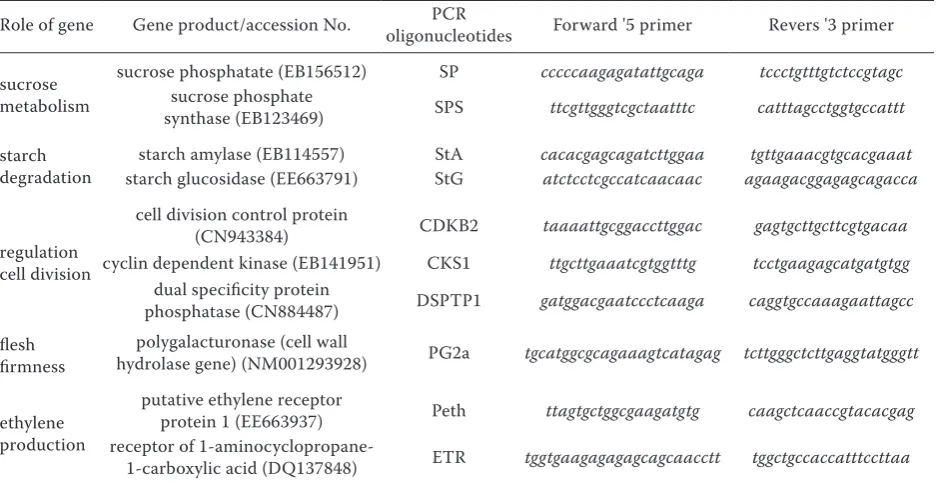
The relative expression level of gene transcripts were evaluated in the Real Time PCR reactions for which specific oligonucleotides complementary to the ten sequences of putative genes were designed. Names of the PCR primer sequences, the putative role of the genes and gene database accession num-bers are presented in Table 2.
2
Vol. 43, 2016 (1): 1–9 Hort. Sci. (Prague)
Quantitative reactions were performed in Rotor-Gen 6000 (Corbett, Life Science) with following thermal profile: 96°C for 5 min, and then 40 cycles of 96°C for 15 s, 60°C for 30 s and 72°C for 30 s. PCR mixture (10 µl) contained: 1 × qPCR Master Mix with 0.04 U of DNA polymerase (Kapa Sybr Fast qPCR Kit; Kapa Biosystems, Polgen, Lodz, Po-land), 10 mMol of dNTP mixture, 1.8 mMol of each primer and cDNA template (in three dilutions, to plot standard curve).
Phenotypic assessment. The fruit weight, the ethylene production rate, total soluble solids content (TSS), titratable acidity (TA) and flesh firmness (FF) were measured in apples collected at different devel-opmental stages (5 fruits/each develdevel-opmental stage).
Fruit weight, expressed in (g), was measured using WPS 2100/C/2 balance (Radwag, Radom, Poland).
To measure the ethylene production rates the apples were placed individually in 1.8 l glass jars equipped with septa. The jars were hermetically closed for two hours and then samples of 1 ml were taken for ethylene production rate measurement. Results were expressed in µl/kg/h of ethylene.
[image:3.595.64.536.113.256.2]The total soluble solids content (from fresh juice) was determined using digital refractometer PR-101 (ATAGO, Hackettstown, USA). The result was expressed as a percentage. Titratable acidity was quantified by titration of juice (automatic titrator DL 50 Graphix; Mettler Toledo, Schwerzenbach, Switzerland) with 0.1 M NaOH to pH 8.1 end point Table 1. Dates of fruit picking (season 2013)
Harvest No. Golden Delicious McIntosh (blooming: 13.05.)
date of picking DAFB date of picking DAFB
1 July 17 65 July 22 77
2 August 2 83 August 7 93
3 August 20 101 August 26 112
4 September 5 117 September 11 128
5 September 26 138 October 3 149
6 October 10 152 October 10 156
7 October 17 159 – –
8 October 24 166 – –
full bloom: Golden Delicious – May 14; McIntosh – May 11; DAFB – days after full bloom
Table 2. The putative role of the genes, GenBank accession numbers, names and sequences of designed oligonucleotides
Role of gene Gene product/accession No. oligonucleotidesPCR Forward '5 primer Revers '3 primer
sucrose metabolism
sucrose phosphatate (EB156512) SP cccccaagagatattgcaga tccctgtttgtctccgtagc
sucrose phosphate
synthase (EB123469) SPS ttcgttgggtcgctaatttc catttagcctggtgccattt
starch
degradation starch glucosidase (EE663791)starch amylase (EB114557) StAStG cacacgagcagatcttggaaatctcctcgccatcaacaac agaagacggagagcagaccatgttgaaacgtgcacgaaat
regulation cell division
cell division control protein
(CN943384) CDKB2 taaaattgcggaccttggac gagtgcttgcttcgtgacaa
cyclin dependent kinase (EB141951) CKS1 ttgcttgaaatcgtggtttg tcctgaagagcatgatgtgg
dual specificity protein
phosphatase (CN884487) DSPTP1 gatggacgaatccctcaaga caggtgccaaagaattagcc
flesh
firmness hydrolase gene) (NM001293928)polygalacturonase (cell wall PG2a tgcatggcgcagaaagtcatagag tcttgggctcttgaggtatgggtt
ethylene production
putative ethylene receptor
protein 1 (EE663937) Peth ttagtgctggcgaagatgtg caagctcaaccgtacacgag
receptor of
1-aminocyclopropane-1-carboxylic acid (DQ137848) ETR tggtgaagagagagcagcaacctt tggctgccaccatttccttaa
[image:3.595.64.533.514.756.2]and was expressed in percentage of malic acid. Flesh firmness was measured on two opposite sides of each fruit (after skin removing) using an EPT-1R (Lake City Technical Products Inc., Kelowna, Canada) pressure tester equipped with a standard 11.1 mm tip (results expressed in N).
Statistical analysis. Relative expression of the gene transcripts was analysed using two standard curves method (Larionov et al. 2005). All data were normalized in regard to 18s RNA reference gene (Acc. No. AB668577). Quantification of the gene expression was estimated using Rotor-Gene 6000 Series 1.7 software. The graphs of relative genes expression are presented in the logarithmic scale (Log10), as a response to skewness towards large value.
Correlation between genes expression changes and the trait value was calculated using the Spear-man’s rank (rs) correlation coefficient (Statistica Statsoft v. 10).
RESULTS
Changes in expression of the genes involved in sugar metabolism with regard
to TSS and TA value
Induction of starch amylase(StA), sucrose phos-phatase(SP) and sucrose phosphate synthase(SPS) genes expression was observed in cv. McIntosh at early and middle stages of fruit development (be-tween 77(1) and 128(4) DAFB). Negligible changes in the expression level of StA and SPS were
esti-mated in Golden Delicious. The SP amplified in fruits of Golden Delicious collected 152(6) DAFB, showed the level of transcript almost 2-fold higher in comparison to McIntosh. Parallel tendency of the changes in transcript level for both analysed apple cultivars were observed for starch glucosi-dase (StG) gene. Its overexpression was noted few days before 166(8) and 156(6) DAFB with regard to Golden Delicious and McIntosh fruits, respective-ly. Phenotypic evaluation conducted in this study showed an increase of TSS and decrease of TA in both tested cultivars at each date of sample fruit picking (Fig. 1).
Changes in expression of the genes regulating cell division in regard
to the fruit weight
The highest expression levels of all tested genes were observed between 128(4) and 156(6) DAFB in McIntosh fruits. However, additional peak of cell division control gene (CDKB2) was noted at the early stage of fruit development in McIntosh (93(2) DAFB). The highest expression level of dual speci-ficity protein phosphatase(DSPTP1) gene was ob-served in fruits of cv. Golden Delicious collected 83(2) DAFB. The expression of this gene was 10-fold higher than in McIntosh fruits picked up at the same fruit developmental phase. No significant changes in the transcript level of cell division con-trol protein (CDKB2) and cyclin dependent kinase (CKS1) genes were observed in fruits of cv. Golden Delicious. The phenotypic data show the
progres-Fig. 1. Expression profiles of the genes involved in sugar and starch metabolism (SP – sucrose phosphatate, StG – starch glucosidase, SPS – sucrose phosphate synthase, StA – starch amylase), and phenotypical values (TSS – total soluble solids, TA – titratable acidity) of the fruits of apple cvs (a) Golden Delicious and (b) McIntosh
1–8 – harvest No. of Golden Delicious; 1–6 – harvest No. of McIntosh
StG StA SP SPS TSS TA 0 2 4 6 8 10 12 14 0.01 0.10 1.00 10.00 100.00 1,000.00
1 2 3 4 5 6
Re la tive gene s e xpr ession
TSS and TA (%)
StG StA SP SPS TSS 0 2 4 6 8 10 12 14 16 0.01 0.1 1 10 100
1 2 3 4 5 6 7 8
Re la tive gene s e xspr ession
TSS and TA (%)
TA
StG StA SP SPS TSS TA 0 2 4 6 8 10 12 14 0.01 0.10 1.00 10.00 100.00 1,000.00
1 2 3 4 5 6
Re la tive gene s e xpr ession
TSS and TA (%)
StG StA SP SPS TSS 0 2 4 6 8 10 12 14 16 0.01 0.1 1 10 100
1 2 3 4 5 6 7 8
Re la tive gene s e xspr ession
TSS and TA (%)
TA (b)
(a)
4
Vol. 43, 2016 (1): 1–9 Hort. Sci. (Prague)
[image:4.595.69.519.548.696.2]sive increase of fruit weight in the subsequent dates of collecting the fruits of both cultivars (Fig. 2).
Changes in expression of the cell wall hydrolase gene (polygalacturonase, PG)
in regard to fruit firmness (FF)
The highest peak of expression of polygalactu-ronase (PG2a) gene was observed between 152(6) and 156(6) DAFB, for cvs Golden Delicious and McIntosh, respectively. Moreover, the gene tran-script level was 3-fold higher in Golden Delicious. The major trends of changes in FF, which succes-sively decreased during fruit development of both apple varieties, are presented in Fig. 3.
Changes in expression of the genes coding ethylene receptor proteins in regard
to ethylene production
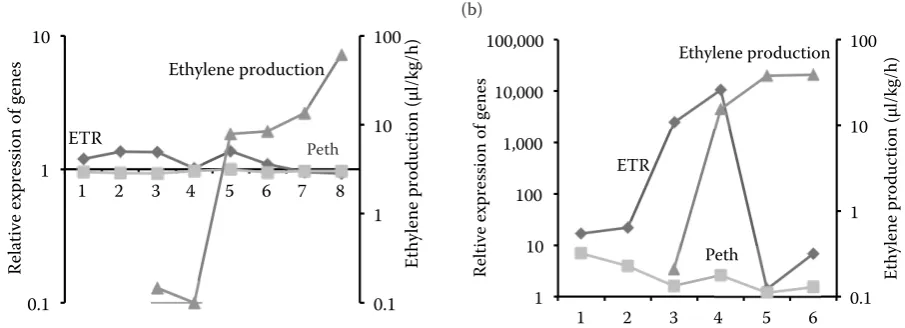
High level of expression of both genes regulating the ethylene production pathway (named Pethand ETR) was noted at early and middle stage of fruit development of McIntosh (77(1) DAFB and 128(4) DAFB), falling gradually as the fruit matured. An increasing tendency in ethylene production, pro-gressive in the following terms of fruit collection, was confirmed by the phenotypic evaluation of each sample of both cultivars. Our results show that senescence process of cv. McIntosh (early fruitful) and cv. Golden Delicious (late fruitful) begins upon 149(5) and 166(8) DAFB, respectively. Additionally,
0 20 40 60 80 100 120 140 160 180 0.1 1 10 100
1 2 3 4 5 6 7 8
Re le tive gene s e xpr ession
Fruit weight (g)
CDKB2 DSTP1 CKS1 fruit waight 0 20 40 60 80 100 120 140 160 0.01 0.10 1.00 10.00 100.00 1,000.00 10,000.00 100,000.00
1 2 3 4 5 6
Re la tive gene s e xpr ession
Fruit waight (g)
CDKB2 DSTP1 0 20 40 60 80 100 120 0.1 1 101 2 3 4 5 6 7 8
Re le tive gene s e xpr ession
Fruit waight (g)
CDKB2 DSTP1 CKS1 Fruit weight 0 20 40 60 80 100 120 140 160 0.01 0.10 1 10 100 1,000 10,000 100,000
1 2 3 4 5 6
[image:5.595.68.532.92.256.2]Re la tive gene s e xpr ession Fruit w eight (g)
Fig. 2. Expression profiles of the genes involved in cell division (CKS1 – cyclin dependent kinase, DSTP1 – dual
specific-ity protein phosphatise, CDKB2 – cell division control protein) and fruit weight measurements of apple cvs (a) Golden
Delicious and (b) McIntosh
1–8 – harvest No. of Golden Delicious; 1–6 – harvest No. of McIntosh (b) (a)
Fig. 3. Expression profiles of the cell wall hydrolase gene PG (PG2a), and fruit firmness (FF) measurements of apple cvs
(a) Golden Delicious and (b) McIntosh
1–8 – harvest No. of Golden Delicious; 1–6 – harvest No. of McIntosh
PG2a FF 0 20 40 60 80 100 120 140 160 0.01 0.1 1 10 1001 2 3 4 5 6 7 8
Re la tive gene s e xpr ession
Fruit firmnes (N)
PG2a FF 0 20 40 60 80 100 120 140 1 10
1 2 3 4 5 6
Re
la
tiuve gene e
xpr
ession
Fruit firmnes (N)
PG2a FF 0 20 40 60 80 100 120 140 160 0.01 0.1 1 10 1001 2 3 4 5 6 7 8
Re la tive gene s e xpr ession
Fruit firmnes (N)
PG2a FF 0 20 40 60 80 100 120 140 1 10
1 2 3 4 5 6
Re
la
tiuve gene e
xpr
ession
Fruit firmnes (N)
(a) (b) CKS1 DSTP1 CDKB2 Fruit weight FF 5
Hort. Sci. (Prague) Vol. 43, 2016 (1): 1–9
[image:5.595.70.527.550.713.2]the range of ethylene production in cv. Golden De-licious was almost 2-fold higher in comparison to cv. McIntosh (Fig. 4).
Correlation between gene expression profile and trait value
Spearman’s correlation coefficient analysis was carried out for the four characteristics measured in
collected apple fruits. In presented study negative correlation between TSS and related genes were observed for Golden Delicious. Additionally, high significant correlation ratio between the StG ac-tivity and TSS (unlike TA), negatively regulated in Golden Delicious and positively in McIntosh, was calculated (Table 3).
In case of fruits of both analysed cultivars, nega-tive correlation between the fruits weight (Table 4.) as well as fruit firmness (FF) (Table 5.) and expres-sion level of all tested genes was noted. Simulta-neously, McIntosh fruits showed negative correla-Table. 3. Correlation between the expression levels of genes involved in sugar metabolism and the characteristics of apple fruits
Marker Total soluble solids (%) Titratable acidity (%) as malic acid
Golden Delicious McIntosh Golden Delicious McIntosh
SPS –0.9*** 0.52* 0.82*** –0.48*
SP –0.63 ** 0.29 0.61** –0.35
StG 0.86*** 0.95*** –0.82*** –0.95***
StA –0.4 0.06 0.36 –0.08
[image:6.595.74.527.96.260.2]*P = 0.05 **P = 0.01 ***P = 0.001 ****P = 0.0001
Table. 4. Correlation between the expression levels of genes involved in cell division and the fruits weight
Marker Fruits weight (g)
Golden Delicious McIntosh
CDKB2 –0.46* –0.79***
CKS1 –0.64*** –0.62**
DSPTP1 –0.67*** –0.61**
[image:6.595.62.532.371.457.2]*P = 0.05; **P = 0.01; ***P = 0.001;
Table. 5. Correlation between the gene expression of polygalacturonase gene and the apple fruits firmness (FF)
Marker Fruits firmness (N)
Golden Delicious McIntosh
PG2a –0.75**** 0.24
****P = 0.0001
Fig. 4. Expression profiles of the genes involved in ethylene biosynthesis (ETR – receptor of 1-aminocyclopropane-1-car-boxylic acid, Peth – putative ethylene receptor protein 1), and ethylene production rate in fruits of apple cvs (a) Golden Delicious and (b) McIntosh
1–8 – harvest No. of Golden Delicious; 1–6 –harvest No. of McIntosh
ETR Peth
Ethylene production
0.1 1 10 100
0.1 1 10
1 2 3 4 5 6 7 8
Re
la
tive e
xpr
ession of gene
s
Ethylene production
(µl/kg/h
)
ETR
Peth
Ethylene production
0.1 1 10 100
1 10 100 1,000 10,000 100,000
1 2 3 4 5 6
Re
ltive e
xpr
ession of gene
s
Ethylene production µl/kg/h
ETR Peth
Ethylene production
0.1 1 10 100
0.1 1 10
1 2 3 4 5 6 7 8
Re
la
tive e
xpr
ession of gene
s
Ethylene production µl/kg/h
ETR
Peth
Ethylene production
0.1 1 10 100
1 10 100 1,000 10,000 100,000
1 2 3 4 5 6
Re
ltive e
xpr
ession of gene
s
Ethylene production
(µl/kg/h
)
(a) (b)
Peth
6
Vol. 43, 2016 (1): 1–9 Hort. Sci. (Prague)
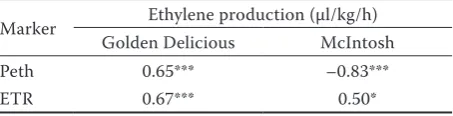
[image:6.595.62.291.666.739.2] [image:6.595.303.532.696.738.2]tion (with high level of significance) between the ethylene production rate and the putative ethylene receptor gene (Peth) transcript level. Contrariwise, relatively lower correlation to the trait value was obtained for gene encoding receptor of 1-aminocy-clopropane-1-carboxylic acid (ETR) (Table 6). No significant correlation (P > 0.1) between the trait value and expression level was calculated for StA (both cultivars, Table 3), SP and PG2a (cv. McIn-tosh, Tables 3 and 5).
DISCUSSION
The present study reports on the changes in ex-pression level of genes putatively involved in pro-cesses associated with development and fruit rip-ening as well as their correlation with qualitative traits of apples. For this study, two apple cultivars characterized by different harvest time were cho-sen. Generally mid-October is the picking time for cv. Golden Delicious, while for cv. McIntosh it is the first half of September (Sapers et al. 1977; Blažek et al. 2003).
Examination of the correlation between fruit quality characteristics and the level of transcripts of the putative sequence were carried out for ten genes, for which differential expression profile in apple cv. Royal Gala, was presented in the study of Janssen et al. (2008).
The relationship between the measured trait and the selected genes was examined using the Spear-man’s rank correlation coefficient. This coefficient is described as less sensitive to variations in sam-ples and it is typically used when the values of measurable characteristics are not described nu-merically but in the form of nonparametric ranks (Shmulevich, Zhang 2002; Tschopp et al. 2014). The results obtained in this study showed the complexity between association of metabolites ap-pearance and gene expression, and it has to be
as-sumed that these relations depend on individual character and intensity of the process that takes place during fruit formation, growth and matura-tion (Han et al. 2008; Janssen et al. 2008; Soglio et al. 2009).
Typically, the starch accumulation increases sig-nificantly about 75 days after the opening of the flower bud. About 100 days after pollination its lev-el begins to decline and then major simple sugars (fructose, glucose, sorbitol) are released that affect fruit sweetness (Thammawong, Arakawa 2007; Janssen et al. 2008; Li et al. 2012). The results sup-port the theory that the induction of sucrose phos-phate synthase (SPS), sucrose phosphatase (SP) and starch amylase (StA) in climacteric fruits (i.e. apple, kiwi, tomato) occurs before the onset of pre-climacteric processes (Langenkämper et al. 1998; Giovannoni 2004; Janssen et al. 2008; Wang et al. 2013). Moreover, the expression peak of StG ap-pears in fruits of both studied cvs. before the ethyl-ene level increases.
Recently, many reports have been released with regard to ethylene regulation in plants and fruit sof-tening (Goulao, Oliveira, 2007; Janssen et al. 2008; Han et al. 2008; Costa et al. 2010; Tacken et al. 2010; Ireland et al. 2013). Our study focused on the genes coding major ACC and ethylene sys-tem 1 receptors (Peth and ETR), revealed by Jans-sen et al. (2008). The regulatory mechanism of eth-ylene in higher plants is controlled at two steps: by the formation of 1-aminocyclopropane-1carboxilic acid (ACC) from S-adenosyl L-methionine, which is controlled by multigene families and by the con-version of intermediates to ethylene. It may be as-sumed that the expression profile of both tested genes could be genotypically dependent, since no significant changes of the expression level of both evaluated genes were observed in the fruits of cv. Golden Delicious well known to produce the high level of ethylene, conferred in our study (cv. Golden Delicious represented 2-fold higher ethylene rate production in comparison to cv. McIntosh). This could mean that those genes might not be directly correlated with the trait. Moreover, softening of ap-ples is also regulated by the increase in expression of number of cell wall degradation-related genes such as polygalacturonase PG, for which the induc-tion during fruits maturainduc-tion occurred in cvs McI-ntosh and Golden Delicious. The facts above point out the positive regulation of fruit softening and negative regulation of fruit firmness processes con-Table. 6. Correlation between the expression level of genes
coding ethylene and ACC receptors and the internal eth-ylene concentration in apples
Marker Ethylene production (µl/kg/h)
Golden Delicious McIntosh
Peth 0.65*** –0.83***
ETR 0.67*** 0.50*
*P = 0.05; ***P = 0.001
[image:7.595.64.291.140.198.2]firmed by other authors (Percy et al. 1996; Park et al. 2006; Payasi et al. 2009; Tacken et al. 2010). An important group of genes playing a key role in fruit formation and growth are genes regulating cells division processes. Transition from cell production to cell expansion in fruits occurs between 3–8 weeks after full bloom and is strictly associated with mei-otic cell production. This is facilitated by the core group of cell cycling genes such as cyclin dependent kinases (CDK) expressed mainly at the early stages of fruit development. Our data correspond to the research conducted by the other authors, who also indicated that these genes are early induced and negatively correlated with the fruit weight (Janssen et al. 2008; Malladi, Johson 2011).
The knowledge of the molecular mechanisms un-derlying fruit quality traits seems to be fundamen-tal for apple ripening physiological status descrip-tion and for improving apple breeding. Since the fruit development and ripening are multi-affected biological processes (Soglio et al. 2009), identifi-cation of the particular genes/sequences, and po-tential functional/physiological molecular markers is difficult. Our analysis shows that the StG ampli-fying gene sequence encoding starch glucosidase seems to be a good candidate for such functional molecular marker. It could be useful for breeders for monitoring the fruit ripening processes and predicting the collective maturity and storage abil-ity of fruits of cvs Golden Delicious and McIntosh. However its utilization for testing the other apple varieties has to be validated.
Acknowledgments
The experiment was carried out within the statu-tory programme of the Institute of Horticulture (1.2.2). Also we would like to thank prof. Robert Maciorowski for the great support in statistical analysis.
References
Bai Y., Dougherty L., Xu K. (2014): Towards an improved apple reference transcriptome using RNA-seq. Molecular Genetics and Genomics, 289: 472–438.
Barry S.C., Liop-Tous I.M, Grierson D. 2000. The regula-tion of 1aminocyclopropane-1carboxylic acid synthase gene expression during the transistion from system-1 to system-2 ethylene synthesis in tomato. Plant Physiology. 123: 979–986.
Blažek J., Hlušičková I., Varga A. (2003): Changes in quality characteristics of Golden Delicious apples under different storage conditions and correlations between them. Horti-cultural Science (Prague), 30: 81–89.
Cevik V., Ryder C.D., Popovich A., Manning K., King G.J., Seymour G.B. (2010): A fruitfull like genes is associated
with genetic variation for fruit firmness in apple (Malus
do-mestica Borkh.). Tree Genetics and Genomics, 6: 271–279. Costa F., Alba R., Schouten H., Soglio V., Gianfranceschi L., Serra S., Musacchi S., Sansavini S., Costa G., Fei Z., Gio-vannoni J.J. (2010): Use of homologous and heterologous gene expression profiling tools to characterize transcrip-tion dynamics during apple fruit maturatranscrip-tion and ripening. Plant Biology, 10: 1–17.
Giovannoni J.J. (2004): Genetic regulation of fruit develop-ment and ripening. The Plant Cell, 16: 170–180.
Goulao L.F., Oliveira C.M. (2007): Molecular identification of novel differentially expressed mRNAs up-regulated during ripening of apples. Plant Science 172: 306–318.
Han S.E, Seo Y.S, Heo S, Kim D, Sung S.K, Kim W.T. (2008): Structure and expression of MdFBCP1, encoding an
F-box-containing protein 1, during ‘Fuji’ apple (Malusdomestica
Borkh.) fruit ripening. Plant Cell Repository, 27: 1291–1301. Hancock J.F., Luby J.J., Brown S.K., Lobos G.A. (2008): Ap-ples. In: Hancock J.F. (ed.): Temperate Fruit Crop Breeding, Germplasm to Genomics. Springer Science USA, Business Media B.V.: 1–38.
Ireland H.S., Yao J-L., Tomes S., Sutherland P.W., Nieuwen-huizen N., Gunaseelan K., Winz R.A., David K.M.,
Schaf-fer R.J. (2013): Apple SEPALLATA1/1-like genes control
fruit flesh development and ripening. The Plant Journal, 73: 1044–1056.
Janssen J.B., Thodey K., Schaffer R.J., Alba R., Balakrishnan L., Bishop R., Bowen J.H., Crowhurst R.N., Gleave A.P., Lendger S., McArtney S., Pichler F.B., Snowden K.C., Ward S. (2008): Global gene expression analysis of apple fruit development from the floral bud to ripe fruit. BMC Plant biology, 8: 16. Langenkämper G., McHale R., Gardner R.C., MacRae E.
(1998): Sucrose-phosphate synthase steady-state mRNA increases in ripening kiwifruit. Plant Molecular Biology, 36: 857–869.
Larionov A., Andreas Krause A., Miller W. (2005): A stand-ard curve based method for relative real time PCR data processing. BMC Bioinformatics, 6: 62.
Lee Y-P., Yu G-H., Seo Y.S., Han S.E., Choi Y.O., Kim D., Mok I-G., Kim W. T., Sung S-K. (2007): Microarray analysis of apple expression engaged to early fruit development. Plant Cell Repository, 26: 917–926.
Lelievre J-M., Latche A., Jones B., Bouzayen M., Pech J-C. (1997): Ethylene and fruit ripening. Physiologia Plantarum, 101: 727–739.
8
Vol. 43, 2016 (1): 1–9 Hort. Sci. (Prague)
Li M., Feng F., Cheng L. (2012): Expression patterns of genes involved in sugar methabolism and accumulation during fruit development. PLoS ONE, 7: 1–14.
Malladi A., Johnson L.K. (2011): Expression profiling of cell genes reveals key facilitators of cell production during carpel development, fruit set and fruit growth in apple (Malus × domestica Borkh.). Journal of Experimental Botany, 62: 205–219.
Park S., Sugimoto N., Larson M.D., Beaudry R., van Nocker S. (2006): Identification of genes with potential roles in apple fruit development and biochemistry through large-scale statistical analysis of expressed sequence tags. Plant Physiology, 141: 811–824.
Payasi A., Mishra N.N., Chaves A.L.S., Singh R. (2009): Bio-chemistry of fruit softening: an overview. Physiology and Molecular Biology of Plants, 15: 1–11.
Percy A.E., O’Brien I.E.W., Jameson P.E., Melton L.D., MacRae E.A., Redgewell R.J. (1996): Xyloglucan endotransglycosy-lase activity during fruit development and ripening of apple and kiwifruit. Physiolgia Plantarum, 96: 43–50.
Sapers G.M., AbbottJ., Massie O., Watada A., Finney Jr E.E.
(1997). Volatile composition of McIntosh apple juice as a function of maturity and ripeness indices. Journal of Food Science, 42: 44–47.
Seo Y.S., Taek W.K. (2009): A genomics approach using ex-pressed sequence tags and microarrays in ripening apple fruit. Journal of Plant Biology, 52: 35–40.
Shi Y., Jiang L., Zhang L., Kang R., Yu Z. 2013. Dynamic
changes in proteins during apple (Malus × domestica)
fruit ripening and storage. Horticulture Research, 1: 1–21. Shmulevich I., Zhang W. (2002): Binary analysis and opti-mization-based normalization of gene expression data. Bioinformatics, 18: 555–565.
Soglio V., Costa F., Molthoff J.W., Weemen-Hendriks W.M.J., Schouten H.J., Gianfranceschi L. (2009): Transcription analysis of apple fruit development using cDNA microar-rays. Tree Genetics and Genomes, 5: 685–698.
Tacken E., Ireland H., Gunaseelan K., Karunairetnam S., Wang D., Schultz K., Bowen J., Atkinson R.G., Johnton J.W., Putterill J., Hellens R., Schaffer R.J. (2010): The role of ethylene and cold temperature in the regulation of the apple polygalactouronase1 gene and fruit softening. Plant Physiology, 153: 294–305.
Tanksley D.S. (2004): The genetic, developmental, and mo-lecular bases of fruit size and shape variation in tomato. The Plant Cell, 16: 181–189.
Thammawong M., Arakawa O. (2007): Starch degradation on detached apple fruit in relation to ripening and ethylene. Journal of the Japanese Society for Horticultural Science, 76: 345–350.
Tschopp P., Sherratt E., Sanger T.J., Groner A.C., Aspiras A.C., Hu J.K., Pourquie O., Gros J., Tabin C.J. (2014): A rela-tive shift in cloacal location repositions external genitalia in amniote evolution. Nature, 516: 391–404.
Wang L., Cui N., Zhang K-Y., Fan H-Y., Li T-L. (2013): Re-search advance of sucrose phosphate synthase (SPS) in higher plant. International Journal of Agriculture and Biology, 15: 1221–1226.
Zeng Y., Yang T. (2002): RNA isolation from highly viscous samples rich in polyphenols and polysaccharides. Plant Molecular Biology Reporter, 20: 417–422.
Zhu Y., Barritt B.H. (2008): Md-ACS1 and Md-ACO1
genotyping of apple (Malus × domestica Borkh.) breeding
parents and suitability for marker-assisted selection. Tree Genetics and Genomes, 4: 555–562.
Received for publication April 8, 2015 Accepted after corrections October 20, 2015
Corresponding author:
Dr. Sylwia Keller-Przybyłkowicz, Research Institute of Horticulture, Department of Plant Breeding, Konstytucji 3 Maja 1/3, 96-100 Skierniewice, Poland; e-mail: [email protected]