Key words: gas gland, hyperoxia, pentose phosphate pathway, enzyme activities, buffering capacity,
Opsanus beta, toadfish.
SHORT COMMUNICATION
ROLES OF BUFFERING CAPACITY AND PENTOSE
PHOSPHATE PATHWAY ACTIVITY IN THE GAS GLAND OF
THE GULF TOADFISH OPSANUS BETA
PATRICK J. WALSH
Division of Marine Biology and Fisheries, Rosenstiel School of Marine and Atmospheric Science, University of Miami, 4600 Rickenbacker Causeway, Miami,
FL 33149-1098, USA
and C. LOUISE MILLIGAN
Department of Zoology, University of Western Ontario, London, Ontario, Canada N6A 5B7
Accepted 14 October 1992
The teleost gas gland is truly remarkable in its abilities to secrete gases into the swim bladder of physoclistous fish. The physiological and metabolic adaptations of this tissue have been elegantly summarized in a recent review article by Pelster and Scheid (1992). There are two key contributors to the function of the gland. First, a specialized metabolism of the swim bladder, involving copious and simultaneous production of lactate and CO2 from anaerobic glycolysis and the pentose phosphate pathway (also
known as the hexose monophosphate shunt), respectively, contributes to gas exchange through pH and salting-out effects on the oxygen-carrying capacity of the blood. Second, a countercurrent multiplier system (i.e. a rete mirabile) enables gas tensions to be elevated further by back diffusion. Several features of metabolism and acid–base physiology remain unclear. First, despite the remarkable ability of this tissue to produce acid, it is not clear if or how intracellular pH (pHi) is regulated. Since ultimately the blood must be acidified, one would predict that the pHi of the tissue would be well regulated via high rates of membrane exchange of protons and/or high tissue buffering capacity. Second, although the functioning of the pentose phosphate pathway has been strongly inferred from measurements of enzyme activities (Boström et al. 1972; Pelster and Scheid, 1991), and from measurements of enhanced rates of CO2excretion relative to the rates of oxygen
uptake (Pelster et al. 1989), direct evidence for the existence of the shunt is lacking. Lastly, although the pentose phosphate pathway is expected to produce CO2, and thus
species, so it is not surprising that the teleost gas gland contains substantial levels of the enzymes catalase, superoxide dismutase and glutathione peroxidase, which scavenge deleterious radicals of oxygen and related harmful compounds (Morris and Albright, 1984). Noteworthy is glutathione peroxidase, which requires a constant supply of NADPH (presumably from the shunt) to maintain glutathione in a reduced state. Reduced glutathione is then used in a variety of oxygen radical detoxification mechanisms. If the pentose phosphate pathway has a role in oxygen detoxification, one would predict that flux rates through the pathway would increase with increased oxygen levels.
In order to address these three facets of the metabolism of the gas gland, we have conducted in vitro experiments with the gas gland of the gulf toadfish, Opsanus beta. Our key findings are (1) that the tissue has an extremely high non-bicarbonate buffering capacity; (2) that the tissue has an active pentose phosphate pathway (as demonstrated by relative 14CO2production rates from C1- versus C6-labelled glucose); and (3) that flux
through the pathway is enhanced under hyperoxic conditions.
Gulf toadfish, Opsanus beta (Goode and Bean), were collected by roller trawl from Biscayne Bay, Florida, in July and August 1990 for metabolic flux experiments and enzyme activity measurements and in November 1990 for buffering capacity measurements. Fish were held for no more than 1 week in the laboratory, without feeding, in flowing sea water, at 24–28˚C and with a salinity of 33‰, under a natural photoperiod. Fish were anaesthetized with MS-222 for 5min at 0.5 gl21in sea water buffered with
NaHCO3. The swim bladder was removed through a ventral incision and opened from the
dorsal side, and the gas gland and surrounding layer of epithelial tissue was then gently peeled away from the ventral floor of the bladder. Detailed drawings of the toadfish swim bladder and gas gland appear in Fänge and Wittenberg (1958). For measurements of enzyme activities and buffering capacity, glands were placed in 1ml plastic cryotubes and frozen at 280˚C. Enzyme activities and buffering capacities were measured within 30 days of freezing. The frozen glands for buffering capacity measurements were transported on dry ice to London, Ontario. The total non-bicarbonate buffer capacity of the gas gland was determined by acid titration as described by Cameron and Kormanik (1982). Individual gas glands were ground to a fine powder with a mortar and pestle under liquid nitrogen and then suspended in 3ml of 0.9% NaCl. The tissue homogenate was titrated to pH8.0 with 1mol l21 NaOH, allowed to stabilize and then back titrated to
pH6.8 with 0.02mol l21HCl at 25˚C under a nitrogen atmosphere (to prevent absorption
of atmospheric CO2by the sample, which would affect the buffering). The slope of the
line relating pH with mmol HCl added was taken as an estimate of the total non-bicarbonate buffer capacity in mmolpHunit21g21(or slykes).
For radiotracer experiments, the gas gland was transferred to a glass slide and carefully sliced approximately in half with a scalpel such that each half had part of the rete and surrounding epithelial layer. Both halves were weighed (range was approximately 25–100mg per half) and placed in 0.95ml of toadfish Hanks salts solution, plus 3 mmol l21NaHCO3, 1mmol l21CaCl2and 1mmol l21glucose, in the bottom of a 20ml
Labelled CO2can be produced from C1-labelled glucose by both the pentose phosphate
pathway and aerobic glycolysis, whereas C6-labelled glucose gives rise to 14CO2only via
glycolysis. Therefore, the ratio of CO2production from C1- versus C6-labelled glucose
gives the relative activity of pentose phosphate pathway activity. All experiments were paired in that half of the gland from each fish received C1 label and the other half received C6 label on a random basis, without regard for left or right or for slight differences in weights of the half glands. The flasks were immediately sealed with rubber stoppers containing centre wells with circles of 2.4cm diameter Whatman GF/C filters, and the tissues were incubated with gentle shaking for 2h. Chemical controls (i.e. as above without tissues) were run in parallel daily. For hyperoxic incubations, saline solutions were vigorously gassed with 100% O2 for 1h prior to bicarbonate addition and pH
adjustment and, after capping the vials, the gas space was purged with 100% oxygen for 30s. No loss of 14CO2 by this purging was detected. Typical oxygen partial pressures
were 73.3kPa (550mmHg) as determined with a Radiometer oxygen electrode and blood gas analyser. At the end of the incubation, 0.2ml of hyamine hydroxide solution (Sigma, St Louis, MO) was injected through the stopper onto the filter paper, and 0.1ml of 70 % perchloric acid was injected into the saline. The samples were shaken for 1.5h, and the filters were removed and counted for 14C activity in 10ml of Ecolume (ICN) in a Tracor
Analytic Betatrac liquid scintillation counter. Counts were converted to total CO2
production rates (mmol g21tissue h21) using the specific activity of glucose in the flask
(i.e. disintsmin21of [14C]glucose added divided by 1mmol total glucose).
For measurements of enzyme activities, glands were homogenized in their cryotubes in 0.5ml of 50mmol l21 Hepes, pH7.5, using a Brinkman polytron. Samples were then
centrifuged for 1min at 13000 g in a Fisher 235B microcentrifuge in a 4˚C room. 10–50ml of these supernatants (or 1:10 dilutions in the case of LDH) was used directly in enzyme assays. The following assays were performed, initially omitting the last listed item in each assay as a control. All assays were performed in a 1ml volume of Hepes, pH7.5, at 24±0.2˚C and the change in absorbance was followed using an LKB Ultrospec (connected to a Kipp and Zonen chart recorder) at 340nm [micromolar extinction coefficient for NAD(P)H=6.22] unless noted.
Glucose-6-phosphate dehydrogenase (E.C. 1.1.1.49, G6PDH): 0.4mmol l21NADP+,
7 mmol l21MgCl2, 1mmol l21glucose 6-phosphate.
6-Phosphogluconate dehydrogenase (E.C. 1.1.1.44, 6PGDH): 0.8mmol l21NADP+, 20mmol l21MgCl2, 3mmol l216-phosphogluconate.
Transaldolase (E.C. 2.2.1.2, TA): 0.12mmol l21 NADH, 10mmol l21 EDTA,
0.8mmol l21erythrose 4-phosphate, 0.6 units of alpha-glycerophosphate dehydrogenase,
9 units of triosephosphate isomerase, 2.7mmol l21fructose 6-phosphate. Transketolase (E.C. 2.2.1.1, TK): 20mmol l21 K
2HPO4 (in addition to Hepes),
100mmol l21 KCl, 5mmol l21 MgCl2, 0.12mmol l21 NADH, 0.2mmol l21
thiaminepyrophosphate (=cocarboxylase), 0.6mmol l21erythrose 4-phosphate, 0.6 units
of alpha-glycerophosphate dehydrogenase, 9 units of triosephosphate isomerase, 1.0mmol l21xylulose 5-phosphate.
MgCl2, 0.5 units of glucose-6-phosphate dehydrogenase, 1.4mmol l21 fructose
6-phosphate.
Phosphofructokinase (E.C. 2.7.1.11, PFK): 0.12mmol l21 NADH, 10mmol l21
MgCl2, 50mmol l21 KCl, 2mmol l21 ATP, 1 unit of alpha-glycerophosphate
dehydrogenase, 5 units of aldolase, 5 units of triosephosphate isomerase, 5mmol l21
fructose 6-phosphate.
Glyceraldehyde-3-phosphate dehydrogenase (E.C. 1.2.1.12, G3PDH): 0.12mmol l21
NADH, 2mmol l21 MgSO
4, 0.9mmol l21 EDTA, 1mmol l21 ATP, 10 units of
phosphoglycerate kinase, 6mmol l21glycerate 3-phosphate.
Lactate dehydrogenase (E.C. 1.1.1.2, LDH): 0.12mmol l21 NADH, 0.5mmol l21
pyruvate.
Malate dehydrogenase (E.C. 1.1.1.37, MDH): 0.12mmol l21 NADH, 0.5mmol l21
oxaloacetate.
Citrate synthase (E.C. 4.1.3.7, CS): pH8.0, 0.1mmol l21 5,59
-dithiobis-(2-nitrobenzoic acid), 0.3mmol l21acetylcoenzyme A, 0.5mmol l21oxaloacetate. (Read at
412nm, micromolar extinction coefficient=13.6.)
All chemicals were reagent grade and biochemicals were purchased from Sigma (St Louis, MO).
Non-bicarbonate buffer capacity in toadfish gas gland was 2105.4±9.4mmol pHunit21kg21wetmass (mean ± S.E., N=6). Compared to the buffer capacity of other
tissues estimated in a similar fashion, that of the toadfish gas gland is 2–3 times that of most teleost skeletal muscle and is of comparable magnitude to that of tuna skeletal muscle (Castellini and Somero, 1981). It is of interest to note, however, that, despite the comparable buffer capacity, toadfish gas gland LDH activity is only one-tenth that reported for tuna muscle, indicating that the gas gland’s ability to produce copious amounts of lactate may be facilitated by an enhanced capacity to buffer the acidic end-products. This enhanced ability of the gas gland to buffer acid, and presumably to maintain intracellular pH despite continuous acid production, would explain the observation by Pelster and Scheid (1991) that the glycolytic enzymes of eel gas gland show no special adaptation to function in an acidic milieu.
gland enzyme assays were performed with crude homogenates, the possibility of a novel form of LDH should be considered as preliminary.
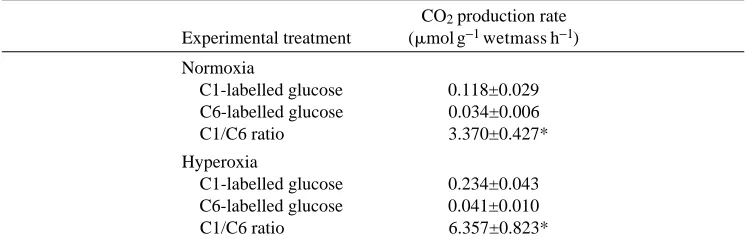
Overall rates of glucose oxidation are comparable to those in prior studies with hepatocytes (Walsh et al. 1985), and the ratio of CO2production from C1- versus
[image:5.612.55.431.91.289.2]C6-labelled glucose is significantly greater than 1 (Table 2), indicating substantial flux through the pentose phosphate pathway. A typical value for this ratio in a teleost liver is 11.2 (Walsh et al. 1985), which is considered a relatively high pentose phosphate pathway activity. The high pentose phosphate pathway activity measured directly corroborates the previous suggestion by Pelster et al. (1989) of a highly active pentose Table 1. Activities of selected enzymes in the gas gland of the gulf toadfish Opsanus beta
Metabolic pathway Activity
Enzyme (mmolmin−1g−1wetmass)
Pentose phosphate pathway
G6PDH 2.22±0.29
6PGDH 1.89±0.12
TA 0.29±0.04
TK 0.10±0.02
Glycolysis
PGI 29.15±1.82
PFK 23.96±2.78
G3PDH 29.97±3.52
LDH (NADH) 173.80±18.4
LDH (NADPH) 2.28±0.20
Tricarboxylic acid cycle
MDH 9.69±1.09
CS 0.14±0.05
Values are mean ± S.E. (N=6).
Table 2. In vitro rates of total CO2production in gas glands of the gulf toadfish Opsanus beta from C1- or C6-labelled glucose
CO2production rate Experimental treatment (mmol g−1wetmass h−1)
Normoxia
C1-labelled glucose 0.118±0.029 C6-labelled glucose 0.034±0.006
C1/C6 ratio 3.370±0.427*
Hyperoxia
C1-labelled glucose 0.234±0.043 C6-labelled glucose 0.041±0.010
C1/C6 ratio 6.357±0.823*
Values are mean ± S.E. (N=5).
[image:5.612.55.428.342.466.2]phosphate pathway in teleost gas gland. Generation of CO2from C1-labelled glucose and
the ratio of CO2production from C1-labelled versus C6-labelled glucose virtually double
under hyperoxic conditions (Table 2), indicating an increase in flux through the pentose phosphate pathway. This observation strongly suggests that an additional role for this pathway in the teleost swim bladder is one of assisting in the protection of tissues from damage by oxygen radicals. Thus, further study of the gas secretion properties of the gas gland must continue to include as part of their experimental design careful control of oxygen partial pressures. Additionally, comparative studies which address both aspects of gas gland metabolism are strongly indicated.
We thank Jimbo Luznar for providing the toadfish and Dr T. P. Mommsen for advice on the TA and TK assays. This research was supported by an NSF grant to P.J.W. (IBN-9118819) and an NSERC grant to C.L.M.
References
BOSTRÖM, S. L., FÄNGE, R. ANDJOHANSSON, R. G. (1972). Enzyme activity patterns in gas gland tissue of the swimbladder of the cod (Gadus morrhua). Comp. Biochem. Physiol. 43B, 473–478.
CAMERON, J. N. ANDKORMANIK, G. A. (1982). Intra- and extracellular acid–base status as a function of temperature in the freshwater catfish, Ictalurus punctatus. J. exp. Biol. 99, 127–142.
CASTELLINI, M. A. ANDSOMERO, G. N.(1981). Buffering capacity of vertebrate muscle: correlations with potentials for anaerobic function. J. comp. Physiol. 43, 191–198.
EWART, H. S. ANDDRIEDZIC, W. R.(1990). Enzyme activity levels underestimate lactate production rates in cod (Gadus morhua) gas gland. Can. J. Zool. 68, 193–197.
FÄNGE, R. ANDWITTENBERG, J. B.(1958). The swimbladder of the toadfish (Opsanus tau L.). Biol. Bull .
mar. biol. Lab., Woods Hole 115, 172–179.
MORRIS, S. M. ANDALBRIGHT, J. T.(1984). Catalase, glutathione peroxidase and superoxide dismutase in the rete mirabile and gas gland epithelium of six species of marine fishes. J. exp. Zool. 232, 29–39. PELSTER, B., KOBAYASHI, H. AND SCHEID, P. (1989). Metabolism of the perfused swimbladder of
European eel: oxygen, carbon dioxide, glucose and lactate balance. J. exp. Biol. 144, 495–506. PELSTER, B. ANDSCHEID, P. (1991). Activities of enzymes for glucose catabolism in the swimbladder of
the European eel, Anguilla anguilla. J. exp. Biol. 156, 207–213.
PELSTER, B. ANDSCHEID, P. (1992). Countercurrent concentration and gas secretion in the fish swim bladder. Physiol. Zool. 65, 1–16.
WALSH, P. J.(1989). An in vitro model of post-exercise hepatic gluconeogenesis in toadfish. J. exp. Biol. 147, 393–406.
WALSH, P. J., BEDOLLA, C. ANDMOMMSEN, T. P. (1989). Scaling and sex-related differences in toadfish (Opsanus beta) sonic muscle enzyme activities. Bull. mar. Sci. 45, 68–75.
WALSH, P. J., MOON, T. W. ANDMOMMSEN, T. P. (1985). Interactive effects of acute changes in temperature and pH on metabolism in hepatocytes from the sea raven, Hemitripterus americanus.