Bachelor Thesis
in Psychology
The Role of Context Dependent Memory on
Perceptual Motor Learning in a DSP go/nogo Task
Nadiya El-Sourani
s0169102
University of Twente
Department of Cognitive Psychology and Ergonomics
Netherlands
First Supervisor: Marit F. L. Ruitenberg
Second Supervisor: Elian de Kleine
Abstract. The present study was designed to address the role of context on
perceptual–motor learning. Further it was of interest if and how practice might act
as a mediation factor in developing these dependencies. Context was manipulated
by changing the incidental context stimuli during retention due to the three different
conditions [Same, Switched, Different]. Practice was manipulated during acquisition
with one versus five practice(s) –block condition. The results revealed changing
context had an effect on performance but only if context switched during retention
rather than changed completely. Also practice did affect performance in any case
Contents
1 Introduction 1
2 Methods 6
2.1 Subjects . . . 6
2.2 Apparatus . . . 6
2.3 Design . . . 6
2.4 Stimuli and Task . . . 7
2.5 Procedure . . . 8
3 Results 10 3.1 Acquisition . . . 10
3.2 Retention . . . 12
3.3 Questionnaire . . . 16
4 Discussion 17
References 21
1
Chapter 1Introduction
This work addresses the role of context on perceptual motor learning. It can be
defined as "a set of processes associated with practice or experience leading to
relatively permanent changes in the capability for movement." (Schmidt & Lee, 2005
as cited in de Kleine, E., 2009). In perceptual motor learning this includes the
processing of nonverbal stimuli.
Anid K. Dey & Gregory D. Abowd (2001) define context as: "any information
that can be used to characterize the situation of an entity. An entity is a person,
place, or object that is considered relevant to the interaction between a user and
an application, including the user and applications themselves." In our case context
describes information about the surrounding (an accumulation of entities) in which
the experiment is conducted. As cited above this includes only information about
entities relevant to the experiment, e.g. while conducting a computer-aided study
a picture behind the user would be a non-relevant entity and thus not part of the
context. However, in perceptual motor learning, context must not only include
information deemed as relevant. Instead there exist more refined definitions (than
the one above) where it is divided intoincidental and intentional cues (explained in detail further below).
As a matter of fact context can influence everyone’s life - consciously and/or
unconsciously. Imagine the loss of an object and the hope of finding it back by
returning to the place where we remember having seen it the last time. The key
1 Introduction
can have a subconscious effect on memory performance. Early research in this area
focused on the verbal memory domain. It has been found that "superior recall of material is retrieved when retention performance is required in the original learning
environment." (S. M. Smith, 1994). This is illustrated by one of the first and most
striking facts psychology students learn about proper exam preparation: One should
always revise in an environment which is similar to that in the exam itself. Thus, not
only the amount of studying the material influences our performance – a common
misconception - but also the surrounding in which we acquire it (Steven M. Smith&
Edward Vela ,2001).
Regarding these facts, one interesting question comes to mind: Is the idea of
context dependent memory also transferable onto perceptual motor learning? A
study by Wright and Shea (1991) focuses on this matter using a sequence key-pressing
experiment. Subjects had to learn series of three/four - key sequences. This was done
in an environment of changing context stimuli. Wright and Shea (1991) differentiated
between intentional andincidental stimuli. Intentional stimuli are defined as "those stimuli that are explicitly identified as essential to task acquisition" whereas incidental
stimuli are defined as "[...] those that have the potential to become associated with a
specific task because of their selective presence in the learning environment" (Wright
and Shea, 1991). The emphasis here lies on the incidental cues. Intentional cues are
measured in numbers, which indicate the sequence of keys pressed by the subjects.
They are always combined with a set of incidental cues (e.g. sound and colour). The
latter however, is not intentionally brought to the subject’s attention.
In the original experiment (Wright and Shea, 1991) the situation of contextual
cues was altered in subsequent setups. These are defined as: same context condition,
switched context condition and intentional-only context condition. A typical experi-ment is divided into two phases, acquisition andretention. Acquisition depicts the preliminary experiment exercise in which a motor task is learned, whereas retention
describes the actual process of assessing the adoption performance of the motor
task. To obtain insight into context change, data sampling takes places in both
phases where context is only altered during retention phase. In Wright and Shea’s
1 Introduction
context was preserved. In switched context however the amount of mistakes rose
tremendously. This was even more so when using four-key sequences opposite to
three-key sequences.
Anderson, Wright and Immink (1998) correctly questioned this assumption by
arguing that not only the amount of mistakes should be regarded but also the reaction
time (RT). As they found in the data from Wright and Shea (1991) there was an
observable effect of context even in the three-key sequence pressing condition. It
was not the amount of mistakes that changed but rather the increase in RT when
the incidental context was altered during retention. Task difficulty had no effect. In
the 1991 experiment of Wright and Shea participants were not briefed to respond as
fast as possible. To counter this deficit Anderson, Wright and Immink (1998) had
to conduct a follow up experiment. As assumed RT is prominently influenced by
context. These results put an emphasis on the importance of RT rather than the
amount of mistakes that were made during the different experimental conditions.
Although Wright and Shea (1991) as well as Anderson, Wright and Immink (1998)
focused on the importance of task difficulty they also mentioned the effect of practice
(on the influence of context on perceptual motor learning). Wright and Shea (1991)
suggested, that "[. . . ] after subsequent practice, an association develops between
the intentional and incidental stimuli. This relationship can support successful
performance of the task if the relationship remains consistent. If the relationship is
disrupted, however, performance will deteriorate." Further Verwey (1996) noticed that
practice is generally viewed as a major determinant of proficient motor performance.
This poses multiple questions: Does context have an influence on memory
per-formance in the perceptual motor domain? If so, can practice time be seen as a
mediating factor in the development of contextual dependencies? And, if present,
how are these dependencies expressed?
The attempt to answer these questions led to the composition of the present study.
Individuals performed a fixed six-key DSP1 go/nogo experiment. Following the line of investigation the idea of using fixed sequences on perceptual motor learning
was already conducted by Verwey (1991, 1994) as was the use of DSP go/nogo
1 Introduction
experiments (Rosenbaum, 1980).
In a standard discrete sequence pressing experiment (DSP) subjects learn a limited
number of distinguishable fixed, discrete sequences, mostly two. Each sequence is
made up of 3-7 keys and hence as many visual stimuli. In a DSP task all but the
first stimulus are presented immediately after the response to the previous stimuli
(De Kleine, 2009). In the special case of a go/ nogo DSP task the whole sequence
is presented prior to execution. Subjects only respond if a go signal appears. The
motive is to separate motor preparation from motor action. This is in line with
Verwey’s (2001) principle of the dual processor theory, which states that motor
learning consists of a cognitive processor as well as a motor processor (Verwey,2001). The cognitive processor initially selects a representation of a sequence based on
a symbolic representation. It involves planning and organizing of the goal and
the structuring of movement. The motor processor loads representation into the
motor buffer2 and executes the movement subsequently. The initial movement has high demands on the cognitive processor, which become less through practice. Thus
through extensive practice (Inhoff,1991) we form some integrated and unified memory
representation that is called motor chunks (Verwey, 1996). According to this model, the formation of motor chunks reduces the load in planning and organization and
hence the demand on the cognitive processor. Chunking generally refers to a strategy to code multiple items in a relational structure and goes beyond motor control in
that the concept is used for central knowledge representations, too (Abrahamse,
Verwey, Jiménez, 2009).
In our study we solely focus on the effect of practice and context differences.
Individuals take part in either of two practice levels, one composed of five and the
other composed of two blocks. Intentional stimuli are combined with incidental
stimuli during acquisition. In retention the incidental context changes due to the
three different conditions (consistent with Wright and Shea (1991)). Individuals are
subject to one of these six conditions: short-practice same context, short-practice
switched context, short-practice intentional-only context, long-practice same context,
long-practice switched context or long-practice intentional-only context.
1 Introduction
Corresponding with findings of Wright and Shea (1991) we expect a measurable
effect of context on memory performance in all of the above mentioned conditions.
Most critical findings should be revealed by the RT data. Following Wright and
Shea’s (1991) suggestion of a correlation between intentional and incidental stimuli
under same context conditions, we assume long practice to have the most significant
2
Chapter 2Methods
2.1 Subjects
Participants in this study were 48 students, either of the University of Münster and
the University of Twente. Age ranged between 19 and 27 years with a mean age
of 22. They either received student credit points or participated voluntarily. As
subjects were either of Dutch or German heritage, instructions of the experiment
were available in both languages
2.2 Apparatus
The apparatus consisted of a computer with a colour monitor and a standard
keyboard.
2.3 Design
The design of this experiment is a 2x3 between-subject design. Subjects are randomly
assigned to one of two different practice conditions and three different context
dependent groups (Table 1).
In the short practice condition the subjects are divided into three different treatment
conditions, indicating the between-subject variables. These are same, switched
2 Methods
block followed by a test block, which depends on the condition the subject is in.
Subsequently each subject has to fill in a questionnaire.
In the long practice condition the between-subject variables of test are the same
as in the short practice condition [same, switched, intentional-only]. The length of
practice, though, differs tremendously. In this design subjects have to finish five
practice blocks before doing the test block. Finally as in the short practice design,
subjects have to fill in the questionnaire.
Subject Number Amount of Practice Blocks Test Condition
1 t/m 8 1 Same Context
9 t/m 16 1 Switched Context
17 t/m 24 1 Intentional-only Context
25 t/m 32 5 Same Context
33 t/m 40 5 Switched Context
41 t/m 48 5 Intentional-only Context
Table 1: Design of the Experiment.
The dependent variables are RT and number of correctly performed sequences
(PC), whereas practice and context conditions indicate the independent variables.
2.4 Stimuli and Task
Participants were asked to place their index and middle fingers of the left and the
right hand on the keys c, v, b, n of a computer keyboard. To allow us to study the
preparation phase of sequence learning in isolation from motor execution each trial
of the experiment started with a fixation cross on the middle of the screen. Right
below it four squares were aligned next to each other. Due to the fact that this was a
Discrete Sequence Production (DSP) go/no go experiment, the fixation-cross turned
either red or blue. Red indicated a no go trial, which asked the participant to wait
without repeating the trial and thus attend until the next sequences was presented,
whereas blue indicated a go trial, which asked the subjects to correspond to the
presented sequence of the colored squares. Accordingly the subjects were presented
with a block of trials including a random repetition of two fixed sequences à six
2 Methods
key presses. The sequences were presented as the squares enlightened six times in a
consecutive order. All stimuli till now represent the intentional cues, thus cues of
which the subjects were aware of. Further each of the two sequences was identified
by colour. During the practice phase one was always presented in blue whereas the
other was presented in yellow. During the test phase the colour of the two sequences
corresponded to the different conditions. Colour is here the incidental cue. Hence
the subjects were not aware in which condition they were in. In the same context conditionthe incidental cues were equal to those in the practice phases. Therefore the yellow sequence was presented in yellow colour whereas the blue one was presented
in blue colour. As the name already indicates the incidental cues in the switched context condition were switched. The yellow coloured sequence in the practice phases was presented in blue colour in the test phase and vice versa. In theintentional-only context condition subjects were stimulated only by red sequences, which followed after the initial blue and yellow sequences during acquisition. Thus the incidental
cues were completely changed. Participants were instructed to respond as fast and
as accurately as possible. Feedback was given after the end of a response sequence
when the participant reacted before the go/no go signal, or when a false button press
was conducted. At the end of each block the subjects were given information about
their progress (in RT and correct responses).
2.5 Procedure
Participants were seated in front of the microcomputer and asked to read the given
instructions carefully before starting the experiment. In the short practice condition
participants started with the practice block which lasted about 20 minutes. Within
the 20 minutes there was a 30 sec break after ten minutes of practice. Each practice
block consisted of 100 go and 20 no/go trials. After participants finished the practice
block the researcher had to start the test block on the computer, which was made
up of ten go and two no/go trials.
The procedure in the long practice condition was similar to the one in the short
2 Methods
program five times in total instead of only one practice session. Furthermore due
to the condition in which the subject was, the researcher started one of the three
test conditions. After the subjects had finished the test they were asked to fill in a
questionnaire. This was an additional measure of the experiment. The questionnaire
was divided into three parts. The first part included recall strategies where the
subjects had to name the two practiced sequences off the top of their head. The
second questionnaire asked the participants to choose the sequences out of twelve
given choices. Thus recognition was the requested aspect here. Finally the third
questionnaire consisted of additional questions such as retrieval cues participants
used to memorize.
Finally the researcher thanked the subjects for participating and those who were
registered in the student system of the University of Twente received their credit
3
Chapter 3Results
Performance was measured in correct responses (PC) and RT. A correct response
was defined as the subject pressing the appropriate keys in the correct order right
after the occurrence of the DSP go/signal [cross turning blue]. Reaction time was
assessed as the six intervals the subject needed in between pressing the relevant six
keys in order to render the previously shown sequence. The first interval being the
period of time that passed between the appearance of the go/nogo signal and the
subject pressing the first key. The other intervals being the periods that passed in
between the subject pressing each of the five subsequent keys. Mean PC and RT
were calculated for each subject for each of 1 or 5 trial blocks during acquisition and
for the one trial block during retention.
3.1 Acquisition
For the mean PC an ANOVA with repeated measures on practice blocks (5) was
used.
The analysis of PC during acquisition revealed a significant effect of practice blocks
with F(4,92) = 19.336, p < .01. Going into more detail it can be seen that the
main reason for this significance can be attributed to changes between the first and
the second practice block. Comparing the Mean PC of the practice blocks with
M1 = 89.6, M2 = 96.5, M3 = 96.3, M4 = 96.7 and M5 = 96.2 underlines this
3 Results
For the acquisition a ANOVA with repeated measures on keys (6) and practice
blocks (5) was used for the RT.
The analysis of acquisition blocks for RT revealed a significant effect of practice
blocks with F(4,88) = 11.55, p < .01. This was done by evaluating the progress
from one practice block to the next, seen in the below Figure 1. As shown the
Mean RT decreases along with an increase in practice. Regarding the mean RT’s for
the practice blocks with M1 = 587.5, M2 = 275.9, M3 = 238.2, M4 = 222.2 and
M5 = 217.6 gives an inside in how this effect is expressed. The RT stagnates from
practice block 2-5 which can also be seen in Figure 1. This effect is comparable to
the one of mean PC of practice blocks.
key 6 5 4 3 2 1 Mean RT(ms) 1,000 800 600 400 200 0 5 4 3 2 1 practiceblock
Figure 1: Reaction Times per Key during Acquisition.
Furthermore the analysis of acquisition blocks for RT revealed a significant effect
of key, withF(5,110) = 14,639, p < .01 indicating the fact that the time needed for
pressing the first key took far longer than the time it took for pressing the other five
keys (Figure 1).
[image:15.595.126.402.326.604.2]3 Results
3.2 Retention
For the retention a One way-way ANOVA was used to test the effects on PC.
The analysis of mean PC from retention block failed to reveal any significant
results for both the effect of test condition with F(2,42) = 0.908 and p > .05 (.388)
and the effect of practice withF(1,42) = 2.343. The overall Means of the different
test conditions withM = 96% for same context, M = 94% for intentional context
and M = 92% show that, although there is a difference, it is very small and thus
can be due to chance.
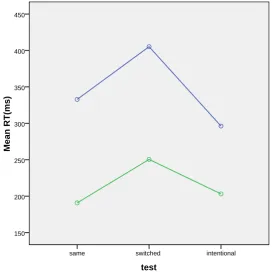
For the RT a 2 (short versus long practice) x 3 (same/ switched/intentional test)
ANOVA with repeated measures on the keys (6) was used.
test intentional switched same Mean RT(ms) 450 400 350 300 250 200 150 long short practice
Figure 2: Mean RT during Test Block.
The analysis of RT data revealed a significant effect of practice with F(1,42) =
22.613 and p < .01 with an M = 214.778 for long practice and M = 344.736 for
short practice as can be seen in Figure 2. In all conditions the subjects score lower
[image:16.595.124.397.341.615.2]3 Results
The effect of test context has a strong affinity towards being significant with
F(2,42) = 3.159 and p=.053. This leads us to have a closer look at the differences
between the test conditions. As seen in Figure 2, the switched context does have
higher a RT in both low practice and short practice condition than do the other test
conditions.
Thus three separate ANOVA’s are conducted to have a view on the difference
between the single test conditions.
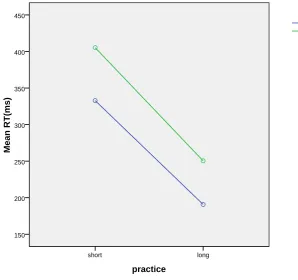
To compare the same and switched test condition we tested one sided due to
the specific expectation that same context condition will score lower in RT. This
expectation was supported by revealing a significant effect withF(1,28) = 3.212 and
p=.042 (two sided: p=.084) as also seen in Figure 3.
practice
long short
Mean RT(ms)
450
400
350
300
250
200
150
switched same
test
[image:17.595.122.421.350.630.2]3 Results
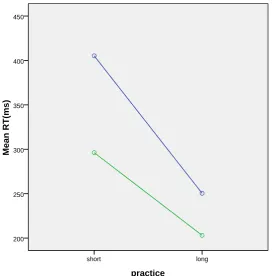
In addition a very significant effect was found when comparing the switched and
intentional test conditions with F(1,28) = 6.611 and p <0.05(0.016) (Figure 4).
practice
long short
Mean RT(ms)
450
400
350
300
250
200
intentional switched
test
[image:18.595.123.402.151.427.2]3 Results
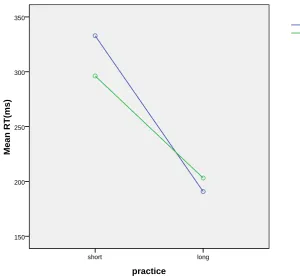
As seen in Figure 5 the difference between the same context and intentional context
is not of significance with F(1,28) = 0.136 andp > 0.05(0.715), meaning that they
do not significantly differ in RT.
practice
long short
Mean RT(ms)
350
300
250
200
150
intentional same
test
[image:19.595.122.423.174.450.2]3 Results
3.3 Questionnaire
Analysis of the questionnaire revealed that practice has a significant effect on both
recall withF(1,42) = 5.6 p < .05 and M = 1.583 for short practice and M = 1.917
for long practice. The same is true for recognition with F(1,42) = 6.0 p < .05 of
the 2 fixed sequences. This means that through extensive practice the recognition as
well as recall becomes better. As one would expect recognition scores slightly better
than recall in any case (Table 2).
Recall Recognition Practice
1.583 1.667 short
1.958 1.987 long
Table 2: The overall Means for Recall and Recognition.
Context condition on the other hand neither influences recall nor recognition. It
was found that there is a positive correlation between recall and recognition with
r=.613. In the below Table 3 the percentage of correct remembered sequences is
shown, indicating that recognition reveals slightly better results than does recall.
Sequences Recall Recognition
None Correct 4.2% 2.1% One Correct 16.7% 14.6% Both Correct 79.2% 83.3%
4
Chapter 4Discussion
The primary purpose of the study was to find out whether context had a significant
effect on perceptual motor learning and if so how it would be expressed. Initially
then it was of interest if and how practice had its effects on this issue. To extend
this idea it was intended to see whether practice is a mediating factor of context in
terms of the different context-test conditions.
Inspection of RT data revealed that practice affects perceptual motor learning
significantly. RT decreased with increasing practice. This effect, however, stagnated
after the second practice block. As expected, the changing context situations
revealed significant results that were in line with former studies (Wright and Shea,
1991). During retention, switched context condition expressed longer RT opposite to
intentional-only and same context condition.
However, against former assumptions the difference in RT between same context
and intentional-only context was not one of significance. Interestingly no interaction
was found in RT between practice and context. The PC data underlined our
expectations. As it was the case in former studies PC data revealed no significant
effect for changing context. Instead the amount of practice had a strong influence
on performance. Not surprisingly the effect was very similar to the one in RT data;
Performance increases with increasing practice. Again, this effect stagnated after the
second practice block. In all of these conditions a significant effect of key was found.
Evidently, RT before the first key press was eminently longer than subsequent ones.
4 Discussion
Verwey(1996) found out that in a DSP task the response to the first item of a chunk
slowed. This explains why the first item took longer to respond to. Furthermore the
dual processor theory underlines this effect as it states that initial movements have high demands on the cognitive processor. This is why reaction time is expected to
be longer for the first item of a sequence.
The effect of practice, which was found in the present study also reveals support
for the dual processor theory. As already mentioned the cognitive processor plans
the movement whereas the motor processor executes it. With extensive practice the
load on the cognitive processor becomes less as motor chunks develop and sequences
become more familiar. Hence RT will slow down and performance will become better.
As expected, this effect was found in our study and shows how practice enhances
perceptual motor learning.
In line with former studies concentrating on the influence of context on motor
learning, we expected an effect on context in all conditions. As seen above this
hypothesis could not be confirmed albeit significant effects of context were found
when context situation was switched. This is in line with findings of Wright and Shea
(1991) as well as Anderson, Wright and Immink(1998). They suggested, that "early in
learning subjects have poorly specified memory networks that do not include separate
associations between intentional and incidental information and the appropriate
responses. It is when subjects are sufficiently practiced or encounter relatively simple
responses that these direct associations are made, and the intentional and incidental
cues can act independently as retrieval cues to support retention. To extend this
thinking, one might argue that in the absence of such direct associations between
the intentional stimuli and the incidental stimuli to the task-specific information,
the subject may be forced to use relatively greater data-driven processes in order to
produce the correct response." (Anderson, Wright, Immink , 1998, p.220)
However, this leaves us wondering why in spite of extensive practice, our study
displays a significant increase in RT during switched context condition. On the other
hand it was surprising that no significant difference was found between
intentional-only and same context condition. This might also be due to the formation of motor
4 Discussion
used in different situation than the one they were practiced in.
This explains why the effect between intentional-only and same context condition
was not of significance. Obviously one practice block must have been sufficient to
create motor chunks which then could be used in any situation for retrieval. However,
as we noted above this was not true when context situation switched. The only
explanation for the development of context dependency when context is switched
and practice is sufficient might be, that although extensive practice is given motor
chunks might lose their robustness when the contextual situation is not as strictly
different as it is in e. g the intentional-alone situation. This assumption could be
prone to future study, concentrating on this finding in closer detail.
Finally an effect of practice was found on both recall and recognition strategies of
the subject’s memory. Test condition on the other hand did not affect any of the two.
In addition a positive correlation between recognition and recall was found. This
was not surprising since remembering sequences by heart should likewise enable us
to make the right choices of sequences out of twelve possibilities.
In summary the present study provides a demonstration that development of
context dependent memory for stimuli, which are not explicitly indentified to be
critical to task learning, can develop in the perceptual motor domain. Further it
can be concluded that practice positively affects memory performance in any case
although it does not interact with context. Hence it cannot be assumed that practice
operates as a mediating factor in the development of context dependent memory in
References
Anderson, Wright, Immink (1998). Contextual dependencies during
perceptual-motor skill performance: Influence of task difficulty, Memory, (pp. 207- 221)
Dey, Anind K. &Abowd, Gregory D. (2001). Towards a better understanding of
context & Context awareness, Graphics, Visualization and Usability Center
and College of Computing, Georgia Institute of Technology, Atlanta. Retrieved
July 2 2010, from http://psu.edu
De Kleine, E. (2009) Cognitive control of sequential behavior (pp.9-20). Enschede: Ipskamp.
Inhoff, A.W. (1991). Word frequency during copytyping. Journal of experimental psychology: Human perception and performance,17 (pp. 478-487).
Rosenbaum, D. A (1980) Human movement initiation, specification of arm, direction
and extent. Journal of experimental Psychology: General, 109, (pp. 444-474)
Smith (1994), Theoretical Principles of Context dependent memory, Retrieved June
10, 2010, from http://www.peop.tam.edu, (pp. 168-195).
Smith, S.M & Vela, E.(2001), Environmental Context dependent memory: A review
Verwey, W.B, Abrahamse, E.L, Jiménez, L. (2009). Segmentation of short keying
sequences does not spontaneously transfer to other sequences. Human Move-ment Science 28, 348-361
Verwey,W.B (2001), Concatenating familiar movement sequences: The versatile cog.
Processor, Acta Psychologica, (pp. 69-95)
Verwey,W.B (1996) Buffer loading and chunking in sequential key pressing. Journal of Experimental Psychology: Human Perception & Performance, Vol.22 No.3, (pp. 544-562)
Verwey, W.B (1994), Evidence for the development of concurrent processing in a
sequential key-pressing task. Acta Psychologica, 85, (pp. 245-262)
Thesis declaration
I hereby declare that the whole of this bachelor thesis is my own work, except where
otherwise stated in the text or bibliography. This work has not been submitted in
similar or identical form, in whole or in part, for any other degree.