M
ASTER’
S THESISDynamic access control
22nd October 2010
Emiel Hollander
Supervisors
dr.ir. Maurice van Keulen (University of Twente)
Nec me pudet fateri nescire quod nesciam.
I am not ashamed to confess that I am ignorant of what I do not know.
Marcus Tullius Cicero
Tusculanae Disputationes (book I,section 60)
Center on the wide horizon Focus on the galaxy
Voorwoord
Dit is het op-een-na-laatste werk dat ik oplever in het kader van mijn opleiding technische informatica aan de Universiteit Twente. Niet het allerlaatste; dat is immers de presentatie, die ik op het moment van schrijven nog niet gegeven heb. Tijdens de periode dat ik student was heb ik veel gedaan, veel geleerd en veel mensen leren kennen. Graag wil ik iedereen met wie ik een leuke tijd heb gehad hiervoor bedanken. Ik ga er niet aan beginnen om namen te noemen; het zijn er te veel en ik zou ongetwijfeld mensen vergeten.
Daarnaast wil ik graag nog een aantal mensen in het bijzonder bedanken omdat zij een bijdrage hebben geleverd aan dit afstudeerverslag. Allereerst mijn begeleiders: Maurice en Virginia vanuit de Universiteit Twente, en Anton en Richard vanuit de Exxellence Group. De overleggen die we hebben gehad vond ik altijd nuttig en de samenwerking was erg plezierig. Bedankt!
Naast mijn begeleiders heeft nog een aantal mensen mij geholpen. Jo heeft mij van nuttig advies voorzien bij het opstellen van mijn vragenlijst en het verwerken van de evaluatiegegevens. Dankzij deze gesprekken en de boeken die ik van haar mocht lenen kon ik mijn evaluatie naar een hoger niveau brengen. Ze heeft ook het verslag proefgelezen. Brenda, Jochem en Barry hebben, voordat de daadwerke-lijke evaluatie begon, het gehele evaluatieproces doorlopen om te kijken of er nog onduidelijkheden of fouten in voorkwamen. Aan de hand van hun opmerkingen heb ik de evaluatie verbeterd. Jochem heeft daarnaast nog een aantal extra mensen geregeld die deelnamen aan de evaluatie. Ook Barry heeft het gehele verslag proef-gelezen. Mijn vader heeft een groot aantal deelnemers voor de evaluatie geregeld en heeft mij in contact gebracht met beveiligingsexperts. Bedankt allemaal! Ten slotte bedank ik graag mijn ouders en mijn broertje voor de steun die ik gedurende mijn gehele studietijd gekregen heb. Als er iets aan de hand was kon ik altijd bij jullie terecht. Dankzij jullie heb ik alles uit mijn studietijd kunnen halen wat erin zat. Heel erg bedankt!
Abstract
An increasing number of services require access control. On the web, access control is usually enforced using a combination of username and password. Users are encouraged to choose secure passwords. These secure passwords are very hard to remember, which causes people to write passwords down, re-use the same password or choose a simple password. Our goal is to design an access control system that is easier to use, while still offering the same amount of security.
The main idea behind this research is that not every service needs the same amount of security. It may not be necessary to ask the secure password for every service; for services that require less security, an access control method that is less secure, but easier to use, may be sufficient.
We have built a system that is capable of dynamically determining the access control method or methods that it has to use to ensure sufficient security. When the user requests a service, the system looks up the amount of security that is needed and adapts the used access control methods to this.
Contents
Voorwoord v
Abstract vii
Contents ix
1 Introduction 1
1.1 Users and security . . . 1
1.2 The digital government . . . 2
1.3 Communication channels . . . 2
1.4 Dynamic authentication . . . 3
1.5 Example . . . 3
1.6 Research questions . . . 4
1.7 Approach . . . 5
1.8 Evaluation . . . 5
1.9 About this research . . . 6
2 State of the art 7 2.1 Authentication . . . 7
2.2 Authorisation . . . 10
2.3 Risk-adaptive access control . . . 11
2.4 Conclusion . . . 11
3 Problem formalisation 13 3.1 Definitions . . . 13
3.2 Behaviour . . . 15
3.3 Open questions . . . 17
4 Quantifying trust and security 19 4.1 Credentials . . . 19
4.2 Trust in authentication methods . . . 21
4.3 Probability of discovery . . . 24
4.4 Discoverability . . . 25
4.5 Security of credentials . . . 30
4.6 Combinations of credentials . . . 30
4.7 Conclusion . . . 34
Contents
5.1 Duplicate detection . . . 35
5.2 Identifying records . . . 36
5.3 String matching . . . 41
5.4 Conclusion . . . 41
6 Making decisions 43 6.1 Deciding on allowing access . . . 43
6.2 Asking for additional credentials . . . 45
6.3 Assessing the needed security level and identity confidence . . . 47
6.4 Conclusion . . . 48
7 Evaluation 49 7.1 General set-up . . . 49
7.2 Prototype . . . 51
7.3 Questionnaire . . . 52
7.4 Results . . . 54
7.5 Evaluation with security experts . . . 63
7.6 Conclusion . . . 64
8 Discussion 65 8.1 Security level for nonexistent answers . . . 65
8.2 Nonexistent users . . . 66
8.3 Typing errors . . . 66
8.4 High security products . . . 67
8.5 Lack of familiarity with DACS . . . 67
9 Related work 69 9.1 Credential-based access control . . . 69
9.2 Trust-based access control . . . 70
9.3 Human factors in access control . . . 71
10 Conclusions 73 10.1 Future work . . . 75
A Instructions 77
B Questionnaire 79
C Evaluation credentials 89
D Evaluation users 91
E Evaluation results 93
List of definitions 97
List of symbols 99
Bibliography 101
1
Introduction
Access control is annoying. More and more websites request that you register before you can use any of the offered services. When calling a company to request a change in your subscription, they will ask you to identify yourself first.
It may seem like a hassle to perform access control, but it is necessary. We need to identify the user, so that we can attribute the changes or requests to the correct user, and verify his identity, so that nothing can be seen or changed by persons who are not allowed to.
Is there a way to make access control less annoying for users, while still maintaining sufficient security? That is what we have set out to do with this research.
1.1 Users and security
Many users have a negative attitude towards security technologies. They see security mechanisms as an obstacle to performing their daily activities. The main cause mentioned is the persistence of intrusion detectors, virus scanners and other security applications to interrupt their current work[22].
Another cause for users to think too lightly about security is that a number of services uses password protection merely to identify users instead of authenticating them for their own protection. For example, online newspapers and Wikipedia use logins only to track users. This has no benefit for the user at all. They do not care if their password is compromised and therefore choose poor passwords[27].
Chapter 1
symbols as well as letters, and they need to change this password periodically to another password that has not been used before. Because of this, users choose poor passwords, because those are easier to remember, or write their passwords down. In short, users do not want to be bothered by security issues and want to put as little effort into security mechanisms as possible. Is it possible to ask less questions to users, have the system identify and verify users as automatically as possible, and still maintain sufficient security?
1.2 The digital government
Over the past few years, governments around the world have increased their efforts to offer more services online[37]. This has reduced the need for citizens to go and visit their government when they have a request or want to access a certain service. These services, however, must serve the entire population. This means that users of these government services differ enormously in terms of age, languages known, technical competence and availability of technology. Governments must ensure that no group of users is excluded; everybody needs to be able to use these services [7, 37].
This also means that we cannot assume that the user is in possession of advanced authentication equipment, like fingerprint scanners, or is able to remember all kinds of information that is needed to authenticate him. Ideally we would like to be able to authenticate every user with as little effort from this user as possible.
Since governments are handling sensitive information, we also need to make sure that sufficient security is ensured at all times. User authentication may need to be more thorough for some services.
1.3 Communication channels
Authentication mechanisms are usually tightly coupled to a certain communication channel. When we need authentication via the web, we use a combination of username and password. When someone contacting us via the telephone needs to be authenticated, we could ask him for his postal code, house number and birth date.
This approach has drawbacks. An entire communication channel becomes unusable, when an authentication mechanism fails. It may very well be possible to still authenticate a user via other means. Current authentication systems are unable to handle this situation.
When a separate system dynamically assesses what credentials are still needed to achieve a certain level of confidence in the identification, we can decouple the authentication mechanism from the communication channel.
Introduction
1.4 Dynamic authentication
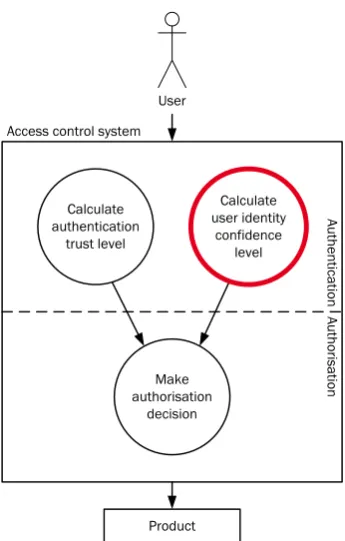
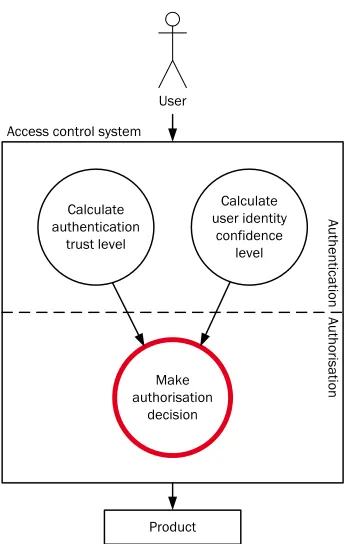
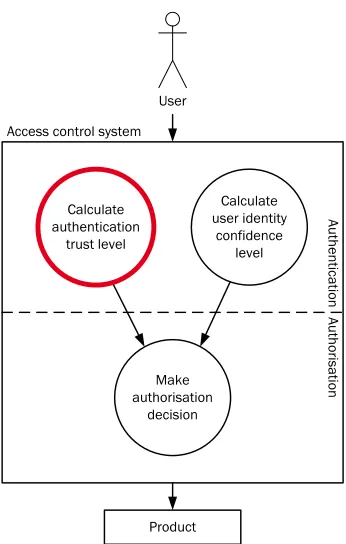
We envision a system that can obtain data directly from the communication channel to identify a user, but can also ask additional questions to this user when the data from the communication channel does not provide sufficient confidence in the user’s identity. The system will act as a spider in the web between users, communication channels and services, making sure there is enough confidence in the identity of every user for each communication channel, authentication mechanism and service used. A schematic layout of the system we envision is given in figure 1.1.
User Access control system
Calculate authentication
trust level
Calculate user identity
confidence level
Au
th
en
tic
at
io
n
Au
th
or
is
at
io
n
Make authorisation
decision
[image:13.595.185.356.257.520.2]Product
Figure 1.1: Schematic layout of the dynamic access control system
1.5 Example
Alice uses her home telephone to make a telephone call to her municipality because she wants to order a birth certificate. She is connected to the interactive voice response system (IVR) of the municipality.
The IVRsystem detects that a call is coming in from telephone number 1234. It proceeds to ask Alice which service she wants to access. Via a menu, Alice chooses the service “order birth certificate”.
Chapter 1
the call to theDACS. In this case it only knows the telephone number, so it sends this to theDACS.
The dynamic access control system requests more details about this telephone number from the data store. This system tells theDACSthat this telephone number belongs to either Alice, Bob or Charlie. They all live on High Street 1 in Mytown. Next, theDACSsends a message to the service that Alice wants to access, requesting what information it needs and how many confidence in the verification of the user it wants. The service “order birth certificate” needs a unique reference to a citizen and a verification confidence level of 3.1
The authentication system checks its list of available identification and verification methods to find a method, or a series of methods, that is capable of delivering a unique reference to a citizen, can deliver this reference with a verification confidence level of 3 and can be used over the telephone.
The telephone number by itself is not enough to obtain a unique reference to a citizen. Policy dictates that verification confidence level 3 can be obtained by asking Alice for her citizen identification number. Further verification using passwords is not necessary for this level. Entering a number is possible using a telephone, so the DACSinstructs theIVRsystem to ask Alice for her citizen identification number. When Alice enters this number correctly, she is granted access to the requested service.
1.6 Research questions
Our main research question is the following.
How can we design a dynamic access control system that takes the in-formation from the communication channel and the requirements of the requested product into account when selecting an appropriate authentica-tion mechanism?
There are several subquestions to ask for this problem.
1. How can we obtain a confidence in the user’s identity that is as high as needed, even when the authentication system is presented with incomplete data? 2. How can we have the authentication system automatically assess the amount
of risk involved when allowing a certain user to access a service, and take decisions based on this assessment?
3. Which authentication methods are available, which amount of security can they ensure and which communication channels can they be used with? 4. How can we let the authentication system know what input information and
security constraints a product needs, so it can use this when taking decisions? 5. In what ways can the authentication system adapt itself when an
authentica-tion method is unavailable?
1This confidence level is fictitious. How the final system will determine the amount of confidence or risk exactly, and how it will quantify this, is one of the subjects of this research.
Introduction
1.7 Approach
We first do a literature study. First, we want to find methods to match incomplete identifiers to a record in a data set. Information about this may be found in literature on data integration. This information will be used to obtain a confidence in the user’s identity that is as high as possible[24, 30, 38].
Second, we need to find literature that describes how security can be adapted to take dynamic authentication into account. We need to look into research on risk-based access control, security levels and trust management[3, 8, 15, 20, 29, 53]. We also need a survey of different authentication methods to determine the amount of security they can deliver[27, 33, 43].
A list of all governmental services, the input data they need and the amount of risk involved in accessing them is needed to enable the dynamic access control system to make decisions based on the service the user wants to access. We need a way to let the authentication system know about this for each service.
Using all this information we design a dynamic access control system that is able to assess the confidence it can have in a user’s identity and is able to make security decisions based on this. This system automatically determines which authentication mechanism is best suited for the combination of communication channel used and service requested. Each service needs to have a method to inform the authentication system of its security requirements, so that the authentication system can make decisions based on this.
When the system determines the best authentication mechanism automatically, it should have no problems finding the best alternative when one of the mechanisms fails. This functionality, however, needs to be taken into account from the beginning. Finally, we can see whether there are easy options to authenticate persons that have already been authenticated for a product, but want to access a product that requires higher security. The authentication they have done for the product that requires lower security is not enough to directly access the product that requires higher security, but we may be able to re-use the information that this user has already entered. We can use this to show the possibilities of dynamic authentication, that are harder to achieve with current authentication mechanisms.
1.8 Evaluation
To evaluate the research we build a prototype of the proposed dynamic access control system. This system will take input from a communication channel and decide whether this information is sufficient to allow the user access to a certain service, based on requirements from the service and identity confidence obtained from a database.
Chapter 1
1 DACS
User
2 Product user data
permission
invocation credentials
needed
possible user matches
[image:16.595.190.461.125.288.2]User data
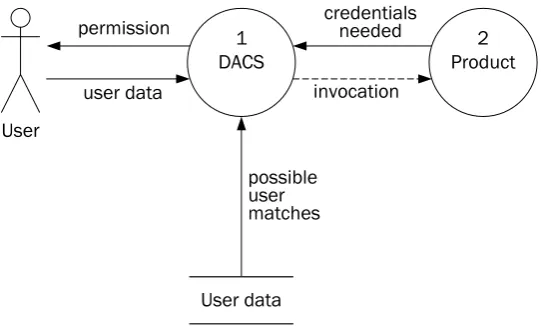
Figure 1.2: Data flow diagram for the dynamic access control system
the prototype, the participants fill in a questionnaire so that we can find out their opinions.
1.9 About this research
The research will be performed for Exxellence Group in cooperation with the Uni-versity of Twente.
The Exxellence Group is a company of 50 professionals that provides responsible and innovativeICTsolutions for (semi-)public authorities such as municipalities, pro-vinces, health authorities and housing associations. Its goal is to improve service and streamline business processes for their customers. To this end, the Exxellence Group has developed an application suite consisting of modular configurable components that enable organisations to implement proven integrated service solutions. For optimal integration, the Exxellence Group has developed a variety of adapters for standard software in the domain of public authorities.
Integrating social and engineering sciences. Developing high tech, with a human touch. It is what the University of Twente is committed to. Through teaching and research at the highest level, and through innovations brought on the market by over 700 spin-off companies. The University of Twente offers degree programmes in fields ranging from behavioural and management sciences to engineering and natural sciences. Research spearheads include nanotechnology, biomedical technology, information technology, governance studies, and learning and cognition.
2
State of the art
Access control emerged in the 1960s to provide isolation of multiple processes on a single system[2, ch. 4]. This kind of access control was enforced by mechanisms built into operating systems, such as preventing processes from writing over or reading each other’s memory.
Operating systems also use access control to make sure that users do not access resources that they are not allowed to. An operating system first authenticates a user, and then checks whether this user is allowed to access the resources he is requesting. A typical operating system maintains an access list or a matrix of permissions for this.
Nowadays access control mechanisms have increased in complexity. For example, a user needs access to an application which needs access to middleware which needs access to a database which needs access to a file on a disk. But the underlying principles have not changed. We want to protect resources against the bad guys.
Definition 1 (Access control) Mechanism that ensures that resources are only gran-ted to those users who are entitled to them[50].
Before we can control access to resources, we need to know who exactly wants to access them. For this, a number of authentication methods exists. We discuss these in section 2.1. When a user has been authenticated, we can decide whether we grant access or not. Authorisation mechanisms, that ultimately make the decision whether a user is granted access or not, are discussed in sections 2.2 and further.
2.1 Authentication
Chapter 2
Authentication methods are usually grouped into three groups, as devised by Wood [61]: authentication based on what you know (for example, a password), what you have (for example, a badge) or who you are (for example, a fingerprint).
O’Gorman[43]is not satisfied with this classification. He claims that a password is not strictlyknown, but memorised instead, and can be forgotten. He also says that
biometrics, like fingerprints, are not what you are, because a fingerprint or your hair colour, although possibly unique, does not indicate your true self. Every person is a human being; a fingerprint is only a representation of this. Therefore, he proposes the following new labels for these groups.
Knowledge-based authenticators are characterised by secrecy or obscurity, for example a password.
Object-based authenticators are characterised by physical possession, for example a badge or a token.
ID-based authenticators are characterised by their uniqueness to one person, for example a passport or driver’s licence, but also a fingerprint or eye scan. This classification differs a little from the original classification by Wood. In the origi-nal classification,ID-cards and drivers licences belong to the category of object-based authenticators, while O’Gorman puts them in the category ofID-based authentica-tors.
The classification by O’Gorman will be used in this report. We list a number of authentication methods next. This list is not meant to be complete, but only intends to give examples of the most widely used authentication methods.
2.1.1 Knowledge-based authenticators
Password The password is by far the most widely used authentication method, and has been in use since ancient times; however, it comes with a lot of drawbacks. Schneier describes them aptly: “The problem is that the average user can’t and won’t even try to remember complex enough passwords to prevent dictionary attacks. As bad as passwords are, users will go out of the way to make it worse. If you ask them to choose a password, they’ll choose a lousy one. If you force them to choose a good one, they’ll write it on a Post-it and change it back to the password they changed it from last month.”[52]. These claims are acknowledged by more authors [1, 22, 27].
Secret question The secret question is used for a lot of applications to restore a password after someone has lost it. The question usually concerns a fact that is not well-known, for example, the maiden name of your mother. The large drawback of this authentication method is that, while the fact may not be well-known, it can be obtained. This makes it easy to impersonate someone else[13, 51].
Graphical password Graphical passwords were invented to avoid users choosing insecure passwords and having difficulties remembering them. The idea is that images are easier to remember and that the ability for users to choose secure passwords without a lot of effort is increased. Graphical passwords are either recognition-based or recall-based. A recognition-based graphical password has the user select one or more images, that the user selected earlier to form his graphical
State of the art
password, from a larger group of images. When using a recall-based graphical password, the user must draw something to authenticate himself, or select a number of spots from an image[54].
2.1.2 Object-based authenticators
One-time password The one-time password was conceived to overcome the pro-blems that exist when using a regular password. They do not have to be remembered, and since they can be used only once, the system will not be compromised when someone learns about a one-time password. One-time passwords can be delivered to the user on a piece of paper, viaSMSor e-mail. They can also be generated using a device. This generation is usually a response to a challenge from the server, or it is time-based, when both the server and the device know which password must be delivered at a certain time.
Token A token can be used to authenticate the person possessing it. There are many types of tokens, like cards, badges and small devices. Some of them generate one-time passwords, others contain a chip or magnetic strip that contains identity information. A drawback of tokens is that anyone finding a token can use it to impersonate as the person the token originally belongs to. This can be remedied by protecting the token with a password.
2.1.3 ID-based authenticators
ID-card AnID-card, like a passport or a driver’s licence, can be used to verify someone’s identity. It can be detected when someone, who is not the owner of the card, uses it.
Biometric features We group all biometric features together since there are so many of them: iris, fingerprints, voice, handwriting and so on. Biometric features are intended to be unique for all people on earth. This makes them very suitable to deliver a unique identification. A drawback of biometric features is that additional equipment is needed in order to do the identification, that may be harder to use for some people[2, ch. 15].
2.1.4 Multi-factor authentication
Multiple authentication methods can be combined to achieve a stronger level of authentication. The combination of authentication methods from different categories is calledmulti-factor authentication. Strictly speaking, asking for both a password
and the answer to a secret question is not multi-factor authentication, because both authenticators are knowledge-based. Some examples of multi-factor authentication are listed below.
Chapter 2
prevents anyone finding a bank card from being able to withdraw funds from the accompanying account.
2.1.5 Implementations
The following authentication methods are implementations of one or more of authenticators mentioned before.
Lightweight Directory Access Protocol (LDAP) Originally,LDAP was designed to offer directory services and functionality to search for persons in an organisation. Because the structure needed for a directory service, that allows users to be allocated to, for example, groups and departments, already exists, it is very easy to exploit this structure to perform authentication and access control[44].
OpenID The aim of OpenID is to provide one authentication service that can be used to log into many websites using only a single password. This eliminates the need to have to remember a password for every site with which you have an account [45].
DigiD The Dutch government has introduced a central authentication method for all its services. The method supports different levels of authentication and provides means to achieve these levels. At the lowest level it requires only a username and password, higher levels require a combination of username, password and a one-time password sent viaSMS.
2.2 Authorisation
Definition 3 (Authorisation) The approval, permission, or empowerment for so-meone or something to do something[50].
After a user has been authenticated, authorisation mechanisms limit what this recognised user can do [49]. Authorisation is usually done based on a triple
〈subject, operation, object〉. The result of the authorisation process is the outcome of
a functionδ(decision) that maps this triple to either authorising or not authorising
access.
δ: subject×operation×object→ {allow, deny} (2.1)
We can, for example, define that Bob is allowed to read resource A as follows. δ(Bob, read, Resource A) =allow
These mappings can be shown in anaccess matrix. This matrix shows what
combi-nations are defined to be allowed.
User Resource A Resource B
Alice write
Bob read, write read
Access matrices in operating systems are tightly coupled to the mechanisms used in that operating system. In Unix, for example, the access matrix is stored as protection bits with the protected resource[60].
State of the art
Since these matrices can become enormous and very cumbersome to manage, actual access control implementations use other methods to store authorisation information. Two examples are access control lists, which store an access matrix by column, and capability lists, which store an access matrix by row[49, 60].
2.2.1 Security policies
Contemporary access control systems are able to assess authorisation decisions using a set of rules, defined using a structured language[57], instead of only an access matrix. These rules may include lookups in an access matrix, but this is not necessary.
We will discuss security policies in more detail in chapter 6.[4, 10, 32, 57, 60].
2.3 Risk-adaptive access control
Risk-adaptive access control methods, also called risk-based access control methods, work in a different way. A risk-adaptive access control method defines a function that can take a number of aspects into account when deciding whether to allow or disallow an action. For this, the method assesses the amount of risk involved or the amount of trust he has in the subject wanting to access an object. Risk-adaptive access control can therefore also be called trust-based access control.
There are currently two major approaches to determine trust: policy-based and reputation-based [11, 12]. Policy-based approaches use certificates, logic and mechanisms with well-defined semantics to make decisions regarding authorisation. Reputation-based approaches, on the other hand, base their decisions on experience they have with the subject, and experiences other systems in their network have had with the subject.
The system we envision is an example of policy-based risk-adaptive access control.
2.4 Conclusion
3
Problem formalisation
The systems that we have discussed in chapter 2 have static access control mecha-nisms. They rely on predefined authentication mechamecha-nisms. The only exception is risk-adaptive access control, which was treated in section 2.3. We envision a risk-adaptive access control system that is able to dynamically choose the most appropriate authentication mechanism(s) based on the information it has.
This chapter contains a formalisation of the functionality we have in mind for a dynamic access control system. In the following chapters, specific details of this system will be filled in.
3.1 Definitions
To offer dynamic authentication, the system we envision has information about users, communication channels and products. A product is anything that can be offered to a market that might satisfy a want or need[35]. In our case, these products require an amount of security before they can be used.
We defineUto be the set of all users that are known to the system,Xto be the set of all communication channels that are known to the system andPto be the set of all products that are known to the system.
Ais the set of attributes that a user can have. These can be attributes like name and address, but also, for example, username, password, identification code held in a token, or a biometric signal.
3.1.1 Complete user representations
Chapter 3
taken from the domainDafor attributea.
πa(R(u))is the projection of attributea∈Aof the complete representation of user u∈Uin the system. In other words, this is the valuedafor attributeaof useru.
Example 3.1 SupposeU={Alice,Bob}andA={name,address,city,e-mail}. Note that the entities inUandAhave no quotes, since these are not strings but references to actual users and attribute entities. An example representation is the following.
R(Alice) ={name←‘Alice’,
address←‘High Street 1’, city←‘Mytown’,
e-mail←‘[email protected]’} For this representation,πcity(R(Alice)) =‘Mytown’.
In other words,Acontains all attributes that are available andR(u)contains the
values for these attributes for a single user.
3.1.2 Known user representations
AK(u)
⊆Ais the set of attributes that are known for a useru. RK(u) =
{a←da|a∈AK,d
a∈Da} is the known representation of useruin the system.
K inAK andRK is not a variable, but simply refers to “known”.
Example 3.2 Suppose Alice sends an e-mail that is processed by the dynamic authenti-cation system. The system does not know that Alice is mailing so it assigns a temporary name to the user. The system extracts Alice’s e-mail address from this e-mail.
AK(User 1) =
{e-mail}
RK(User 1) ={e-mail←‘[email protected]’}
3.1.3 Product requirements
AN(p)
⊆A,p∈P, is the set of attributes that are needed for a productp. lN(p)∈Ris the level of security needed for a productp.
Similar to the known user presentations, hereNinANandlN is not a variable, but refers to “needed”.
Example 3.3 The product “order birth certificate” needs the name, address and date of birth and security level 3.
AN(order birth certificate) =
{name,address,date of birth}
lN(order birth certificate) =3
Problem formalisation
3.1.4 Security level
l:X×A∗→
Ris the current level of security. This function takes a communication channelχ fromXand a set of attributes fromA∗and maps these to the amount of
security that can be deduced from this combination. It is used to calculate a security level based on attributes of a user that are currently known.
Example 3.4 The e-mail that Alice sent in example 3.2 has been processed further by the dynamic authentication system. The system has also extracted anIPaddress. It uses this information to calculate the current security level.
l(χ,AK(User 1)) =l(e-mail,{e-mail address,IPaddress})
=1.5
How to calculate this security level is the subject of chapter 4
3.2 Behaviour
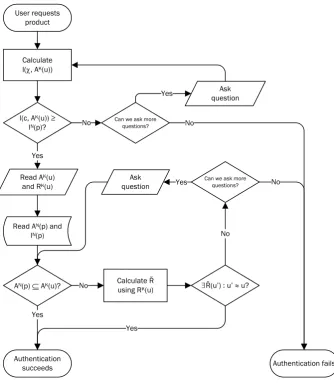
Step 1 Useru∈Ucontacts the system using communication channelχ∈Xto access productp∈P. Known representationRK(u)of useruis sent.
Step 2 The system asks productpfor needed attributesAN(p)and needed security levellN(p). How to determine the needed security level is discussed in chapter 4.
Step 3 The system calculates the current security level l(χ,AK(u)). How this works is discussed in chapter 4. Whenl≥lN(p), go to step 5. Otherwise, go the step 4.
Step 4 The system decides which attributes still need to be known to make
l(χ,AK(u))
≥ lN(p) and that can be asked using channel χ. If no additional information can be asked, authentication fails. Otherwise, proceed with step 3.
Step 5 The system decides whether we have enough information:AN(p)
⊆AK(u).
When we have enough information, authentication succeeds. Otherwise, go to step 6.
Step 6 The system asks the database whether it has a complete representationR(u)
that resemblesRK(u)closely enough. The database delivers a set of representations and confidences, ˇR= [0, 1]×R, using fRˇ:R
K(u)
×R→[0, 1]×R. The confidence
value indicates the amount of confidence the system has that, for a certain ˇR(u0),u0= u. In other words, the system finds a list of users that match best with the information
that is currently known. How the system does this is discussed in chapter 5.
Step 7 The system deducts ˇR(u0)andˇA(u0)for the representation that has the
highest confidence. By definition,RK(u)⊆Rˇ(u0)andAK(u)⊆ˇA(u0). If the
confi-dence is high enough, and the difference in conficonfi-dence is above a certain threshold for the top results, the system can use ˇR(u0)and ˇA(u0)during the remaining part of
the process instead ofRK(u)andAK(u)because there is enough confidence in the
Chapter 3
questions to the user. If this is the case, continue with step 8. Chapter 6 explains how the system will make this decision.
Step 8 The system determines which question(s) it can ask, using communication channelχ, to obtainAN(p)
⊆AK(u). When multiple questions are possible, the system chooses the one that has the most unique values. How the system decides this is elaborated on in chapter 6. Continue with step 5.
In this context, we can seel as the amount of confidence the system has in the authenticationof the user and ˇRas the amount of confidence the system has in the identificationof the user.
User requests product
Read AK(u)
and RK(u)
Read AN(p) and
lN(p)
AN(p) Í AK(u)? No Ř(u’) : u’ ≈ u?
Authentication succeeds
Can we ask more questions?
No Yes
Authentication fails Ask
question
Calculate Ř using RK(u)
Calculate l(, AK(u))
l(c, AK(u)) ≥
lN(p)?
Can we ask more questions?
No
Ask question Yes
No
No Yes
Yes
[image:26.595.154.489.315.699.2]Yes
Figure 3.1: Flowchart for the dynamic authentication system
Problem formalisation
3.3 Open questions
In the design specified above, we have mentioned a number of things that will be elaborated on in the following chapters. We give an overview of these open questions below.
• How do we calculate the current security levell(χ,AK(u))? (chapter 4)
• How do we obtain the needed security levellN(p)for all products? (chapter 4) • How do we calculate ˇRbased on a knownRK(u)? (chapter 5)
• How do we determine when a ˇR(u)is close enough toRK(u)? (chapter 6) • How do we decide what additional information is needed to makeAN(u)
⊆
AK(p)andl(χ,A
4
Quantifying trust and security
The notion of quantifying security may sound strange. Usually security is thought of as a binary: either something is secure or it is not[31]. Since we are working with varying authentication methods and varying levels of certainty about the identity of a person, we need dynamic security as well. For some products, a higher level of security may be needed before someone is allowed access, than for others. How exactly can we quantify security? How much security is sufficient for access to a product?
We recognise that the amount of security is affected by the robustness of the au-thentication mechanism. A password that can easily be guessed offers a lesser level of security than a token that generates one-time passwords. The system needs to conform to the intuitive notion a user may have about the level of security that is provided by the system and needed for a certain product. But how can we assess the robustness of an authentication mechanism?
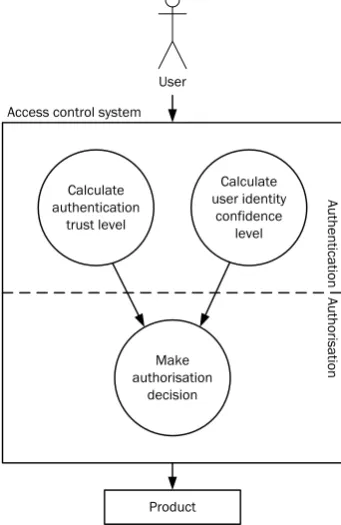
The contents of this chapter are be the basis of the part of our system that calculates the amount of trust we have in the authentication method(s) used, as shown in figure 4.1. We will first look into methods that can be used to quantify the amount of security that we have. We will then apply one method to quantify the amount of trust that a number of authentication methods offer. Finally, we see how to calculate the amount of security for combinations of authentication methods.
4.1 Credentials
Chapter 4
User Access control system
Calculate user identity
confidence level
Au
th
en
tic
at
io
n
Au
th
or
is
at
io
n
Make authorisation
decision
Product Calculate
[image:30.595.236.409.119.391.2]authentication trust level
Figure 4.1: Schematic layout of the dynamic access control system
Existing literature usually evaluates authentication methods; for example, the com-bination of username and password or PIN code. We, however, assess the au-thentication trust level based on thecredentialsthat are known, not on complete
authentication methods.
Definition 4 (Credential) A piece of information that contributes to the succesful authentication of a user.
Using this definition, the authentication method of username and password consists of two credentials: the username and the password. Each credential is also an attribute in the representation of the user, so we can reuse the set of attributesA
that we have defined earlier for this.
A credential also often refers to a signed, trusted certificate that is used to verify a user’s identity[10, 59]. In our definition, such a certificate can also be a credential, but our definition is less specific. We also need to reason on usernames and other pieces of information. Winsborough et al.[58]define a credential to contain one or more attribute name-value pairs and the public key of the owner. For our research, we define a credential to only contain one name-value pair and no public key. This makes it easier for the system to reason on entered credentials and the user can directly type in the credentials for which this is possible.
Quantifying trust and security
4.2 Trust in authentication methods
Methods to quantify trust or security are usually a continuous numerical range or a discrete semantic classification[8, 34]. An example of such a discrete classification is high, medium, low. A lot of governments have already defined several security levels and the minimum security level needed for doing certain transactions[23, 36, 39, 42]. These governments all use discrete classifications.
The New Zealand government identifies different transaction types based on the amount of confidence in one’s identity: anonymous, pseudonymous, identified and verified transactions[39]. The government of the United Kingdom on the other hand defines security levels based on the level of damage that can be inflicted when something goes wrong: minimal, minor, significant and substantial damage. These levels of damage are defined using a set of criteria, like the amount of risk to one’s personal safety or the amount of financial loss. They also specify the acceptable ways to verify the user’s identity for each security level[42]. The government of the United States uses a similar approach, defining assurance levels and several impact profiles[23]. The Dutch government only specifies what kind of authentication is needed to obtain basic, middle or high security levels[36].
Thomas et al. further elaborate on the robustness of authentication mechanisms by proposingquantified trust levels[55]. In contrast to trust levels defined by the
governments, which are discrete, their trust level is continuous. They have coined the following definition for a quantified trust level.
Definition 5 (Probability of crack) The probability that an authentication method can be cracked by using random input.
LetCa1be the event that the authentication methoda1is cracked by an attacker. P
is the corresponding probability distribution. We define an authentication trust level as:
la1=−log(P(Ca1)) (4.1)
The logarithmic scale is used to create a more human-readable way to represent small probability values. Suppose authentication methoda2is defective and lets
everyone in. The probability that the authentication method is cracked is therefore 1.
P(Ca2) =1⇒la2=0
Authentication methoda3has a 0.5% probability of being cracked. Its authentication
trust level is:
P(Ca3) =0.005⇒la3≈2.3
Example 4.1 Suppose we use aPINcode as authentication method a4. ThePINcode has a length of four digits from 0 to 9, and a maximum number of three failed attempts before access is blocked. What is its authentication trust level?
For aPINcode of lengthn, the probability that someone can guess thePINon his first attempt is 101n. The probability that someone does not guess thePINon his first attempt, but does guess it on his second attempt, is(1−101n)·(
Chapter 4
We can generalise this to the probability that a password-based authentication mechanismax, with alphabetΣ, of lengthn, is cracked afterkattempts.
P(Ca
x) =1− k−1
Y
i=0
1− 1
|Σ|n−i
(4.2)
The probability that ourPINcode of length 4, with a maximum number of three failed attempts, is cracked, is therefore
P(Ca4) =1−
2
Y
i=0
1−1041
−i
=0.0003
The authentication trust level for thisPINis
la4=−log(0.0003)
≈3.5
Figure 4.2 shows that the authentication trust level decreases as the probability of crack increases. In other words, authentication methods that are easier to crack receive a lower authentication trust level.
0 0.5 1 1.5 2
0 0.2 0.4 0.6 0.8 1
Q ua nti fied aut hentication tr us t l ev el
Probability of crack
Figure 4.2: Quantified authentication trust level
The drawback of this approach is that it assumes that both the password and the guesses from the attacker are chosen at random. In general, this is not the case. As we have seen before, most people do not choose a password that is completely random. When someone attacking an authentication mechanism is able to make educated guesses instead of random guesses, the probability that he is be able to crack the mechanism is much higher.
Also, the probability of guessing a key that has been stored in a token is very low. The amount of trust for such a token, calculated using this method, therefore is very
Quantifying trust and security
high; however, someone finding a lost token will have no problem at all in gaining access. This needs to be taken into account when calculating the authentication trust level. This method unfortunately does not do so.
Cheng et al.[15]quantify risk based on the following formula. quantified risk=probability of damage·value of damage
They explicitly do not define what damage is because they feel it is the task of the security analyst to determine what exactly the damage is for the organisation and how to value it.
Unfortunately, they also do not give further methods to determine the probability of the damage done. Instead, they claim that “due to the unpredictability of the future, the probability and the value can at best be good enough estimates to compute reasonable quantified risk estimates.”
Sahinoglu[48]bases risk on the combination of vulnerabilities, threats, lack of countermeasures and criticality. He gives the following definitions.
vulnerability A weakness in any information system, system security procedure, internal controls, or implementation that an attacker could exploit.
threat A potential event that will have an unwelcome consequence if it becomes an attack asset.
countermeasure An action, device, procedure, technique, or other measure that reduces risk to an information system.
criticality Indicates the significance of the risk. Criticality is low if risk is of little or no significance, such as the malfunctioning of an office printer, but in the case of a nuclear power plant, criticality is close to 100 percent, because its security is vital for humans.
In Sahinoglu’s model, a vulnerabilityvihas an associated probability. The
probabili-ties of all vulnerabiliprobabili-ties add up to 1. Each vulnerability has one or more threats
ti j. The probabilities of all threats for a single vulnerability add up to 1. Each threat
may or may not have a countermeasurecmi j, also with an associated probability. The probability of a lack of countermeasures isP(¬cmi j). The criticality is indicated byc.
Combining this, the formula to calculate the risk is the following.
R=
X
i,j
P(vi)·P(ti j)·P(¬cmi j)
·c (4.3)
Sahinoglu does not describe how to obtain the probability values for each vulnerabi-lity, threat and countermeasure. He only suggests an “educated guess”, using the average of a lower and upper limit of this probability. How to obtain these limits is not described either. Sahinoglu assumes that a security analyst knows how to calculate these values.
Chapter 4
4.3 Probability of discovery
During the remaining part of this research, we use the algorithm devised by Thomas et al. to assess the security of credentials. This algorithm allows for an objective assessment of the security that a credential offers by calculating the probability that a credential can be cracked by random guesses.
A drawback of this algorithm, that reduces its accuracy, is that most guesses are not random. Furthermore, a token may contain a long key that is very hard to guess, but, once lost, this token may be used by anyone to gain entry. To overcome this shortcoming, we incorporate aprobability of discovery,P(Da)∈[0, 1], in the algorithm.
Definition 6 (Probability of discovery) The probability that an authentication me-thod can be cracked by informed guesses from the attacker because the probability space of chosen credentials is not uniform or because users write passwords down.
The probability that a credential iscompromisedis a combination of the probability
that it is cracked and the probability of discovery. We call the probability that a credential a1 is compromised P(A1), and the probability of discovery for this
credential isP(Da1).
Definition 7 (Probability of compromise) The combination of the probability of crack and the probability of discovery.
It is clear that the probability that a credential is compromised is always at least the probability that it is cracked. Educated guesses will only make compromising the mechanism easier, so the probability of discovery will increase the probability that a credential is compromised.
When the probability of discovery equals zero, it is clear thatP(Ai) =P(Cai). Simi-larly, when it is certain that a way to gain access to the system can be discovered, so, whenP(Dai) =1,P(Ai) =1 as well. We therefore have to defineP(Dai)in such a way thatP(Cai)≤P(Ai)≤1 holds whenP(Dai)influences the final result. The probability distribution does not have to be linear. These may differ per access control system. To account for this, we introduce an additional parameterα∈R+ that can be used to tweak the influence of the probability of discovery on the final probability of compromise. We determine a value forαthat is suitable for our access control system when we build and test a prototype.
The equation to calculate the probability of compromise is as follows.
P(Ai) =P(Cai) + (P(Dai)·P(C¯ai))α (4.4)
Figure 4.3 shows the influence that the probability of discovery has on the resulting probability of compromise for a number of values ofα. In this figure, the probability of crack equals 0.4.
The authentication trust level is also calculated using this new function, sola
i = −log(P(Ai))instead oflai=−log(P(Cai)).
Example 4.2 A system uses thePINcode we assessed in example 4.1. Users are allowed to choose their ownPINcode. What is the quantified authentication trust level?
Quantifying trust and security 0 0.1 0.2 0.3 0.4 0.5 0.6 0.7 0.8 0.9 1
0 0.1 0.2 0.3 0.4 0.5 0.6 0.7 0.8 0.9 1
P rob abi lit y of c ompr omi se
Probability of discovery
P(A) 0.5 1 2 3
Figure 4.3: Influence of the probability of discovery for different values ofα.
For this example we have chosenα =1. From example 4.1 we know that the
P(Ca4) =0.0003. When someone chooses his birthday as hisPINcode, the probability of discovery is very high. Not everyone, however, chooses such a fact that is easily guessable. We therefore assess the probability of discovery for this credential at high.
How to make a sound assessment of the probability of discovery is treated in section 4.4. For this example, however, this assessment suffices.
P(A4) =P(Ca4) +P(Da4)·P(C¯a4) =0.0003+0.75·0.9997 =0.750075
Based on this result we can now calculate the authentication trust level of this credential.
la4=−log(P(A4))
=0.12
For a system where each PIN code is assigned at random we would assess the probability of discovery very low. The trust level for such a system would bel≈1.0.
We assess more credentials in the next section to get a better feeling for what this number exactly means.
4.4 Discoverability
Chapter 4
Table 4.1: Values for probability of discovery
name P(Da) very low 0.1
low 0.25
medium 0.5
high 0.75
very high 0.9
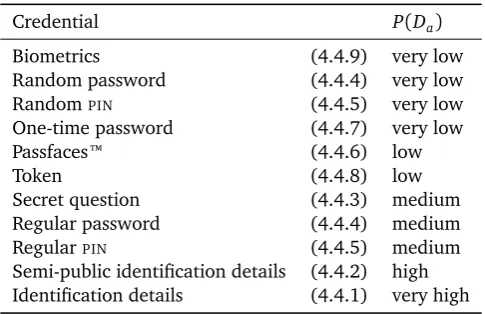
table 4.1. The following sections estimate the probability of discovery for a number of credentials. We will use the classification in table 4.1 for all estimates.
4.4.1 Identification details
Since our system may allow or disallow access also when only identification details, like name, telephone number or e-mail address, are known, we need to specify their probability of discovery as well. This information is usually publicly available, therefore we give these a very high probability of discovery.
4.4.2 Semi-public identification details
Not all identification details can be obtained as easily as someone’s name or te-lephone number. Information like citizen ID or municipality of birth are usually only known to a handful of people in the owner’s environment and are not easy to retrieve from public systems. It cannot be justified to give these pieces of information a very high probability of discovery (0.9); therefore, we give these a high probability of discovery (0.75).
4.4.3 Secret question
Schechter et al. [51]have done empirical research on the guessability of secret questions. They have assessed the secret questions of webmail providersAOL, Google, Microsoft and Yahoo! For these sites, they have measured whether secret questions are vulnerable to statistical guessing. They define an answer as statistically guessable when “it is among the five most popular answers provided byotherparticipants”
of their research. They also assess whether answers can be guessed by the user’s partner.
Summing up the results for all tested sites, Schechter et al. found that 13% of all answers are statistically guessable and 22% of all answers can be guessed by the user’s partner. The choice of questions has a significant influence on this result. For example, the question “What is your favourite sports team?” is statistically guessable for 57% of the answers.
Considering these results, we assign to the secret question a medium probability of discovery.
Quantifying trust and security
4.4.4 Password
The probability of discovery for a password largely depends on how a user chooses his password. When he uses his name, the password is obviously easier to guess then when he uses a random set of letters and numbers.
Yan et al. [62]have researched how easy passwords can be guessed based on the way that the user constructs them. In their experiment, three groups of users were told to construct their password in different ways. The first group of users was told to construct a password that is at least 7 characters long and contains one non-letter. They got no further aid in constructing the password.
The second group constructed their password by using a passphrase. This is a sentence, for example, “It’s 12 noon and I am hungry”. This sentence is then used to construct the password “I’s12&Iah”.
The third group was told to randomly construct a password by closing their eyes and randomly picking eight characters from a sheet of paper with the lettersA–Z and the numbers 1–9 printed repeatedly on it.
Yan et al. tried four attacks on these passwords. They first performed a dictionary attack. Then they used the words from the dictionaries and permuted them with 0, 1, 2 and 3 digit(s), and made substitions that are commonly used, like 1 for I and 5 for S. Using this, they again tried to attack the passwords. The third attack exploited known user information, like name, to crack passwords. Finally they tried a brute force attack.
When a user is given no further instructions, besides the minimum length the password needs to have and the fact that it needs to include one non-letter, 32% of passwords can be discovered using the first three attacks. Yan et al. have found that a password that has been constructed using a passphrase is as secure as a randomly chosen string of characters. Of the first, 6% was discovered using the first three attacks, of the latter, 8%.
The probability that a password can be cracked using a brute force attack is estimated by the algorithm of Thomas et al. that we have discussed in section 4.2. We therefore do not discuss this here.
In a similar research, Dell’amico et al.[17]have found that 30% of all passwords of an Italian instant messaging service can be obtained by using a set of dictionaries. Organisations may choose to give a user a random password and offer no options for him to change it. This way, we can be certain that a user’s password is random. Based on the observations above, we give this kind of password a very low probability of discovery. When a user is allowed to change his password, we cannot be certain that it is random anymore. We give this kind of password a medium probability of discovery.
4.4.5 PIN code
Chapter 4
completely random. The probability distribution forPIN codes is therefore not uniform. The probability that such a code is guessed differs for eachPINcode and for each distribution. When an attacker has information on the probability distribution, he is able to do educated guesses.
What they do not take into account is that an attacker may be able to do an educated guess because he has information on his victim. When the victim has chosen his birthday as isPINcode, and the attacker knows this birthday, this could be one of the educated guesses the attacker tries first.
Since the results of this research do not suggest otherwise, we choose the probability of discovery for thePINanalogous to these probabilities for passwords. We assess the probability of discovery for a randomPINcode at very low and medium for aPIN code chosen by the user.
4.4.6 Graphical password
Davis et al.[16]have researched how easy it is to do educated guesses on graphical passwords. They have tested a graphical password scheme that has been modeled after Passfaces™1and a scheme they made up themselves, that they call “Story”. Since only Passfaces™is used in practice, we disregard the authors’ own “Story” scheme.
Using Passfaces™the user makes a selection from a number of faces. This selection is his graphical password. When logging in, his selection is shown amongst a number of other faces. When the user selects the correct faces, he is authenticated. Davis et al. found that the choice of faces is heavily biased based on the race of the user and the attractiveness of the faces used. People tend to select attractive faces from their own race. For certain populations of users, 10% of the passwords that are used by males could be guessed in two tries. Based on this information, we give Passfaces™a low probability of discovery.
4.4.7 One-time password
A one-time password is usually either acquired from a token that the user possesses (for instance a cell phone), sent by e-mail or retrieved from a previously acquired piece of paper. We assume that the user takes great caution to protect the token or the paper. Therefore we give the one-time password a very low probability of discovery.
4.4.8 Token
The key that is typically used in a token is long enough to not be discoverable at all. Nevertheless, someone may lose his token, making it possible for anyone finding it to access whatever the access control method using the token is protecting. Therefore,
1
http://www.passfaces.com/
Quantifying trust and security
Table 4.2: Overview of probabilities of discovery
Credential P(Da)
Biometrics (4.4.9) very low
Random password (4.4.4) very low
RandomPIN (4.4.5) very low
One-time password (4.4.7) very low
Passfaces™ (4.4.6) low
Token (4.4.8) low
Secret question (4.4.3) medium
Regular password (4.4.4) medium
RegularPIN (4.4.5) medium
Semi-public identification details (4.4.2) high
Identification details (4.4.1) very high
a user should take great care in protecting his token. Based on this observation, we give the token a low probability of discovery.
4.4.9 Biometrics
This method using a probability of discovery does not seem to make sense for biometric authentication methods. It makes no sense to assess the probability that a fingerprint or an iris has been discovered. We assume that fingers or eyes are never lost or stolen.
Ballard et al.[5]have done research into the probability that keys, generated from biometric data, are guessed based on auxiliary information, for example, information on how the key is generated, or information on population demographics. In some cases, the probability to guess such a key in a single attempt is 15%. This auxiliary information, however, is usually not available. While 15% may seem high, the chances that this probability is reached are slim.
They also assess the probability that these keys are guessed by using information leaked by templates used to generate the keys. They say that it is important to keep these templates private. Otherwise, the probability of guessing a key in a single attempt could become as high as 22%.
Based on this research, we give biometrics a very low probability of discovery.
4.4.10 Overview
Chapter 4
4.5 Security of credentials
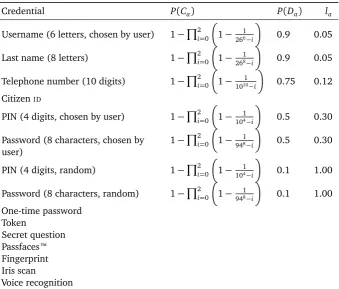
[image:40.595.155.495.223.512.2]Table 4.3 gives an overview of quantified authentication trust levels for a selection of credentials. These have been calculated using the method we have described before.
Table 4.3: Quantified authentication trust level for credentials
Credential P(Ca) P(Da) la
Username (6 letters, chosen by user) 1−Q2i=0
1−2616−i
0.9 0.05
Last name (8 letters) 1−Q2
i=0
1−2618−i
0.9 0.05
Telephone number (10 digits) 1−Q2
i=0
1−10101−i
0.75 0.12
CitizenID
PIN (4 digits, chosen by user) 1−Q2
i=0
1−1014−i
0.5 0.30
Password (8 characters, chosen by user)
1−Q2
i=0
1−9418−i
0.5 0.30
PIN (4 digits, random) 1−Q2
i=0
1−1014−i
0.1 1.00
Password (8 characters, random) 1−Q2
i=0
1−9418−i
0.1 1.00 One-time password Token Secret question Passfaces™ Fingerprint Iris scan Voice recognition
4.6 Combinations of credentials
Once a single credential cannot deliver a high enough trust level, the system may decide to try additional credentials. It then needs to calculate a new trust level based on the combination of the credentials that have been used.
This new trust level is based on the probability that two credentials,a1anda2, both
fail: P(A1∩A2). But, since eventsA1andA2may not be independent, we cannot
simply say P(A1∩A2) = P(A1)·P(A2). When an intruder knows how to crack a
password, he may also know how to crack aPINcode. When these two credentials are used together, the probability of both being cracked is not independent. For dependent events,P(A1∩A2) =P(A1)·P(A2|A1) =P(A2)·P(A1|A2)by
de-finition. The problem is that we cannot calculate P(A2 |A1)as this conditional
Quantifying trust and security
probability is not known. It is not possible to calculate the influence that the proba-bility that authentication methoda2has been compromised has on the probability
thata1will also be compromised.
Thomas et al.[55]have thought of this as well. Their idea is to estimateP(A1∩A2).
To do this, they first define the lower and upper bounds that this function can have. Because we are working with probabilities, the lower bound represents the highest trust while the upper bound represents the lowest trust.
They assume that P(A2 | A1) ≥ P(A2) since the probability that a credential is
compromised can onlyincreasewhen another credential has been compromised,
and will never decrease. Using this assumption we can deduce thatP(A1)·P(A2)≤
P(A1)·P(A2|A1) =P(A1∩A2). This is the lower bound.
Thomas et al. further argue that any combination of credentials is at least as strong as its strongest credential, since an attacker has to go through all credentials to gain access. So, when comparing two credentials, the amount of trust the strongest one offers is min(P(A1),P(A2)). This is the upper bound.
We now have a first approximation of the probability that two credentials are compromised.
P(A1)·P(A2)≤P(A1∩A2)≤min(P(A1),P(A2)) (4.5)
4.6.1 Similarity coefficient
To estimate whether the actual value ofP(A1∩A2)is closer to the upper or the lower
bound, Thomas et al. describe asimilarity coefficient h∈[0, 1]that describes the
similarity of different credentials. This similarity coefficient is based on the idea that, when two credentials are similar, it is easier to crack both than when they differ a lot. When using two similar credentials, the authentication trust level should not rise as much as when using two credentials that are very different. The similarity coefficient is meant to accomplish this.
SinceP(A1∩A2) =P(A1)·P(A2|A1)andP(A1)is known, we can deduce that this
similarity coefficient only influences the value ofP(A2|A1). This value is not known,
but we do know the lower and upper bounds. These can be based on equation 4.5. SinceP(A2|A1) = P(A1∩A2)
P(A1) , the following holds.
P(A2)≤P(A2|A1)≤min
1,P(A2)
P(A1)
(4.6)
We can also intuitively see that this equation is correct. When the similarity coef-ficient equals zero, the probability that credentiala1has been compromised has
no influence at all on the probability that credentiala2is compromised as well,
soP(A2|A1) =P(A2). On the other hand, when the similarity coefficient equals
one, the compromise of credentiala1has a maximum effect on the probability that
credentiala2is compromised; so, when credentiala1is compromised, credentiala2
Chapter 4
Table 4.4: Similarity coefficients
![Table 4.4: Similarity coefficients for multiple authentication methods (from [55])](https://thumb-us.123doks.com/thumbv2/123dok_us/1207123.644280/42.595.152.497.146.218/table-similarity-coefcients-multiple-authentication-methods.webp)