Regina Antoni*, Daniela Dietrich*, Malcolm J. Bennett and Pedro L. Rodriguez†
Instituto de Biología Molecular y Celular de Plantas, Consejo Superior de Investigaciones
Científicas-Universidad Politécnica de Valencia, 46022 Valencia, Spain (P.L.R.)
Centre for Plant Integrative Biology, University of Nottingham, LE12 5RD, UK (R.A., D.D.,
M.J.B.)
*Both authors contributed equally to this work
†To whom correspondence should be addressed;
e-mail [email protected]; phone: 34 963877860
Summary
Hydrotropism is a genuine response of roots to a moisture gradient to avoid drought. An
experimental system for the induction of hydrotropic root response in Petri dishes was
designed by pioneering groups in the field. This system uses split agar plates containing an
osmolyte only in a region of the plate in order to generate a water potential gradient.
Arabidopsis seedlings are placed on the MS agar plate so that their root tips are near the
junction between plain MS medium and the region supplemented with the osmolyte. It elicits
a hydrotropic response in Arabidopsis roots that can be measured as the root curvature
angle.
Keywords: hydrotropism, water potential gradient, root curvature angle, moisture gradient,
root growth, sorbitol, ABA, Arabidopsis
1. Introduction
Drought is a major environmental stress that affects plant growth and has a serious impact
on agriculture. Plants have developed a range of mechanisms to overcome drought stress
including stomatal closure, regulation of gene expression, accumulation of osmoprotectants
or compatible solutes and modulation of growth (1). Hydrotropism forms part of the
drought-avoidance plant response and is a mechanism by which roots change growth direction
according to differences in the water potential of the soil. Elucidating the molecular
mechanism of hydrotropism in roots is important both for understanding plant adaptation to
soil moisture gradients and improving crop productivity. Root growth is strongly directed by
gravity and also by other tropisms like photo-, thigmo- or hydrotropism (2). The study of this
latter process is complicated by the fact that gravitropism and hydrotropism influence each
other and make it difficult to observe hydrotropism in isolation. However, since roots of the
pea mutant ageotropum are agravitropic but hydrotropic both sensing pathways must
operate through independent mechanisms (3). Additionally, the non-hydrotropic Arabidopsis
regulation has been well described, the molecular mechanisms that regulate hydrotropism
are still largely unknown. Screening procedures in model plant species are needed for
genetic dissection of complex biological processes. Therefore, a protocol that allows the
analysis of the hydrotropic response in Arabidopsis seedlings can help to isolate key genes
involved in this response. Takahashi et al. (6) and Eapen et al. (4) described two methods to
measure the hydrotropic response in Arabidopsis seedlings. Both methods are based on the
same principle of challenging roots with a water potential gradient that will ultimately trigger
root bending. Here we describe one of them based on the use of split agar plates that
contain two media with different water potential. The use of these strategies has allowed the
isolation of mutants that lack a normal hydrotropic response such as miz1, miz2/gnom, ahr1
and nhr1 (6-8, 4), or the identification of mutants that show an enhanced hydrotropic
response, such as the pp2c quadruple mutant impaired in the protein phosphatases type 2C
that negative regulate ABA signalling (9). As a result, it has been identified a gene, MIZ1,
that plays an essential role for hydrotropism and is expressed in the columella cells of the
root cap (6). It has been also found that GNOM-mediated vesicular trafficking and ABA
signalling through PYR/PYL/RCAR receptors is required for hydrotropism in Arabidopsis (7,
9). Finally, in addition to ABA (5, 9), cytokinins also play a role in root hydrotropism (8).
2. Materials:
D-Sorbitol
Murashige and Skoog (MS) basal salt macronutrient solution (10)
120 x 120 x 17 mm square polystyrene Petri dishes
3M Micropore surgical tape
Growth chamber in darkness
Imaging system (optional, if time course analysis is intended): IR camera system (11)
3. Methods:
3.1. Growth of Arabidopsis seedlings
1- Sterilise Arabidopsis seeds by treatment with 50% sodium hypochlorite for 5 minutes
followed by four washes with sterile distilled water and stratify them in the dark at 4°C
for 3 days.
2- Sow the seeds on plates containing half-strength (0.5x) MS medium, pH 5.6-5.8 and
solidified with 1% agar (0.5xMS plates).
3- Seal the plates with 3M Micropore surgical tape and put them vertically in a growth
chamber with 24h light at 22°C for 5-6 days.
3.2. Preparation of plates that establish a water potential gradient
1- The osmotic pressure ( ) of an ideal solution can be approximated using the Morse
equation iMRT, where M is the molarity of the solute. Sorbitol is a common
solute in laboratory that lacks secondary effects and we use it to generate a water
potential gradient in split agar plates. For instance, adding 0.4 M sorbitol as solute
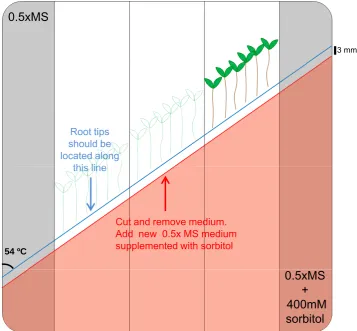
lowers the water potential by -1 MPa. Split agar plates are generated by filling the
upper region of the square Petri dish with medium containing 0.5xMS salts and the
lower region with 0.5xMS salts + 0.4 M sorbitol (Fig. 1). Thus, a water potential
gradient will be generated between the two different media. Root tips will be located
at the border between both media and the root curvature will be measured within 12
h (Fig. 1). The water potential gradient between both media becomes smaller over
time, but exists for a substantial portion of the experimental period.
2- The split agar plates must be prepared just before the experiment. We use a
template placed below the plate in order to guide the diagonal cutting of the medium
supplemented with 0.4 M sorbitol.
3- Use the same template to guide the transfer of Arabidopsis seedlings grown on
vertical plates to the plates with a water potential gradient so that their root tips are
2-3 millimetres above the border between the two media (blue line in Fig. 1). Seedlings
should be transferred only to the 3 central rectangles. According to the size of the
square Petri dishes, 5-6 seedlings of each genotype can be transferred to one of the
rectangles in such a way that each plate contains up to 3 different genotypes.
4- At least three plates per experiment are needed. In order to avoid a positional effect,
the order of the genotypes on the plates should be varied. The two rectangles close
to the edges of the plate should be left empty as diffusion of water and sorbitol could
be affected by boundary effects.
5- Seal the plates with 3M Micropore surgical tape to allow gas exchange.
3.3. Root curvature measurement
1- Place the plates vertically in a growth chamber at 22°C in darkness and take images
of the plants after 8-13 h. Performing the experiment in darkness eliminates the effect
of phototropism on root angle, although it has been described that the hydrotropic
curvature of light-grown seedlings is notably higher than in dark-grown seedlings
(12). In wild type plants root curvature generated in response to the moisture gradient
can be observed from the first hour onwards; however, after 8-13 h the angle values
of root curvature will be higher, which will make it easier to distinguish between
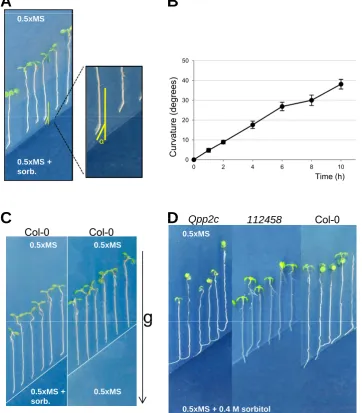
altered and normal hydrotropic response (Fig. 2A, B). If detailed analysis of the
development of the hydrotropic root curvature over time is intended, images should
be taken with an automated IR camera system.
4. Notes:
1- After the preparation of the plates, the water potential gradient will decrease over
time (6). For this reason, plates must be prepared just before the start of the
experiment and angle measurements should be taken after 8-13 h.
2- While setting up the experiment, maintain plants in vertical orientation as much as
possible. As roots tend to grow in the direction of gravity, keeping them in the same
initial position will avoid unnecessary perturbations in root growth.
3- When preparing the plates take special care of working on a level surface to ensure
that the level between the two media is similar. We use a spirit level to ensure the
flow laminar hood where media are poured is really on the same level. Additionally
take care to obtain a horizontal surface in the border between the two media that
generate the water potential gradient. The transition between both media should be
as flat as possible since irregular surfaces between both media could alter the root
hydrotropic response.
4- It is necessary to include in the experiment control 0.5xMS plates lacking the water
potential gradient. As shown in Fig. 2C, seedlings growing on control plates follow
the gravity vector while those growing on plates that contain a water potential
gradient bend and avoid the low water potential area. Once the measurement of root
curvature is done, seedlings can be left growing for 2-3 days to observe if the
response persists in time (Fig. 2D).
5- As temperature affects osmolyte diffusion and in order to keep the water potential
gradient as steep as possible, cool down the 0.5xMS medium supplemented with
sorbitol as much as possible before pouring.
6- Select seedlings of the same developmental stage, which should have similar root
growth rates. Under our growth conditions (22°C in darkness) Col-0 plants show a
(Fig. 2D).
Acknowledgment
Funding was provided by a Marie Curie Intra-European Fellowship to R.A and grants from
the Ministerio de Ciencia e Innovacion, Fondo Europeo de Desarrollo Regional and Consejo
Superior de Investigaciones Cientificas to P.L.R. (BIO2011-23446) and the Biotechnology
and Biological Sciences Research Council to D.D and M.J.B.
References
1. Verslues,P.E., Agarwal,M., Katiyar-Agarwal,S., et al. (2006). Methods and concepts in quantifying resistance to drought, salt and freezing, abiotic stresses that affect plant water status. Plant J. 45, 523-539.
2. Roy, R. and Bassham, D. C. (2014) Root growth movements: Waving and skewing.
Plant Science 221, 42-47.
3. Jaffe, M.J., Takahashi,H. and Biro,R.L. (1985) A pea mutant for the study of hydrotropism in roots. Science 230, 445-447.
4. Eapen, D., Barroso, M.L., Campos, M.E., et al. (2003) A no hydrotropic response (nhr1) root mutant that responds positively to gravitropism in Arabidopsis. Plant Physiology 131, 536-546.
5. Kobayashi, A., Takahashi, A., Kakimoto, Y., et al. (2007) A gene essential for hydrotropism in roots. Proc Natl Acad Sci USA 104, 4724-4729.
6. Takahashi, N., Goto, N., Okada, K. et al. (2002) Hydrotropism in abscisic acid, wavy, and gravitropic mutants of Arabidopsisthaliana. Planta 216, 203-211.
7. Miyazawa, Y., Takahashi, A., Kobayashi, A., et al. (2009) GNOM-mediated vesicular trafficking plays an essential role in hydrotropism of Arabidopsis roots. Plant Physiol
149, 835-840.
8. Saucedo, M., Ponce, G., Campos, M., et al. (2012) An altered hydrotropic response (ahr1) mutant of Arabidopsis recovers root hydrotropism with cytokinin. Journal of Experimental Botany 63, 3587-3601.
9. Antoni, R., Gonzalez-Guzman, M., Rodriguez, L., et al. (2013). PYRABACTIN RESISTANCE1-LIKE8 plays an important role for the regulation of abscisic acid signaling in root. Plant Physiol 161, 931-941.
10. Murashige, T. & Skoog, F. (1962) A Revised Medium for Rapid Growth and Bio Assays with Tobacco Tissue Cultures. Physiologia Plantarum 15, 473-497.
11. Wells, D. M., French, A. P., Naeem, A., et al. (2012) Recovering the dynamics of root growth and development using novel image acquisition and analysis methods
Philosophical Transactions of the Royal Society B: Biological Sciences 367, 2245.
12. Moriwaki,T., Miyazawa,Y., Fujii,N. et al. (2012) Light and abscisic acid signalling are integrated by MIZ1 gene expression and regulate hydrotropic response in roots of
0.5xMS
3 mm
Root tips should be located along
this line
54 ºC
Cut and remove medium. Add new 0.5x MS medium supplemented with sorbitol
[image:8.595.125.483.203.534.2]this line
Figure 1. Schematic representation of the split agar plate used for the analysis of the
root hydrotropic response. The upper part of the plate contains 0.5xMS medium while
0.5xMS
+
400mM
sorbitol
y p p pp p p
30 40 50 (degrees) 0.5xMS α 0 10 20
0 2 4 6 8 10
Curvature Time (h) Col 0 112458 Qpp2c
C
D
0.5xMS + sorb. 0.5xMS Col-0 112458 Qpp2c Col-0 Col-0g
0.5xMS 0.5xMSC
D
[image:9.595.106.469.150.564.2]0.5xMS + 0.4 M sorbitol
Figure 2 Root hydrotropic response of 6 day old Arabidopsis seedlings in plates where
g
0.5xMS 0.5xMS +
sorb.
Figure 2.Root hydrotropic response of 6-day-old Arabidopsis seedlings in plates where
a water potential gradient has been established. (A) Measurement of the root curvature
angle (α) after 10 h of transferring the seedlings to split agar plates to estimate the hydrotropic response. (B) Time course of the hydrotropic response in Col-0Arabidopsis
seedlings. (C) Root bending only occurs in Col-0 seedlings after transferring them to
plates with a water potential gradient. Otherwise, they follow the gravity (g) vector. (D)
Root hydrotropic response of the ABA-hypersensitive mutant impaired in four clade A PP2Cs (abi1-2 hab1-1 pp2ca-1 abi2-2,abbreviated asQpp2c) and the ABA-insensitive
t t i i d i i PYR/PYL ABA t ( 1 l1 l2 l4 l5 l8
mutant impaired in six PYR/PYL ABA receptors (pyr1 pyl1 pyl2 pyl4 pyl5 pyl8,
abbreviated as112458). 6-day-old seedlings were transferred to plates with a moisture
gradient and photographs were taken after 3 days. An enhanced hydrotropic response was observed inQpp2c,whereas a lack of response was found in112458compared to