LAW AND ORDER ON THE ANGLO-SCOTTISH BORDER,
1603-1707
Catherine Mary Faith Ferguson
A Thesis Submitted for the Degree of PhD
at the
University of St. Andrews
1981
Full metadata for this item is available in
Research@StAndrews:FullText
at:
http://research-repository.st-andrews.ac.uk/
Please use this identifier to cite or link to this item:
http://hdl.handle.net/10023/2787
Catherine Mary Faith Ferguson
Abstract to Law and Order on the Anglo-Scottish Border,
160_3-1707.
Thesis submitted for degree of Ph.D., St. Andrews University, May 1981 For centuries the Borders were notorious for their lawlessness and were regarded as beyond redemption by those in London and Edinburgh. Undisturbed, the landowners had assumed extensive powers and the population organised themselves into virtually autonomous clans. For James VI and
I,
however, the Borders symbolised the Union of the Crowns, for 'be the happie union' they were now 'the verie hart of the countrey'. It was thus, intolerable that the Bordersshould remain in their old state and so from
1603
there was a new drive to. pacify the region.Previous studies have either considered the region from one side of the frontier only, or have stopped at some date within the seventeenth century. It is however, important that the Border counties of England and Scotland be
considered as a whole, for although divided by man-made divisions, they were united geographically, topographically, economically and socially. It is
equally vital that the seventeenth century be regarded in its entirety, for the pacification of the Borders was
a gradual process, of which the final stages
were not reached until the last quarter of the century.
In order to examine the whole process of the pacification and how the
region gradually adapted to its new role as the Middle Shires of Britain, the
on the Border Commissioners who were the body most intimately concerned with pacifying the region and who made a lasting impression upon every aspect of Border society. The Commissions have spanned over 80 years and more than
any other judicial body shaped the Borders into the Eiddle Shires, yet no detailed study of them has ever been undertaken before.
LAW AND ORDER ON IHE
ANGLO-SCOTTISH BORDER,
1603 - 1707
by
CAIEERINE MARY FAITH FERGUSON
THESIS SUBMITTED FOR DEGREE OF
DOCTOR OF PHILOSOPHY,
TABLE OF CONTENTS
Table of contents
List of maps, tables and graphs
Acknowledgements
Preface
if
i41;(
Conventions
XVIntroduction
Chapter I
:
The Central Government
Chapter II
:
Assizes and Justice Ayres
S9Chapter III
:
The Border Commissioners
99I.
The Commissioners and their activities
99i.
The Commission and the Commissioners
ii.Activity: 1605-1611
1611-22
99
11:3
Zi2 iv. - 1622-25
v. 1625-37 146
vi. 1637-50 1s2
vii.
1650-60
1154viii. 1660-84 159
Chapter FT
Chapter V
II. The work of the Border Commissioners' courts
i. Securing the offenders
ii. Dealing with offenders
: The Sheriff Courts
: The Justices of the Peace
I.
The Scottish Justices
The work of the courts: Scotland
II. The English Justices
The work of the courts : England
vis zo6 zt-24.9 252 269
279
The English Border Justices : special features :503
Chapter Vi
The Franchise Courts
320
I. The Scottish Franchise Courts.
221
i. Competence
32.1ii. Procedure
IA44
1,41
iii. Relations with other courts
II. The English Franchise Courts
Chapter
VII
:
The Town Courts
369
Conclusion Abbreviations
Preface : Notes Introduction : Notes
Chapter I : Sources and Notes Chapter II : Sourcias and Notes Chapter III : Sources and Notes Chapter IV : Sources and Notes Chapter V : Sources and Notes Chapter VI : Sources and Notes Chapter VII : Sources and Notes Chapter VIII : Sources and Notes Conclusion : Notes
IV
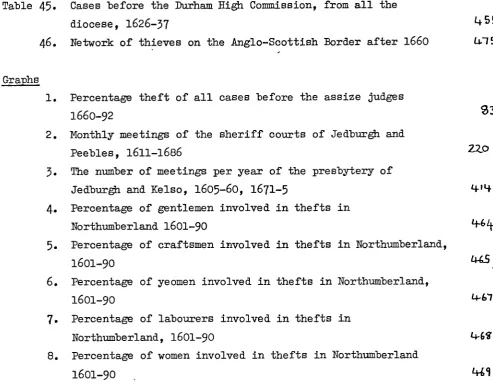
List of maps, graphs and tables
Maps Page
1.
Map of the Anglo-Scottish Border showing principal
towns and counties
2.
Map of the Anglo-Scottish Border showing franchises and
villages mentioned in the text
2
Tables
5-Table 1. Distribution of Population in Scotland in 1691
2.
Number of Days with sleet or snow likely to have fallen
at Rydal, November 1689-April 1693
73.
Seed yields in Cumberland and Westmorland on Sir John
Lowther f
slands, 1598-1605
4.
Crop yields on the Cassillis Estates, Wigtownshire,
1655-1661
5. Exports from Whitehaven, 1672, 1680, 1684
196.
England: hierarchy of justice in the seventeenth century
2577.
Scotland: hierarchy of justice in the seventeenth century
8.
Persons before Star Chamber in the reign of James I
3L1-9.
Cases removed from Northumberland and Cumberland qunrter
sessions by writ of
certiorari, 1668-1700 4-110.
Cases from the Borders decided before the Scottish Privy
Council, 1605-78
11.
Commissions issued from the Scottish Privy Council to
officials in the Borders for the trial or apprehension
of named persons, 1603-91
5-812.
Scottish justice ayres in the seventeenth century
6113. Cases before Scottish justice ayres in the seventeenth
century
6314. Verdicts imposed by the Scottish justice ayres, 1656, 1658,
1659, 1671
Gi+
15. Numbei of persons indicted before the summer assizes at
Newcastle, 1602, 1604, 1605, 1606, 1608, 1616
-7716.
Indictments from Northumberland before the Northern Circuit
Assizes, 1660-92
17.
Indictments from Cumberland before the Northern Circuit
Assizes, 1660-92
7918. Indictments from Westmorland before the Northern Circuit
1+3
2
Page
Table 19. Number of prisoners delivered from the gaol at Newcastle
by the assize judges, summer, 1628 and 1629
%I
20.
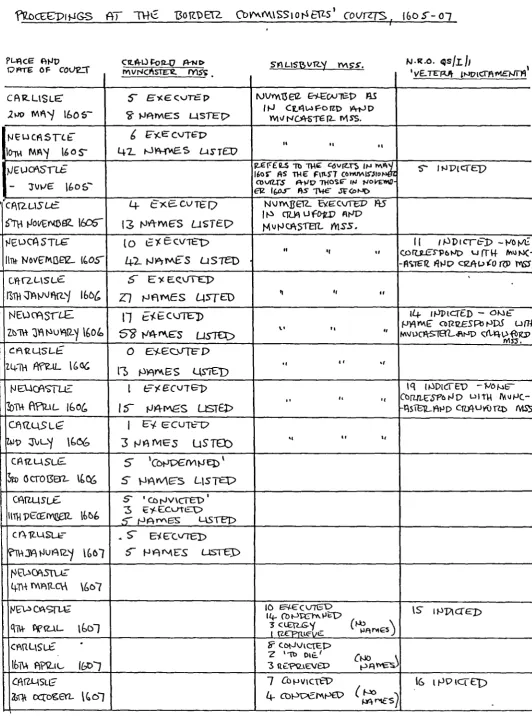
Comparison of the three main sources for the proceedings
at the Border Commissioners' courts, 1605-7
111.'-21. Punishments imposed by the English Border Commissioners'
courts, 1605-76
18622. Punishments imposed by the Scottish Border Commissioners'
courts, 1611-76
(81
23.
Scottish Border sheriffdoms in the seventeenth century
24.
Cases before Peebles sheriff court, 1652-1706
12525.
Cases before Jedburgh sheriff court, 1610-15, 1634-58,
1665-71 226
26.
Cases before Peeblesshire justices of the peace, 1656-9,
1660, 1664-6, 1670, 1677
2.56
27.
Cases before Roxburghshire justices of the peace, 1656-9
157
28.
Indictments before Northumberland quarter sessions, 1604-30
28329.
Indictments before Northumberland quarter sessions
1675-1705
213450. Indictments before Westmorland quarter sessions, 1655-67
285
31.
Indictments before Cumberland quarter sessions, 1668-1701
186
32.
Cases before Melrose regality court, 1605-9, 1657-76,
32.8
1682-4
33. Cases before Stitchill baron court, 1655-1707
32934.
Cases before Kelso baillie court, 1623-6, 1641-51, 16 59-74
'330
35. Cases before Hexham manorial court, 1606, 1616, 1619, 1622,
1624-30
36136. Cases before Gilsland manorial court, 1611-13
37. Cases before Newcastle-upon-Tyne civil court, October
1656-March 1657
Y7838. Recognizances before Newcastle-upon-Tyne justices of the
peace, 1650-1
383a
39. Cases before Berwick-upon-Tweed justices of the peace,
March 1695-March 1696
40. Cases before Dumfries burgh council 1663
41.
Cases before Kirkcudbright town council, 1606-17, 1630, 1650
42. Cases before Jedburgh kirk session, 1672-5, 1678-81, 1684-7
43. .Dumfries kirk session: referrals to civil magistrate,
1648-61,
1668-9VI
Page
Table
45.Cases before the Durham High Commission, from all the
diocese, 1626-37
145546.
Network of thieves on the Anglo-Scottish Border after 1660
LC75
Graphs
1.
Percentage theft of all cases before the assize judges
1660-92
032.
Monthly meetings of the sheriff courts of Jedburgh and
Peebles, 1611-1686
2293.
The number of meetings per year of the presbytery of
Jedburgh and Kelso, 1605-60, 1671-5
1+144.
Percentage of gentlemen involved in thefts in
Northumberland 1601-90
5.
Percentage of craftsmen involved in thefts in Northumberland,
1601-90
445.6.
Percentage of yeomen involved in thefts in Northumberland,
1601-90
4.617.
Percentage of labourers involved in thefts in
Northumberland, 1601-90
4-6S8.
Percentage of women involved in thefts in Northumberland
[image:9.595.50.544.80.469.2]vi
ACKNOWLEDGMENTS
In researching and preparing this thesis, I have received a considerable
amount of help from a number of people, whom I should here like to thank for
their contribution.
For the first three years of research, I received a grant from the Social
Science Research Council, whose support in that respect I gratefully acknowledge.
The thesis has drawn to a large extent on the Crawford MSS in the John
Rylands Library and I am indebted to the Earl of Crawford and Balcarres for
giving me his permission to read and cite these manuscripts. From the staff
of the various record offices I visited, both national and local, I have
received considerable help and assistance, and I am especially grateful to the
staff of Durham University Department of Palaeography and Diplomatic.
My
most sincere thanks goes to my two supervisors, Mr. Bruce Lenman and
Dr. Geoffrey Parker, whose contribution has been inestimable. They have both
given me inspiration and encouragement and have never failed to provide helpful
suggestions and comments on the script of the thesis. For their assistance on
general and specific points, I wish also to thank Mr. A. Upton, Dr. K. Wrightson,
Dr. L. Smith, Mr. S. Davies and Dr. A. Foster. For the unenviable and arduous
task of typing the thesis, I am indebted to Mrs. Joyce Siddle.
I wish also to thank my husband for his tremendous assistance during the
years of my research. And last, but certainly not least, to my parents, for
their unfailing support, I owe far more than I could say.
;IA
PREFACE
No more discourse of Scotch or English race, Nor chant the fabulous hunt of Chevy Chase. Mixed in Corinthian metal, at thy flame Our nations melting, thy colossus frame. Prick down the point (whoever has the art), Where Nature Scotland does from England part. Anatomists may sooner fix the cells
Where life resides, or understanding dwells: But this we know, though that exceeds our skill, That whosoever sep l rates them does kill.
Will you the Tweed that sudden bounder call Of soil, of wit, of manners, and of all? Why draw we not as well the thrifty line
From Thames, Trent, Humber, or at least the Tyne? So may we the state corpulence redress,
And little England, when we please, make less. What ethic river is this wondrous Tweed,
Whose one bank vertue, other vice does breed? Or what new perpendicular does rise
Up from her stream, continued to the skies, That between us the common air should bar And split the influence of every star?
(Andrew Marvell, 'The Loyal Scot',
1669)
The final paragraph in T. I. Rae's book on the administration of the Scottish border in the sixteenth century implied that the Border problem solved itself on the Union of the Crowns in
1603;
but it was not to be the case. The Borders proved to be still difficult to deal with, for although the international tension had been removed with the Stuart succession in England, it was replaced by a more subtle, but equally important pressure.To James VI and I, the Borders symbolised the Union of the Crowns. If the area he now ruled was to be the Great Britain of his hopes, then the Borders as they existed, had to be radically changed. The Border region, then, for the century between the 'Union of the Crowns and the Act of Union, became the focus of 'the Great Britain issue'. Each step in the pacifying of the Borders was regarded as a step further towards uniting the two nations. Moreover, the seventeenth century saw the gradual increase in the power of
the state at the expense of personal monarchy. Government bureaucracy increased and the process of centralisation was visible in most areas of government activity. This was especially true in the realm of law and order. In order that the state might further increase in power and authority, it was essential that the areas hitherto 'little governed' should be brought within the system. Once again, the Borders - with the relative independence
of their powerful landowners with their awn jurisdictions; governed in England by that bastion of personal monarchy - the Council of the North - were
symbolic in this respect.
area, the 'borders' as defined by the Border Commissioners who operated
after 1605; that is: Northumberland, Cumberland, Westmorland, Roxburghshire,
Selkirkshire, Berwickshire, Dumfriesshire, Peeblesshire, and Kirkcudbright.
Thus, it deals with the inland areas as much as those directly adjacent to
the actual frontier. It seems essential that the Borders be considered as a
whole region - the actual boundary line was not defined with precision until
the eighteenth century, and some areas in the previous century were classed as
'debateable'. The Debateable Lands
1in the West March were, as their name
implies, neither truly part of England nor of Scotland. Moreover, the
inhabitants of that area regarded themselves as part of either or neither as
the whim suited them. Nor did the physical attributes of the region drastically
alter on crossing the boundary, for the area was one region geographically,
topographically, economically and socially. When he called them the 'Middle
Shires', James VI and I grasped what later writers (with the possible exception
of Andrew Marvell) have failed to understand: that once the man-made divisions
were disregarded, the Borders were a single unit.
This thesis takes as its time limits, the two 'natural breaks' of 1603 and
1707,
for to take any other dates within that period would be misleading. The
Border problem with law and order and its gradual pacification did not stop
at any definite date, but were rather a progression, with deceptive regressions
and recessions. It is only when the whole area is examined over the whole
century that any clear and meaningful pattern emerges.
For the same reason, it is important that no dividing line be drawn when
dealing with the types of court operating on the Borders. G. R. Elton, in his
introduction to
Crime in England, 1560-1850 2critic4sed the contributors to
one chapter to each level. Each chapter, then, describes the position of a particular type of court in the judicial hierarchy of England or Scotland, together with its methods, procedure and personnel and with the offences and offenders it dealt with. There are natural discrepancies in the balance of each chapter; an English court rarely being of identical importance to its Scottish counterpart and vice versa. There are also discrepancies between chapter and chapter, with the more important courts meriting a lengthier description.
The chapter on the Border Commissioners is noticeable in this respect. Yet this chapter might be considered the most important. Nowhere else in Britain did a special commission exist as it did in the Borders. Such was
the central importance of the Border Commission in pacifying that area and their impact upon every aspect of Border society, that they deserve a whole book to themselves, yet they have never been studied. Journals and manuals exist which describe the methods of sheriffs, justices of the peace and
assize judges; practicks and commentaries describe the central institutions, but no history has been written of the Border Commissioners who seem to have become a 'forgotten institution' over the centuries.
The analysis and examination of each type of court depends largely on the documentary evidence available. In some chapters the balance may be weighted heavily towards the individual tribunals with the best documentary
survival. This is an unfortunate, but necessary evil of historical research. Even the documents where they do exist, must be treated with caution. Just as one would not expect the entries in a modern-day court record to reflect the true state of affairs, so one must not expect the same of seventeenth century material. The records only reveal the offenders and offences which were
All 5
they never came to court. Edward Hext, a Somerset magistrate and Star
Chamber clerk thought, in
1590,that 80 per cent of all criminals evaded
trial. We shall never know the true percentage 3 ; but it is certain that
criminals escaped justice on a large scale.
Many were never detected. Detection in the seventeenth century was
always a problem in the absence of a police force. Constables were
notoriously partisan and were frequently in the courts themselves for
negligence. Most of the law courts, then, relied upon members of the
population to supply the relevant detail to bring an offender to court.
The chapter on the Border Commissioners shows that fear of revenge could
prevent the population from reporting crime so that the activities of the
law officials could be severely hindered.
Others concluded an extra-judicial settlement. There is sufficient
evidence to suggest that this took place at all levels and at all times,
although we only see the tip of the iceberg. The following case is typical.
Henry Dodd of Dunebank in July 1661 complained to the assize judges that
John Robson, Andrew Waugh and Thomas Waugh stole his black cow, and that
William Robson 'father to the said James Robson did confess to this informer
that his sonne James Robson was one of the stealers of the said
Quyand offered
in behalfe of his sonne twenty shillings for agreement 14 . There must have been
many of these settlements, but only the ones that went wrong are recorded.
The inaccuracies and unreliability of details in early modern assize
records have been clearly pointed out by J. S. Cockburn5 . He shows that often
the indictments are so suspect that perhaps as many as
30per cent are
incorrect. Thus, any statistical analysis of crime would be meaningless, as
would any quantitative research into occupation. The examples he gives
ofare also mainly confined to London where, perhaps, problems of identification and of attributing a specific occupation to an individual were more
pronounced than in a close-knit agricultural society. In many towns people quite legitimately used to have various occupations - an ale-housekeeper
could easily be a husbandman or craftsman. Every effort has been made in the course of this study to identify any inaccuracies in the placing of persons (and, because the jurisdiction of some courts operating in the area overlapped, checks can be made in several cases). Most of the inaccuracies seem to be in the realm of social definition, with yeoman, husbandman and labourer
frequently muddled. In the early seventeenth century, however, the practice of giving everyone a nick-name helped considerably in the identification of offenders (see page 4-72 below). Cockfourn I s comments, nevertheless, are valuable and should be borne in mind when analysing such data.
The extra-judicial settlements, the inaccuracies in the documents and the unknown quantity of undiscovered crime, all make for difficulties when
$ V
Note on conventions
Spelling has not been modernised except that placenames outside quotations have been given in their present form and all contractions have been expanded. English as well as Scottish dates have been given as if the year began on the 1st January.
The sums of money mentioned in English court records were invariably in sterling; the text, therefore, does not state this. The Scottish courts used either English or Scots pounds or marks, so if the original document had stated which, this has been made clear after the sum given. One English pound was the equivalent of 12 Scottish pounds and the mark was worth 13 shillings and
4
pence Scots.Many of the documents used were not catalogued or sorted and in some others the page numbering was so erratic as to be more of a hindrance than a help. As far as possible, all documents have been
identified with (1) repository (2) call number
(3)
page or folio numbersozo kok, -ruEe-17
• 40(4 iszApsD
netro, a P- — SCO
TTIS
H- 7-1Dert_ S-Ho P 1) Ta( k P4c-TOL-NOS Pr I-3D COL/
quvw scK. s: 1.1.1 eelrrtAT , tieucAsilel
't cJ/ z _
PRX-N KIKKCUI7B,24 > 4461:4i1=1•61 I
cActusLE
„ ,1 n,. .... , , ..5_.
• • ••• •••• ,
• e_ • ‘4.-" % id S s _ , - • . \'-i , # sJ • SS' i , %&_- 134E5 .../ .4.: n 1 I ; • :%°,
1, (it/ .. ,/ ..../ cv,1g4 , u_' -(2, so
i n 13-• • i 4-' I 0(1/ .7E.PIYKI-1
• ' ,
, -, , - - - f /c31-/ / ..t. H Auicx
1 : -- ',/ 0
/ —.- --% .
r r ". - •
e , P \-) n", te- ra. i ES '..
4
• EP! t--)554E-CI+
Ove•CRIEs - - - K c 5)17
rz_ c, IA '
u\CTaut\t`-,
, •••• • I
ci ..C)., • -.,, ..,-•
\., P` t 0 Du""1
, 6
, ,...
, Ct- .,, , .
<L7
r— — r — —... , % _ l'i
44" .
i
5
f \')
J .... ' RPr LES V es
G / - -
o
...
f'5 -,
• - - , KciADFIL ,.- • 1
,"
Y
.1
I LAwcs . ', - _
. • , / q 6...,....
rykrt? 6,re The nOGLD ilo1lDE12- SH-DtA 0q I-cLqLICH tsEs
INTRODUCTION
In the absence of censuses conducted along modern lines, it is
difficult to know the exact population of the area known as the Borders,
in the seventeenth century. Early modern governments occasionally commissioned
surveys of the population, but they were usually interested only in certain
sections of the community - those
whocould pay taxes, or were religious
dissenters, for example. Thus, the diocesan surveys of 1563, the Protestation
of
1641and the Hearth Tax assessments of the 1660 1 s and 1670 1 s do not give
1
strictly accurate numbers. Moreover, this information was often collected
by households and unless the exact number of persons per household in each
period and each area is known (which it is not), then it is extremely
difficult to convert the figure into population size. Taking these problems
into account, A. Appleby calculated that the population of Cumberland in
1563 was 42,400 and Westmorland was 30,500. By 1670, the Westmorland population
had declined to 28,300, but by 1688 the Cumberland population had risen to
63,100. From the Carlisle diocesan records of 1603, Appleby calculated that
the population of Cumberland at that time was around
95,000although by the
time of the Protestation in 1641 it had dropped to 53,800. It would seem, then,
that between 1563 and 1603 the population of Cumberland and Westmorland
increased by
43 percent; between 1603 and 1641 it declined by
9 percent; only to
rise by 10 per cent between 1641 and the 1670 1 s and 16801s.2
S. Watts suggested that in 1584 the population of Northumberland was
around 74,300 and that by 1627 the figure had risen slightly to 85,000. Taking
into account the differing size of counties, it would seem that in 1584 there
were
35people per sure mile in Northumberland, about the same in Westmorland
There is a dearth of census information for Scotland in the seventeenth
century, so that, as one historian has written 'it remains very uncertain
what the population of Scotland was at any point before 1750'. It was
estimated, around the time of the Union in 1707, that the population of the
whole country was just over 1 million. As late as
1755, 51per cent of the
population lived beyond the Tay and out of a total estimated population of
1,265,000, a mere 149,000 lived in southern Scotland. The Table 1 shows
the distribution of population in 1691, from which it can be seen that the
Borders were sparsely populated. Out of
57parishes in Nithsdale, Annandale,
Wigtown and Carrick, in the south-west, only 11 averaged over 20 per 1000
acres and
6of the 11 were parishes containing a royal burgh. In human
terms, the Borders were a very empty partof Britain4.
A great deal of the region consisted of high hills and mountains. Indeed,
the highest peaks in England (Scafell and Helvellyn) are in Cumberland. The
hilly topography contributed to the poor climate experienced in the Border
region. The Lake District, for example, has always been noted for its high
precipitation counts; between 1911 and 1950 for example, rainfall in Cumberland
was the highest in Britain, with Borrowdale experiencing 130 inches of
"TA 15LE i .
AreaPaid
Deficient
Poor
Paid Hearths
Hearths
per 1000 acre.
15351
870
2969
27
3429424
130
324
32
-
-
41
Total
205748
12687
8667
on in Scotland in
1691
(Taken from M.Flinn (ed.),
Scottish Population History from
the Seventeenth Century to the
1930's,
p.188).
Cupar l St.Andrews and
5
7
14
Lanark
Renfrew
5019
..
ClarAmannan
1252
Bo'ness, Linlithgow
Aueensfprry
2622
173
1761
4
6
9
260
Rest of West Lothian
160
241
prevailing between Ireland and Iceland were appreciably lower than today'
5
. Indeed, it has been suggested that from around1645
until 1715 the climate of the world was cooler than before or after. The almost complete absence of sunspots between1645
and1715
was noted by leading astronomers of the late seventeenth century, such as G. D. Cassini (1625-1715) inFrance and John Flamsteed (1646-1719) in England. Their astronomical notebooks also reveal an absence of aurora borealis (or the northern lights) and evidence that the sun was rotating in a significantly different way in the seventeenth century. Moreover, there was a notable increase of carbon-14 (radioactive
\\
isotope of carbon (
14c))
deposited during the period 1650 to 1750, indicating an increase of carbon in the earth's atmosphere which could have resulted from a reduction in solar energy. In other words, there may have been a reduction in the amount of heat received on earth from the sun; a factor which would affect agriculture in no small way6
.The Borders were essentially an agricultural region, with most of the population working on the land. Even those who lived in the towns as craftsmen most probably worked their parcel of land in addition. In the upland areas of the Borders there was limited arable land, confined to the valley floors, with the rest of the rough barren moors used for pasture. A description ofRedesdale in the seventeenth century noted the 'barren heath, high mountains and
desert wastes, so that in ten miles of ground there will not be 100 acres of arable
1 . 7
In England, small hanlets were occasionally clustered alongside the arable areas, but in general, isolated farms were the norm, surrounded by separately held enclosures.TALE 2
Number of days with sleet or snow likely to have fallen at
1689
Rydal, November
1689 -
April
1693
29+
'winter'
1689-90
JFMAMJJASOND
? (2)
3
'
1690
11
5
2
3 (2)
1
-
-
-
1
5
4
29
1690-91
1691
4 (3)(8)
2
2
---
6
4
43
1691-92
1692
10 11
4
5
2
1
-
-
5 (0) 4
3
32+
1692-93
Rydal
1931-1970
>5 5 4 2<1 -
-
<1 <2 3
23
Reproduced from G.Matley, 'Sir Daniel Fleming
Meteorological Observations at Rydal,
1689-93'
T.C.W.A.A.S., new series, vol.LXXVII
(1977),
p.125.
Brackets indicate uncertainties, not likely
st.
summerings or sheilings, but in the winter they were brought dawn to the meadows to feed on the stubble. Wills and inventories from Cumberland, Westmorland and Northumberland, reveal the central importance of livestock.
Thomas Birstead of Crossthwaite parish left, in 1570, 200 sheep, nine caws and calves, two horses and some hay, but no grain and no plough. Seventy per cent of the value of the goods of Lancelot Thirlwall of Thirlwall, consisted of livestock. It would seem, then, that although these upland Border farmers worked a small arable holding, they were mainly preoccupied with livestock and used the proceeds of these to buy grain if the arable holding proved inadequates.
In the lowland areas of the English Bor ders? villages were more common, although the hamlet was the most typical form of settlement. There was more arable cultivation than in the upland areas, with greater diversity of crops. Whereas oats and barley were the basic crops in the upland areas, in the lowland region they also grew rye. Christopher Lowther, travelling in
1629
wrote that 'from Leaven to the river Esk, 2 miles, all this space plain very good ground, most corn ground'. Wry occasionally, peas and beans were
grown, but they were not a common crop in comparison with the south of England. In the lowland areas, poultry were more common than on the higher land and so were swine. However, despite the greater diversity of arable crops, the
lowland farmer, like his upland counterpart, was still mostly concerned with livestock. The will of John Dalton of Crosby parish on Eden, is typical of the area: in
1614
he left cattle worth £254
shillings, with two mares worth£5;
but only£15
worth of corn and hay10.9
arable area. In general, however, oats predominated in the lowland
Scottish areas and were the main food crop of Scotland. As on the English
side of the Border, however, livestock were of central importance and every
rural family would keep at least one dairy cow. Cattle grazing was
particularly important in the south-west. Hector Boece, in
1527
described
Annandale, Nithsdale and Galloway as a 'store of bestial]) and Bishop Lesley,
in
1577,
described the same area as abounding in I nobill pastorali'. Over
most of the Scottish Borders sheep were ubiquitous, with Tweeddale especially
important in this respect. As on the English side, transhumance was
practised in the summer, but in the winter, large scale cattle slaughtering
took place; for once the stubble had been eaten, the bleak moors offered
little by way of food. Root crops for winter fodder were unknown and any
oats that were available were reserved for the horses.
11
The Borders, then, although divided by a national boundary were united
in agricultural practice. They were also united in the poverty of that
agricultural life.
On the English side of the Border, the agricultural population could be
divided into four economic types:- (1) the large landholder, who had a
number of customary of freehold lands and tenements which were farmed by others,
(2) the customary tenant with one tenement and a parcel or two of land which
he worked himself,
(3)
the cottager, with a little plot of land beside his
cottage, and .(4) the sub-tenant, who rented land from the large landholder.
It was this last who bore the brunt of any rack-renting. 12
10
limited number of large proprietors'. Certainly the landowners were not numerous, but neither were they homogenous, differing enormously in social prestige and economic power. At the top of the scale were the small number of great families - nobility and aristocracy, who acknowledged the King as their immediate feudal lord. The vast majority of land owners, however, were not noble and were generally referred to as 'lairds ? . Some of these held land directly from the Crown, but most as sub-vassals of the nobility.
In a few areas, particularly in Galloway and some areas in the Borders, were a group of small independent owners, working the ground by their own and their servants' labour. This group were known as the bonnet-lairds. These were closer in economic status to the large peasant than to the first two
categories of owner-occupiers. Lairds and bonnet-lairds usually held their land by feuing. Many of the established landed families feud out their estates in large blocks to augment their estates. Feu-ferme was a form of tenure whereby, through an initial cash payment and an annual feu-duty, the grantee had security of possession in perpetuity, which possession he could pass on to his heirs on condition that the feu charter was renewed by a further payment. Many of the lesser gentry improved their social position substantially, by acquiring land in this way13 .
Below the class of feu-r, no-one had the right to occupy his land
termanently and might therefore be classified as peasants. Probably as many as three out of four members of the population could be described as such. Yet these, like the landowners, were ranked according to economic status and
11
even claimed the style of gentlemen. Those employed by the tenants were the lesser orders of the peasant classes - the crofters, cottars and grassmen, who were almost always tenants-at-will. In reality, there was little difference between these people, who were probably a larger class than the tenants. They usually possessed just a hut and yard, with a small amount of arable land and the right to graze a few animals on the moor.
14 These were, then, in more or less the same position as the English cottagers .
Below these levels, in both countries, were the landless labourers and indoor farm servants who received wages, partly in money, partly in kind. These would appear to have been either the families of a poor tenant or junior members of a crofte2s, cottageA or cottaA family. In terms of married males, this landless servant class was 'probably rather small'15.
The English gentry and Scottish lairds lived in substantial houses of stone; many of them, in the early part of the century, were fortified manors, or adjoined to pele towers. As the seventeenth century progressed, with
the gradual pacification of the Borders, the defensive nature of the architecture became less important. By the post-Restoration period, the influence of southern English architecture was felt throughout the Borders and the traditional type of manor house became the habitual abode of the gentry and lairds.
The lesser orders of society the majority of the Border population -were not so fortunate. The Border tenant's house had to be large enough for
not only his family, but his cattle and servants. The house was usually built of stone in the manner of a 'long house' where the humans and animals slept under the same roof, although separated by a partition. The living quarters of the house were normally divided into two and called, in Scotland, the 'but' and 'ben'. The 'but' was the communal sleeping apartment of the servants. It also served as dining-room and kitchen. The 'ben' was the private apartment for the tenant and usually of the same dimensions as the
12
superiors - their inferiors were entertained in the but'.
Even this was luxury compared with the habitations of the labourers,
cottars and cottagers. Christopher Lowther visited a poor thatched house
in Langholm, Dumfriesshire, in 1629, the walls being 'one course of stones,
another sods of earth; it had a door of wicker rods and the spiders webs
hung over our heads as thick as might be; the peat fire burnt in a hearth
in the middle of the floor and the smoke found its way out through a hole
in the roof'.
A description of Border dwellings in the 1680's showed
that they had made little improvement in 60 years.
The vulgar houses and what are seen in the villages are low
and feeble. Their walls are made of a few stones jumbled
together without mortar to cement 'em, on which they set up
pieces of wood meeting at the top, ridge-fashion, but so
ordered that there is neither sightliness nor strength....
they cover these houses with turf of an inch thick and in the
shape of larger tiles which they fasten with wooden pins and
renew as often as there is occasion and that is frequently
done. 'Tis rare to find chimneys in these places, a small
vent in the roof sufficing to convey the smoke away.
Even as late as
1725,
a traveller in Eskdale, Cumberland, commented:
Everywhere about us is the most melancholy dreary view I
ever beheld, and as the back door of creation; here and
there a castellate house by the river, whither at night
the cattle are driven for security from borderers: as for
the houses of the cottagers, they are mean beyond imagination;
made of mud and thatched with turf, without windows, and only one
storey: the people almost naked. We returned through Longtown,
a market townwhose streets are wholly composed of such kind of
structure: the piles of ttrf for firing are generally as large and
as handsome as the houses .
The Border farmer's poverty stemmed from the smallness of his holding.
In England, this was due, in part, to the practice of partible inheritance.
As the
Border Papersnoted of Tynedale and Redesdale, 'if a man have issue
ten sons, eight,
six,five or four, and sits on a holding of but six
13
mete only for one arable Householder and Famelye into the occupacion of
sondry persons commonlye being the children or other Kinsfolkes f . In
Scotland, too, it seems to have been the practice to provide every son
with a fragment of land, although in some areas, where there was a strong baron
court, a I stent l might be placed on the number of cottars a husbandman might
have working for him, dependant on the size of his farm. In such areas, then,
population pressure would lead, not to fragmented holdings (as in other parts
of the Borders) but to an increased number of landless labourers. Not all
areas in England, however, allowed partible inheritance. Holm Cultram Manor,
for example, in 1571, forbade the practice
17
. J. Thirsk believes that
partible inheritace must once have been the norm in England, but that by
the seventeenth century, it had gradually died out in all but the most
backward regions
18
.
The survey of the royal manors of Harbottle and Wark in 1604 revealed that
the average North Tynedale farmer lived barely above subsistence level with only
about six or seven acres of arable land and four to
sixacres of meadow, in
individually held closes. In Redesdale, most of the 202 customary tenants
held between four and five acres of arable land. The largest holding belonging
to a member of the Routledge family on the Borders totalled 18 acres of poor
arable and meadow, whereas the smallest was only
5.5
acres. In all, 42 tenants
shared 530 acres, an average of 12.6 for each tenant. According to the survey
of the Debateable lands in 1604,
1065
persons held 1219 acres. In all, the
Debateable lands totalled
7403acres, so if the remainder of this land was
pasture, each person, as the average, enjoyed only one acre of arable and six
of pasture
19
.
TA 3LE 3.
Seed yields in Cumberland and Westmorland on Sir John Lowtherst
Year
1583.
Lands,
1598 - 1605
2E222
Wheat
Barley
Oats
Wheat
Bigg *
Oats
Wheat
Barley
Oats
Wheat
Bigg
Oats
Wheat
Bigg
Oats
Wheat
Bigg
Oats
Wheat
Barley
Yield Ratio
1598-99
1599-1600
1600-01
1601-02
1602-03
1604-05
Somerset,
3:1
2-3:1
2-2:1
5°3:1
4:1
1•9:1
4.8:1
5-3:1
1.6:1
1.8:1
3•1:1
3•2:1
2•5:1
2•8:1
3°5:1
01:1
2•1:1
2•7:1
'
8:1
6•6:1
•
* primitive barley
Taken from A.Appleby, Famine
t3
TA t5 LE
Li-Crop Yields on the Cassillis
Estates, Wigtownshire. 1655-1661
1655
1656
1657
1658
1659
1660
1661
Balker
-
-
-
-
(8.0)*
(8 . 0)
2.7
Balzeat
2.4
2•3
2•7
2-2
3•1
-
-(5.0)
Culcaldie
3 . 5
-
-
-
-
-
-Cullopitie
2 • 1
2-3
2•7
2-7
(6.0)
3-2
2.0
(6
•
0)
(3.0)
Cults
2•5
2•4
2•4
2•8
3•3
3.0
2-9
(6
.
0)
(2•0)
(2.0)
Killmirren
-
-
-
-
-
2•1
2.6
(5 . 0)
(4.0)
Maise
-
2•2
2•3
-
NMI _ _Uchtrelure
(Nether)
2•0
1-8
2-2
2•3
2•7
-
-(3.0)
Uchtrelure
(Over)
-
-
2.0
2•4
2•0
-
_
(6.0)
Taken from I.Whyte, Agriculture and
Society in Seventeenth Century Scotland, p.74
* Figures in brackets refer to bere (primitive
IG
records kept by the Lowther family in Cumberland and Westmorland, however, provide valuable insight into the seed yields in that area (see Table
3).
When these are compared with yields in the southern English counties, for example Somerset and when it is considered that the Lowthers were vigorous land managers,keeping systematic seed records and harvest accounts, it can be appreciated that the average poor Borderer must have had a great struggle to eke an
existence from his small arable holding. Table
4
reveals that the crop yields on the Scottish Cassillis Estates in Wigtownshire were little better. Yet although that area was not the most fertile, compared with the higher Border lands, it was certainly not marginal. The Scottish Borderers, then, must also have had a poor existence. Indeed, as A. Appleby has written, 'it isdifficult to see how these people could have survived'. 20
The comparison between gentry and lairds, husbandmen and farmers can be seen not only in the type of housing and seed yields, but also in diet. The Lowther family ate bread made of wheat, used barley and oats for the servants and strangers, as also for horses and swine. They also malted their barley and oats. The household of Lord William Howard used the grains in a similar manner; feeding beans and peas to riding horses and eating ample amounts of meat, gamebirds, fish, deer and fruit. Scottish lairds, too, ate meat
regularly and often fish and poultry. Such was the interest in food of one Border Commissioner in the
1670's
that he went so far as to take note of a recipe for Chinese soy sauce.2117
of the Borders, made the majority of the Border population reliant upon buying grain to supplement their diet. They were, thus, very vulnerable
to grain shortages and the consequent price rises and, as a result, were in a weak position when famine conditions arose. 22
In the seventeenth century, most of the Border population lived off the land and towns were very small indeed. Kendal, for example, the
largest town in Cumberland and Westmorland, had only 338 households in 1606. The other 'large' towns of that area, had very small populations by today's standards: Workington in 1563 had 140 families, Whitehaven in 1633 had only nine or ten families. Jedburgh and Dumfries probably had a population of between 2000 and 4000 each, whereas Peebles, in 1570, was able to raise only 170 able-bodied males for a muster. Newcastle was probably the largest town in the Borders, with a population of around 13,000 in the 1660'8.23
Seventeenth century Border towns consisted of large numbers of poor people. Howell calculated that 70 per cent of the population of Newcastle in the 1660's were 'poor', whereas 17 per cent were 'relatively comfortable'. Only
5
percent of the population were 'prosperous' and a mere one per cent could be classed as 'wealthy'. The Scottish burghs seem to have been more prosperous. According to a recent study of Scottish population, 'in the town we can describe most people as belonging to the merchant class or as tradesmen', and estimated that in Selkirk, one in six of the population was of the merchant class. There were however, large numbers of craftsmen within Selkirk also, especially
IS
During the course of the century, the Scottish burghs do not seem to
have grown in size: Dumfries possibly declined slightly. By comparison,
the English Border urban population grew rapidly at the expense of the
rural population and industry and commerce within the region grew from
negligible beginnings into a thriving part of the economy of the area. It
was Sir John Lowther who first established trade patterns between France,
Ireland and Whitehaven in Cumberland, dealing with wine, lead, butter, cloth,
salt and coal in the 1630 1 s. It was not, however, until after the Interregnum
that the business began to boom. Table
5
shows this clearly. By 1685,
Sir John Lowther's grandson, also called Sir John, was able to write that
The Port of Whitehaven from a very meane & inconsiderable
place, is of late yeares advanced to a Towne of some
trade & Comerce by the Industry of the Inhabitants, who
from ther ancient Imployment of small Barques of the
Importation of Cattle and Exportacon of a small quantity
of Coales thither, are become owners of 30 or 40 serviceable
Vessilles for any other sort of Trade as well as Coales, and
for many other places as well as Ireland.
Newcastle, too, grew in size and in industrial stature during the seventeenth
century. Whereas there were 400 ships engaged in coastal trade in 1625, this
had grown, by the end of the century / to 1,000. The number of keels* on the
Tyne grew from 40 in pre-Elizabethan days, to 400 by the end of the seventeenth
century. By that time, Newcastle had firmly established itself as the centre
of the coal industry in the north, with the collieries on the south bank of
the Tyne producing 600,000 tons on the eve of the Civil War.25
Scotland, too, was developing its commerce; acting, not only as a market
for imported English goods, but also exporting large numbers of cattle to
England through Carlisle. In 1621, for example, 4640 sheep and 2531 cattle
were transported to England across the Eden and Esk rivers, but by 1662, the
number of Scottish cattle passing through Carlisle had risen to 20,000.
19
TA 5LE 5.
Exports
from
Whitehaven, 1672, 1680, 1684.
Year
Tons
of
coal exported
Tons
of iron
ore exported
1672
17,992
1020
1680
24,400
925
1684
32,784
1371
Taken from A.Appleby,
Famine in
Tudor
2.0
Most of these animals were on their way to Norfolk to be fattened there for
the London market. By the Restoration, this trade was so important that
Scotland was described as 'little more than a grazing field for England'.
26
To the rural Border population in England, in the poverty of their
agricultural life, the towns acted as a magnet. Penrith doubled its population
in the course of the century, as did Cleator, Egremont and Harrington.
Workington grew from 140 households in 1563 to 189
in1688 and Whitehaven,
with only
9or 10 families
in1633 grew to 268 families
in1685. Kendal had
grown, by 1671-3, to
454households from 338 in 1606. These stand in contrast
to the Scottish burghs.
27
For those English Borderers who remained in the country, there were slight
improvements in their lives. The declining number of customary tenants and
manors in both Cumberland and Westmorland meant that some of these tenants
that remained could consolidate larger parcels of land; but
ingeneral it was
the larger landowners that benefitted most. Using improved farming techniques,
backed by substantial capital, landowners, such as the Howard family, the
Lowthers and the Percys, could take advantage of the more peaceful state of
the Borders to improve their lands. By the end of the seventeenth century,
there is a diversity
inthe agriculture of the English Borders, that was
lacking before. Inventories reveal pigs, hens, geese, the cultivation of peas,
beans and hemp; and an increased number of carts indicates that transport had
improved since 1603. The value of the improvements that the landowner made to
his lands is rflected in the
sumscharged for rent. The income of the Grey
Z.I
In the 1590 1 s, 1620's and late 1640 1 s, bad harvests and grain shortages
had had a disastrous effect upon the population of northern England, because,
as shown above, the peasants were unable to supply themselves with grain and
had to rely upon buying it out of the money made from livestock. During the
course of the century, grain prices in England gradually stabilised and the
price of livestock remained strong, which meant that the peasant could
concentrate on the livestock rearing to which his lands were most suited.
Thus, when the terrible harvests of the 1690's occurred, the massive demographic
disruption visible after the earlier famines did not occur. This was indeed a
measure of the improved position of the English Borderer.
29
The terrible effect of the 1690's harvests on Scotland and especially on
the Borders, must be seen as a measure also, of the extent to which the
agricultural development of that country had lagged behind that of England.
As one historian has written, 'in the course of the seventeenth century,
Scottish agriculture had developed, yet clearly insufficiently to avoid a
catastrophe of this magnitude'. As a result of the 1690's there was a sudden
flourish of writing on agricultural improvement in Scotland. The first
published works on Scottish husbandry appeared in the 1690's.30
Yet still, in 1707, the Borders stood as one of the poorest areas of
Britain. Buckatsch estimated that in 1693 Cumberland ranked as the poorest
of the
39English counties, Westmorland 38th out of
39,and Northumberland 37th.
The Hearth Taxes of the 1660's and 1670's reveal that the towns were
increasingly pZosperous, as shown by the large number of multiple hearths.
Sixty-four per cent of the 2,510 households assessed in Newcastle possessed
multiple hearths and
73 percent of the
454assessed in Kendal.
Yet atthe
22.
Forty-one per cent of the Newcastle households were exempt and
47
per cent in
Kendal. The Scottish Hearth Tax returns reveal the comparable poverty of the
Scottish Borders. In Dumfries parish, for example, out of
604
households
named, merely
35
per cent possessed multiple hearths. The rural communities
in both countries were extremely poor - for example, of the ten rural
communities adjoining Penrith to the north-west, two-thirds of the
411
households were exempt. Dumfriesshire Hearth Tax returns show that Dumfries
parish was wealthy compared with the rural parishes. In Mbuswald parish,
only 10 per cent of the house holdsassessed possessed multiple hearths; in
Kirkmahoe, only
21
per cent; in Wauchope, only
21
per cent; and in Kirkmichael
parish, only one per cent possessed more than one hearth.
31
It was possibly as a result of their poverty, that the Borderers had,
by 1603,
found the need to group together in clans, or surnames. Despite the
statistics shown above of the small number of persons per square mile, the
Borders were actually over-populated, in the sense that there were too many
people trying to subsist off too little fertile land. Population pressure on
limited food producing capacity, must have meant that the larger clans were
constantly needing more land and it was only
by
gathering into clans that the
weaker surnames could have any hope of survival on their lands. Contemporaries
and modern historians are generally agreed, that in order to survive, the
Borderers needed to supplement their incomes and, in the absence of industry,
or any other means, they turned to stealing. Sir Robert Bowes, writing in
1550
on the state
of
the frontier between England and Scotland
concluded:-the great occasioun of concluded:-the disorder... is That concluded:-there be
more inhabitants within either
ofthem [Tynedale and
Redesdnle] than the saide countrye maye susteyne to live
truely for uppon a fyrme of a noble rent There doe
inhabite in some place three or fower households soe
that they cannot uppon so small fermes without any other
craftes live truely but by stealing in England or
z
3
As the environment had driven the Borderers into a life of theft in
order to survive, so it encouraged them to continue that life imimpeded.
The Borders were isolated - a lengthy journey from London by anyone's
standn-rds and although closer to Edinburgh, it could still take several
days to travel to the south-west of the country. Those who had to travel
to Edinburgh to the High Court of Justiciary frequently found this a
wearisome journey. Sir Andrew Agnew of Lochnaw, sheriff of Galloway
lamented in
1678,
'for Ten or tuelff days bygan ... we have been at for
coming to this place.' The poor roads made travelling very slow and the
frequently appalling weather made them treacherous. Sir William Bowes,
travelling from Norham Castle into Scotland in
1597
reported 'this journey
has been painfull and dangerous to ua that travelled by reason of exceeding
storm of snow, wind and rain.' In
1684,
the Scottish Privy Council received
a petition from the inhabitants of Dumfriesshire to build a road across the
Lochermoss.
All passangers and travellers coming to and fro, the Borders
of Scotland to the weekly mercatts keeped at Dumfries ... are
forced by reassoun of ane way through a moss called Lochermosse,
which is not passable, but in tyme of ane extraordinary drought
in the summer and frost in the winter to ryde term mylles about
before they can come to Dumfries.
The Border Commissioners' records often state that no meeting could be
held because the weather had prevented members travelling to the meeting place.33
The topography, the weather and the sheer distances involved, then,
was often the case, a Commissioner was travelling in the Borders, letters
could be delayed for weeks. Letters between the Scottish and English
Commissioners took around two weeks to arrive, if they ever arrived at all;
several letters seem to have gone astray causing disruption in the planning
and holding of courts.34
The task of pacifying the Borders was formidable. Not only were the law
enforcers faced with suppressing a pattern of disorder which had been
2_5
TA5LE 6.
EKIGLANT) : HtERARCH •NI OF TUS -rtcE IN/
-THE
sEVE1•4Ea--t.rri-1
c--Er\rfvRy
KI N G- N
FR RLAM Et\rlI
PR\ Vy
aut.)
CI L.
I
I
I
I
1
STMR
KING'S
cHnOcEnt
E•Aci-lecvER
ADIAIRALT/
ci-telt
v
v3Ef
13E
NcH
(ut•rn L
16E44I I I
I
I
A
S517__Es
I
SfECIAL COMMISSIoNS
1
SHE.-.v,kcys
Jli-IcE-.S oC TV-1C
TE ACC
(co-.
v oi pot,
CPLrAvri
1 03RPoium
0ps
zc,
TPIT3LE
7.
SCOTLAND: 1-HERRRI-1)
1
OF
-
TUSTICE
1N
THE SEVENTE EN -qi c-E 1\n-
o R\I
KIWG-?'ik\/ \I
COON\ C 1 1_
I
I
I
Co u RT 0C'
HIGH COUrcr OF
5 ESS\ 0 N
u-usT
n
cIRSZ`ii
1
5t-1E.- gxfF's
1-1E.RITP13l.L.7
IAEVNITASLE
Roy1=11.._
TUS-ncEs
S 1-1ERif CS
gE6nuitES
3uRGHS
,:*
THE?Ef9c5
(1655- 6o)
1
I
I
i
H ERvm 13 LE
13
UR.GI-15 c)2.7
CHAPTER I
The Central Government
'Princes are to be indulgent, nursing fathers to their people; their modest liberties, their sober rights, ought to be precious in their eyes; the branches of their government be for shadow, for habitation, the comfort of life, repose, safe and still under the protection of their sceptres. Subjects on the other
side ought with solicitous eyes of jealousy to watch over the prerogatives of a crown; the authority of a king is the keystone which closeth up the arch of order and government, which contains each part in due relation to the whole
(Thomas Lord Viscount Wentworth's speech when he first sat as Lord President of the Council of the North, December 1628)
Wentworth's speech epitomised the seventeenth century concept of government as the 'circle of order'. Government was thought to be a balance between King and people and the implementation of just laws the King's first duty to his subjects. 'The first atribute of sovereignty', wrote Bodin in RepublicOis to give law to all in general and each in particular.' Thus the highest courts in the land were in the capital. The early modern state regarded the
administration of the nation as inextricably linked with law and order.1 Any study of law and order, then,must include a consideration of the central administrative and judicial machinery. Although London and Edinburgh were a considerable distance from the Borders, they were all part of the same
chain of government. The process of law and order was a reciprocal interaction between the central and local courts. The central courts made the laws to be
implemented arld the local courts referred those who broke the laws to the
centre, if necessary, for punishment. Thus, the central courts provide a point of co-ordination for a vast array of local courts.
In England, the law was administered through the Privy Council and its courts and the higher courts of King's Bench, Exchequer, Chancery and
complex system of Scottish courts, often in private hands (see Table
7),
the
central government had considerable links with law and order in the localities.
The Privy Council was the guardian of political stability and domestic peace,
which maintained and often asserted the right to make law and intervene at any
level in the judicial structure. Important people sought justice before the
Privy Council and these men were often holders of their own jurisdictions.
The Court of Session and the High Court of Justiciary, the highest civil and
criminal courts in the land, heard cases referred to them from inferior courts.
It is then, important to look at law and order on the Anglo-Scottish
Border initially through the eyes of the central government. This is not,
however, a detailed study of the history and functions of such institutions.
This study is concerned with law and order on the Borders and with the effect
of the central institutions on that topic. In consequence of this approach,
the records of the central courts have not been subject to minute analysis,
but have rather been used to illustrate the general and national context of
the developments of law and order on the Borders.
In April 1603, James VI of Scotland set off for London as James I of
England, to a new constitution and a new system of government. The monarch
reigned in England and may even have ruled, but it was the Privy Council that
governed the country. The institution of the Privy Council which greeted
James I had made its appearance in that form in August
1540
as a result of
Thomas Cromwell's governmental reforms. It was a well defined bureaucratic
organisation, with a staff of clerks, ushers and messengers, holding regular
meetings and keeping orderly minutes of all but the most secret of its
discussions (when, of course, the clerks were excluded).
35
in1623, 40
in1625
and by1630,
it had reached42.
From the Restoration it continued to become progressively larger. Its members were a mixture of nobility and gentry, who were office holders and always the most importantofficials in the realm. Thomas Cromwell had excluded judges from the Council and from that time onwards a distinction was maintained between judicial and ordinary administration. Not all the members of the Council were equal in importance and not all were equally zealous in their duties. Thus, the general day-to-day administration was in the hands of a small group of executive
ministers. These usually possessed formal titles, but in effect were acting as ministers without portfolio. The main force in this group and therefore in the Council was the principal secretary. Hallam has written of Elizabeth I's reign, that Burghley's letters give the impression that 'England was managed as if it had been the household and estate of a nobleman under a strict and prying steward ... it was a main part of his system to keep alive in the English gentry a persuasion that his eye was upon them.' 2.
Certainly the Council was concerned with everything that went on in England and was in constant communication with officials and bodies of local
government. Local officials were expected to report on the state of affairs in each area aid on the activities of their courts. John Crane, for example, wrote to Lord Cecil from Berwick in January
1604
and reported 'the appearanceof contrariety in the affections of those that live here'. The activities of local officials were also reported back to the Council. In
1608,
forexample, Lord,William Howard was accused of encouraging recusants in the north and Roger Widdrington of encouraging outlaws. In