Developmental programming: Cumulative effects of increased
pre-hatching corticosterone levels and post-hatching unpredictable
food availability on physiology and behaviour in adulthood
☆
Cédric Zimmer, Neeltje J. Boogert, Karen A. Spencer
⁎
School of Psychology and Neuroscience, University of St. Andrews, St. Andrews, United Kingdom
a b s t r a c t
a r t i c l e i n f o
Article history: Received 7 March 2013 Revised 24 June 2013 Accepted 17 July 2013 Available online 26 July 2013
Keywords:
Developmental programming Environmental matching Exploration
HPA axis Neophobia Pre-natal stress Post-natal stress Risk-taking Quail
Prolonged exposure to stress during development can have long-term detrimental effects on health and wellbeing. However, the environmental matching hypothesis proposes that developmental stress programs physiology and behaviour in an adaptive way that can enhancefitness if early environments match those expe-rienced later in life. Most research has focused on the harmful effects that stress during a single period in early life may exert in adulthood. In this study, we tested the potential additive and beneficial effects that stress experi-enced during both pre- and post-hatching development may have on adult physiology and behaviour. Japanese quail experienced different stress-related treatments across two developmental life stages: pre-hatching cortico-sterone (CORT) injection, post-hatching unpredictable food availability, both pre- and post-hatching treatments, or control. In adulthood, we determined quails' acute stress response, neophobia and novel environment explo-ration. The pre-hatching CORT treatment resulted in attenuated physiological responses to an acute stressor, in-creased activity levels and exploration in a novel environment. Post-hatching unpredictable food availability decreased adults' latency to feed. Furthermore, there were cumulative effects of these treatments across the two developmental stages: quail subjected to both pre- and post-hatching treatments were the most explorative and risk-taking of all treatment groups. Such responses to novel environments could enhance survival in unpredictable environments in later life. Our data also suggest that these behavioural responses may have been mediated by long-term physiological programming of the adrenocortical stress response, creating pheno-types that could exhibitfitness-enhancing behaviours in a changing environment.
© 2013 The Authors. Published by Elsevier Inc. All rights reserved.
Introduction
Prolonged exposure to adverse conditions during development can have serious long-term effects on an individuals' physiology and behav-iour, leading to significantly higher risks of many health pathologies and behavioural disorders later in life (Cottrell and Seckl, 2009; Lupien et al., 2009; Sachser et al., 2011; Welberg and Seckl, 2001). For this reason the role of developmental environments in shaping adult phenotypes has received a lot of attention in the last decade (Lindstrom, 1999; Monaghan, 2008). In contrast, one recent view proposes an adaptive framework of developmental programming, where shaping of physiol-ogy and behaviour by early-life conditions can enhancefitness if early environmental conditions match those experienced across life stages.
According to this‘environmental matching hypothesis’, negative effects of developmental adversity may occur due to a mismatch between en-vironmental conditions at different life stages (Bateson et al., 2004; Gluckman et al., 2005; Monaghan, 2008). Whilst this is an intriguing hy-pothesis that has prompted theoretical studies (Monaghan, 2008), there is currently a lack of studies that have tested it empirically (Gluckman et al., 2005; Monaghan et al., 2012). No study to date has explored the interaction between different developmental stages in shaping these potentially adaptive responses in adulthood. In addition, we have little information about the effects of developmental conditions on behav-iours, such as risk-taking behaviour, that may be related to coping with adverse conditions.
One fundamental physiological system that links an individual to changes in the environment is the hypothalamic–pituitary–adrenal (HPA) axis or stress axis (Cottrell and Seckl, 2009; Monaghan, 2008). This axis is activated during adverse conditions in both development and adulthood and, in vertebrates, results in the release of glucocorti-coids (Weinstock, 2008; Welberg and Seckl, 2001). This stress response facilitates a switch of physiological processes and behaviours from non-essential activities to those that promote short-term survival, such as in-creased locomotion and mobilisation of energy stores (Wingfield and ☆ This is an open-access article distributed under the terms of the Creative Commons
Attribution-NonCommercial-No Derivative Works License, which permits non-commercial use, distribution, and reproduction in any medium, provided the original author and source are credited.
⁎ Corresponding author at: School of Psychology and Neuroscience, University of St. Andrews, South Street, St. Andrews, KY16 9JP, United Kingdom.
E-mail addresses:[email protected](C. Zimmer),[email protected] (N.J. Boogert),[email protected](K.A. Spencer).
0018-506X/$–see front matter © 2013 The Authors. Published by Elsevier Inc. All rights reserved. http://dx.doi.org/10.1016/j.yhbeh.2013.07.002
Contents lists available atScienceDirect
Hormones and Behavior
Romero, 2001). This axis is therefore a prime candidate for a mechanism by which adversity over different developmental stages could program an individual's behaviour in an adaptive manner. Indeed, many studies have already shown a link between stress during development and later behavioural effects, such as sexual signalling, longevity, breeding behav-iour, learning and memory (Henriksen et al., 2011; Lupien et al., 2009; Monaghan, 2008; Monaghan et al., 2012; Sachser et al., 2011; Spencer and Verhulst, 2007; Weinstock, 2008). Stress during the last days of pregnancy can also result in alterations to behaviours linked to risk-taking, such as higher fearfulness (Henriksen et al., 2011) and reduction in exploration levels (Champagne and Meaney, 2006) in rats (Rattus norvegicus).
Many of these effects appear to be mediated by permanent changes in HPA axis functioning, mainly through perturbation of the negative feedback systems that regulate glucocorticoid secretion, such as the in-tracellular glucocorticoid receptors (GR) and mineralocorticoid recep-tors (MR) (Banerjee et al., 2012; Cottrell and Seckl, 2009; Lupien et al., 2009; Welberg and Seckl, 2001). In mammals, pre-natal stress through immobilisation during six hours from day 8.5 of pregnancy to birth in mice (Mus musculus) resulted in a prolonged response to an acute stress (Chung et al., 2005). However, post-natal glucocorticoid treatment in rats led to a decreased stress response later in life (Vázquez et al., 2012). In birds, injection of glucocorticoids into starling (Sturnus vulgaris) eggs resulted in a reduced stress response (Love and Williams, 2008). Conversely, post-hatching deprivation of maternal care in zebrafinches (Taeniopygia guttata) resulted in a prolonged re-sponse to an acute stressor (Banerjee et al., 2012). In both mammals and birds, the prolonged response to acute stress is linked to a decreased expression of glucocorticoid receptors in areas of the brain linked with HPA negative feedback (Banerjee et al., 2012; Chung et al., 2005). When living in an environment with frequent exposure to stressful stimuli, an attenuated stress response could allow an individual to bet-ter cope with these conditions; repeated elevated levels of glucocorti-coids have detrimental effects, and a quicker return to baseline levels may facilitate more adaptive behaviours (Love and Williams, 2008; Weinstock, 2008). Moreover, in stressful situations increased explora-tion and risk-taking associated with an attenuated stress response could also be adaptive (Blas et al., 2007; Cavigelli and McClintock, 2003; Dingemanse et al., 2004; Love and Williams, 2008; Martins et al., 2007; Smith and Blumstein, 2008). The overwhelming majority of experimental studies conducted to date have focused on possible det-rimental effects that developmental stress during a single developmen-tal stage, either pre- or post-nadevelopmen-tal, may exert on adult traits. However, to test the environmental matching hypothesis, empirical data are re-quired that address how a combination of pre- and post-natal stressors affects phenotypic traits.
In this study, we exposed test subjects to stress-related treatments during pre- and/or post-hatching development and examined the effects on behavioural traits related to risk-taking behaviour and HPA axis functioning in adulthood. We used a precocial avian species (Japanese quail,Coturnix japonica) as it allowed us to easily manipulate pre-hatching glucocorticoid levels by injecting eggs and avoid the con-founding effects of post-hatching/-natal maternal care as present in al-tricial birds and mammals, respectively (Henriksen et al., 2011; Spencer et al., 2009). To test the effects of environmental matching be-tween developmental and adult conditions, and the importance of the developmental timing and nature of the stressor(s) in programming adult physiology and behaviour, we created four treatment groups: we treated one group in the pre-hatching phase only by injecting corti-costerone (CORT) into the egg yolks, thereby simulating the transfer of elevated CORT from the mother into her eggs, which is known to occur in several bird species, including Japanese quail (Henriksen et al., 2011). We treated another group in the post-hatching phase only by exposing chicks to an unpredictable food availability paradigm (Buchanan et al., 2003; Cuthill et al., 2000), thereby simulating a stressful foraging envi-ronment. A third group was exposed to both treatments and thefinal
group was maintained as a control. We hypothesized that both pre-and post-hatching treatments would affect physiology pre-and behaviour as seen in previous studies. If the environmental matching hypothesis is correct, we predicted that birds in the pre- or post-hatching treatment groups would exhibit behaviours that could potentially enhancefitness under stressful adult conditions, such as reduced neophobia and more exploratory or risk-taking behaviours in novel environments (Blas et al., 2007; Cavigelli and McClintock, 2003; Dingemanse et al., 2004; Smith and Blumstein, 2008). Additionally, if stress experienced during early life matched across both developmental stages and with condi-tions later in life, we also predicted that birds in the pre- and post-hatching treatment group would show stronger behavioural responses when exposed to stressful conditions as adults than birds exposed to only one of the treatments. Finally, we expected that these behavioural changes would be associated with changes to the acute CORT response to stress (Cavigelli and McClintock, 2003; Love and Williams, 2008; Spencer and Verhulst, 2007).
Methods
Pre- and post-hatching treatments and stress response measurements
stressful environment, the Food−treatment simulated this stressful environment, allowing us to match environmental conditions across de-velopmental stages in an ecologically relevant way. At 20 days post-hatching, all birds were provided with access to ad libitum food (Standard Layer Pellet, BOCM, UK and daily supplement of dried mealworms). We thus created four treatment groups: pre-hatching control/post-hatching control (Ctrl/Ctrl: n = 15, 9 males, 6 females); pre-hatching control/post-hatching unpredictable food availability (Ctrl/Food−: n = 13, 7 males, 6 females), pre-hatching CORT-injection/post-hatching control (CORT/Ctrl: n = 16, 4 males, 12 fe-males) and pre-hatching CORT-injection/post-hatching unpredictable food availability (CORT/Food−: n = 15, 9 males, 6 females). The exper-iment was repeated and conducted in two batches (batch 1 = 31 chicks; batch 2 = 28 chicks). Japanese quail become sexually mature be-tween 4 and 6 weeks post-hatching (Hazard et al., 2005). At this time, we tested the potential long-term effects of both early treatments on the acute stress response, neophobia and exploration of a novel environment. Between 42 and 44 days of age (43 ± 0.6 days), stress responses were assessed using a standardized capture-handling-restraint stress protocol (Wingfield, 1994). Specifically, between 0900 and 1200 h each bird was captured from its home cage and blood (70μl) was collect-ed within 2 min of capture to determine basal CORT levels. Birds were then placed in an opaque box and two more blood samples were collect-ed 10 and 30 min after initial capture. Samples were taken by venipunc-ture of a brachial vein. Blood was collected in a heparinised capillary and then transferred into a microtube and kept on ice until centrifugation (less than 3 h). Samples were centrifuged for 5 min at 3500 rpm and plasma stored at−20 °C for later analysis. All experimental procedures were carried out under Home Office Animals (Scientific) Procedures Act project licence 60/4068 and personal licence 70/1364.
Hormone assays
CORT concentrations were measured after extraction of 20μl ali-quots of plasma in 1 ml of dichloromethane by the radioimmunoassay method (Spencer et al., 2009), using anti-CORT antiserum code Esoterix Endocrinology, USA B3-163 and [1,2,6,7-3H]-CORT label (Perkin Elmer, UK). The cross-reactivity of the antibody is 0.01–1%, depending on the compound. CORT levels of all birds were above the detection limit (0.08 ng/ml). For all samples, extraction efficiency was estimated and ranged between 68 and 100%. All samples were run in duplicate in two assays and intra-assay and inter-assay coefficients of variation were 0.08 and 0.09, respectively. CORT concentration at 50% binding was 1.92 ng/ml. All samples from a single individual were quantified in the same assay and treatment groups were equally represented with-in each assay.
Behavioural measurements
One day before the start of behavioural tests birds were placed in in-dividual cages (76 × 48 × 3 cm).
Neophobia
Neophobia was measured when quail were 50–58 days of age (53.6 ± 2.9 days). Tests assessed individual responses to two novel ob-jects placed during two test sessions in the familiar feeding dish (an oval white opaque dish 11 cm long × 3 cm high). Thefirst novel object consisted of two plastic balls (1 pink, 1 blue, 6 cm diameter), taped to a piece of paper. The second object was a coloured block tower made with 8 plastic bricks (yellow, blue, green and red bricks, 10 cm high). Both objects were the same for all birds. Tests took place in individual cages and all birds were food-deprived 90 min before the beginning of each test session to standardize hunger levels. Birds were allowed to re-cover for 2 h withad libitumfood access after the end of thefirst test (started at 1030 h) and the beginning of food deprivation for the second
test (starting at 1430 h). Each novel object was tested in a control— novel object—control design. In control trials, the feeding dish contained 3 dried mealworms. In novel object trials, the feeding dish contained 3 dried mealworms and the novel object. For each trial, quail had access to the feeder for 10 min and their behaviour was recorded with a cam-corder. The inter-trial interval was 3 min. From the videos, we recorded the latency (in seconds) to eat mealworms from the feeding dish during each trial.
Novel environment exploration
Novel environment exploration was measured after individuals had been tested for object neophobia, when they were 51–60 days of age (55.9 ± 3 days). Quail werefirst deprived of food for 80 min in their in-dividual cages. They were then moved to the introductory compartment of the novel environment and allowed to habituate for another 10 min without food (see insertFig. 3). The novel environment was a cage (120 × 75 × 75 cm) containing four novel objects (2 orange plastic traffic cones (17.5 cm high × 10 cm wide on the basis), a multi-coloured enclosed feeder (26 cm × 19 cm × 15 cm), a cloth ring with coloured fabrics (28 cm high × 30 cm wide) and two white opaque plastic panels, one of which hid one of the traffic cones while the other panel hid the cloth ring with coloured fabrics. The second traffic cone was positioned close to the exit of the introductory compartment. Three small white opaque plastic dishes (7 cm diameter × 4 cm high) containing three dried mealworms each were placed near both hidden objects and in the enclosed feeder (see insertFig. 3). After the 10 min habituation period, a sliding door opened to allow the test subject to enter the novel environment, and the experimenter left the room. The behaviour of the test subject was recorded for 15 min with two cam-corders: one in front of the cage and one above the cage. For video anal-yses, we imagined the cage to be divided into three zones (see insert Fig. 3). From the videos, we recorded the latency to exit the introductory cage, the latency to enter each of the three virtual zones, latency to feed from each of the three feeders, the time spent in each zone and in the introductory compartment, the number of feeders visited, the number of mealworms eaten and the time spent moving.
Statistical analyses
We assessed whether CORT concentrations during the capture-handling-restraint stress response changed with sampling time and pre- and post-hatching stress-related treatments using generalized lin-ear mixed models (GLMM)fitted with a gamma error distribution. Pre-hatching treatment, post-Pre-hatching treatment, sex, batch and sample time (0, 10 or 30 min) and all interactions between these variables were specified asfixed factors. Sample time was also included as a re-peated factor to take into account the non-independence between sam-ples. Individual identity was used as a random factor to account for inter-individual differences. To further describe the stress response for each bird, we calculated the peak CORT (highest CORT concentration at either 10 or 30 min minus basal CORT) and the change in CORT be-tween 10 and 30 min after capture. The effects of CORT and Food− treatments on both of these dependent variables were analysed with General Linear Models (GLM). In each model, pre-hatching treatment, post-hatching treatment, sex and batch and all interactions between these variables were included asfixed factors. To take into account the potential effects of bleeding day, time of the day of bleeding, time be-tween capture and basal bleeding and basal CORT on the dependent variables, these factors were added as covariates in the models.
We assessed how CORT and Food−treatments affected quail behav-iour in the novel environment test with GLMs after checking residuals' normality. For each model, pre-hatching treatment, post-hatching treat-ment, sex and batch and all interactions between these variables were specified asfixed factors. For the number of feeders visited and the number of mealworms eaten, models werefitted using the Poisson error distribution. The impact of both CORT and Food−treatments on the proportion of birds entering feeder 2, which should be the most stressful to enter since it was enclosed by a plastic brick construction, was determined by using a G-test. The G-test was calculated with the UNIVARIATE procedure in SAS 9.2 (SAS Institute Corporation).
GLMMs were fitted using the GLIMMIX procedure, GLMs, after checking for residuals' normality, using the GLM procedure for normal models and the GENMOD procedure for the model based on Poisson error distribution in SAS 9.2. In the GLMMs, the MSPL (Maximum Subject-specific Pseudo-Likelihood) was used as the estimation method. For all GLMMs and GLMs, Tukey–Kramer multiple comparison adjust-ment was applied to obtain corrected p-values. Probability levelsb0.05 were considered as significant. Data presented are means ± SEM.
Results
There were no sex differences in any of our test measures (F1,58b2.12, pN0.15), and no significant interactions between sex and treatments (F1,58b3.61, pN0.061).
Stress response
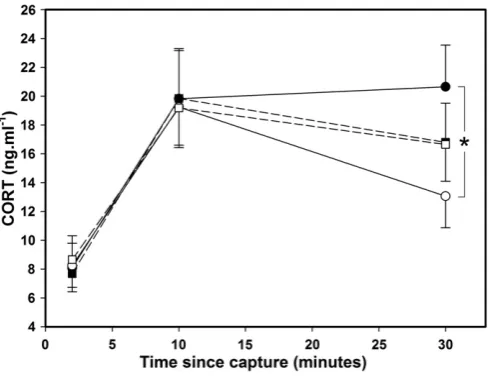
CORT levels differed significantly between sample times (F2,117.1= 44.64, pb0.0001): basal CORT (8.16 ± 1.03 ng/ml) was lower than CORT levels at 10 (19.52 ± 2.15 ng/ml) and 30 (16.26 ± 1.85 ng/ml) minutes after capture (tb−7.53, df = 117, pb0.0001). This stress response over time was influenced by pre-hatching treatment (pre-hatching treatment × time: F2,117.1= 4.55, p = 0.013;Fig. 1) but not post-hatching treatment (post-hatching treatment × time: F2,117.1= 0.14, p = 0.87). Pre-hatching treatment influenced the change in CORT, with a larger decrease in CORT levels between 10 and 30 min after capture in CORT-treated quail (−6.2 ± 3.1 ng/ml) than in pre-hatching control ones (0.8 ± 3.3 ng/ml) in which CORT levels remained high (F1,58= 4.54, p = 0.039;Fig. 1).
Neophobia
Latencies to eat mealworms from the normal food dish in the indi-vidual home cage were higher during the novel object trials compared to the pre- and post-object control trials (F5,290= 187.29, pb0.0001; Fig. 2). The latencies during control trials were not different before versus after the presentation of each new object or across objects (t290b2.61, pN0.10;Fig. 2), suggesting quail were highly motivated to eat throughout all trials. Latencies during novel object trials were not different between the two objects (t290= 1.31, p = 0.78;Fig. 2). Pre- and post-hatching treatments had no effects on the latency to eat mealworms in any of the trials (F1,58b0.4, pN0.55).
Novel environment exploration
The latency to exit from the introductory compartment into the novel environment was affected by pre-hatching treatment (F1,58= 4.92, p = 0.031) as CORT-treated birds were faster to exit than pre-hatching controls (Fig. 3). Consequently, CORT-treated quail spent less time in the introductory compartment (380 ± 55 s) and more time in Zone 1 of the novel environment (327 ± 46 s) than controls (543 ± 72 s, 207 ± 53 s, respectively) (introductory compartment: F1,58= 5.01, p = 0.029; zone1: F1,58= 4.00, p = 0.05). CORT-treated quail spent also more time moving in the novel environment (253 ± 42 s) than did pre-hatching controls (124 ± 36 s) (F1,58= 8.08, p = 0.006).
One of the three feeders in the novel environment, feeder 2, was designed so that birds had to enter an enclosed space to gain food. We hypothesised that this would be the feeder perceived as the riskiest to enter. Post-hatching CORT exposure significantly reduced the latency to feed from feeder 2 compared to controls (813 ± 34 s, 893 ± 6 s, re-spectively) (F1,58= 6.47, p = 0.014).
Exposure to both pre- and post-hatching treatments (CORT/Food−) affected the latency to feed in the novel environment (interaction pre-hatching × post-hatching treatments: F1,58= 4.84, p = 0.032), the time spent in zone 3 (interaction pre-hatching × post-hatching treatments: F1,58= 4.95, p = 0.031) and the number of mealworms eaten (interaction pre-hatching × post-hatching treatments:χ2
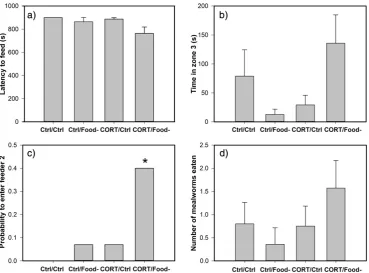
[image:4.595.47.294.499.687.2]1,58= 4.45, p = 0.035). Although multiple comparisons did not show signif-icant differences between treatment groups for these behaviours, birds experiencing both pre- and post-hatching treatments (CORT/Food−) tended to exhibit the shortest latency to feed from any of the three feeders (Fig. 4a). These birds also spent more time in zone 3 of the novel environment than birds in the other three groups (Fig. 4b) and
Fig. 1.CORT level modification in response to a standardized capture-handling-restraint stress protocol in hatching control quail (black dots and solid line, n = 28), in pre-hatching CORT-treated quail (white dots and solid line, n = 31), in post-pre-hatching control quail (black squares and dashed line, n = 30) and in post-hatching food-manipulated quail (white squares and dashed line, n = 29). Dots are means ± SEM. * indicate signifi-cant differences.
[image:4.595.311.561.529.703.2]were more likely to enter feeder 2 (40%) than quail from any other group (Ctrl/Ctrl = 0%, Ctrl/Food−= 7%, CORT/Ctrl = 7%) (G = 12.09, df = 3, p = 0.0071;Fig. 4c). Finally, quail exposed to both developmen-tal treatments obtained more mealworms from the feeders in the novel environment (Fig. 4d).
Discussion
In this study, we show that pre-hatching CORT injection and post-hatching unpredictable food availability led to long-term changes in
the physiological stress response and behaviour. Both pre- and post-hatching treatments had effects on behaviour, enhancing exploration of a novel environment. The pre-hatching CORT-treatment significantly altered physiological responses to stress, potentially mediating some of the behavioural effects observed. Most importantly, the effects of com-bined pre- and post-hatching treatments seemed to be cumulative, leading quail exposed to both to be the most explorative and most likely tofind food in the novel environment of all treatment groups. This in-crease in risk-taking behaviour in a novel, and presumably stressful, en-vironment resulted in a higher food acquisition. We suggest that this is evidence in favour of the environmental matching hypothesis.
[image:5.595.34.285.53.223.2]In the novel environment test, pre-hatching CORT-treated adult quail exited the introductory cage earlier, spent more time in the novel environment, and spent more time active than controls. Pre-hatching CORT-treatment thus induced increased levels of activity and exploration in adulthood, which has also been found in mammals (Emack and Matthews, 2011; Meek et al., 2000). For instance, exposure of pregnant guinea pig females to chronic stress every second day from gestational days 22 to 66 resulted in an increase in ambulatory activity in male offspring in an open-field test on post-natal day 80 (Emack and Matthews, 2011). In our quail, pre-hatching CORT-treatment also resulted in a permanently attenuated acute stress response. This atten-uated stress response may underlie the observed increase in exploration in these birds. Indeed, it has been shown in various mammal and bird species that individuals showing more explorative behaviour and taking more risks in a novel environment have an attenuated stress response to an acute stress as compared to individuals that do not explore (Cavigelli and McClintock, 2003; Macrì and Würbel, 2007; Martins et al., 2007; Stöwe et al., 2010). This suggests increased negative feed-back efficiency within the HPA axis. In rats, early-life stress resulting in an attenuated stress response is inextricably linked to a higher expression of glucocorticoid receptors in brain regions involved in neg-ative feedback, such as the paraventricular nucleus of the hypothalamus and the hippocampus (Catalani et al., 2000; Cottrell and Seckl, 2009; Fig. 3.Mean latency in seconds ± SEM to exit from the introductory compartment for
pre-hatching control quail (Ctrl) and pre-hatching CORT-treated quail (CORT). * indicate sig-nificant differences. Insert: Plan of the cage used for the novel environment exploration test. Circles with numbers represent feeders. The solid line in zone 2 and the one between zones 2 and 3 represent opaque panels. Triangles represent cones, thefive linked circles represent the cloth ring with coloured fabric and the open rectangle represents an enclosed multi-coloured feeder. Dashed lines represent the virtual separations between the different zones.
[image:5.595.110.480.430.703.2]Kapoor et al., 2008). It has also been shown in birds that glucocorticoid receptor expression in the brain can be affected by stress (Banerjee et al., 2012; Hodgson et al., 2007). Thus, we suggest that increased pre-hatching exposure to CORT modified the HPA axis activity in our quail chicks through a higher expression of glucocorticoid receptors in the brain, a hypothesis that we are currently testing.
Unpredictable food removal during the post-hatching phase had no effects on stress physiology in adulthood. However, it did exert specific effects on feeding behaviour: birds in the post-hatching treatment group exhibited decreased latencies to feed from an unfamiliar and stressful enclosure (feeder 2). Hence, it appears that birds exposed to unpredictable food availability post-hatching took more risks tofind food in adulthood than hatching controls. Similar effects of post-hatching stress on adult risk-taking behaviour have been reported in different species (e.g. rats: Macrì and Würbel, 2007; Roman et al., 2006; great titsParus major:Carere et al., 2005; domestic chickenGallus gallus domesticus:Freire et al., 2006; zebrafinch:Krause et al., 2009) and may be linked to increased nutritional needs (Krause et al., 2009). Such behavioural responses in novel environments, where food availability is unknown, may allow individuals to better cope with periods of food shortage even in more familiar environments and as such could be con-sidered adaptive (Carere et al., 2005).
In mammals, it has been shown that exposure to pre- and post-natal stress can have cumulative effects, resulting in greater negative conse-quences than exposure to stress during a single developmental stage, or having opposite effects (Chung et al., 2005; Koo et al., 2003; Meaney et al., 2007; Vallée et al., 1999). In our case, the effects of pre-and post-hatching treatments on physiology pre-and behaviour appeared to lead to cumulative effects in our birds that experienced both treatments: these birds were the fastest to feed in the novel environ-ment, spent more time away from the introductory cage and in the zone of the enclosed feeder, were more likely to enter this feeder, and tended to eat more mealworms than control quail and those treated during a single developmental period. We suggest that exposure to both early stress-related treatments resulted in an overall increase in exploration and higher risk-taking when exposed to stressful situations later in life, which has been demonstrated to have significantfitness advantages in several species (Dingemanse et al., 2004; Smith and Blumstein, 2008). It remains to be determined whether Japanese quail that show more explorative and risk-taking behaviours will experience similarfitness advantages when subjected to natural selection pressures in the wild.
Contrary to our predictions we found no treatment effects on neophobia. In contrast, studies on other species have shown that pre-natal and post-pre-natal stress can decrease neophobia. In chickens for example, CORT injection in eggs reduced the probability that hatchlings crossed a barrier to access food (Janczak et al., 2006), and CORT-treated zebrafinch male nestlings showed less neophobia as adults (Spencer and Verhulst, 2007). In rats, post-natal maternal separation resulted in increased object exploration compared to controls (Hensleigh et al., 2011; Roy and Chapillon, 2004). However, rearing environment had no effect on neophobia in starlings (Feenders et al., 2011). It has been proposed that differences in neophobia due to developmental history might only be evident when individuals experience intense fear (Feenders et al., 2011). As CORT-treatment and unpredictable food availability affected quail behaviour in the novel environment test (see above) but not in the object neophobia test, it seems likely that ex-posure to novel objects in the individual cage did not induce as much fear as exposure to a completely different environment filled with novel objects. Hence, object neophobia and responses to a novel envi-ronment were not correlated in our birds or in other avian studies (Boogert et al., 2006; Feenders et al., 2011).
Although other studies have already shown that early-life stress can have long-term effects on behaviour and physiology, to our knowledge this is thefirst study to show long-term persistent cumulative effects of stress-related treatments experienced during both pre- and
post-hatching stages on adult behaviour. We show that early life conditions can program physiology and behaviour into adulthood in a way that could potentially enhancefitness. Therefore, our results are in accor-dance with the environmental matching hypothesis. Exposure to stress-related events across different developmental stages appears to program the HPA axis and behaviour in such a way that individuals en-countering novel environments obtain more resources, which in turn may result in an increase infitness.
Acknowledgments
This study was funded by a BBSRC David Phillips Research Fellow-ship to KAS. NJB was funded by a Netherlands Organisation for Scientific Research Rubicon Award. We thank the animal care staff of the bird unit of St. Andrews University for bird husbandry, Bill Mullen for LC-MS analysis and Graeme Ruxton for useful comments on previous versions of this manuscript.
References
Banerjee, S.B., Arterbery, A.S., Fergus, D.J., Adkins-Regan, E., 2012.Deprivation of maternal care has long-lasting consequences for the hypothalamic–pituitary–adrenal axis of zebrafinches. Proc. R. Soc. Biol. Sci. B 279, 759–766.
Bateson, P., Barker, D., Clutton-Brock, T., Deb, D., D'Udine, B., Foley, R.A., Gluckman, P., Godfrey, K., Kirkwood, T., Lahr, M.M., McNamara, J., Metcalfe, N.B., Monaghan, P., Spencer, H.G., Sultan, S.E., 2004.Developmental plasticity and human health. Nature 430, 419–421.
Blas, J., Bortolotti, G.R., Tella, J.L., Baos, R., Marchant, T.A., 2007.Stress response during de-velopment predictsfitness in a wild, long lived vertebrate. Proc. Natl. Acad. Sci. U. S. A. 104, 8880–8884.
Boogert, N.J., Reader, S.M., Laland, K.N., 2006.The relation between social rank, neophobia and individual learning in starlings. Anim. Behav. 72, 1229–1239.
Buchanan, K.L., Spencer, K.A., Goldsmith, A.R., Catchpole, C.K., 2003.Song as an honest sig-nal of past developmental stress in the European starling (Sturnus vulgaris). Proc. R. Soc. Lond. Sci. B 270, 1149–1156.
Carere, C., Drent, P.J., Koolhaas, J.M., Groothuis, T.G.G., 2005.Epigenetic effects on personality traits: early food provisioning and sibling competition. Behaviour 142, 1329–1355.
Catalani, A., Casolini, P., Scaccianoce, S., Patacchioli, F.R., Spinozzi, P., Angelucci, L., 2000. Maternal corticosterone during lactation permanently affects brain corticosteroid re-ceptors, stress response and behaviour in rat progeny. Neuroscience 100, 319–325. Cavigelli, S.A., McClintock, M.K., 2003.Fear of novelty in infant rats predicts adult
cortico-sterone dynamics and an early death. Proc. Natl. Acad. Sci. U. S. A. 100, 16131–16136. Champagne, F.A., Meaney, M.J., 2006.Stress during gestation alters postpartum maternal care and the development of the offspring in a rodent model. Biol. Psychiatry 59, 1227–1235.
Chung, S., Son, G.H., Park, S.H., Park, E., Lee, K.H., Geum, D., Kim, K., 2005.Differential adaptive responses to chronic stress of maternally stressed male mice offspring. En-docrinology 146, 3202–3210.
Cottrell, E.C., Seckl, J., 2009.Prenatal stress, glucocorticoids and the programming of adult disease. Front. Behav. Neurosci. 3, 19.
Cuthill, I.C., Maddocks, S.A., Weall, C.V., Jones, E.K.M., 2000.Body mass regulation in re-sponse to changes in feeding predictability and overnight energy expenditure. Behav. Ecol. 11, 189–195.
Dingemanse, N.J., Both, C., Drent, P.J., Tinbergen, J.M., 2004.Fitness consequences of avian personalities in afluctuating environment. Proc. R. Soc. Biol. Sci. B 271, 847–852. Emack, J., Matthews, S.G., 2011.Effects of chronic maternal stress on hypothalamo–
pituitary–adrenal (HPA) function and behavior: no reversal by environmental enrichment. Horm. Behav. 60, 589–598.
Feenders, G., Klaus, K., Bateson, M., 2011.Fear and exploration in European starlings (Sturnus vulgaris): a comparison of hand-reared and wild-caught birds. PLoS One 6. Freire, R., van Dort, S., Rogers, L.J., 2006.Pre- and post-hatching effects of corticosterone
treatment on behavior of the domestic chick. Horm. Behav. 49, 157–165. Gluckman, P.D., Hanson, M.A., Spencer, H.G., Bateson, P., 2005.Environmental influences
during development and their later consequences for health and disease: implica-tions for the interpretation of empirical studies. Proc. R. Soc. Biol. Sci. B 272, 671–677. Hayward, L.S., Richardson, J.B., Grogan, M.N., Wingfield, J.C., 2006.Sex differences in the organizational effects of corticosterone in the egg yolk of quail. Gen. Comp. Endocrinol. 146, 144–148.
Hazard, D., Couty, M., Faure, J., Guemene, D., 2005.Relationship between hypothalamic–
pituitary–adrenal axis responsiveness and age, sexual maturity status, and sex in Japanese quail selected for long or short duration of tonic immobility. Poult. Sci. 84, 1913–1919.
Henriksen, R., Rettenbacher, S., Groothuis, T.G.G., 2011.Prenatal stress in birds: Pathways, effects, function and perspectives. Neurosci. Biobehav. Rev. 35, 1484–1501. Hensleigh, E., Smedley, L., Pritchard, L.M., 2011.Sex, but not repeated maternal separation
during thefirst postnatal week, influences novel object exploration and amphet-amine sensitivity. Dev. Psychobiol. 53, 132–140.
receptor mRNA expression reduced in zebrafinches (Taeniopygia guttata) selected for acute high corticosterone response to stress. Proc. R. Soc. Biol. Sci. B 274, 239–245. Janczak, A.M., Braastad, B.O., Bakken, M., 2006.Behavioural effects of embryonic exposure
to corticosterone in chickens. Appl. Anim. Behav. Sci. 96, 69–82.
Kapoor, A., Petropoulos, S., Matthews, S.G., 2008.Fetal programming of hypothalamic–
pituitary–adrenal (HPA) axis function and behavior by synthetic glucocorticoids. Brain Res. Rev. 57, 586–595.
Koo, J.W., Park, C.H., Choi, S.H., Kim, N.J., Kim, H.-S., Choe, J.C., Suh, Y.-H., 2003.The post-natal environment can counteract prepost-natal effects on cognitive ability, cell prolifera-tion, and synaptic protein expression. FASEB J. 17, 1556–1558.
Krause, E.T., Honarmand, M., Wetzel, J., Naguib, M., 2009.Early fasting is long lasting: differences in early nutritional conditions reappear under stressful conditions in adult female zebrafinches. PLoS One 4.
Lindstrom, J., 1999.Early development andfitness in birds and mammals. Trends Ecol. Evol. 14, 343–348.
Love, O.P., Williams, T.D., 2008.Plasticity in the adrenocortical response of a free-living vertebrate: the role of pre- and post-natal developmental stress. Horm. Behav. 54, 496–505.
Lupien, S.J., McEwen, B.S., Gunnar, M.R., Heim, C., 2009.Effects of stress throughout the lifespan on the brain, behaviour and cognition. Nat. Rev. Neurosci. 10, 434–445. Macrì, S., Würbel, H., 2007.Effects of variation in postnatal maternal environment on
ma-ternal behaviour and fear and stress responses in rats. Anim. Behav. 73, 171–184. Martins, T.L.F., Roberts, M.L., Giblin, I., Huxham, R., Evans, M.R., 2007.Speed of exploration
and risk-taking behavior are linked to corticosterone titres in zebrafinches. Horm. Behav. 52, 445–453.
Meaney, M.J., Szyf, M., Seckl, J.R., 2007.Epigenetic mechanisms of perinatal programming of hypothalamic–pituitary–adrenal function and health. Trends Mol. Med. 13, 269–277. Meek, L.R., Burda, K.M., Paster, E., 2000.Effects of prenatal stress on development in mice:
maturation and learning. Physiol. Behav. 71, 543–549.
Monaghan, P., 2008.Early growth conditions, phenotypic development and environmen-tal change. Philos. Trans. R. Soc. Lond. B Biol. Sci. 363, 1635–1645.
Monaghan, P., Heidinger, B.J., D'Alba, L., Evans, N.P., Spencer, K.A., 2012.For better or worse: reduced adult lifespan following early-life stress is transmitted to breeding partners. Proc. R. Soc. Biol. Sci. B 279, 709–714.
Roman, E., Gustafsson, L., Berg, M., Nylander, I., 2006.Behavioral profiles and stress-induced corticosteroid secretion in male Wistar rats subjected to short and prolonged periods of maternal separation. Horm. Behav. 50, 736–747.
Roy, V., Chapillon, P., 2004.Further evidences that risk assessment and object exploration behaviours are useful to evaluate emotional reactivity in rodents. Behav. Brain Res. 154, 439–448.
Sachser, N., Hennessy, M.B., Kaiser, S., 2011.Adaptive modulation of behavioural profiles by social stress during early phases of life and adolescence. Neurosci. Biobehav. Rev. 35, 1518–1533.
Smith, B.R., Blumstein, D.T., 2008.Fitness consequences of personality: a meta-analysis. Behav. Ecol. 19, 448–455.
Spencer, K.A., Verhulst, S., 2007.Delayed behavioral effects of postnatal exposure to corticosterone in the zebrafinch (Taeniopygia guttata). Horm. Behav. 51, 273–280.
Spencer, K.A., Evans, N.P., Monaghan, P., 2009.Postnatal stress in birds: a novel model of glucocorticoid programming of the hypothalamic–pituitary–adrenal axis. Endocrinol-ogy 150, 1931–1934.
Stöwe, M., Rosivall, B., Drent, P.J., Moestl, E., 2010.Selection for fast and slow exploration affects baseline and stress-induced corticosterone excretion in Great tit nestlings,
Parus major. Horm. Behav. 58, 864–871.
Vallée, M., Maccari, S., Dellu, F., Simon, H., Le Moal, M., Mayo, W., 1999.Long-term effects of prenatal stress and postnatal handling on age-related glucocorticoid secretion and cognitive performance: a longitudinal study in the rat. Eur. J. Neurosci. 11, 2906–2916.
Vázquez, D.M., Neal Jr., C.R., Patel, P.D., Kaciroti, N., López, J.F., 2012.Regulation of corticoid and serotonin receptor brain system following early life exposure of glucocorticoids: long term implications for the neurobiology of mood. Psychoneuroendocrinology 37, 421–437.
Weinstock, M., 2008. The long-term behavioural consequences of prenatal stress. Neurosci. Biobehav. Rev. 32, 1073–1086.
Welberg, L.A.M., Seckl, J.R., 2001.Prenatal stress, glucocorticoids and the programming of the brain. J. Neuroendocrinol. 13, 113–128.
Wingfield, J.C., 1994.Modulation of the adrenocortical response to stress in birds. In: Davey, K.G., Peter, R.E., Tobe, S.S. (Eds.), Perspectives in Comparative Endocrinology. National Research Council of Canada, Ottawa, pp. 520–528.