ECE 300
Signals and Systems
Homework 4
Due Date: Wednesday March 28 at 1 PM
Exam #1, Thursday March 29!
Problems
1. K & H, Problem 2.34 parts a and b only. This is pretty easy. You will have a differential equation for h t( ) to solve (without Maple, use an integrating factor!)
2. K & H, Problem 2.29 part c. Do the convolutions graphically.
3. Consider a causal linear time invariant system with impulse response given by
( 1) ( ) t ( 1) h t =e− − u t−
The input to the system is given by
( ) ( ) ( 1) ( 3) x t =u t −u t− +u t−
Using graphical convolution, determine the outputy t( ) for 2≤ ≤t 5. Note the limited range of t we are interested in !
Specifically, you must
a) Flip and slideh t( )
b) Show graphs displaying both h t( −λ) and x( )λ for each region of interest c) Determine the range of t for which each part of your solution is valid d) Set up any necessary integrals to compute y t( )
e) Evaluate the integrals
You should get (in unsimplified form)
( 1) 1
( 1) 1 ( 1) 1 3
[ 1] 2
( )
[ 1] [ ] 4
t
t t t
e e t
y t
e e e e e t
− −
− − − − −
⎧ 4
5
− ≤ ≤
= ⎨
− + − ≤
⎩ ≤
(The answer, of course, was not given on the exam.
4. Consider a linear time invariant system with impulse response given by
( 1) ( ) t ( 1) h t =e− + u t+
( ) 2[ ( ) ( 1)] 3[ ( 3) ( 4)] x t = u t −u t− + u t− −u t−
Using graphical convolution, determine the outputy t( ). Specifically, you must
a) Flip and slideh t( )
b) Show graphs displaying both h t( −λ) and x( )λ for each region of interest c) Determine the range of t for which each part of your solution is valid d) Set up any necessary integrals to compute y t( ) Do Not Evaluate the Integrals
5. (Matlab Problem) Read the Appendix, then
Donwload Fourier_Sine_Series.m from the class website.
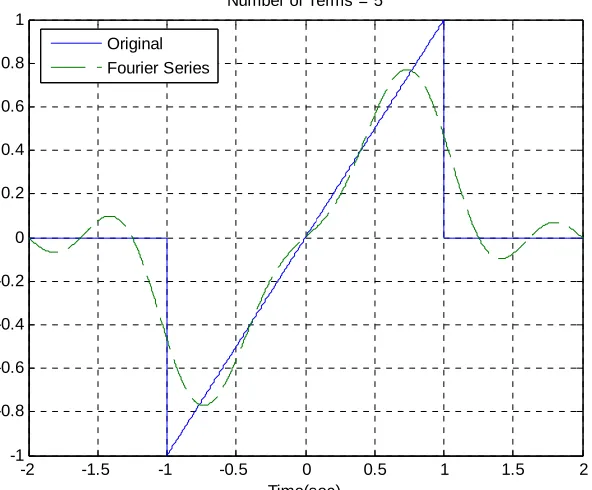
a) If you type (in Matlab’s command line) Fourier_Sine_Series(5) you should get a plot like that shown in Figure 1. As you increase the number of terms in the Fourier series, you should get a better match to the function. Run the code for N=100 and turn in your plot.
b) Read through the code and answer the following questions:
• What variable in the code represents the Fourier series approximation to the input?
• In extending this program to implement a full trigonometric Fourier series, does the computation for a0 need to be inside a for loop?
c) Copy Fourier_Sine_Series.m to a file named Trig_Fourier_Series.m and implement a full trigonometric Fourier series representation. This means you will have to compute the average value and the , and then use these values in the final estimate.
o
a ak
d) Using the code you wrote in part c, find the trigonometric Fourier series representation for the following functions (defined over a single period)
1( ) ( ) 0 3 t
f t =e u t− ≤ <t
2
0 2
( ) 3 2 3
0 3 4
t t
f t t
t
≤ < ⎧
⎪
=⎨ ≤ <
⎪ ≤ <
3
0 2
1 1 2
( )
3 2 3
0 3 4
t t f t
t t
1
− ≤ < − ⎧
⎪ − ≤ <
⎪
= ⎨ ≤ <
⎪
⎪ ≤ <
⎩
Use N = 10 and turn in your plots for each of these functions. Also, turn in your Matlab program for one of these. Notes: (1) the values of low and high will be different for each of these functions! (2) we are going to use these functions again, so once your code is working it is best to comment out the function description.
-2 -1.5 -1 -0.5 0 0.5 1 1.5 2
-1 -0.8 -0.6 -0.4 -0.2 0 0.2 0.4 0.6 0.8 1
Time(sec) Number of Terms = 5
[image:3.612.140.436.237.482.2]Original Fourier Series
Figure 1. Trigonometric Fourier series for problem 7b.
6. Pre-Lab Exercises (to be done by all students. Turn this in with your homework and bring a copy of this with you to lab!)
a) Calculate the impulse response of the RC lowpass filter shown in Figure 2, in terms of unspecified components R and C. Determine the time constant for the circuit.
+
C1
Vout
-+
0
+
-V1
Figure 2. Simple RC lowpass filter circuit.
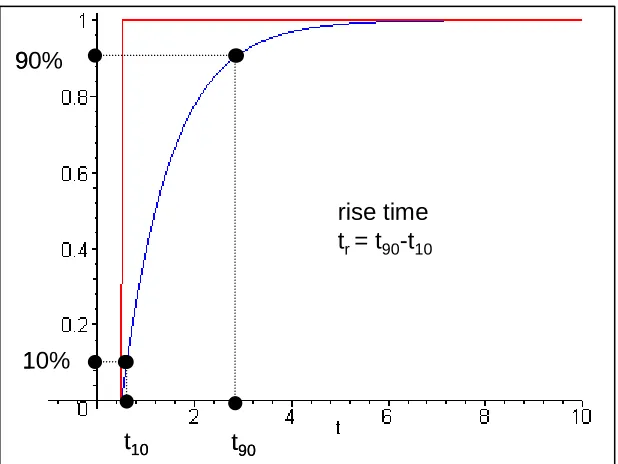
[image:4.612.133.442.201.433.2]b) Find the step response of the circuit (the response of the system when the input is a unit step), and determine the 10-90% rise time. , as shown below in Figure 3. The rise time is simply the amount of time necessary for the output to rise from 10% to 90% of its final value. Specifically, show that the rise time is given by
r t
ln(9) r
t =τ
t90 t10
rise time tr= t90-t10 90%
10%
t90 t10
rise time tr= t90-t10 90%
10%
Figure 3. Step response of the RC lowpass filter circuit of Figure 1, showing the definition of the 10-90% risetime.
c) Specify values R and C which will produce a time constant of approximately 1 msec. Be sure to consider the fact that the capacitor will be asked to charge and discharge quickly in these measurements.
d) Show that the response of the circuit to a unit pulse of length T (, i.e. a pulse of amplitude 1 starting at 0 and ending at T) is given by
/ ( ) /
( ) (1 t ) ( ) (1 t T ) ( ) pulse
y t = −e− τ u t − −e− − τ u t T−
e) Plot the response to a unit pulse (in Matlab) for τ =0.001 and , 0.001, and 0.0001 from 0 to 0.008 seconds. Note on the plots the times the capacitor is charging and discharging. Use the subplot command to make three separate plots, one on top of another (i.e., use subplot(3,1,1), subplot(3,1,2),
subplot(3,1,3)).
f) If the input is a pulse of amplitude A and width T, determine an expression for the amplitude of the output at the end of the pulse, ypulse( )T . Assume that T 1
τ
(the duration for the pulse is much small than the time constant of the circuit) and use Taylor series approximations for the exponentials. Under these assumptions, show that the amplitude of ypulse( )t at time T is approximately the area of the pulse divided by the time constant, that is pulse( )
AT
y T
τ
=
Appendix
In DE II you learned about representing periodic functions with a Fourier series using trigonometric functions (sines and cosines). In this appendix we will determine how to determine a Fourier sine series series for an odd periodic function using our knowledge of numerical integration in Matlab. The only new thing we will need is the idea of a loop.
Trigonometric Fourier Series If x t( ) is a periodic function with fundamental period T, then we can represent x t( ) as a Fourier series
0
1 1
( ) kcos( o ) ksin( )
k k
o
x t a a kω t b kω t
∞ ∞
= =
= +
∑
+∑
where o 2
T π
ω = is the fundamental period, is the average (or DC, i.e. zero
frequency) value, and
o a
0
0
0 1
( )
2
( ) cos( )
2
( ) sin( ) T
o T
k o
T
k o
a x t dt
T
a x t k t
T
b x t k t
T
ω
ω
=
=
=
∫
∫
∫
dt
dt
Even and Odd Functions Recall that a function x t( ) is even if x t( )= −x( t) (it is symmetric about the y-axis) and is odd if x(− = −t) x t( )(it is antisymmetric about the y-axis). If we know in advance that functions are even or odd, we can determine that some of the Fourier series coefficients are zero. Specifically,
Ifx t( ) is even all of the bk are zero.
For Loops Let’s assume we want to generate the coefficients 2
1 k
k b
k
=
+ for k =1
to k=10. One way of doing this in Matlab is by using the following for loop for k=1:10
b(k) = k/(1+k^2); end;
In this loop, the variable k first takes the value of 1 until the end is reached, then the value 2, all the way up to k = 10. In this loop we are assigning the coefficients to the array b, hence b(1) = , b(2) = b1 b2, etc.
Similarly, if we wanted to generate the coefficients 1
1 k
a k
=
+ and 2
2 1 k
b k
=
+ for
to , we could do this using for loops as follows:
1
k= k=5
for k=1:5
a(k) = 1/(k+1); b(k) = 2/(k^2+1); end;
Note that Matlab requires the indices in an array to start at 1, and that for loops should usually be avoided in Matlab if possible since they are usually less efficient (Matlab is designed for vectorized operations).
Fourier Sine Series Now we want to generate the Fourier series for the periodic function
0 2
( ) 1 1
0 1 2
t
x t t t
t 1
− ≤ < − ⎧
⎪
=⎨ − ≤ <
⎪ ≤ <
⎩
%
% This routine implements a trigonometric Fourier Sine Series %
% Inputs: N is the number of terms to use in the series %
function Fourier_Sine_Series(N) %
% one period of the function goes from low to high %
low = -2; high = 2; %
% the difference between low and high is one period %
T = high-low; w0 = 2*pi/T; %
% the periodic function... %
x = @(t) 0.*(t<-1) + t.*((-1<=t)&(t<1)) + 0.*(t>=1); %
% find b(1) to b(N) %
for k = 1:N
arg = @(t) x(t).*sin(k*w0*t); b(k) = (2/T)*quadl(arg,low,high);
end;
%
% determine a time vector over one period %
t = linspace(low,high,1000); %
% find the Fourier series representation %
est = 0;
for k=1:N
est = est + b(k)*sin(k*w0*t);
end;
%
% plot the results %
plot(t,x(t),'-',t,est,'--'); grid; xlabel('Time(sec)');
legend('Original','Fourier Series','Location','NorthWest');