Adaptive Routing Algorithm for Information Management in
Distributed Microgrids in Smart Grid
IKPEHAI, Augustine, ADEBISI, Bamidele, ANOH, Kelvin, JOGUNOLA,
Olamide and HAMMOUDEH, Mohammad
Available from Sheffield Hallam University Research Archive (SHURA) at:
http://shura.shu.ac.uk/24593/
This document is the author deposited version. You are advised to consult the
publisher's version if you wish to cite from it.
Published version
IKPEHAI, Augustine, ADEBISI, Bamidele, ANOH, Kelvin, JOGUNOLA, Olamide and
HAMMOUDEH, Mohammad (2019). Adaptive Routing Algorithm for Information
Management in Distributed Microgrids in Smart Grid. IFAC-PapersOnLine, 52 (4).
Copyright and re-use policy
See
http://shura.shu.ac.uk/information.html
Sheffield Hallam University Research Archive
Adaptive Routing Algorithm for
Information Management in Distributed
Microgrids in Smart Grid
Olamide Jogunola∗ Bamidele Adebisi∗ Kelvin Anoh∗ Augustine Ikpehai∗∗ Mohammad Hammoudeh∗
∗ Faculty of Science and Engineering, Manchester Metropolitan
University, Manchester M1 5GD, UK (e-mail: o.jogunola; b.adebisi, k.anoh, m.hammoudeh {@mmu.ac.uk}).
∗∗Department of Engineering and Mathematics, Sheffield Hallam
University, Sheffield. S1 1WB, UK (email: [email protected]).
Abstract:The increasing affordability of renewable energy resources is inspiring new interest in smart management techniques for the power grid. This paper presents an adaptive routing algorithm technique based on distributed dual-gradient update for facilitating communication among distributed energy resources (DER) units in smart grid. In particular, we consider the optimal message routing as a minimum cost flow problem among DER units in the network. The proposed technique employs a multi-commodity flow optimization, with the aim of minimizing the communication cost against network performances indicators such as throughput and delay. The results show that the proposed technique is able to route messages across the network in fewer processing steps than minimum spanning tree algorithm without any message drop. The algorithm is investigated for mesh, partial mesh and ring networks, with the result consistently showing potential cost savings and reduced complexity which can save significant amount of time when applied to a larger system.
Keywords: Distributed energy resources, prosumer, distributed algorithm, communication network, information flow management, optimal power flow.
1. INTRODUCTION
The power network is undergoing one of the major trans-formations in its history. The need for flexible, distributed energy management has given rise to new concepts such as prosuming (Jogunola et al. (2017)). To ensure optimal performance of the system, monitoring and control ca-pabilities underpinned by reliable communication system are essential. Large scale integration of distributed genera-tors brought new challenges with bidirectional power and information flows. From the power network perspective, the main challenge with adoption of distributed energy resources (DER) units is voltage control and power flow management (Lo and Ansari (2013)). In power flow man-agement, excess power produced by DERs can be ex-changed/shared/traded within the community or delivered to the neighboring distribution networks, thus leading to bidirectional power flow between the DER unit and the grid. Likewise, a communication network is required to transmit, analyze and coordinate the data traffic and control messages exchanged by the distributed DERs.
The traditional approach to information coordination and control is the centralized strategy (Liu et al. (2017)), where all control messages are directed to a single point that has complete knowledge of the whole network. In this approach, the DER units or microgrids (MGs) do not have the ability to interact among themselves, instead, they communicate via a central entity such as a virtual power
plant controller (Shaaban et al. (2017)). However, such reliance on a central entity reduces resilience against faults and unforeseen contingencies such as changes in link capac-ity or energy consumption caused by interference or other external events. Additional drawbacks include increase in power costs associated with power disturbance, congestion and loss, whereas the communications costs may include overheads, signal interference, and data packet loss (Lo and Ansari (2013)).
net-work for data exchange among MGs. In Nguyen et al. (2010), the authors considered the optimal power flow (OPF) problem as a graph minimum cost flow problem by applying a cost-scaling push-relabel algorithm in a distributed agent environment, with the simulation imple-mented for both mesh and radial networks.
Lang et al. (2013) implemented agent-based communica-tion using a minimum spanning tree (MST) algorithm for DER control. In MST, the communication process among the DERs commences after the formation of the tree net-work, which increases the number of steps and thus may not be suitable for a large network implementation or net-work with sensitive delay constraint. A peer-to-peer (P2P) communication scheme is proposed in Lakshminarayanan et al. (2016) for MAS and applied to economic dispatch problem with the aim of reducing complexity, as well as the communication steps of MST. However, the proposed scheme requires a supporting agent when the total number of agents in the network is odd, thus utilizing additional resources.
In contrast to Lang et al. (2013); Nguyen et al. (2010), and Lakshminarayanan et al. (2016), this paper proposes a min-cost adaptive routing solution for the exchange of data among the connected MGs. It considers with consideration of the communication link constraints for a more practical implementation. This shows potential application on opti-mal message routing in active distribution network (ADN) to facilitate efficient communication among the DER units.
The main contributions of this paper are:
• Formulation of a distributed dual-gradient algorithm for low-cost adaptive information routing among DER units with potential application in an ADN in smart grid;
• The proposed algorithm is applied to address conges-tion problem when routing the informaconges-tion among the DER units by directing the traffic to less congested alternate communication paths;
• While satisfying delay requirements for data delivery in smart grid, this study shows potential application of multi-commodity flow optimization to message routing among DER units in smart grid.
2. PROBLEM FORMULATION
Given a list of DER units, the anticipated size of informa-tion to route their energy control message with other DER units in the network, with aim of utilizing the minimum communication cost, whilst also ensuring data reliability, privacy and resilience. In the following, we present a dis-tributed minimum cost routing algorithm to route the information by allocating link capacity and relying on only local information available at each unit for privacy and resilience.
2.1 Communication Network
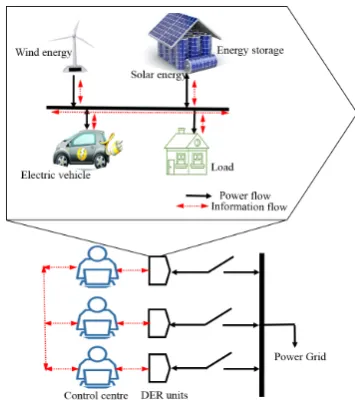
Given a strongly connected undirected graph G= (V,E), of V = {1,· · ·,N } interconnected nodes (i.e. DER unit) and E ⊆ V × V, being the set of bidirectional arcs (links) as shown in Fig 1. A directed link from DER ni to DER
nj is denoted by (i, j) ∈ E. For simplicity, we denote e
[image:3.595.340.518.103.305.2]as the connecting linki, j. Each e is characterized by its bandwidth capacity,ue.
Fig. 1. IEEE 3-bus System showing the interaction among the DER units
In this paper, the communication topology is an overlay network different from the electrical network. Thus, the communication network is modeled as a time-varying networkG(t) = (V,E(t)), where each link set changes over time based on the state of the communication link at time,
t. The set of message size, D, required to be routed in the network is considered from source unit nd
i ∈ N, to
destination unit nd
j ∈ N with offered traffic or assigned
bandwidthbd to each datad i.
2.2 Multi-commodity Network Flow Model
The network problem is modeled as a multi-commodity flow (MCF) optimization (Pi´oro and Medhi (2004); Trdlicka and Hanzalek (2012)), because of the flexibility it offers in analyzing the communication links to ensure the conservation law is observed, in order to eliminate incidence of dropped data packets. A MCF optimization accepts multiple traffic inGand it models the average be-haviour of the data transmissions across the network using transmission resources installed on the link. A MCF prob-lem is expressed either through a link, path or destination-based formulation (Marino (2016)) depending on the opti-mization objective. For the purpose of consistency, we de-note commodity as the control messages exchanged among the distributed DERs in the rest of the paper.
In this study, the flow-path formulation is considered, because the interest is in optimal message routing among the DERs. In the path-based formulation, P is defined as the set of paths traversed by control message di,
from source unit nd
i, to destination unit ndj, and yp as
min
xp:p∈P X
p∈P
ypxp (1a)
subject to: X
p∈Pe
xp ≤ue, ∀e∈ E (1b)
X
p∈Pd
xp=bd, ∀d∈ D (1c)
xp≥0, ∀p∈ P (1d)
wherexpis the flow traffic in the network. Constraints (1b)
suggest that the individual traffic carried through pathPe
using the linkemust not exceed its capacityue. Equation
(1c) is the flow conservation constraint, i.e., as the data
dflows through the link Pd to the units, no data drop is
allowed. Constraints (1d) represent non-negativity of the flow traffic xp traversing the network.
3. PROPOSED ADAPTIVE ROUTING ALGORITHM
Without loss of generality, the optimal message routing problem in (1) can be rewritten into the linear optimiza-tion problem as
min
x c
Tx (2a)
subject to:Ax=b (2b)
x≥0. (2c)
wherexrepresents the vector of unknown variables,cand
b are vectors of known coefficients, and A is a known matrix of coefficients. The linearity of the cost function
c of (2) with both equality (2b) and inequality (2c) constraints would result in oscillations of the gradient algorithm without finding an optimal solution because of its non-strictly convex nature(Trdlicka and Hanzalek (2012)). Strict convexity of the objective function improves convergence of the dual algorithms (Marino (2016)). To enforce the convexity of the objective function f(x), a regularization term (Marino (2016); Trdlicka and Hanzalek (2012)) can be added to f(x), which in practice would still be equal to solving the original problem. In this model, a regularization term P
jx
2
j is used to enforce
strict convexity of the objective function. In addition, to minimize the weight of P
jx
2
j, a small value 0≤≤1 is
added. Thus, the function becomesf(x) +P
jx
2
j, where
xj is the jthcomponent of vectorx. Other regularization
methods exist in the literature, for instance, Trdlicka and Hanzalek (2012) used proximal point method to enforce strict convexity of the objective function by minimizing
f(x) over the proximal-point variable vector y, where
≥0. This regularization method translates to somewhat complex problem to solve compared to what is used in this study.
Therefore, the new objective function involves rewriting (1) in terms of (2) as follows
min
x
X
p∈P
Bp(xp) (3a)
subject to: X
p∈Pe
xp ≤ue, ∀e∈ E (3b)
X
p∈Pd
xp=bd, ∀d∈ D (3c)
xp≥0, ∀p∈ P (3d)
whereBp(xp) =Pp∈Pypxp+Pp∈Px2p is the term that
translates the non-strictly convex routing model in (1) into a strictly-convex optimization problem. A unique minimizer, called the primal optimal solution, exist since
Bp(xp) is strictly convex. However, solving the primal
problem (3) with constraints (3b)-(3d) directly, requires coordination among all units, which is impractical in real networks (Low and Lapsley (1999)). Rather, solving the optimization problem using its dual transformation would result in the desired decentralized and distributed solution.
3.1 Dual Lagrange Problem
To solve (3) over the flow variable, xp, its dual problem
is first presented, before presenting the distributed sub-gradient algorithm. The Lagrangian function for relaxing the link capacity constraints of problem (3) is
L(x, λe) =
X
p∈P
Bp(xp)−λe
X
p∈Pe
xp−ue
(4a)
s.t: X
p∈Pd
xp=bd, ∀d∈ D (4b)
xp≥0, ∀p∈ P (4c)
where λe ≥ 0 represents the Lagrange multiplier
associ-ated with the flow constraint on linketransmitted to the DER units to ensure that the constraint conditions are not violated. In this study, λe can be explained as the
dual variable representing the bandwidth cost per unit of control message flow on link e. While Bp(xp) is the total
cost per unit bandwidth for all links in the path xp of
message di. The dual decomposition results in each unit,
ni, solving,
xp:p∈Pd = arg min
0≤xp≤bd
− X
p∈Pe
xpλe+Bp(xp)
(5)
which is unique due to the strict convexity of the cost function (Palomar and Chiang (2006)). Each flow adapts its routing to the current update using (5), thus each control message is conveyed through the shortest path usingP
p∈Pexpλe+Bp(xp) as the link bandwidth cost and
λeue= 0 as no cost is charged to self.
The dual functionwis given as:
w(λe) = min x∈(4b,4c)
L(x, λe)
= min
x∈(4b,4c)
X
p∈P
Bp(xp)−λe
X
p∈Pe
xp−ue
(6)
The Lagrange dual problem is the maximization of the Lagrange dual function,
w∗= max
λe≥0
w(λe) (7)
3.2 Dual Optimization Distributed Algorithm
sub-problem can be solved as a sub-gradient of the main problem as follows;
λe(t+ 1) = [λe(t)−α(t)g(t)]+ (8)
where α(t) is the step size at time t, and g(t) is a sub-gradient towatλe(t), i.e.g(t) =
∂w(λe(t))
∂λ(t) .
Remark 1. The objective function is strictly convex and
w(λe) is continuously differentiable (Bertsekas (1999)).
When w(λe) is differentiable, the sub-gradient g(t) is
∇w(λe), which can be written as g(t) = ∂w(λe). The
partial derivative ∂w(λe) in (6) is given by the slack
variable of the relaxed link capacity constraints:
g(t) =∂w(λe)
∂λe
=xe−ue (9)
where xe ≡ P p∈Pe
xp is the aggregate demand messages
rate at link e. Substituting (9) into (8), we obtain the (sub)gradient update of (7) along each dual variable,
λe(t+ 1) = [λe(t)−α(t)(xe−ue)]+, ∀e∈ E (10)
The dual variables are updated synchronously at discrete time t={0,1,· · ·,∞}, and only neighbours can commu-nicate. At every time step, there is an upper bound on the optimal value of the optimization problem (3), which is obtained by evaluating the dual objective function (7). Each link computes its (sub)gradient coordinate using its capacity,ue, and the schedules of the flowsPp∈Pexpthat
pass over it. From (10), if the bandwidth required for a control message xe(t) = P
p∈Pe
xp(t) at link e exceeds the
bandwidth capacity of that link ue(t), increase the link
cost λe(t), and vice versa. This control forces each unit
to restrain from overloading the communication links thus reducing individual cost as well as reducing congestion on the links. The proposed routing algorithm is summarized in (Algorithm 1).
4. SIMULATION AND RESULT ANALYSIS
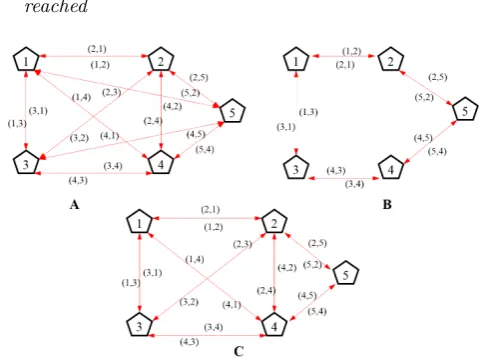
Simulations are performed using java (Net2plan (Sept. 2018); Marino (2016)) to observe the behaviour and con-vergence properties of the proposed distributed algorithm. An instance of a 5-bus network are connected as presented in the different network topology shown in Fig. 2. The required size of information (in bits) to be routed by each DER unit is given as d1 = 40kb, d2 = 50kb, d3 = 50kb,
d4= 55kb,d5= 55kb. The link capacities are set toue≥di
with a total installed capacity of 800kb. The step size, α, is set to a constant value of 1 (unless otherwise stated) for most of the cases considered.
The topmost plot of Fig. 3 shows the convergence of information routed by each of the DER units, while the bottom plot shows the total data routed and the capacity installed on the links for the mesh network topology. For this type of network, the cost functions settled around 2ndtime step (mean value), indicating just about a hop or communication step for each DER unit prior to convergence. This shows an improvement over the one proposed in (Lakshminarayanan et al. (2016)) which requiresO(N) communication steps. Moreover, the
Algorithm 1.Proposed Adaptive Routing Algorithm
1: Input: The strongly connected time-varying graph
G(t) = (V,E(t)), the constant step-size, α, each link capacity,ue, data,di, the initial link costλe(t) = 1 for
alli∈ N
2: Output:The optimal link cost,λe(t), and the optimal
routed data,di(t).
3: t >0,
4: Communicate λeto the DER units
5: ni informs nj,j6=i, using
xp:p∈Pd= arg min
xp≥0,P p∈Pd
xp=bd
− X
p∈Pd
xpλe+Bp(xp)
∀n
6: Each link updates its cost,λe, ∀d∈ D,∀e∈ E, using
λe(t+ 1) = [λe(t)−α(t)(xe−ue)]
+
7: The link signals its updated link cost to the units, V
8: Each unit adapts its traffic routing based on the up-dated link price
[image:5.595.311.553.353.533.2]9: Go to next time slot until maximum time-step is reached
Fig. 2. Communication network topologies used for the test cases of the proposed algorithm (A: Mesh; B: Ring; C: Partial mesh)
number of units does not have to be parity dependent as in (Lakshminarayanan et al. (2016)), i.e., the algorithm proposed in (Lakshminarayanan et al. (2016)) works for an even number of agents, where a supporting agent is required each time the number of agents in the network is an odd number (see Table 1).
0 5 10 15 40
60 80 100
Data (kb)
Unit 1 Unit2 Unit
3 Unit
4 Unit5
0 5 10 15
Time Step 200
400 600 800
Optimal Bandwidth Cost (kb)
Total Bandwidth Installed Total Bandwidth Required 1.5 2 2.5 3
40 50 60
1.5 2 2.5 3 250
[image:6.595.56.283.81.240.2]300
[image:6.595.317.533.314.489.2]Fig. 3. Result for the mesh network showing convergence of the proposed Routing Algorithm
Table 1. Result comparison with related works Lakshminarayanan et al. (2016).
Description MST Ref. Lakshmi-narayanan
et al. (2016)
Proposed
Number of communication always> N Odd,N+ 1; < N
steps forNagents Even,N
Communication complexity Less (one to one)
Less (one to one)
Less (one to one) Pre-communication steps Yes Nil Nil
constraints, and to ensure minimum routing cost to the connected units. However, the network delay for the ring topology is the lowest compared to other topologies. This is as a result of the less event that was processed in the network. Although the DER units in the mesh network are directly connected, the network complexity increases as a result of increased number of links. The behaviour of the three network topologies meet the required network delay for smart grid.
Mesh Partial-mesh Ring
Network Topologies 0
100 200 300 400
Optimal Value (Bandwidth Cost (kb))
0 50 100 150 200
Netwoork Delay (ms)
[image:6.595.41.292.317.438.2]Bandwidth Cost Network Delay
Fig. 4. Bandwidth cost and network delay for the three topologies
4.1 Varying Number of DER units from 3 to 15
To investigate the scalability of the proposed algorithm, we vary the number of DERs from 3−15 using the partial-mesh topology. The size of information for each unit is set between 10−15kb, the link capacities are varied up to a total network capacity ofU ≥ D ≤4D. This is to validate the total link bandwidth capacity required to successfully route the traffic for the distributed units.
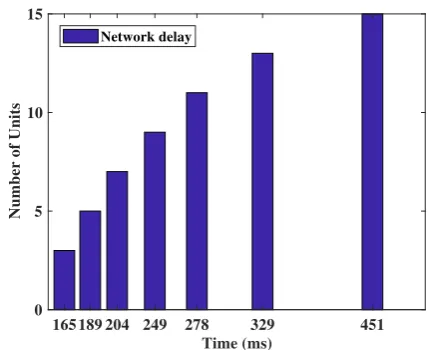
Fig. 5 corroborates the fact that as the number of units in-creases, so does the network delay. However, it is observed that the linearity tends to geometric growth as the number of the units increases. This implies that the messages in the network would be subjected to higher delays before being delivered. Depending on the size of the network and each unit’s message size, at some point, it is suggested that the network be grouped into clusters to minimize the network delay as presented in (Anoh et al. (2018)). The relationship between the message size, number of units and maximum acceptable delay is beyond the scope of this work.
165 189 204 249 278 329 451
Time (ms) 0
5 10 15
Number of Units
Network delay
Fig. 5. Network delay for increasing number of DER Units in partial-mesh topology.
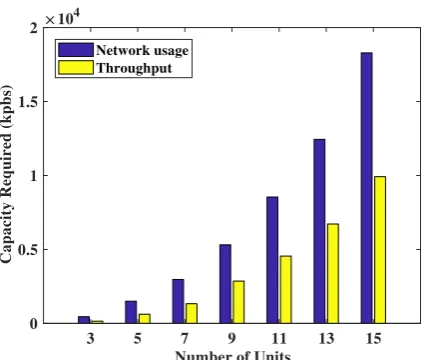
Furthermore, it is observed that the higher the network capacity installed, the lower the network delay, but this results in high network cost due to unused network capac-ity. As expected, increase in number of DER units would require more communication resources to be installed in the network, to achieve higher traffic throughput as shown in Fig. 6
[image:6.595.57.285.574.725.2]3 5 7 9 11 13 15 Number of Units
0 0.5 1 1.5 2
Capacity Required (kpbs)
104
[image:7.595.61.276.69.249.2]Network usage Throughput
Fig. 6. Capacity required for increasing number of DER units.
5. CONCLUSION
In this paper, we proposed an adaptive routing algorithm for information coordination among DER units in smart grid. We showed that the proposed algorithm converges faster with fewer communication steps than previously proposed techniques including minimum spanning tree. This study can inform network planners on the average bandwidth capacity required and number of communi-cation links to be installed for a particular number of DERs when considering bidirectional implementation. In the future studies, we shall evaluate the impact of each unit processing capacity on the adaptive routing algorithm.
ACKNOWLEDGMENT
This research has been carried out within the P2P Energy Trading and Sharing (times, scales, Multi-qualities) project funded by EPSRC (EP/N03466X/1).
REFERENCES
K. Anoh, A. Ikpehai, D. Bajovic, O. Jogunola, B. Adebisi, D. Vukobratovic, and M. Hammoudeh. Virtual micro-grids: a management concept for peer-to-peer energy trading. InProceedings of the 2nd Intl. Conf. on Future Netw. and Distributed Systems, page 43. ACM, 2018. D. P. Bertsekas.Nonlinear programming. Athena scientific
Belmont, 1999.
J. J. Gomez-Sanz, S. Garcia-Rodriguez, N. Cuartero-Soler, and L. Hernandez-Callejo. Reviewing microgrids from a multi-agent systems perspective. Energies, 7(5):3355– 3382, 2014.
O. Jogunola, A. Ikpehai, K. Anoh, B. Adebisi, M. Ham-moudeh, S-Y. Son, and G. Harris. State-of-the-art and prospects for peer-to-peer transaction-based energy sys-tem. Energies, 10(12):2106, 2017.
O. Jogunola, B. Adebisi, K. Anoh, A. Ikpehai, M. Ham-moudeh, G. Harris, and H. Gacanin. Distributed adap-tive primal algorithm for p2p-ets over unreliable com-munication links. Energies, 11(9):2331, 2018.
V. Lakshminarayanan, V. C. Sekar, and K. Rajashekara. Novel communication architecture for multi-agent sys-tems in autonomous microgrid. In Power and Energy
Society General Meeting (PESGM), 2016, pages 1–5, 2016.
S. Lang, N. Cai, and J. Mitra. Multi-agent system based voltage regulation in a low-voltage distribution network. In North American Power Symposium (NAPS), 2013, pages 1–6, 2013.
N. Liu, X. Yu, C. Wang, C. Li, L. Ma, and J. Lei. Energy-sharing model with price-based demand response for microgrids of peer-to-peer prosumers. IEEE Trans. Power Systems, 32(5):3569–3583, 2017.
C-H. Lo and N. Ansari. Decentralized controls and communications for autonomous distribution networks in smart grid.IEEE trans. smart grid, 4(1):66–77, 2013. S. H. Low and D. E. Lapsley. Optimization flow controli: basic algorithm and convergence. IEEE/ACM Trans. Netw. (TON), 7(6):861–874, 1999.
R. Majumder, G. Bag, and K-H. Kim. Power sharing and control in distributed generation with wireless sensor networks.IEEE Trans. Smart Grid, 3(2):618–634, 2012. P. P. Marino.Optimization of Computer Networks: Model-ing and Algorithms: a Hands-on Approach. John Wiley & Sons, 2016.
S. Marzal, R. Salas, R. Gonz´alez-Medina, G. Garcer´a, and E. Figueres. Current challenges and future trends in the field of communication architectures for microgrids.
Renewable and Sustainable Energy Reviews, 82:3610– 3622, 2018.
Net2plan. Net2plan: the open-source network planner, Sept. 2018.
P. H. Nguyen, W. L. Kling, G. Georgiadis, M. Papatri-antafilou, L. Bertling, et al. Distributed routing al-gorithms to manage power flow in agent-based active distribution network. In 2010 IEEE PES Innovative Smart Grid Technologies Conf. Europe (ISGT Europe), pages 1–7, 2010.
D. P. Palomar and M. Chiang. A tutorial on decomposition methods for network utility maximization. IEEE J. Sel. Areas Commun., 24(8):1439–1451, 2006.
M. Pi´oro and D. Medhi.Routing, flow, and capacity design in communication and computer networks. Elsevier, 2004.
M. S. Rahman and A. Oo. Distributed multi-agent based coordinated power management and control strategy for microgrids with distributed energy resources. Energy conversion and management, 139:20–32, 2017.
Y. A. Shaaban, A. Ikpehai, B. Adebisi, and K. M. Rabie. Bi-directional coordination of plug-in electric vehicles with economic model predictive control. Energies, 10 (10):1507, 2017.
H. Terelius, U. Topcu, and R. Murray. Decentralized multi-agent optimization via dual decomposition. In
18th IFAC World Congress, 28 Aug. 2011 - 2 Sept. 2011, Milano, Italy, pages 11245–11251, 2011.