Statistics SIG: identifying and addressing issues within
statistics support
MARSHALL, Ellen and OWEN, Alun
Available from Sheffield Hallam University Research Archive (SHURA) at:
http://shura.shu.ac.uk/24786/
This document is the author deposited version. You are advised to consult the
publisher's version if you wish to cite from it.
Published version
MARSHALL, Ellen and OWEN, Alun (2019). Statistics SIG: identifying and
addressing issues within statistics support. MSOR Connections, 17 (2), p. 83.
Copyright and re-use policy
See
http://shura.shu.ac.uk/information.html
WORKSHOP REPORT
Statistics SIG: identifying and addressing issues within
statistics support
Ellen Marshall, Department of Engineering and Mathematics, Sheffield Hallam University, Sheffield, UK. Email: [email protected]
Alun Owen, School of Computing, Electronics and Mathematics, Coventry University, Coventry, UK. Email: [email protected]
Abstract
The Special Interest Group (SIG) in Statistics Support maintained by the sigma Network for excellence in mathematics and statistics support held a discussion workshop at the CETL-MSOR conference 2018. This was focused on identifying and addressing issues within statistics support and facilitated a very interesting and valuable sharing of experiences and suggestions for good practice in the provision of statistics support. Discussions were primarily focused on the limitations and scope of statistics support, and in particular the following issues were discussed: supporting student with statistics software, understanding the remit of statistics support, supporting students with choosing statistical techniques, as well as a short discussion on raising awareness of statistics support and evidencing its impact. One key action arising from the workshop was the proposal to run a workshop on statistics software.
Keywords: Statistics, support issues, scope, remit.
1. Overview
The sigma Network for excellence in mathematics and statistics support (http://www.sigma-network.ac.uk) maintains a Special Interest Group (SIG) in Statistics Support. This SIG is focused on statistics support provided in Higher Education institutions primarily in the UK, but does have a wider global perspective since the same issues and challenges are faced worldwide. The SIG held a discussion based workshop at the CETL-MSOR conference 2018, which was focused on identifying and addressing issues within statistics support. This workshop report outlines the issues that were discussed during the workshop, as well as offering some thoughts on suggested good practice. The report is organised by reporting on the preparation and management of the workshop in Section 2, whilst Section 3 provides a commentary of the discussions at the workshop, which are then summarised in Section 4 to complete the report.
2. Workshop preparation and management
Prior to the workshop taking place at the conference, colleagues subscribing to the sigma-Network mailing list at (https://www.jiscmail.ac.uk/cgi-bin/webadmin?A0=SIGMA-NETWORK) were contacted, asking (irrespective of whether or not they were planning to attend the conference) to share questions they had or challenges they faced when providing statistics support. Sharing was done by posting on the workshop’s padlet wall (https://padlet.com) at https://en-gb.padlet.com/owen_a3/nob4xbxkekgj. Colleagues were invited to consider any questions or challenges posted by others, and “like” them if they shared similar questions or challenges. This was to gauge how common particular questions or challenges are. Finally, colleagues were invited to add ideas or suggestions in response to existing questions or challenges posted by others.
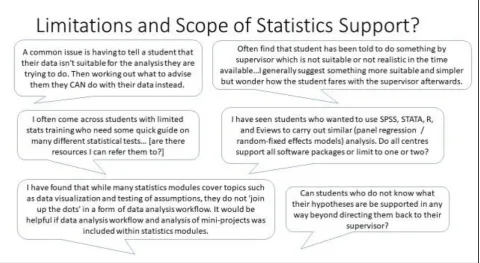
questions and challenges posted prior to the conference that were included in this theme. This slide was displayed at the workshop and these questions and challenges related to this theme were discussed, along with other aspects related to this theme.
Figure 1: Questions and challenges posted prior to the conference that were included in the theme of “Limitations and Scope of Statistics Support”.
A total of 10 colleagues attended the workshop who were organised into two groups, and were tasked with discussing any questions and challenges not only posted prior to the workshop, but also those that they themselves wished to discuss. The notes recorded by these two groups were captured on flipchart paper and reproduced in the appendix to this report.
The remainder of this report summarises the discussions that subsequently took place during the workshop. All of the views and opinions and recommendations expressed in this workshop report are therefore of those that attended the workshop or colleagues who contributed to the discussions prior to the workshop.
3. Discussion
3.1. Support with statistics software
The main suggestion for good practice in relation to this issue related to the need to manage the expectations of students, clearly stating the statistics software that support staff were proficient in on relevant support centre websites. In addition it was also agreed that maintaining suitable links on support centre websites to resources on how to use other statistics software would be very helpful to students.
The need for tutor training with the use of statistics software was considered and it was thought that basic training in R would be most beneficial, as many tutors are not familiar with R but its popularity is increasing. There are some R resources available via the community resources contributed to statstutor (https://statstutor.ac.uk), whilst additional resources are available through the Sheffield Hallam Maths and Stats support centre website at https://maths.shu.ac.uk/mathshelp/Resources/. However, a basic training giving an introduction to R was felt would be the easiest way for tutors to get to grips with the basics. Another software package, Nvivo (https://www.qsrinternational.com/nvivo/home), which is aimed at the analysis of qualitative and mixed methods data, was also identified as something statistics tutors would like to have training in. One outcome from these discussions was the proposal for a potential meeting of the SIG hosted at Liverpool John Moores University, focused on a training workshop on statistics software to include R and Nvivo and other relevant statistical software products.
3.2. What is in the remit of statistics support?
The provision of help and advice with statistical software is commonplace with the context of statistics support. However, it was agreed that in many cases, the software students are being expected to use is not always covered within departments’ core course delivery. It was agreed that the basics of any software students are expected to use should be provided within the student’s course, and that it shouldn’t be an expectation that a mathematics and statistics support centre will offer the teaching and learning opportunities in this area. This is particularly true where packages that many statistics support tutors are much less likely to be familiar with, such as STATA and eviews. Indeed, it was agreed that the helping students with the basics in the use software could be seen as computing support, rather than statistics support. If the student has been told to use a specific package but has received no teaching or learning opportunities with the software, it could be argued that statistics support tutor should help the student develop skills with a package the tutor is familiar with.
One area of statistics support that it was agreed should not necessarily fall within the scope of statistics support is advising on the formulation of hypotheses or research questions in the context of students seeking help with projects. However, whilst statistics support tutors cannot be expected to understand the research context within all academic disciplines or help formulate research questions, it was agreed that sometimes asking probing questions of the student about what they hoped to learn from their study and/or the nature of the data they have or plan to collect could help the student clarify their aims. If after a session focused on these aspects, the student still wasn’t sure of their aims or were unable to formulate a hypotheses or research questions, it was recommended that they are re-directed back to the supervisor.
trialled a scheme where statistics support tutors attend initial dissertation meetings with students with the student’s supervisors present to offer guidance at the beginning. Whilst providing this sort of support/training for supervisors would clearly be beneficial in the long run, discussion centred on whether this was feasible in larger institutions. It was suggested that advising groups of project supervisors on study design and analysis, in a workshop context, could work but whether this should be within the remit of statistics support was questioned as well as whether it was manageable in larger institutions.
3.3. Supporting students with choosing statistical techniques
There were many issues raised relating to the expectations of students and project supervisors. These included students seeking help with techniques suggested by their supervisor or teacher that appear to be inappropriate, choosing the appropriate level of statistics to support a project student with and whether this choice conflicts with the suggestions from the student’s supervisor.
Many students come to statistics support with an idea of the technique they want help with, or may have been suggested by their supervisor or teacher, but often the suggested technique is considered by the statistics support tutor to be inappropriate or perhaps too advanced for the student given their evident mathematical/statistical expertise or the time frame within which the student is working. A student obviously wants to do as their supervisor suggests, even if they have no idea what the technique is or why it is appropriate. It was agreed that it is important to check why the student or their supervisor thinks they should use a specific technique and how it relates to their research questions. In addition it is equally important for the statistics tutor to explain to the student (and their project supervisor) the justification for any suggestions the tutor makes for using a different technique to the one the student or their supervisor had suggested.
If a student’s project supervisor has suggested inappropriate methods, the statistics support tutor should be cautious, since ultimately it is the supervisor who will assess the student’s work. In addition, good close relationships between statistics support staff and the staff teaching students is are vital, to maintain the support of teaching staff in promoting the value of using mathematics and statistics support centres.
The general consensus was that the statistics support tutor talks through the research questions and possibilities for analysis with the student and suggests that the student then talks through the options with their supervisor. This also applies to techniques which the statistics support tutor feels are too advanced for the student given the students level of ability or time frame. Students often worry if using simpler techniques will reduce their grade, therefore it is important to stress that understanding and reporting the chosen technique in relation to the research question is preferable to doing more complex analysis badly or incorrectly. It was also agreed that the importance of ascertaining the student’s prior statistical knowledge, clarifying expectations and the time available, before making any suggestions regarding techniques, are all elements of good practice in providing statistics support. If a student is new to statistics and has more time, basic hypothesis testing using a simple test should be discussed first before moving up to more complex analyses.
them with no explanations. Some useful resources that were discussed include those available through the Sheffield Hallam Maths and Stats support centre website at https://maths.shu.ac.uk/mathshelp/Resources/testchoose.html, or the whattest resource available from the Mathematics Learning Centre at Loughborough University via http://whattest.lboro.ac.uk/index.html
Given the number of students requiring help with the process of choosing the right technique, embedding these skills within taught modules would clearly be the most beneficial approach. However, it was evident that some mathematics and statistics support centres also run workshops on this aspect of statistics.
Finally, in relation to supporting students with the right technique, it should be acknowledged that there will be, and often are, limitations on the range of statistical techniques that staff within a mathematics and statistics support centre have expertise in, particularly where statistics support is offered by non-specialists. As with providing support with a range of statistical software discussed in the previous section, it was agreed that it should be possible to give an overview of the level of statistics taught within individual centres, via centre websites etc. As a closing remark in this section, in the case of less well known statistical techniques, one suggestion was to ask the lecturer who specified the technique to teach support staff about the topic.
3.4. Advertising and evidencing the impact of statistics support
There are many modes of advertising used by mathematics and statistics support centres to raise awareness amongst the student population that statistics support is available. Although advertising during induction/welcome weeks, through events, talks and emails is common, it was agreed that this was not the best time to advertise statistics support, as students were often overloaded with information at that time, and more importantly their awareness of the need for statistics support would not yet be evident. Word of mouth was generally seen as an effective method of advertising and increasing awareness through lecturers, students union and student ambassadors for more timely advertising helped with this. In particular, it was felt that developing relationships with staff that lead project modules across the institution would be beneficial to facilitate timely promotion of the availability of statistics support and the need to seek advice on study design and data collection early. Having a good website presence which is easy for students to find and networking at higher levels to spread the word about the service was also suggested.
Discussion also took place about evaluating the impact of mathematics and statistics support, in order to raise the profile and demonstrate the value of the service to both students and the institution. It was agreed that surveying students who had used statistics support, particularly around the impact of the help they received in reducing their perceived risk failing or dropping out, would offer some evidence to support the development or continuation of statistics support provision in an institution. Finally it was agreed that networking with relevant committees and management across the institution, would also help in terms of promoting evidence of the impact that statistics support provision has on reducing student attrition, as well as contributing to positively to outcomes related to the NSS (and ultimately the TEF).
4. Summary
topics that were discussed included supporting student with statistics software, understanding the remit of statistics support, supporting students with choosing statistical techniques, as well as a short discussion on raising awareness of statistics support and evidencing its impact. One key action arising from the workshop was the proposal to run a workshop on statistics software.
5. Appendix
Written comments recorded at the workshop: Group 2