organic papers
o3440
Buttet al. C14H12N2O6 doi:10.1107/S1600536806027395 Acta Cryst.(2006). E62, o3440–o3442
Acta Crystallographica Section E Structure Reports Online
ISSN 1600-5368
1,2-Bis(
p
-nitrophenoxy)ethane
M. Saeed Butt,aM. Khawar Rauf,aMichael Bolte,bZareen Akhtera* and M. Zafar-uz-Zamanc
aDepartment of Chemistry, Quaid-i-Azam
University, Islamabad 45320, Pakistan,bInstitut
fu¨r Anorganische Chemie, J. W. Goethe-Universita¨t Frankfurt, Max-von-Laue-Strasse 7, 60438 Frankfurt/Main, Germany, andcNational
Engineering and Scientific Commission, PO Box 2801, Islamabad, Pakistan
Correspondence e-mail: [email protected]
Key indicators
Single-crystal X-ray study
T= 173 K
Mean(C–C) = 0.002 A˚
Rfactor = 0.036
wRfactor = 0.102
Data-to-parameter ratio = 14.6
For details of how these key indicators were automatically derived from the article, see http://journals.iucr.org/e.
Received 19 June 2006 Accepted 14 July 2006
#2006 International Union of Crystallography All rights reserved
Molecules of the title compound, C14H12N2O6, are located on
centres of inversion. The molecule is essentially planar, with the exception of the nitro group, which is twisted slightly out of the plane of the remaining atoms.
Comment
Polyimides form a very interesting group of mechanically, chemically and heat-resistant polymers (Lee & Jung, 1998). In many cases, polyimides are insoluble and do not react below their decomposition temperatures. On the other hand, their resistivity complicates their processing for technical applica-tions. For these reasons their application as engineering materials is restricted (Im & Jung, 2000). Therefore, efforts have been made to improve their processability while main-taining their excellent thermal and mechanical properties (Cholet al., 2001).
For example, bulky lateral substituents (Yang et al., 2000), flexible alkyl side chains (Jung & Park, 1996), non-coplanar biphenyl groups, and flexible alkyl or aryl ether spacers (Liaw
et al., 1998) have been used to enhance solubility and thus processability. Incorporation of flexible segments such as –O–, –SO2–, –CH2– and –C(CF3)2–, and of bulky pendant groups
such astert-butyl and adamantyl, were found to be successful in altering crystallinity and intermolecular interactions to increase solubility (Eastmond et al., 1996). Bulky pendant groups increase the disorder in chains and hinder dense chain packing. This is concomitant with reduction of crystallinity and enhancement of solubility. Unfortunately, while the solubility of non-coplanar structures with pendant aliphatic segments is enhanced, the thermal properties of such substances are usually worsened.
Recently, Hsio et al. (1997) reported some soluble ther-moplastic polyimides derived from spiro-linked diamine structures in an effort to overcome this problem. The latter polymers had glass transition temperatures between 509 and 529 K and withstood temperatures up to 723 K (in N2). The
enhanced solubility of the polymer is expected to result (Hedrich, 1992).
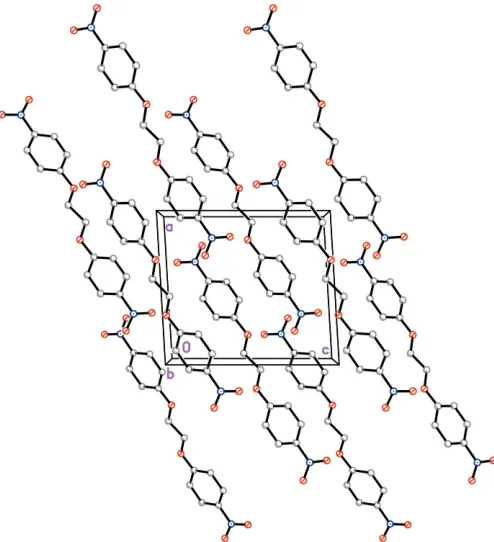
The molecules of the title compound, (I), are located on centres of inversion. Geometric parameters are normal. All the non-H atoms apart from the nitro groups lie in a common plane with an r.m.s. deviation of 0.0128 A˚ (Khawar Raufet al., 2006). The NO2group makes a dihedral angle of 12.15 (13)
with the mean plane through the benzene ring (see also Table 1). The crystal structure is stabilized by a C—H O hydrogen bond (Table 2).
Experimental
p-Nitrophenol (8.0 g, 0.057 mol) and anhydrous potassium carbonate (7.86 g, 0.057 mol) were suspended in a mixture of N,N0
-dimethyl-formamide (50 ml) and toluene (30 ml). The mixture was refluxed at 473 K with a Dean–Stark trap for azeotropic removal of water. When most of the toluene had been removed, 1,2-dichloroethane (2.35 ml, 0.0285 mol) was added to the mixture, which was then refluxed for 12 h. The resulting solution was allowed to cool to room temperature and then it was poured into 300 ml of methanol–water (1:1) to give a yellow precipitate. After repeated washing with water, the product was separated by filtration and recrystallized from ethanol in 83% yield (m.p. 432 K).
Crystal data
C14H12N2O6
Mr= 304.26
Monoclinic,P21=n
a= 9.1465 (12) A˚ b= 7.3137 (7) A˚ c= 10.2852 (13) A˚
= 93.353 (10) V= 686.85 (14) A˚3
Z= 2
Dx= 1.471 Mg m
3
MoKradiation
= 0.12 mm1
T= 173 (2) K Block, light yellow 0.490.460.44 mm
Data collection
Stoe IPDS II two-circle diffractometer
!scans
Absorption correction: none 8567 measured reflections
1477 independent reflections 1380 reflections withI> 2(I) Rint= 0.037
max= 27.0
Refinement
Refinement onF2
R[F2> 2(F2)] = 0.036
wR(F2) = 0.103
S= 1.08 1477 reflections 101 parameters
H-atom parameters constrained
w= 1/[2(F
o2) + (0.0586P)2
+ 0.1845P]
whereP= (Fo2+ 2Fc2)/3
(/)max< 0.001
max= 0.37 e A˚
3
min=0.20 e A˚
3
Extinction correction:SHELXL97 Extinction coefficient: 0.11 (2)
Table 1
Selected torsion angles ().
O3—N1—C4—C3 168.86 (10) O2—N1—C4—C3 11.59 (15)
Table 2
Hydrogen-bond geometry (A˚ ,).
D—H A D—H H A D A D—H A
C3—H3 O3i
0.95 2.48 3.4166 (14) 169
Symmetry code: (i)xþ1 2;yþ
1 2;zþ
3 2.
All the H atoms were located in a difference map. However, they were refined using a riding model, with C—H = 0.95 and 0.99 A˚ for aryl and methylene H atoms, respectively.Uiso(H) values were set to
1.2Ueq(C).
Data collection: X-AREA (Stoe & Cie, 2001); cell refinement: X-AREA; data reduction: X-AREA; program(s) used to solve structure:SHELXS97(Sheldrick, 1997); program(s) used to refine structure:SHELXL97(Sheldrick, 1997); molecular graphics:XPin
organic papers
Acta Cryst.(2006). E62, o3440–o3442 Buttet al. C
[image:2.610.44.294.68.260.2]14H12N2O6
o3441
Figure 1
Molecular structure of (I). Displacement ellipsoids are drawn at the 50%
[image:2.610.47.294.300.571.2]probability level. [Symmetry code: (A)x+ 2,y+ 1,z+ 1.]
Figure 2
SHELXTL-Plus(Sheldrick, 1991); software used to prepare material for publication:SHELXL97.
The authors are grateful to the Department of Chemistry, Quaid-I-Azam University, Islamabad, and to the National Engineering and Scientific Commission, Islamabad, Pakistan, for providing laboratory and analytical facilities.
References
Chol, K. H., Lee, K. H. & Jung, J. C. (2001).J. Polym. Sci. Part A: Polym. Chem.39, 3818–3825.
Eastmond, G., Paprotny, C. & Irwin, R. S. (1996).Macromolecules,29, 1382– 1388.
Hedrich, J. L. (1992).Polymer,33, 1399–1405.
Hsio, S. H., Yang, C. P. & Yang, C. Y. (1997).J. Polym. Sci. Part A Polym. Chem.35, 1487–1497.
Im, J. K. & Jung, J. C. (2000).Polymer,41, 8709–8716.
Jung, J. C. & Park, S. B. (1996).J. Polym. Sci. Part A Polym. Chem.34, 357–365. Khawar Rauf, M., Badshah, A. & Bolte, M. (2006).Acta Cryst.E62, o1859–
o1860.
Lee, K. H. & Jung, J. C. (1998).Polym. Bull.40, 407–414.
Liaw, D. J., Liaw, B. Y. & Jeng, M. Q. (1998).Polymer,39, 1597–1607. Sheldrick, G. M. (1991).SHELXTL-Plus. Release 4.1. Siemens Analytical
X-ray Instruments Inc., Madison, Wisconsin, USA.
Sheldrick, G. M. (1997). SHELXS97 and SHELXL97. University of Go¨ttingen, Germany.
Stoe & Cie (2001).X-AREA. Stoe & Cie, Darmstadt, Germany.
Yang, C. P., Hsiao, S. H. & Yang, H. W. (2000).Macromol. Chem. Phys.201, 409–418.
organic papers
o3442
Buttet al. Csupporting information
sup-1
Acta Cryst. (2006). E62, o3440–o3442
supporting information
Acta Cryst. (2006). E62, o3440–o3442 [https://doi.org/10.1107/S1600536806027395]
1,2-Bis(
p
-nitrophenoxy)ethane
M. Saeed Butt, M. Khawar Rauf, Michael Bolte, Zareen Akhter and M. Zafar-uz-Zaman
1,2-Bis(p-nitrophenoxy)ethylene
Crystal data
C14H12N2O6
Mr = 304.26 Monoclinic, P21/n
Hall symbol: -P 2yn a = 9.1465 (12) Å b = 7.3137 (7) Å c = 10.2852 (13) Å β = 93.353 (10)° V = 686.85 (14) Å3
Z = 2
F(000) = 316 Dx = 1.471 Mg m−3
Melting point: 432 K
Mo Kα radiation, λ = 0.71073 Å Cell parameters from 8996 reflections θ = 3.6–27.2°
µ = 0.12 mm−1
T = 173 K
Block, light yellow 0.49 × 0.46 × 0.44 mm
Data collection
Stoe IPDS-II two-circle diffractometer
Radiation source: fine-focus sealed tube Graphite monochromator
ω scans
8567 measured reflections 1477 independent reflections
1380 reflections with I > 2σ(I) Rint = 0.037
θmax = 27.0°, θmin = 4.0°
h = −11→11 k = −9→8 l = −13→13
Refinement
Refinement on F2
Least-squares matrix: full R[F2 > 2σ(F2)] = 0.036
wR(F2) = 0.103
S = 1.08 1477 reflections 101 parameters 0 restraints
Primary atom site location: structure-invariant direct methods
Secondary atom site location: difference Fourier map
Hydrogen site location: inferred from neighbouring sites
H-atom parameters constrained w = 1/[σ2(F
o2) + (0.0586P)2 + 0.1845P]
where P = (Fo2 + 2Fc2)/3
(Δ/σ)max < 0.001
Δρmax = 0.37 e Å−3
Δρmin = −0.20 e Å−3
Extinction correction: SHELXL97, Fc*=kFc[1+0.001xFc2λ3/sin(2θ)]-1/4
Extinction coefficient: 0.11 (2)
Special details
supporting information
sup-2
Acta Cryst. (2006). E62, o3440–o3442
Refinement. Refinement of F2 against ALL reflections. The weighted R-factor wR and goodness of fit S are based on F2,
conventional R-factors R are based on F, with F set to zero for negative F2. The threshold expression of F2 > σ(F2) is used
only for calculating R-factors(gt) etc. and is not relevant to the choice of reflections for refinement. R-factors based on F2
are statistically about twice as large as those based on F, and R- factors based on ALL data will be even larger.
Fractional atomic coordinates and isotropic or equivalent isotropic displacement parameters (Å2)
x y z Uiso*/Ueq
N1 0.32402 (10) 0.57146 (14) 0.80918 (9) 0.0217 (3) O1 0.82156 (8) 0.59629 (11) 0.51718 (7) 0.0210 (2) O2 0.21184 (9) 0.64765 (14) 0.76280 (9) 0.0322 (3) O3 0.32999 (9) 0.48898 (12) 0.91408 (8) 0.0286 (3) C1 0.70374 (11) 0.58452 (14) 0.59315 (10) 0.0174 (3) C2 0.58574 (11) 0.70123 (14) 0.55763 (10) 0.0190 (3)
H2 0.5916 0.7824 0.4860 0.023*
C3 0.46058 (11) 0.69710 (15) 0.62798 (10) 0.0197 (3)
H3 0.3792 0.7732 0.6041 0.024*
C4 0.45655 (11) 0.57869 (15) 0.73473 (10) 0.0192 (3) C5 0.57319 (12) 0.46538 (16) 0.77235 (11) 0.0227 (3)
H5 0.5683 0.3879 0.8461 0.027*
C6 0.69805 (11) 0.46696 (16) 0.70017 (11) 0.0223 (3)
H6 0.7784 0.3889 0.7235 0.027*
C7 0.94301 (11) 0.47511 (15) 0.54757 (11) 0.0211 (3)
H7A 0.9125 0.3459 0.5363 0.025*
H7B 0.9821 0.4933 0.6385 0.025*
Atomic displacement parameters (Å2)
U11 U22 U33 U12 U13 U23
N1 0.0185 (5) 0.0250 (5) 0.0222 (5) −0.0030 (3) 0.0047 (3) −0.0054 (4) O1 0.0141 (4) 0.0242 (4) 0.0255 (4) 0.0051 (3) 0.0061 (3) 0.0052 (3) O2 0.0172 (4) 0.0468 (6) 0.0330 (5) 0.0046 (4) 0.0054 (3) −0.0015 (4) O3 0.0288 (5) 0.0335 (5) 0.0243 (4) −0.0050 (3) 0.0093 (3) 0.0001 (3) C1 0.0135 (5) 0.0191 (5) 0.0197 (5) −0.0008 (4) 0.0022 (4) −0.0024 (4) C2 0.0178 (5) 0.0194 (5) 0.0198 (5) 0.0015 (4) 0.0017 (4) 0.0011 (4) C3 0.0152 (5) 0.0214 (5) 0.0224 (5) 0.0030 (4) 0.0005 (4) −0.0022 (4) C4 0.0153 (5) 0.0230 (5) 0.0198 (5) −0.0028 (4) 0.0043 (4) −0.0043 (4) C5 0.0216 (5) 0.0258 (6) 0.0211 (5) 0.0000 (4) 0.0034 (4) 0.0037 (4) C6 0.0174 (5) 0.0248 (6) 0.0246 (6) 0.0043 (4) 0.0018 (4) 0.0043 (4) C7 0.0142 (5) 0.0226 (5) 0.0269 (6) 0.0042 (4) 0.0044 (4) 0.0036 (4)
Geometric parameters (Å, º)
N1—O3 1.2346 (13) C3—C4 1.4006 (15)
N1—O2 1.2384 (13) C3—H3 0.9500
N1—C4 1.4721 (13) C4—C5 1.3879 (16)
O1—C1 1.3703 (12) C5—C6 1.3981 (14)
supporting information
sup-3
Acta Cryst. (2006). E62, o3440–o3442
C1—C6 1.4000 (15) C6—H6 0.9500
C1—C2 1.4074 (14) C7—C7i 1.515 (2)
C2—C3 1.3899 (14) C7—H7A 0.9900
C2—H2 0.9500 C7—H7B 0.9900
O3—N1—O2 123.35 (9) C5—C4—N1 118.46 (10)
O3—N1—C4 118.45 (9) C3—C4—N1 119.36 (9)
O2—N1—C4 118.19 (9) C4—C5—C6 119.05 (10)
C1—O1—C7 117.36 (8) C4—C5—H5 120.5
O1—C1—C6 123.61 (9) C6—C5—H5 120.5
O1—C1—C2 115.50 (9) C5—C6—C1 119.44 (10)
C6—C1—C2 120.89 (9) C5—C6—H6 120.3
C3—C2—C1 119.61 (10) C1—C6—H6 120.3
C3—C2—H2 120.2 O1—C7—C7i 105.24 (11)
C1—C2—H2 120.2 O1—C7—H7A 110.7
C2—C3—C4 118.80 (9) C7i—C7—H7A 110.7
C2—C3—H3 120.6 O1—C7—H7B 110.7
C4—C3—H3 120.6 C7i—C7—H7B 110.7
C5—C4—C3 122.19 (10) H7A—C7—H7B 108.8
C7—O1—C1—C6 2.41 (15) O3—N1—C4—C3 −168.86 (10) C7—O1—C1—C2 −178.10 (9) O2—N1—C4—C3 11.59 (15) O1—C1—C2—C3 179.13 (9) C3—C4—C5—C6 −1.09 (17) C6—C1—C2—C3 −1.36 (16) N1—C4—C5—C6 178.14 (9) C1—C2—C3—C4 1.31 (15) C4—C5—C6—C1 1.03 (17) C2—C3—C4—C5 −0.10 (16) O1—C1—C6—C5 179.64 (10) C2—C3—C4—N1 −179.31 (9) C2—C1—C6—C5 0.17 (17) O3—N1—C4—C5 11.90 (15) C1—O1—C7—C7i −177.67 (10)
O2—N1—C4—C5 −167.66 (10)
Symmetry code: (i) −x+2, −y+1, −z+1.
Hydrogen-bond geometry (Å, º)
D—H···A D—H H···A D···A D—H···A
C3—H3···O3ii 0.95 2.48 3.4166 (14) 169