organic papers
o3262
Saeedet al. C15H9BrO2 doi:10.1107/S1600536806024998 Acta Cryst.(2006). E62, o3262–o3263
Acta Crystallographica Section E Structure Reports Online
ISSN 1600-5368
3-(2-Bromophenyl)isocoumarin
Aamer Saeed,aEdwin F. van der Eideband Masood Parvezb*
a
Department of Chemistry, Quaid-i-Azam University, Islamabad 45320, Pakistan, and bDepartment of Chemistry, University of
Calgary, 2500 University Drive NW, Calgary, Alberta, Canada T2N 1N4
Correspondence e-mail: [email protected]
Key indicators
Single-crystal X-ray study T= 173 K
Mean(C–C) = 0.006 A˚ Rfactor = 0.038 wRfactor = 0.094
Data-to-parameter ratio = 15.2
For details of how these key indicators were automatically derived from the article, see http://journals.iucr.org/e.
Received 21 June 2006 Accepted 28 June 2006
#2006 International Union of Crystallography All rights reserved
The molecular structure of the title compound, C15H9BrO2,
consists of two essentially planar units, benzopyran-1-one and 2-bromophenyl, which are inclined at 51.42 (12)with respect
to one another. The structure is stabilized by two weak
intermolecular C—H O interactions.
Comment
More than two hundred isocoumarins and 3,4-dihydro-isocoumarins have been isolated, predominantly from a variety of fungi, lichens and bacteria, and to a lesser extent from higher plants, insects and marine organisms, and the number of known isocoumarins is still increasing dramatically (Barry, 1964; Napolitano, 1997). Isocoumarins are useful intermediates (Hauser & Baghdanor, 1988; Mali & Babu, 1998) in the synthesis of a variety of natural products. We have reported the syntheses of a number of naturally occurring and synthetic isocoumarins (Saeed, 2003a,b, 2004a,b; Saeed & Ehsan, 2005). 3-Halophenylisocoumarins are not known in nature and are expected to display a number of bioactivities. The title compound, (I), was prepared in order to investigate its bioactivity systematically. In this paper, the structure of (I) is described.
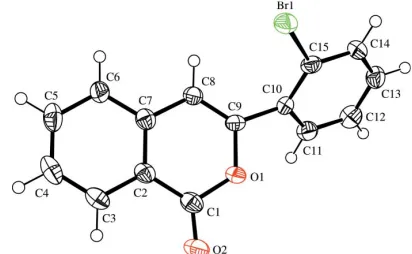
[image:1.610.224.430.596.723.2]The structure of (I) consists of an essentially planar benzopyran-1-one unit, the maximum deviation of any atom
Figure 1
from its plane being 0.025 (4) A˚ for C1, and a 2-bromophenyl
unit for which Br1 is 0.046 (8) A˚ out of the plane of the
benzene ring (Fig. 1); the mean planes of the two units are inclined at 51.42 (12)with respect to one another. The
mol-ecular dimensions in (I) agree with the corresponding
dimensions reported for 3,4-dihydroisocoumarins and
isocoumarins included in the Cambridge Structural Database (Version 5.27, 2005 Release; Allen, 2002). The structure is
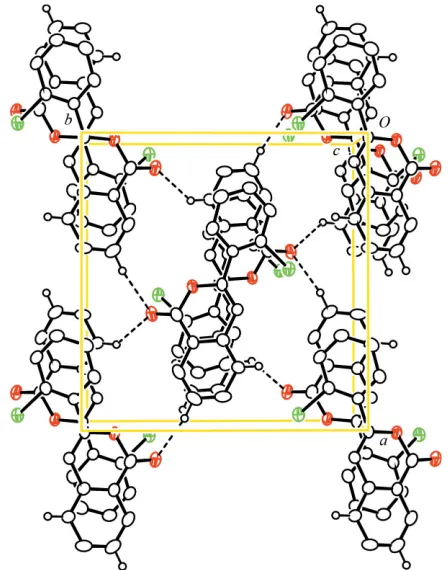
stabilized by two weak intermolecular C—H O interactions
(Fig. 2 and Table 1). There are no significant —stacking
interactions.
Experimental
A stirred mixture of homophthalic acid (0.5 g, 2.77 mmol) and 2-bromobenzoyl chloride (2.12 g, 9.7 mmol) was heated in an oil bath at 473 K for 4 h. Thin-layer chromatography of the residue (petroleum ether–ethyl acetate 8:3) followed by recrystallization from MeOH– H2O (4:1) gave the title isocoumarin (0.7 g, 2.35 mmol, 85%) as
light-yellow needles (m.p. 391–393 K).1H NMR (CDCl3,, p.p.m.): 6.90 (s,
1H, H-4), 7.43 (m, 1H, H-5), 7.47 (m, 1H, H-7), 7.49 (m, 1H, H-40),
7.51 (m, 1H, H-60), 7.69 (dt,J= 7.2, 1.8 Hz, 1H, H-6); 7.81 (dt,J= 7.8,
1.7 Hz, 1H, H-50).
Crystal data
C15H9BrO2 Mr= 301.13
Orthorhombic,Pna21
a= 12.595 (6) A˚
b= 12.128 (9) A˚
c= 7.699 (6) A˚
V= 1176.0 (14) A˚3
Z= 4
Dx= 1.701 Mg m
3
MoKradiation
= 3.48 mm1
T= 173 (2) K Block, colourless 0.160.140.10 mm
Data collection
Bruker–Nonius KappaCCD diffractometer
!and’scans
Absorption correction: multi-scan (SORTAV; Blessing, 1997)
Tmin= 0.594,Tmax= 0.708
7105 measured reflections 2492 independent reflections 2096 reflections withI> 2(I)
Rint= 0.056
max= 27.5
Refinement
Refinement onF2 R[F2> 2(F2)] = 0.038 wR(F2) = 0.094
S= 1.04 2492 reflections 164 parameters
H-atom parameters constrained
w= 1/[2
(Fo2) + (0.0492P)2
+ 0.803P]
whereP= (Fo2+ 2Fc2)/3
(/)max= 0.001
max= 0.37 e A˚
3
min=0.50 e A˚
3
Absolute structure: Flack (1983), 1073 Fridels
Flack parameter: 0.536 (17)
Table 1
Hydrogen-bond geometry (A˚ ,).
D—H A D—H H A D A D—H A
C4—H4 O2i
0.95 2.55 3.439 (6) 155 C6—H6 O2ii
0.95 2.45 3.242 (7) 140
Symmetry codes: (i)x1 2;yþ
1
2;z; (ii)xþ 1 2;yþ
1 2;z
1 2.
The crystal is inversion twinned with roughly equal components. The Friedel pairs (1073) were not merged during the refinement. H
in the refinement at geometrically idealized positions, with C—H = 0.95 A˚ andUiso(H) = 1.2Ueq(C).
Data collection: COLLECT (Hooft, 1998); cell refinement:
DENZO (Otwinowski & Minor, 1997); data reduction: SCALE-PACK (Otwinowski & Minor, 1997); program(s) used to solve structure:SAPI91(Fan, 1991); program(s) used to refine structure:
SHELXL97 (Sheldrick, 1997); molecular graphics: ORTEPII
(Johnson, 1976); software used to prepare material for publication:
SHELXL97(Sheldrick, 1997).
References
Allen, F. H. (2002).Acta Cryst.B58, 380–388. Barry, R. D. (1964).Chem. Rev.64, 229–260. Blessing, R. H. (1997).J. Appl. Cryst.30, 421–426.
Fan, H.-F. (1991).SAPI91. Rigaku Corporation, Tokyo, Japan. Flack, H. D. (1983).Acta Cryst.A39, 876–881.
Hooft, R. (1998).COLLECT. Nonius BV, Delft, The Netherlands. Hauser, F. M. & Baghdanov, V. M. (1988).J. Org. Chem.53, 4676–4681. Johnson, C. K. (1976).ORTEPII. Report ORNL-5138. Oak Ridge National
Laboratory, Tennessee, USA.
Mali, R. S. & Babu, K. N. (1998).J. Org. Chem.63, 2488–2492. Napolitano, E. (1997).Org. Prep. Proced. Int.29, 631–664.
Otwinowski, Z. & Minor, W. (1997). Methods in Enzymology, Vol. 276,
Macromolecular Crystallography, Part A, edited by C. W. Carter Jr & R. M. Sweet, pp. 307–326. New York: Academic Press.
Saeed, A. (2003a).Helv. Chim. Acta,86, 377–383. Saeed, A. (2003b).J. Heterocycl. Chem.40, 337–340. Saeed, A. (2004a).Nat. Prod. Res.18, 373–378. Saeed, A. (2004b).J. Heterocycl. Chem.41, 975–978.
[image:2.610.327.551.70.355.2]Saeed, A. & Ehsan, S. (2005).Chem. Heterocycl. Compd.11, 1644–1648.
Figure 2
supporting information
sup-1 Acta Cryst. (2006). E62, o3262–o3263
supporting information
Acta Cryst. (2006). E62, o3262–o3263 [https://doi.org/10.1107/S1600536806024998]
3-(2-Bromophenyl)isocoumarin
Aamer Saeed, Edwin F. van der Eide and Masood Parvez
3-(2-Bromophenyl)isocoumarin
Crystal data
C15H9BrO2
Mr = 301.13
Orthorhombic, Pna21
Hall symbol: P 2c -2n
a = 12.595 (6) Å
b = 12.128 (9) Å
c = 7.699 (6) Å
V = 1176.0 (14) Å3
Z = 4
F(000) = 600
Dx = 1.701 Mg m−3
Mo Kα radiation, λ = 0.71073 Å Cell parameters from 2492 reflections
θ = 3.4–27.5°
µ = 3.48 mm−1
T = 173 K Block, colorless 0.16 × 0.14 × 0.10 mm
Data collection
Bruker–Nonius KappaCCD diffractometer
Radiation source: fine-focus sealed tube Graphite monochromator
ω and φ scans
Absorption correction: multi-scan (SORTAV; Blessing, 1997)
Tmin = 0.594, Tmax = 0.708
2492 measured reflections 7105 independent reflections 2096 reflections with I > 2σ(I)
Rint = 0.056
θmax = 27.5°, θmin = 3.4°
h = −16→15
k = −15→15
l = −9→9
Refinement
Refinement on F2
Least-squares matrix: full
R[F2 > 2σ(F2)] = 0.038
wR(F2) = 0.094
S = 1.04 2492 reflections 164 parameters 1 restraint
Primary atom site location: structure-invariant direct methods
Secondary atom site location: difference Fourier map
Hydrogen site location: inferred from neighbouring sites
H-atom parameters constrained
w = 1/[σ2(F
o2) + (0.0492P)2 + 0.803P]
where P = (Fo2 + 2Fc2)/3
(Δ/σ)max = 0.001
Δρmax = 0.37 e Å−3
Δρmin = −0.50 e Å−3
Absolute structure: Flack (1983), 1073 Fridels Absolute structure parameter: 0.536 (17)
Special details
Experimental. EI–MS m/z (%): 303, 301 (M+, 30), 165?(28), 137 (19.8), 117?(100); IR (film, ν, cm-1): 2913, 2849, 1712,
1694, 1598, 1572, 1471, 1151, 832 cm-1; 1H NMR (CDCl
3): δ 6.90 (s, 1H, H-4), 7.43 (m, 1H, H-5), 7.47 (m, 1H, H-7),
Fractional atomic coordinates and isotropic or equivalent isotropic displacement parameters (Å2)
x y z Uiso*/Ueq
Br1 0.54430 (3) 0.73308 (3) 0.79476 (12) 0.03527 (14) O1 0.4843 (2) 0.3883 (2) 0.7077 (4) 0.0284 (6) O2 0.3909 (2) 0.24387 (19) 0.7917 (10) 0.0367 (6) C1 0.3881 (3) 0.3320 (3) 0.7239 (6) 0.0324 (10) C2 0.2941 (3) 0.3891 (3) 0.6602 (6) 0.0282 (9) C3 0.1939 (3) 0.3388 (4) 0.6767 (6) 0.0333 (9) H3 0.1877 0.2684 0.7298 0.040* C4 0.1049 (3) 0.3923 (4) 0.6156 (6) 0.0408 (11) H4 0.0371 0.3590 0.6286 0.049* C5 0.1133 (4) 0.4932 (4) 0.5362 (6) 0.0407 (12) H5 0.0514 0.5279 0.4918 0.049* C6 0.2118 (4) 0.5460 (4) 0.5195 (7) 0.0306 (12) H6 0.2168 0.6161 0.4648 0.037* C7 0.3026 (3) 0.4941 (4) 0.5847 (6) 0.0292 (10) C8 0.4055 (3) 0.5443 (3) 0.5733 (5) 0.0268 (9) H8 0.4130 0.6151 0.5219 0.032* C9 0.4909 (3) 0.4918 (3) 0.6346 (5) 0.0256 (8) C10 0.6035 (3) 0.5289 (3) 0.6275 (5) 0.0261 (8) C11 0.6799 (4) 0.4572 (4) 0.5590 (6) 0.0330 (10) H11 0.6583 0.3865 0.5192 0.040* C12 0.7865 (4) 0.4862 (5) 0.5475 (7) 0.0369 (14) H12 0.8370 0.4366 0.5000 0.044* C13 0.8172 (3) 0.5889 (4) 0.6067 (6) 0.0366 (10) H13 0.8895 0.6103 0.5978 0.044* C14 0.7440 (3) 0.6617 (4) 0.6790 (6) 0.0326 (9) H14 0.7660 0.7315 0.7219 0.039* C15 0.6384 (3) 0.6301 (3) 0.6871 (5) 0.0291 (9)
Atomic displacement parameters (Å2)
U11 U22 U33 U12 U13 U23
supporting information
sup-3 Acta Cryst. (2006). E62, o3262–o3263
C12 0.035 (3) 0.041 (3) 0.035 (3) 0.006 (2) 0.003 (2) 0.002 (2) C13 0.027 (2) 0.041 (3) 0.041 (3) −0.0020 (18) −0.0012 (19) 0.004 (2) C14 0.033 (2) 0.029 (2) 0.036 (2) −0.0076 (17) −0.0045 (18) 0.0047 (18) C15 0.031 (2) 0.0251 (19) 0.031 (2) 0.0009 (15) 0.0020 (18) 0.0071 (17)
Geometric parameters (Å, º)
Br1—C15 1.911 (4) C7—C8 1.434 (6) O1—C9 1.378 (5) C8—C9 1.335 (6) O1—C1 1.396 (5) C8—H8 0.9500 O2—C1 1.190 (6) C9—C10 1.488 (5) C1—C2 1.457 (6) C10—C15 1.382 (6) C2—C7 1.404 (6) C10—C11 1.400 (6) C2—C3 1.407 (5) C11—C12 1.390 (6) C3—C4 1.378 (6) C11—H11 0.9500 C3—H3 0.9500 C12—C13 1.381 (8) C4—C5 1.372 (7) C12—H12 0.9500 C4—H4 0.9500 C13—C14 1.392 (7) C5—C6 1.402 (7) C13—H13 0.9500 C5—H5 0.9500 C14—C15 1.386 (6) C6—C7 1.399 (6) C14—H14 0.9500 C6—H6 0.9500
C9—O1—C1 122.3 (3) C9—C8—H8 119.9 O2—C1—O1 116.9 (4) C7—C8—H8 119.9 O2—C1—C2 126.8 (4) C8—C9—O1 122.0 (4) O1—C1—C2 116.3 (4) C8—C9—C10 127.6 (4) C7—C2—C3 119.9 (4) O1—C9—C10 110.3 (3) C7—C2—C1 120.6 (4) C15—C10—C11 117.3 (4) C3—C2—C1 119.5 (4) C15—C10—C9 123.9 (4) C4—C3—C2 119.6 (4) C11—C10—C9 118.8 (4) C4—C3—H3 120.2 C12—C11—C10 122.0 (5) C2—C3—H3 120.2 C12—C11—H11 119.0 C5—C4—C3 120.6 (4) C10—C11—H11 119.0 C5—C4—H4 119.7 C13—C12—C11 118.5 (5) C3—C4—H4 119.7 C13—C12—H12 120.7 C4—C5—C6 121.1 (5) C11—C12—H12 120.7 C4—C5—H5 119.5 C12—C13—C14 121.2 (4) C6—C5—H5 119.5 C12—C13—H13 119.4 C7—C6—C5 119.0 (5) C14—C13—H13 119.4 C7—C6—H6 120.5 C15—C14—C13 118.6 (4) C5—C6—H6 120.5 C15—C14—H14 120.7 C6—C7—C2 119.6 (4) C13—C14—H14 120.7 C6—C7—C8 121.7 (4) C10—C15—C14 122.4 (4) C2—C7—C8 118.6 (4) C10—C15—Br1 121.8 (3) C9—C8—C7 120.3 (4) C14—C15—Br1 115.7 (3)
C9—O1—C1—C2 −0.5 (5) C7—C8—C9—C10 177.3 (4) O2—C1—C2—C7 179.1 (6) C1—O1—C9—C8 −0.6 (6) O1—C1—C2—C7 1.0 (6) C1—O1—C9—C10 −177.4 (3) O2—C1—C2—C3 −0.1 (8) C8—C9—C10—C15 53.5 (6) O1—C1—C2—C3 −178.1 (4) O1—C9—C10—C15 −129.9 (4) C7—C2—C3—C4 1.2 (6) C8—C9—C10—C11 −127.4 (5) C1—C2—C3—C4 −179.6 (4) O1—C9—C10—C11 49.1 (5) C2—C3—C4—C5 1.1 (7) C15—C10—C11—C12 −1.2 (7) C3—C4—C5—C6 −1.9 (7) C9—C10—C11—C12 179.7 (4) C4—C5—C6—C7 0.3 (7) C10—C11—C12—C13 0.4 (7) C5—C6—C7—C2 2.0 (7) C11—C12—C13—C14 1.0 (8) C5—C6—C7—C8 −179.3 (5) C12—C13—C14—C15 −1.5 (7) C3—C2—C7—C6 −2.8 (6) C11—C10—C15—C14 0.7 (6) C1—C2—C7—C6 178.1 (4) C9—C10—C15—C14 179.7 (4) C3—C2—C7—C8 178.6 (4) C11—C10—C15—Br1 −176.7 (3) C1—C2—C7—C8 −0.6 (6) C9—C10—C15—Br1 2.3 (6) C6—C7—C8—C9 −179.1 (4) C13—C14—C15—C10 0.6 (6) C2—C7—C8—C9 −0.4 (6) C13—C14—C15—Br1 178.1 (3)
Hydrogen-bond geometry (Å, º)
D—H···A D—H H···A D···A D—H···A
C4—H4···O2i 0.95 2.55 3.439 (6) 155
C6—H6···O2ii 0.95 2.45 3.242 (7) 140