from simultaneous lightness contrast
DANEYKO, Olga and ZAVAGNO, Daniele
Available from Sheffield Hallam University Research Archive (SHURA) at:
http://shura.shu.ac.uk/16752/
This document is the author deposited version. You are advised to consult the
publisher's version if you wish to cite from it.
Published version
DANEYKO, Olga and ZAVAGNO, Daniele (2008). On the concept of error in visual
perception: An example from simultaneous lightness contrast. Teorie & Modelli, 8
(2-3), 175-184.
Copyright and re-use policy
See
http://shura.shu.ac.uk/information.html
Teorie & Modelli, n.s., XIII, 2-3, 2008 (175-184)
On the concept of error in visual perception: An
example from simultaneous lightness contrast
Olga Daneyko* (Trieste), & Daniele Zavagno (Milan)**
1. Introduction
In vision sciences the multiform category of phenomena known as il-lusions are most often treated as errors or mistakes made by the visual sys-tem (Gregory et al. 1995). This view is almost always coupled with notion of veridicality and veridical perception (Rock 1983). The notion of veridi-cal perception implies that in some cases we do not see what we should see, and that in other cases we see exactly what should be seen. Hence, two simple but intriguing questions arise: (1) Given a visual scene, what is it that we should exactly see? (2) How do we know that what we should see is actually what we are seeing? Experimental research on illusions often deals sideways with these questions, and seldom comes up with a straight an-swer.
The variety of visual illusions is huge, and counting also the numerous versions that exist of a same illusion (Da Pos & Zambianchi 1996), the field comprises a rich bestiary of “curious” phenomena. To frame our in-vestigation we will consider only those illusions that are made of two ob-jects that should look alike along some, or all, dimensions – given that their respective physical characteristics are identical – but that appear different because of other surrounding features in the visual scene. For sake of sim-plicity we shall call this type of phenomena “comparison illusions”.1 In particular, we will be writing about this class of illusions in lightness perception.
* Department of Psychology “Gaetano Kanizsa”, University of Trieste. ** Psychology Department, University of Milano-Bicocca.
Researching the mechanisms or conditions that underlie an illusion usually goes hand in hand with a quantification of its magnitude. This last aspect, however, can be tricky, for some term of comparison is needed. With comparison illusions there are usually two alternatives:
- A measurement of the perceptual differences between two objects that do not appear equal despite their corresponding physical dimensions are equal. This is what we call a “within approach”, and the basic question sounds like: how different are the two objects?
- A measurement of the differences between the perceptual dimensions of the two objects and their corresponding physical dimensions, to determine the magnitude of the errors made by the visual system. This is what we call a “between approach”, and the basic question sounds like: which of the two physically equal objects shows a bigger departure from their actual (physi-cal) dimension?
The within approach is epistemologically safe: the researcher stays within the phenomenal domain and eventually uses physical units as a nu-meric expression of the quantifications carried out, without bothering to ask which of the two objects is more responsible for the illusion.
The between approach is instead epistemologically more problematic. Lets just consider one of the problems: which of the two perceived objects of a comparison illusion is closer to its physical model? The between ap-proach is closely related to two very different ways of thinking how the visual system works: (1) the visual system has direct access to the structure of the physical scene, in the sense that it sees what is actually there: things appear as they do because they are what they are (Gibson, 1979); (2) the visual system generates a good enough replica of the physical scene by means of inferences on raw sensations based on logical and statistical as-sumptions driven by cues and past experience (Rock, 1983; Knill & Rich-ards, 1996). Given that both these theoretical views meet large approval in the field of perceptual sciences, it is not surprising that the between ap-proach nourishes the interest and indeed the fantasies of many vision scien-tists
The concept of error in perception 177
2. The “locus of error” paradigm
The phenomenon we examined is simultaneous lightness contrast (SLC)2, which has served as a test-bench for many lightness theories. A question that can be asked is the following: where does the visual system go wrong when in a SLC display it assigns different lightness values to targets that are photometrically equal? This question specifically targets the locus of error of the illusion and it is at the base of a clever experimental para-digm developed by Gilchrist et al. (1999).
The question is not trivial: if we were able to answer similar questions we could easily reject theories that make wrong predictions with reference to both the direction and the magnitude of certain illusions. In fact, we think it is quite fair to claim that in the field of lightness perception this is a core question for different theories, from classic contrast theories to more recent approaches such as the Anchoring theory (Gilchrist, 2006). The An-choring theory in particular is explicitly based and developed on the notion of errors (Gilchrist et al., 1999), which are to be considered as the trade-mark of the visual system, as Gilchrist (2006) himself puts it.
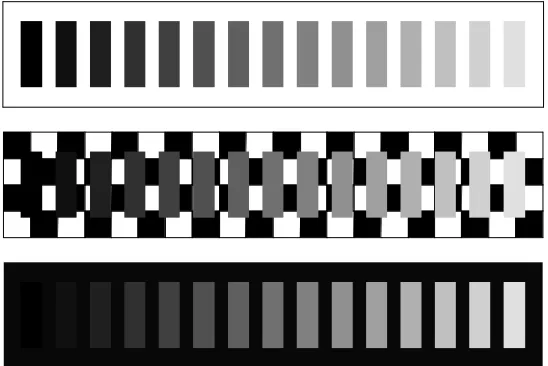
Recently Economou, Zdravkovic, & Gilchrist (2007) applied the locus of error paradigm to SLC displays employing a matching method. The method consists in finding the matches of each target on an achromatic Munsell scale. The scale they used ranged from Munsell 2.0 to Munsell 9.5 by means of 16 equally spaced rectangular chips placed from darkest to lightest on a white-black chequered background. Based on the Anchoring theory, the authors predicted a major error for targets on the black back-ground against no or a small error for targets on the white backback-ground (Fig. 1). According to their arguments, both classic lateral inhibition models and more recent low level models, such as ODOG (Oriented Differences of Gaussians, Blackeslee & McCourt, 2003), should predict instead different or even opposite results in terms of the magnitudes of the illusion. The re-sults of their experiments largely agree with the predictions based on the Anchoring theory (Figure 2A).
Our intent is not to challenge the findings or the conclusions of Economou et al. (2007); rather we want to verify the robustness of the Neutral Value Munsell scale. In fact, the problem is of a methodological
nature, but it does not concern the matching method per se. Rather, the problem is related to the question that is being asked: which of the two targets shows the biggest departure from its actual value? This question requires, in fact, a basic assumption: that the Munsell scale (MS) is capable of showing actual lightness values, i.e. veridical percepts.
3. Veridicality and the Neutral Value Munsell Scale
Error and veridicality are two faces of a same coin. In order to ac-knowledge that something is wrong, you must assume that there is a truth-ful or correct answer. According to the locus of error paradigm, the MS provides a way to quantify both the perceptual difference between lightness targets that are physically equal, and also the perceptual difference between a lightness target and its veridical lightness value, as displayed on the scale. This last point is critical for theories in lightness perception: if we know what the target should look like, we can find where the error lies, quantify it, and even model hypothetic mechanisms.
At first glance the solution appears ideal. However there is an issue that ought to be addressed: is a Neutral Value Munsell scale actually capa-ble of showing veridical lightness values?
We must confess that we have no idea about what a veridical percept is, how it should look like, and how to distinguish it from a non-veridical percept. In our view, the distinction between veridical and non-veridical is pointless in visual perception. However, from a logical point of view we can speculate that a veridical percept should correspond to some perceptual feature of an object that does not change appearance despite relevant changes in the physical scene.
In lightness literature, it is an established fact that the main issues about lightness constancy concern changes in the level of illumination of a surface target and changes in the luminance pattern surrounding a surface target (background). An achromatic MS is by all means a lightness scale derived by conducting psychophysical experiments (Judd & Nickerson, 1975; Munsell, Sloan, & Godlove, 1933). The idea was to create interval scales to systemize and measure colour perception. However, in order to be able to speak about veridicality, a MS should not be affected by changes ei-ther in its level of illumination or in the intensities of its background.
The concept of error in perception 179
[image:6.595.161.435.225.408.2]Here we present the results of an experiment that uses the locus of er-ror paradigm but with three 16 step achromatic Munsell scales that differ only for the backgrounds against which they are seen (Figure 1).
Figure 1. Lightness scales on three different backgrounds.
4. The experiment
Munsell scales are usually employed with backgrounds that are either white-black chequered or completely white. We are aware of only one study that actually employed lightness-matching scales on different back-grounds (Jandò et al., 2003). The aim of such study was to solve the prob-lem of matching increment and decrement targets when a target does not seem to match any of the chips of a lightness scale. Last but not least, such study employed so-called simulated Munsell scales presented on a CRT.
In our experiment we used targets and Munsell scales derived from actual Neutral Value Munsell papers. The question that underlies our work is the following: If we change the background against which a MS is seen, will we get the same lightness matches for SLC displays?
targets had a luminance of 900 cd/m2, the background luminances were re-spectively 2400 and 80 cd/m2. The observers were assigned to three groups and each group used a MS on a specific background to perform the match-ing task: a white background, a black background, and a white-black chequered background (Figure 1). The scales ranged from Munsell 2.0 to Munsell 9.5, and consisted of rectangular chips (cm 6 × 2.2) distanced 0.2 cm from each other. MSs were placed 12 cm below the SLC display (Fig-ure 1); the same spotlight illuminated display and scales.
[image:7.595.131.463.386.567.2]To summarize, we had a within subject variable (target background, TB: black, white) and a between subject variable (Munsell scale back-ground, MSB: white, black, white-black checkers).
Figure 2B shows the mean matches for the three levels of MSB; axes intersect at the actual log reflectance of the targets. An ANOVA for re-peated measures, with MSB as between factor, was conducted on the data: both MSB (F2, 45=9.52, p<0,0005) and TB (F1,45= 96.135, p<0,0001) pro-duced significant effects.
The concept of error in perception 181
With respect to the target on the black background, unpaired t-tests show that the Munsell scales on the white and on the white-black chequ-ered backgrounds, and Munsell scales on the white and on the black back-grounds, determined matches that are statistically different (respectively: T30=2.67, p=0.012; T30=3.84, p=0.0006), while Munsell scales on the white-black chequered and the black backgrounds determined matches that were statistically indistinguishable (T30=1.09, p=0.2). As for the target on the white background, there is a tendency for a significant difference only between matches carried out with Munsell scales on the white and the black backgrounds (T30=1.99, p=0.055).
With reference to the question we put forward, the main result of our experiment is that while matches for the target on the white background are relatively stable, those for the target on the black background are highly sensitive to the background against which a MS is seen. Given these re-sults, can we still consider the achromatic MS a reliable instrument capable of showing veridical lightness values?
5. Conclusions
Despite our results challenge the Anchoring theory in different ways3, the aim of this paper is not to question its validity, but to put forward an ar-gument against the widespread use of the concepts of error and veridicality in visual perception sciences.
Our findings, in fact, show that matches performed by using an achromatic MS can change depending on the background against which the scale is seen. In other words, the MS is not a perfect measuring instrument, in the sense that it does not belong to the physical domain: it is by all means a lightness scale, i.e. a psychophysical scale that lies entirely inside the phenomenological domain, hence it’s appearance can be affected by photo-geometric factors within a given visual scene, just like any other ob-ject displaying lightness. Researchers should bear this in mind when they report and discuss their data. It is safe to use matching data to describe the directions of illusions and even to quantify the magnitude of lightness in-duction between surface targets. However, even in this last case researchers should be aware of the fact that the value of their quantifications are
tive to the instrument they used to measure an effect. In fact, our data sug-gests that lightness scales look less like a ruler and more like a rubber band with the average intensity of the scale’s background acting like a stretching the scale either from the black end or the white end.
We nevertheless understand that one might still be tempted to consider the Munsell scale on the white-black chequered background as the only ap-propriate scale to use. This would be true if we could ultimately say that a white-black chequered background is a neutral background that has no ef-fect whatsoever on the MS. If this were the case, then such scale– background combination would eventually be the only one capable of showing “veridical lightness”. This conclusion is however still question-able.
First of all, no background can be considered “neutral”, that is having no effect on a target placed on top of it. Neutral displays in visual percep-tion just do not exist. Perceppercep-tion is about ratios and funcpercep-tional relapercep-tionships among features inside the proximal stimulus; we believe there is very little space left for absolute intensities.
Secondly, such a conclusion leads to an epistemological dead-end: how can we know that the lightness values on the Munsell scale seen against a white-black chequered background are veridical? What makes them more veridical than the values seen against a white or a black back-ground?
If veridicality is a concept devoid of empirical grounds in visual per-ception, it is obvious that the notion of error is also in trouble. You cannot flip a coin that has only one side to it: such a coin just does not exist in our phenomenal world.
References
Blakeslee B., & McCourt M.E. (2003). A multiscale spatial filtering account of brightness phenomena. In L. Harris & M. Jenkin (Eds.), Levels of Perception. New York: Springer, pp. 47-72.
Da Pos O., & Zambianchi E. (1996). Visual illusions and effects: A collection. Mi-lano: Guerini & Associati.
Economou E., Zdravkovic S., & Gilchrist A. (2007). Anchoring versusspatial fil-tering accounts of simultaneous lightness contrast. Journal ofVision, 7, 1-15. Gibson J.J. (1979). The ecological approach to visual perception. Boston:
Hough-ton Mifflin.
The concept of error in perception 183
Gilchrist A. (2006). Seeing Black & White. New York: Oxford University Press. Gregory R., Harris J., Heard P., & Rose D. (1995). The artful eye. Oxford, UK:
Oxford University Press.
Jandò G., Agostini T., Galmonte A., & Bruno N. (2003). Measuring surface achromatic color: Toward a common measure for increments and decrements. Behaviour, Research Methods, Instruments & Computers, 35, 70-81.
Judd D.B, & Nickerson D. (1975). Relation between Munsell and Swedish Natural Colour System scales. Journal of the Optical Society of America, 65, 85-90. Knill D., & Richards W. (1996). Perception as Bayesian Inference. Cambridge
University Press.
Munsell A.E.O., Sloan L.L., & Godlove I.H. (1933). Neutral value scales. I. Mun-sell Neutral Value Scale. Journal of the Optical Society of America, 23, 394-411.
Rock I. (1983). The logic of perception. Cambrige, MA: MIT Press.
Abstract
This work deals with the concepts of “error” and “veridicality” in visual perception studies by considering the matching paradigm often employed in empirical re-search to study simultaneous lightness contrast (SLC). Matching paradigms often employ Neutral Value Munsell scales, and there is a strong tendency in the field to consider these scales as a ruler capable of showing veridical lightness values, that is perfect transformations of reflectance values into perceptual values. If this were the case, then Munsell scales should show high constancy to critical changes inside the visual scene. We performed an experiment in which three groups of observers were asked to perform a matching task for a classic SLC display. Each group used the same Munsell scale (MS) but seen against three different backgrounds: white, black, or white-black chequered. Results showed that the background against which the MS is seen heavily influences matches for the target on the black back-ground of the SLC display. Our results support the claim that achromatic Munsell scales are not capable of showing veridical lightness values.
Riassunto
critici in una scena visiva. Abbiamo condotto un esperimento in cui tre gruppi di osservatori dovevano trovare su una SM il valore di bianchezza corrispondente a quello dei target in una classica configurazione CSB. Ciascun gruppo ha utilizzato la stessa scala ma vista sopra uno dei seguenti sfondi: bianco, nero, a scacchi bian-co-neri. I risultati mostrano una forte influenza dello sfondo della SM sulle valuta-zioni di bianchezza per il target CSB su sfondo nero. I nostri risultati sono di sup-porto all’affermazione secondo cui una scala Munsell non è in grado di mostrare valori veridici di bianchezza.
Addresses. Olga Daneyko, Department of Psychology “Gaetano Kanizsa”, Uni-versity of Trieste, Via S. Anastasio 12, I-34134 Trieste, Italy.