Declining object recognition performance in Semantic
Dementia - a case for stored visual object representations
TREE, Jeremy J. and PLAYFOOT, David <http://orcid.org/0000-0003-0855-334X>Available from Sheffield Hallam University Research Archive (SHURA) at: http://shura.shu.ac.uk/11762/
This document is the author deposited version. You are advised to consult the publisher's version if you wish to cite from it.
Published version
TREE, Jeremy J. and PLAYFOOT, David (2015). Declining object recognition
performance in Semantic Dementia - a case for stored visual object representations. Cognitive Neuropsychology, 32 (7 - 8), 412-426.
Copyright and re-use policy
See http://shura.shu.ac.uk/information.html
Abstract
The role of the semantic system in recognising objects is a matter of debate. Connectionist
theories argue that it is impossible for a participant to determine that an object is familiar to
them without recourse to a semantic hub; localist theories state that accessing a stored
representation of the visual features of the object is sufficient for recognition. We examine
this issue through the longitudinal study of two cases of Semantic Dementia, a
neurodegenerative disorder characterised by a progressive degradation of the semantic system.
The cases in this paper do not conform to the "common" pattern of object recognition
performance in Semantic Dementia described by Rogers et al (2004b), and show no
systematic relationship between severity of semantic impairment and success in object
decision. We argue that this data is inconsistent with the connectionist position but can be
easily reconciled with localist theories that propose stored structural descriptions of objects
outside of the semantic system.
Recognising that a visual object is familiar requires first that the visual features of the object
are sufficiently processed and second that those features are successfully matched with
knowledge stored in long term memory. In this paper, the term "recognition" is used to
describe the process whereby an individual determines that they have encountered a
particular stimulus before. The precise nature of the knowledge that is sufficient for object
recognition as defined above is the subject of considerable debate in the literature. Key
theorists can broadly be divided into two camps. One group, dubbed connectionists, consider that “the ability to recognize objects from vision always draws upon semantic resources” (Rogers, Lambon Ralph, Hodges, & Patterson, 2003, p. 627) - that is, success is predicated on
alternative localist position (e.g. Coltheart, 2004) is that recognition only requires identifying that an object is - it is not critical to retrieve the name of the object, to be able to categorise it or to understand its use as long as a matching visual featural representation can be found in
memory. A representation cannot have been stored in memory if the object has not been
encountered previously, thus finding a matching featural representation is only possible for
familiar objects. The implication of this difference of theoretical views is that the latter
assumes no necessary relationship between intact or impaired object recognition and intact or
impaired conceptual semantics.
Traditionally, models of visual recognition posited that two types of representation are stored
in long term memory (e.g. Hillis & Caramazza, 1995). The first of these provides a
structural description of each particular object that belongs to a given object class. For example, a structural description of "chair" may include four vertical cylinders of equal
length, a flat horizontal surface and a second flat surface that stands upright along one edge
of the horizontal surface. The second type of representation is a conceptual semantic
description of the object. In relation to our previous example, this would include information
that the horizontal surface allowed the user to sit and that the upright surface provided back
support to the person sitting on the object, which was called a "chair." Typically testing of
object recognition and the stored structural description system involves the object decision
task (e.g., Riddoch & Humphreys, 1987a). In this task, the participant must determine
whether the picture they are presented with represents an existing object or a chimera - a
non-existent object that is a recombination of parts from real items. For example, a chimera may
combine the head of a goat with the body of a camel. In traditional cognitive
neuropsychology, it was argued that success at this visual object recognition paradigm
required. This suggestion of a separation between structural and semantic description systems
was predicated on the performance of brain damaged patients with agnosia. Lissauer (1890) argued for a distinction between two forms of visual agnosia which relate to dysfunction at
different stages of the perceptual process, and this notion has received support from
researchers in the field (e.g. McCarthy & Warrington, 1986; Riddoch & Humphreys, 1987b;
Warrington & James, 1988). The first is termed apperceptive agnosia, which relates to an inability to create a perceptual representation from vision. Patients with apperceptive agnosia
perform poorly in tasks that require that they make discrimination on the basis of shape (e.g.
Efron, 1968; Warrington & James, 1988) and without an adequate perceptual representation
of the stimulus any attempt to process it for recognition or meaning is likely to be
unsuccessful. The second type of visual agnosia is associative in nature. Cases with this presentation are able to perform normally in perceptual tasks (such as matching pictures of
the same object from different viewpoints) but cannot associate the visual stimulus with
meaning. Importantly, a number of published studies have described associative agnosic
patients who were able to perform normally on the object decision task even though they
were unable to access semantic information about visual objects (e.g. Carlesimo, Casadio,
Sabbadini & Caltagirone, 1998; Hillis & Caramazza, 1995; Riddoch & Humphreys, 1987a).
These authors have argued that in such cases the damage at the root of the disorder must be
limited to connections between the visual system and the semantic system. Rogers et al.
(2003), however, offered an alternative explanation. Specifically, they argued that damage to
the semantic system causes the patient to lose specific knowledge of objects and instead fall
back on the general conceptual knowledge that is preserved. As a result, they argue, patients
may appear to be recognising visual objects in the normal range in spite of poor semantics when in actuality they are offering guesses based on the existence (or absence) of unusual
the relationship between semantic performance and object recognition in the context of the
neuropsychological presentation that is the focus of this paper.
In recent years, however, the independence of structural and semantic description systems has
been called into question on the basis of studies of patients with Semantic Dementia (SD;
Hodges, Patterson, Oxbury & Funnell, 1992; Snowden, Goulding & Neary, 1989). SD is a
variant of primary progressive aphasia in which the focal impairment is of semantic memory,
while other cognitive processes are left relatively intact. Several reports have demonstrated
that the object decision accuracy of patients with SD is below the normal range and that the
degree of object decision impairment is a correlated with the severity of semantic impairment
in these cases (Patterson et al., 2006; Rogers et al., 2003). The above authors argue that these
findings indicate that deficits in semantic processing are the keystone of poor performance in
object decision. In short, object agnosia emerges as a consequence of conceptual semantic
impairment. More generally, connectionists consider that damage to the semantic system will
have an adverse impact on processing of input from any sensory modality (Rogers, Lambon
Ralph, Garrard, Bozeat, McClelland, Hodges & Patterson, 2004). Using a computer
simulation, they demonstrated that damaging a single semantic network, a transmodal "hub"
for cognitive processing that acts to integrate information received from the brain areas that
underpin the processing of input signals, can recreate the cardinal features of SD. The
successful simulation of patient data in four tasks (picture naming, word-picture matching,
categorization and delayed copying of pictures) was achieved without requiring that
modality-specific "spokes" were damaged. Since Rogers et al.'s (2004a) model, data from
neuroimaging studies have suggested that the patterns of activity in the bilateral anterior
temporal lobes (ATL) are a good fit for the theoretical action of a transmodal semantic hub.
of input modality and that these areas are not activated in non-semantic tasks of similar
difficulty (see Lambon Ralph, 2014, for an overview of this research). Two crucial
assumptions of this model are that a) damage to the semantic hub will adversely affect
performance in all semantic tasks and b) that object recognition necessitates access to
semantics, but that stimuli that are in some way unusual (or atypical) are more reliant on the function of the semantic hub (Patterson et al., 2006; Plaut, 2002; Rogers et al., 2003; Rogers,
Lambon Ralph, Hodges & Patterson, 2004b).
However, there are several case studies reported in the literature concerning SD and object
recognition that call into question the assumptions of the hub and spoke model. It has been
shown that patients with semantic deficits do not necessarily perform poorly on tasks that
connectionists argue rely on the semantic system. For example, AT (Hovius, Kellenbach,
Graham, Hodges & Patterson, 2003) was a semantic dementia case who scored significantly
below the normal range on spoken word-to-picture matching tasks requiring a level of object
comprehension, but showed no impairment on object decision. This is at odds with an
assumption that semantics must be accessed as a precursor to the recognition response. More
compelling still are the reports of two patients (SB, Sheridan & Humphreys, 1993; RS,
Samson & Pillon, 2003) who were able to recognise objects with the same level of accuracy
as a healthy control sample even when the object decision task had been specifically
constructed to include members of a category for which comprehension was impaired. SB,
for example, was able to successfully verify the meaning of only 55% of sentences about
foodstuffs (e.g. "Onions grow on trees") in a yes/no task, yet her accuracy was 96% when
presented with an object decision task using foodstuffs and food-like chimera. In these
reports the patients are able to recognise specific objects for which they cannot access
are able to access the semantic system from one modality but not another. DJ could
understand written words but was not able to generate the meaning of visual objects.
Also of relevance to the debate regarding the relationship between semantic performance and
object decision accuracy are the data from neuropsychological studies of individuals with
"category-specific" semantic deficits. Such cases can show a selective impairment in
comprehension of one class of objects (e.g. animals) while their access to semantic
information about another class of objects (e.g. fruit/vegetables) remains intact. Some
theorists (e.g. Caramazza, Hillis, Rapp & Romani, 1990) suggest that representations of items
that share some meaning are clustered together in the semantic system, and that
category-specific deficits reflect instances where the neural structures that hold the representations for
only one cluster have been damaged. Other theorists (e.g. Humphreys & Forde, 2001)
consider that a "semantic" deficit could reflect damage to the structural description system,
because objects that have a similar meaning are also likely to share visual features. For
example, the structural description of an animal may be likely to include four legs, a tail and
fur. Thus an inability to identify these features will disproportionately affect objects in the
animal category, sparing the ability to describe fruit and vegetables. Capitani, Laiacona,
Mahon and Caramazza (2003) conducted a review of 79 published reports of patients with
category-specific deficits in an attempt to examine these two positions and concluded that the
structural description system operates relatively independently from conceptual knowledge.
That is, it appears that category-specific semantic deficits arise from damage to the semantic
system and are not artefacts of damage to other knowledge stores.
Given that category-specific semantic deficits indeed appear to be semantic in their locus, the
exhibit difficulties in recognising only those objects for which they cannot access meaning. Caramazza and Shelton (1998) described the performance of EW on picture naming and
object recognition tasks. EW showed a marked deficit in retrieving the names for animals
using the Snodgrass and Vanderwart picture set, and a similarly clear deficit in distinguishing
real from non-real animals in object decision. Her naming and recognition of non-animal
stimuli was within the normal range. EW, therefore, performs exactly as the connectionist
framework expects. Again though, this association between semantics and object recognition
is not universal amongst cases with category-specific deficits. Blundo, Ricci and Miller
(2006), for example, reported the case of KC who also showed a deficit in naming the animal
items from Snodgrass and Vanderwart but showed no difficulty in distinguishing pictures of
real animals from chimaera. According to localist theories, typified by Coltheart (2004), this dissociation between patterns of performance in semantic and visual tasks is possible because
of modality-specific stores of the visual forms for all stimuli that are familiar to the
participant. This model suggests, therefore, that it is possible to recognise an object on the
basis of the visual features of the input (stored structural representations for objects – stored
orthographic representations for words). Thus it is possible for the semantic system to
become damaged (as it does in SD) without requiring any impairment in object decision, provided that the stored structural representations remains intact (see Coltheart, Saunders &
Tree, 2010 for a discussion of this principle in relation to visual word recognition).
Rogers and his colleagues (2003; 2004b) have suggested mechanisms by which object
decision performance can remain good in the face of semantic impairment despite the
assumptions of their model – and thus attempt to account for the contrary evidence discussed
earlier. Their position is that information is encoded through the weights of connections
experience. That is, pairs of input and output that are encountered often are associated by
stronger connections. The strength of a given connection may be increased either by
accessing that specific stimulus or because of overlap with other items in the same category.
Thus, according to Rogers et al (2003; 2004b), object decision can remain accurate when the
target is typical of the category and the distractor is not or when the target itself is highly familiar. In essence then, these authors argue that object decision performance (successful or
otherwise) is confounded with this typicality variable – such that ‘intact’ performance may in fact simply reflect stimulus selection that was insufficiently rigorous. To attempt to confirm
this, Rogers et al created a two-alternative forced-choice version of the object decision task.
In this task the participant is shown a picture of an object and a chimera at the same time, and
is asked which of the stimuli is real. Targets can be of high or low familiarity and pairs of
stimuli vary in terms of how "typical" they are of that category of objects. For example, most
members of the "animal" category do not have horns at the end of their noses. Thus a
rhinoceros is a real animal that is less typical of the animal category than a version of the rhinoceros depicted without the horn; a donkey is a real animal that is more typical of the animal category than a picture of a donkey with a horn added. Rogers et al (2004b) showed
that, in a group of SD patients, target familiarity interacted with the typicality factor. High
familiarity targets were recognised accurately irrespective of whether they were more or less
typical than the chimera. When the target was not commonly encountered, however, patients
made a greater number of errors when the chimera was the more typical of the category. The
authors argued that in the face of semantic impairment, SD cases become dependent on
general (or ‘default’) properties when performing object decision tasks. Moreover, this
dependence increases in the face of further semantic memory deterioration - thus the size of
the interaction likely increases during disease progression as the semantic deficit becomes
decision performance in SD without the need for representations of visual forms in a pictorial
lexicon.
It should be noted, however, that the pattern reported by Rogers et al (2004b) is by no means
incompatible with theories that propose a visual object lexicon - under the localist framework
both the effects of familiarity and visual overlap with other known objects can be seen as
lexical effects. Related to this issue, Grainger and Jacobs (1996) argued that correct word
recognition responses can occur either because the stimulus is an exact match to a stored
visual representation, or because the stimulus looks like it could be a real exemplar. In the absence of an exact match for the input, participants may guess that they ought to recognise
the stimulus on the grounds that there are sufficient overlapping features with familiar words.
A similar decision process may well be applied to object decision. High familiarity targets
would be recognised because a matching representation could be determined from stored
structural descriptions. When targets are low familiarity, and hence an exact match cannot be
found quickly, any features that overlap with other known objects will increase the activation
of currently stored structural descriptions. The participant is likely, therefore, to guess at the
more typical of the two presented options. Although this process may produce an interaction
between familiarity and typicality, it does not necessarily implicate semantics in the size (or
even the existence) of the interaction.
Another interesting theory of the potential relationship between semantic performance and
object decision accuracy was offered by Zannino, Perri, Caltagirone and Carlesimo (2011;
also Zannino, Perri, Monaco, Caltagirone, Luzzi & Carlesimo, 2014) who argued that
system reaches a catastrophic level, at which point accuracy will improve. Zannino et al
(2011) suggested that there are two possible ways to complete an object decision task; a
visual strategy and a semantic strategy. In their view, objects can be recognised via accessing
modality-specific visual representations. However, the default strategy for object (and indeed
word) recognition responses is to rely on a semantic hub. In SD the semantic system has
become compromised, so the use of a semantic strategy relies on faulty information and is
thus inaccurate. By contrast, agnosia is characterised by a disconnection between
modality-specific visual representations and the semantic hub, and this disconnection precludes the use
of a semantic strategy. Agnosics therefore perform object decision tasks via a visual strategy
which enables accuracy in these cases to remain good. If we take this theory to its logical
conclusion, it is possible to suggest that SD disease progression will eventually damage the
semantic system to such an extent that it becomes "pathologically disconnected" (Zannino et
al., 2001, p. 2113) from the modality-specific representation system. This leads to a
particularly interesting prediction - that at some point the object decision performance of SD
cases may dramatically improve following an initial decline. Such a prediction can only be
assessed through longitudinal study.
This study is a longitudinal assessment of two SD cases, directly comparing semantic
performance and corresponding ability to perform object decision. The three theories
outlined above make distinct predictions about the relationship between comprehension and
recognition tasks. The hub and spoke model predicts that as semantic ability decreases so too
will object decision accuracy, and that interactions between target familiarity and object
typicality will be greater when semantic processing is more severely compromised. Zannino
et al's (2011) work suggests that this may not be the case throughout the disease progression,
occurred) object recognition performance may return to normal or near-normal levels.
Coltheart's (2004) position is that there need never be a relationship between object
recognition performance and semantic ability provided that separately stored object structural
representations remain intact.
Method
Case summaries
When we started to collect the data described in this paper, JD was 59 years old. The
background to her diagnosis and her performance on a number of different cognitive tasks
have been described elsewhere (e.g. Playfoot, Izura & Tree, 2013; Playfoot, Tree & Izura,
2014). JD had deficits in semantic processing tasks (e.g. Pyramids and Palm Trees, Howard
& Patterson, 1992), but her performance on tests of basic visual processing were within the
normal range. She exhibited no difficulties in tests of grammar processing (Test for
Reception of Grammar, Bishop, 1982), rhyme judgement, phonological segmentation, word
or non-word repetition (from Psycholinguistic Assessment of Language Processing in
Aphasia, Kay, Lesser & Coltheart, 1992).
NJ (born 1948) first approached the researchers in 2002 after referral by their GP regarding
word-finding difficulties (anomia). Although at that point mild, NJ was a highly articulate
individual (with a PhD in English Literature) and a wealth of experience in public speaking
(both as a lecturer and amateur actor/play-write) and thus he felt there was a cause for
complicating medical factors – family history was also unremarkable, with no history of
similar dementia in recent memory and no evidence of general anxiety and/or depression. Over subsequent years NJ’s anomia markedly worsened, and additional comprehension
difficulties began to emerge. By 2005, based on his behavioural profile and radiological
investigations (indicating bilateral temporal atrophy), NJ was given a clinical diagnosis of
semantic dementia and he had retired from his work as a lecturer – despite his increasing
deterioration in language abilities, NJ remained an excellent artist and draftsman – exhibiting
work in the local area for a number of years after diagnosis. There was also no evidence of a
general deterioration in other cognitive processes, and NJ should no impairment in general
activities of everyday living. Prior to the commencement of this study, he performed in the
normal range on tests of visual processing, rhyme judgement, segmentation, repetition and
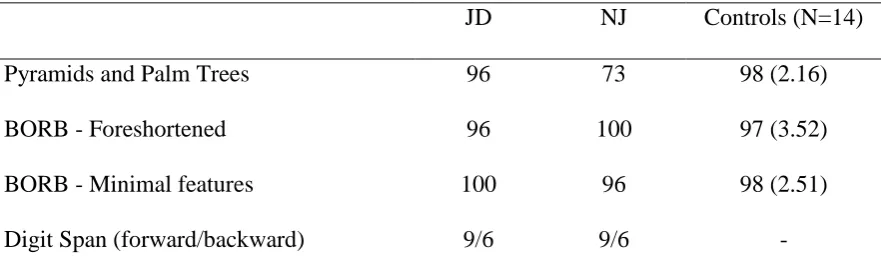
grammatical processing (on the same tests as for JD, above). Table 1 presents the baseline
performance of both cases on the critical tests for this paper, alongside descriptive statistics
for a group of healthy control participants (N = 14, 10 of whom were female, mean age =
63.5 years, SD of ages = 3.5) recruited as part of the current study.
(Table 1 about here)
Materials
We used three different tests in total. The Pyramids and Palm Trees (Howard & Patterson,
1992) presents participants with a picture cue and asks them to indicate which of two possible
semantic decline caused by the progression of the dementia in our cases. As a measure of
basic visual processing ability (to rule out an apperceptive agnosia), JD and NJ were asked to
complete the Foreshortened View and Minimal Feature tasks from the Birmingham Object
Recognition Battery (BORB, Riddoch & Humphreys, 1993). The critical measure used in the
current study was the Over-Regular Object Test (OOT; Rogers et al., 2004b). This task
presents participants with pairs of line drawings. One picture in each pair is an existing
object. The second picture is a chimera, where the existing object has had one distinguishing
feature altered. The participant is required to indicate which of the two pictures is real.
Target objects vary on the basis of familiarity. The important manipulation in this task is that
the objects vary also in their "typicality" - the degree to which this particular object matches
with the features of the other objects in that class. For example, a "typical" animal has
relatively small ears. Thus a drawing of a chimeric elephant with small ears is more typical
of the "animal" category than a drawing of a real elephant with large ears. The OOT contains
30 pairs such as this, where the real object has a feature that is atypical of the category that
the non-real item does not (these are known as the NR > R items). The OOT also contains 30
pairs in which the real item is more typical of the category than the non-real item (R > NR
trials). For example, real monkeys have small ears so an accurate drawing of a monkey is
more typical of "animal" than a chimeric monkey with large ears.
Procedure
JD performed the above tasks on 5 occasions. The test periods were roughly a year apart.
For NJ, there were 4 test sessions. A year separated the first two sessions, and the tasks were
repeated every 6 months thereafter. In any given test session the BORB, OOT and semantic
screen, and instructions and encouragement were provided verbally. Interestingly both cases
said they felt they were guessing when presented with the OOT - this was true for all sessions.
Results
The longitudinal performance of each of our cases on each of the tasks is presented in Table 2.
It appears from this table that a) semantic performance decreased for both JD and NJ and b)
that basic visual processing performance and object decision performance remained fairly
stable over time. The following sections analyse these data more formally with regard to
specific research questions. Firstly, we examined whether either of our cases presented an
apperceptive agnosia at any point. Secondly, we assessed the point at which their semantic
performance became significantly impaired, and whether this ability continued to decline.
Finally, we examined performance on the OOT to determine when performance became
impaired versus controls, whether the pattern of impairment matched the pattern reported by
Rogers at al. (2004), and whether there was a systematic relationship between performance
on this tasks and the degree of semantic impairment. All descriptive statistics are presented
in Table 2.
(Table 2 about here)
In what follows we used Crawford's t-test (Crawford & Howell, 1998) to compare patient
formally assess changes in accuracy for each of our cases in consecutive sessions. Finally we
used chi square analyses to examine accuracy across stimulus types and to compare the
performance of JD and NJ.
Visual impairment and apperceptive agnosia.
We compared the performance of each of our cases on two subtests of the BORB battery with
data from the normative population reported by Riddoch and Humphreys (1993) in the
publication of the tests. Results indicated that both of our cases performed in the normal
range throughout the testing period for both BORB tasks (all p > .1). These findings make it
unlikely that any errors made in object decision stemmed from deficits in basic visual
processing.
Semantic performance
Semantic performance (as measured using Pyramids and Palm Trees) was already impaired
for NJ at initial testing [t(13) = 10.881, p < 0.01], and JD was significantly impaired from
session 2 [t(13) = 6.741, p < 0.01] versus our healthy control group. Performance continued
to decline significantly for JD and for NJ over the duration of the testing period. JD's accuracy was significantly poorer in the second session than it had been in the first [Χ2
(1) =
5.1429, p < .05]. By the final session, JD had dropped from 96% to only 62% on this task - a significant overall decline [Χ2
(1) = 14.45, p < .001]. Although NJ's accuracy decreased from
one session to the next across the whole testing period, only the drop between consecutive
overall score on the semantic task decreased by a significant 21% over the 4 sessions [Χ2 (1)
= 12, p < .001].
Object Decision
In Rogers et al's (2004b) original report on the OOT, the semantic dementia cases they
studied made the greatest number of errors in trials where the chimera was more typical of
the category than the target, and the target itself was of low familiarity. This pattern was
exacerbated in cases with more severe semantic deficits. According to this position, our
patients ought to show impairments on low familiarity NR > R trials earlier in the disease
progression than high familiarity NR > R trials, and may remain relatively unimpaired in R >
NR trials until later test sessions.
Analyses indicated that JD was not significantly impaired for high familiarity NR > R or low
familiarity R > NR trials at in any session (all p < .1). She performed significantly worse
than controls for the high familiarity R > NR trials from the penultimate session [t(13) =
3.531, p < 0.01] and again in the final session. JD's recognition of objects in the low
familiarity NR > R trials remained in the normal range until the final session, whereupon it
became impaired [t(13) = 4.034, p < .001]. This is not the pattern that would be expected
according to Rogers et al (2004b) - in fact JD's object decision performance remained good
long after the semantic system had been compromised.
NJ performed at ceiling for all trial types in the first test session. He showed significantly
session 2 [t(13) = 5.560, p < 0.001]. He dropped significantly below the normal range for
high familiarity R > NR trials in session 3 [t(13) = 3.531, p < 0.01] but returned to the normal
range thereafter. His accuracy in low familiarity NR > R and low familiarity R > NR trials
remained normal until the final session [t(13) = 5.872, p < 0.001 and t(13) = 4.649, p < 0.001,
respectively]. This is also a marked departure from the pattern reported by Rogers et al
(2004b). JD's accuracy did not decrease significantly for any trial type across any adjacent
sessions, and neither did NJ's (all p > .1).
Rogers et al (2004b) reported that the accuracy of the semantic dementia cases that they
tested on the OOT showed an interaction between target familiarity and object typicality.
Specifically, accuracy in their sample tended to be high when the target object is more typical
of that category that the foil - this was true irrespective of how frequently the target object
was encountered in itself. Accuracy dropped significantly when the target was less typical of
the object category than the chimera, and a greater decrease in performance was observed
when the target was unfamiliar than when it was a common object. As can be seen in Figure
1, neither of the cases we describe in this paper showed the pattern Rogers et al (2004b)
reported consistently. In fact, only in the fourth session with NJ does the object decision
performance data represented in the figure look anything like the interaction between
typicality and object familiarity that Rogers et al described.
We used chi square to examine these data more closely. As JD performed at ceiling for low
familiarity R > NR trials throughout, no formal analyses including this condition could be
computed, and neither could comparisons with any trial type for which JD achieved 100% in
similarly in all conditions and in all sessions. In her final session, her accuracy for low
familiarity NR > R was significantly poorer than for high familiarity NR > R trials [Χ2 (1) =
6.166, p < .05].
NJ performed significantly worse in high familiarity NR > R trials than he did in all other
conditions in the third session [all Χ2 (1) = 12.792, p < .001]. Responses in high familiarity
NR > R trials remained significantly less accurate than for low familiarity R > NR and low
familiarity NR > R trials in session 4 [Χ2 (1) = 6.166, p < .05 in both instances], but was not
significantly different from high familiarity R > NR trials [Χ2 (1) = 1.306, p > .1]. In the final
session, NJ's showed a typicality effect, but not a familiarity effect, and no interaction
between the two factors. His accuracy was statistically equivalent in R > NR trials
irrespective of familiarity [Χ2 (1) = 1.389, p > .1]. Accuracy in high familiarity R > NR trials
was significantly better than in high familiarity NR > R trials [Χ2 (1) = 6.166, p < .05].
Accuracy was also significantly better in low familiarity R > NR trials than in low familiarity NR > R trials [Χ2
(1) = 5.281, p < .05].
(Figure 1 about here)
In summary, neither case ever showed the pattern reported by Rogers et al (2004b). In the
final session, NJ showed an effect of typicality, but not of familiarity, and no interaction; JD
The nature of neuropsychological case study methodology, such as ours, is that there are
insufficient data points available to formally assess the relationship between semantic
performance and object decision scores using correlation or regression methods.
Nevertheless, we wanted to statistically analyse this relationship. Rogers et al.'s (2004b)
argument is that there is an association between semantic ability and object decision
performance. That is, object decision accuracy should decline roughly in line with semantic
performance. Hence the difference between PPT score and OOT scores should not be greater
in our cases than is possible in a control sample. By that logic, if a dissociation can be
determined it is unlikely that the same underlying cognitive system is being used for both
tasks. Crawford and Garthwaite (2007) developed the Bayesian Standardized Difference Test,
which allows for the formal examination of whether a single case exhibits a dissociation
between ability on two tasks. This test determines a) whether an individual is impaired on
task X, b) whether the individual is impaired on task Y and c) whether a difference between
performance on tasks X and Y as large as that exhibited by the test case is likely to occur in a
control population. The test takes into account normal performance on each task and the
correlation between scores on task X and Y in a control group is incorporated into the
calculation. Importantly, this test has been shown to allow only a small number of Type 1
errors, even if the distribution of control scores is severely skewed (as it is likely to be in
neuropsychological testing). Further, the Bayesian Standardized Difference Test is able to
take into account the severity of the patient's impairment in the tasks, becoming more
conservative when the impairment is greater.
Crawford and Garthwaite (2007) define two types of dissociation between scores on a pair of
unimpaired for test X but impaired for test Y exhibits the classical dissociation. A strong dissociation is observed when a patient is impaired for both tests relative to a control sample,
but their deficit is significantly greater for one test than the other. The computation of the
Bayesian Standardized Difference Test indicates whether a neuropsychological case fulfils
the criteria for either a classical or a strong dissociation and provides a p value for the
likelihood of a member of the control sample showing a discrepancy between test scores as
extreme as the patient. We ran the Bayesian Standardized Difference Test on observations
from JD and NJ in each test session, comparing their performance to out 14 healthy controls.
In each instance, we included semantic performance (PPT) and one of the conditions of the object recognition task. Table 3, below, summarises the findings of these analyses.
(Table 3 about here)
JD was not impaired on either semantic or object recognition tests in the first test session.
With these exceptions, both JD and NJ showed significant dissociations between accuracy on
Pyramids and Palm Trees and the OOT in every condition and every test session. A few other observations about the relationship between semantic performance and object decision
accuracy should also be highlighted here. Firstly, at some point in the data collection both of
our cases scored 69% on the Pyramids and Palm Trees task. This provides a useful point of
comparison between JD and NJ, and a means to examine the hypothesis that semantic ability
is a key determinant of object decision performance. When both cases scored the same on
the semantic measure, JD outperformed NJ for high familiarity NR > R trials [Χ2 (1) = 12.792,
p < .001]. Secondly, in the penultimate and final sessions, NJ scored the same for Pyramids
and Palm Trees (58% correct), yet his performance in low familiarity NR > R object
between semantics and object decision is far more complex that argued by Rogers et al
(2004b).
Discussion
We administered tests of semantic ability, visual processing and object decision to two cases
of SD in a longitudinal study to assess the relationship between semantic decline and object
recognition performance. Our main findings can be summarised as follows; although both of
our patients showed considerable decline in semantic ability over time and both performed
below the normal range in object decision for at least some types of stimuli during the test
period, there was no predictable relationship between semantics and object recognition
accuracy. We acknowledge that the picture version of the Pyramids and Palm Trees test
requires the use of both the structural description system and the semantic system proposed
by localist theories. As a result our measure of semantic ability is not fully independent of
visual object recognition. However, in instances where the "semantic" deficit was the result
of error in the structural representation system, the relationship between Pyramids and Palm
Trees score and object decision score would have been increased. Further, as neither of our
cases exhibited problems in tests of basic visual perception it is unlikely that either a) poor
performance on Pyramids and Palm Trees or b) the dissociation between semantic ability and
object decision performance in our cases was the result of apperceptive issues.
These findings are not easily reconciled with the connectionist theory that recognising an
object as familiar necessitates recourse to semantics. According to the hub and spoke model
(Rogers et al, 2004a), the regions of the brain that are specialised to accommodate input from
interrogated by a transmodal semantic hub. As the modality-specific areas in this model do
not store long term representations the only mechanism for recognising familiar objects is the
semantic system. As a consequence, damage to the semantic "hub" system as occurs in SD
ought to result in poor object recognition performance, and the more severe the damage the
greater the deficit (Patterson et al., 2006; Rogers et al., 2003). This is not evident in our data.
Firstly, in sessions where JD and NJ had equivalent scores on the Pyramids and Palm Trees
task they were significantly different in their object decision accuracy. Secondly, in two
consecutive sessions NJ scored the same on Pyramids and Palm Trees but his object decision
accuracy was far lower in one session than the other. At the very least, this indicates that the
integrity of the semantic system is not the sole determinant of successful object recognition.
Such a finding can be accommodated by a localist theory (e.g. Coltheart, 2004) in which
object recognition relies on accessing a stored representation of the visual features of familiar
objects from a store of structural descriptions. In this framework it is theoretically possible
for the semantic system to become damaged without the structural descriptions being
compromised at all. Thus a case with significant semantic dysfunction may still perform
normally in object decision, and no consistent relationship between semantic performance
and object recognition is predicted.
Rogers et al (2003; 2004b) argued that both the familiarity and the visual typicality of an
object can impact on the likelihood of recognising it in a two-alternative forced choice task -
that is, that the presence of an effect of semantic ability on object decision performance could
be confounded by other factors. To reiterate from the introduction, the position of Rogers et
al is that meaning is represented by the weights of connections in a distributed network, and
that the weight of each connection is affected by individual experience. Stronger links exist
a well-practiced coupling of a single input with a single output (as in high familiarity objects)
or because the link is relevant to a large number of different stimuli from the same category.
In this framework, damage to the semantic system is most likely to adversely affect responses
to objects that are neither commonly encountered nor typical of the category (Patterson et al.,
2006; Plaut, 2002; Rogers et al., 2003; Rogers et al, 2004b). Again our data do not match
with this prediction. Neither of our cases ever showed the interaction between familiarity and
typicality reported by Rogers et al (2004b). JD performed equally well irrespective of target
familiarity and irrespective of which member of the pair was more visually typical of the
target category. NJ was affected by typicality but not by familiarity. In addition, the
presence or absence of these effects was not tied to the level of semantic dysfunction. We
demonstrated, in fact, that both of our cases showed strong or classical dissociations between
semantic performance and object recognition accuracy - that is, the discrepancy in their
scores on these two tasks was greater than that expected in a healthy control population. In
each case, performance was significantly worse in the test of semantic ability than in object
decision. This pattern of performance can also be accommodated by a localist theory that
does not implicate semantics in object recognition, but pose questions for a theory in which
the semantic system is integral to object recognition.
Zannino et al (2011) suggested that object recognition could be accomplished either by
recourse to semantics or by accessing a modality-specific representation in long term memory.
They argued that the default strategy when performing object decision tasks was to rely on
the semantic system unless this was pathologically disconnected from the modality-specific
system (as in visual associative agnosia). On this assumption, the performance of SD cases
in object decision tasks should initially decline in line with the severity of the semantic
data do not support a linear relationship between semantic ability and object recognition
performance. Zannino et al's (2011) position, if taken to a logical conclusion, would suggest
that if the damage to the semantic system became sufficiently extensive to preclude its use in
object recognition then performance on object decision may improve later in disease
progression - once the semantic system is no longer a viable option the patient will begin to
use the modality-specific representations instead. Although our data do not support this
prediction our findings do not rule out the potential for object decision accuracy to ultimately
improve. It could simply be that neither of the cases described in this paper had semantic
damage severe enough to force them to switch to the modality-specific strategy to perform
the task. However, we consider that this is not likely given that there was no predictable
relationship between semantic ability and object decision accuracy. We argue that object
recognition in JD and NJ is not based on the semantic system and instead relies on
modality-specific object based stored structural representations – which have become impaired to
varying degrees for both cases during disease progression. Given we assume no necessary dependence on the semantic system, there is no need for a ‘strategy switch’ to emerge and
hence we would not expect an improvement in performance at any stage during disease
progression.
Taken together, our findings call in to question the assumptions of connectionist theory, but
are readily reconciled with localist theories which propose the existence of a pictorial lexicon
(e.g. Coltheart, 2004). We argue that object decision does not necessitate semantic activation
to be successful, and that instead the identification of a modality-specific representation that
References
Blundo, C., Ricci, M., & Miller, L. (2006). Category-specific knowledge deficit for animals
in a patient with herpes simplex encephalitis. Cognitive Neuropsychology, 23, 1248-1268.
Bishop, D. (1982). Test for reception of grammar. Pearson Assessment.
Capitani, E., Laiacona, M., Mahon, B., & Caramazza, A. (2003). What are the facts of
semantic category deficits? A critical review of the clinical evidence. Cognitive Neuropsychology, 20, 213-261.
Caramazza, A., & Shelton, J.R (1998). Domain-specific knowledge systems in the brain: The
animate-inanimate distinction. Journal of Cognitive Neuroscience, 10, 1- 34.
Caramazza, A., Hillis, A.E., Rapp, B.C., & Romani, C (1990). The multiple semantics
hypothesis: multiple confusions? Cognitive Neuropsychology, 7, 161-189.
Carlesimo, G. A., Casadio, P., Sabbadini, M., & Caltagirone, C. (1998). Associative visual
agnosia resulting from a disconnection between intact visual memory and semantic systems.
Cortex, 34, 563–576.
Coltheart, M., Saunders, S., & Tree, J. (2010). Computational modelling of the effects of
semantic dementia on visual word recognition. Cognitive Neuropsychology, 27(2), 101-114.
Crawford, J. R., & Howell, D. C. (1998). Comparing an individual’s test score against norms
derived from small samples. The Clinical Neuropsychologist, 12, 482-486.
Craword, J.R., & Garthwaite, P.H. (2007). Comparison of a single case to a control or
normative sample in neuropsychology: Development of a Bayesian approach. Cognitive Neuropsychology, 24 (4), 343-372.
Efron, R. (1968). What is perception? Boston Studies in the Philosophy of Science, 4, New York: Humanities Press Inc., pp. 137-173.
Fery, P., & Morais, J. (2003). A case study of visual agnosia without perceptual processing
or structural descriptions impairment. Cognitive Neuropsychology, 20 (7), 595-618.
Grainger, J., & Jacobs, A.M. (1996). Orthographic processing in visual word recognition: A
multiple read-out model. Psychological Review, 103, 518-565.
Hillis, A. E., & Caramazza, A. (1995). Cognitive and neural mechanisms underlying visual
and semantic processing: Implications from “Optic Aphasia”. Journal of Cognitive Neuroscience, 7, 457–478.
Hodges, J. R., Patterson, K., Oxbury, S., & Funnell, E. (1992). Semantic dementia:
Hovius, M., Kellenbach, M. L., Graham, K. S., Hodges, J. R., & Patterson, K. (2003). What
does the object decision task measure? Reflections on the basis of evidence from semantic
dementia. Neuropsychology, 17, 100–107.
Howard, D., & Patterson, K. (1992). Pyramids and palm trees: A test of semantic access from pictures and words. Bury St Edmunds, Suffolk: Thames Valley Test Company.
Humphreys, G.W, & Forde, M.E (2001). Hierarchies, similarity and interactivity in object
recognition: "Category-specific" neuropsychological deficits. Behaviour and Brain Sciences, 24, 453-509.
Kay, J., Lesser, R. & Coltheart, M. (1992). PALPA: Psycholinguistic Assessments of Language Processing in Aphasia. Hove, UK: Lawrence Erlbaum Associates Ltd.
Lambon Ralph, M.A. (2014) Neurocognitive insights on conceptual knowledge and its
breakdown. Philosophical Transactions of the Royal Society B, 369: 20120392.
Lissauer, H. (1890). Ein Fall von Seelenblindheit nebst einem Beitrag zur Theorie derselben.
Archiv für Psychiatrie, 21, 222–270.
McCarthy, R.A. & Warrington, E.K., (1986). Visual associative agnosia: a clinico-anatomical
Patterson, K., Lambon Ralph, M.A., Jefferies, E., Woollams, A., Jones, R., Hodges, J.R., &
Rogers, T.T., (2006). "Presemantic" cognition in Semantic Dementia: Six deficits in search of
an explanation. Journal of Cognitive Neuroscience, 18 (2), 169-183.
Plaut, D. C. (2002). Graded modality-specific specialization in semantics: A computational
account of optic aphasia. Cognitive Neuropsychology, 19, 603–640.
Playfoot, D., Izura, C., & Tree, J. J. (2013). Are acronyms really irregular? Preserved
acronym reading in a case of semantic dementia. Neuropsychologia, 51, 1673-1683.
Playfoot, D., Tree, J. J., & Izura, C. (2014). Naming acronyms: The influence of reading
context in skilled reading and surface dyslexia. Aphasiology, 28 (12), 1448-1463.
Riddoch, M. J., & Humphreys, G.W.(1987a). Visual object processing in optic aphasia: A
case of semantic access agnosia. Cognitive Neuropsychology, 4, 131–185.
Riddoch, M. J., & Humphreys, G. W. (1987b). A case of integrative visual agnosia. Brain, 110, 1431–1462.
Riddoch,M. J.,& Humphreys, G. W. (1993).BORB: Birmingham Object Recognition Battery. Hove,UK: Psychology Press.
Rogers, T. T., Lambon Ralph, M. A., Garrard, P., Bozeat, S., McClelland, J. L., Hodges, J. R.,
& Patterson, K. (2004a). The structure and deterioration of semantic memory: A
Rogers, T. T., Lambon Ralph, M. A., Hodges, J. R., & Patterson, K. (2003). Object
recognition under semantic impairment: The effects of conceptual regularities on perceptual
decisions. Language and Cognitive Processes, 18, 625–662.
Rogers, T. T., Lambon Ralph, M. A., Hodges, J. R., & Patterson, K. (2004b). Natural
selection: The impact of semantic impairment on lexical and object decision. Cognitive Neuropsychology, 21, 331–352.
Samson, D., & Pillon, A. (2003). A case of impaired knowledge for fruit and vegetables.
Cognitive Neuropsychology, 20, 373–400.
Sheridan, J., & Humphreys, G. W. (1993). A verbal-semantic category-specific recognition
impairment. Cognitive Neuropsychology, 10, 143–184.
Warrington, E.K., & James, M. (1988). Visual apperceptive agnosia: a clinico-anatomical
study of three cases. Cortex, 24:13–32
Zannino, G. D., Perri, R., Caltagirone, C., & Carlesimo, G. A. (2011). Spared structural
knowledge in a case of semantic dementia: Implications for models of object recognition,
semantic memory and structural description. Neuropsychologia,49(7), 2112–2120.
Zannino, G.D., Perri, R., Monaco, M., Caltagirone, C., Luzzi, S., & Carlesimo, G.A., (2014).
The special status of verbal knowledge in semantic memory: Evidence from performance of
semantically impaired subjects on verbalizable and non-verbalizable versions of the object
Table 1 - Percentage correct in baseline neuropsychological tests JD and NJ. Healthy control
participant performance is also included (SD in parentheses)
JD NJ Controls (N=14)
Pyramids and Palm Trees 96 73 98 (2.16)
BORB - Foreshortened 96 100 97 (3.52)
BORB - Minimal features 100 96 98 (2.51)
Digit Span (forward/backward) 9/6 9/6 -
Note: BORB = Birmingham Object Recognition Battery (Riddoch & Humphreys, 1993),
Table 2 - Accuracy data (%) for JD and NJ, along with healthy control performance (SD provided in parentheses).
Note: PPT = Pyramids and Palm Trees (Howard & Patterson, 1992). BORB = Birmingham Object Recognition Battery (Riddoch & Humphreys, 1993). OOT = Over-Regular Object Test (Rogers, Lambon Ralph, Hodges & Patterson, 2004b).
JD NJ
2008 2009 2010 2011 2012 Late 2007
Late 2008
Early 2009
Late 2009
Controls (N = 14)
Semantics PPT 96 83 81 69 62 73 69 58 58 98 (2.16)
Visual Processing
BORB - Foreshortened 96 100 92 80 80 100 92 88 100 97 (3.52)
BORB - Minimal features 100 100 92 96 92 96 100 96 96 98 (2.51)
Object Decision
OOT High Familiarity R>NR 100 93 93 87 87 100 93 87 93 98 (3.13)
OOT High Familiarity NR>R 93 100 93 93 93 100 73 80 80 98 (4.22)
OOT Low Familiarity R>NR 100 100 100 100 100 100 93 93 87 99 (3.86)
Table 3 - Dissociations between performance on Pyramids and Palm Trees and object decision task conditions.
Note: C = classical dissociation, S = strong dissociation. In all cases, a classical dissociation was observed when semantic performance was impaired and object decision performance was not. Strong dissociations always indicated a greater deficit in semantics that object decision. * p < .05, ** p < .01, *** p < .001, p values indicate the likelihood of a member of the control population exhibiting a greater discrepancy between test scores than the patient.
JD NJ
2008 2009 2010 2011 2012 Late 2007
Late 2008
Early 2009
Figure captions