A new splitting-based displacement prediction approach
for location-based services
DAOUD, Mohammad Sh., AYESH, Aladdin, HOPGOOD, Adrian A. and
AL-FAYOUMI, Mustafa
Available from Sheffield Hallam University Research Archive (SHURA) at:
http://shura.shu.ac.uk/5645/
This document is the author deposited version. You are advised to consult the
publisher's version if you wish to cite from it.
Published version
DAOUD, Mohammad Sh., AYESH, Aladdin, HOPGOOD, Adrian A. and
AL-FAYOUMI, Mustafa (2011). A new splitting-based displacement prediction approach
for location-based services. In: IEEE international conference on systems, man, and
cybernetics 2011. IEEE Xplore, 392-397.
Copyright and re-use policy
See
http://shura.shu.ac.uk/information.html
Sheffield Hallam University Research Archive
A new Splitting-based Displacement Prediction
Approach for Location-Based Services
Mohammad Sh. Daoud Aladdin Ayesh Adrian A. Hopgood
Faculty of Technology, De Montfort University Leicester, UK
Mustafa Al-Fayoumi
College of Computer Engineering and Sciences, Al-Kharj University Al-Kharj,KSA
Abstract—In location-based services (LBSs), the service is
pro-vided based on the users’ locations through location determina-tion and mobility realizadetermina-tion. Several locadetermina-tion predicdetermina-tion models have been proposed to enhance and increase the relevance of the information retrieved by users of mobile information systems, but none of them studied the relationship between accuracy rate of prediction and the performance of the model in terms of consuming resources and constraints of mobile devices. Most of the current location prediction research is focused on generalized location models, where the geographic extent is divided into regular-shape cells. These models are not suitable for certain LBSs where the objectives are to compute and present on-road services. One such technique is the Prediction Location Model (PLM), which deals with inner cell structure. The PLM technique suffers from memory usage and poor accuracy. The main goal of this paper is to propose a new path prediction technique for Location-Based Services. The new approach is competitive and more efficient compared to PLM regarding measurements such as accuracy rate of location prediction and memory usage.
Index Terms—Location-Based Services, Cell-Based,
Map-Based, Markov Chain Model, UMTS.
I. INTRODUCTION
With the advancement of wireless networks and cellular communication have led to the emergence of the mobile com-puting paradigm, where information is accessible anywhere and any time. This new paradigm enables almost unrestricted mobility to the users which poses a new set of constraints and new kinds of challenges that need to be considered in the design of network protocols and information services.
The two key issues that affect network protocols are mobil-ity and wireless link characteristics. Since mobilmobil-ity became the norm rather than the exception, a user’s location information is an additional parameter that needs to be taken into consid-eration in protocol design. A cost-effective technique should be deployed to locate a certain user as well as efficient data structures and algorithms to manage this fast-changing data.
This proliferation in mobile devices and users’ demands gives rise to Location-Based Services (LBSs). They deliver dependent and suitable information relevant to a client’s lo-cation, hence narrowing redundancy in information provided. A key feature of LBSs is that any service requested may need to be answered with different results, depending on the location of the mobile user. Location prediction provides
time to prepare services that may be needed by the user in anticipation of requesting them. Especially, services involved with complex computation which may need to extract data and to save time, to ensure that only desired services are available when requested. The mobile communication environment is considered as a restricted dynamic environment [1][2]. The restriction in such environment is due to the limitations of the mobile user in terms of processing power, memory, storage, capacity, screen resolution and battery performance.
This paper discusses a new path prediction technique to improve the prediction of locations in LBSs. The proposed ap-proach divides the cell into eight equivalent regions (octants). In this scheme, an update message is sent to the network with the current user location whenever a change in the moving direction of the user is detected. The main contribution of this paper targets the LBS’s cost by deploying a Markov Chain model that allows intelligent LBSs to minimize consumption of resources and the overall cost of the location management process. The proposed scheme utilizes geometrical and topo-logical techniques allowing users to receive desired services in a timely fashion.
The rest of the paper is organized as follows. Section 2 discusses the related work on location prediction for LBSs and their limitations. The Framework and proposed scheme is introduced in Section 3. The simulation model and result analysis is presented in Section 4. Finally, the conclusion and future work is presented in Section 5.
II. RELATEDWORK
Locating users as they move from one place to another in a mobile computing environment is the key to providing continuous services with unrestricted mobility. Therefore, the data management in this environment is especially challenging for the need to process information on the move, to cope with resource limitations, and to deal with heterogeneity. One of the applications of mobile data management is LBSs which have been identified as one of the most promising areas of research and development [3].
techniques for users with varying speed that have been reported in the literature, but none of them can fulfill the optimal accuracy prediction rate and effective cost requirements. The literature is divided into two sections, the cell-based approach and the map-based approach.
In the cell approach [5], [6], [7], [8], [9], [10] a service area is partitioned into several cells; the cell covering the mobile user will page his or her device to establish a radio link in order to track changes in the location of mobile users.
The cells broadcast their identities and the mobile user periodically listens to the broadcast cell identity and compares it with the cell identity stored in its buffer. If the comparison indicates that the location has been changed then the mobile user sends a location update message to the network [11].
Prediction techniques based on a cell approach can be enhanced by heuristic methods and neural networks [12], [13]. Liou and Lu [12] divided the cell into two areas, edge and non-edge. The edge areas have neighboring cells, while the remaining areas are considered as non-edge areas. When the mobile user is in a cell’s edge area, the information is passed to a neural network which predicts from the neighbor’s cells the next cell to be visited. Another technique captures some of the mobile user activity and paths. These paths are progressively recorded, giving a history record which is used as an input to a neural network to predict the next cell to be visited [13].
The techniques proposed in [12], [13] suffered from a long training phase on mobile movements data which are used to build a knowledge base before making predictions. Therefore, the mobile user may change his or her activity, such as movement pattern or visiting a location he/she has never visited before, thereby bringing new cases which the techniques have not encountered in training. Hence, the prediction percentages dramatically decrease.
Map-Based approaches [14], [15] determine a user location as a point on a road instead of a cell, using geopositioning systems such as GPS. A service area is partitioned into road segments that assist in determining a specific request service such as a nearest restaurant or a park. On the other hand, the destination must be determined before starting to explain the shortest path to reach the target. If the target point is not previously determined, the conservative routing algorithm cannot be used to reach that point. GPS has another drawback, it only works outdoors because it cannot detect the satellite transmissions indoors, especially in steel-framed buildings [16]. Furthermore, it is not accurate for home or office applications [10].
Predictive Location Model (PLM) is an approach obtained from theMap-Based model without some of its limitations, such as the need to know the end of travel before starting. A service area is modeled as a graph; the edge indicates a road segment and the intersection of edges is represented as a vertex [17]. During a user trip traveling on a road, the network generates a trajectory. The trajectory defines a sequence of connected road segments or a sequence of connected vertices between two locations, namely start point and end point. The user trajectory is stored in a database to assist in prediction
of its future trajectory when beginning a new journey. The historical trajectory information stored can be used to infer the number of times the user has traveled on each road segment and the trajectory choice at each intersection. The data are then used to predict the travel of a user.
PLM depends on creating a Dynamic Computational Win-dow (DCW). A DCW is defined as a circular clipping winWin-dow that centers around the user’s current location to retrieve information from a database for location prediction [17]. The size of DCW dynamically changes relative to the speed of the user. PLM does not allow a given user to visit each of the trajectories more than once for the whole trip. That means the user cannot turn around at an intersection. Extra calculation is needed because the end of travel has not been determined previously.
Many techniques have been developed to speed up these schemes, but these improvements consume a significant portion of the overall system resource. Therefore, this paper will endeavor to design a new model that provides a balance between accuracy rate and power efficiency, suitable for the mobile environment.
III. SPLITTING-BASEDDISPLACEMENTPREDICTION APPROACH
This section presents a prediction framework and a novel approach called A new Splitting-based Displacement Predic-tion Approach (SDPA). This approach is based on a third generation mobile network, such as the Universal Mobile Telecommunications System (UMTS).
A. Prediction Framework for SDPA
The UMTS is one of the new ’third generation’ (3G) mobile cellular communication systems being developed within the framework defined by the International Telecommunication Union (ITU) and known as IMT-2000. UMTS aims to provide a broadband, packet-based service for transmitting video, text, digitized voice, and multimedia at data rates of up to 2 megabits per second while remaining cost effective.
information due to the movement of the user to a new location which has different information from the previous location. This appears especially when a large number of results are returned to mobile user.
These filters have been implemented in LBS. These prob-lems cannot fulfill the requirements of LBS in terms of accuracy prediction rate and cost effectiveness. However, these problems can be avoided and the requirements of LBS can be enhanced by three processes. Firstly, the time by which the service is requested by the user and the time within which the user gets the service are relatively short to fit with the period of staying in that location for a specific period, whereas the proportionality between the two periods reasonably allows the user to benefit from the information associated with its current location before moving on to a new location, especially if the user is in constant motion. Secondly, the volume of results returned to users of mobile information systems is small. Thirdly, enhancing the accuracy prediction leads to retrieval of information that is relevant to a user’s potential future location. A new idea for LBSs prediction is suggested, which is called A new Splitting-based Displacement Prediction Ap-proach (SDPA). The SDPA employs operations in a circle. There is a similarity between a cell and circle. By considering symmetry, the shape of a circle is similar in each quadrant. We can generate the circle section in the second quadrant of the
x yplane by noting that the two circle sections are symmetric with respect to they-axis. Circle sections in the third and fourth quadrants can be obtained from sections in the first and second quadrants by considering symmetry about thex-axis.
We can take this one step further and note that there is also symmetry between octants. Circle sections in adjacent octants within one quadrant are symmetric with respect to the 45o
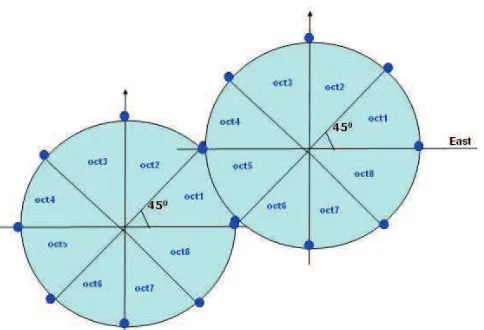
line dividing the two octants. These symmetry conditions are illustrated in figure 1, where a point at position(x,y) on one-eight circle sector is mapped into the seven circle points in other octants of thex yplane.
Fig. 1. Architecture of Cell in Splitting-based Displacement Prediction Approach
The SDPA addresses these problems by dividing each cell into eight equivalent octants (small regions). This technique reduces the number of relevant services within the small coverage area of each cell. Figure 1 shows the architecture of
one cell and eight regions (octants). The circle that represents a cell is divided into eight octants; each adjacent octant within one quadrant is symmetric with respect to the 45o
line dividing two octants. This geometry helps to reduce the volume of results returned to users of mobile information systems, thereby avoiding the need for manual filtering and improving the precision of information retrieved, increasing the accuracy prediction and meeting the characteristics of the mobile device such as the power consumption, storage space and low computing power and resources.
B. Description SDPA Approach
In order to demonstrate the SDPA approach, a set of parameters is defined. Table I summarises the parameters needed to perform the SDPA approach.
TABLE I SDPA PARAMETERS
Parameters Description
i ID of the cell
j The octant ID where the mobile user located, the current locationLk k The sequence time for mobile user movements, the next locationLk+1
To split a cell area into eight equivalent octants, eight θ
intervals will be used as in equation 1:
Ci=
8
X
j=1
Octci,jwhereOctci,j∈(θs, θe] (1)
wherej=1,2,...,8 is the ID of the octant,θsis the beginning andθethe closing angle of each octant, which are determined as in equations 2 and 3:
Θs= 0 + 45∗(j−1) (2)
Θe= 45 + 45∗(j−1) (3)
To determine the octant within which a mobile user is located, theta of that mobile user is compared with every interval.
The dynamic movement of a mobile user through a period of time to Tk+1 will result in changing the current location, in a new neighboring octant. After a set time interval, the mobile user will have moved through a number of octants. These octants are stored in a database, to assist in predicting a new octant to be entered.
Fig. 2. Movement of Mobile User between Octants in Two Cells
H(Octci,j, tk) =
f(0,0) f(0,1) ... f(0,n)
f(1,0) f(1,1) ... f(1,n)
. . ... ... . . ... ... f(n,0) f(n,1) ... f(n,n)
(4)
Wheref(x,y)=Nm+x,j+y/Nm+x, x is the row number and
y is the column number.Nmis the number of the traversal over
octantm, andNm,jis the number of times the user has entered
octant j when the user had been on octant m. When the user locates atOctci,j atTk then the available octants atTk+1are
Octci,j+1, Octci,j−1 and the facing octant in the neighboring cell Octcp,q, where pis the neighboring cell IDandq is the facing octantID. Based on figure 2, when the user is located at Octc1,1, thenN1=1,N2,1=N8,1=Noctc2,5,1=1/3.
The historical matrix is periodically updated to achieve consistency. It is also updated whenNiis incremented by one
andN(i, j)is incremented by one. To reach the probabilistic information for the predicted next state, a transition matrix is needed as in equation 5:
T P(Octci,j, tk) =
P(g(0,0)) P(g(0,1)) ... P(g(0,n))
P(g(1,0)) P(g(1,1)) ... P(g(1,n))
. . ... ...
. . ... ...
P(g(n,0)) P(g(n,1)) ... P(g(n,n))
(5) Where g(x,y)= Octci,y, Octci,x. The current state of a mobile user after registration in a network can be represented as in equation 6:
Currentstate=
1 0 0 0
(6)
So the next state will be predicted after multiplying equation 5 by equation 6. The resultant vector is expressed in equation 7:
P r=
P r0 P r1 P r2 P r3 (7)
[image:5.595.308.554.203.377.2]wherePris the probability that the mobile user will travel to surrounding octants, andP r0+P r1+P r2+P r3=1. Logically, the values of Pr will give the indication of the next octant to be visited in the next state since the highest Pr will give the highest probability of the octant. Generally, to generate more predictable octants for further states, equation 7 will be multiplied by transition matrix 5. In other words, the operation that resulted in equation 7 will be repeated.
Fig. 3. Pseudo-code of Splitting Approach for Location-Based Services
Discussions are now presented on the phases used in simu-lating the SDPA approach and the steps that follow. Figure 3 shows the pseudo-code of SDPA. InitilaizeEnvironmentParam-eters( )initializes the parameters, which is an important phase in the simulation. However, all parameters are initialized before the simulation began. To ensure that the accuracy of the results is not affected by previous turns, the procedure of splitting cells is a predefined step. In this process, a virtual splitting for each cell in a network is performed in order to produce eight octants. The splitting process is done once without the need to recalculate because it is not affected by natural changes such as closed roads, maintenance and congestion. Consequently, the splitting is excluded from the computation cost as it has been processed before running the approach. The splitting process is done bySplitoctant(cells), giving equations 1, 2 and 3. When the execution is started, the information about the octant are stored in the database byCellOctant(cellid, octantid).
When a mobile user registers to a network, the currenttheta
is provided to SDPA through the base station where the mobile user is located. The specific octant in which the mobile user is located will be calculated by passing the thetato find the octantFindOctant(double theta). The output for this step is the octant Identification where the mobile user is located.
the matrix is consistent and up-to-date. The two states are implemented by MatrixCalculation( ), giving equations 4, 5 and 6.
Transition and probability matrices are built based on the historical movement matrix. Therefore, the historical ment matrix must be up-to-date for the mobile user move-ments. The probabilities of each octant around the mobile user are derived based on the transition matrix. In the meantime, the current state vector for the mobile user is initialized and then multiplied by the transition matrix. The result is the probability that the user will be moving to each octant around the user i.e. the potential octants. This process done byPrediction ( ), giving equation 7.
All of the above steps are repeated until some cases occur such as out of coverage or the simulation time has expired. In each case, the parameter environment will be updated by
UpdateEnvironmentParameter ( ).
IV. DISCUSSION OFSIMULATION ANDRESULTSANALYSIS
A. Parameter Setup and Environment
The simulations are done over Pentium IV computers with 2 GB RAM and CPU speed of 3 GHz. The operating system used was Windows XP, where the LAN speed was 100 Mbps. A simulator was created using Java programming language for the SDPA, in which the algorithm based on Markov Chain models is implemented and tested. The number of cells in the simulated experiments varies between one, two, three, five, fifty and one hundred cells with a fixed radius of 250m each. The movement is recorded to train the program to learn how the mobile user moves during different trips. Different samples of data are used to test the performance of the SDPA.
Each experiment consisted of 10 different iterations to improve accuracy. Each experiment took five hours, as shown in table II.
TABLE II SIMULATIONPARAMETERS
Parameter Value
Number of cells 100 Cell radius 250 m Transmission Rate 8 Mbps
Simulation time 18000 s
Iterations 10
Pause time 20 s
B. Simulation Model
The proposed model was simulated to calculate the predic-tion ratio and the cost per unit of time for mobile users with different mobility for each request ratio. The implementation was constructed as follows:
1) Network Modeling:The same cell identification coding system is used as that in [19]. Each cell has a unique identifier, determined by its x andy coordinates. Num-bering starts from the center cell and expands radially across the entire network.
2) Request Service Modeling:Services arrive for mobile users according to a Poisson distribution with meanm=1 per unit of time.
3) Mobility Modeling: The simulation model implements the users’ cell residence time with a Poisson distribution with meanr.
C. Experiments and Result Analysis
The simulation study has been carried out in order to analyse prediction performance. The primary metric for per-formance was memory usage and prediction accuracy between mobile network entities. The simulation was carried out using different mobility rates. Therefore, the merit of the SDPA can be evaluated with respect to various criteria.
The first criterion is prediction accuracy, which is the ratio between the number of correct predictions and the total number of predictions [4]. The performance of the SDPA is compared to the PLM approach in terms of prediction accuracy rate. Figure 4 shows that SDPA has improved the prediction rate up to 60% compared to the PLM. This improvement is due to the nature of the mobility pattern in which the mobile user travels into a series of predicted cells and the changing number of cells visited within a trip. This conclusion is generally valid, though the percentage improvement may differ with a different set of assumptions.
Fig. 4. Prediction Performance for Splitting Approach for Location-Based Services
approach, the movement of the mobile user within one cell will involve many intersections in different routes.
[image:7.595.48.288.280.429.2]The overall average correct prediction rate for SDPA is 79.47% while the same overall average rate for PLM is 30.96%. The SDPA achieved more accurate dependent infor-mation. This is because the main factor for location based services is the knowledge of the next location of a given user movement, which is satisfied more by SDPA than by PLM. Each cell has a circular shape of radius approximately 250 m. Therefore, the area of each cell approximately equals 0.2km2 and the area of five cells equals 1 km2. SDPA shows a high correct prediction rate in areas whose size is approx. five cells. In practice, this area is sufficient for users’ activities in urban areas as it is a typical size for a city center, university campus or small town.
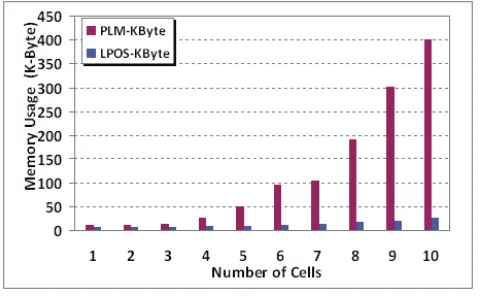
Fig. 5. Memory usage for SDPA and PLM
The second criterion is the important reduction in memory usage. Figure 5 illustrates the differences in total memory usage between the PLM approach and the SDPA. The PLM approach needs 125kB as space storage, but the SDPA needs only 15kB. The reduction in required memory is more than 70%. This conclusion is generally valid, though the percentage improvement may differ with a different set of assumptions. This improvement is due to the division of the cell into set regions, where each region acts as a serving region that retrieves the information related to that section only. Additional factors are the mobility pattern in which the mobile user travels into a series of predicted cells and changes in the number of cells that were visited within a trip.
V. CONCLUSION
An efficient A new Splitting-based Displacement Predic-tion Approach (SDPA) is suggested. The new approach is more efficient than Predictive Location Model (PLM). The suggested approach also provides other characteristics. For example, SDPA minimizes consumption of resources, and the overall cost of the location management process. Also, the SDPA reduces the service area and the number of predicted routes during the mobile user trip, by dividing the cell into eight equivalent regions. Consequently, the SDPA approach improves the location prediction probability over PLM. In
addition, the average complexity requirements for usage space are smaller than for the PLM approach. The simulation results have demonstrated that the average prediction accuracy rate, the memory usage are improved when compared with the PLM approach.
REFERENCES
[1] E. P. G. V.C. and Oltra.J.M, “Reducing location updates and paging costs in a pcs network,”IEEE Transactions on Wireless Communications, vol. 1, no. 1, pp. 200–209, Jan 2002.
[2] J. Zheng, Y. Zhang, L. Wang, and J. Chen, “Adaptive location update area design for wireless cellular networks under 2d markov walk model,” Comput. Commun., vol. 30, no. 9, pp. 2060–2069, 2007.
[3] D. Barbar[3], “Mobile computing and databases-a survey,”IEEE Trans-actions on Knowledge and Data Engineering, vol. 11, pp. 108–117, 1999.
[4] J.-M. Francois and G. Leduc, “Mobility prediction’s influence on qos in wireless networks: A study on a call admission algorithm,” inWIOPT ’05: Proceedings of the Third International Symposium on Modeling and Optimization in Mobile, Ad Hoc, and Wireless Networks. Washington, DC, USA: IEEE Computer Society, 2005, pp. 238–247.
[5] S. Das and S. Sen, “Adaptive location prediction strategies based on a hierarchical network model in a cellular mobile environment,” inThe Computer Journal, vol. 42, no. 6, 1999, pp. 473–486.
[6] E. E. J. Biesterfeld and K. Jobmann, “Location prediction in mobile networks with neural networks,” in the International Workshop on Applications of Neural Networks to Telecommunications, June 1997, pp. 207–214.
[7] U. Kubach, “A map-based, context-aware hoarding mechanism,” in Berichtskolloquium des Graduiertenkollegs Parallele und Verteilte Sys-teme,University of Stuttgart, Germany, July 2000.
[8] B. P. V. Kumar and P. Venkataram, “Prediction-based location manage-ment using multilayer neural networks,” inJournal of Indian institute of science, 2002, pp. 7–21.
[9] S. H. Shah and K. Nahrstedt, “Predictive location-based qos routing in mobile ad hoc networks,” in IEEE International Conference on Communications (ICC ’02), vol. 2, New York, NY, USA, April-May 2002, pp. 1022–1027.
[10] K. U and K. Rothermel, “An adaptive, location-aware hoarding mecha-nism,” inProceedings. ISCC 2000. Fifth IEEE Symposium on Computers and Communications, Antibes-Juan les Pins, France, July 2000, pp. 615– 620.
[11] H. Holma and A. Toskala, “Wcdma for umts: Radio access for third generation mobile communications,” in Transactions on Networking, vol. 9, no. 6. New York, NY, USA: John Wiley and Sons, December 2001, pp. 790–800.
[12] S.-C. L. H.-C. Lu, “Applied neural network for location prediction and resources reservation scheme in wireless networks,” in International Conference on Communication Technology Proceedings, 2003, ICCT 2003, IEEE, vol. 2, 9-11 April 2003, pp. 958 – 961.
[13] J. Capka and R. Boutaba,Mobility Prediction in Wireless Networks Using Neural Networks, I. I. F. for Information Proceeding, Ed. Springer Berlin / Heidelberg, 2004, vol. 3271/2004.
[14] H. Gowrisankar and S. Nittel, “Reducing uncertainty in location predic-tion of moving objects in road networks,” inIn 2nd Int. Conference on Geographic Information Science, September 2002.
[15] O. Wolfson, “The opportunities and challenges of location information management,” inIn Intersections of Geospatial Information and Infor-mation Technology Workshop, 2001.
[16] R. M. A.Patterson and M.Pancake, “Challenges in locationaware comput-ing,” inIEEE Pervasive Computing, vol. 2, no. 2, Council, Washington, DC, USA, April-June 2003, pp. 80–89.
[17] H. A. Karimi and X. Liu, “A predictive location model for location-based services,” inGIS ’03: Proceedings of the 11th ACM international symposium on Advances in geographic information systems. New York, NY, USA: ACM, 2003, pp. 126–133.
[18] M. I. Wardlaw, “Intelligence and mobility for bt’s next generation networks,”BT Technology Journal, vol. 23, no. 1, pp. 28–47, 2005. [19] M. C. H. Hwang and C. Tseng, “A direction based location update