Managing interactions in the e-learning environment :
Technological support for academic staff.
ISLAM, N.
Available from Sheffield Hallam University Research Archive (SHURA) at:
http://shura.shu.ac.uk/20168/
This document is the author deposited version. You are advised to consult the
publisher's version if you wish to cite from it.
Published version
ISLAM, N. (2015). Managing interactions in the e-learning environment :
Technological support for academic staff. Doctoral, Sheffield Hallam University
(United Kingdom)..
Copyright and re-use policy
OMI ISPiSilPMS
snduuBQ Ajiq ‘3JJU0Q sjiespv
seoiAJes uon.BijjJCjui pus Oujuiesi 'AnsjaAiun Luej|BH PiaiiiOMS
L.— i ...■■■■
.. - v ... . .i ■; i : ;
* ' * V
P roQ uest N u m b e r: 10699996
All rights reserved
INFORMATION TO ALL USERS
The qu ality of this repro d u ctio n is d e p e n d e n t upon the q u ality of the copy subm itted.
In the unlikely e v e n t that the a u th o r did not send a c o m p le te m anuscript and there are missing pages, these will be note d . Also, if m aterial had to be rem oved,
a n o te will in d ica te the deletion.
uest
ProQuest 10699996
Published by ProQuest LLC(2017). C op yrig ht of the Dissertation is held by the Author.
All rights reserved.
This work is protected against unauthorized copying under Title 17, United States C o d e M icroform Edition © ProQuest LLC.
ProQuest LLC.
789 East Eisenhower Parkway P.O. Box 1346
Managing interactions in the
e-learning environment: technological
support for academic staff
Acknowledgements
In the name of Allah, The Most Gracious, The Most Merciful.
All praise and thanks to Allah, the lord of the worlds for giving me the ability and patience to accomplish this study.
Contents
List of Tables...8
List of figures...9
A bstract...10
Chapter 1 Introduction... 11
1.1 Background to the research... 11
1.2 Research is s u e ... 14
1.3 Aim / O bjectives... 14
1.4 Significance and outcome of this study... 15
1.5 D efinitions...16
1.6 M ethodology... 18
1.7 Structure of the th e sis ...18
1.8 C onclusion...20
Chapter 2 Literature Review... 21
2.1...Introduction... 21
2.2 Pros and cons of e-learning... 22
2.3 Globalisation and cost implications of e-learning... 24
2.4 The Six Challenges... 27
2.5 Cognitive com plexity... 43
2.6 Human Resource and academic workload... 45
2.7 New trends in e-learning...49
2.8 Crowd sourcing...50
2.9 E-learning in Middlesex University London... 52
2.10 Management of e-learning implementation...53
2.11 C onclusion... 55
Chapter 3 Methodology...57
3.1 Introduction... 57
3.2 Research A im ... 57
3.3 Research Philosophy: Ontology and E pistem ology... 58
3 .3 .1 1nterpretivism: Philosophy o f this research...58
3.4 Qualitative Study... 59
3.5 Quantitative analysis... 62
3.6 S am pling... 63
3.7 Data Collection Process...64
3.7.1 First phase data collection: Qualitative semi-structured interviews...65
3.7.2 Second phase: Transactions log... 68
3.7.3 Third phase data collection...69
3.8 Knowledge-Base Forum: A Prototype Approach... 72
3.8.1 Demonstration and trial o f the Knowledge-Base Forum prototype...74
3.9 Data Validity... 75
3.10 Ethical Issues... 76
3.11 Analysis of interview data... 77
3.12 C onclusion... 81
Chapter 4 Findings and Analysis... 83
4.1 Introduction...83
4.2 First Interview Results and Analysis... 85
4.2.1 Interviewees’ Technologies...85
4.2.2 Advantages and Disadvantages of e-learning technology... 86
4.2.3 Advantages... 90
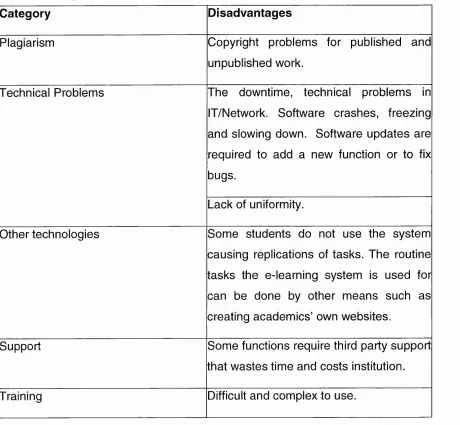
4.2.4 Disadvantages...91
4.2.5 Categorising the disadvantages: effects on institution, academics and students...94
4.2.6 E-learning technology changing academics role...100
4.2.7 Training required for academ ics... 101
4.2.8 Frustrated and annoyed academics... 104
4.2.9 Longer working h o u rs... 104
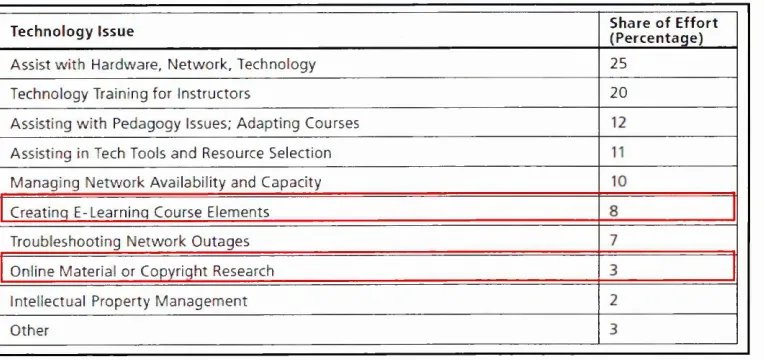
4.2.10 Literature supports longer working hours... 108
4.2.11 Blackboard transaction logs support interview find ings...112
4.2.12 Increase workload for academ ics... 116
4.2.13 Academic work contract...117
4.3 Academics’ wish lis t...118
4.3.1 Human Support... 119
4.3.2 Student expectation...119
4.3.4 Feedback...123
4.3.5 Specialist s u p p o rt... 123
4.3.6 Standardise technology... 123
4.3.7 Student monitoring... 124
4.3.8 Usability...125
4.3.9 Dynamic System... 128
4.3.10 Infrastructure...130
4.3.11 Visual Com m unication... 131
4.3.12 Training Support... 132
4.3.13 Individual needs... 134
4.3.14 Health H azards... 134
4.3.15 Flexibility... 135
4.3.16 Pedagogical... 135
4.3.17 Editing...136
4.3.18 Interactive W hiteboard... 137
4.3.19 Authority.... 138
4.3.20 M iscellaneous...139
4.4 Outcome of academics’ suggestions as solutions... 141
4.4.1 Friendly E-assessm ent...144
4.4.2 Visual Com m unication...145
4.4.3 Knowledge-Base F o rum... 146
4.4.3.1 KBF supports shared lea rning... 148
4.4.3.2 Knowledge-Base Forum will not confuse academ ics...148
4.4.3.3 Knowledge-Base Forum will help with learning...148
4.4.3.4 Knowledge-Base Forum will help to re-engage curious academ ics 149 4.4.3.5 Knowledge-Base Forum resolves many listed disadvantages... 149
4.4.3.6 Knowledge-Base Forum over S K Y P E... 151
4.4.3.7 Reduce red ta p e... 152
4.4.3.8 Knowledge-Base Forum will aid academics in busy periods... 154
4.4.3.9 Knowledge-Base Forum will be embraced due to being effective...154
4.4.3.10 Knowledge-Base Forum requires training... 155
Chapter 5 The analysis of piloting the e-learning Prototype: the Knowledge-Base
Forum s o lu tio n ... 158
5.1 Introduction...158
5.2 Mapping the findings to the prototype...158
5.2.1 Crowd source know ledge... 162
5.3 Market Research...164
5.4 Objective is Proof of Concept... 169
5.4.1 Knowledge-Base Forum proposal... 169
5.4.2 How KBF will identify credible m em bers... 171
5.4.3 Training on Knowledge-Base F o ru m... 171
5.4.4 Operational steps in using K B F... 171
5.5 Navigation of Knowledge-Base Forum prototype... 174
5.6 Results and analysis of the trial of the prototype... 187
5.6.1 Key findings after trial: Knowledge-Base Forum saves tim e... 192
5.6.2 Knowledge-Base Forum can reduce w orkload... 193
5.6.3 Knowledge-Base Forum is easy to u s e... 195
5.6.4 Knowledge-Base Forum is useful for communication p u rp o se s... 195
5.6.5 Academics will recommend Knowledge-Base Forum to their friends and colleagues... 196
5.7 Discussion... 196
5.8 C onclusion...200
Chapter 6 Conclusion...202
6.1 Key fin d in g s... 203
6.1.1 More disadvantages listed than advantages... 203
6.1.2 Academics spend too much time on e-learning...204
6.1.3 Changes to academic ro le s...204
6.1.4 Complexity is underestimated... 205
6.1.5 The e-learning wish lis t... 205
6.1.6 The need to improve training... 206
6.1.7 Frustrated and annoyed but ready to give another s h o t... 207
6.1.8 E-learning platforms: are they required?...208
6.1.10 Incorrectly implementing e-learning in institutions... 210
6.2 The prototype... 210
6.2.1 Further developments of the prototype... 212
6.3 Implications for literature...213
6.4 Lim itations...214
6.5 Further Research...214
References...216
APPENDIX 1: Notes for the candidates... 235
APPENDIX 2: Interview qu estion s:... 236
APPENDIX 3: Summary of the first phase interview results with aca dem ics...240
APPENIDX 4: First phase interviews...241
APPENDIX 5: Transaction logs...261
APPENDIX 6: Identifying the m es... 274
APPENDIX 7: Wish list...279
APPENDIX 8: Patent search... 282
APPENDIX 9: Second phase interview s... 287
APPENDIX 10: MDX Migration to M oodle... 295
List of Tables
List 4.1 Showing advantages of e-learning suggested by academics... 87
List 4.2 Showing disadvantages of e-learning suggested academics... 88
Table 4.3 Showing the breakdown of twenty-nine disadvantages...94
Table 4.4 The main disadvantages of e-learning which effect the institution...98
Table 4.5 Blackboards logs of usage by academics from Middlesex University... 113
Table 4.6 Breakdown of usage into four groups by academics from M id d le se x 114 Table 5.1 Showing the core points from the interview... 161
Table 5.2 Comparing wish list items against E-learning systems and websites...167
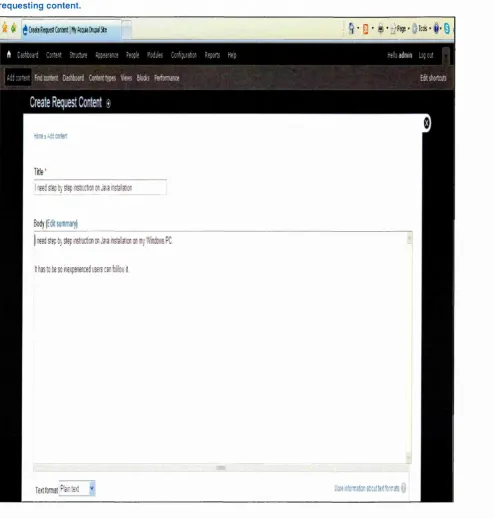
Table 5.3 Showing the information required when academic request content...178
Table 5.4 Interview analysis of Dr AK after piloting the prototype...188
Table 5.5 Interview analysis of Dr UH after piloting the prototype... 189
Table 5.6 Interview analysis of Dr D BB after piloting the prototype... 190
List of figures
Figure 4.1 Academics difficulty with e-learning technology...110
Figure 4.2 shows academics require support strongly...111
Figure 4.3 Academics would like support for content creation... 111
Figure 5.1: Example of the login screen...175
Figure 5.2: Example of the home page... 176
Figure 5.3: Example of the ‘Request Content Page...177
Figure 5.4: Example of saving the content... 179
Figure 5.5: Shows an example of confirmation screen when submitted... 180
Figure 5.6: A second example of request for content...181
Figure 5. 7: Example of bidder reviewing all requests made by academ ics...182
Figure 5. 8: Example bidder reviewing request and activate the ‘bid’... 183
Figure 5.9: Academic clicks on ‘List of bids’ to displays all bids... 184
Figure 5.10: Example of the requester reviewing the bid and awarding the bid by clicking on ‘Award this Job’... 185
Abstract
Over the last two decades the use of e-learning technology increased to such an extent that the role of the traditional academic has been forced to change. Focusing on
academics’ views, this study examines their interactions in the e-learning environment and whether online learning applications have increased academic workload (Eynon, 2005; Olaniran, 2006). This study also identifies how their role has changed and the underlying factors which may cause negativity in their working environment. This
understanding then generated the theory behind a prototype application, produced to be an addition to the current tools that academics use, with the intention to reduce
academic efforts in creating content for teaching.
Based on literature review, twelve interviews with academics and analysis of participant transaction logs suggests that online learning applications have increased workload. For some academics the use of e-learning technology in UK higher education can be a full time occupation. It is evident from the data that the drawbacks to current e-learning technology outweigh the number of benefits. A key concern is the high number of hours which are being spent on e-learning systems by academics. This research states
unequivocally that the level of complexity for some academics is daunting, as well as frustrating. This study argues that managing expectations of academic staff is vital to the success of e-learning systems.
Chapter 1 Introduction
1.1 Background to the research
Throughout history, mankind always had a high regard for learning and devised technology to deliver knowledge to the new generations. Traditional methods of learning usually required a teacher, textbook and writing board when various kinds of teachers and religious scholars delivered knowledge by holding lectures and seminars (Huddlestone and Pike, 2008).
However, with the advent of computer technology many changes have arisen in teaching styles and methods. During the last fifteen years, computer based learning has emerged as the innovative delivery method for education (Moos and Azevedo, 2009). In some instances Internet based education has taken the place of traditional classroom learning (Zhang et al., 2004; Huddlestone and Pike, 2008; Wang and Wang, 2009; Hardaker and Singh, 2011; Macharia and Pelser, 2012).
Historically, the slate board was invented during the 17th century in the United Kingdom (UK) a cost effective alternative to pen and paper. It allowed students to make notes for learning and the technology was re-usable and efficient. The slate board focused on individual learning whilst the teacher was solely responsible for giving clear instructions, this kept the teacher dominant and class control was at its peak (Roberts, Leung, and Lins, 2013).
In the early 18th century the blackboard appeared, allowing teachers to write notes to assist student learning, this also allowed larger classes of students. The teacher gained more prominence in presenting instructions whilst the student note taking reduced in comparison to the slate board period (Kidwell, Ackerberg-Hastings, and Roberts, 2008).
In early 1980s Computer Based Training (CBT) software was introduced, this was primarily designed for computing professionals to learn how to use computers. The late 80s and early 1990s saw the CD ROM become popular which allowed CBT courses to be easily stored, transportable and a cheaper alternative to instructor class room based training (Cross, 2004). Other technologies such as the ballpoint pen, whiteboard and the overhead projector (OHP) were created to serve the purpose of delivering
knowledge. These instruments have become the norm.
Whilst technology advanced, the last two decades have seen the rise of UK higher education institutions taking advantage of these technologies to facilitate distance learning education using whatever tools available to support learning. Two example institutions stand out the University of London 1 and the Open University2.
Distance learning has been offered at The University of London since 1858; with communication and delivery being achieved via postal services in the early years. Since then their student numbers have been increasing; today the number stands at over 54,000 students studying from 180 different countries (The University of London, 2013).
Another great British institution, the Open University started in the early 1970s using the most advanced computing application available to facilitate distance learning, as well as TV and radio broadcasts to support their distance learning courses (UNESCO, 2002). The UK Open University has set the standard for distance learning institution, this model has been established in other European countries including Germany the
Fernuniversitat, Spain the Universitat Oberta de Catalunya and Universidad Nacional de Educacion a Distancia (UNED), in Netherlands the Open Universiteit and the
Universidade Aberta of Portugal (UNESCO, 2002).
Zemsky and Massy (2004) state: “the major innovation in education is e-learning technology”. The Department for Education and Skills announced in 2005 that e- learning should be adopted by all UK higher education institutions (Brown, 2005). This is one of the factors that encouraged higher education institutions in the UK to adopt computing and internet based tools for learning on a significant scale.
1.2 Research issue
This study focuses on how e-learning tools can be accommodated for the academics’ needs by understanding what academics actually want, what problems they are facing since they have adopted to use the technology by force or by choice. The ultimate aim is to address a technical issue existing that may cause failure; or a functionality that can be added to make academics more at ease when using the tool; or a tool that can help in their role as teachers during this time of change.
In order to gain a better understanding of e-learning technology, it is necessary to select a specific area where this technology has been implemented and to view it from a
particular group of users’ perspective. The two common groups of users in educational institutions are the students and teachers. Since students’ perspective has been
covered by various writers (Zhang at al., 2004; Childs et al., 2005; Liaw, 2008) the perspective of academics will be studied because a gap in knowledge exists as will be shown in literature review chapter. Thus this study performs an in depth examination of the academics’ point of view, how their role has changed and the underlying factors causing negativity in the academics’ working environment.
1.3 Aim / Objectives
The aim of this research is to explore the extent to which online learning applications have increased academic workload by requiring academics to spend time supporting online learning. The research objectives are as follows:
1. To identify the effects that online interactions have on teaching staff.
3. To propose a framework providing a technical solution to improve the online interactions in an e-learning environment for academics.
4. To design, develop and evaluate a technical prototype based on the proposed framework which will address the online interaction issues.
5. To add to the body of knowledge on the use of e-learning environments by academic staff.
The research is designed with a focus on academic needs, the problems they are facing, the perception they have and ways technology can be adjusted to suit their needs. The overall objective is to add to the body of knowledge in the use of the e- learning environment by academics.
1.4 Significance and outcome of this study
It has been over a decade since e-learning has become popular. The demand for it has been growing rapidly, especially among people who have a keen interest in lifelong learning: answers are required to immediate problems faced by academic staff (Liebowitz and Frank, 2010). What are the effects on academic staff? What are the changing requirements? Is there any research carried out to mitigate these challenges? The answer is that concentration has been on the student perspective and substantially less research has been carried out on the perspective of academics administering e- learning.
Many researchers have written on the demand from student of instant feedback from academic staff that e-learning technologies are used to gratify students academic needs
by demanding immediate responses (Burd and Buchnan, 2004; Vrocharidou and Efthymoiu, 2012; Nandi et al., 2012). For these reasons it is imperative that research such as this be carried out to identify the issues involved in managing an online presence in the e-learning environment and the technological support required for academic staff.
This research will contribute to an understanding of academics’ needs in changing times and contribute in a practical way by a prototype application that will be an addition to the current tools that academics use, with the intention of reducing academics efforts in delivering and creating content for teaching.
The aim is to publish key aspects of this research that will benefit both academics and institution managers in understanding the challenges academics face. It is hoped that institution managers will be encouraged to be open minded in accommodating solutions or suggestions that may benefit academics’ role.
1.5 Definitions
Many terminologies relating to computer learning have been used. One such term is Virtual Learning Environment (VLE), defined as "Computer-based environments that are relatively open systems, allowing interactions and encounters with other participants and providing access to a wide range of resources" (Piccoli, Ahmad and Ives, 2001: p.402). This definition is referring to individuals engaged with various technologies for learning purposes.
2002), internet learning and web based learning (Boisvert, 2000). Another term E- teaching (Mohammad, 2012) has been used to highlight when a teacher is using the technology to teach as opposed to the term e-learning which also encompasses
students use of the technology to learn; however all of the terms have similar meanings. For this research, the broad term e-learning will be used; this encompasses the above terms and refers to teaching or learning achieved by the aid of electronic technology.
Currently academics in higher education institutions use three modes of learning. Full time e-learning use is where all their teaching activities and research are done using technology (Song et al., 2004) such as computers, phones, postal and online services: email, internet, discussion boards and Learning Management Systems such as
Blackboard and Moodle.
The second mode of learning is called blended learning, where academics teach in a traditional classroom setting and technology is used to enhance and support the learning (Garrison and Kanuka, 2004).
The more traditional mode is where academics are lecturing and presenting
instructions: the tool is the pen and paper, and black or whiteboard is the main aid. These academics do not use technology in their learning (Garrison and Kanuka, 2004).
1.6 Methodology
The research is an inductive study where data and information is discovered, and
narrowed down to identify cause, solution or theory. It is intrepetivism in epstimology as it is based on academics’ experiences. The research was based on the collection of primary data through interviews and transaction logs from Middlesex University. The reliance was fundamentally based on primary data via interviews and triangulated with data from transaction logs. The interviews are exploratory and solely based on the needs of the academics. Analysis of both sources determined the findings.
A prototype solution has been developed from the findings and piloted with four academics to meet the goal of this research to produce something practical and
beneficial to academics. A second round of interviews was conducted with academics who piloted the software to gain feedback as to their opinion; this ultimately decided the success or failure of the prototype application.
1.7 Structure of the thesis
The research starts by identifying the effects of the presence of the e-learning systems and its causes on academic staff. This led to investigating the changing requirements for supporting academic staff in their management of the e-learning technology.
The first chapter contains the introduction that introduces the research area.
The second chapter, the literature review, explains the growth of e-learning tools. The literature highlights some of the underlying factors that contributed to the rise of e- learning such as Globalisation and UK Government policy. The literature review identifies problem areas and concerns from the practitioners and writers on the
technology. Their view points to six areas of concern where gaps in research exist and describes the current ongoing development with e-learning technology such as mobile and hand held devises. The literature review explores and verifies current issues with e-learning, and discusses future issues that may arise.
Chapter three describes the research methodology selected and justification for it. The chapter starts with research design, the tools of data collection, addresses ethical concerns, the validity of data and covers how the analysis was carried out.
Chapter four presents the results of data collection and analysis. The data collected from interviews has been analysed and categorised according to the research
objectives. The perspectives are exclusively academics in relation to their use of e- learning technology and not the view of all e-learning users. The findings have identified numerous disadvantages compared to few advantages, a wish list from academics was derived where they suggested ideas on how academics maybe
supported by institution management. This chapter also confirms, in its discussion, that there is sufficient justification and argument for the development of the technical
Chapter five takes the findings and lays out the framework of the developed prototype application to support the academics’ role. The prototype is piloted at Middlesex University to get a preliminary feeling for the application and how academics react to it.
Chapter six concludes this research.
1.8 Conclusion
The introduction chapter lays the foundation of this research. It introduces the history of technology used for delivering learning, and describes the research issues that have come about due to the use of e-learning technology. The aims and objective are stated and the structure of this report is outlined. Based on these foundations the
Chapter 2 Literature Review
2.1 Introduction
With the advent of e-learning technology, academics are facing the challenges of acquiring and implementing IT skills for the purposes of teaching. The internet is a perfect tool of learning that offers flexibility and expediency to learners while at the same time offering endless opportunities for inventive teaching (Novak et al., 1999; Applebome, 1999).
Some of the reasons for e-learning technology success are: e-learning systems are likely to encourage student learning resulting in a higher level of student engagement (Hiltz, 1993; Wang and Wang, 2009; Hardaker and Singh, 2011; Macharia and Pelser, 2012). E-learning can be better than face-to-face learning, the quality of interaction and timely feedback is superior, with good course design which can untangle the
geographical limitations to education (Chen and Young, 2006). The financial benefits as a result of enrolling large quantity of students made e-learning systems irresistible to institutions.
Since then many research articles and case studies have been completed on how best to use the technology. The vast majority of the research is focused on the needs of the student. Ever more ideas, recommendations and solutions have been developed to improve student learning. For example, Macharia and Pelser’s (2012) study of computing technology in Kenyan Higher Education formed valuable insights into the reasons that influence e-learning acceptance by students, the study provided new ideas for higher education management for dissemination and infusion of computing
technology for the purposes of learning. They concluded that the availability and
However very little research has been undertaken that discusses the perspective of the academic staff. Even less research has been conducted on the effects of e-learning on the academic staff. This is at a time when administrators and academic managers are
increasingly pressuring academic staff to incorporate technology into teaching for more active learning (Steele and Hudson, 2001; Eynon, 2005; Olaniran, 2006).
2.2 Pros and cons of e-learning
There has been much discussion amongst the research community about the pros and cons of e-learning technology. Some researchers highlight this issue of superiority of e-learning technology saying blended learning has greater advantage than traditional learning specifically in the declarative knowledge such as recalling definitions, facts terminologies or concepts as opposed to procedural or problem solving knowledge
(Means et al., 2009).
A study conducted by Campbell et al. (2008) with students from a postgraduate
research module concluded that the course could be run wholly online as successfully as blended learning, and that the online discussion could be just as useful as face to face discussion. They also found that face to face teaching does not necessarily mean that a student will attain higher grades than the grades of those taking part in distance learning; in fact, an increase in e-learning activity was associated with higher student grades.
Learning technology is not just used in educational establishments and businesses but also used in the Armed Services. For example, e-learning technology is an invaluable training tool in airline or combat simulations or building models of structures to support the training process (Welsh et al., 2003). Some practical skills cannot be just talked through; although students will pick it up through discussion, real life practical
Foley (2009) collected data on academics using e-learning, and concluded that uptake of this technology had been a success. He stated that e-learning tools increased interactivity between students and academics, and also interactivity amongst students which led to a better learning environment. This conclusion was also ascertained by Beldarrain (2006: p. 140):
“As new technologies emerge, instructional designers and educators have
unique opportunities to foster interaction and collaboration among learners, thus
creating a true learning community”.
Boulos et al. (2006: p4) state
"The combination o f wikis, blogs and podcasting technologies, has the potential
to both liberate and tie learners together, creating dynamic learning
communities".
Diaz and Entonado (2009) discuss other positive aspects of e-learning. They state that face-to face teaching takes time to prepare mentally and requires time for explanation, whist e-learning material may already exist and therefore can be quicker to collate and saves the academic time, therefore in occasions e-learning can be better. However Zhao et al.’s (2005) research found advantages for blended learning rather than purely online learning experiences. They add that teacher’s involvement is crucial; the greater the teacher’s involvement the better the learning outcome.
There have been numerous researchers who have stated that e-learning has not
delivered as expected (Robertson, 2003; Guri-Rosenblit, 2005 and Njenga, 2010). They argue there was a great hope invested in e-learning technology however the hope has not been realised; e-learning technology has not been better than class room teaching and has not delivered better learning than traditional methods of teaching.
Other researchers have pointed out a reason for the failure of e-learning technology is because the design is not compliant with learner centred design; this refers to students not being involved thought the course design (Penna et al., 2009).
Dublin (2009) states that "having a great e-learning strategy and having great e-learning programs are not guarantees of success. Without a clear and well-thought-out
implementation strategy and plan “one’s e-learning efforts will most likely fall far short of one’s goals," (Dublin, 2009: p.291).
Michaelson (2003: p.63) states “for all the hype and expenditure, advances in eLearning have been limited". As can be seen, e-learning has gained various opinions from academic researchers; some arguing that e-learning is superior to those who believe it to be a complete failure. The discussion should be viewed in a balanced way; where e- learning technology is appropriate it should be encouraged, where it is seen to be ineffective it should be treated cautiously. Where blended learning is appropriate it should be adopted, where it is convenient for distance learning it should be
implemented.
Gunasekaran, McNeil and Shaw (2002) discuss four reasons for e-learning failure and for each put forward a suggestion to overcome the difficulties. First, failure is due to high expectations with inadequate investment with finance resources, time and funds.
Second, appropriate learning design is not taken into consideration. Third, the software is purchased or developed without adequate planning, and fourth, organisations fail to prepare students and instructors for e-learning.
2.3 Globalisation and cost implications of e-learning
Advances in technology, infrastructure and transportation are major factors in the rapid pace of globalisation. Globalisation has been named to explain all sorts of effects such as reduction in household income, introduction of student fees, growth of international tourism and even the cutting of the public sector budget (Brown, 1999).
Globalisation can be further identified where the fusion of technology and the pace of globalisation meet. This growth is spurred on by companies competing in national and international markets for profits that require technological advances over their
competitors. Not only is technology used for industrial competiveness but also collaborations, sharing of information and knowledge used by international
organisations, governments, academic establishments, researchers and non-profit organisations (Archibugi and Michie, 1995).
The rapid pace of advances in e-learning technology can no doubt be attributed to Globalisation as institutions in the UK are competing to gain more fee paying students without geographical boundaries and where institutions are trying their utmost to offer flexible education so age, academics background, and experiences are not a hindrance to pursue academic studies. The rapid pace of embracing e-learning technology has ramifications on academic staff; it creates unwanted pressure and the results are hard to monitor as to whether e-learning technology is being used effectively (Clegg et al.,
2003).
The UK Government has encouraged the rise of e-learning within higher education. In 1997, the Labour Government used the globalisation argument to justify and encourage UK higher education institutions to adopt ICT for learning. Since then, the Government agenda remains the same to push forward with technology to enhance learning (Brown, 1999, 2006; Mee, 2012; Allan et al., 2012; Jackson and Fearon, 2013).
other words education has been globalised by computing technology (Ally, 2004; Selinger, 2005; Zondiros, 2008).
E-learning technology offers return on investment for institutions; it offers cost effective training compared to face to face learning, hence e-learning has increased due to reduction in cost. For example, IBM saved $200 million in 1999 due to the introduction of e-learning technology and Ernst & Young reduced training costs by 35% while improving consistency and scalability (Strother, 2002).
Institutions are able to offer courses at short notices with a huge number of participants, mainly because the participants are geographically dispersed. Welsh (2003) provides an example of a large organisation, Dow Chemicals successfully trained 1000 students within a week having a seating capacity of 20. Such a target would have taken 50 weeks to achieve through face-to-face learning. As a result, Dow Chemicals saved $30 million by implementing e-learning technology during 2003 (Welsh, 2003).
There is a disadvantage and cost involved during implementation and early stage of the e-learning strategy. The cost includes software and hardware purchase, the recruitment of qualified staff and the training of users. The cost can be significantly high but in the long run it can save both money and time (Phelps et al., 1991; Wisher and Priest, 1998; Whalen and Wright, 2000).
being overwhelmed (Rovai, 2002). Academics being overwhelmed and an increase in number of students per academic are linked to poor retention and poor pass rate which is bad for any educational establishment (Boyle et al., 2003; Blatchford et al., 2011). This raises the question: what is the ideal student-staff ratio and how can academics be organised to meet this challenge? According to Rovai (2002) eight to ten students in a class is a reasonable estimate to promote good interactions in an online learning environment. Twenty or thirty students are a reasonable number that a single online instructor can realistically handle in a single class. Over thirty students can be
managed by a team using teaching assistants with the principal academic. The number of students can increase as long as a team of teaching assistants aid the learning.
2.4 The Six Challenges
There are many challenges faced by academics regarding the use and success of e- learning in an academic environment. Current discussion around the challenges in this area can be divided into six categories: learning styles and culture, pedagogical e- learning, technology, technical training, time management, and health challenges. The six challenges have been extracted from literature and they highlight some of the key issues researchers have discussed regarding the field of e-learning. Each challenge is significant; academics being aware of the challenges will help them to seek appropriate guidance.
1. Learning style and cultural challenge
Everyone has their own learning style along with their cultural influences; the ones who are taught using their own learning style and taking into consideration cultural aspects of individuals will perform better academically (Sywelem etal., 2012).
To achieve the best learning outcome it is desirable to have an understanding of students’ learning styles. Online students’ learning styles can be unclear, this has implications on how academics develop learning material. Some students learn through
interacting, some prefer learning through visual presentation, and some by listening to instructions and using written notes. This challenge has an implication on the learning outcomes and poses a serious issue for academics to understand the learning styles of their students in an e-learning environment.
There are various teaching styles; notable approaches are didactic, facilitative and socratic and the experimental method (Banning, 2005).
The didactic is the traditional method mainly involves lecturing and is very much teacher-centred where learning is involved mainly through note taking and listening to teachers. Traditional methods of teaching continue to use the lecture as a means of teaching and an economical one where one academic can disperse knowledge to large audience (Walkin, 2000). However didactic can mean full responsibility of teaching on academics as it is strongly teacher centred; the teacher is the knowledge expert, all the learning objects and knowledge flows from the teacher
The facilitative learning moves away from the strong teacher centred learning to what is known as self-directed learning, where the academic uses various strategies by
acknowledging students past experience and learning styles to encourage student to become independent learners. To be a competent academic to be a facilitator they have to be competent in their knowledge base, have confidence, authority and be empathic to students’ needs and individual learning style.
The Socratic method is heavily student orientated learning so students are able to think independently and various strategies can be used by academic such as quizzes,
Researchers have pointed out that no particular learning style is dominant amongst students; therefore teachers are expected to understand various learning styles to accommodate students (Mupinga, 2006). When a student has a strong preference to a particular learning style it becomes impossible for them to learn if materials and
resources are not delivered using that particular method (Zapalska and Brozik, 2006).
A popular method of identifying the learning style of an individual is the VARK
questionnaire. This process identifies a learning style of a student and categorises it as Aural, Read/Write, Visual and kinaesthetic. Aural (A) refers to students who prefer to learn through receiving verbal instructions. Read/Write refers to the learning style of students who prefer reading instruction and writing notes as the best way to learn.
Visual (V) are students who prefer the utilisation of visual objects as a way to learn such as graphs, charts and videos. Kinaesthetic (K) is when learners prefer to learn by a doing approach. It should be noted that a student may fall into two categories but one may be a stronger preference than the other (Zapalska and Brozik, 2006).
A current challenge for academics in an e-learning environment is to understand the different learning styles of different students for better learning outcomes. The traditional method of learning may not be adequate in the modern day classroom where e-learning technology is playing a major role in the delivery of education. In principal the key to understanding the student needs is to understand the diversity in the virtual class (Folley, 2010; Donahue and Glodstein, 2013).
Researchers have pointed out various problems when instructors use e-learning technology. Phipps and Merisotis (1999) authored a 48-page report reviewing and examining research papers throughout the 1990s on the effectiveness of e-learning technology. They put forward recommendations to cover the gaps in research that require further investigation. They recommend that “there needs to be more emphasis on individual differences such as gender, age, educational experience, motivation and learning style” (p.3). Implying current research on e-learning learning does not identify individual needs. This poses a question as how instructors are coping with the
technology to teach a variety of students with different educational needs, and coming from different backgrounds. It is common that students, lecturers and institutions use a variety of different application platforms for learning and teaching, therefore they
suggest that in the future “research should focus on the interaction of multiple technologies rather than the impact of single technologies” (p.3).
Taylor (2002) describes e-learning as exceptional for courses that require cognitive learning. However for teachers dealing with cultural barriers, differences in student attitude do not work well in the e-learning environment. Academic staffs that are better trained will bear the fruits of higher student learning. However if the teaching staff are not trained in using the e-learning technology and do not have a strong grasp of the operation of the technology then student learning is likely to suffer.
Teachers must understand and recognise individual learning styles of the many hundreds of students (how they learn and how they perceive) in the context of online education. It is important to convey and share the information with students (Brozik and Zapalska, 2006). For the hundreds of students who usually are not seen by academics in the e-learning environment, at present, the technology practice does not help such a scenario.
Hannon and D’Netto (2007: 419) state “instructors usually fail to take into account cultural differences when designing and delivering courses”. He argues that because pedagogy and technology do not reflect the culture of the student, it reduces his or her learning outcome and the cultural differences affect their ability to work with e-learning technologies. The outcome is reduced because students of different languages
respond differently to how things are organised in e-learning technologies and also students of different cultures have different abilities to work with e-learning technology.
providers to design courses and materials that take into consideration these differences and “engages culturally diverse audiences” (Callaghan et al., 2008: p.56).
When a student has a preference to a particular learning style then it becomes difficult to learn other ways, which means academic must be aware of different styles and needs to design learning materials that enables students to learn. This is the most important role of an academic. Therefore understanding learning style is critical consideration during course design and institutions should provide resources and training for academics to meet this challenge. However this is a time consuming and costly task, lot of time and effort is required and the courses material and students learning style has to be assessed when new student cohort joins. If learning style is not recognised then a possibility of learning will not be achieved and it is the most important challenge to meet.
2. Pedagogical e-learning challenge
Pedagogy is concerned with enabling the best way to achieve learning (Teo, 2006); if pedagogy is not considered then the desired learning outcome will not be achieved. Successful pedagogy requires the teacher to understand how students learn then design and deliver course materials, and mentor students appropriately, so that knowledge and skills are passed on. In this way, e-learning will produce the return on investment. Pedagogy should be the cornerstone to any e-learning technology; without pedagogical principals learning will be hampered.
E-learning requires a different approach to pedagogy especially in areas such as individual and group interaction and online assessment. However these skills are not alien to all, distance education has been around for decades using postal services, TV, and telephone.
progress, and they require extensive skills development (Ellis, O’ Reilly and Debreceny, 1998).
However, not only are the technical skills an issue but content should be appropriately designed for distance learning; it is not simply about “dumping large amounts of text onto a website” as this is inefficient (Leask, 2004: 347). In order for academics to
effectively make the transition to become online teachers they need to do more than just develop new ICT skills; it should be pedagogy based (Morley, 2010).
Other researchers went further and stated learning different pedagogical online strategies by teachers is not sufficient in an online learning environment, it should include academics correctly interpreting students’ online written text, understanding the context, and understating group dynamics with individual needs. This will then make online learning more successful (Turvey, 2008; Loveless, 2011). Having a well designed course that is pedagogically focused, and academics understanding the different strategies of online learning with the understating of diversity, context, group dynamics is not sufficient, all require the institution management marketing the
pedagogical benefits of online learning with practice examples that academics can relate to so they are encouraged to use the e-learning technology (Jackson and Fearon, 2013).
Conrad (2004) highlights four areas of expertise required to be an effective online
instructor; Pedagogical, Social, Managerial, and Technical. His study is based around a questionnaire delivered to five new academics, new to the e-learning environment, to learn their views and experience. The numbers of participants was small, but the study gives insight into first time e-learning experiences from the perspective of academic staff. Some of the concerns academics raised related to pedagogy and e-learning as follows:
contrast to traditional methods of learning where lecturers can stop, explain, quiz their students to see if they understood, if not then they can explain further until happy to move on.
2. One lecturer found it difficult using the WebCT platform to look back thorough different postings to retrieve the messages of interest.
3. It was pointed out that when teaching online a lecturer could feel they are “left in the dark” (2004: 35) where they are unable to observe students.
4. Management issues involving “agenda setting, pacing, objective setting, rule making and decision making is so closely related to pedagogical and the social roles”, (2004: 36) that the academics did not separate online teaching and management duties. Some of it was due to the online course structure where management process is already set. However, some course management decisions were applied from academics’ past experience without reflection. It would be interesting to learn where e-learning systems management process stop and academics’ management decisions start.
5. Since a lot of the management process is inbuilt into the course structure, once the course is mounted and initialised it is hard to change the structure or modify the course material.
Conrad’s study highlighted good pointers but did not concentrate on how much training or what a programme of enrichment required to fulfil the areas of expertise needed within an academic department to solve to pedagogical and the e-learning concerns.
Burd and Buchanan (2004) suggest four distinct learning styles: imaginative, common sense, analytic and dynamic. The dilemma to instructors is how to identify and
understand the learning styles of online students when they cannot be visualised, especially when they have limited time and many students enrolled. Also they recommend “to be effective, teachers need to communicate with non-participants privately to encourage discussion (p.24)”. This is a brilliant idea, however finding non participants may not be easy; it may require time and effort that may not be practical for academics to accommodate.
Govindasamy (2001) says e-learning pedagogy should consist of a few important aspects:
First content: material should be in learning objects, it is an independent class room session comprising small instructions and independent to other learning objects. A test should be assigned before access is given to the learning object. Students that fail the test should be directed to relevant learning material enabling them to gain sufficient understanding to start the learning object. After the learning object is completed a test should be conducted to determine if they learned the required learning targets.
Second storing: The learning object should be removed when the task or knowledge is outdated. The learning objects should be reviewed, modified and corrected to reflect current task.
Fourth student support: correct support should be put in place as e-learning can be different to class room learning where the teacher is available to answer student queries. Support should be programmed into the learning object and ample feedback should be provided. Even keeping track on student progress is required so the
instructor can target areas of weakness.
Fifth assessment: appropriate test and assessment should be in place such as MCQ, essays, exam questions and project deliverables. All should be incorporated within a course for a successful learning outcome.
As well as student learning style, the Pedagogy is an important and serious
consideration for learning, for it is the way an academic administers learning, it is not about dumping information on a website and hoping students will learn it, but a process to be followed to enable pedagogy in the e-learning tools, which institutions should show utmost importance.
3. Technological challenge
Technical challenge refers to development issues such as the bugs, the speed, the errors, functions and features not correctly working or do not work according to what academics require.
In reviewing e-learning literature there are various criticisms of the quality of the e- learning systems currently being used. Issues have been raised that include: usability problems, bad performance, institutions being unable to customise according to their requirements and sometimes criticised for having a teacher centred system rather than learner centred system (Chua and Dyson, 2004).
There are more than 35 e-learning technology vendors in the market (Edu tools, 2009); however, a study carried out in Australia found Blackboard to be very popular amongst educational establishments (Paulson, 2002). However Blackboard “is limited to its
environment’” (Farmer, 2004: 5), this is referring to Blackboard’s features restricted to its own environment. It does not allow discussion, updates, notices and various other messaging within blogs and topics from different vendors, and it does not allow
discussion forums to be directed to students’ personal email addresses which is a disadvantage to student engagement. This limits the academic staff and students to a particular environment even if they are not familiar with it or do not like it.
Technical support to academics is lacking in comparison to the desire of learning success and the profound use of e-learning technology. The great desire is met with insufficient investment in infrastructure and technological assistance (Reeder et al., 2004: 91-92).
Institutions have a variety of applications and computer operating systems for various uses such as the student registration system, and research support applications such as NVIVO and SPSS. All these applications have to be merged and linked within one e- learning environment to make it accessible and enable central support; however, this requires the merging and linking of various applications. This creates increased network traffic to support the centralised infrastructure, thus it should be robust and have enough capacity and capability to handle student academic communication. This is a complex process especially where old and new applications meet, and is a challenging process effecting academics who have to use the system (Nielsen et al., 2011).
Technical errors, bugs, slowness is critical if academics are to use the system and is critical to the success of the e-learning technology, if the system does not function
4. Technical training challenge
Training challenge refers to the training requirement that will enable academics to learn the e-learning features and functions correctly and to use them effectively.
In reviewing e-learning literature, there are various criticisms of poor training provided by institutions to academics. Issues have been raised that include not enough training, inadequate training, training styles in use that do not fit academics personal
preferences, lack of hands on practice, and also how to create materials according the pedagogical requirement was missing from the training scenario.
Volery and Lord (2000) explain the three requirements needed for effective e-learning success:
Technology
Instructor characteristics Student characteristics
Technology needs to improve; however, the instructor’s characteristics and familiarity with technology are most important in terms of having a successful learning experience. Teachers who are motivated and have an encouraging attitude towards the e-learning technology will enable a positive learning outcome. They state it is “crucial that the instructor has good control of technology and is able to perform basic trouble shooting tasks (e.g. adding a student at the last minute, modifying student’s password, changing course settings)” (2000: 218).
They also state that the instructor must have the ability to motivate students, show empathy, resolve emergency problems and respond to emails rapidly. A positive
troubleshoot, nor change passwords or course settings never mind resolve emergency technical problems.
They state student characteristics such as intelligence, motivation, and computer experience are crucial to the success of online learning. We cannot agree that all students will join university with computer experience as students may be novices or intermediate at using computers (Smith and Morris, 2003). If the capabilities of students are at best intermediate then there has to be organised training for the students. If sufficient training is not implemented then the burden of training will fall on the overburdened academics. This is supported by Salmon (2000) who suggests that instructors do not have sufficient training to make them successful and productive to online learners. Similarly Gerrard (2002) states the need of academics is understood as technological skill improvement such as how to create a better presentation and how to upload it on e-learning systems rather than learning new e-teaching skills to improve and aid student learning.
According to Taylor (2002) academics are only good as much as they can adapt to the new technology; this is a challenge for most academics. There is not always the
technical challenge but also time management, busy schedules and not all content can be presented well in an e-learning environment.
According to Gerrard (2005) two types of training are required for online teachers. First is in-depth training for those who spend the majority of their time teaching by using e- learning technology and the second is a shorter course for teachers who will use the technology in addition to face to face learning.
A case study by Wijekumar and Spielvogel (2006) discusses and recommends many ways the intelligent discussion boards of the traditional e-learning system can be
p.200) that the tool can be “a powerful resource for learning if the instructor knows how to encourage thoughtful posting”.
A study carried out by Cornelius & Macdonald (2008) states academics that teach distance learning programmes for the Open University in Scotland, who are not based on campus, fail to acknowledge the needs of distance learning in terms of training and support. The Open University is one of the first institutions in the UK to take distance learning as their core method of delivering education and if their online support and training is not adequate to support their teachers, then a reasonable question can be posed to the state of all other institutions who have taken up e-learning much later than the Open University. Those academics who attended training complained that training was not as they expected; it was an overview session without emphasis on practice, it did not give them enough confidence, it was not inspiring enough for them to carry on learning, training sessions was badly planned with errors, and it was rushed and not fully functional (Jackson and Fearon, 2013).
Therefore providing adequate training would help academics do their job effectively whether this relates to managing online discussion forums, or identifying pedagogical needs amongst students (Allan et al., 2012). Training is vital how to academics utilise pedagogy in the e-learning environment, how do they adapt learning style in their
material, correctly using the e-learning features are important, if academics do not know then investment will not yield the expected result.
5. Time management challenge
Academics that use e-learning systems face difficulties in managing their time. According to Reeder (2004) some of the “cyber culture values” are characterised by speed, reach and quick response. However in recommendations set out by Burd and Buchman (2004), the prerequisite needed to be an effective online instructor is that academics must visit the discussion page at least once a day to see if there is a posting by students. A viable question is that visiting the discussion board once a day may not
be seen as adequate according to cyber culture values. Some researchers have stated that academics should always maintain a vigorous presence on online discussion boards so they control discussion, provide answers and feedback so students do not disengage from the course (Vonderwall et al., 2007; Mayes etal., 2011; Nandi et al.,
2012).
A case study conducted by Mihhailova (2006) aimed to find some of the challenges faced by lecturers who were trialling e-learning technology in an Estonian University. It concentrated on ten interviews conducted with lecturers and found that time
management was complicated as answering queries or preparing lecture notes took longer than expected and there was “no compensation system or clarity in pay for the lecturers” (2006: 275). Understanding and improving how academics can balance their workload was a key recommendation of this case study.
Academics in the UK are finding it difficult to keep pace with postings in the discussion boards and forums. “The volume of traffic on the forum affected the time needed to keep up to date” (Cornelius and Macdonald 2008: 52), causing academics sometimes to skim over posted messages. They also found that other academics who are
persistent about checking every posting become selective when traffic increases.
There is a difference of opinion whether e-learning reduces time and effort of
academics. Some of the literature states e-learning has automated and streamlined some of the administrative tasks making communication easier and that having a central repository to place content is freeing up time for quality contact (Feldstein and Masson, 2006; Heinrich, Milne and Moore, 2009; Kotze and Nageland, 2010). However other researchers state that e-learning becomes 30% more time consuming for
Literature points out that while the traditional methods of learning have changed,
teacher and student roles remain, but e-learning allows the 24 hours a day for a class to run, and verbal conversation have been replaced with a permanent written discussion forum where students can update any time of the day or night (Clark, 2001). This means academics have to be working nights, weekends and holidays as the student expects to have a reply immediately and “if things go wrong then they have a sem i permanent existence on the screen” (Gustafson and Gibbs, 2010: 208The literature shows a heavy demand is made on academics when e-learning is introduced, if academics are overworked and do not have time then student learning will suffer, especially when they are not being compensated for the extra work they are carrying out, which will lead to low academic moral and may jeopardise learning and institution image to be damaged.
6. Health challenge
The health challenge refers to the ill effects of using computing technology for learning and teaching. Literature provides various criticisms which suggest that the impact of long term usage of computers can do harm to people's health, through electrical
radiation, harm to eyesight, backache and neck ache amongst others (Nazarlou, 2013). There is also a condition known as Repetitive Strain Injury (RSI), which describes pain resulting from using the hands to perform a repetitive task such as typing, clicking a mouse too often, or writing. This develops a pain, stiffness, numbness and cramp in the muscles, nerves, back, neck area, shoulders, forearm, and hand (Yassi, 1997).
often taking a break from looking at the computer screen to avoid poor eyesight, headaches and migraines.
Higher education institutions were keen on e-learning due to its availability 24 hours a day, as students preferred convenience and flexibility. Due to the adoption of e-learning for convenience and availability, institutions must heed the warning: “The social
dynamics of education changes once participants choose online education” (Smith and Rupp, 2003: 101). With the introduction of education being required 24 hours a day, the role of the academic has to change, to ensure that they can effectively interact with their students when required.
Research conducted by Allan and Lawless (2004) therefore explains that as online learning and collaboration increases, it is believed this can itself cause stress to academics. They may feel compelled to work during the evenings, at weekends, and even during their holiday periods, to be there for their students when required. This feeling of not being able to take a break from their work is likely to cause frustration, a decline in academics job satisfaction and low moral (Jackson and Fearon, 2013). These may lead to stress or other health conditions. Having academics who are dissatisfied with their job or dealing with stress and frustration will be affecting the quality of education provided by the university, thus destroying the credibility of institutions built up over centuries. If educational establishments do not create the correct nurturing ground then no doubt it will effect cooperation and communication that will eventually lead to reduced job satisfaction and stress (Zeffane and McLoughlin, 2006).
which suit them. This may allow them to achieve a successful work-life balance, which in turn could result in a reduced stress level.
The health challenge is linked with all the other challenges; if the other challenges are dealt correctly, some of the health problems will be reduced, such as stress and frustration regarding the academic role. Part of the training on e-learning can be used to show how to safely use technology, to minimise health implications. Health
challenges should be dealt with by initiating to resolve the other challenges first, at the same time there could be an information campaign developed by the institutions to inform staff on how to use technology safely.
2.5 Cognitive complexity
The six challenges are by no means the only issues for an academic working in higher education: there are also issues with cognitive load, in particular that of working memory being vulnerable to overload from information being processed (Kalyuga, 2007).
The cognitive overload occurs when a processing task in the working memory exceeds the working memory capacity. Whilst the capacity to hold data in long term memory is unlimited, the capacity to hold and manipulate data in working memory is limited
(Mayer, 2003). Similarly Jong (2009) states that cognitive load theory in its most basic form is that the cognitive capacity in working memory is limited, therefore if a learning task requires too much capacity, learning will be hampered, academics and students alike.
The short term or the working memory is responsible for processing information (Dosher 2003). The working memory is small compared to the long term memory (Cowan,
2001); therefore when learners perform complex tasks or subjects become increasingly complex the working memory gets utilised more. This memory could be easily