Review Article
Comparison between specific exercises and physical
therapy for managing patients with ankylosing
spondylitis:
a
meta-analysis of randomized
controlled trials
Wen-Dien Chang1, Yung-An Tsou2, Chia-Lun Lee3
1Department of Sports Medicine, China Medical University, Taichung, Taiwan (R.O.C); 2Graduate Institute of Clinical Medical Science, China Medical University, Taichung, Taiwan (R.O.C); 3Division of Physical and Health Education, Center for General Education, National Sun Yat-sen University, Kaohsiung, Taiwan (R.O.C)
Received June 1, 2016; Accepted August 10, 2016; Epub September 15, 2016; Published September 30, 2016
Abstract: Engaging in specific exercises and physical therapy are two strategies for managing ankylosing spondy
-litis (AS). In this study, we conducted a systematic review and meta-analysis to compare the differences between the outcomes of these strategies. Data from January 2005 - July 2014 was retrieved from the MEDLINE, PubMed, AMED, Embase, and CINAHL databases. Randomized controlled trials were conducted, and the outcomes of these interventions were compared using a meta-analysis. The outcome assessments were classified into the domains of impairment, activity limitations, and participation restrictions for AS according to the International Classification of Functioning model. Eight articles were included in the analysis, and four specific exercises, namely Pilates, aero
-bic and aquatic exercises, and the Global Postural Reeducation method, were compared with physical therapy. The meta-analysis results revealed that some outcomes of chest expansion and pulmonary function favored the specific exercises. The outcomes of the Bath Ankylosing Spondylitis Metrology Index, Bath Ankylosing Spondylitis Disease Activity Index, and Bath Ankylosing Spondylitis Functional Index were favored physical therapy. Both interventions exhibited low to moderate effects on impairment, activity limitations, and participation restriction among the pa
-tients with AS. However, different outcomes for specific exercises and physical therapy were found; a combination of both interventions is suggested as a clinical program for patients with AS.
Keywords: Ankylosing spondylitis, exercise, meta-analysis
Introduction
Ankylosing spondylitis (AS), a chronic inflam-matory disease, mainly affects the axial skele -ton, peripheral joints, and tendons [1]. Thus, AS symptoms reduce the physical activity of patients. The main AS symptoms are pain, mus -cle stiffness, decreased function activity, and decreased spinal mobility. These symptoms are often accompanied by sleep disturbances and psychological problems, such as depression [1]. Treatment strategies for AS have several basic principles [2]. Administering immediate analgesics to patients with AS to reduce pain and resolve morning muscle stiffness is criti -cal. Additionally, in patients with early-stage AS it is essential to improve spinal mobility as well
as to maintain the appropriate posture and physical condition. When the physical condition of patients with AS improves, treatment strate -gies focus on psychological problems, reducing the likelihood of depression. Furthermore, when short-term treatment goals are achieved, improving spinal mobility and pulmonary func -tion are vital long-term goals for patients with AS [3]. The ideal method of managing AS is using conventional treatments to decrease symptoms and promote long-term quality of life by controlling inflammatory pain and preventing articular deformation [4].
receive pharmacological treatment to relieve pain and discomfort often including non-steroi -dal anti-inflammatory drugs and sulfasalazine, which have analgesic properties [4]. In addition to pain relievers, patients with AS must receive physical and exercise therapies, which could maintain spinal mobility and appropriate pos -ture as well as improve muscular strength and functional activity [5]. Therefore, pain relievers, physical therapy, and exercise therapy are con -ventional treatment strategies for patients with AS. Home-based physical therapy is convenient and can improve self-health having a high degree of patient acceptance [6]. Furthermore, physical therapy for AS includes stretching, strengthening, flexibility, and breathing exercis -es. Under the guidance of physical therapists, hospital-based or home-based physical thera -py could improve trunk stiffness and reduce breathing restrictions [7]. Exercise therapy generally refers to disease-specific exercises, including active exercise training that focusing on improving the physical conditions of patients with AS [8]. Specific exercise is a rehabilitation strategy employed to target specific diseases that are particular to one type of exercise. The exercise is applied using various training meth-ods, focusing on the developments of muscle strength, endurance, flexibility, and cardiopul
-patients [12]. However, the benefits of specific exercises and physical therapy in patients with AS require further exploration. Therefore, this meta-analysis reviewed relevant studies on specific exercises and physical therapy for AS and compared the outcomes of the 2 interventions.
Materials and methods
Study selection
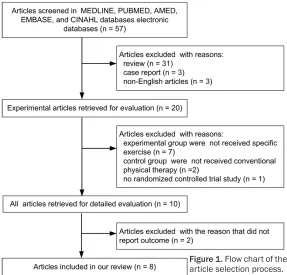
[image:2.612.90.377.72.347.2]The keywords “ankylosing spondylitis”, “exer -cise”, “physical therapy”, and “rehabilitation” were applied in searches of MEDLINE, PubMed, AMED, Embase, and CINAHL databases to obtain relevant articles. Article inclusion crite-ria in the current study are as follows: random -ized controlled trials, patients with AS as the experimental group, intervention involving spe-cific exercises, control group undergoing physi -cal therapy, and article publication date between January 2005 and July 2014. Studies not published in English, single group study designs, reviews, and case reports were exclud-ed. The searched abstracts were screened and selected by 2 investigators. Finally, the full-text articles were selected and included in the pres-ent study. The Jadad quality score, which is a Figure 1. Flow chart of the
article selection process.
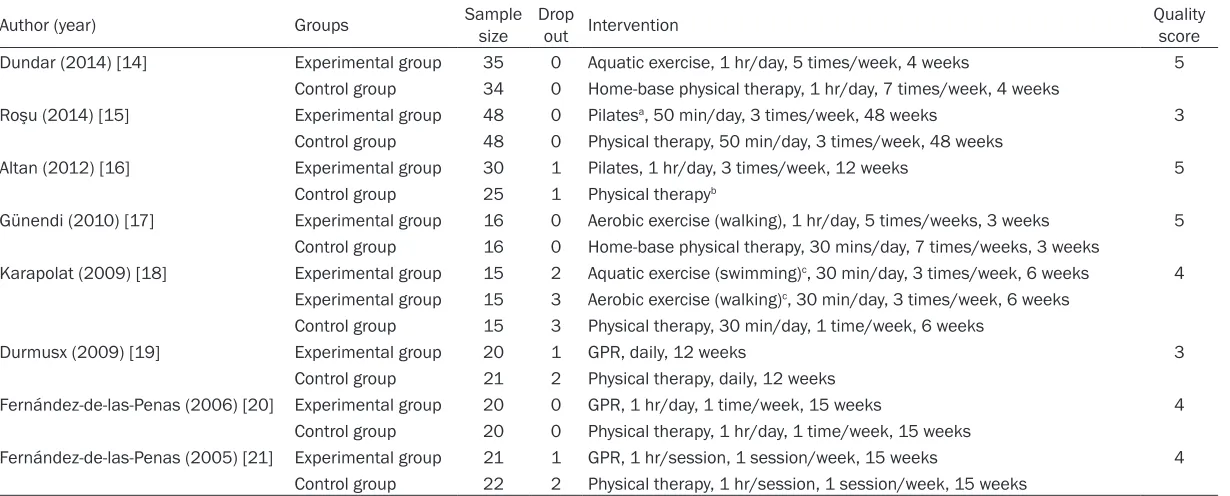
Table 1. Characteristics of 8 articles
Author (year) Groups Sample size Drop out Intervention Quality score Dundar (2014) [14] Experimental group 35 0 Aquatic exercise, 1 hr/day, 5 times/week, 4 weeks 5
Control group 34 0 Home-base physical therapy, 1hr/day, 7 times/week, 4 weeks
Roşu (2014) [15] Experimental group 48 0 Pilatesa, 50 min/day, 3times/week, 48 weeks 3 Control group 48 0 Physical therapy, 50 min/day, 3times/week, 48 weeks
Altan (2012) [16] Experimental group 30 1 Pilates, 1 hr/day, 3 times/week, 12 weeks 5 Control group 25 1 Physical therapyb
Günendi (2010) [17] Experimental group 16 0 Aerobic exercise (walking), 1 hr/day, 5 times/weeks, 3 weeks 5 Control group 16 0 Home-base physical therapy, 30mins/day, 7 times/weeks, 3 weeks
Karapolat (2009) [18] Experimental group 15 2 Aquatic exercise (swimming)c, 30 min/day, 3 times/week,6 weeks 4 Experimental group 15 3 Aerobic exercise (walking)c, 30 min/day, 3 times/week, 6 weeks
Control group 15 3 Physical therapy, 30 min/day, 1 time/week, 6 weeks
Durmusx (2009) [19] Experimental group 20 1 GPR, daily, 12 weeks 3
Control group 21 2 Physical therapy, daily, 12 weeks
Fernández-de-las-Penas (2006) [20] Experimental group 20 0 GPR, 1 hr/day, 1time/week, 15 weeks 4 Control group 20 0 Physical therapy, 1hr/day, 1time/week, 15 weeks
Fernández-de-las-Penas (2005) [21] Experimental group 21 1 GPR, 1 hr/session, 1 session/week, 15 weeks 4 Control group 22 2 Physical therapy, 1 hr/session, 1 session/week, 15 weeks
aCombined Heckscher and McKenzie methods with exercise protocol; bThere are no treatment frequency and duration in the article; cCombined physical therapy with exercise proto
5-point scale, was applied to assess article quality, with higher scores representing higher article quality.
Data extraction and statistical method
Data of the recruited articles were extracted for analysis in three steps. First, data on author, publication year, sample size, interventions, and article quality were collected and reviewed. Second, the intervention types, assessments, and results of specific exercises and physical therapy were extracted, indicating consider -able differences in the outcomes after the interventions. Third, the outcome assessments on the effects of each intervention were classi -fied according to the ICF model as impairment, activity limitations, and participation restric -tions; these terms were based on those from a previous study by Moncur [13]. Furthermore, two investigators collected the extracted data and analyzed the standardized mean differ -ence and 95% confid-ence intervals by using MedCalc software (Mariakerke, Belgium) for meta-analysis. The publication bias of the recruited articles was investigated to deter-mine its influence on the meta-analysis, as revealed using Rosenthal’s file drawer method, in which a fail-safe number higher than the tol -erance level influences the outcomes. The out -comes of assessment items, representing the effect size, were compared between specific exercises and physical therapy; positive stan -dardized mean differences favored specific exercises, whereas negative values favored physical therapy. Homogeneity was assessed using the Cochran Q test, and P > 0.05 or I2 <
50% was considered significant. According to Cohen’s rule, small (effect size = 0.2-0.5), mod -erate (effect size = 0.5-0.8), and large (effect size > 0.8) effects were expressed for various assessment outcomes.
Results
Study characteristics
In the present study, through keyword search -ing, 57 related articles were obtained, compris-ing 31 review articles, three case reports, 20 experimental articles, and eight randomized controlled trials that conformed to the inclu -sion criteria (Figure 1 and Table 1) [14-21]. Furthermore, four specific exercises, namely Pilates, aerobic and aquatic exercises, and the
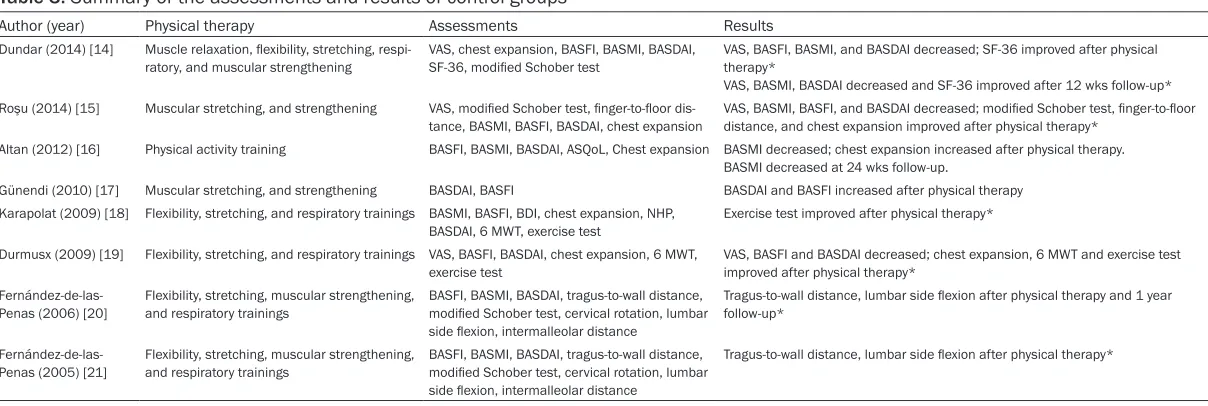
Global Postural Reeducation (GPR) method, were used in the experimental group (Table 2). Physical therapy was applied in the control group in all included articles, which comprised hospital-based and home-based physical ther -apy, involving flexibility, stretching, muscular strengthening, and respiratory training for patients with AS under physiotherapist guid -ance (Table 3). The Jadad quality scores of the included articles ranged 3-5, indicating high study quality.
Outcome assessments
The outcome assessments of the eight articles were recorded and measured using the follow -ing three categories.
Physical activity outcomes: Chest expansion was used to measure the increased chest cir-cumference at the level of the fourth intercos -tals during maximum inspiration, representing the respiratory movement limitations [16, 18, 19]. The finger-to-floor distance, modified Schober, and lumbar side flexion tests were used to measure the degree of lumbar spine flexibility [14, 15, 20, 21]. Moreover, the tragus-to-wall distance and cervical rotation tests were applied to measure the degree of cervical spine flexibility [14, 15, 20, 21]. The intermal -leolar distance test was employed to measure the degree of genu varum or valgum [20, 21]. The Bath Ankylosing Spondylitis Metrology Index (BASMI), a 10-point scale, was used to measure the severity of trunk stiffness in the patients with AS; this index was combined with the results of cervical rotation, tragus-to-wall distance, lumbar side flexion, modified Scho-ber, and intermalleolar distance tests. Scores of 0 and 10 represent no limitation and most severe limitation, respectively [14-16, 20, 21].
Table 2. Summary of the assessments and results of experimental groups
Author (year) Specific exercises Assessments Results
Dundar (2014) [14] Aquatic exercise VAS, chest expansion, BASFI, BASMI, BASDAI, SF-36, modified Schober test VAS, BASFI, BASMI, and BASDAI decreased; SF-36 improved after intervention* VAS, BASMI, BASDAI decreased and SF-36 improved after 12 wks follow-up* Roşu (2014) [15] Pilates VAS, modified Schober test, finger-to-floor distance, BASMI, BASFI, BASDAI,
chest expansion
VAS, BASMI, BASFI, and BASDAI decreased; modified Schober test, finger-to-floor distance, and chest expansion improved after intervention*
Altan (2012) [16] Pilates BASFI,BASMI, BASDAI, ASQoL, Chest expansion BASFI, BASMI, and BASDAI decreased; chest expansion increased after intervention* BASFI, and BASMI decreased at 24 wks follow-up*
Günendi (2010) [17] Aerobic exercise BASDAI, BASFI BASDAI and BASFI decreased after intervention*
Karapolat (2009) [18] Aquatic exercise
Aerobic exercise BASMI, BASFI, BDI, Chest expansion, NHP,BASDAI, 6 MWT, exercise test Swimming: 6 MWT, NHP decreased; chest expansion increased; exercise test improved after intervention* Walking: 6 MWT, NHP decreased; exercise test improved after intervention*
Durmusx (2009) [19] GPR VAS, BASFI, BASDAI, chest expansion, 6 MWT, exercise test VAS, BASFI, and BASDAI decreased; chest expansion, 6 MWT, and exercise test improved after intervention*
Fernández-de-las-Penas (2006) [20] GPR BASFI, BASMI, BASDAI, tragus-to-wall distance, modified Schober test, cervical rotation, lumbar side flexion, intermalleolar distance - BASFI, BASMI, and BASDAI decreased; tragus-to-wall distance, modified Schober test, cervical rotation, lumbar side flexion, intermalleolar distance improved after intervention and 1 year follow-up*
Fernández-de-las-Penas (2005) [21]
GPR BASFI, BASMI, BASDAI, tragus-to-wall distance, modified Schober test, cervi
-cal rotation, lumbar side flexion, intermalleolar distance
BASFI, and BASMI decreased; tragus-to-wall distance, modified Schober test, cervical rotation, lumbar side flexion, intermalleolar distance improved after intervention
*P < 0.05, before vs. after intervention or follow-up. VAS, visual analog scale; BASMI, Bath Ankylosing Spondylitis Metrology Index; BASDAI, Bath Ankylosing Spondylitis Disease Activity Index; BASFI, Bath Ankylosing Spondylitis Functional Index; 6 MWT, 6-minute walking test; ASQoL, ankylosing spondylitis quality of life; NHP, Nottingham Health Profile.
Table 3. Summary of the assessments and results of control groups
Author (year) Physical therapy Assessments Results
Dundar (2014) [14] Muscle relaxation, flexibility, stretching, respi
-ratory, and muscular strengthening
VAS, chest expansion, BASFI, BASMI, BASDAI, SF-36, modified Schober test
VAS, BASFI, BASMI, and BASDAI decreased; SF-36 improved after physical therapy*
VAS, BASMI, BASDAI decreased and SF-36 improved after 12 wks follow-up* Roşu (2014) [15] Muscular stretching, and strengthening VAS, modified Schober test, finger-to-floor dis
-tance, BASMI, BASFI, BASDAI, chest expansion VAS, BASMI, BASFI, and BASDAI decreased; modified Schober test, finger-to-floor distance, and chest expansion improved after physical therapy*
Altan (2012) [16] Physical activity training BASFI,BASMI, BASDAI, ASQoL, Chest expansion BASMI decreased; chest expansion increased after physical therapy. BASMI decreased at 24 wks follow-up.
Günendi (2010) [17] Muscular stretching, and strengthening BASDAI, BASFI BASDAI and BASFI increased after physical therapy
Karapolat (2009) [18] Flexibility, stretching, and respiratory trainings BASMI, BASFI, BDI, chest expansion, NHP, BASDAI, 6 MWT, exercise test
Exercise test improved after physical therapy*
Durmusx (2009) [19] Flexibility, stretching, and respiratory trainings VAS, BASFI, BASDAI, chest expansion, 6 MWT,
exercise test
VAS, BASFI and BASDAI decreased; chest expansion, 6 MWT and exercise test improved after physical therapy*
Fernández-de-las-Penas (2006) [20] Flexibility, stretching, muscular strengthening, and respiratory trainings BASFI, BASMI, BASDAI, tragus-to-wall distance, modified Schober test, cervical rotation, lumbar side flexion, intermalleolar distance
Tragus-to-wall distance, lumbar side flexion after physical therapy and 1 year follow-up*
Fernández-de-las-Penas (2005) [21]
Flexibility, stretching, muscular strengthening, and respiratory trainings
BASFI, BASMI, BASDAI, tragus-to-wall distance, modified Schober test, cervical rotation, lumbar side flexion, intermalleolar distance
Tragus-to-wall distance, lumbar side flexion after physical therapy*
[image:5.792.93.697.326.529.2]within the 6-min period was recorded in meters [18, 19].
Self-reported outcomes: On the 10-point VAS pain assessment scale, 0 represents no pain and 10 represents severe pain, revealing patient pain status regarding discomfort in inflamed or stiff joints [14, 15, 18]. The Bath Ankylosing Spondylitis Disease Activity Index (BASDAI) assesses six factors, namely fatigue, spinal pain, joint pain and swelling, localized tenderness, stiffness duration, and severity, for reporting the severity of AS. It is a 10-point scale, with 1 and 10 representing no symptoms and the most severe symptoms, respectively [14-21]. The SF-36 questionnaire was used to assess the physical and mental health status of patients with AS; the questionnaire involves
a 10-point scale, comprises 10 items, focusing on the changes in the function of patients with AS; a higher score indicates that a patient has greater difficulty in performing activities of daily living [14-21].
Data analysis
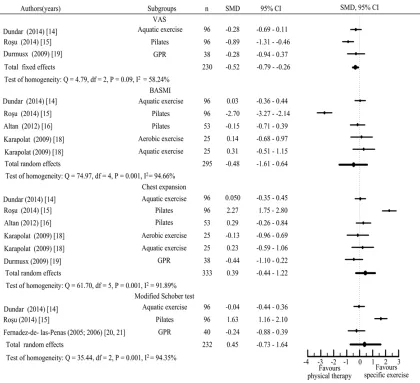
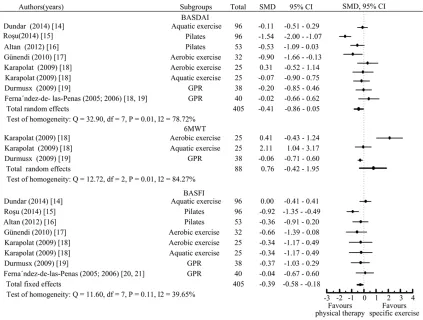
The results of the recruited articles revealed that 199 patients with AS in the experimental group performed specific exercises. Seven patients withdrew from the exercise session, and 192 completed the exercise. Moreover, 184 patients in the control group received physical therapy. Six patients withdrew from therapy, and thus, 178 completed therapy. The results of the present study revealed that 3-48 weeks of aquatic exercises, Pilates, aerobic exercises, and GPR significantly improved the impairment, activity limitations, and participa -tion restric-tions of the outcome assessments. The publication bias did not influence the meta-analysis results because the fail-safe number
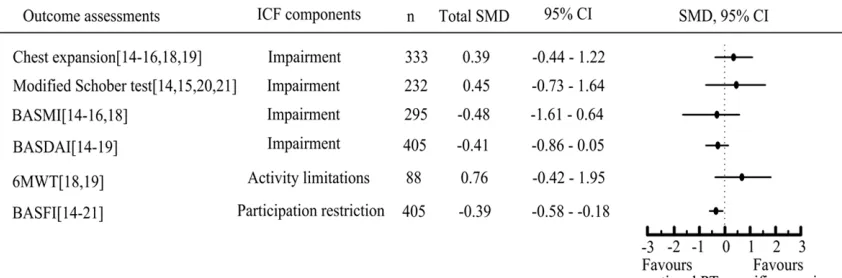
[image:7.612.96.519.72.392.2]cant total effects in the VAS, BASMI, BASDAI, and BASFI, which were superior to those observed in specific exercises. The meta-analy -sis results revealed that some outcomes in impairment (chest expansion and modified Schober test) and activity limitations (6 MWT) favored specific exercises (Figure 4), which had small to moderate effects (total effects of standardized mean difference = 0.39-0.76). Physical therapy had a small effect on patients with AS (total effects of standardized mean dif -ference = -0.39 - -0.48) regarding impairment (BASMI and BASDAI), and participation restric -tion (BASFI).
Discussion
In recent years, disability care, including that for AS, has focused on health improvement rather than curing the condition. The ICF model has facilitated the assessments of intervention efficacy for patients with AS [22]. The findings of the present meta-analysis confirm that phys -ical therapy effectively improves the impair -ment, and participation restrictions of patients with AS. We compared the outcomes of Pilates, the GPR method, and aerobic and aquatic exer-cises with those of physical therapy. The spe -cific exercises were focused on increasing trunk flexibility and mobility to achieve training goals, which caused the differences among the chest expansion, modified Schober test, and 6 MWT. Therefore, the effects in the impairment and activity limitations of ICF favored specific exercises.
Pilates, developed by J. H. Pilates, emphasize core muscle strength and stretching training for
[image:8.612.97.518.73.212.2]Furthermore, Durmusx et al. [19] proved that the GPR method has a positive effect on pul -monary function. These reports have suggest -ed that the GPR method is superior to physical therapy in treating AS patients. Hence, the GPR method and Pilates were applied for the spe -cific stretch of the trunk in AS patients, and had significant effects on improvements in chest expansion and modified Schober test.
Aquatic exercise refers to active exercise in thermal water and differs from passive spa therapy [25]. Dundar et al. [14] proposed func -tional movements, such as jumping, jogging, and stretching exercise, for performance in swimming pools (32°C-33°C) by patients with AS. Karapolat et al. [18] selected a specific type of swimming training, similar to aerobic exercise, for training patients with AS. The patients performed freestyle swimming for 30 min in a thermal pool (32°C) and warm-up ex- ercises for 10-15 min before and after swim -ming training. The swim-ming intensity was in accordance with the mean heart rate recorded during the exercise. The specific exercise aimed to improve trunk flexibility, chest expansion, and cardiopulmonary function in patients with AS. Moreover, compared with aerobic exercise performed on land, aquatic exercise could reduce joint loading and has benefits for arthri -tis, particularly in AS patients [26]. Dundar et al. [14] considered swimming to be an uncon-ventional aquatic exercise program. Aquatic exercises required supervision because no standard guidelines regarding exercise dura-tion or frequency for patients with AS has previ -ously been provided [14]. Engaging in specific supervised aquatic exercises may be more beneficial for AS patents compared with swim -ming alone; this requires further exploration. Furthermore, the present meta-analysis results revealed that aquatic exercise in a thermal pool led to significant improvements in chest expan -sion and the BASMI. The specific exercise pro -gram focusing on trunk flexibility in a thermal environment, providing tissue circulation, ben-efitted the patients with AS.
Karapolat et al. [18] considered walking as an aerobic exercise, in which the intensity of exer -cise reaches 60%-70% of the maximal heart rate (beats/min) yielding 13-15 points for the perceived exertion rating. A Polar Beat watch was used for heart rate monitoring during exer
-cise. Günendi et al. [17] used an exercise pro-cedure that included a 30-min walk on a tread -mill until the exercise intensity reached 60% -80% of the maximal heart rate (beats/min). Roşu et al. [15] employed a combination of Pilates and aerobic exercises performed using the Heckscher and McKenzie methods, focus -ing on correct-ing posture and improv-ing core muscle strength and cardiopulmonary fitness. The specific exercises aim to improve function -al capacity, aerobic capacity, and cardiopulmo -nary function. The present meta-analysis reported similar outcomes to those of prior study, evidencing significant effects regarding improvements in the BASMI, BASDAI and 6 MWT [27]. The improvements in cardiopulmo-nary function, allowing the more oxygen to be transported and used by muscles, enhanced functional activity of the patients with AS. Moreover, pulmonary involvement was com -monly observed in early-stage AS patients, and prompt aerobic exercise improved the cardio-pulmonary function and prevented the func -tional restriction [28]. For patients with AS, an aerobic exercise training program requires fur -ther consideration, because the insufficient exercise duration observed in this study could not induce the adaptation and activation of an antioxidant activity [29]. However, overtraining in aerobic exercise could cause injuries [30]. Günendi et al. [17] suggested conducting a future study for assessing oxidant and antioxi -dant statuses and devising a suitable aerobic exercise program for patients with AS.
step exercise in the control group. Various assessments of impairment, activity limita -tions, and participation restrictions revealed significant improvements in both groups after the intervention. The outcomes of the experi -mental group were far superior to those of the control group. Therefore, physical therapy in combination with aerobic exercise is recom-mended. Regular exercises could increase anti-oxidant enzyme activity and enhance resis -tance to oxidative stress [29]. Some studies have considered that oxidative stress causes physiological changes in the pathogenesis of AS [29, 31]; Günendi et al. [17] considered this factor to underlie the benefits of aerobic exer -cise in patients with AS. A 12-week follow-up study by Dundar et al. [14] revealed that aquat -ic exercises can signif-icantly improve results of the VAS, BASMI, BASDAI, and SF-36 for AS patients. Altan et al. [16] reported that Pilates could significantly improve the results of the BASFI and BASMI at 24-week follow-up. Furthermore, Fernández-de-las-Penas et al. [20] revealed that GPR could the results of the BASFI, BASMI and BASDAI, and improve the tragus-to-wall distance, modified Schober test, cervical rotation, lumbar side flexion, and inter -malleolar distance in patients with AS at a 1-year follow-up
Günendi et al. [17] reported that muscular stretching and strengthen training used in home-based physical therapy increased the results of the BASDAI and BASFI. The results of the aforementioned studies indicated that the symptoms of patients with AS worsen after the intervention, thus suggesting that the home-based physical therapy program might be unsuitable for these patients. By contrast, a supervised physical therapy program has been shown to be more effective for patients with AS as suggested by Lubrano et al. [32] and Dagfinrud et al. [33]. The present study sug -gested that supervised specific exercise or physical therapy programs are more clinically suitable according to the requirements of patients with AS. This meta-analysis study compared the benefits of four specific exercis -es with those of physical therapy in patients with AS. A small to moderate effect was shown regarding the impairment and activity limita -tions of ICF components for the specific exer -cises, whereas a small effect was observed concerning impairment and participation res-
triction for physical therapy. The study findings could provide information for clinical therapists regarding comparisons of the outcomes for various treatments. However, the study had some limitations. First, physical therapy for AS is a specific therapy, and a generalized conclu -sion could not be drawn from the diverse treat -ments. Second, because studies on specific exercises for AS were scarce, meta-analysis of the outcomes was difficult and prone to bias, particularly because of the inadequate out -comes of the exercise test. Cardiopulmonary function is a critical factor for patients with AS; however few studies have assessed this factor. Although 6 MWT is a simple tool for cardiopul -monary function assessment, a detailed assessment of the pulmonary function could assist in designing effective exercise prescrip -tions for patients with AS.
The present meta-analysis reveals that Pilates, the GPR method, and aerobic and aquatic ex- ercises could improve the impairment and activity limitations of patients with AS. The assessed outcomes revealed the benefits and small effects of physical therapy on AS. The findings regarding chest expansion and pulmo -nary function favor specific exercises, evidenc -ing small to moderate effects in patients with AS. However different outcomes of for specific exercises and physical therapy were found respectively, a combination of both interven -tions is suggested as an effective clinical pro -gram for patients with AS.
Disclosure of conflict of interest
None.
Address correspondence to: Dr. Yung-An Tsou, De-
partment of Otorhinolaryngology, China Medical Un-iversity and Hospital, Graduate Institute of Clinical Medical Science, China Medical University, No. 91, Hsueh-Shih Road, Taichung 40402, Taiwan (R.O.C).
E-mail: [email protected]
References
[1] Lim HJ, Lim HS and Lee MS. Relationship
be-tween self-efficacy and exercise duration in patients with ankylosing spondylitis. Clin
Rheumatol 2005; 24: 442-443.
[2] Grazio S. Nonpharmacological treatment of patients with spondyloarthritides. Reumatizam
[3] Dougados M, Dijkmans B, Khan M, Maksymowych W, van der Linden S and Brandt J. Conventional treatments for ankylosing spondylitis. Ann Rheum Dis 2002; 61: 40-50.
[4] Sari İ, Öztürk MA and Akkoç N. Treatment of ankylosing spondylitis. Turk J Med Sci 2015;
45: 416-430.
[5] Zochling J. Assessment and treatment of ankylosing spondylitis: current status and fu
-ture directions. Curr Opin Rheumatol 2008;
20: 398-403.
[6] Passalent LA. Physiotherapy for ankylosing spondylitis: evidence and application. Curr Opin Rheumatol 2011; 23: 142-147.
[7] Giannotti E, Trainito S, Arioli G, Rucco V and
Masiero S. Effects of physical therapy for the management of patients with ankylosing spon
-dylitis in the biological era. Clin Rheumatol
2014; 33: 1217-1230.
[8] Niedermann K, Sidelnikov E, Muggli C, Dagfinrud H, Hermann M, Tamborrini G, Ciurea A and Bischoff-Ferrari H. Effect of cardiovascu
-lar training on fitness and perceived disease activity in people with ankylosing spondylitis.
Arthritis Care Res 2013; 65: 1844-1852. [9] Chang WD, Huang WS and Lai PT. Muscle
acti-vation of vastus medialis oblique and vastus
lateralis in sling-based exercises in patients
with patellofemoral pain syndrome: a cross-over study. Evid Based Complement Alternat
Med 2015; 2015: 740315.
[10] Hagen KB, Dagfinrud H, Moe RH, Østerås N, Kjeken I, Grotle M and Smedslund G. Exercise therapy for bone and muscle health: an over
-view of systematic re-views. BMC Med 2012;
10: 167.
[11] Lee EN, Kim YH, Chung WT and Lee MS. Tai chi
for disease activity and flexibility in patients with ankylosing spondylitis-a controlled clinical trial. Evid Based Complement Alternat Med
2008; 5: 457-462.
[12] Kiltz U, van der Heijde D, Cieza A, Boonen A, Stucki G, Ustün B and Braun J. Developing and validating an index for measuring health in patients with ankylosing spondylitis. Rheumatology 2011; 50: 894-898.
[13] Moncur C. Ankylosing spondylitis measures: The Ankylosing Spondylitis Quality of Life (ASQOL) Scale, Bath Ankylosing Spondylitis Disease Activity Index (BASDAI), Bath Ankylo-sing Spondylitis Functional Index (BASFI), Bath Ankylosing Spondylitis Global Score (BAS-G), Bath Ankylosing Spondylitis Metrology Index (BASMI), Dougados Functional Index (DFI), Health Assessment Questionnaire for the Spondyloarthropathies (HAQ-S), and Revised Leeds Disability Questionnaire (RLDQ).
Arth-ritis Care Res 2003; 49: 197-209.
[14] Dundar U, Solak O, Toktas H, Demirdal US, Subasi V, Kavuncu V and Evcik D. Effect of aquatic exercise on ankylosing spondylitis: a
randomized controlled trial. Rheumatol Int 2014; 34: 1505-1511.
[15] Roşu MO, Ţopa I, Chirieac R, Ancuta C. Effects of Pilates, McKenzie and Heckscher training on disease activity, spinal motility and pulmonary function in patients with anky
-losing spondylitis: a randomized controlled tri -al. Rheumatol Int 2014; 34: 367-372. [16] Altan L, Korkmaz N, Dizdar M and Yurtkuran M.
Effect of Pilates training on people with anky
-losing spondylitis. Rheumatol Int 2012; 32:
2093-2099.
[17] Günendi Z, Sepici Dinçel A, Erdoğan Z, Aknar O, Yanpal S, Göğüş F and Atalay F. Does exer
-cise affect the antioxidant system in patients with ankylosing spondylitis? Clin Rheumatol
2010; 29: 1143-1147.
[18] Karapolat H, Eyigor S, Zoghi M, Akkoc Y, Kirazli
Y and Keser G. Are swimming or aerobic
exer-cise better than conventional exerexer-cise in anky
-losing spondylitis patients? A randomized con
-trolled study. Eur J Phys Rehabil Med 2009;
45: 449-457.
[19] Durmuş D, Alayli G, Uzun O, Tander B, Cantürk F, Bek Y and Erkan L. Effects of two exercise interventions on pulmonary functions in the patients with ankylosing spondylitis. Joint Bone Spine 2009; 76: 150-155.
[20] Fernández-de-Las-Peñas C, Alonso-Blanco C,
Alguacil-Diego IM and Miangolarra-Page JC.
One-year follow-up of two exercise interven
-tions for the management of patients with an
-kylosing spondylitis: a randomized controlled trial. Am J Phys Med Rehabil 2006; 85:
559-567.
[21] Fernández-de-Las-Peñas C, Alonso-Blanco C,
Morales-Cabezas M and Miangolarra-Page JC.
Two exercise interventions for the manage
-ment of patients with ankylosing spondylitis: a randomized controlled trial. Am J Phys Med
Rehabil 2005; 84: 407-419.
[22] Cieza A, Hilfiker R, Boonen A, van der Heijde D, Braun J and Stucki G. Towards an ICF-based clinical measure of functioning in people with ankylosing spondylitis: a methodological explo -ration. Disabil Rehabil 2009; 31: 528-537. [23] De Oliveira Francisco C, de Almeida Fagundes
A and Gorges B. Effects of Pilates method in elderly people: systematic review of random
-ized controlled trials. J Bodyw Mov Ther 2015;
19: 500-508.
[24] Amorim CS, Gracitelli ME, Marques AP and
Alves VL. Effectiveness of global postural re -education compared to segmental exercises
pain: a preliminary clinical trial. J Manipulative Physiol Ther 2014; 37: 441-447.
[25] Kamioka H, Tsutani K, Okuizumi H, Mutoh Y, Ohta M, Handa S, Okada S, Kitayuguchi J,
Kamada M, Shiozawa N and Honda T.
Effectiveness of aquatic exercise and balneo
-therapy: a summary of systematic reviews based on randomized controlled trials of water
immersion therapies. J Epidemiol 2010; 20: 2-12.
[26] Altan L, Bingöl U, Aslan M and Yurtkuran M. The effect of balneotherapy on patients with ankylosing spondylitis. Scand J Rheumatol
2006; 35: 283-289.
[27] Martins NA, Furtado GE, Campos MJ, Leitão JC, Filaire E and Ferreira JP. Exercise and anky
-losing spondylitis with New York modified crite
-ria: a systematic review of controlled trials with meta-analysis. Acta Reumatol Port 2014; 39:
298-308.
[28] Fisher LR, Cawley MI and Holgate ST. Relation between chest expansion, pulmonary function, and exercise tolerance in patients with anky
-losing spondylitis. Ann Rheum Dis 1990; 49:
921-925.
[29] Lazarevic G, Antic S, Cvetkovic T, Vlahovic P, Tasic I and Stefanovic V. A physical activity pro
-gramme and its effects on insulin resistance and oxidative defense in obese male patients with type 2 diabetes mellitus. Diabetes Metab
2006; 32: 583-590.
[30] Tanskanen M, Atalay M and Uusitalo A. Altered
oxidative stress in overtrained athletes. J Sports Sci 2010; 28: 309-317.
[31] Karakoc M, Altindag O, Keles H, Soran N and Selek S. Serum oxidative-antioxidative sta-tus in patients with ankylosing spondilitis.
Rheumatol Int 2007; 27: 1131-1134.
[32] Lubrano E, D’Angelo S, Parsons WJ, Corbi G,
Ferrara N, Rengo F and Olivieri I. Effectiveness of rehabilitation in active ankylosing spondyli
-tis assessed by the ASAS response criteria. Rheumatology 2007; 46: 1672-1675.
[33] Dagfinrud H, Kvien TK and Hagen KB. Physio-therapy interventions for ankylosing spon-dylitis. Cochrane Database Syst Rev 2008;