Toward Automatically Measuring Learner Ability from Human-Machine
Dialog Interactions using Novel Psychometric Models
Vikram Ramanarayanan
Educational Testing Service R&D
90 New Montgomery Street, #1500
San Francisco, CA
[email protected]
Michelle LaMar
Educational Testing Service R&D
90 New Montgomery Street, #1500
San Francisco, CA
[email protected]
Abstract
While dialog systems have been widely de-ployed for computer-assisted language learn-ing (CALL) and formative assessment systems in recent years, relatively limited work has been done with respect to the psychometrics and validity of these technologies in evaluat-ing and providevaluat-ing feedback regardevaluat-ing student learning and conversational ability. This paper formulates a Markov decision process based measurement model, and applies it to text chat data collected from crowdsourced native and non-native English language speakers interact-ing with an automated dialog agent. We inves-tigate how well the model measures speaker conversational ability, and find that it effec-tively captures the differences in how native and non-native speakers of English accom-plish the dialog task. Such models could have important implications for CALL systems of the future that effectively combine dialog man-agement with measurement of learner conver-sational ability in real-time.
1 Introduction
Advances in multimodal dialog technologies have helped improve the state of the art in interactive computer-assisted language learning (CALL) and edu-cational assessment applications in recent years. How-ever, while much progress has been made with respect to the technology infrastructure and automated pro-cessing required in such dialog applications, relatively less work has carefully investigated the efficacy and validity of such assessment instruments, for instance, how well they measure students’ capabilities. In other words, there is relatively little investigation into the psychometrics of such CALL applications and dialog-based assessments1.
1Psychometrics is the field of study concerned with the theory and technique of psychological measurement, which includes the measurement of knowledge, abilities, attitudes, and personality traits. Psychometricians use a specialized set of statistical tools to create scientifically valid “standardized” assessments of various behaviors. Typically, a test is
consid-Interactive tasks such as multi-turn conversations have had limited use as standardized assessments due in part to the difficulty of evaluating these perfor-mances. When such assessment tasks are used, the con-versational performance is scored primarily using hu-man raters (take for instance, the IELTS exam2).
Ma-chine scoring of complex task performances has made substantial progress, especially is the domain of written essays (Shermis,2014), but has been limited by path complexity in interactive performances such as dialog (Graesser et al.,2005).
While technical language use, (e.g. grammar or pro-nunciation) might be scorable at the word or phrase grain size, pragmatic conversational ability can only be judged in the context of the conversation history, per-sonal goals, and interperper-sonal dynamics. In a conversa-tional task, for example, the “correctness” of single ut-terances cannot be scored independently as their func-tion, and therefore their value, depends upon the cur-rent state of the dialog. An utterance at one stage of the conversation might be of high value while the same ut-terance at a different point would be detrimental. Each utterance must be evaluated based on the speaker’s con-versational goals, what they have already accomplished in the conversation, and what sequence of interactions might bring them closer to their goal.
Such data is unsuitable to model with traditional psy-chometric models that assume conditionally indepen-dent performance data, such as either classical test the-ory or item response thethe-ory (De Boeck and Wilson,
2004), requiring a more structured and dynamic model (Mislevy et al., 2002). It is this modeling gap that we attempt to bridge in this paper using Markov De-cision Process (or MDP)-based measurement modeling (LaMar,2018). To our knowledge, this is the first at-tempt at developing a psychometric model for dialog data that explicitly accounts for temporal dependencies in the observed data stream.
ered to have been standardized if data have been collected on large numbers of subjects using a set of structured rules for administration and scoring. These data are used to determine the mean score and the standard deviation, which the psycho-metrician then uses to benchmark the performance of those being tested. For more details, seeAssociation et al.(1999) orWeiss and Zureich(2008).
2https://www.ielts.org/
While the field does need more research into psycho-metrics and validity of dialog-based summative assess-ments, there has been substantial work by the learn-ing and formative assessment community in examin-ing learnexamin-ing gains/progressions and modelexamin-ing cognitive strategies in conversational tutoring applications (see for examplePerson et al.,2001;VanLehn et al.,2002;
Heffernan and Koedinger,2002;Michael et al.,2003;
Pon-Barry et al.,2006;Rus et al.,2013). Researchers have also examined how one can perform adaptive di-alog management to personalize the instruction to in-dividual participants over the course of the interac-tion (Forbes-Riley and Litman,2011;Vail and Boyer,
2014). This includes using learning progressions, nat-ural language processing and affective computing to adaptively selecting appropriate tasks for the learner to work on, but also adapting the scaffolding while the learner is working on a tasks (Rus et al.,2013).
Such research has important implications for dialog system design as well. Particularly for CALL applica-tions, it is important to integrate formative assessment of student ability into the dialog management process, in order to better adapt instruction to student needs, both in terms of the level of instruction (obtained in real time through measurement models) as well as the content and dialog path (decided by the dialog man-ager). We envision that future statistical dialog systems could combine statistical dialog management achieved using Partially Observable Markov Decision Processes or POMDPs (see for instanceYoung,2006;Williams and Young,2007;Young et al.,2010) in tandem with statistical measurement (using POMDP-based models) in order to develop more effective conversational lan-guage learning applications.
Our work also directly relates to user modeling in di-alog systems. While there is plenty of theoretical work on such models (see for example,Kobsa,1990;Kass,
2012), implemented statistical versions of user models typically estimate the probability of a particular user response given a candidate system response or a inter-action history thereof (e.g.,Eckert et al.,1997;Levin et al.,2000;Horvitz and Paek,2001;Pietquin,2005;
Kim et al.,2008). However, the difference in our case is that in order to serve as a measurement model of stu-dent performance, our MDP represents the cognitive model of an ideal automated interlocutor. Given a spec-ified set of model parameters, the MDP model can gen-erate action (or response) probabilities for every pos-sible conversational state, depending on a learner/user-specific latent ‘conversational ability’ parameter which needs to be estimated for each user. Note that for the purposes ofthispaper, we will be broadly looking at conversational ability (in achieving a certain goal), and
notnecessarily technical English language proficiency. The rest of the paper is organized as follows: Section
2lays out the mathematical foundations of how MDP models can be used to model learner ability, includ-ing the equations for statistical parameter estimation.
Section3then describes the dialog infrastructure used along with details regarding the conversational task and crowdsourcing data collection, followed by the formu-lation of the task-specific MDP for our use case in Sec-tion 4. Section5 analyzes the results of running the model on our dataset and studies how well the model differentiates between native and non-native speakers (who are potential language learners) of English, with example dialogs included for illustration purposes. Fi-nally, we conclude with a discussion of the current state of the art and outstanding issues for future research.
2 Markov Decision Process
Measurement Models
As an extension of inverse reinforcement learn-ing, partially observable Markov Decision Processes (POMDPs) have recently been used to represent a cog-nitive model that describes both human decision mak-ing and people’s ability to infer the goals and beliefs of others.Baker et al.(2011) describe a “Bayesian theory of mind” in which cognition is modeled as a POMDP. They hypothesize that people act based on their beliefs, modeled by the state space, action set, and transition functions, and in accordance to their desires, which are modeled by the reward structure. With this cognitive framing, POMDPs can be used for measurement within a goal-directed task by comparing actions selected by human participants with the model’s predicted proba-bility of those actions (LaMar,2018). The model and estimation algorithms will be described briefly below; for full details can be found in LaMar(2018). Note that in this work we utilize the more constrained MDP, in which the problem state is assumed to be observable, but extensions to full POMDP models are a natural next step.
2.1 Mathematical Formulation
As a decision model, the MDP defines the probability of selecting of an actiona∈Agiven a specific state of the tasks∈S. This probability,p(a|s), is known as the
policy. Action selection occurs within the context of a reward functionr(s,a,s0), which specifies the
imme-diate reward for taking actionain statesand entering states0 and a transition model p(s0|s,a), which is the probability of transitioning to a states0 given that ac-tion a was taken in state s. An additional parameter
γ∈[0,1], known as the discount parameter, represents
the relative value of future versus immediate rewards. From this specification, one can calculate theQ func-tion, which is the expected sum of discounted rewards obtained by taking actionawhile in states,
Q(s,a)=∑s0∈Sp(s0|s,a) (r(s,a,s0) +γ∑a0∈Ap(a0|s0)Q(s0,a0)).
(1) Note that∑a0∈Ap(a0|s0)Q(s0,a0)is the expected value
is the sum of the immediate reward and the discounted value of the future state. The expectation of this sum is then taken over all possible statess0that might result from actionain states. TheQfunction is recursive, as the value of a state is defined using theQfunction it-self, but can be calculated using dynamic programming (Howard,1960).
When MDPs are used in the context of artificial agents, they generally employ an optimal policy which selects the action that maximizedQin each state. To model human performance, however, optimal decision making is not assumed. Instead a Bolzmann policy is used (Baker et al.,2009),
p(a|s)∝eβQ(s,a), (2)
whereβ ∈[0,∞)represents the decision maker’s
abil-ity to choose actions that will result in higher total re-wards. Asβ increases, the probability choosing an op-timal action increases. Whenβ goes to zero, actions are selected uniformly at random from the action set.
2.2 MDPs for Measurement and Inference
Researchers have recently extended the MDP frame-work to study the quality of inferences that can be made about student/learner cognition based on records of ac-tion; for instance, to model learner goals and beliefs (Rafferty et al.,2015;Baker et al.,2009), to model in-quiry strategies (LaMar et al.,2017), and to model stu-dent decision making ability (LaMar,2018). Using the Boltzmann policy (Eq.2), the MDP model can be seen as a generative latent-trait model provided that the la-tent traits of interest can be formulated as parameters of the model. While elements of the reward function and the transition model can be parameterized for inference about the decision maker’s goals and beliefs, here we focus on the capability parameterβj, aperson-specific
Boltzmann parameter, indicating a person’s capability to optimally solve the given problem. The formulation of theQfunction remains as in Equation1, except that we note explicitly the dependency upon the capability parameterβj. The conditional probability of student j
selecting actionawhen in statesnow becomes
p(a|s,βj) =∑ exp(βjQ(s,a|βj))
a0∈Aexp(βjQ(s,a0|βj)). (3)
If the reward and transition parameters are fixed to ob-jectively correct values, theQfunction acts as a scoring function, determining the relative value of the actions available in each state. Theβjparameter is then
simi-lar to a traditional ability parameter in IRT, measuring the extent to which the highest valued action is taken at each decision point.
2.3 Parameter Estimation
The observed data for student j consist of a sequence of state-action pairs,
Oj={(s1j,a1j),(s2j,a2j), . . .(sNjj,aNjj)}, (4)
whereNj is the total number of actions taken by the
student. Each pair indicates a state and the action taken in that state.
The Markov property applies to this model, allow-ing us to take each action to be conditionally indepen-dent, conditioned upon student capability and the sys-tem state in which the action was taken. Thus the prob-ability of the observed data can be written as
p(Oj|βj,µ,σ) = Tj
∏
t=1
p(at j|st j,βj,µ,σ) (5)
=
Tj
∏
t=1
exp(Q(st j,at j|βj)βj) ∑a0∈Aexp(Q(st j,a0|βj)βj).
whereβj∼Lognormal(µ,σ2) (6)
where the optimal value of the person-specific ability parameter, ˆβj, can be estimated by finding the value of
βjthat maximizes this likelihood:
ˆ
βj=argmax βj
p(Oj|βj,µ,σ) (7)
To estimate the population parameters of the log-normal distribution3, µ and σ, we use marginal
maximum likelihood (MML), marginalizing over the specific parameter distributions. The person-specificβj can be estimated either using maximum
a-posteriori (MAP) or maximum likelihood estimation (MLE) methods. With smaller population sizes the MLE estimation has been found to be more robust and is used for this study. Both the MML and MLE es-timations are performed using a two-phase numerical optimization with a global optimization algorithm fol-lowed by a local optimization algorithm, both drawn from thenloptlibrary. Gaussian quadrature is used for the approximation of the integrals and the Q-function is approximated using policy iteration methods.
3 Dialog Data
3.1 Dialog System
We use an open-source dialog system4 to develop a
text-based chatbot application. But note that this work is not limited to or dependent on the dialog system be-ing used. Indeed, there are multiple academic (Olym-pus (Bohus et al.,2007), Alex (Jurˇc´ıˇcek et al.,2014), Virtual Human Toolkit (Hartholt et al.,2013), Open-Dial5, etc.) and industrial (Voxeo6, Alexa7, etc.)
im-plementations of dialog systems, any of which can be
3We chose to modelβjusing the Lognormal distribution as it has a non-negative range and has been used to describe growth patterns in nature. Moreover, person-specific “abil-ity” can be argued to be the result of a growth process (mul-tiplicative rather than additive).
4Link to software anonymized.
5http://www.opendial-toolkit.net
6https://voxeo.com/prophecy/
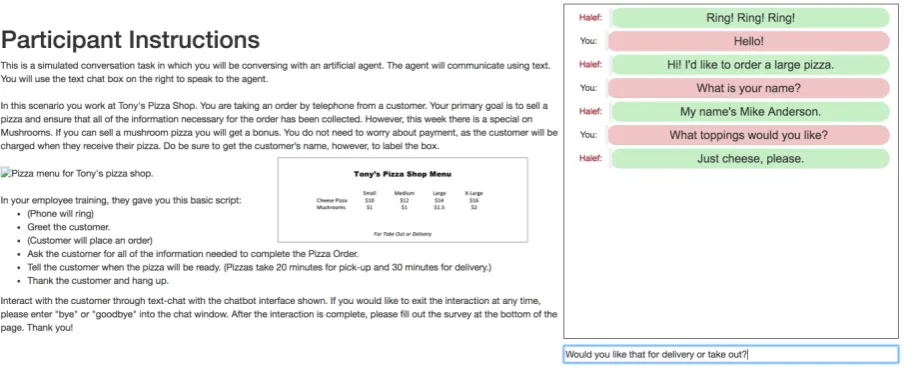
Figure 1: Example webpage screenshot of the text dialog interface that participants might see for the task described in this paper.
used, but many of these often use special architectures, interfaces, and languages paying relatively less atten-tion to existing W3C and other industry standards (see
Ramanarayanan et al. (2017) for more details). We however choose to use theAnonymouscloud-based di-alog system for its standards-compliance, modularity and flexibility in developing both text- and speech-based applications. In this study we will limit ourselves to text-based dialog for simplicity.
3.2 Conversational item design
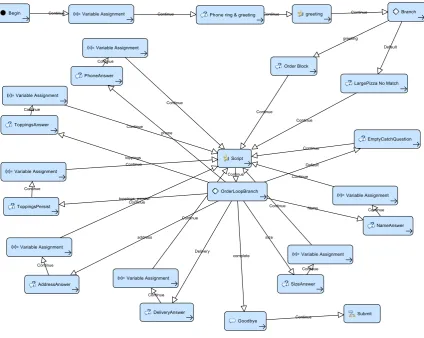
This study leverages a conversational practice task de-veloped for English language learners, where subjects are asked to pose as a customer services representative at a pizza restaurant, and field an order from an au-tomated customer (played by the dialog system). See Figure1for a screenshot of the web-based dialog inter-face that participants interacted with. Participants are instructed that their primary goal is to sell a pizza while ensuring that they collect all information necessary to complete the order (such as the name of the customer, his address if delivery is requested, etc.). They are fur-ther instructed that if they manage to sell the customer mushroom toppings, they will be awarded a bonus for task performance. We used regular expressions to per-form the natural language understanding. Figure2 de-picts the dialog flow of the conversational item. Recall that for the purposes ofthispaper, the target of mea-surement is the student’s ability to navigate conversa-tional conventions and achieve the pre-specified task goal (to maximize the pizza sale) through conversation with the automated customer, and not their technical language skills.
3.3 Crowdsourcing data collection
We used Amazon Mechanical Turk for our crowdsourc-ing data collection experiments. Crowdsourccrowdsourc-ing has been used in the past for the assessment of dialog sys-tems as well as for collection of dialog interactions (see
for instance (McGraw et al.,2010;Rayner et al.,2011;
Jurcıcek et al.,2011;Ramanarayanan et al.,2016)). In addition to interacting with the text chatbot interface to complete the conversational task, workers were re-quested to fill out a 2-3 minute survey regarding dif-ferent aspects of the interaction, such as their over-all experience, how engaged they felt while interact-ing with the system, how well the system understood them, and basic demographic information. Particularly relevant for this study are callers’ self-reported first lan-guage, and their ratings of system performance, defined as a qualitative measure of how the system performed as per caller expectations and whether the system re-sponses were appropriate. In all we collected and ana-lyzed dialogs from 390 participants, 54% of which self-reported as native English language speakers and 70% of which were male, primarily in the 20–40 age range. See Tables 3–7 for example dialogs.
[image:4.595.309.539.591.751.2]4 MDP Model for the Pizza Dialog Task
Table 1: The action set and transition function for the MDP PizzaOrder cognitive model.
Action Prob Customer ...
RequestToppings 0.6 requests cheese pizza RequestToppings 0.4 requests mushroom pizza SuggestMushroom 0.4 requests cheese pizza SuggestMushroom 0.6 requests mushroom pizza AskDelivery 0.5 wants delivery
AskDelivery 0.5 wants take-out AskName 1.0 gives name AskSize 1.0 orders large pizza AskAddress 1.0 gives address AskPhone 1.0 gives phone number SayOther 1.0 no effect
Continue
Continue
Delivery phone
toppings
Name Default Continue
Continue Continue Continue
greeting
Continue
Continue Continue
Continue
address
Continue
Continue
Continue Continue
Continue
Continue
Continue complete
Default
Continue
size
Continue Continue
Continue toppings_persist
Continue
Continue Begin
Order Block
Script
OrderLoopBranch
DeliveryAnswer PhoneAnswer
ToppingsAnswer
AddressAnswer
NameAnswer EmptyCatchQuestion
Goodbye
Variable Assignment Phone ring & greeting greeting Branch
Variable Assignment
Variable Assignment
Variable Assignment Variable Assignment
Variable Assignment
Submit LargePizza No Match
SizeAnswer Variable Assignment ToppingsPersist
Variable Assignment
[image:5.595.99.524.68.406.2]Figure 2:Workflow design of the pizza restaurant-based conversational task deployed and analyzed in this paper. The dialog flow employs a slot-filling structure, where the customer service representative has to ask the automated customer multiple questions in order to fill slots on an order form.
Table 2: The reward table for the simple Pizza Order task
Reward Type Value Trigger
PizzaOrdered 3 end-of-call and got all needed info Mushrooms 1 end-of-call and
Piz-zaOrdered + mush-rooms ordered CompleteInfo 0.5 end-of-call and also
got phone #
AngryCustomers -0.3 any action while cus-tomer is annoyed TimeIsMoney -0.2 any action
To serve as a measurement model for student perfor-mance, the MDP must represent the cognitive model of an ideal pizza shop representative. The full MDP cog-nitive model consists of a set of actions, a state space, the transition functions, and the reward structure. In Ta-ble1the action set is listed in the left column, while the transition function is partially illustrated by the proba-bility of effects from each action. The state space is
defined by a set of state variables which includes in-formation slot boolean variables such asgotSize,
go-tAddress, andgotCustomerName. For order
informa-tion which might affect the choice of future acinforma-tions, we model the possible values along with a value for “unknown.” For example, thewantsMushroomvariable has three discrete values, 0 for unknown, -1 for “does not want mushrooms,” and 1 for “wants mushrooms;”
wantsDelivery is coded similarly. The possibility of
stochastic transitions based on “likely” outcomes from different conversational moves. For example, in the test task the customer will always ask for delivery, however the cognitive model for the pizza salesperson gives the probability of the customer wanting delivery as .5, as the representative does not know whether the customer will want delivery until they ask.
The rewards are defined based on actions taken and values of the state variables. Table 2 shows the five reward or cost conditions used for this model. The biggest reward comes from completing the call with a pizza ordered, for a reward of 3 points. An additional point is awarded if the pizza order includes mush-rooms and an additional half point is given for col-lecting the not-required, but nice-to-have phone num-ber of the customer. When customers get annoyed, the whole conversation gets unpleasant causing a cost of 0.3 points (equivalently a reward of -0.3) for every ac-tion taken while the customer is annoyed. Finally, each and every action costs 0.2 points. This “time cost” is essential for motivating efficiency in action planning.
Given this specification, the PizzaOrder MDP can generate action probabilities for every possible conver-sational state, dependent upon theβjparameter, which
we take to be conversational ability as demonstrated by the task.
[image:6.595.307.534.93.207.2]5 Analyses and Observations
Table 3: Example dialog from a native Hindi speaker (log(β) =−2.75).
Speaker Dialog
Human Hello, Welcome to Tony’s Pizza Shop, How may I help you today?
System Hi! I’d like to order a large pizza.
Human Of course. May I know your name please? System My name’s Mike Anderson.
Human Sure sir, We have a special on mushroom pizza this week, would you be interested in that?
System Just cheese, please.
Human Is that a large or an extra large? A large cheese pizza is $14, andd an extra large is $16.
System Just cheese, please. Human Large cheese pizzza. System Just cheese, please.
Human the pizza will be ready in 30 minutes System Alright, thanks! Goodbye!
We ran the MDP measurement model over the full data set of 390 dialogs, estimating the person-specific conversational ability (which, again, is their ability to achieve the pre-specified task goal through conversa-tion, and not their technical language skill) for each dialog as βj. In our analyses we examine log(βj)
which should follow a more familiar normal
distribu-Table 4: Example dialog from a native Tamil speaker (log(β) =−1.26).
Speaker Dialog Human hello
System Hi! I’d like to order a large pizza. Human Are you want mushroom pizza? System Just cheese, please.
Human Are you want large one? System I’d like a large, please.
[image:6.595.309.535.251.541.2]Human It will take 30 minutes to deliver. System Alright, thanks! Goodbye!
Table 5: Example dialog from a native Dutch speaker (log(β) =0.258).
Speaker Dialog
Human Hi, welcome to Tony’s Pizza Shop System Hi! I’d like to order a large pizza.
Human Absolutely, what kind of pizza would you like? We have a special on mushroom pizza, where you can get a medium mush-room pizza for just $1
System Just cheese, please.
Human A large cheese pizza is nearly 10 times as expensive as a mushroom
System Okay, I’d like mushrooms on my pizza as well.
Human Absolutely, would you like it delivered or do you want to pick it up?
System Delivery, please.
Human And what’s your name and adress? System My name’s Mike Anderson. Human and your adress?
System I’m sorry, I didn’t catch that. Can you re-peat that, please?
Human and your address? System 23 Maple Street. Human Ok, that will take 30min System Alright, thanks! Goodbye!
tion. To evaluate the validity8 of the resulting
esti-mates, we analyzed them vis-a-vis their reported na-tive language, with the expectation that nana-tive-English speakers would generally have higher conversational ability9. Recall that our sample included 209 native
English speakers, and 181 participants who reported a non-English language as their native tongue.
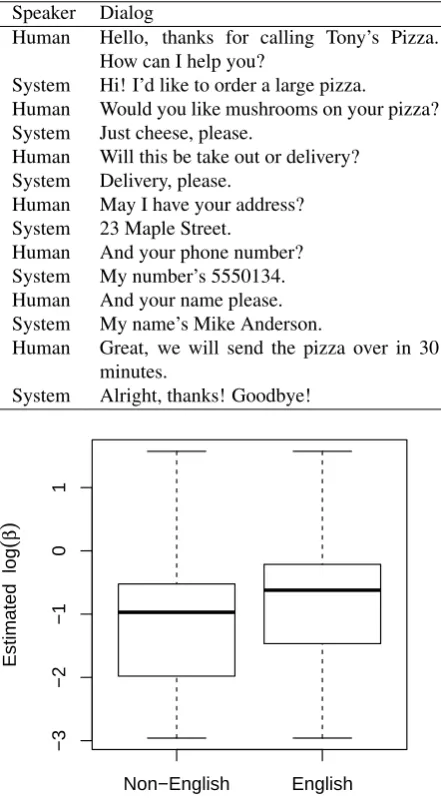
We observed that participants who reported English as their first language had averagelog(βj) estimates
0.31 logits higher than players who reported a non-English language as their first language (t=3.00,df =
8In other words, does this test actually measure what it sets out to measure?
[image:6.595.73.297.451.667.2]Table 6: Example dialog from a native Indonesian speaker (log(β) =1.57).
Speaker Dialog
Human Hello, thanks for calling Tony’s Pizza. How can I help you?
System Hi! I’d like to order a large pizza.
Human Would you like mushrooms on your pizza? System Just cheese, please.
Human Will this be take out or delivery? System Delivery, please.
Human May I have your address? System 23 Maple Street.
Human And your phone number? System My number’s 5550134. Human And your name please. System My name’s Mike Anderson.
Human Great, we will send the pizza over in 30 minutes.
System Alright, thanks! Goodbye!
Non−English English
−3
−2
−1
0
1
Estimated
log
(
β
)
Figure 3: Estimated conversational ability by partici-pant’s self-reported primary language.
374,p=0.003). Figure3shows a boxplot of the esti-matedlog(β)values grouped by native language.
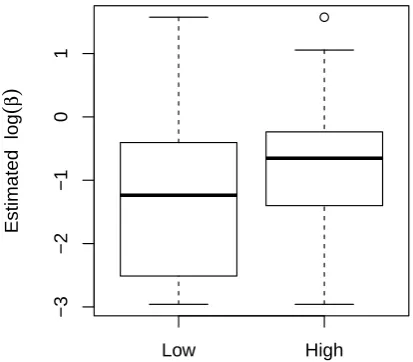
We also compared the dialog-ability estimates to participant-reported satisfaction ratings with respect to the dialog system performance. Here we hypothesize that participants who used phrases that the dialog en-gine did not recognize would both be dissatisfied with the performance of the system and have low estimated conversational ability. In our sample, 254 participants reported that the system performed well (4 or 5 on a 5-point Likert scale), while 103 participants rated the sys-tem at a 3 or lower. Players who rated that the syssys-tem performed well had an averagelog(βj)estimate 0.47
logits higher than those who rated the system poorly (t =3.64,df =159.7,p<0.001) (Figure 4), which seems to conform with our hypothesis. However, note that these system performance ratings are subjective and might vary depending on the speaker sample and specific conversational item under study.
While these results provide, as yet, only weak valid-ity evidence for the measurement model, they do indi-cate that the model is performing as expected. We also examined the actual dialogs of different participants in-teracting with the system in order to better understand how the model of student dialog reflects actual student performance. We have listed example dialogs of non-native participants interacting with the system of dif-ferent estimated dialog ability and self-reported system performance rating. Note that these are presented as is, without correcting for errors in spelling or grammar. Table3shows an example dialog which was assigned a low dialog ability rating (log(βj)) as well as a low
sys-tem performance rating. In this case, while the Hindi speaker mentioned the deal on mushrooms, he asked for the pizza size again even though the automated cus-tomer had already given him that information. Per our earlier model specification, this might have ‘annoyed’ the automated customer. Crucially, though, he failed to ask the automated customer whether he wanted de-livery or not, and subsequently his address, which re-sulted in a lowlog(βj)score on the task overall. Table
4shows an example where the automated customer did not get annoyed, but it nonetheless shows clear gaps in the non-native participant’s conversational competence in achieving the goal of maximizing the sale. In con-trast to these examples, the Indonesian speaker (Table
6) asked the automated customer for each of the requi-site pieces of information to complete the task success-fully resulting in a successful interaction that received a highlog(βj)score, despite the fact that he didn’t sell
the customer mushrooms. A native speaker of Dutch (Table5) who performed well on the task in general, but was scored slightly lower (log(βj) = 0.258) did
persist in selling mushroom toppings to the automated customer while asking for his name and address, but incorrectly spelled the word ‘address’. However, the participant caught this error in the next dialog turn, ul-timately resulting in successful completion. Note that there were also cases that received a highlog(βj)score
with low system performance ratings, many of which were due to system natural language understanding is-sues. Going forward, we will aim to improve this as-pect of the system to improve user experience and mod-eling accuracy.
6 Discussion and Outlook
We have presented a Markov decision process-based measurement model (MDP-MM) for the assessment of of learners’ ability to complete a simple customer in-teraction dialog task. We put forth a formal mathe-matical description of the model including a maximum likelihood based method to estimate the parameters of the model given input data. On applying the model to crowdsourced customer services dialog interactions at a pizza restaurant, we observed that the model abil-ity (log(βj)) estimate is able to differentiate between
partic-●
Low High
−3
−2
−1
0
1
Rating of System Performance
Estimated
log
(
β
)
Figure 4: Estimated conversational ability by par-ticipant’s rating of the system’s performance, where “Low” indicates a rating of 1, 2, or 3 and “High” in-dicates a rating of 4 or 5 on the 5-point Likert scale.
ipant ratings of system performance in a statistically significant manner. Note that the MDP-MM is partic-ularly useful over traditional methods of measurement when the dialogs increase in complexity and branching, and the resulting paths cannot be easily enumerated for scoring.
We plan to investigate several lines of research go-ing forward. First, while we have shown the model’s efficacy in capturing conversational ability of partici-pants in successfully completing a given task to a cer-tain extent, neither the degree of nativeness nor their rating of system performance are ideal correlates to es-tablish the validity of the model. A more appropriate variable might be, for instance, an 3rd-party expert
rat-ing of their conversational ability (where experts could be English language teachers, for instance). In addi-tion, we hand-crafted a specific set of actions, transi-tion probabilities and rewards for the model presented in this paper based on our subjective expertise. Care-ful selection of these parameters is important because they directly influence model behavior. Future itera-tions could benefit from a more scientifically objective method of model specification. We will also need more data from more conversational items and participants to concretely establish the utility of the model and its applicability to a wide variety of dialog use cases in a statistically significant manner.
Second, while this paper has focused on conversa-tional task ability, our longer term goal is to apply such a model to the measurement of conversational language proficiency. This will require modifications to both the task (the goals, dialog flow design, natural language un-derstanding and dialog management logic) as well as the specific variables we measure (such as fluency, lan-guage use, vocabulary and grammatical accuracy,
prag-matics and historical discourse context, among others). Third, while the proposed model assumes that the state of the system is known at every given point of time for simplicity, relaxing this assumption is a natural next step. In such a case, we would have to use a
par-tially observableextension of the MDP-MM model (or
a POMDP-MM) that explicitly models the uncertainty in the observation process that estimates the state of the system at every time step.
A fourth important future research direction, as men-tioned in this paper’s introductory paragraphs, involves the integration of statistical measurement of student conversational ability with dialog management, espe-cially for computer-assisted language learning (CALL) or formative assessment applications. Such integration would leverage the measurement of learner conversa-tional ability and/or language proficiency into the dia-log manager, allowing one to adapt the conversational instruction flow both based on the content of what the learner said, as well as his/her conversational ability. In addition, popular statistical dialog management mod-ules are based on POMDPs, which might allow for eas-ier combination with the POMDP-based measurement model into a unified model, given that both share the underlying mathematical framework. For example, in such a scenario, one could imagine that the user action model, user goal model and dialog model in a POMDP-based dialog manager (that estimate the user’s next ac-tion and state, and the next dialog system state, respec-tively, as described inYoung,2006) would now depend (and be conditional) on the user’s conversational ability and/or language proficiency estimate.
Finally, we also plan to evaluate model efficacy and integrability into a full-blown spoken dialog scenario (as opposed to text chat, as in this paper). In addi-tion, the current paper uses simple regular expression-based natural language understanding; incorporating more accurate statistical natural language understand-ing modules could further improve model performance and estimation accuracy. Such improvements and the early nature of the model notwithstanding, the relative lack of previous work in measuring conversational abil-ity in CALL dialogue and the results presented in this paper speak to the necessity and potential of such mea-surement models in developing more comprehensive and effective CALL applications.
References
American Educational Research Association, Ameri-can Psychological Association, and National Coun-cil on Measurement in Education. 1999. Standards
for educational and psychological testing.
Ameri-can Educational Research Association.
C.L. Baker, R. Saxe, and J.B. Tenenbaum. 2009. Ac-tion understanding as inverse planning. Cognition
[image:8.595.71.278.63.244.2]C.L. Baker, R.R. Saxe, and J.B. Tenenbaum. 2011. Bayesian theory of mind: Modeling joint belief-desire attribution. InProceedings of the Thirty-Third
Annual Conference of the Cognitive Science Society.
page 2469–2474.
D. Bohus, A. Raux, T. Harris, M. Eskenazi, and A. Rudnicky. 2007. Olympus: An Open-Source Framework for Conversational Spoken Language In-terface Research. In Proc. of the HLT-NAACL. Rochester, USA.
P. De Boeck and M. Wilson. 2004. Explanatory item response models: A generalized linear and
nonlin-ear approach. Springer Verlag.
Wieland Eckert, Esther Levin, and Roberto Pierac-cini. 1997. User modeling for spoken dialogue sys-tem evaluation. In Automatic Speech Recognition and Understanding, 1997. Proceedings., 1997 IEEE
Workshop on. IEEE, pages 80–87.
Kate Forbes-Riley and Diane Litman. 2011. Bene-fits and challenges of real-time uncertainty detection and adaptation in a spoken dialogue computer tutor.
Speech Communication53(9):1115–1136.
Arthur C Graesser, Patrick Chipman, Brian C Haynes, and Andrew Olney. 2005. Autotutor: An intelligent tutoring system with mixed-initiative dialogue.
Ed-ucation, IEEE Transactions on48(4):612–618.
Arno Hartholt, David Traum, Stacy C Marsella, Ari Shapiro, Giota Stratou, Anton Leuski, Louis-Philippe Morency, and Jonathan Gratch. 2013. All together now. InIntelligent Virtual Agents. Springer, pages 368–381.
Neil T Heffernan and Kenneth R Koedinger. 2002. An intelligent tutoring system incorporating a model of an experienced human tutor. InInternational
Con-ference on Intelligent Tutoring Systems. Springer,
pages 596–608.
Eric Horvitz and Tim Paek. 2001. Harnessing models of users goals to mediate clarification dialog in spo-ken language systems. InInternational Conference
on User Modeling. Springer, pages 3–13.
Ronald A. Howard. 1960. Dynamic Programming and
Markov Processes. The MIT Press, Cambridge,
Mass., 1st edition.
Filip Jurˇc´ıˇcek, Ondˇrej Duˇsek, Ondˇrej Pl´atek, and Luk´aˇs ˇZilka. 2014. Alex: A statistical dialogue systems framework. InText, Speech and Dialogue. Springer, pages 587–594.
Filip Jurcıcek, Simon Keizer, Milica Gaˇsic, Fran-cois Mairesse, Blaise Thomson, Kai Yu, and Steve Young. 2011. Real user evaluation of spoken di-alogue systems using amazon mechanical turk. In
Proceedings of INTERSPEECH. volume 11.
Robert Kass. 2012. Student modeling in intelligent tutoring systems–implications for user modeling.
User Models in Dialog Systemspage 386.
Dongho Kim, Hyeong Seop Sim, Kee-Eung Kim, J Kim, JW Sung, et al. 2008. Effects of user mod-eling on pomdp-based dialogue systems. In9th An-nual Conference of the International Speech
Com-munication Association, 2008. Interspeech, pages
1169–1172.
Alfred Kobsa. 1990. User modeling in dialog systems: Potentials and hazards. AI & society4(3):214–231. M. LaMar, R. S.J.D Baker, and Samuel Greiff. 2017.
Methods for assessing inquiry: Machine-learned and theoretical. InDesign recommendations for
Intelli-gent Tutoring Systems: Assessment, volume 5.
Michelle LaMar. 2018. Markov decision process mea-surement model.Psychometrika.
Esther Levin, Roberto Pieraccini, and Wieland Eckert. 2000. A stochastic model of human-machine inter-action for learning dialog strategies. IEEE
Transac-tions on speech and audio processing8(1):11–23.
Ian McGraw, Chia-ying Lee, I Lee Hetherington, Stephanie Seneff, and Jim Glass. 2010. Collecting voices from the cloud. InLREC.
Joel Michael, Allen Rovick, Michael Glass, Yujian Zhou, and Martha Evens. 2003. Learning from a computer tutor with natural language capabilities.
Interactive Learning Environments11(3):233–262.
Robert J. Mislevy, Russell Almond, Lou Dibello, Frank Jenkins, Linda Steinberg, Duanli Yan, and Deniz Senturk. 2002. Modeling conditional probabilities in complex educational assessments. CSE tech. rep., The National Center for Research on Evaluation, Standards, Student Testing, Cen- ter for Studies in Education, University of California, Los Angeles, Los Angeles, CA.
Natalie K Person, AC Graesser, L Bautista, EC Math-ews, Tutoring Research Group, et al. 2001. Evalu-ating student learning gains in two versions of auto-tutor. Artificial intelligence in education: AI-ED in
the wired and wireless futurepages 286–293.
Olivier Pietquin. 2005. A framework for unsupervised
learning of dialogue strategies. Presses univ. de
Louvain.
Heather Pon-Barry, Karl Schultz, Elizabeth Owen Bratt, Brady Clark, and Stanley Peters. 2006. Re-sponding to student uncertainty in spoken tutorial di-alogue systems. International Journal of Artificial
Intelligence in Education16(2):171–194.
Anna N. Rafferty, Michelle M. LaMar, and Thomas L. Griffiths. 2015. Inferring Learners’ Knowledge From Their Actions. Cognitive Science39(3):584– 618.https://doi.org/10.1111/cogs.12157.
Vikram Ramanarayanan, David Suendermann-Oeft, Patrick Lange, Alexei V Ivanov, Keelan Evanini, Zhou Yu, Eugene Tsuprun, and Yao Qian. 2016. Bootstrapping development of a cloud-based spo-ken dialog system in the educational domain from scratch using crowdsourced data. ETS Research
Vikram Ramanarayanan, David Suendermann-Oeft, Patrick Lange, Robert Mundkowsky, Alexei V Ivanov, Zhou Yu, Yao Qian, and Keelan Evanini. 2017. Assembling the Jigsaw: How Multiple Open Standards Are Synergistically Combined in the HALEF Multimodal Dialog System. In
Mul-timodal Interaction with W3C Standards, Springer,
pages 295–310.
Emmanuel Rayner, Ian Frank, Cathy Chua, Nikolaos Tsourakis, and Pierrette Bouillon. 2011. For a fist-ful of dollars: Using crowd-sourcing to evaluate a spoken language call application .
Vasile Rus, Sidney DMello, Xiangen Hu, and Arthur Graesser. 2013. Recent advances in conversational intelligent tutoring systems. AI magazine34(3):42– 54.
Mark D. Shermis. 2014. State-of-the-art auto-mated essay scoring: Competition, results, and future directions from a United States demonstration. Assessing Writing 20:53–76.
https://doi.org/10.1016/j.asw.2013.04.001.
Alexandria Katarina Vail and Kristy Elizabeth Boyer. 2014. Adapting to personality over time: examining the effectiveness of dialogue policy progressions in task-oriented interaction. InProceedings of the 15th Annual SIGDIAL Meeting on Discourse and
Dia-logue. pages 41–50.
Kurt VanLehn, Collin Lynch, Linwood Taylor, Anders Weinstein, Robert Shelby, Kay Schulze, Don Treacy, and Mary Wintersgill. 2002. Minimally invasive tu-toring of complex physics problem solving. In Intel-ligent Tutoring Systems: 6th International Confer-ence, ITS 2002, Biarritz, France and San Sebastian,
Spain, June 2-7, 2002. Proceedings. Springer, pages
43–55.
Lawrence G. Weiss and Patricia Zureich. 2008. A primer on psychometrics: The important points for speech–language pathologists. Pearson Education, Inc.24:1–12.
Jason D Williams and Steve Young. 2007. Partially observable markov decision processes for spoken dialog systems. Computer Speech & Language
21(2):393–422.
Steve Young. 2006. Using POMDPs for dialog man-agement. In Spoken Language Technology
Work-shop, 2006. IEEE. IEEE, pages 8–13.
Steve Young, Milica Gaˇsi´c, Simon Keizer, Franc¸ois Mairesse, Jost Schatzmann, Blaise Thomson, and Kai Yu. 2010. The hidden information state model: A practical framework for pomdp-based spoken dia-logue management. Computer Speech & Language