Proceedings of the Thirteenth Workshop on Innovative Use of NLP for Building Educational Applications, pages 223–230
Modeling Second-Language Learning from a Psychological Perspective
Alexander S. Rich Pamela J. Osborn Popp David J. Halpern
Anselm Rothe Todd M. Gureckis
Department of Psychology, New York University
{asr443,pamop,david.halpern,anselm,todd.gureckis}@nyu.edu
Abstract
Psychological research on learning and mem-ory has tended to emphasize small-scale lab-oratory studies. However, large datasets of people using educational software provide op-portunities to explore these issues from a new perspective. In this paper we describe our approach to the Duolingo Second Lan-guage Acquisition Modeling (SLAM) com-petition which was run in early 2018. We used a well-known class of algorithms (gradi-ent boosted decision trees), with features par-tially informed by theories from the psycho-logical literature. After detailing our mod-eling approach and a number of supplemen-tary simulations, we reflect on the degree to which psychological theory aided the model, and the potential for cognitive science and pre-dictive modeling competitions to gain from each other.
1 Introduction
Educational software that aims to teach people new skills, languages, and academic subjects have become increasingly popular. The wide-spread deployment of these tools has created interest-ing opportunities to study the process of learninterest-ing in large samples. The Duolingo shared task on Second Lanugage Acquisition Modeling (SLAM) was a competitive modeling challenge run in early 2018 (Settles et al., 2018). The challenge, orga-nized by Duolingo1, a popular second language learning app, was to use log data from thousands of users completing millions of exercises to pre-dict patterns of future translation mistakes in held-out data. The data was divided into three sets cov-ering Spanish speakers learning English (en es), English speakers learning Spanish (es en), and English speakers learning French (fr en). This paper reports the approach used by our team,
1http://duolingo.com
which finished in third place for the en es data set, second place for es en, and third place for
fr en.
Learning and memory has been a core focus of psychological science for over 100 years. Most of this work has sought to build explanatory the-ories of human learning and memory using rela-tively small-scale laboratory studies. Such studies have identified a number of important and appar-ently robust phenomena in memory including the nature of the retention curve (Rubin and Wenzel,
1996), the advantage for spaced over massed prac-tice (Ruth,1928;Cepeda et al.,2006;Mozer et al.,
2009), the testing effect (Roediger and Karpicke,
2006), and retrieval-induced forgetting ( Ander-son et al., 1994). The advent of large datasets such as the one provided in the Duolingo SLAM challenge may offer a new perspective and ap-proach which may prove complementary to lab-oratory scale science (Griffiths, 2015; Goldstone and Lupyan, 2016). First, the much larger sam-ple sizes may help to better identify parameters of psychological models. Second, datasets cover-ing more naturalistic learncover-ing situations may allow us to test the predictive accuracy of psychological theories in a more generalizable fashion (Yarkoni and Westfall,2017).
Despite these promising opportunities, it re-mains unclear how much of current psychologi-cal theory might be important for tasks such as the Duolingo SLAM challenge. In the field of ed-ucation data mining, researchers trying to build predictive models of student learning have typi-cally relied on traditional, and interpretable, mod-els and approaches that are rooted in cognitive science (e.g.,Atkinson,1972b,a;Corbett and An-derson,1995;Pavlik and Anderson,2008). How-ever, a recent paper found that state-of-the-art re-sults could be achieved using deep neural net-works with little or no cognitive theory built in (so
called “deep knowledge tracing”, Piech et al.,
2015). Khajah, Lindsey, & Mozer (2016) com-pared deep knowledge tracing (DKT) to more standard “Bayesian knowledge tracing” (BKT) models and showed that it was possible to equate the performance of the BKT model by additional features and parameters that represent core aspects of the psychology of learning and memory such as forgetting and individual abilities (Khajah et al.,
2016). An ongoing debate remains in this com-munity whether using flexible models with lots of data can improve over more heavily structured, theory-based models (Tang et al., 2016; Xiong et al.,2016;Zhang et al.,2017).
For our approach to the SLAM competition, we decided to use a generic and fairly flexible model structure that we provided with hand-coded, psy-chologically inspired features. We therefore posi-tioned our entry to SLAM somewhat in between the approaches mentioned above. Specifically, we used gradient boosting decision trees (GBDT,Ke et al., 2017) for the model structure, which is a powerful classification algorithm that is known to perform well across various kinds of data sets. Like deep learning, GBDT can extract complex interactions among features, but it has some ad-vantages including faster training and easier inte-gration of diverse inputs.
We then created a number of new psychologically-grounded features for the SLAM dataset covering aspects such as user per-severance, learning processes, contextual factors, and cognate similarity. After finding a model that provided the best held-out performance on the test data set, we conducted a number of “lesioning” studies where we selectively removed features from the model and re-estimated the parameters in order to assess the contribution of particular types of features. We begin by describing our overall modeling approach, and then discuss some of the lessons learned from our analysis.
2 Task Approach
We approached the task as a binary classification problem over instances. Each instance was a sin-gle word within a sentence of a translation exer-cise and the classification problem was to predict whether a user would translate the word correctly or not. Our approach can be divided into two components—constructing a set of features that is informative about whether a user will answer an
instance correctly, and designing a model that can achieve high performance using this feature set.
2.1 Feature Engineering
We used a variety of features, including features directly present in the training data, features con-structed using the training data, and features that use information external to the training data. Ex-cept where otherwise specified, categorical vari-ables were one-hot encoded.
2.1.1 Exercise features
We encoded the exercise number, client, session, format, and duration (i.e., number of seconds to complete the exercise), as well as the time since the user started using Duolingo for the first time.
2.1.2 Word features
Using spaCy2, we lemmatized each word to pro-duce a root word. Both the root word token and the original token were used as categorical features. Due to their high cardinality, these features were not one-hot encoded but were preserved in single columns and handled in this form by the model (as described below).
Along with the tokens themselves we encoded each instance word’s part of speech, morphologi-cal features, and dependency edge label. We no-ticed that some words in the original dataset were paired with the wrong morphological features, particularly near where punctuation had been moved from the sentence. To fix this, we re-processed the data using Google SyntaxNet3.
We also encoded word length and several word characteristics gleaned from external data sources. Research in psychology has suggested certain word features that play a role in how difficult a word is to process, as measured by how long read-ers look at the word as well as people’s perfor-mance in lexical-decision and word-identification tasks. Two such features that have somewhat inde-pendent effects are word frequency (i.e., how often does the word occur in natural language;Rayner,
1998) and age-of-acquisition (i.e., the age at which children typically exhibit the word in their vo-cabulary; Brysbaert and Cortese, 2011; Ferrand et al.,2011). We therefore included a feature that encoded the frequency of each word in the lan-guage being acquired, calculated fromSpeer et al.
2https://spacy.io/
(2017), and a feature that encoded the mean age-of-acquisition (of the English word, in English native speakers), derived from published age-of-acquisition norms for 30,000 words (Kuperman et al., 2012), which covered many of the words present in the dataset. Additionally, words shar-ing a common lshar-inguistic derivation (also called “cognates”; e.g., “secretary” in English and “sec-retario” in Spanish), are easier to learn than words with dissimilar translations (De Groot and Keijzer,
2000). As an approximate measure of linguis-tic similarity, we used the Levenshtein edit dis-tance between the word tokens and their transla-tions scaled by the length of the longer word. We found translations using Google Translate4 and calculated the Levenshtein distance to reflect the letter-by-letter similarity of the word and its trans-lation (Hyyr¨o,2001).
2.1.3 User features
Just as we did for word tokens, we encoded the user ID as a single-column, high-cardinality fea-ture. We also calculated several other user-level features that related to the “learning type” of a user. In particular, we encoded features that might be related to psychological constructs such as the motivation and diligence of a user. These features could help predict how users interact with old and novel words they encounter.
As a proxy for motivation, we speculated that more motivated users would complete more exer-cises every time they decide to use the app. To es-timate this, we grouped each user’s exercises into “bursts.” Bursts were separated by at least an hour. We used three concrete features about these bursts, namely the mean and median number of exercises within bursts as well as the total number of bursts of a given user (to give the model a feature re-lated to the uncertainty in the central tendency es-timates).
As a proxy for diligence, we speculated that a very diligent user might be using the app regu-larly at the same time of day, perhaps following a study schedule, compared to a less diligent user whose schedule might vary more. The data set did not provide a variable with the time of day, which would have been an interesting feature on its own. Instead, we were able to extract for each exercise the time of day relative to the first time a user had used the app, ranging from 0 to 1 (with
4https://cloud.google.com/translate/
0 indicating the same time, 0.25 indicating a rela-tive shift by 6 hours, etc.). We then discretized this variable into 20-minute bins and computed the en-tropy of the empirical frequency distribution over these bins. A lower entropy score indicated less variability in the times of day a user started their exercises.
The entropy score might also give an indication for context effects on users’ memory. A user prac-ticing exercises more regularly is more likely to be in the same physical location when using the app, which might result in better memory of previously studied words (Godden and Baddeley,1975).
2.1.4 Positional features
To account for the effects of surrounding words on the difficulty of an instance, we created several features related to the instance word’s context in the exercise. These included the token of the pre-vious word, the next word, and the instance word’s root in the dependency tree, all stored in single columns as with the instance token itself. We also included the part of speech of each of these con-text words as additional features. When there was no previous word, next word, or dependency-tree root word, a specialNonetoken orNonepart of speech was used.
2.1.5 Temporal features
A user’s probability of succeeding on an instance is likely related to their prior experience with that instance. To capture this, we calculated several features related to past experience.
First, we encoded the number of times the cur-rent exercise’s exact sentence had been seen be-fore by the user. This is informed by psycho-logical research showing memory and perceptual processing improvements for repeated contexts or “chunks” (e.g.,Chun and Phelps,1999).
We also encoded a set of features recording past experience with the particular instance word. These features were encoded separately for the in-stance token and for the inin-stance root word created by lemmatization. For each token (and root) we tracked user performance through four weighted error averages. At the user’s first encounter of the token, each error termE starts at zero. After an
encounter with an instance of the token with label
L(0 for success, 1 for error), it is updated
accord-ing to the equation:
where α determines the speed of error up-dating. The four weighted error terms use
α={.3, .1, .03, .01}, allowing both short-run and long-run changes in a user’s error rate with a ken to be tracked. Note that in cases where a to-ken appears multiple times in an exercise, a sin-gle update of the error features is conducted us-ing the mean of the token labels. Along with the error tracking features, for each token we calcu-lated the number of labeled, unlabeled, and total encounters; time since last labeled encounter and last encounter; and whether the instance is the first encounter with the token.
In the training data, all instances are labeled as correct or incorrect, so the label for the previous encounter is always available. In the test data, la-bels are unavailable, so predictions must be made using a mix of labeled and unlabeled past encoun-ters. In particular, for a user’s test set withn
ex-ercises, each exercise will have between zero and
n−1preceding unlabeled exercises.
To generate training-set features that are com-parable to test-set features, we selectively ignored some labels when encoding temporal features on the training set. Specifically, for each user we first calculated the number of exercisesnin their true
test set5. Then, when encoding the features for each training instance, we selected a random inte-gerrin the range[0, n−1], and ignored the labels in the priorr exercises. That is, we encoded
fea-tures for the instance as though other instances in those prior exercises were unlabeled, and ignored updates to the error averages from those exercises. The result of this process is that each instance in the training set was encoded as though it were be-tween one andnexercises into the test set.
2.2 Modeling
After generating all of the features for the train-ing data, we trained GBDT models to minimize log loss. GBDT works by iteratively building re-gression trees, each of which seeks to minimize the residual loss from prior trees. This allows it to capture non-linear effects and high-order inter-actions among features. We used the LightGBM6 implementation of GBDT (Ke et al.,2017).
For continuous-valued features, GBDT can split a leaf at any point, creating different predicted
val-5If the size of the test set were not available, it could be
estimated based on the fact that it is approximately 5% of each participant’s data.
6http://lightgbm.readthedocs.io/
ues above and below that threshold. For categories that are one-hot encoded, it can split a leaf on any of the category’s features. This means that for a category with thousands of values, potentially thousands of tree splits would be needed to capture its relation to the target. Fortunately, LightGBM implements an algorithm for partitioning the val-ues of a categorical feature into two groups based on their relevence to the current loss, and create a single split to divide those groups (Fisher,1958). Thus, as alluded to above, high-cardinality fea-tures like token and user ID were encoded as sin-gle columns and handled as categories by Light-GBM.
We trained a model for each of the three lan-guage tracks of en es, es en, andfr en, and also trained a model on the combined data from all three tracks, adding an additional “language” fea-ture. Following model training, we averaged the predictions of each single-language model with that of the all-language model to form our fi-nal predictions. Informal experimentation showed that model averaging provided a modest perfor-mance boost, and that weighted averages did not clearly outperform a simple average.
To tune model hyper-parameters and evaluate the usefulness of features, we first trained the mod-els on thetraindata set and evaluated them on thedev data set. Details of the datasets and the actual files are provided on the Harvard Dataverse (Settles,2018). Once the model structure was fi-nalized, we trained on the combinedtrain and
devdata and produced predictions for thetest
data. The LightGBM hyperparameters used for each model are listed in Table1.
2.3 Performance
The AUROC of our final predictions was .8585 onen es,.8350ones en, and.8540onfr en. For reference this placed us within .01 of the win-ning entry for each problem (.8613 on en es,
.8383 on es en, and .8570 on fr en). Also note that the Duolingo-provided baseline model (L2-regularized regression trained with stochastic gradient descent weighted by frequency) obtains
.7737 onen es, .7456on es en, and.7707on
Parameter fr en en es es en all
num leaves 256 512 512 1024
learning rate .05 .05 .05 .05
min data in leaf 100 100 100 100 num boost rounds 750 650 600 750
cat smooth 200 200 200 200
feature fraction .7 .7 .7 .7
max cat threshold 32 32 32 64
Table 1: Parameters of final LightGBM models. See LightGBM documentation for more information; all other parameters were left at their default values.
temporal external neighbors word other word ids word all user other user id user all none
0.820 0.825 0.830 0.835 0.840 0.845
AUROC
lesioned f
eatures
lesion type none
user word
[image:5.595.182.418.61.144.2]other
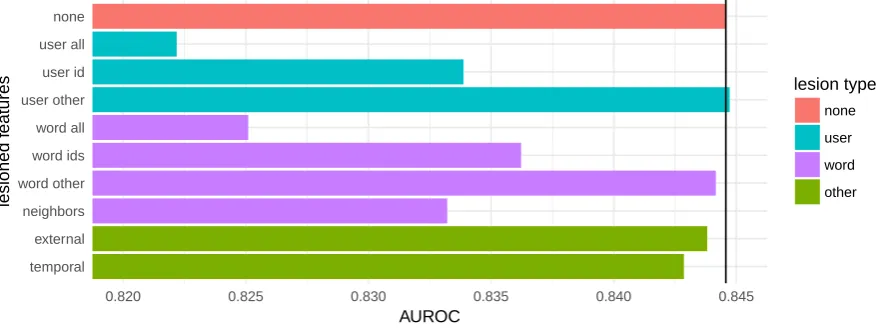
Figure 1: Performance ondevof models trained on alltraindata, with different groups of lesioned features. See main text for description of lesion groups
3 Feature Removal Experiments
To better understand which features or groups of features were most important to our model’s pre-dictions, we conducted a set of experiments in which we lesioned (i.e., removed) a group of fea-tures and re-trained the model on thetrainset, evaluating performance on thedev set. For sim-plicity, we ran each of the lesioned models on all language data and report the average performance. We did not run individual-language models as we did for our primary model. The results of the le-sion experiments are shown in Figure1. The mod-els are as follows.
none: All features are included.
user all: All user-level features, including the user ID and other calculated features like en-tropy and measures of exercise bursts, are re-moved.
user id & user other: Only user ID or only the calculated user features, respectively, are re-moved.
word all: Token and token root IDs; previous, next, and dependency-tree root word IDs; and
morphological, part of speech, and depen-dency tree features are removed. This does not includeexternalfeatures listed below.
word id & word other: Only word IDs or only other word features, respectively, are re-moved. word otherdoes not include exter-nalfeatures listed below.
neighbors: Both word IDs and other word fea-tures are removed, but only for the previous, next, and dependency-tree root words. Infor-mation about the present word is maintained.
external: External information about the word, including corpus frequency, Levenshtein dis-tance from translation, and age of acquisition, are removed.
temporal: Temporal information, including num-ber and timing of past encounters with the word and error tracking information, is re-moved.
[image:5.595.78.517.197.363.2]alone, represented as high-cardinality categorical features. Removing other word features, such as morphological features and part of speech, created only a small degradation of performance. In the case of users, removing features such as entropy and average exercise burst length led to a tiny in-crease of performance. In the case of both users and words, though, we find that in the absence of ID features the other features are helpful and lead to better performance than removing all features. We also found that removing all information about neighboring words and the dependency-parse root word degraded performance. This confirms that word context matters, and suggests that users com-monly make errors in word order, subject–verb matching and other grammatical rules.
Our external word features—Levenshtein dis-tance to translation, frequency, and age of acquisition—provided a slight boost to model per-formance, showing the benefit of considering what makes a word hard to learn from a psychological and linguistic perspective. Adding temporal fea-tures about past encounters and errors helped the models, but not as much as we expected. While not included in the final model, we had also tried augmenting the temporal feature set with more features related to massing and spacing of encoun-ters with a word, but found it did not improve per-formance. This is perhaps not surprising given how small the benefit of the existing temporal fea-tures are in our model.
Though not plotted above, we also ran a model lesioning exercise-level features including client, session type, format, and exercise duration. This model achieved an AUROC of.787, far lower than any other lesion. This points to the fact that the manner in which memory is assessed often affects observed performance (e.g., the large literature in psychology on the difference between recall and recognition memory,Yonelinas,2002).
4 Discussion
When approaching the Duolingo SLAM task, we hoped to leverage psychological insights in build-ing our model. We found that in some cases, such as when using the word’s age-of-acquisition, this was helpful. In general, though, our model gained its power not from hand-crafted features but from applying a powerful inference technique (gradi-ent boosted decision trees) to raw input about user IDs, word IDs, and exercise features.
There are multiple reasons for the limited appli-cability of psychology to this competition. First, computational psychological models are typically designed based on small laboratory data sets, which might limit their suitability for generating highly accurate predictions in big data settings. Because they are designed not for prediction but for explanation, they tend to use a small number of input variables and allow those variables to inter-act in limited ways. In contrast, gradient boosted decision trees, as well as other cutting-edge tech-niques like deep learning can extract high-level in-teractions among hundreds of features. While they are highly opaque, require a lot of data, and are not amenable to explanation, these models excel at prediction.
Second, it is possible that our ability to use the-ories of learning, including ideas about massed and spaced practice, was disrupted by the fact that the data may have been adaptively created using these very principles (Settles and Meeder,2016). If Duolingo adaptively sequenced the spacing of trials based on past errors, then the relationship between future errors and past spacing may have substantially differed from that found in the psy-chological literature (Cepeda et al.,2006).
Finally, if the task had required broader gener-alization, psychologically inspired features might have performed more competitively. In the SLAM task, there is a large amount of labeled training data for every user and for most words. This al-lows simple ID-based features to work because the past history of a user will likely influence their future performance. However, with ID-based features there is no way to generalize to newly-encountered users or words, which have an ID that was not in the training set. The learned ID-based knowledge is useless here because there is no way to generalize from one unique ID to an-other. Theory-driven features, in contrast, can of-ten generalize to new settings because they capture aspects that are shared across (subsets of) users, words, or situations of the learning task. For ex-ample, if we were asked to generalize to a com-pletely new language such as German, many parts of our model would falter but word frequency, age of acquisition, and Levenshtein distance to first-language translation would still likely prove to be features which have high predictive utility.
oppor-tunities for cognitive science and psychology. Large-scale, predictive challenges like this one might be used to identify features or variables that are important for learning. Then, complementary laboratory-scale studies can be conducted which establish the causal status of such features through controlled experimentation. Conversely, insights from controlled experiments can be used to gener-ate new features that aid predictive models on nat-uralistic datasets (Griffiths, 2015;Goldstone and Lupyan,2016). This type of two-way interaction could lead to long-run improvements in both sci-entific explanation and real-world prediction.
5 Acknowledgments
This research was supported by NSF grant DRL-1631436 and BCS-1255538, and the John S. Mc-Donnell Foundation Scholar Award to TMG. We thank Shannon Tubridy and Tal Yarkoni for help-ful suggestions in the development of this work.
References
Michael C Anderson, Robert A Bjork, and Elizabeth L Bjork. 1994. Remembering can cause forgetting: Retrieval dynamics in long-term memory. Jour-nal of Experimental Psychology: Learning, Mem-ory, and Cognition, 20:1063–1087.
R.C. Atkinson. 1972a. Ingredients for a theory of in-struction. American Psychologist, 27:921–931.
R.C. Atkinson. 1972b. Optimizing the learning of a second-language vocabulary. Journal of Experimen-tal Psychology, 96:124–129.
Marc Brysbaert and Michael J Cortese. 2011. Do the effects of subjective frequency and age of ac-quisition survive better word frequency norms? Quarterly Journal of Experimental Psychology, 64(3):545–559.
N.J. Cepeda, H. Pashler, E. Vul, J.T. Wixted, and D. Rohrer. 2006. Distributed practice in verbal re-call tasks: A review and quantitative synthesis. Psy-chological Bulletin, 132(3):354–380.
M.M. Chun and E.A. Phelps. 1999. Memory deficits for implicit contextual information in amnesic sub-jects with hippocampal damage. Nature Neuro-science, 2(9):844–847.
AT Corbett and JR Anderson. 1995. Knowledge track-ing: Modeling the acquisition of procedural knowl-edge. User Modeling and User-Adapted Interac-tion, 4:253–278.
Annette De Groot and Rineke Keijzer. 2000. What is hard to learn is easy to forget: The roles of word
concreteness, cognate status, and word frequency in foreign-language vocabulary learning and forget-ting. Language Learning, 50(1):1–56.
Ludovic Ferrand, Marc Brysbaert, Emmanuel Keuleers, Boris New, Patrick Bonin, Alain M´eot, Maria Augustinova, and Christophe Pallier. 2011. Comparing word processing times in naming, lexi-cal decision, and progressive demasking: Evidence from chronolex. Frontiers in psychology, 2:306.
Walter D Fisher. 1958. On grouping for maximum ho-mogeneity. Journal of the American statistical As-sociation, 53(284):789–798.
Duncan R Godden and Alan D Baddeley. 1975. Context-dependent memory in two natural environ-ments: On land and underwater. British Journal of psychology, 66(3):325–331.
R.L. Goldstone and G. Lupyan. 2016. Discovering psychological principles by mining naturally occur-ring data sets. Topics in Cognitive Science, 8:548– 568.
T.M. Griffiths. 2015. Manifesto for a new (computa-tional) cognitive revolution. Cognition, 135:21–23.
Heikki Hyyr¨o. 2001. Explaining and extending the bit-parallel approximate string matching algorithm of myers. Technical report in Journal of the ACM, page 408.
Guolin Ke, Qi Meng, Thomas Finley, Taifeng Wang, Wei Chen, Weidong Ma, Qiwei Ye, and Tie-Yan Liu. 2017. Lightgbm: A highly efficient gradient boost-ing decision tree. In Advances in Neural Informa-tion Processing Systems, pages 3149–3157.
Mohammad Khajah, Robert V. Lindsey, and Michael Mozer. 2016. How deep is knowledge tracing? Pro-ceedings of the Educational Data Mining (EDM).
Victor Kuperman, Hans Stadthagen-Gonzalez, and Marc Brysbaert. 2012. Age-of-acquisition ratings for 30,000 english words. Behavior Research Meth-ods, 44(4):978–990.
M. C. Mozer, H. Pashler, N. Cepeda, R. Lindsey, and E. Vul. 2009. Predicting the optimal spacing of study: A multiscale context model of memory. In Advances in Neural Information Processing Systems 22, pages 1321–1329, La Jolla, CA. NIPS Founda-tion.
P.I. Pavlik and J.R. Anderson. 2008. Using a model to compute the optimal schedule of practice. Journal of Experimental Psychology: Applied, 14(2):101– 117.
Keith Rayner. 1998. Eye movements in reading and information processing: 20 years of research. Psy-chological bulletin, 124(3):372.
Henry L. Roediger and Jeffrey D. Karpicke. 2006.
Test-enhanced learning: Taking memory tests im-proves long-term retention. Psychological Science, 17(3):249–255. PMID: 16507066.
D.C. Rubin and A.E. Wenzel. 1996. One hundred years of forgetting: A quantitative description of retention. Psychological Review, 103(4):734–760.
T.C. Ruth. 1928. Factors influencing the relative econ-omy of massed and distributed practice in learning. Psychological Review, 35:19–45.
B. Settles, C. Brust, E. Gustafson, M. Hagiwara, and N. Madnani. 2018. Second language acquisition modeling. InProceedings of the NAACL-HLT Work-shop on Innovative Use of NLP for Building Educa-tional Applications (BEA). ACL.
Burr Settles. 2018. Data for the 2018 duolingo shared task on second language acquisition model-ing (slam).
Burr Settles and Brendan Meeder. 2016. A trainable spaced repetition model for language learning. In Proceedings of the 54th Annual Meeting of the As-sociation for Computational Linguistics (Volume 1: Long Papers), volume 1, pages 1848–1858.
Robert Speer, Joshua Chin, Andrew Lin, Sara Jew-ett, and Lance Nathan. 2017. Luminosoin-sight/wordfreq: v1.7.
Steven Tang, Joshua C. Peterson, and Zachary A. Par-dos. 2016. Deep neural networks and how they ap-ply to sequential education data. InProceedings of the Third (2016) ACM Conference on Learning @ Scale, L@S ’16, pages 321–324, New York, NY, USA. ACM.
Xiaolu Xiong, Siyuan Zhao, Eric Van Inwegen, and Joseph Beck. 2016. Going deeper with deep knowl-edge tracing. InEDM, pages 545–550.
T. Yarkoni and J. Westfall. 2017. Choosing predic-tion over explanapredic-tion in psychology: Lessons from machine learning. Persectives in Psychological Sci-ence, 12(6):1100–1122.
Andrew P Yonelinas. 2002. The nature of recollection and familiarity: A review of 30 years of research. Journal of memory and language, 46(3):441–517.