Proceedings of the Workshop on Figurative Language Processing, pages 56–66
A Report on the 2018 VUA Metaphor Detection Shared Task
Chee Wee Leong, Beata Beigman Klebanov Educational Testing Service
{cleong,bbeigmanklebanov}@ets.org
Ekaterina Shutova University of Amsterdam
Abstract
As the community working on computational approaches to figurative language is growing and as methods and data become increasingly diverse, it is important to create widely shared empirical knowledge of the level of system performance in a range of contexts, thus fa-cilitating progress in this area. One way of creating such shared knowledge is through benchmarking multiple systems on a common dataset. We report on the shared task on metaphor identification on the VU Amsterdam Metaphor Corpus conducted at the NAACL 2018 Workshop on Figurative Language Pro-cessing.
1 Introduction
Metaphor use in everyday language is a way to relate our physical and familiar social experi-ences to a multitude of other subjects and con-texts (Lakoff and Johnson, 2008); it is a funda-mental way to structure our understanding of the world even without our conscious realization of its presence as we speak and write. It highlights the unknown using the known, explains the complex using the simple, and helps us to emphasize the relevant aspects of meaning resulting in effective communication. Consider the following examples of metaphor use in Table1.
Metaphor has been studied in the context of political communication, marketing, mental health, teaching, assessment of English profi-ciency, among others (Beigman Klebanov et al.,
2018; Gutierrez et al., 2017; Littlemore et al.,
2013; Thibodeau and Boroditsky, 2011; Kaviani and Hamedi, 2011;Kathpalia and Carmel, 2011;
Landau et al., 2009; Beigman Klebanov et al.,
2008;Zaltman and Zaltman,2008;Littlemore and Low,2006;Cameron,2003;Lakoff,2010;Billow et al.,1997;Bosman,1987); see chapter 7 inVeale et al.(2016) for a recent review.
M:The alligator’s teeth are like whitedaggers I: The alligator have white and pointed teeth.
M:Heswamin aseaof diamonds.
I: He is a rich person.
M:Authority is achair, it needslegstostand.
I: Authority is useless when it lacks support.
M: In Washington, people change dance part-nersfrequently, but not thedance.
I: In Washington, people work with one another opportunistically.
M:Robert Muller is like abulldog— he will get what he wants.
I: Robert Muller will work in a determined and aggressive manner to get what he wants.
Table 1:Metaphorical sentences (M) characterized by metaphors in bold and their literal interpreta-tions (I)
In this paper, we report on the first shared task on automatic metaphor detection. By making available an easily accessible common dataset and framework for evaluation, we hope to contribute to the consolidation and strengthening of the grow-ing community of researchers workgrow-ing on com-putational approaches to figurative language. By engaging a variety of teams to test their systems within a common evaluation framework and share their findings about more or less effective architec-tures, feaarchitec-tures, and data sources, we hope to create a shared understanding of the current state of the art, laying a foundation for further work.
This report provides a description of the shared task, dataset and metrics, a brief description of each of the participating systems, a comparative evaluation of the systems, and our observations about trends in designs and performance of the
systems that participated in the shared task.
2 Related Work
Over the last decade, automated detection of metaphor has become an increasingly popular topic, which manifests itself in both a variety of approaches and in an increasing variety of data to which the methods are applied. In terms of meth-ods, approaches based on feature-engineering in a supervised machine learning paradigm explored features based on concreteness and imageability, semantic classification using WordNet, FrameNet, VerbNet, SUMO ontology, property norms, and distributional semantic models, syntactic depen-dency patterns, sensorial and vision-based fea-tures (Bulat et al., 2017; K¨oper and im Walde,
2017;Gutierrez et al.,2016;Shutova et al.,2016;
Beigman Klebanov et al.,2016; Tekiroglu et al.,
2015; Tsvetkov et al., 2014; Beigman Klebanov et al., 2014; Dunn, 2013; Neuman et al., 2013;
Mohler et al., 2013; Hovy et al.,2013;Tsvetkov et al., 2013; Turney et al., 2011; Shutova et al.,
2010; Gedigian et al., 2006); see Shutova et al.
(2017) andVeale et al.(2016) for reviews of super-vised as well as semi-supersuper-vised and unsupersuper-vised approaches.
Recently, deep learning methods have been ex-plored for token-level metaphor detection (Rei et al., 2017;Gutierrez et al., 2017; Do Dinh and Gurevych,2016). As discussed later in the paper later, the fact that all but one of the participating teams for the shared task experimented with neu-ral network architectures testifies to the increasing popularity of this modeling approach.
In terms of data used for evaluating metaphor detection systems, researchers used specially con-structed or selected sets, such as adjective noun pairs (Gutierrez et al.,2016;Tsvetkov et al.,2014), WordNet synsets and glosses (Mohammad et al.,
2016), annotated lexical items (from a range of word classes) in sentences sampled from cor-pora (¨Ozbal et al.,2016;Jang et al., 2015;Hovy et al.,2013;Birke and Sarkar,2006), all the way to annotation of all words in running text for metaphoricity (Beigman Klebanov et al., 2018;
Steen et al.,2010);Veale et al.(2016) review addi-tional annotated datasets. By far the largest anno-tated dataset is the VU Amsterdam Metaphor Cor-pus; it has also been used for evaluating many of the cited supervised learning-based systems. Due to its size, availability, reliability of annotation,
and popularity in current research, we decided to use it to benchmark the current field of supervised metaphor detection approaches.
3 Task Description
The goal of this shared task is to detect, at the word level, all metaphors in a given text. Specifically, there are two tracks, namely, All Part-Of-Speech (POS) and Verbs. The former track is concerned with the detection of all content words, i.e., nouns, verbs, adverbs and adjectives that are labeled as metaphorical while the latter track is concerned only with verbs that are metaphorical. We excluded all forms or be,
do, and have for both tracks. Each participating individual or team can elect to compete in the All POS track, Verbs track, or both. The competition is organized into two phases: training and testing.
3.1 Dataset
We use the VU Amsterdam Metaphor Corpus (VUA) (Steen et al.,2010) as the dataset for our shared task. The dataset consists of 117 fragments sampled across four genres from the British Na-tional Corpus: Academic, News, Conversation, andFiction. Each genre is represented by approx-imately the same number of tokens, although the number of texts differs greatly, where the news archive has the largest number of texts. We ran-domly sampled 23% of the texts from each genre to set aside for testing, while retaining the rest for training. The data is annotated using the MIP-VU procedure with a strong inter-annotator re-liability of κ > 0.8. It is based on the MIP procedure (Group, 2007), extending it to handle metaphoricity through reference (such as marking
didas a metaphor in As the weather broke up, so did their friendship) and allow for explicit cod-ing of difficult cases where a group of annotators could not arrive at a consensus. The tagset is rich and is organized hierarchically, detecting various types of metaphors, words that flag the presense of metaphors, etc. In this paper, we consider only the top-level partition, labeling all content words with the tag “function=mrw” (metaphor-related word) as metaphors, while all other content words are la-beled as non-metaphors. Table2shows the overall statistics of our training and testing sets.
re-Data Training Testing
#texts #tokens %M #texts #tokens %M
Verbs
Academic 12 4,903 31% 4 1,259 51%
Conversation 18 4,181 15% 6 2,001 15%
Fiction 11 4,647 25% 3 1,385 20%
News 49 3,509 42% 14 1,228 46%
All POS
Academic 12 27,669 14% 4 6,076 24%
Conversation 18 11,994 10% 6 5,302 10%
Fiction 11 15,892 16% 3 4,810 14%
[image:3.595.146.449.63.232.2]News 49 17,056 20% 14 6,008 22%
Table 2:Verbs and All POS datasets. The table reports the number of text fragments from BNC, number of tokens and percentage of tokens marked as metaphor group by genres.
search, the complete set of task instructions and scripts are published on Github1. Specifically, we
provide a script to parse the original VUAMC.xml, which was not provided in our download bundle due to licensing restriction, to extract the verbs and other content words required for the shared task. We also provide a set of features used to construct the baseline classification model for prediction of metaphor/non-metaphor classes at the word level, and instructions on how to replicate the baselines.
3.2 Training phase
In this first phase, data is released for train-ing and/or development of metaphor detection models. Participants can elect to perform cross-validation on the training data, or partition the training data further to have a held-out set for preliminary evaluations, and/or set apart a subset of the data for development/tuning of hyper-parameters. However the training data is used, the goal is to haveN final systems (or versions of a system) ready for evaluation when the test data is released.
3.3 Testing phase
In this phase, instances for evaluation are re-leased.2 Each participating system generated
predictions for the test instances, for up to N models.3 Predictions are submitted to CodaLab4
1https://github.com/EducationalTestingService/metaphor
/tree/master/NAACL-FLP-shared-task
2In principle, participants could have access to the test
data by independently obtaining the VUA corpus. The shared task was based on a presumption of fair play by participants.
3We setN=12.
4https://competitions.codalab.org/competitions/17805
and evaluated automatically against the true labels. We selected CodaLab as a platform for organizing the task due to its ease of use, availability of communication tools such as mass-emailing, online forum for clarification of task issues, and tracking of submissions in real time. Submissions were anonymized. Hence, the only statistics displayed were the highest score of all systems per day, and the total number of system submissions per day. The metrics used for evaluation is the F1 score (least frequent class/label, which is “metaphor”) with Precision and Recall also available via the detailed results link in CodaLab.
4 Systems
teams’ papers for more details.
Baseline Classifiers
We make available to shared task participants a number of features from prior published work on metaphor detection, including unigram features, features based on WordNet, VerbNet, and those derived from a distributional semantic model, POS-based, concreteness and difference in con-creteness, as well as topic models.
As baselines, we train two logistic regression classifiers for each track (Verbs and All-POS), with instance weights inversely proportional to class frequencies. Lemmatized unigrams (UL) is a simple yet fairly strong baseline (Baseline 1). This feature is produced using NLTK (Bird and Loper,
2004) to generate the lemma of each word accord-ing to its tagged POS. AsBaseline 2, we use the best system fromBeigman Klebanov et al.(2016). The features are: lemmatized unigrams, general-ized WordNet semantic classes, and difference in concreteness ratings between verbs/adjectives and nouns (UL + WordNet + CCDB).5
4.1 System Descriptions
The best-performing system from each participant is described below, in alphabetic order.
bot.zen (Stemle and Onysko, 2018) used word embeddings from different standard cor-pora representing different levels of language mastery, encoding each word in a sentence into multiple vector-based embeddings which are then fed into an LSTM RNN network architec-ture. Specifically, the backpropagation step was performed using weightings computed based on the logarithmic function of the inverse of the count of the metaphors and non-metaphors. Their implementation is hosted on Github6 under the
Apache License Version 2.0.
DeepReader (Swarnkar and Singh,2018) The authors present a neural network architecture that concatenates hidden states of forward and backward LSTMs, with feature selection and classification. The authors also show that re-weighting examples and adding linguistic features (WordNet, POS, concreteness) helps improve performance further.
5Baseline 2 is “all-16” inBeigman Klebanov et al.(2018). 6https://github.com/bot-zen/naacl flp st
MAP (Pramanick et al., 2018) used a hybrid architecture of Bi-directional LSTM and Con-ditional Random Fields (CRF) for metaphor detection, relying on features such as token, lemma and POS, and using word2vec embeddings trained on English Wikipedia. Specifically, the authors considered contextual information within a sentence for generating predictions.
nsu ai (Mosolova et al., 2018) used linguistic features based on unigrams, lemmas, POS tags, topical LDAs, concreteness, WordNet, VerbNet and verb clusters and trained a Conditional Random Field (CRF) model with gradient descent using the L-BFGS method to generate predictions.
OCOTA (Bizzoni and Ghanimifard, 2018) experimented with a deep neural network com-posed of a Bi-LSTM preceded and followed by fully connected layers, as well as a simpler model that has a sequence of fully connected neural networks. The authors also experiment with word embeddings trained on various data, with explicit features based on concreteness, and with preprocessing that addresses variability in sentence length. The authors observe that a model that combines Bi-LSTM with the explicit features and sentence-length manipulation shows the best performance. The authors also show that an ensemble of the two types of neural models works even better, due to a substantial increase in recall over single models.
Samsung RD PL (Skurniak et al., 2018) ex-plored the use of several orthogonal resources in a cascading manner to predict metaphoricity. For a given word in a sentence, they extracted three fea-ture sets: concreteness score from the Brysbaert database, intermediate hidden vector representing the word in a neural translation framework, and generated logits of a CRF sequence tagging model trained using word embeddings and contextual information. Trained on the VUA data, the CRF model alone outperforms that of a GRU taking all three features.
Bi-LSTM to capture local and long-range de-pendencies for generating metaphorical labels. Specifically, they used an ensemble strategy in which iterative modeling is performed by training on randomly selected training data and averaging the model predictions for finalized outputs. At the inferencing layer, the authors showed that the best-performing system is one achieved by using a weighted-softmax classifier rather than the Conditional Random Field pre-dictor, since it can significantly improve the recall.
ZIL IPIPAN (Mykowiecka et al., 2018) used word2vec embeddings over ortographical word forms (no lemmatization) as an input for LSTM network for generating predictions. They ex-plored augmenting word embeddings by binarized vectors that reflect the General Inquirer dictionary category of a word and its POS. Experiments were also carried out with different parametrization of LSTM based on type of unit network, number of layers, size of dropout, number of epochs, etc., though vectors enriched with POS information did not result in any improvement.
5 Results
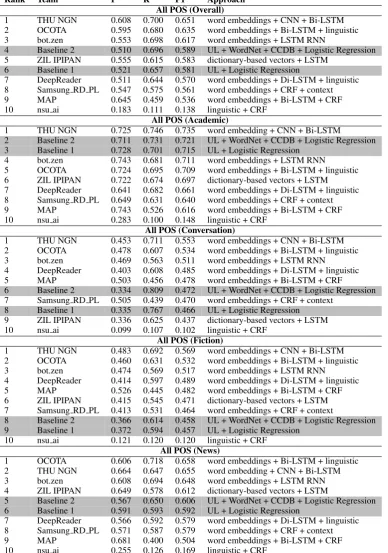
Tables 3 and 4 show the performance and the ranking of all the systems, including the baseline systems. For overall results on All-POS track, three out of the seven systems outperformed the stronger of the two baselines, with the best submit-ted system gaining 6 F1-score points over the best baseline (0.65 vs 0.59). We note that the best sys-tem outperformed the baseline through improved precision (by 10 points), while the recall remained the same, around 0.7.
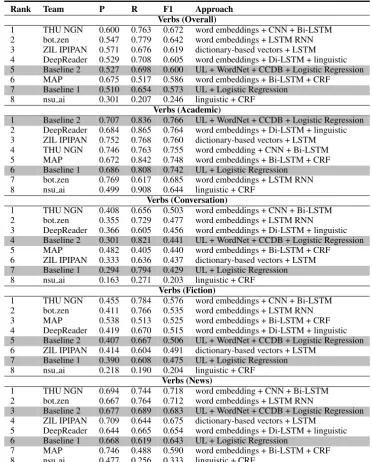
For the Verbs track, four out of the five tems outperformed both baselines. The best sys-tem posted an improvement of 7 F1-score points over best baseline (0.67 vs 0.60), achieved by im-provements of about the same magnitude in both recall and precision.
In the following section, we inspect the perfor-mance of the different systems more closely.
6 Discussion
6.1 Trends in system design
All the submitted systems but one are based on a neural network architecture. Out of the top three systems that outperform the baseline on All-POS,
two introduce explicit linguistic features into the architecture along with the more standard word-embedding-based representations, while the third experiments with using a variety of corpora – including English-language-learner-produced cor-pora – to compute word embeddings.
6.2 Performance across genres
Tables 3and 4show the overall performance for the best submission per team, as well as the per-formance of these systems by genre. It is clear that the overall F1 scores of 0.62-0.65 for the top three systems do not make explicit the substan-tial variation in performance across genres. Thus, Academic is the easiest genre, with the best per-formance of 0.74, followed by News (0.66), with comparable scores for Fiction (0.57) and Conver-sation (0.55). In fact, this trend holds not only for the top systems but for all systems, includ-ing baselines, apart from the lowest-performinclud-ing system that showed somewhat better results on News than on Academic. The same observations hold for the Verb data. The large discrepancies in performance across different genres underscore the need for wide genre coverage when evaluat-ing metaphor detection systems, as the patterns of metaphor use are quite different across genres and present tasks of varying difficulty to machine learning systems across the board.
Furthermore, we note that the best overall sys-tem, which is the only system that improves upon the baseline for every single genre in All-POS evaluation, improved over the baseline much more substantially in the lower-performance gen-res. Thus, for Academic and News, the in-crease is 1.4 and 5.2 F1 points, respectively, while the improvements for Conversation and Fiction are 8.1 and 11.1 points, respectively. The best-performing system thus exhibits more stable per-formance across genres than the baseline, though genre discrepancies are still substantial, as de-scribed above.
6.3 Part of Speech 6.3.1 AllPOS vs Verbs
Rank Team P R F1 Approach All POS (Overall)
1 THU NGN 0.608 0.700 0.651 word embeddings + CNN + Bi-LSTM 2 OCOTA 0.595 0.680 0.635 word embeddings + Bi-LSTM + linguistic 3 bot.zen 0.553 0.698 0.617 word embeddings + LSTM RNN
4 Baseline 2 0.510 0.696 0.589 UL + WordNet + CCDB + Logistic Regression 5 ZIL IPIPAN 0.555 0.615 0.583 dictionary-based vectors + LSTM
6 Baseline 1 0.521 0.657 0.581 UL + Logistic Regression
7 DeepReader 0.511 0.644 0.570 word embeddings + Di-LSTM + linguistic 8 Samsung RD PL 0.547 0.575 0.561 word embeddings + CRF + context 9 MAP 0.645 0.459 0.536 word embeddings + Bi-LSTM + CRF 10 nsu ai 0.183 0.111 0.138 linguistic + CRF
All POS (Academic)
1 THU NGN 0.725 0.746 0.735 word embedding + CNN + Bi-LSTM
2 Baseline 2 0.711 0.731 0.721 UL + WordNet + CCDB + Logistic Regression 3 Baseline 1 0.728 0.701 0.715 UL + Logistic Regression
4 bot.zen 0.743 0.681 0.711 word embeddings + LSTM RNN 5 OCOTA 0.724 0.695 0.709 word embeddings + Bi-LSTM + linguistic 6 ZIL IPIPAN 0.722 0.674 0.697 dictionary-based vectors + LSTM 7 DeepReader 0.641 0.682 0.661 word embeddings + Di-LSTM + linguistic 8 Samsung RD PL 0.649 0.631 0.640 word embeddings + CRF + context 9 MAP 0.743 0.526 0.616 word embeddings + Bi-LSTM + CRF 10 nsu ai 0.283 0.100 0.148 linguistic + CRF
All POS (Conversation)
1 THU NGN 0.453 0.711 0.553 word embeddings + CNN + Bi-LSTM 2 OCOTA 0.478 0.607 0.534 word embeddings + Bi-LSTM + linguistic 3 bot.zen 0.469 0.563 0.511 word embeddings + LSTM RNN 4 DeepReader 0.403 0.608 0.485 word embeddings + Di-LSTM + linguistic 5 MAP 0.503 0.456 0.478 word embeddings + Bi-LSTM + CRF 6 Baseline 2 0.334 0.809 0.472 UL + WordNet + CCDB + Logistic Regression 7 Samsung RD PL 0.505 0.439 0.470 word embeddings + CRF + context
8 Baseline 1 0.335 0.767 0.466 UL + Logistic Regression 9 ZIL IPIPAN 0.336 0.625 0.437 dictionary-based vectors + LSTM 10 nsu ai 0.099 0.107 0.102 linguistic + CRF
All POS (Fiction)
1 THU NGN 0.483 0.692 0.569 word embeddings + CNN + Bi-LSTM 2 OCOTA 0.460 0.631 0.532 word embeddings + Bi-LSTM + linguistic 3 bot.zen 0.474 0.569 0.517 word embeddings + LSTM RNN 4 DeepReader 0.414 0.597 0.489 word embeddings + Di-LSTM + linguistic 5 MAP 0.526 0.445 0.482 word embeddings + Bi-LSTM + CRF 6 ZIL IPIPAN 0.415 0.545 0.471 dictionary-based vectors + LSTM 7 Samsung RD PL 0.413 0.531 0.464 word embeddings + CRF + context
8 Baseline 2 0.366 0.614 0.458 UL + WordNet + CCDB + Logistic Regression 9 Baseline 1 0.372 0.594 0.457 UL + Logistic Regression
10 nsu ai 0.121 0.120 0.120 linguistic + CRF All POS (News)
1 OCOTA 0.606 0.718 0.658 word embeddings + Bi-LSTM + linguistic 2 THU NGN 0.664 0.647 0.655 word embedding + CNN + Bi-LSTM 3 bot.zen 0.608 0.694 0.648 word embeddings + LSTM RNN 4 ZIL IPIPAN 0.649 0.578 0.612 dictionary-based vectors + LSTM
5 Baseline 2 0.567 0.650 0.606 UL + WordNet + CCDB + Logistic Regression 6 Baseline 1 0.591 0.593 0.592 UL + Logistic Regression
[image:6.595.106.495.125.679.2]7 DeepReader 0.566 0.592 0.579 word embeddings + Di-LSTM + linguistic 8 Samsung RD PL 0.571 0.587 0.579 word embeddings + CRF + context 9 MAP 0.681 0.400 0.504 word embeddings + Bi-LSTM + CRF 10 nsu ai 0.255 0.126 0.169 linguistic + CRF
Rank Team P R F1 Approach Verbs (Overall)
1 THU NGN 0.600 0.763 0.672 word embeddings + CNN + Bi-LSTM 2 bot.zen 0.547 0.779 0.642 word embeddings + LSTM RNN 3 ZIL IPIPAN 0.571 0.676 0.619 dictionary-based vectors + LSTM 4 DeepReader 0.529 0.708 0.605 word embeddings + Di-LSTM + linguistic 5 Baseline 2 0.527 0.698 0.600 UL + WordNet + CCDB + Logistic Regression 6 MAP 0.675 0.517 0.586 word embeddings + Bi-LSTM + CRF 7 Baseline 1 0.510 0.654 0.573 UL + Logistic Regression
8 nsu ai 0.301 0.207 0.246 linguistic + CRF Verbs (Academic)
1 Baseline 2 0.707 0.836 0.766 UL + WordNet + CCDB + Logistic Regression 2 DeepReader 0.684 0.865 0.764 word embeddings + Di-LSTM + linguistic 3 ZIL IPIPAN 0.752 0.768 0.760 dictionary-based vectors + LSTM 4 THU NGN 0.746 0.763 0.755 word embedding + CNN + Bi-LSTM 5 MAP 0.672 0.842 0.748 word embeddings + Bi-LSTM + CRF 6 Baseline 1 0.686 0.808 0.742 UL + Logistic Regression
7 bot.zen 0.769 0.617 0.685 word embeddings + LSTM RNN 8 nsu ai 0.499 0.908 0.644 linguistic + CRF
Verbs (Conversation)
1 THU NGN 0.408 0.656 0.503 word embeddings + CNN + Bi-LSTM 2 bot.zen 0.355 0.729 0.477 word embeddings + LSTM RNN 3 DeepReader 0.366 0.605 0.456 word embeddings + Di-LSTM + linguistic 4 Baseline 2 0.301 0.821 0.441 UL + WordNet + CCDB + Logistic Regression 5 MAP 0.482 0.405 0.440 word embeddings + Bi-LSTM + CRF 6 ZIL IPIPAN 0.333 0.636 0.437 dictionary-based vectors + LSTM 7 Baseline 1 0.294 0.794 0.429 UL + Logistic Regression 8 nsu ai 0.163 0.271 0.203 linguistic + CRF
Verbs (Fiction)
1 THU NGN 0.455 0.784 0.576 word embeddings + CNN + Bi-LSTM 2 bot.zen 0.411 0.766 0.535 word embeddings + LSTM RNN 3 MAP 0.538 0.513 0.525 word embeddings + Bi-LSTM + CRF 4 DeepReader 0.419 0.670 0.515 word embeddings + Di-LSTM + linguistic 5 Baseline 2 0.407 0.667 0.506 UL + WordNet + CCDB + Logistic Regression 6 ZIL IPIPAN 0.414 0.604 0.491 dictionary-based vectors + LSTM
7 Baseline 1 0.390 0.608 0.475 UL + Logistic Regression 8 nsu ai 0.218 0.190 0.204 linguistic + CRF
Verbs (News)
1 THU NGN 0.694 0.744 0.718 word embedding + CNN + Bi-LSTM 2 bot.zen 0.667 0.764 0.712 word embeddings + LSTM RNN
3 Baseline 2 0.677 0.689 0.683 UL + WordNet + CCDB + Logistic Regression 4 ZIL IPIPAN 0.709 0.644 0.675 dictionary-based vectors + LSTM
5 DeepReader 0.644 0.665 0.654 word embeddings + Di-LSTM + linguistic 6 Baseline 1 0.668 0.619 0.643 UL + Logistic Regression
[image:7.595.109.482.63.526.2]7 MAP 0.746 0.488 0.590 word embeddings + Bi-LSTM + CRF 8 nsu ai 0.477 0.256 0.333 linguistic + CRF
Table 4:Performance and ranking of the best system per team and baselines for the Verbs track, including split by genre.
Team All-POS Verbs Adjectives Nouns Adverbs Best to Worst
THU NGN .651 .674 (1) .651 (2) .629 (3) .588 (4) .09
OCOTA .635 .669 (1) .625 (2) .609 (3) .569 (4) .10
bot.zen .617 .655 (1) .582 (3) .594 (2) .539 (4) .12
Baseline 2 .589 .616 (1) .557 (3) .564 (2) .542 (4) .07 ZIL IPIPAN .583 .619 (1) .571 (2) .552 (3) .484 (4) .14 Baseline 1 .581 .594 (1) .578 (2) .564 (3) .563 (4) .03 DeepReader .570 .605 (1) .568 (2) .537 (3) .521 (4) .08 SamSung RD PL .561 .615 (1) .540 (2) .516 (3) .498 (4) .12
MAP .536 .586 (1) .527 (2) .481 (4) .496 (3) .10
nsu ai .138 .155 (1) .131 (3) .136 (2) .102 (4) .05
Av. rank among POS – 1 2.3 2.8 3.9 .09
Rank order correlation 1 .94 .92 .98 .81 –
with AllPOS performance
[image:7.595.100.495.567.716.2]This could be related to the larger preponder-ance of metaphors among verbs, which, in turn, leads to a more balanced class distribution in the Verbs data.
6.3.2 AllPOS by POS
To better understand performance patterns across various parts of speech, we break down the All-POS test set by All-POS, and report performance of each of the best systems submitted to the All-POS track on each All-POS-based subset of the test data; Table 5 shows the results. First, we ob-serve that the average difference in performance between best and worst POS is 9 points (see col-umn Best to Worst in the Table), with different systems ranging from 3 to 14. We note that the baseline systems are relatively more robust in this respect (3-7 points), while the the top 3 systems exhibit a 9-12 point range of variation in perfor-mance by POS. While this gap is substantial, it is much smaller than the 20-point gap observed in by-genre breakdown.
Second, we note that without exception all sys-tems performed best on verbs, and for all but one system performance was worst on adverbs (see “Av. rank among POS” row in Table5). Perfor-mance on adjectives and nouns was comparable for most systems, with slightly better results for adjectives for 7 out of 10 systems. These trends closely follow the proportions of metaphors within each POS:
While 30% of verbs are marked as metaphor-ical, only 8% of adverbs are thus marked, with nouns and adjectives occupying the middle ground with 13% and 18% metaphors, respectively.
Third, we observe that the relative performance of the systems is quite consistent across POS. Thus, the rank order correlation between systems’ overall performance (AllPOS) and their perfor-mance on Verbs is 0.94; it is 0.98 for nouns and 0.92 for Adjectives (see the last row of Table 5). In fact, the top three ranks are occupied by the same systems in AllPOS, Verbs, Adjectives, and Nouns categories. The somewhat lower rank or-der correlation for Adverbs (0.81) reflects Base-line 1 (which ranks 6th overall) posting a rela-tively strong performance for Adverbs (ranks 3rd), while the ZIL IPIPAN system (ranks 5th overall) shows relatively weak performance on Adverbs (ranks 9th). Overall, the systems’ relative stand-ings are not much affected when parceled out by POS-based subsets.
7 Conclusion
This paper summarized the results of the 2018 shared task on metaphor identification in the VUA corpus, held as part of the 2018 NAACL Work-shop on Figurative Language Processing. We pro-vided brief descriptions of the participating sys-tems for which detailed papers were submitted; systems’ performance in terms of precision, recall, and F-score; and breakdowns of systems’ perfor-mance by POS and genre.
We observed that the task of metaphor detection seems to be somewhat easier for verbs than for other parts of speech, consistently across partici-pating systems. For genres, we observed a large discrepancy in best and worst performance, with results in the .7s for Academic and in .5s for Con-versation data. Clearly, understanding and bridg-ing the genre-based gap in performance is an im-portant avenue for future work.
While most systems employed a deep learn-ing architecture effectively, the baselines that use a traditional feature-engineering design were not far behind, in terms of performance; the stronger baseline came 4th overall. Indeed, some of the contributions explored a combination of a DNN architecture and explicit linguistic features; this seems like a promising direction for future work. Some of the teams made their implementations publicly available, which should facilitate further work on improving performance on this task.
8 Acknowledgements
As organizers of the shared task, we would like to thank all the teams for their interest and participa-tion. Specifically, we would also like to thank Yuri Bizzoni for his help with pre-testing the shared task setup.
References
Beata Beigman Klebanov, Daniel Diermeier, and Eyal Beigman. 2008. Lexical cohesion analysis of politi-cal speech.Political Analysis, 16(4):447–463. Beata Beigman Klebanov, Chee Wee Leong, and
Michael Flor. 2018. A corpus of non-native writ-ten english annotated for metaphor. InProceedings of the Annual Meeting of the North American Chap-ter of the Association for Computational Linguistics, New Orleans,LA.
metaphors. InProceedings of the 54th Annual Meet-ing of the Association for Computational LMeet-inguistics (Volume 2: Short Papers), volume 2, pages 101–106.
Beata Beigman Klebanov, Chee Wee Leong, Michael Heilman, and Michael Flor. 2014. Different texts, same metaphors: Unigrams and beyond. In Pro-ceedings of the Second Workshop on Metaphor in NLP, pages 11–17.
Richard M Billow, Jeffrey Rossman, Nona Lewis, De-berah Goldman, and Charles Raps. 1997. Observ-ing expressive and deviant language in schizophre-nia. Metaphor and Symbol, 12(3):205–216.
Steven Bird and Edward Loper. 2004. Nltk: the nat-ural language toolkit. In Proceedings of the ACL 2004 on Interactive poster and demonstration ses-sions, page 31. Association for Computational Lin-guistics.
Julia Birke and Anoop Sarkar. 2006. A clustering ap-proach for nearly unsupervised recognition of non-literal language. In 11th Conference of the Euro-pean Chapter of the Association for Computational Linguistics.
Yuri Bizzoni and Mehdi Ghanimifard. 2018. Bigrams and bilstms: Two neural networks for sequential metaphor detection. In Proceedings of the Work-shop on Figurative Language Processing, New Or-leans,LA.
Jan Bosman. 1987. Persuasive effects of political metaphors. Metaphor and Symbol, 2(2):97–113.
Luana Bulat, Stephen Clark, and Ekaterina Shutova. 2017. Modelling metaphor with attribute-based se-mantics. InProceedings of the 15th Conference of the European Chapter of the Association for Com-putational Linguistics: Volume 2, Short Papers, vol-ume 2, pages 523–528.
Lynne Cameron. 2003. Metaphor in educational dis-course. A&C Black.
Erik-Lˆan Do Dinh and Iryna Gurevych. 2016. Token-level metaphor detection using neural networks. In
Proceedings of the Fourth Workshop on Metaphor in NLP, pages 28–33.
Jonathan Dunn. 2013. What metaphor identification systems can tell us about metaphor-in-language. In
Proceedings of the First Workshop on Metaphor in NLP, pages 1–10.
Matt Gedigian, John Bryant, Srini Narayanan, and Bra-nimir Ciric. 2006. Catching metaphors. In Proceed-ings of the Third Workshop on Scalable Natural Lan-guage Understanding, pages 41–48. Association for Computational Linguistics.
Pragglejaz Group. 2007. Mip: A method for iden-tifying metaphorically used words in discourse.
Metaphor and symbol, 22(1):1–39.
E Dario Gutierrez, Guillermo Cecchi, Cheryl Corco-ran, and Philip Corlett. 2017. Using automated metaphor identification to aid in detection and pre-diction of first-episode schizophrenia. In Proceed-ings of the 2017 Conference on Empirical Methods in Natural Language Processing, pages 2923–2930.
E Dario Gutierrez, Ekaterina Shutova, Tyler Marghetis, and Benjamin Bergen. 2016. Literal and metaphor-ical senses in compositional distributional semantic models. In Proceedings of the 54th Annual Meet-ing of the Association for Computational LMeet-inguistics (Volume 1: Long Papers), volume 1, pages 183–193.
Dirk Hovy, Shashank Shrivastava, Sujay Kumar Jauhar, Mrinmaya Sachan, Kartik Goyal, Huying Li, Whit-ney Sanders, and Eduard Hovy. 2013. Identifying metaphorical word use with tree kernels. In Pro-ceedings of the First Workshop on Metaphor in NLP, pages 52–57.
Hyeju Jang, Seungwhan Moon, Yohan Jo, and Car-olyn Rose. 2015. Metaphor detection in discourse. In Proceedings of the 16th Annual Meeting of the Special Interest Group on Discourse and Dialogue, pages 384–392.
Sujata S Kathpalia and Heah Lee Hah Carmel. 2011. Metaphorical competence in esl student writing.
RELC Journal, 42(3):273–290.
Hossein Kaviani and Robabeh Hamedi. 2011. A quan-titative/qualitative study on metaphors used by per-sian depressed patients. Archives of Psychiatry and Psychotherapy, 4(5-13):110.
Maximilian K¨oper and Sabine Schulte im Walde. 2017. Improving verb metaphor detection by propagating abstractness to words, phrases and individual senses. InProceedings of the 1st Workshop on Sense, Con-cept and Entity Representations and their Applica-tions, pages 24–30.
George Lakoff. 2010.Moral politics: How liberals and conservatives think. University of Chicago Press.
George Lakoff and Mark Johnson. 2008. Metaphors we live by. University of Chicago press.
Mark J Landau, Daniel Sullivan, and Jeff Green-berg. 2009. Evidence that self-relevant motives and metaphoric framing interact to influence polit-ical and social attitudes. Psychological Science, 20(11):1421–1427.
Jeannette Littlemore, Tina Krennmayr, James Turner, and Sarah Turner. 2013. An investigation into metaphor use at different levels of second language writing. Applied linguistics, 35(2):117–144.
Saif Mohammad, Ekaterina Shutova, and Peter Tur-ney. 2016. Metaphor as a medium for emotion: An empirical study. In Proceedings of the Fifth Joint Conference on Lexical and Computational Seman-tics, pages 23–33.
Michael Mohler, David Bracewell, Marc Tomlinson, and David Hinote. 2013. Semantic signatures for example-based linguistic metaphor detection. In
Proceedings of the First Workshop on Metaphor in NLP, pages 27–35.
Anna Mosolova, Ivan Bondarenko, and Vadim Fomin. 2018. Conditional random fields for metaphor de-tection. InProceedings of the Workshop on Figura-tive Language Processing, New Orleans,LA.
Agnieszka Mykowiecka, Aleksander Wawer, and Mal-gorzata Marciniak. 2018. Detecting figurative word occurrences using word embeddings. In Proceed-ings of the Workshop on Figurative Language Pro-cessing, New Orleans,LA.
Yair Neuman, Dan Assaf, Yohai Cohen, Mark Last, Shlomo Argamon, Newton Howard, and Ophir Frieder. 2013. Metaphor identification in large texts corpora. PloS one, 8(4):e62343.
G¨ozde ¨Ozbal, Carlo Strapparava, and Serra Sinem Tekiroglu. 2016. Prometheus: A corpus of proverbs annotated with metaphors. InLREC.
Malay Pramanick, Ashim Gupta, and Pabitra Mitra. 2018. An lstm-crf based approach to token-level metaphor detection. In Proceedings of the Work-shop on Figurative Language Processing, New Or-leans,LA.
Marek Rei, Luana Bulat, Douwe Kiela, and Ekaterina Shutova. 2017. Grasping the finer point: A su-pervised similarity network for metaphor detection. In Proceedings of the 2017 Conference on Empiri-cal Methods in Natural Language Processing, pages 1537–1546.
Ekaterina Shutova, Douwe Kiela, and Jean Maillard. 2016. Black holes and white rabbits: Metaphor identification with visual features. InProceedings of the 2016 Conference of the North American Chap-ter of the Association for Computational Linguistics: Human Language Technologies, pages 160–170.
Ekaterina Shutova, Lin Sun, Elkin Dar´ıo Guti´errez, Pa-tricia Lichtenstein, and Srini Narayanan. 2017. Mul-tilingual metaphor processing: Experiments with semi-supervised and unsupervised learning. Com-putational Linguistics, 43(1):71–123.
Ekaterina Shutova, Lin Sun, and Anna Korhonen. 2010. Metaphor identification using verb and noun clustering. InProceedings of the 23rd International Conference on Computational Linguistics, pages 1002–1010. Association for Computational Linguis-tics.
Filip Skurniak, Maria Janicka, and Aleksander Wawer. 2018. Multim-module recurrent neural networks with transfer learning. a submission for the metaphor detection shared task. InProceedings of the Work-shop on Figurative Language Processing, New Or-leans,LA.
Gerard J Steen, Aletta G Dorst, J Berenike Herrmann, Anna Kaal, Tina Krennmayr, and Trijntje Pasma. 2010. A method for linguistic metaphor identifica-tion: From MIP to MIPVU, volume 14. John Ben-jamins Publishing.
Egon Stemle and Alexander Onysko. 2018. Using lan-guage learner data for metaphor detection. In Pro-ceedings of the Workshop on Figurative Language Processing, New Orleans,LA.
Krishnkant Swarnkar and Anil Kumar Singh. 2018. Di-lstm contrast : A deep neural network for metaphor detection. In Proceedings of the Work-shop on Figurative Language Processing, New Or-leans,LA.
Serra Sinem Tekiroglu, G¨ozde ¨Ozbal, and Carlo Strap-parava. 2015. Exploring sensorial features for metaphor identification. InProceedings of the Third Workshop on Metaphor in NLP, pages 31–39.
Paul H Thibodeau and Lera Boroditsky. 2011. Metaphors we think with: The role of metaphor in reasoning.PloS one, 6(2):e16782.
Yulia Tsvetkov, Leonid Boytsov, Anatole Gershman, Eric Nyberg, and Chris Dyer. 2014. Metaphor detec-tion with cross-lingual model transfer. In Proceed-ings of the 52nd Annual Meeting of the Association for Computational Linguistics (Volume 1: Long Pa-pers), volume 1, pages 248–258.
Yulia Tsvetkov, Elena Mukomel, and Anatole Gersh-man. 2013. Cross-lingual metaphor detection using common semantic features. InProceedings of the First Workshop on Metaphor in NLP, pages 45–51.
Peter D Turney, Yair Neuman, Dan Assaf, and Yohai Cohen. 2011. Literal and metaphorical sense iden-tification through concrete and abstract context. In
Proceedings of the Conference on Empirical Meth-ods in Natural Language Processing, pages 680– 690. Association for Computational Linguistics.
Tony Veale, Ekaterina Shutova, and Beata Beigman Klebanov. 2016. Metaphor: A com-putational perspective. Synthesis Lectures on Human Language Technologies, 9(1):1–160.