Proceedings of the First Workshop on Storytelling, pages 50–59
An Encoder-decoder Approach to Predicting Causal Relations in Stories
Melissa Roemmele and Andrew S. Gordon
Institute for Creative Technologies, University of Southern California
[email protected], [email protected]
Abstract
We address the task of predicting causally re-lated events in stories according to a standard evaluation framework, the Choice of Plausi-ble Alternatives (COPA). We present a neu-ral encoder-decoder model that learns to pre-dict relations between adjacent sequences in stories as a means of modeling causality. We explore this approach using different meth-ods for extracting and representing sequence pairs as well as different model architectures. We also compare the impact of different train-ing datasets on our model. In particular, we demonstrate the usefulness of a corpus not pre-viously applied to COPA, the ROCStories cor-pus. While not state-of-the-art, our results es-tablish a new reference point for systems eval-uated on COPA, and one that is particularly in-formative for future neural-based approaches.
1 Introduction
Automated story understanding is a long-pursued task in AI research (Dehn,1981;Lebowitz,1985; Meehan,1977). It has been examined as a com-monsense reasoning task, by which systems make inferences about events that prototypically occur in common experiences (e.g. going to a restau-rant) (Schank and Abelson,1977). Early work of-ten failed to scale beyond narrow domains of sto-ries due to the difficulty of automatically inducing story knowledge. The shift to data-driven AI es-tablished new opportunities to acquire this knowl-edge automatically from story corpora. The field of NLP now recognizes that the type of common-sense reasoning used to predict what happens next in a story, for example, is as important for natu-ral language understanding systems as linguistic knowledge itself.
A barrier to this research has been the lack of standard evaluation schemes for benchmarking progress. The Story Cloze Test (Mostafazadeh
et al., 2016) was recently developed to address this, with a focus on predicting events that are temporally and causally related within common real-world scenarios. The Story Cloze Test in-volves selecting which of two given sentences best completes a particular story. Related to this is the Choice of Plausible Alternatives (COPA) task (Roemmele et al., 2011), which uses the same binary-choice format to elicit a prediction for ei-ther the cause or effect of a given story event. While the Story Cloze Test involves predicting the ending of a story, COPA items focus specifically on commonsense knowledge related to identifying causal relations between sequences.
The competitive approaches to narrative predic-tion evaluated by the Story Cloze Test largely in-volve neural networks trained to distinguish be-tween correct and incorrect endings of stories (Cai et al.,2017, e.g.). A neural network approach has yet to be applied to the related COPA task. In the current paper, we initiate this investigation into these models for COPA. In particular, we evaluate an encoder-decoder model that predicts the prob-ability that a particular sequence follows another in a story. Our experiments explore a few differ-ent variables for configuring this approach. First, we examine how to extract temporally related se-quence pairs provided as input to the model. Sec-ond, we vary the use of feed-forward versus re-current layers within the model. Third, we as-sess different vector-based representations of the sequence pairs. Finally, we compare our model us-ing different narrative corpora for trainus-ing, includ-ing the ROCStories corpus which was developed in conjunction with the Story Cloze Test. Our re-sults are presented in comparison to existing sys-tems applied to COPA, which involve lexical co-occurrence statistics gathered from web corpora. Our best-performing model achieves an accuracy of 66.2% on the COPA test set, which falls short of
the current state-of-the-art of 71.2% (Sasaki et al., 2017). Interestingly, this best result utilizes the ROCStories for training, which is only a small fraction of the size of the datasets used in existing approaches. Applying our model to these larger datasets actually yields significantly worse perfor-mance, suggesting that the model is sensitive to the density of commonsense knowledge contained in its training set. We conclude that this density is far more influential to COPA performance than just data quantity, and further success on the task will depend on methods for isolating implicit com-monsense knowledge in text.
2 Choice of Plausible Alternatives
The Choice of Plausible Alternatives (COPA) is composed of 1,000 items, where each item con-tains three sentences, a premise and two alter-natives, as well as a prompt specifying the rela-tion between them. The items are divided equally into development and test sets of 500 items each. The goal is to select which alternative conveys the more plausible cause (or effect, based on the prompt) of the premise sentence. Half of the prompts elicit the more plausible effect of the premise event, while the other half ask for the more plausible cause of the premise.
1. Premise: The homeowners disliked their nosy neighbors.What happened as a result?
Alternative 1:* They built a fence around their property.
Alternative 2: They hosted a barbecue in their backyard.
2. Premise: The man fell unconscious. What was the cause of this?
Alternative 1:*The assailant struck the man in the head.
Alternative 2: The assailant took the man’s wallet.
Above are examples of COPA items, where the designated correct alternative for each is starred. In a given item, both alternatives refer to events that could be found within the same story, but the correct one conveys a more coherent causal rela-tion. All sentences consist of a single clause with a past tense verb. COPA items were written by a single author and then validated by other an-notators to ensure human accuracy approximated 100%. SeeRoemmele et al.(2011) for further de-tails about the authoring and validation process.
3 Existing Approaches
Roemmele et al. (2011) presented a baseline ap-proach to COPA that focused on lexical co-occurrence statistics gathered from story corpora. The general idea is that a causal relation between two story events can be modeled by the proxim-ity of the words that express the events. This approach uses the Pointwise Mutual Information (PMI) statistic (Church and Hanks,1990) to com-pute the number of times two words co-occur within the same context (i.e. within a certain N number of words of each other in a story) rela-tive to their overall frequency. This co-occurence measure is order-sensitive such that the first word in the pair is designated as the cause word and the second as the effect word, based on the assump-tion that cause events are more often described before their effects in stories, relative to the re-verse. To calculate an overall causality score for two sequences S1 andS2, each cause word c in S1 is paired with each effect word ein S2, and the PMI scores of all word pairs are averaged:P
c∈S1
P
e∈S2P M I(c,e)
|S1|∗|S2| . For a given COPA item, the
predicted alternative is the one that has the higher causality score with regard to the premise. Since the scores are asymmetric is assumingS1 is the cause ofS2, COPA items that elicit the more plau-sible effect assign the premise and alternative to
S1 andS2respectively, whereas this assignment is reversed for items that ask for the cause of the premise. Gordon et al. (2011) applied this ap-proach to PMI scores taken from a corpus of one million stories extracted from personal weblogs, which were largely non-fiction stories about daily life events written from the first-person perspec-tive. A co-occurrence between two words was counted when they appeared within 25 words of one another in the same story. This resulted in 65.2% accuracy on the COPA test set.
propose a measure ofcausal strength that adapts the PMI statistic to model both necessary causality and sufficient causality for a given pair(c, e). In the measure for necessary causality, a discounting factor is applied to the overall frequency ofcin the
PMI statistic, which models the degree to whichc
must appear in order foreto appear. Alternatively,
the measure for sufficient causality applies the dis-counting factor to the overall frequency ofe,
mod-eling the degree to whichcalone will result in the
occurrence ofe. The necessary and sufficient PMI
scores for a given word pair are combined into a single causal strength score. Akin to the previous approach, the overall causality score for two se-quences is given by averaging the scores for their word pairs. See Luo et al. for further technical details about the causal strength measure.
Luo et al.applied this approach to extract causal pairs from a corpus of approximately 1.6 billion web pages. They achieved 70.2% accuracy on the COPA test set, significantly outperforming the result from Gordon et al. (2011). Sasaki et al. (2017) evaluated the same CausalNet approach on a smaller corpus of web documents, ClueWeb1,
which contains 700 million pages. They discov-ered that treating multi-word phrases as discrete words in the pairs boosted accuracy to 71.2%. Both results indicate that causal knowledge can be extracted from large web data as an alterna-tive to story corpora. Rather than assuming that causality is implicitly conveyed by temporally re-lated sequences, they relied on explicit mentions of causality to filter data relevant to COPA. Still, a lot of causal knowledge in stories is not high-lighted by specific lexical items. Consider the se-quence “John starts a pot of coffee because he is sleepy”, for example. This sequence would be extracted by the CausalNet approach since it contains one of the designated lexical markers of causality (“because”). However, the sequence “John is sleepy. He starts a pot of coffee” ex-presses the same causal relation but would not be captured, and we know by people’s ability to an-swer COPA questions that they can infer this rela-tion. Using a large web corpus can possibly com-pensate for missing these instances, since the same causal relations may be conveyed by sequences that contain explicit mentions of causality. How-ever, it still means that a lot of causal information is potentially being overlooked.
1lemurproject.org/clueweb12/
4 Neural Network Approach
As mentioned in the introduction, our work ini-tiates the exploration of neural approaches to COPA. We focus here on an encoder-decoder ar-chitecture. Originally applied to machine trans-lation (Cho et al., 2014), encoder-decoder mod-els have been extended to other sequence model-ing tasks like dialogue generation (Serban et al., 2016; Shang et al., 2015) and poetry generation (Ghazvininejad et al., 2016; Wang et al., 2016). We propose that this technique could be similarly useful for our task in establishing a mapping be-tween cause-effect sequence pairs. This direct modeling of co-occurrence between sequences is unique from the previous work, which relies on co-occurrence between pairs of individual words.
4.1 Sequence Segmentation
The inputs and outputs for the encoder-decoder model are each word sequences. Given a cor-pus of stories as the training set for a model, we first segmented each story by clausal boundaries. This was done heuristically by analyzing the de-pendency parse of each sentence. Words whose dependency label was an adverbial clause mod-ifier (ADVCL; e.g. “After I got home, I got a text from her.”), conjunct (CONJ; “I dropped the glass and the glassbroke.”), or prepositional com-plement (PCOMP; “He took me to the hospital to
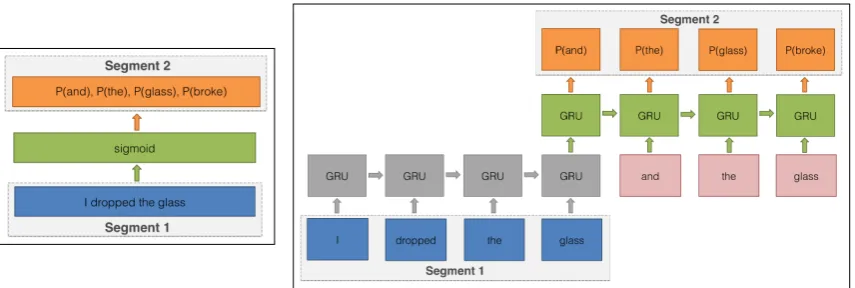
Figure 1: FFN (left) and RNN (right) encoder-decoder models
4.2 Sequence Pairs
After segmenting the stories, we joined neigh-boring segments (i.e. clauses or sentences) into input-output segment pairs (S1, S2). In all of our experiments, we filtered pairs where one or both of the segments contained more than 20 words. We manipulated the temporal window within which these pairs were joined, by pairing all segments within N segments of each other. For a given segment at position t in a story,
pairs were established between all segments in
segmentt, . . . , segmentt+N. For example, when
N=1, a pair was formed with the next segment only (segmentt, segmentt+1); when N=2, pairs
were formed between (segmentt, segmentt+1)
and(segmentt, segmentt+2). By doing this, we
intended to examine the proximity of causal infor-mation in a story according to its impact on COPA prediction; we expected that more adjacent clauses would contain stronger causal relations than more distant clauses. Gordon et al.(2011) analogously evaluated this by varying the number of words within which PMI pairs were formed, but without regard to sentence or clause boundaries.
4.3 Encoder-decoder Models
We examined two types of encoder-decoder mod-els: one with feed-forward (FFN) layers and one with recurrent (RNN) layers (i.e. a sequence-to-sequence model), both shown in Figure1. In both cases, the model implicitly assumes that the input segmentS1represents the cause of the output seg-ment S2, so the model learns to predict that S2 will appear as the effect ofS1. The theoretical mo-tivation for comparing the FFN and RNN is to de-termine the importance of word order for this task. The existing COPA approaches only accounted for word order to the extent of capturing word pairs
within the same context of N words (thoughSasaki et al.(2017) also accounted for multi-word expres-sions). The FFN encoder-decoder ignores word order. The model is very simple: both the iput and outiput segments are collapsed into flat n-dimensional vectors of word counts (i.e. bag-of-words), so the hidden (encoder) layer observes all words in each segment in parallel. On the output (decoder) layer (which has sigmoid activation like the encoder), the FFN computes a score for each word indicating its probability of appearing any-where in output segment.
In contrast, the RNN captures word order in the segments. In particular, it uses a recurrent (en-coder) layer with Gated Recurrent Units (GRUs) (Cho et al., 2014) to iteratively encode the input sequence, and another recurrent (decoder) layer to represent output segment. The final hidden state of the encoder layer after observing the whole in-put is provided as the initial hidden state to the decoder. The decoder then iteratively computes a representation of the output sequence that is con-ditioned upon the input segment. For each time-point in this decoder layer, a softmax layer is ap-plied to predict a probability distribution over each word being observed in the segment at that partic-ular timepoint. Both the FFN and RNN encoder-decoders are trained using the cross-entropy loss function to maximize the output word probabili-ties observed during training.
5 Initial Experiments
5.1 ROCStories Corpus
ROCStories Instance COPA Item
Susie went away to Nantucket. She wanted to relax. When she got there it was amazing. The waves were so relaxing. Susie never wanted to leave.
Premise: The man went away for the weekend. What was the cause of this?
Alt 1*:He wanted to relax.
Alt 2:He felt content. Albert wanted to enter the spelling bee, but he was a bad
speller. He practiced every day for the upcoming con-test. When Albert felt that he was ready, he entered the spelling bee. In the very last round, Albert failed when he misspelled a word. Albert was very proud of himself for winning the second place trophy.
Premise: The girl received a trophy. What was the cause of this?
Alt 1*:She won a spelling bee.
Alt 2:She made a new friend.
Anna was lonely. One day, Anna went to the grocery store. Outside the store, she met a woman who was giving away kittens. Anna decided to adopt one of those kittens. Anna no longer felt lonely with her new pet.
Premise:The woman felt lonely. What happened as a result?
Alt 1:She renovated her kitchen.
Alt 2*:She adopted a cat. April is fascinated by health and medicine. She decided
to become a doctor. She studied very hard in college and medical school. April graduated at the top of her medical school class. April now works in a hospital as a doctor.
Premise: The woman wanted to be a doctor. What happened as a result?
Alt 1:She visited the hospital.
[image:5.595.82.524.62.324.2]Alt 2*:She went to medical school.
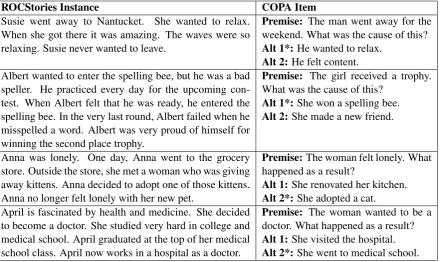
Table 1: Examples of stories in ROCStories corpus and similar COPA items
COPA questions. Mostafazadeh et al.(2016) fol-lowed this proposal by releasing the ROCStories corpus2, intended to be applied to commonsense
reasoning tasks. The ROCStories corpus has yet to be utilized for COPA prediction. This dataset con-sists of 97,027 five-sentence narratives authored via crowdsourcing. In contrast to weblog sto-ries, these stories were written with the specific objective to minimize discourse complexity and explicate prototypical causal and temporal rela-tions between events in salient everyday scenar-ios. COPA items also target these latent com-monsense relations, so the ROCStories appear to be particularly suitable for this domain. Table 1 shows some examples of stories in this corpus and corresponding COPA items that address the same causal knowledge. The ROCStories corpus is dramatically smaller than the datasets used in the work described in Section3.
5.2 Procedure
We applied the methodology outlined in Section 4to pairs of sequences from the ROCStories cor-pus. Our first set of experiments varied segmen-tation (clause versus sentence boundaries), dis-tance between segments (N=1 to N=4), and the type of encoder-decoder (FFN or RNN). Note that N=4 is the maximum setting when using sentence
2cs.rochester.edu/nlp/rocstories/
boundaries since there are five sentences in each story, so here pairs will be formed between all sen-tences. For all experiments, we filtered grammati-cal words (i.e. all words except for adjectives, ad-verbs, nouns, and verbs) and lemmatized all seg-ments, consistent with Luo et al.(2016). COPA items intentionally do not contain proper nouns, so we excluded them as well. We assembled a model lexicon that included each word occurring at least five times in the data, which totaled 9,299 words in the ROCStories. All other words were mapped to a generic<UNKNOWN>token.
The hidden layers of the FFN and RNN models each consisted of 500 dimensions. The RNN had an additional word embedding layer of 300 nodes in order to transform discrete word indices in the input segments into distributed vectors. They were both trained for 50 epochs using the Adam opti-mizer (Kingma and Ba, 2015) with a batch size of 100 pairs. After each epoch, we evaluated the model on the COPA development set and saved the weights that obtained the highest accuracy.
5.3 Results
FFN RNN
Segment N # Pairs Dev Test Dev Test
Sentence
1 389,680 64.8 64.4 63.4 54.4 2 682,334 65.2 65.4 61.2 57.6 3 877,963 63.8 63.8 60.2 55.4 4 976,568 63.8 66.0 59.4 55.6
Clause
[image:6.595.173.426.60.202.2]1 539,342 64.2 63.6 59.4 56.8 2 981,677 65.2 65.0 59.2 54.6 3 1,327,010 65.4 66.2 63.4 58.0 4 1,575,340 66.0 66.2 61.2 56.6
Table 2: Accuracy by segmentation unit and pair distance (N) for the FFN and RNN encoder-decoders trained on ROCStories
universally, suggesting that the order of words in the segments did not provide a strong signal for prediction beyond the presence of the words them-selves. Among the FFN results, the model trained on clauses with N=4 obtained the highest accuracy on the development set (66.0%), and was tied for the highest test accuracy with the model trained on clauses with N=3 (66.2%). The model with N=4 was trained on three times as many pairs as the model with N=1. We can conclude that some of these additional pairs pertained to causality, de-spite not appearing adjacently in the story. The im-pact of clause versus sentence segmentation is less clear from these results, given that the best result of 66.2% accuracy using clauses is only trivially better than the corresponding result for sentences (66.0% for N=4).
5.4 Other Findings
5.4.1 Alternative Input Representations
Model Dev Test
FFN (above) 66.0 66.2
FFN GloVe 65.0 61.6 FFN ConceptNet 61.6 62.4 FFN Skip-thought 66.8 63.8
Table 3: Accuracy of FFN trained on ROCStories with different input representations
In the FFN model evaluated above, the in-put segments were simply represented as bag-of-words vectors indicating the count of each word in the segment. Alternatively, we explored the use of pretrained word embeddings to represent the segments. We proposed that because they pro-vide the model with some initial signal about lexi-cal relations, the embeddings could facilitate more
specifically learning causal relations. We exper-imented with three sets of embedding represen-tations. First, we encoded the words in each in-put segment as the sum of their GloVe embed-dings3 (Pennington et al., 2014), which represent
words according to a global log-bilinear regression model trained on word co-occurrence counts in the Common Crawl corpus. We also did this using ConceptNet embeddings4 (Li et al.,2013), which
apply the word2vec skip-gram model (Mikolov et al.,2013) to tuples that specifically define com-monsense knowledge relations (e.g. soak in hot-spring CAUSES get pruny skin). Lastly, we used skip-thought vectors5 (Kiros et al., 2015), which
compute one embedding representation for an en-tire sentence, and thus represent the sentence be-yond just the sum of its individual words. Analo-gous to how word embedding models are trained to predict words near a given target word in a text, the skip-thought vectors represent sentences according to their relation to adjacent sentences, such that sentences with similar meanings are ex-pected to have similar vectors. The provided skip-thought vectors are trained on the BookCorpus dataset, which is described in Section6.
We trained the FFN model on the ROCStories with each of these three sets of embeddings. Be-cause they obtained the best performance in the previous experiments, we configured the models to use clause segmentation and distance N=4 in constructing the pairs. Table3shows the results of these models, compared alongside the best result from above with the standard bag-of-words repre-sentation. Neither the GloVe nor ConceptNet
em-3nlp.stanford.edu/projects/glove/
[image:6.595.104.260.538.608.2]beddings performed better than the bag-of-words vectors (61.6% and 62.4% test accuracy, respec-tively). The skip-thought vectors performed better than bag-of-words representation on the develop-ment set (66.8%), but this improvedevelop-ment did not scale to the test set (63.8%).
5.4.2 Phrases
Model Dev Test
FFN (above) 66.0 66.2
FFN Phrases 62.6 64.8
Table 4: Accuracy of FFN trained on ROCStories with explicit phrase representations
As mentioned above,Sasaki et al.(2017) found that modeling multi-word phrases as individual words was helpful for the CausalNet approach. The RNN encoder-decoder has the opportunity to recognize phrases by modeling sequential de-pendencies between words, but Table2indicated this model was not successful relative to the FFN model. To assess whether the FFN model would benefit from phrase information, we merged all phrases in the training corpus into individual word tokens in the same manner asSasaki et al., using their same list of phrases. We again filtered all tokens that occurred fewer than five times in the data, which resulted in the vocabulary increasing from 9,299 words to 10,694 when the phrases were included. We trained the same FFN model in Table 2 that achieved the best result (clause segmenta-tion, N=4, and bag-of-words input representation). The test accuracy, relayed for clarity in Table 4 alongside the above best result, was 64.8%, indi-cating there was no benefit to modeling phrases in this particular configuration.
5.4.3 Comparison with Existing Approaches
Model Dev Test
FFN (above) 66.0 66.2
PMI 60.0 62.4
[image:7.595.118.247.608.665.2]CausalNet 50.2 51.8
Table 5: Accuracy of PMI and CausalNet trained on ROCStories
To establish a comparison between our encoder-decoder approach and the existing models applied to the same dataset, we trained the PMI model on the ROCStories. Rather than using a fixed
word window, we computed the PMI scores for all words in each story, which generally corresponds to using distance N=4 among sentence segments in the encoder-decoder. Table 5 shows that this approach had 62.4% test accuracy, so our new ap-proach outperformed it on this particular dataset. For completeness, we also applied the CausalNet approach to this dataset. Its poor performance (51.8%) is unsurprising, because the lexical tem-plates used to extract causal pairs only matched 4,964 sequences in the ROCStories. This demon-strates that most of the causal information con-tained in these stories is conveyed implicitly.
6 Experiments on Other Datasets
Gordon et al.(2011) found that the PMI approach trained on blog stories performed better on COPA than the same model trained on books in Project Gutenburg6, despite the much larger size of the
latter. Beyond this, there has been limited explo-ration of the impact of different training datasets on COPA prediction, so we were motivated to ex-amine this. Thus, we applied the FFN encoder-decoder approach to the following datasets:
Visual Storytelling (VIST): 50,200 five-sentence stories7authored through crowdsourcing
in support of research on vision-to-language tasks (Huang et al.,2016). Participants were prompted to write a story from a sequence of photographs depicting salient “storyable” events.
CNN/DailyMail corpus: 312,085 bullet-item summaries8 of news articles, which have been
used for work on reading comprehension and sum-marization (Chen et al.,2016;See et al.,2017).
CMU Book/Movie Plot Summaries (CMU Plots): 58,862 plot summaries9 from Wikipedia,
which have been used for story modeling tasks like inferring relations between story characters (Bam-man et al.,2014;Srivastava et al.,2016).
BookCorpus: 8,032 self-published fiction nov-els, a subset of the full corpus10of 11,000 books.
Blog Stories: 1 million weblog stories used in the COPA experiments by Gordon et al. (2011) identified above.
ClueWeb Pairs: Approximately 150 million sequence pairs extracted from the ClueWeb corpus
6gutenberg.org/
7visionandlanguage.net/VIST/ 8github.com/danqi/rc-cnn-dailymail 9cs.cmu.edu/˜ark/personas/;
bySasaki et al.(2017) using the CausalNet lexical templates method.
6.1 Procedure and Results
Dataset # Pairs Dev Test
ROCStories-Half 762,130 64.0 62.6
VIST 854,810 58.2 49.2
ROCStories-Full 1,575,340 66.0 66.2
CNN/DailyMail 3,255,010 59.4 51.8 CMU Plots 6,094,619 57.8 51.0 ClueWeb Pairs 157,426,812 60.8 61.2 Blog Stories 222,564,571 58.4 57.2 BookCorpus 310,001,015 58.2 55.0
Table 6: Accuracy of the FFN encoder-decoder on dif-ferent datasets
We trained the FFN model with the best-performing configuration from the ROCStories ex-periments (clause segments, N=4, bag-of-words input). After determining that the lexicon used in the previous experiments included most of the words (93.5%) in the COPA development set, we re-used this same lexicon to avoid the inefficiency of assembling a new one for each separate corpus. We also trained a model on the initial 45,502 sto-ries in the ROCStosto-ries (ROCStosto-ries-Half) to fur-ther analyze the impact of this dataset.
Table6shows the results for these datasets com-pared alongside the ROCStories result from above (ROCStories-Full), listed in ascending order of the number of training pairs they contain. As shown, none of the other datasets reach the level of accu-racy of ROCStories-Full (66.2%). Even the model trained on only the initial half of this corpus out-performs the others (62.6%). The next closest re-sult is for the ClueWeb Pairs, which had 61.2% test accuracy despite containing 100 times more pairs than the ROCStories. The ClueWeb pairs ob-tained 71.2% accuracy when used in the Causal-Net approach, so the encoder-decoder model is apparently not as effective in utilizing the causal knowledge contained in this dataset. The larger Blog Stories and BookCorpus datasets also did not have much impact, despite that the Blog Stories obtained 65.2% accuracy in the PMI approach. One speculative explanation for this is that our approach is highly dependent on the density of COPA-relevant knowledge contained in a dataset. As mentioned above, authors of the ROCStories were instructed to emphasize the most obvious
possibilities for ‘what happens next’ in prototyp-ical scenarios. These expectations align with the correct COPA alternatives. However, naturally occurring stories often focus on events that vio-late commonsense expectations, since these events make for more salient stories (Schank and Able-son,1995). Thus, they may show greater diversity in ‘what happens next’ relative to the ROCStories. This diversity was seemingly more distracting for our encoder-decoder architecture than for the ex-isting approaches. Accordingly, despite all being related to narrative, the VIST, CNN/DailyMail, and CMU Plots datasets were also ineffective on the test set with regard to this model.
7 Conclusion
Acknowledgments
We would like to thank the authors ofSasaki et al. (2017) for sharing the data and resources associ-ated with their work.
The projects or efforts depicted were or are sponsored by the U.S. Army. The content or infor-mation presented does not necessarily reflect the position or the policy of the Government, and no official endorsement should be inferred.
References
David Bamman, Brendan O’Connor, and Noah A Smith. 2014. Learning latent personas of film char-acters. InProceedings of the Annual Meeting of the Association for Computational Linguistics (ACL). page 352.
Zheng Cai, Lifu Tu, and Kevin Gimpel. 2017. Pay at-tention to the ending: Strong neural baselines for the ROC Story Cloze Task. In Proceedings of the 55th Annual Meeting of the Association for Compu-tational Linguistics (Volume 2: Short Papers). As-sociation for Computational Linguistics, pages 616– 622.
Danqi Chen, Jason Bolton, and Christopher D. Man-ning. 2016. A thorough examination of the CNN/Daily Mail reading comprehension task. In Association for Computational Linguistics (ACL). Kyunghyun Cho, Bart van Merri¨enboer, Dzmitry
Bah-danau, and Yoshua Bengio. 2014. On the properties of neural machine translation: Encoder–decoder ap-proaches. Syntax, Semantics and Structure in Statis-tical Translationpage 103.
Kenneth Ward Church and Patrick Hanks. 1990. Word association norms, mutual information, and lexicog-raphy.Computational linguistics16(1):22–29. Natalie Dehn. 1981. Story Generation After
TALE-SPIN. Proceedings of the 7th International Joint Conference on Artificial Intelligence (IJCAI ’81) pages 16–18.
Marjan Ghazvininejad, Xing Shi, Yejin Choi, and Kevin Knight. 2016. Generating topical poetry. In EMNLP. pages 1183–1191.
Andrew Gordon, Cosmin Adrian Bejan, and Kenji Sagae. 2011. Commonsense Causal Reasoning Us-ing Millions of Personal Stories. Twenty-Fifth Con-ference on Artificial Intelligence (AAAI-11) pages 1180–1185.
Ting-Hao K. Huang, Francis Ferraro, Nasrin Mostafazadeh, Ishan Misra, Jacob Devlin, Aish-warya Agrawal, Ross Girshick, Xiaodong He, Pushmeet Kohli, Dhruv Batra, et al. 2016. Visual storytelling. In 15th Annual Conference of the North American Chapter of the Association for Computational Linguistics (NAACL 2016).
Diederik Kingma and Jimmy Ba. 2015. Adam: A method for stochastic optimization. In The Inter-national Conference on Learning Representations (ICLR). San Diego.
Ryan Kiros, Yukun Zhu, Ruslan R Salakhutdinov, Richard Zemel, Raquel Urtasun, Antonio Torralba, and Sanja Fidler. 2015. Skip-thought vectors. In C. Cortes, N. D. Lawrence, D. D. Lee, M. Sugiyama, and R. Garnett, editors, Advances in Neural Infor-mation Processing Systems 28. Curran Associates, Inc., pages 3294–3302.
Michael Lebowitz. 1985. Story-telling as planning and learning.Poetics14(6):483–502.
Boyang Li, Stephen Lee-Urban, George Johnston, and Mark Riedl. 2013. Story Generation with Crowd-sourced Plot Graphs. In27th AAAI Conference on Artificial Intelligence.
Zhiyi Luo, Yuchen Sha, Kenny Q. Zhu, Seung-won Hwang, and Zhongyuan Wang. 2016. Common-sense causal reasoning between short texts. In15th International Conference on Principles of Knowl-edge Representation and Reasoning (KR-2016).
James R Meehan. 1977. TALE-SPIN, An Interactive Program that Writes Stories. In 5th International Joint Conference on Artificial Intelligence. pages 91–98.
Tomas Mikolov, Ilya Sutskever, Kai Chen, Greg S Cor-rado, and Jeff Dean. 2013. Distributed representa-tions of words and phrases and their compositional-ity. InAdvances in neural information processing systems. pages 3111–3119.
Nasrin Mostafazadeh, Nathanael Chambers, Xiaodong He, Devi Parikh, Dhruv Batra, Lucy Vanderwende, Pushmeet Kohli, and James Allen. 2016. A cor-pus and cloze evaluation for deeper understanding of commonsense stories. InProceedings of NAACL-HLT. pages 839–849.
Jeffrey Pennington, Richard Socher, and Christo-pher D. Manning. 2014. Glove: Global vectors for word representation. InEmpirical Methods in Nat-ural Language Processing (EMNLP). pages 1532– 1543.
Melissa Roemmele, Cosmin Adrian Bejan, and An-drew S. Gordon. 2011. Choice of Plausible Alterna-tives : An Evaluation of Commonsense Causal Rea-soning. AAAI Spring Symposium: Logical Formal-izations of Commonsense Reasoningpages 90–95. Shota Sasaki, Sho Takase, Naoya Inoue, Naoaki
Okazaki, and Kentaro Inui. 2017. Handling multi-word expressions in causality estimation. InIWCS 201712th International Conference on Computa-tional SemanticsShort papers.
Roger C Schank and Robert P Ableson. 1995. Knowl-edge and memory: The real story.In. Rober S. Wyer (Ed.), Knowledge and memory: The real storypages 1–85.
Abigail See, Peter J Liu, and Christopher D Manning. 2017. Get to the point: Summarization with pointer-generator networks. In Association for Computa-tional Linguistics (ACL).
Iulian Vlad Serban, Alessandro Sordoni, Yoshua Ben-gio, Aaron C Courville, and Joelle Pineau. 2016. Building end-to-end dialogue systems using gener-ative hierarchical neural network models. InAAAI. pages 3776–3784.
Lifeng Shang, Zhengdong Lu, and Hang Li. 2015. Neural Responding Machine for Short-Text Conver-sation. In Proceedings of the 53th Annual Meet-ing of Association for Computational LMeet-inguistics and the 7th International Joint Conference on Natu-ral Language Processing (ACL-IJCNLP’15). pages 1577–1586.
Shashank Srivastava, Snigdha Chaturvedi, and Tom M Mitchell. 2016. Inferring interpersonal relations in narrative summaries. InAAAI. pages 2807–2813.