
Proceedings of NAACL-HLT 2018, pages 554–559
Contextualized Word Representations for Reading Comprehension
Shimi Salant Tel-Aviv University [email protected]
Jonathan Berant Tel-Aviv University [email protected]
Abstract
Reading a document and extracting an answer to a question about its content has attracted substantial attention recently. While most work has focused on the interaction between the question and the document, in this work we evaluate the importance of context when the question and document are processed inde-pendently. We take a standard neural architec-ture for this task, and show that by providing rich contextualized word representations from a large pre-trained language model as well as allowing the model to choose between context-dependent and context-incontext-dependent word rep-resentations, we can obtain dramatic improve-ments and reach performance comparable to state-of-the-art on the competitive SQUAD dataset.
1 Introduction
Reading comprehension (RC) is a high-level task in natural language understanding that requires reading a document and answering questions about its content. RC has attracted substantial attention over the last few years with the ad-vent of large annotated datasets (Hermann et al.,
2015; Rajpurkar et al., 2016; Trischler et al.,
2016; Nguyen et al., 2016; Joshi et al., 2017), computing resources, and neural network models and optimization procedures (Weston et al.,2015;
Sukhbaatar et al.,2015;Kumar et al.,2015). Reading comprehension models must invari-ably represent word tokens contextually, as a func-tion of their encompassing sequence (document or question). The vast majority of RC systems en-code contextualized representations of words in both the document and question as hidden states of bidirectional RNNs (Hochreiter and Schmid-huber, 1997; Schuster and Paliwal, 1997; Cho et al., 2014), and focus model design and capac-ity around question-document interaction,
carry-ing out calculations where information from both is available (Seo et al.,2016;Xiong et al.,2017b;
Huang et al.,2017;Wang et al.,2017).
Analysis of current RC models has shown that models tend to react to simple word-matching be-tween the question and document (Jia and Liang,
2017), as well as benefit from explicitly provid-ing matchprovid-ing information in model inputs (Hu et al.,2017;Chen et al.,2017;Weissenborn et al.,
2017). In this work, we hypothesize that the still-relatively-small size of RC datasets drives this be-havior, which leads to models that make limited use of context when representing word tokens.
To illustrate this idea, we take a model that car-ries out only basic question-document interaction and prepend to it a module that produces token embeddings by explicitly gating between contex-tual and non-contexcontex-tual representations (for both the document and question). This simple addi-tion already places the model’s performance on par with recent work, and allows us to demonstrate the importance of context.
Motivated by these findings, we turn to a semi-supervised setting in which we leverage a lan-guage model, pre-trained on large amounts of data, as a sequence encoder which forcibly facilitates context utilization. We find that model perfor-mance substantially improves, reaching accuracy comparable to state-of-the-art on the competitive SQuAD dataset, showing that contextual word representations captured by the language model are beneficial for reading comprehension.1
2 Contextualized Word Representations
Problem definition We consider the task of ex-tractive reading comprehension: given a para-graph of textp= (p1, . . . , pn)and a questionq=
1Our complete code base is available at http://
github.com/shimisalant/CWR.
(q1, . . . , qm), an answer span(pl, . . . , pr)is to be
extracted, i.e., a pair of indices1≤l≤r≤ninto pare to be predicted.
When encoding a word token in its encompass-ing sequence (question or passage), we are inter-ested in allowing extra computation over the se-quence and evaluating the extent to which con-text is utilized in the resultant representation. To that end, we employ a re-embedding compo-nent in which a contextual and a non-contextual representation are explicitly combined per token. Specifically, for a sequence of word-embeddings w1, . . . , wk withwt ∈ Rdw, the re-embedding of
thet-th tokenw0tis the result of a Highway layer (Srivastava et al.,2015) and is defined as:
wt0 =gtwt+ (1−gt)zt
gt=σ(Wgxt+Ugut)
zt=tanh(Wzxt+Uzut)
wherextis a function strictly of the word-type of
thet-th token,utis a function of the enclosing
se-quence, Wg, Wz, Ug, U z are parameter matrices,
andthe element-wise product operator. We set xt= [wt;ct], a concatenation ofwtwithct∈Rdc
where the latter is a character-based representation of the token’s word-type produced via a CNN over character embeddings (Kim,2014). We note that word-embeddingswtare pre-trained (Pennington et al.,2014) and are kept fixed during training, as is commonly done in order to reduce model ca-pacity and mitigate overfitting. We next describe different formulations for the contextual termut. RNN-based token re-embedding(TR) Here we set {u1, . . . , uk} = BiLSTM(x1, . . . , xk) as the
hidden states of the top layer in a stacked BiLSTM of multiple layers, each uni-directional LSTM in each layer havingdhcells anduk∈R2dh.
LM-augmented token re-embedding (TR+LM) The simple module specified above allows better exploitation of the context that a token appears in, if such exploitation is needed and is not learned by the rest of the network, which operates over w01, . . . , w0k. Our findings in Section4indicate that context is crucial but that in our setting it may be utilized to a limited extent.
We hypothesize that the main determining fac-tor in this behavior is the relatively small size of the data and its distribution, which does not re-quire using long-range context in most examples. Therefore, we leverage a strong language model
that was pre-trained on large corpora as a fixed encoder which supplies additional contextualized token representations. We denote these represen-tations as {o1, . . . , ok} and set ut = [u0t;ot] for
{u01, . . . , u0k}=BiLSTM(x1, . . . , xk).
The LM we use is from J´ozefowicz et al.
(2016),2trained on the One Billion Words
Bench-mark dataset (Chelba et al.,2013). It consists of an initial layer which produces character-based word representations, followed by two stacked LSTM layers and a softmax prediction layer. The hidden state outputs of each LSTM layer are projected down to a lower dimension via a bottleneck layer (Sak et al., 2014). We set{o1, . . . , ok} to either
the projections of the first layer, referred to as TR + LM(L1), or those of the second one, referred to as TR + LM(L2).
With both re-embedding schemes, we use the resulting representationsw01, . . . , wk0 as a drop-in replacement for the word-embedding inputs fed to a standard model, described next.
3 Base model
We build upon Lee et al. (2016), who proposed the RaSoR model. For word-embedding in-puts q1, . . . , qm and p1, . . . , pn of dimension dw,
RaSoR consists of the following components:
Passage-independent question representa-tion The question is encoded via a BiLSTM {v1, . . . , vm} = BiLSTM(q1, . . . , qm) and
the resulting hidden states are summarized via attention (Bahdanau et al., 2015; Parikh et al.,
2016): qindep = Pmj=1αjvj ∈ R2dh. The
attention coefficients α are normalized log-its {α1, . . . , αm} = softmax(s1, . . . , sm) where
sj =wTq·FF(vj)for a parameter vectorwq ∈Rdf
and FF(·)a single layer feed-forward network.
Passage-aligned question representations For each passage position i, the question is encoded via attention operated over its word-embeddings qialign = Pmj=1βijqj ∈ Rdw. The
coeffi-cients βi are produced by normalizing the logits
{si1, . . . , sim}, wheresij =FF(qj)T ·FF(pi). Augmented passage token representations
Each passage word-embeddingpiis concatenated
with its corresponding qaligni and with the inde-pendentqindepto producep∗i = [pi;qialign;qindep], 2Named BIG LSTM+CNN INPUTS in that work and available athttp://github.com/tensorflow/
and a BiLSTM is operated over the resulting vectors:{h1, . . . , hn}=BiLSTM(p∗1, . . . , p∗n).
Span representations A candidate answer span a = (l, r) with l ≤ r is represented as the con-catenation of the corresponding augmented pas-sage representations: h∗a = [hl;hr]. In order to
avoid quadratic runtime, only spans up to length 30 are considered.
Prediction layer Finally, each span representa-tionh∗ais transformed to a logitsa=wTc ·FF(h∗a)
for a parameter vectorwc ∈ Rdf, and these
log-its are normalized to produce a distribution over spans. Learning is performed by maximizing the log-likelihood of the correct answer span.
4 Evaluation and Analysis
We evaluate our contextualization scheme on the SQuAD dataset (Rajpurkar et al., 2016) which consists of 100,000+ paragraph-question-answer examples, crowdsourced from Wikipedia articles.
Importance of context We are interested in evaluating the effect of our RNN-based re-embedding scheme on the performance of the downstream base model. However, the addition of the re-embedding module incurs additional depth and capacity for the resultant model. We there-fore compare this model, termed RaSoR + TR, to a setting in which re-embedding is non-contextual, referred to as RaSoR + TR(MLP). Here we set ut =MLP(xt), a multi-layered perceptron onxt,
allowing for the additional computation to be car-ried out on word-level representations without any context and matching the model size and hyper-parameter search budget of RaSoR + TR. In Table
1we compare these two variants over the develop-ment set and observe superior performance by the contextual one, illustrating the benefit of contextu-alization and specifically per-sequence contextual-ization which is done separately for the question and for the passage.
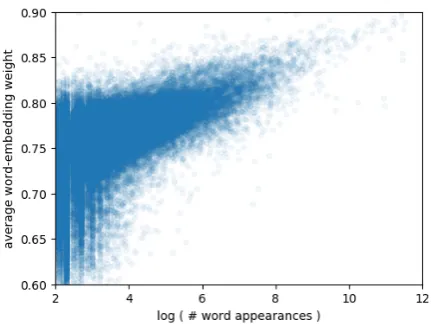
Context complements rare words Our formu-lation lends itself to an inspection of the differ-ent dynamic weightings computed by the model for interpolating between contextual and non-contextual terms. In Figure1we plot the average gate value gt for each word-type, where the
av-erage is taken across entries of the gate vector and across all occurrences of the word in both passages
Model EM F1
RaSoR (base model) 70.6 78.7 RaSoR + TR(MLP) 72.5 79.9
RaSoR + TR 75.0 82.5
RaSoR + TR + LM(emb) 75.8 83.0 RaSoR + TR + LM(L1) 77.0 84.0 RaSoR + TR + LM(L2) 76.1 83.3
[image:3.595.334.498.63.155.2]Table 1: Results on SQuAD’s development set. The EM metric measures an exact-match between a pre-dicted answer and a correct one and the F1 metric mea-sures the overlap between their bag of words.
Figure 1: Average gate activations.
and questions. This inspection reveals the follow-ing: On average, the less frequent a word-type is, the smaller are its gate activations, i.e., the re-embedded representation of a rare word places less weight on its fixed word-embedding and more on its contextual representation, compared to a com-mon word. This highlights a problem with main-taining fixed word representations: albeit pre-trained on extremely large corpora, the embed-dings of rare words need to be complemented with information emanating from their context. Our specific parameterization allows observing this di-rectly, but it may very well be an implicit burden placed on any contextualizing encoder such as a vanilla BiLSTM.
Incorporating language model representations
[image:3.595.307.523.227.389.2]Model EM F1 BiDAF + Self Attention + ELMo [1] 78.6 85.8 RaSoR + TR + LM(L1) [2] 77.6 84.2
SAN [3] 76.8 84.4
r-net [4] 76.5 84.3
FusionNet [5] 76.0 83.9
Interactive AoA Reader+ [6] 75.8 83.8
RaSoR + TR [7] 75.8 83.3
DCN+ [8] 75.1 83.1
Conductor-net [9] 73.2 81.9
· · ·
RaSoR (base model) [10] 70.8 78.7
Table 2: Single-model results on SQuAD’s test set.3 [1]Peters et al.(2018) [2,7] This work. [3]Liu et al.
(2017b) [4]Wang et al.(2017) [5]Huang et al.(2017) [6] Cui et al.(2017) [8]Xiong et al. (2017a) [9]Liu et al.(2017a) [10]Lee et al.(2016)
word-type representations (referred to as RaSoR + TR + LM(emb)), which are based on character-level embeddings and are naturally unaffected by context around a word-token.
Overall, we observe a significant improvement with all three configurations, effectively showing the benefit of training a QA model in a semi-supervised fashion (Dai and Le,2015) with a large language model. Besides a crosscutting boost in results, we note that the performance due to utiliz-ing the LM hidden states of the first LSTM layer significantly surpasses the other two variants. This may be due to context being most strongly rep-resented in those hidden states as the representa-tions of LM(emb) are non-contextual by definition and those of LM(L2) were optimized (during LM training) to be similar to parameter vectors that correspond to word-types and not to word-tokens. In Table 2we list the top-scoring single-model published results on SQuAD’s test set, where we observe RaSoR + TR + LM(L1) ranks second in EM, despite having only minimal question-passage interaction which is a core component of other works. An additional evaluation we carry out is followingJia and Liang(2017), which demon-strated the proneness of current QA models to be fooled by distracting sentences added to the para-graph. In Table3we list the single-model results reported thus far and observe that the utilization of LM-based representations carried out by RaSoR + TR + LM(L1) results in improved robustness to adversarial examples.
3From SQuAD’s leaderboard per Dec 13, 2017. http: //rajpurkar.github.io/SQuAD-explorer
Model AddSent AddOneSent
RaSoR + TR + LM(L1) [1] 47.0 57.0 Mnemonic Reader [2] 46.6 56.0
RaSoR + TR [3] 44.5 53.9
MPCM [4] 40.3 50.0
RaSoR (base model) [5] 39.5 49.5
ReasoNet [6] 39.4 50.3
[image:4.595.81.281.62.194.2]jNet [7] 37.9 47.0
Table 3: Single-model F1 on adversarial SQuAD. [1,3] This work. [2]Hu et al.(2017) [4]Wang et al.
(2016) [5]Lee et al.(2016) [6]Shen et al.(2017) [7]
Zhang et al.(2017)
5 Experimental setup
We use pre-trained GloVe embeddings ( Penning-ton et al., 2014) of dimension dw = 300 and
produce character-based word representations via dc = 100 convolutional filters over character
embeddings as in Seo et al. (2016). For all BiLSTMs, hyper-parameter search included the following values, with model selection being done according to validation set results (underlined): number of stacked BiLSTM layers(1,2,3), num-ber of cells dh (50,100,200), dropout rate over
input(0.4,0.5,0.6), dropout rate over hidden state (0.05,0.1,0.15). To further regularize models, we employed word dropout (Iyyer et al., 2015; Dai and Le, 2015) at rate (0.05,0.1,0.15) and cou-ple LSTM input and forget gate as inGreff et al.
(2016). All feed-forward networks and the MLP employed the ReLU non-linearity (Nair and Hin-ton,2010) with dropout rate (0.2,0.3), where the single hidden layer of the FFs was of dimension df = (50,100) and the best performing MLP
consisted of 3 hidden layers of dimensions 865, 865 and 400. For optimization, we used Adam (Kingma and Ba,2015) with batch size80.
6 Related Work
Our use of a Highway layer with RNNs is re-lated to Highway LSTM (Zhang et al.,2016) and Residual LSTM (Kim et al.,2017). The goal in those works is to effectively train many stacked LSTM layers and so highway and residual con-nections are introduced into the definition of the LSTM function. Our formulation is external to that definition, with the specific goal of gating between LSTM hidden states and fixed word-embeddings.
[image:4.595.307.526.63.155.2]Pre-training a LM in order to initialize the weights of an encoder has been reported to improve gener-alization and training stability for sequence classi-fication (Dai and Le,2015) as well as translation and summarization (Ramachandran et al.,2017).
Similar to our work,Peters et al.(2017) utilize the same pre-trained LM from J´ozefowicz et al.
(2016) for sequence tagging tasks, keeping en-coder weights fixed during training. Their formu-lation includes a backward LM and uses the hid-den states from the top-most stacked LSTM layer of the LMs, whereas we also consider reading the hidden states of the bottom one, which substan-tially improves performance. In parallel to our work,Peters et al.(2018) have successfully lever-aged pre-trained LMs for several tasks, including RC, by utilizing representations from all layers of the pre-trained LM.
In a transfer-learning setting, McCann et al.
(2017) pre-train an attentional encoder-decoder model for machine translation and show improve-ments across a range of tasks when incorporating the hidden states of the encoder as additional fixed inputs for downstream task training.
7 Conclusion
In this work we examine the importance of con-text for the task of reading comprehension. We present a neural module that gates contextual and non-contextual representations and observe gains due to context utilization. Consequently, we ject contextual information into our model by in-tegrating a pre-trained language model through our suggested module and find that it substantially improves results, reaching state-of-the-art perfor-mance on the SQuAD dataset.
Acknowledgements
We thank the anonymous reviewers for their con-structive comments and suggestions. This work was supported by the Israel Science Foundation, grant 942/16.
References
Dzmitry Bahdanau, Kyunghyun Cho, and Yoshua Ben-gio. 2015. Neural machine translation by jointly learning to align and translate. InICLR.
Ciprian Chelba, Tomas Mikolov, Mike Schuster, Qi Ge, Thorsten Brants, and Phillipp Koehn. 2013. One bil-lion word benchmark for measuring progress in sta-tistical language modeling. CoRRabs/1312.3005.
Danqi Chen, Adam Fisch, Jason Weston, and Antoine Bordes. 2017. Reading wikipedia to answer open-domain questions. InACL.
Kyunghyun Cho, Bart van Merrienboer, Dzmitry Bah-danau, and Yoshua Bengio. 2014. On the properties of neural machine translation: Encoder-decoder ap-proaches. InEMNLP.
Yiming Cui, Zhipeng Chen, Si Wei, Shijin Wang, Ting Liu, and Guoping Hu. 2017. Attention-over-attention neural networks for reading comprehen-sion. InACL.
Andrew M. Dai and Quoc V. Le. 2015. Semi-supervised sequence learning. InNIPS.
Klaus Greff, Rupesh Kumar Srivastava, Jan Koutn´ık, Bas R. Steunebrink, and Jurgen Schmidhuber. 2016. Lstm: A search space odyssey. In IEEE Transac-tions on Neural Networks and Learning Systems.
Karl Moritz Hermann, Tom´as Kocisk´y, Edward Grefenstette, Lasse Espeholt, Will Kay, Mustafa Suleyman, and Phil Blunsom. 2015. Teach-ing machines to read and comprehend. CoRR
abs/1506.03340.
S. Hochreiter and J. Schmidhuber. 1997. Long short-term memory. Neural Computation 9(8):1735– 1780.
Minghao Hu, Yuxing Peng, and Xipeng Qiu. 2017. Mnemonic reader for machine comprehension.
CoRRabs/1705.02798.
Hsin-Yuan Huang, Chenguang Zhu, Yelong Shen, and Weizhu Chen. 2017. Fusionnet: Fusing via fully-aware attention with application to machine compre-hension. CoRRabs/1711.07341.
Mohit Iyyer, Varun Manjunatha, Jordan L. Boyd-Graber, and Hal Daum´e III. 2015. Deep unordered composition rivals syntactic methods for text classi-fication. InACL.
Robin Jia and Percy Liang. 2017. Adversarial exam-ples for evaluating reading comprehension systems. InEMNLP. pages 2011–2021.
Mandar Joshi, Eunsol Choi, Daniel S. Weld, and Luke Zettlemoyer. 2017. Triviaqa: A large scale distantly supervised challenge dataset for reading comprehen-sion. InACL.
Rafal J´ozefowicz, Oriol Vinyals, Mike Schuster, Noam Shazeer, and Yonghui Wu. 2016. Exploring the lim-its of language modeling. CoRRabs/1602.02410.
Jaeyoung Kim, Mostafa El-Khamy, and Jungwon Lee. 2017. Residual LSTM: design of a deep recurrent architecture for distant speech recognition. CoRR
abs/1701.03360.
Diederik P. Kingma and Jimmy Lei Ba. 2015. Adam: A method for stochastic optimization. InICLR. Ankit Kumar, Ozan Irsoy, Jonathan Su, James
Brad-bury, Robert English, Brian Pierce, Peter Ondruska, Ishaan Gulrajani, and Richard Socher. 2015. Ask me anything: Dynamic memory networks for natu-ral language processing. CoRRabs/1506.07285. Kenton Lee, Shimi Salant, Tom Kwiatkowski, Ankur P.
Parikh, Dipanjan Das, and Jonathan Berant. 2016. Learning recurrent span representations for extrac-tive question answering. CoRRabs/1611.01436. Rui Liu, Wei Wei, Weiguang Mao, and Maria
Chik-ina. 2017a. Phase conductor on multi-layered attentions for machine comprehension. CoRR
abs/1710.10504.
Xiaodong Liu, Yelong Shen, Kevin Duh, and Jian-feng Gao. 2017b. Stochastic answer networks for machine reading comprehension. CoRR
abs/1712.03556.
Bryan McCann, James Bradbury, Caiming Xiong, and Richard Socher. 2017. Learned in translation: Con-textualized word vectors. InNIPS.
Vinod Nair and Geoffrey E. Hinton. 2010. Rectified linear units improve restricted boltzmann machines. InICML.
Tri Nguyen, Mir Rosenberg, Xia Song, Jianfeng Gao, Saurabh Tiwary, Rangan Majumder, and Li Deng. 2016. MS MARCO: A human generated machine reading comprehension dataset. InNIPS Workshop on Cognitive Computation.
Ankur P. Parikh, Oscar T¨ackstr¨om, Dipanjan Das, and Jakob Uszkoreit. 2016. A decomposable attention model for natural language inference. InEMNLP. Jeffrey Pennington, Richard Socher, and
Christo-pher D. Manning. 2014. Glove: Global vectors for word representation. InEMNLP.
Matthew E. Peters, Waleed Ammar, Chandra Bhaga-vatula, and Russell Power. 2017. Semi-supervised sequence tagging with bidirectional language mod-els. CoRRabs/1705.00108.
Matthew E. Peters, Mark Neumann, Mohit Iyyer, Matt Gardner, Christopher Clark, Kenton Lee, and Luke Zettlemoyer. 2018. Deep contextualized word rep-resentations. CoRRabs/1802.05365.
Pranav Rajpurkar, Jian Zhang, Konstantin Lopyrev, and Percy Liang. 2016. Squad: 100, 000+ questions for machine comprehension of text. InEMNLP. Prajit Ramachandran, Peter J. Liu, and Quoc V. Le.
2017. Unsupervised pretraining for sequence to se-quence learning. InEMNLP.
Hasim Sak, Andrew W. Senior, and Franc¸oise Bea-ufays. 2014. Long short-term memory recurrent neural network architectures for large scale acoustic modeling. InINTERSPEECH.
Mike Schuster and Kuldip K. Paliwal. 1997. Bidirec-tional recurrent neural networks. IEEE Trans. Sig-nal Processing45(11):2673–2681.
Min Joon Seo, Aniruddha Kembhavi, Ali Farhadi, and Hannaneh Hajishirzi. 2016. Bidirectional at-tention flow for machine comprehension. CoRR
abs/1611.01603.
Yelong Shen, Po-Sen Huang, Jianfeng Gao, and Weizhu Chen. 2017. Reasonet: Learning to stop reading in machine comprehension. InSIGKDD.
Anders Søgaard. 2013. Semi-supervised learning and domain adaptation for nlp .
Rupesh Kumar Srivastava, Klaus Greff, and Jrgen Schmidhuber. 2015. Highway networks. In ICML 2015 Deep Learning workshop.
Sainbayar Sukhbaatar, Arthur Szlam, Jason Weston, and Rob Fergus. 2015. End-to-end memory net-works. InNIPS.
Adam Trischler, Tong Wang, Xingdi Yuan, Justin Har-ris, Alessandro Sordoni, Philip Bachman, and Ka-heer Suleman. 2016. Newsqa: A machine compre-hension dataset. CoRRabs/1611.09830.
Wenhui Wang, Nan Yang, Furu Wei, Baobao Chang, and Ming Zhou. 2017. Gated self-matching net-works for reading comprehension and question an-swering. InACL.
Zhiguo Wang, Haitao Mi, Wael Hamza, and Radu Flo-rian. 2016. Multi-perspective context matching for machine comprehension. CoRRabs/1612.04211.
Dirk Weissenborn, Georg Wiese, and Laura Seiffe. 2017. Making neural QA as simple as possible but not simpler. InCoNLL.
Jason Weston, Antoine Bordes, Sumit Chopra, and Tomas Mikolov. 2015. Towards ai-complete ques-tion answering: A set of prerequisite toy tasks.
CoRRabs/1502.05698.
Caiming Xiong, Victor Zhong, and Richard Socher. 2017a. DCN+: mixed objective and deep resid-ual coattention for question answering. CoRR
abs/1711.00106.
Caiming Xiong, Victor Zhong, and Richard Socher. 2017b. Dynamic coattention networks for question answering. InICLR.
Junbei Zhang, Xiao-Dan Zhu, Qian Chen, Li-Rong Dai, Si Wei, and Hui Jiang. 2017. Ex-ploring question understanding and adaptation in neural-network-based question answering. CoRR
abs/1703.04617.
![Table 3:Single-model F1 on adversarial SQuAD.[1,3] This work. [2] Hu et al. (2017) [4] Wang et al.(2016) [5] Lee et al](https://thumb-us.123doks.com/thumbv2/123dok_us/1397649.674558/4.595.81.281.62.194/table-single-model-adversarial-squad-work-wang-lee.webp)