Proceedings of NAACL-HLT 2018: Student Research Workshop, pages 136–143
Sensing and Learning Human Annotators
Engaged in Narrative Sensemaking
McKenna K. Tornblad,1Luke Lapresi,2Christopher M. Homan,2 Raymond W. Ptucha3 and Cecilia Ovesdotter Alm4
1College of Behavioral and Health Sciences, George Fox University
2Golisano College of Computing and Information Sciences, Rochester Institute of Technology 3Kate Gleason College of Engineering, Rochester Institute of Technology
4College of Liberal Arts, Rochester Institute of Technology
[email protected],[email protected],[email protected], [email protected],[email protected]
Abstract
While labor issues and quality assurance in crowdwork are increasingly studied, how an-notators make sense of texts and how they are personally impacted by doing so are not. We study these questions via a narrative-sorting annotation task, where carefully selected (by sequentiality, topic, emotional content, and length) collections of tweets serve as exam-ples of everyday storytelling. As readers pro-cess these narratives, we measure their facial expressions, galvanic skin response, and self-reported reactions. From the perspective of an-notator well-being, a reassuring outcome was that the sorting task did not cause a mea-surable stress response, however readers re-acted to humor. In terms of sensemaking, readers were more confident when sorting se-quential, target-topical, and highly emotional tweets. As crowdsourcing becomes more com-mon, this research sheds light onto the percep-tive capabilities and emotional impact of hu-man readers.
1 Introduction
A substantial sector of the gig economy is the use of crowdworkers to annotate data for machine learning and analysis. For instance, storytelling is an essential human activity, especially for in-formation sharing (Bluvshtein et al.,2015), mak-ing it the subject of many data annotation tasks. Microblogging sites such as Twitter have reshaped the narrative format, especially through character restrictions and nonstandard language, elements which contribute to a relatively unexplored mode of narrative construction; yet, little is known about reader responses to such narrative content.
We explore reader reactions to narrative sense-making using a new sorting task that varies the presumed cognitive complexity of the task and
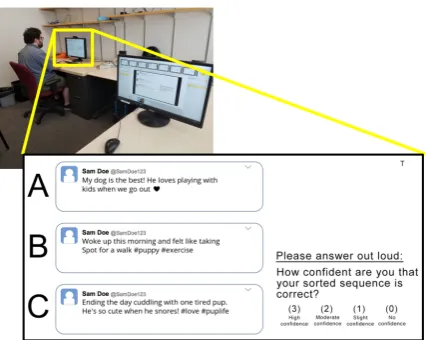
elicits readers’ interpretations of a target topic and its emotional tone. We carefully and systemati-cally extracted 60 sets of tweets from a 1M-tweet dataset and presented them to participants via an interface that mimicks the appearance of Twitter (Figure1). We asked subjects to sort chronolog-ically the tweets in each set, half with true narra-tive sequence and half without. Each set consisted of 3–4 tweets from a previously collected corpus, where each tweet was labeled using a framework by Liu et al. (2016) as work-related or not. In addition to sequentiality and job-relatedness, sets were evenly distributed across two other variables with two levels each, of interest for understand-ing narrative sensemakunderstand-ing (Table1). We recorded readers’ spoken responses to four questions (Fig-ure 2) about each set, which involved the sort-ing task, reader confidence, topical content (job-relatedness), and emotional tone. We used gal-vanic skin response (GSR) and facial expression analysis to explore potentially quantifiable met-rics for stress-based reactions and other aspects of reader-annotator response. Our results add under-standing of how annotators react to and process everyday microblog narratives.
This study makes these contributions:
1) Opens a dialogue on annotator well-being; 2) Presents a method to study annotator reactions; 3) Indicates that narrative sorting (task with de-grees of complexity) does not cause an increased stress response as task complexity increases; 4) Studies the role of topic saliency and emotional tone in narrative sense-making; and
5) Probes how features model annotator reactions.
2 Related Work
That annotation tasks cause fatigue is widely rec-ognized (Medero et al.,2006), and crowdsourcing
Figure 1: The experimental setup showing the experi-menter’s screen, a view of the participant on a second monitor, and a closeup view of the participant’s screen. A fictional tweet set is shown to maintain privacy.
1. What is the correct chronological order of these tweets?
2. How confident are you that your sorted se-quence is correct?
3. Are these tweets about work? [Target topic] If so, are they about starting or leaving a job? 4. What is the dominant emotion conveyed in
this tweet set?
Figure 2: The four study questions that participants an-swered for each tweet set in both trials.
annotations has been critiqued for labor market is-sues, etc. (Fort et al.,2011). Another important concern is how stressful or cognitively demanding annotation tasks may adversely impact annotators themselves, a subject matter that has not yet been prominently discussed, despite its obvious ethical implications for the NLP community and machine learning research.
Microblogging sites raise unique issues around sharing information and interacting socially. Compared to traditional published writing, Twitter users must choose language that conveys meaning while adhering to brevity requirements (Barnard,
2016). This leads to new narrative practices, such as more abbreviations and nonstandard phraseol-ogy, which convey meaning and emotion differ-ently (Mohammad, 2012). Tweets are also pub-lished in real time and the majority of users make their tweets publicly available, even when their subject matter is personal (Marwick and Boyd,
2011). Stories are shared among—and everyday narrative topics are explored by—communities, providing a window into the health and well-being of both online and offline networks at community levels.
We selected job-relatedness as ourTarget Topic
variable. Employment plays a prominent role in the daily lives and well-being of adults and is a popular theme in the stories microbloggers share of their lives. One study reported that slightly more than a third of a sample of nearly 40,000 tweets by employed people were work-related (van Zoonen et al.,2015). Employees can use social media to communicate with coworkers or independently to share their experiences ( Mad-sen, 2016; van Zoonen et al., 2014), providing many interesting job-related narratives. Because it is so common in on- and off-line storytelling, an-notators can relate to narratives about work. Work is also a less stressful topic, compared to other ones (Calderwood et al.,2017). Tweets with high or low emotional content in general may also af-fect readers in ways that change how they under-stand texts (Bohn-Gettler and Rapp, 2011). We used the sentiment functionality of TextBlob1 to distinguish high- and low-emotion tweets in the study.
Variable Lvl 1 Abbr. Lvl 2 Abbr.
Narrative Seq. yes seq+ no
seq-Target Topic yes job+ no
job-Emo. Content high emo+ low
emo-Num. Tweets 3 4
Table 1: Overview of the four study variables that char-acterize each tweet set. Lvl 1 indicates the first condi-tion for a variable, and Lvl 2 indicates the second. The primary distinction is between sets in Trial 1 (all seq+) and 2 (all seq-).
3 Study Design
The study involved 60 total tweet sets across two trials, reflecting a presumed increase in the cog-nitive complexity of the narrative sorting task. Trial 1 consisted of sets with a true narrative or-der (seq+) and Trial 2 of sets without (seq-); with the assumption that the latter is more cognitively demanding. The tweets were evenly distributed across the other three study variables (Table1).
For selecting job+ sets in Trial 1, queries of the corpus combined with keywords (such as
coworker,interview,firedand other employment-related terms) identified job-employment-related seed tweets while additional querying expanded the set for the same narrator. For example, a 3-item narrative could involve interviewing for a job, being hired, and then starting the job. For the job- sets in Trial 1, queries for seed tweets focused on keywords for other life events that had the potential to contain narratives (such asbirthday, driver’s license, and
child), continuing with the same method used for job+ sets. For each Trial 2 set, we conducted simi-lar keyword queries, except that we chose the seed tweet without regard to its role in any larger nar-rative. We selected the rest of the tweets in the set to match and be congruent with the same user and job+/job- and emo+/emo- classes as the seed tweet. The final selection of 60 tweet sets was based on careful manual inspection.
4 Methods
Participants: Participants were nineteen individ-uals (21% women) in the Northeastern U.S. who ranged in age from 18 to 49 years (M = 25.3). 58% were native English speakers, and active Twitter users made up 42% of the sample.
Measures: Galvanic Skin Response (GSR): We used a Shimmer3 GSR sensor with a sampling rate of 128 Hz to measure participants’ skin conduc-tance in microsiemens (µS). More cognitively dif-ficult tasks may induce more sweating, and higher µS, corresponding to a decrease in resistance and indicating cognitive load (Shi et al., 2007). We used GSR peaks, as measured by iMotions soft-ware (iMotions,2016), to estimate periods of in-creased cognitive arousal.
Facial Expression: To also differentiate be-tween positive and negative emotional arousal, we captured and analyzed readers’ expressed fa-cial emotions while interacting with the task using Affectiva’s facial expression analysis in iMotions (McDuff et al.,2016;iMotions,2016).
Procedure: Participants sat in front of a monitor with a Logitech C920 HD Pro webcam and were fitted with a Shimmer3 GSR sensor worn on their non-dominant hand. They then completed a de-mographic pre-survey while the webcam and GSR sensor were calibrated within the iMotions soft-ware. Next, participants completed a practice trial with an unsorted tweet set on the left-hand side of
the screen and questions on the right (Figure1). Participants answered each question aloud, minimizing movement, and continued to the next question by pressing a key. We provided a visual of Plutchik’s wheel of emotions (Plutchik,2001) if the participant needed assistance in deciding on an emotion for Question 4 (Figure2), although they were free to say any emotion word. After the prac-tice trial, the participant completed Trial 1 (seq+), followed by a short break, then Trial 2 (seq-). Fi-nally, we gave each participant a post-study sur-vey on their self-reported levels of comfort with the equipment and of cognitive fatigue during each trial.
One experimenter was seated behind the partic-ipant in the experiment room with a separate video screen to monitor the sensor data and answer any questions. A second experimenter was in another room recording the participants’ answers as they were spoken via remote voice and screen sharing.
Classifier:Pairing each tweet set with each partic-ipant’s response data as a single item yields 1140 data items (19 subjects * 60 sets). We used the LIBSVM (Chang and Lin, 2011) support vector machine (SVM) classifier library, with a radial ba-sis function kernel and 10-fold cross-validation, to predict variables of interest in narrative sensemak-ing. Table2lists observed and predicted features. When a feature served as a prediction target it was not used as an observed one. The mean value of the feature was used in cases of missing data points.
Study Self-Report Sensing
Narrative Seq. Kendallτ Dist. Facial Expression
Emo. Content Confidence Average GSR
Target Topic Topic Judgment Num. GSR Peaks Num. Tweets . Dom. Emotion Time
Twitter User Soc. Media Use
Table 2: Features used for a SVM classifier were put into three groups: 1) Study variables; 2) Subject self-reported measures from participants’ answers to study questions and pre-survey responses related to social media use; and 3) Sensing attributes relating to col-lected sensor and time data.
5 Results and Discussion
cor-rect narrative sequence for each tweet set in Trial 1, we used the Kendall τ rank distance between the two, or the total number of pairwise swaps of adjacent items needed to transform one sequence into the other. An ANOVA revealed that partici-pants were significantly closer to the correct nar-rative order when tweets were job-related (job+), compared to not job-related (job-), regardless of emotional content,F(1,566) = 13.30, p < .001 (Figure 3a). This result indicates that the target topic was useful for temporally organizing parts of stories. Without this topic’s frame to start from, readers were less accurate in the sorting task.
Figure 3: The four panels show: (a) Average Kendall
τ rank distance between participants’ orders and the
correct order by job-relatedness (target topic) and emo-tional content in Trial 1 only. Participants were signif-icantly more accurate with sets about the target topic, regardless of emotional content. (b) Average Kendall
τrank distance between participants’ sorted orders and the correct order by confidence level in Trial 1. 0 =
No Confidenceand 3=High Confidence. Participants
tended to be closer to the correct order as their confi-dence increased. (c) Average conficonfi-dence ratings across both trials by job-relatedness and emotional content. The only non-significant difference was between Job-Related (job+) x High Emotional Content (emo+), and Job-Related (job+) x Low Emotional Content (emo-) groups (see Table3), indicating an interaction between target topic and emotional content. (d) Average time spent (ms) per tweet set by confidence and trial. Par-ticipants spent overall less time on sets in Trial 2 than Trial 1, and less time for sets in both trials as confidence increased.
Trial Question 2: Confidence An ANOVA showed that as participants became more confident
Grp 1 Grp 2 t p SE d
Y×H Y×L 1.646 .101 0.066 0.097
Y×H N×H 4.378 <.001* 0.062 0.259 Y×H N×L 10.040 <.001* 0.063 0.595
Y×L N×H 2.541 .012† 0.064 0.151
[image:4.595.77.281.257.462.2]Y×L N×L 8.030 <.001* 0.065 0.476 N×H N×L 5.750 <.001* 0.063 0.341
Table 3: Student’st-test indicates differences in con-fidence by job-relatedness and emotional content (vi-sualized in Figure3c) with df=284 for all conditions. Groups are named with the following convention: Job-Relatedness x Emotional Content. Y=Yes (job+), N =No (job-), H=High (emo+), and L=Low (emo-). (*p < .001†p < .05).
in Trial 1, their sorted tweet orders were closer to the correct order, F(3,566) = 14.72, p < .001. This demonstrated that readers are able to accu-rately estimate their correctness in the sorting task when tweets had a true narrative sequence (Fig-ure 3b). This is an interesting result suggesting that participants were not under- or overconfident but self-aware of their ability to complete the sort-ing task. An ANOVA also showed that partici-pants were significantly more confident in Trial 1 (M = 2.20, SD = 0.79) than Trial 2 (M = 1.50, SD = 0.92), F(1,1138) = 188.00, p < .001, regardless of other study variables (Fig-ure 4). This indicates that it was more difficult for participants to assign a sorted order when the tweets did not have one.
Figure 4: Total instances of each confidence level by trial (0 =No Confidenceand 3 =High Confidence).
[image:4.595.310.531.552.648.2]job- tweets (M = 1.65, SD = 0.97),t(1138) =
−7.38, p < .001. By including emotional con-tent in an ANOVA, we also found that partic-ipants were significantly more confident about emo+ tweets compared to emo-, but only when the topic was not job-related (job-),F(1,1136) = 5.65, p=.018. Comparisons among groups these groups can be seen in Table3and Figure3c.
These findings suggest that the target topic, hav-ing a known narrative frame, was the most useful piece of information for participants in ordering tweets. When there was no job narrative to guide interpretation, emotional context was instead used as the primary sorting cue. This result agrees with previous work (Liu et al.,2016) by suggesting that the job life cycle involves a well-known narrative sequence that is used as a reference point for sort-ing tweets chronologically.
Confidence level could indicate cognitive load, which is supported by the ANOVA result that participants spent less time for each tweet set as their confidence increased, regardless of trial, F(3,1103) = 16.71, p < .001 (Figure 3d). This suggests that participants spent less time on sets that appeared to be easier to sort and more time on sets that were perceived as more diffi-cult. This could be a promising factor to predict how straightforward sorting different texts will be based on readers’ confidence and time spent.
However, participants also spent significantly more time for each tweet set in Trial 1 than Trial 2 regardless of confidence level, F(1,1103) = 29.53, p < .001(Figure 3d), even though Trial 2 was expected to be more difficult and thus time-consuming. This contrary result could be for sev-eral reasons. First, participants may have simply got faster through practice. Second, they may have been fatigued from the task and sped up to finish. Lastly, participants could have given up on the task more quickly because it was more difficult, an in-dicator of cognitive fatigue.
Trial Question 3: Target TopicParticipants cor-rectly inferred the topic as job-related 97.5% of the time (true positive rate) and not job-related 96.3% (true negative rate) of the time. For more ambigu-ous sets, we observed that participants added qual-ifiers to their answers more often, such as “these tweets could be about starting a job,” but were still able to determine the topic. These observations in-dicate that readers perform well when determining the topical context of tweets despite the format
pe-culiarities that accompany the text.
Trial Question 4: Dominant Emotion If partic-ipants gave more than one word to answer this question, we used only the first to capture the participant’s initial reaction to the text. We cate-gorized words according to Plutchick’s wheel of emotions (2001), and used the fundamental emo-tion in each secemo-tion of the wheel (such asjoyand
sadness) as the category label. Emotion words in between each section were also used as labels and a neutral category was added, resulting in 17 cate-gories explored in classification (below).
Sensor Data Analysis We averaged GSR read-ings across all four study questions for each tweet set. Because participants spent minutes answering questions 1 and 4 compared to mere seconds on 2 and 3, we chose to examine overall readings for each set instead of individual questions. An ex-tremely short timeframe yields fewer data points and more impact in the event of poor measure-ment. We were also more interested in differences between the study variables of the tweet sets (Ta-ble1) rather than differences by question, although this could be a direction for future data analysis and research.
Interestingly, an ANOVA indicated no differ-ences in overall normalized GSR levels or num-ber of peaks across any of the four study variables, which leads to important insights. First, it suggests that annotators may not feel more stressed when trying to sort texts that have no true narrative se-quence. This could be because piecing together narratives is so fundamental and natural in human interaction and cognition. Second, when the focus is the sorting task, it appears that engaging with tweet sets with high emotional content—whether about or not about the target topic—did not elicit a greater stress response in readers. This adds more understanding to previous research (Calderwood et al., 2017) on emotional and physiological re-sponses to texts.
We analyzed facial expressions using Affec-tiva (McDuff et al.,2016), obtaining the total num-ber of instances per minute of each facial expres-sion (anger, contempt, disgust, fear, joy, sadness, and surprise) for each tweet set by participant. We recorded the emotion that was displayed most of-ten by a participant for a given tweet set (neutral
narra-tives regardless of topic or emotional content.We observed that participants’ neutral resting faces tended to be falsely registered as disgust and con-tempt. Other factors such as skin tone and glasses influenced facial marker tracking.
[image:6.595.305.529.64.373.2]By observation it was clear that participants had reactions (Figure5) to tweet sets that were funny, including complex forms of humor such as irony and sarcasm. This is an important finding because annotating humor is a task that human readers are very good at compared to machines. The facial re-sponse to humor when reading texts could be used in a machine learning-based model to identify and classify humorous content.
Figure 5: Participant displaying a neutral facial expres-sion followed by a joy reaction to a humorous tweet.
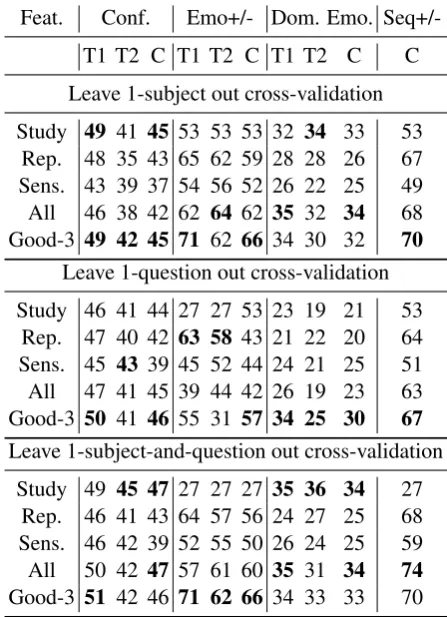
Classification Results To further study the col-lected human data and explore patterns of inter-est in the data, we used SVMs to model a tweet set’s Emotional Content (emo+/-) and Narra-tive Sequence(seq+/-); and a participant’s Confi-denceand self-reportedDominant Emotion(Dom. Emo.) (see Table 4). The label set differed for each classification problem, ranging from binary (emo+/- and seq+/-) to multiple, less balanced classes (4 for confidence and 17 for dominant emotion). When the label being predicted was also part of the observed feature group used to build the classifier, it was excluded from the feature set.
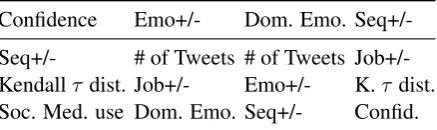
Table 4 displays the accuracy for these classi-fiers, using various combinations of the features sets from Table2. It also shows, for each variable modeled, results from aGood-3selection of fea-tures. This approach uses top-performing features via exhaustive search over all valid combinations of three. The same Good-3 features (Table5) were used for all trials for a classification problem in Ta-ble4.
Often, either All or Good-3 sets result in higher performance. Confidence and emo+/- tion improves performance with Trial 1 classifica-tion; however, since the dataset is modest in size,
Feat. Conf. Emo+/- Dom. Emo.
Seq+/-T1 T2 C Seq+/-T1 T2 C Seq+/-T1 T2 C C
Leave 1-subject out cross-validation
Study 49 41 45 53 53 53 32 34 33 53
Rep. 48 35 43 65 62 59 28 28 26 67
Sens. 43 39 37 54 56 52 26 22 25 49
All 46 38 42 62 64 62 35 32 34 68
Good-3 49 42 45 71 62 66 34 30 32 70
Leave 1-question out cross-validation
Study 46 41 44 27 27 53 23 19 21 53
Rep. 47 40 42 63 58 43 21 22 20 64
Sens. 45 43 39 45 52 44 24 21 25 51
All 47 41 45 39 44 42 26 19 23 63
Good-3 50 41 46 55 31 57 34 25 30 67
Leave 1-subject-and-question out cross-validation
Study 49 45 47 27 27 27 35 36 34 27
Rep. 46 41 43 64 57 56 24 27 25 68
Sens. 46 42 39 52 55 50 26 24 25 59
All 50 42 47 57 61 60 35 31 34 74
Good-3 51 42 46 71 62 66 34 33 33 70
Table 4: Classification accuracies rounded to nearest percent for Trial 1 (T1), Trial 2 (T2) and both trials combined (C). Bold values indicate the most accurate feature set’s prediction percentage per trial or com-bined. Because trials 1 and 2 differed in having a true narrative sequence, no seq+/- prediction is reported by trial.
it is difficult to make a judgment as to whether or not presenting users with chronologically ordered tweets yield better classifiers for narrative content. As expected, regardless of which set of features is being used, simpler boolean problems outperform the more difficult multiclass ones.
6 Conclusion and Future Work
This study adds understanding of how annotators make sense of microblog narratives and on the portance of considering how readers may be im-pacted by engaging with text annotation tasks.
[image:6.595.80.284.266.364.2]an-Confidence Emo+/- Dom. Emo. Seq+/-Seq+/- # of Tweets # of Tweets Job+/-Kendallτ dist. Job+/- Emo+/- K.τ dist. Soc. Med. use Dom. Emo. Seq+/- Confid.
Table 5: Good-3 features used for each SVM classifier.
notation. Confidence ratings can also help iden-tify outlier narratives that are more challenging to process and interpret. The increase in cognitive complexity in Trial 2 did not appear to cause a po-tentially unhealthy stress response in annotators.
Despite generating interesting results, this study had limitations. For example, the sample size was modest and trial order was not randomized. Ad-ditionally, the topics of tweets were not overly stressful, and we avoided including tweets we thought could trigger discomfort. As an ex-ploratory study, the quantitative results presented represent preliminary findings. More nuanced and advanced statistical analysis is left for future work. Future work could benefit from developing clas-sifiers for predicting whether a microblog post is part of a narrative; a useful filtering task completed by careful manual inspection in this study. Ad-ditional development of classifiers will focus on further aspects related to how readers are likely to interpret and annotate microblog narratives.
Acknowledgments
This material is based upon work supported by the National Science Foundation under Award No. IIS-1559889. Any opinions, findings, and conclu-sions or recommendations expressed in this ma-terial are those of the author(s) and do not nec-essarily reflect the views of the National Science Foundation.
References
Josie Barnard. 2016. Tweets as microfiction: On Twit-ter’s live nature and 140-character limit as tools for developing storytelling skills.New Writing: The In-ternational Journal for the Practice and Theory of Creative Writing, 13(1):3–16.
Marina Bluvshtein, Melody Kruzic, and Victor Mas-saglia. 2015. From netthinking to networking to net-feeling: Using social media to help people in job transitions. The Journal of Individual Psychology, 71(2):143–154.
Catherine M Bohn-Gettler and David N Rapp. 2011. Depending on my mood: Mood-driven influences
on text comprehension.Journal of Educational Psy-chology, 103(3):562.
Alexander Calderwood, Elizabeth A Pruett, Raymond Ptucha, Christopher Homan, and Cecilia O Alm. 2017. Understanding the semantics of narratives of interpersonal violence through reader annota-tions and physiological reacannota-tions. InProceedings of the Workshop on Computational Semantics beyond Events and Roles, pages 1–9.
Chih-Chung Chang and Chih-Jen Lin. 2011. LIB-SVM: A library for support vector machines. ACM Transactions on Intelligent Systems and Technology, 2:27:1–27:27.
Kar¨en Fort, Gilles Adda, and K Bretonnel Cohen. 2011. Amazon Mechanical Turk: Gold mine or coal mine? Computational Linguistics, 37(2):413–420.
iMotions. 2016. iMotions Biometric Research Plat-form 6.0.
Tong Liu, Christopher Homan, Cecilia Ovesdotter Alm, Megan C Lytle, Ann Marie White, and Henry A Kautz. 2016. Understanding discourse on work and job-related well-being in public social me-dia. In Proceedings of the 54th Annual Meeting
of the Association for Computational Linguistics,
pages 1044–1053.
Vibeke Thøis Madsen. 2016. Constructing organi-zational identity on internal social media: A case study of coworker communication in Jyske Bank.
International Journal of Business Communication,
53(2):200–223.
Alice E Marwick and Danah Boyd. 2011. I tweet hon-estly, I tweet passionately: Twitter users, context collapse, and the imagined audience. New Media & Society, 13(1):114–133.
Daniel McDuff, Abdelrahman Mahmoud, Moham-mad Mavadati, May Amr, Jay Turcot, and Rana el Kaliouby. 2016. AFFDEX SDK: A cross-platform real-time multi-face expression recognition toolkit.
In Proceedings of the 2016 CHI Conference
Ex-tended Abstracts on Human Factors in Computing
Systems, CHI EA ’16, pages 3723–3726, New York,
NY, USA. ACM.
Julie Medero, Kazuaki Maeda, Stephanie Strassel, and Christopher Walker. 2006. An efficient approach to gold-standard annotation: Decision points for com-plex tasks. InProceedings of the Fifth International
Conference on Language Resources and Evaluation,
volume 6, pages 2463–2466.
Saif M Mohammad. 2012. #Emotional tweets. In Pro-ceedings of the First Joint Conference on Lexical
and Computational Semantics, pages 246–255.
As-sociation for Computational Linguistics.
Robert Plutchik. 2001. The Nature of Emotions.
Yu Shi, Natalie Ruiz, Ronnie Taib, Eric Choi, and Fang Chen. 2007. Galvanic skin response (GSR) as an in-dex of cognitive load. In Proceedings of CHI ’07 Extended Abstracts on Human Factors in
Comput-ing Systems, CHI EA ’07, pages 2651–2656, New
York, NY, USA. ACM.
Ward van Zoonen, Toni GLA van der Meer, and Joost WM Verhoeven. 2014. Employees work-related social-media use: His master’s voice.Public Relations Review, 40(5):850–852.
Ward van Zoonen, Joost WM Verhoeven, and Rens Vliegenthart. 2015. How employees use Twitter to talk about work: A typology of work-related tweets.