1
Contents
Foreword 2
Mission Statement and Organisational Structure 3
Articles
Weather Review 2004 4
Irish Weather Measurements 2004 7
Bourke Medal 8
Chair of Meteorology at University College Dublin 8
Borealis Weather Graphics System 9
Strategic Management – Delivering Met Éireann’s High-Level Goals 11
Appendices
I. Forecast Accuracy 26
II. Publications 29
III. Met Éireann Finances 30
Corporate Information 31
2
2004 was a busy and eventful year for Met Éireann, one in which we were challenged to optimise the deployment of staff and other resources in response to ever-increasing customer demands. Effective business planning is critical in meeting such challenges, and so the publication of our third Statement of Strategy early in the year was very opportune. Building on past experience, the new Strategy Statement focuses on Met Éireann’s outputs – the services we supply to our customers – rather than the internal arrangements to produce them. In setting out an imposing list of ambitious but achieveable objectives, the Strategy Statement outlines a coherent and practical programme within which Met Éireann will plan its activities and against which performance will be assessed.
As ever, Met Éireann’s principal function in 2004 was to help protect life and property by issuing accurate weather forecasts and warnings.
The importance of this task was strikingly illustrated in late October, when heavy rainfall caused
widespread flooding in the south and southeast. Computer-based weather prediction models, both in Met Éireann and at the European Centre for
Medium-Range Weather Forecasts, identified the risk of severe weather well in advance. The accurate and timely warnings issued by Met Éireann proved of great benefit to the public and the emergency services in their efforts to cope with the extreme conditions.
Until recently, Ireland was one of the very few European countries without a Department of Meteorology in any of its 3rd-level educational Institutes. Efforts to address this shortcoming were rewarded in June 2004 with the appointment of Professor Peter Lynch to the newly-established Chair of Meteorology at University College Dublin.
I have no doubt that this new synergy between Met Éireann and the 3rd-level sector will prove of enormous benefit to Irish meteorology.
In any Annual Report there may be a tendency to focus unduly on the highlights of the year’s activities. This can sometimes mask the very substantial effort entailed in maintaining routine operations. I would like to take this opportunity to acknowledge the commitment and professionalism shown by all Met Éireann staff throughout 2004, whatever their role in the overall task of delivering high-quality services to end-users and customers.
Declan Murphy
Director June 2005
Mission Statement
Our Mission is to monitor, analyse and predict Ireland’s weather and
climate, and to provide a range of high quality meteorological and
related information to our customers.
Organisational Structure of Met Éireann (December 2004)
3 Director
Declan Murphy
Assistant Director Operations and Administration
Séamus Ó Laoghóg
Aviation Services Dave Murphy
General Forecasting Michael Walsh
Administration and Training Eamon Murphy
Commercial Liam Campbell
Assistant Director Scientific and Technical Support
(Vacant)
Climatology and Observations Tom Sheridan
Information Technology Paul Halton
Research and Applications Denis Fitzgerald
Instrumentation and Environmental Monitoring
4
Global Weather
According to estimates of the World Meteorological Organisation (WMO), the global mean surface temperature in 2004 was 0.44°C above the 1961-1990 annual average. This value of 0.44°C places 2004 as the fourth warmest year in the temperature record since 1861, just behind 2003 (+0.49°C). 1998 remains the warmest year, when surface temperatures averaged 0.54°C above the same 30-year mean. The last 10 years (1995-2004), with the exception of 1996, are among the warmest 10 years on record.
Warmer temperatures were by no means the only remarkable feature of 2004’s weather. The year was also notable for its above-average number of hurricanes and typhoons. During the Atlantic hurricane season, 15 named tropical storms developed, compared to an average of around ten. Nine of these storms were classified as hurricanes, of which six were ‘major’ hurricanes (category three or higher on the Saffir-Simpson scale). Hurricane Charley (August 2004) was the strongest and most destructive hurricane to strike the United States since Andrew in 1992.
In the South Atlantic Ocean, sea-surface and atmospheric conditions do not normally favour the formation of hurricanes. However in March 2004, the first documented hurricane since geostationary satellite records began in 1966 was observed. Named Catarina, it made landfall along the coast of southern Brazil (in the state of Santa Catarina) on March 28th 2004.
Global precipitation in 2004 was above average – 2004 was the wettest year since 2000. Wetter-than-average conditions prevailed especially in the southern and eastern United States, eastern Europe and parts of western Asia. However drought
conditions continued to affect parts of eastern South Africa, Mozambique, Lesotho and Swaziland. Drought persisted also in much of southern and eastern Australia, while a record area was burned by wildfires in Alaska as a result of above-normal summer temperatures and dry conditions.
Weather Review 2004
5
Weather in Ireland
In 2004 Ireland’s weather was warmer and sunnier than normal everywhere, although rainfall totals were near average.
Rank Year +/- Normal (°C)
1 1945 +1.14
2 1949 +1.06
3 1997 +1.00
4 2003 +0.98
5 1921 +0.89
6 1959 +0.86
7 2004 +0.86
8 2002 +0.85
9 1995 +0.84
10 1998 +0.79
2004 ranked as Ireland’s 7th warmest year since records began, based on temperatures measured at four long-established stations – Phoenix Park (Dublin), Cahirciveen (Kerry), Malin Head (Donegal) and Birr (Offaly). Annual mean temperatures ranged between 10°C and 11°C at most locations, around 0.5 - 1.0°C higher than normal generally. Apart from July and October, every month of 2004 was warmer than normal; the periods from April to June and August to September were particularly warm relative to the average. At the majority of stations, the highest temperatures of the year coincided with the August bank holiday when maxima rose above 25°C in many places and over 27°C at Birr. The year’s lowest temperatures were measured during late January and late February; Kilkenny’s minimum air temperature of -7.7°C on January 29th was the lowest value at the station for around 20 years.
Annual rainfall totals were close to normal at most stations; percentages of normal values were between 91% at Cork Airport and 110% at Malin Head. May and November were the driest months relative to normal, while March and October were very wet, especially in the south. The number of
raindays during the year (days with 0.2mm or more rainfall) was also close to normal generally, ranging from around 165 raindays in the southeast to just over 280 in the northwest. The heaviest falls occurred during the second half of October, leading to significant flooding in parts of the south and southeast. Falls of up to 150mm were measured in this area in the 48-hour period of October 27th-28th.
6
Sunshine totals were above normal everywhere, although they were not as high as those for 2003. February and March were exceptionally sunny months and were the sunniest on record at some locations; in contrast, November was extremely dull. Cork Airport measured 16 hours of sunshine on June 15th, the highest daily value of the year and the highest value at the station since it opened in 1962.
Mean windspeeds for the year were between 9 and 11 knots (10 and 13 m.p.h.) at most stations and between 13 and 15 knots (15 and 17 m.p.h.) at coastal stations of the north and northwest. The strongest winds of the year at many stations were measured on March 20th, but Belmullet recorded the highest gust of the year, 73 knots (84 m.p.h.) on February 3rd.
Fine weather in Dublin on May 1st for celebrations marking the accession of ten new member states to
the European Union.
7
CO. CLARE
Shannon Airport 903.7 98 21.7 18 Dec 10.8 +0.6 24.9 -3.1 3.82 105 14.2 24 Jun 219 4 21 13 5 34 65
CO. CORK
Cork Airport 1115.4 91 44.3 22 Jun 10.2 +0.7 25.2 -4.0 4.31 110 16.0 15 Jun 217 4 15 7 2 84 67
CO. DONEGAL
Malin Head 1141.3 110 28.6 23 Jun 10.3 +0.9 23.6 -0.5 3.59 101 15.6 7 Jul 251 10 4 45 6 11 170
CO. DUBLIN
Dublin Airport 702.6 n/a 32.8 18 Aug 10.0 n/a 24.3 -6.4 4.26 106 15.0 22 May 202 7 29 14 8 26 90
Casement Aerodrome 772.5 106 44.2 20 Oct 10.2 +0.9 25.7 -6.8 3.75 97 14.8 18 May 192 8 35 12 5 20 65
CO. KERRY
Valentia Observatory 1398.9 100 42.3 11 Mar 11.2 +0.7 24.9 -2.1 3.88 109 15.4 14 Jun 257 1 8 15 4 13 76
CO. KILKENNY
Kilkenny 803.3 97 34.4 28 Oct 10.3 +0.9 25.5 -7.7 4.04 111 15.5 14 Jun 185 n/a 42 --- n/a --- 35
CO. MAYO
Belmullet 1130.1 103 27.8 31 Jan 10.9 +1.0 24.2 -0.8 3.87 104 15.1 25 May 280 13 5 42 8 14 144
Connaught Airport 1374.5 n/a 29.4 31 Jan 9.0 n/a 24.3 -3.7 3.61 n/a 15.5 7 Jul 281 23 23 14 5 135 75
CO. MONAGHAN
Clones 852.0 93 23.4 31 Jan 9.7 +0.8 23.9 -4.6 3.58 110 14.6 7 Jul 231 n/a 29 --- n/a --- 35
CO. OFFALY
Birr 751.3 92 23.3 28 Oct 10.2 +0.9 27.3 -6.4 3.38 95 14.0 18 May 207 n/a 36 --- n/a --- 33
CO. WESTMEATH
Mullingar II 953.1 103 26.6 20 Nov 9.7 +1.0 25.9 -6.3 4.15 115 14.5 18 May 229 n/a 39 --- n/a --- 24
CO. WEXFORD
Rosslare 878.8 99 44.7 22 Oct 11.2 +1.0 25.5 -3.3 4.87 109 15.6 14 Jun 165 3 6 8 4 29 108
County/
Station
RAINFALL (mm) TEMPERATURE (°C) SUNSHINE (HOURS) NO. OF DAYS WITH:
R
ain
Snow Air frost Hail Thunder Fo
g
Gale gusts
T
otal % of average
% of average
Mean dif Daily mean
f.
from average
Highest Lowest
amount date(s)
Most in a day
amount date(s)
Most in a day Extremes
8
On February 26th the AGMET Group instituted the Austin Bourke Medal, named in honour of the late Dr. Austin Bourke, Director of Met Éireann from 1964 until his retirement in 1978. The inaugural medal was presented to Clodagh Bourke, widow of Dr. Bourke, by Mr. Declan Murphy, Director of Met Éireann. The presentation took place in the course of a conference on Climate Change and Irish Agriculture held at the Royal Irish Academy, Dublin.
Austin Bourke was one of the first meteorologists recruited in 1939 to the newly-formed Irish Meteorological Service. His outstanding work in agricultural meteorology, especially in the analysis and forecasting of episodes of potato blight, won him national and international acclaim. From 1958 to 1962 he served as President of the World Meteorological Organisation’s Commission for Agricultural Meteorology, and in 1973 he was awarded a Doctorate in Science by the National University of Ireland.
In 2003, as part of an Agreement with University College Dublin on the establishment of a new Research Centre in Meteorology and Climatology, Met Éireann undertook to fund a Professorship of Meteorology in the Department of Mathematical Physics at UCD. In June 2004 the new Chair of Meteorology was filled by Dr. Peter Lynch, who prior to that time was Met Éireann’s Assistant Director (Scientific and Technical Support).
Peter joined Met Éireann in 1971 and served as Assistant Director from 1994 to 2004. He was awarded his Ph.D. by the University of Dublin (Trinity College) in 1982, for his thesis entitled ‘Planetary Scale Hydrodynamic Instability in the Atmosphere’. He played a leading role in developing Met Éireann’s Numerical Weather Prediction (NWP) capability, taking a particular interest in techniques for data assimilation. Peter's flair for original research earned him an international reputation, his pioneering work on Digital Filter Initialisation making a major impact on NWP worldwide.
The new Chair of Meteorology will contribute greatly to national progress in meteorological science and its applications. The first students on the new M.Sc. Degree course in Meteorology at UCD began their studies on September 16th 2004.
Mrs. Clodagh Bourke accepts the Austin Bourke Medal from Mr. Declan Murphy (Director, Met Éireann).
Professor Peter Lynch
In 2004, over the October bank holiday weekend, Met Éireann and RTÉ together implemented a new weather presentation system called Borealis. Developed by WeatherOne, a Norwegian company specialising in graphical broadcast systems, Borealis ushered in a new era of quality and innovation on RTÉ Weather.
Borealis is the most recent upgrade in a succession of graphical software packages, all dedicated to the same purpose – to communicate a weather ‘message’ which is accurate, informative and attractive to viewers.
Borealis presents basic weather information from Met Éireann’s limited-area atmospheric model (HIRLAM), and longer-range forecast data from the European Centre for Medium-Range Weather Forecasts (ECMWF). Satellite imagery comes from the European Meteosat family of weather satellites, and radar data from both the UK/Irish co-ordinated network and the high-resolution Met Éireann network. Images from the American NOAA series of polar-orbiting weather satellites can also be displayed.
The task of exploiting the Borealis system to make all this information comprehensible and visually attractive falls to a collaboration between RTÉ’s graphics artist and Met Éireann’s software specialist. The graphics artist creates the ‘look and feel’ of the weather presentation – designing the background maps, the various weather symbols (for temperature, wind etc.), the font style, size of text and so on. The software specialist implements the graphic artist’s designs, using the flexibility built into the Borealis system to depict the varying states of the weather. A whole host of issues must be addressed – at what rates of rainfall do we show the symbols for light, moderate or heavy rain? At what values should the temperature symbols be coloured blue, yellow or red? How do we best adjust the appearance of satellite images through the year, from winter
Borealis Weather Graphics System
10
(when the sun is low on our horizon, and
consequently satellite images over northern Europe have low illumination) to summer?
On the larger scale, the Borealis software offers a rich assortment of visual tools with which to tell the weather story. Aside from the charts of weather symbols there are colour-coded charts for temperature; a variety of different formats for displaying wind; the usual ‘isobaric’ charts on which are indicated the highs, lows and weather fronts; and the facility to add ‘airmass’ arrows to these latter charts to indicate large sweeps of cold or warm air as appropriate. A wide variety of satellite imagery can be presented (visible or infra-red, from full hemisphere discs down to high-resolution images over the island of Ireland), along with radar imagery and lists of city forecasts in ‘league-table’ format. Pictorial background images of sporting or cultural events can be employed when a specific forecast for such an event is being presented. Borealis also has the capability of performing three-dimensional ‘fly-through’ representations of actual or forecast weather.
The Borealis system runs on a PC. However when the PC is broadcasting directly to air, supporting a vital public service such as the weather forecast, then a standard off-the-shelf machine will not suffice. Security and reliability are of paramount importance and are achieved through redundancy. Met Éireann has installed two separate ‘SuperMicro’ computers in RTÉ to service the weather studio. Each PC has three distinct power supply units; two can fail and the machine will continue to run with the remaining operational unit. There are four 120 Gigabyte hard disks, configured as a redundant array of independent disks (RAID), giving total disk space of almost half a Terabyte. The disks work in pairs, with each pair capable of running the system independently. Thus one, and possibly two disks can fail with no noticeable impact on operations.
The response to Borealis from the Irish public – an especially discerning audience for weather information – has been very positive. Ireland is large enough to allow a variety of different weather types to co-exist at any given time, yet each viewer expects a description of what the weather will be like in their locality for the coming days. To present this variety of complex, highly-detailed information – in effect, a series of different weather stories to viewers in different parts of the country – in just two minutes of air time would be impossible without fully exploiting all possible means of visual communication. Only the best is good enough and, in using the Borealis software, Met Éireann and RTÉ employ one of the world’s foremost graphics systems to illustrate some of the world’s most interesting weather.
Progress in Achieving High-Level Goals
Met Éireann’s Strategy Statement lists ten High-Level Goals which together describe the organisation’s key objectives and strategies. Progress in achieving these Goals during 2004 is detailed below.
HIGH-LEVEL GOAL 1:To make available to the general public of Ireland an excellent service of high quality general weather forecasts, warnings of hazardous weather and other information helpful in the prevention or mitigation of environmental disasters.
General Forecasting Division
Much of Met Éireann’s work is directed towards its core task of delivering high-quality weather forecasts and warnings to end-users. The General Forecasting Division (GFD) supplies a wide range of forecast services and weather warnings through the Central Analysis and Forecast Office (CAFO) and the RTÉ Weather Office. Customers include the general public, Government and semi-state bodies, local authorities, media and a range of business and commercial interests.
During 2004 the volume of routine forecasts issued by the Division was similar to the 2003 level, while the number of non-routine customised forecasts increased by approx. 30%. The number of weather warnings also increased, most notably in late October when an exceptionally deep depression became slow-moving off the south coast. Heavy rainfall caused severe flooding which persisted for several days in many southern and south-eastern areas. The forecasts and warnings issued by General Forecasting Division proved extremely accurate and provided invaluable guidance to the public and the emergency services.
Throughout the year the Division provided updates for Met Éireann’s web site several times daily and made a major contribution to the implementation of the new Borealis TV Graphics System.
Forecasts of pollen count and sunburn index were issued during the spring and summer months. The Small Craft Warning service introduced as a pilot project in 2003 became fully operational in 2004, following positive feedback from the marine community. A new forecast service for Inland Lakes was introduced on a trial basis during the months April – September.
In all, a total of 509 gale warnings and 339 small craft warnings were issued during the year.
Additional specific warnings were issued in relation to particular weather conditions (see Table).
Customised weather services were delivered to energy utilities, the building industry and several other business and commercial interests. In collaboration with the National Roads Authority, winter road maintenance forecasts for over 50 sites were provided to local authorities nationwide. The Telephone Consultancy Service (which provides direct customer access to the operational weather forecasters) continued to prove popular with many industrial and commercial clients. There was strong demand for premium-rate telephone weather services.
11
Strategic Management –
Delivering Met Éireann’s High-Level Goals
Specific Warnings Number
Frost 7
Rainfall 44
Snow 16
Thunder 91
Wind 91
12
Towards the end of the year, the introduction of new communications technology enabled the Division to deliver improved customer service while increasing overall efficiency. All manual fax services were automated, including the transmission of premium-rate fax products.
Throughout 2004 staff from General Forecasting Division made important contributions to a number of customer-focused meetings and seminars, some organised by Met Éireann and others by major end-user groups.
Numerical Weather Prediction
Research and Applications Division continued the development of Met Éireann’s High-Resolution Limited Area Model (HIRLAM), with a particular focus on lateral boundary conditions.
HIRLAM, which began in 1985, is a cooperative project between the National Meteorological Services of the Nordic countries, Spain, the Netherlands and Ireland. Throughout 2004 the HIRLAM model ran 4 times daily on Met Éireann’s computer systems and the output formed the principal basis for short-range forecasting (up to 48 hrs ahead).
The Wave Forecast Model (WAM) which forecasts sea conditions such as wave height, swell height etc. runs in tandem with the HIRLAM model. In 2004 both HIRLAM and WAM were ported to a Linux cluster where they ran in parallel with the main operational computers. It may eventually be possible to rely exclusively on such clusters in preference to the more expensive mainframe machines.
The EUMETSAT ATOVS Retransmission Service (EARS) aims to make satellite data from US National Oceanic and Atmospheric Administration (NOAA) satellites available within 30 minutes of observation time, thus facilitating their use in European short range NWP models. During 2004 Met Éireann engaged an INTRA student to investigate how biases in the EARS data could be removed – an essential precondition for their use in the HIRLAM model (INTRA – INtegrated TRAining – is a scheme which enables 3rd-level students to take up paid work-placements in an area relevant to their particular field of study). The project proved successful and significant progress was made in solving this complex problem.
For forecasts in the range 3 to 7 days ahead, Met Éireann relies mainly on guidance provided by the European Centre for Medium-Range Weather Forecasts (ECMWF). Since beginning operations in 1978, ECMWF has produced and disseminated forecast guidance once per day, based on data at 12 noon. However early in 2004 the Centre increased its schedule to two cycles per day, adding a
12 midnight forecast to the long-established 12 noon forecast. This additional guidance was a welcome enhancement to the range of forecast information available in Met Éireann’s operational offices.
HIGH-LEVEL GOAL 2:To fulfil the State’s
obligations to provide meteorological services to aviation and to influence future developments in this area in order to achieve the best long-term result for the State and for the aviation sector.
recommendations and national procedures. It comprises the Central Aviation Office at Shannon Airport, at which the Head of the Division is based, together with the Meteorological Offices at Dublin, Cork and Knock Airports and at Casement
Aerodrome. The Division is also responsible for services to a number of Regional Airports around the country. ASD is the focal point for liaison between Met Éireann and the Irish Aviation Authority, the airport authorities, and the various international agencies insofar as their activities are concerned with aviation meteorology.
All routine operations continued as normal throughout the year. The delivery of Flight Data through self-briefing units (SBUs) became
operational at Shannon Airport – these had already been in use at Dublin and Cork Airports. Terminal aerodrome forecasts (TAFs) were issued for Shannon, Dublin, Cork and Knock Airports and for Casement Aerodrome. Local Aerodrome Warnings were provided for these sites and also for a number of regional airports. A total of 105 SIGMET warnings were issued for the Shannon Flight Information Region, while 216 forecasts were provided to assist Search and Rescue operations. At Casement Aerodrome, the number of local meteorological reports issued each day was increased by 40% to facilitate the activities of the Garda Air Support Unit.
A new anemometer system was installed at Dublin Airport as part of the Irish Aviation Authority’s CAIRDE programme.
The new instruments enclosure at Shannon Airport was completed. The need for a new enclosure arose some years ago, when Air Rianta indicated they wanted the existing site for other purposes. A location for the new development was selected and comparison measurements over a period of
18 months were used to establish a climatological link with the old enclosure. Early in 2003 agreement was reached with Aer Rianta on fencing, power supply, cable routing etc., and detailed planning was completed on the layout of the site. Construction and installation work proceeded during 2003, and by early 2004 the new enclosure was declared operational. In its final design the enclosure has a trapezoidal shape, and the specifications provide for the overall area to be divided into 5m sq. blocks each accommodating one piece of equipment.
The Single European Sky (SES) is a policy initiative emanating from the European Commission aimed at making air transport within Europe more efficient and cost effective. SES seeks to rationalise the management of European airspace, reducing the present multiplicity of Flight Information Regions (FIRs) and perhaps ultimately creating a single unified airspace in Europe. SES also regulates the provision of services to aviation, including meteorological services.
The impact of SES on Met Éireann, which is currently the designated provider of meteorological services to civil aviation in Ireland, will be
significant. In future, Met Éireann will be required to apply to a government-appointed Regulator for a licence to provide such services. Licensing will be contingent on compliance with a number of
conditions – for example, it will be necessary for the Aviation Services Division to implement certified quality assurance procedures. To this end in 2004 the Division continued its preparations for the implementation of the ISO 9000:2001 Quality Management System, with certification expected to take place in mid-2005.
14
Throughout 2004 the Climatology and Observations Division continued its main tasks of maintaining the National Climate Database, managing the
observational station networks and operating the Climate Enquiries Office.
Routine quality control of data from the network of synoptic stations operated in up-to-date mode. For data from the climatological and rainfall stations quality control was normally completed within 1 to 3 months. Considerable effort was committed to the development of new quality control systems which will be significantly more automated than present procedures. The need for such systems will become increasingly pressing with the wider deployment of automatic weather stations.
The number of e-mail subscriptions to the End-of-Month Summary – now officially titled the Monthly Weather Summary – increased to 130. Of this number, 40 represent media interests – newspapers, TV and radio stations. The number of postal subscriptions to the Monthly Weather Bulletin remained steady at around 460, of which 270 were paid subscriptions.
During 2004 the Climate Enquiries Office received approximately 4,900 telephone enquiries and 2,400 requests for climatological information and reports. The Climate section of Met Éireann’s website was re-designed to provide detailed information on
product availability and to allow for on-line ordering.
Over one-third of the network of 575 operational climatological and rainfall stations were inspected during 2004. One additional climatological and 10 additional rainfall stations were opened, while 3 climatological and 6 rainfall stations were closed.
The Division maintained its active involvement in the TUCSON project. TUCSON (The Unified Climate and Synoptic Observation Network) is based on an Automatic Weather Station designed and
constructed by Met Éireann to carry out both synoptic and climatological observations. Significant resources were directed towards evaluating TUCSON measurements, developing an automatic quality control system and establishing a database of station metadata. The Division also exercised the lead responsibility for investigating and assessing potential TUCSON sites, negotiating with site owners, handling planning permission issues, making arrangements for caretaking etc.
Climatology and Observations Division continued to liaise with public service, research and other bodies on matters relating to climate change and
variability, and maintained its role on the Climate Modelling Committee which oversees the C4I project. C4I – the Community Climate Change Consortium for Ireland – was established to investigate the impact of climate change in Ireland. The project’s principal goal is to build a capability for addressing climate change issues specific to national needs, and to provide a support framework for wider climate-related research activities. Model research and simulation work for C4I are carried out in the Regional Climate Analysis and Prediction Centre in Met Éireann, while system analysis and code development activities are centred at University College, Dublin.
HIGH-LEVEL GOAL 3:To provide a
15
C4I’s main achievement in 2004 was the completion of a simulation of the future Irish climate
(2021-2060) using a regional climate model.
The results show a general warming in the future period with mean monthly temperatures increasing typically between 1.25 and 1.5 °C. The largest increases are seen in the south-east and east, with the greatest warming occurring in July. For precipitation the most significant changes occur in the months of June and December. June values show a decrease of about 10% compared with the current climate, noticeably in the southern half of the country. December values show increases ranging between 10% in the south-east and 25% in the north-west. There is also some evidence of an increase in the frequency of extreme precipitation events (20mm or more per day) in the north-west.
In a practical application of this new dataset a hydrological model was used to assess the impact of climate change on river discharge and local flooding in the river Suir catchment area. The increase in winter precipitation was found to produce a significant increase in the more intense discharge episodes, raising the risk of future flooding in the area.
In the future scenario the frequency of intense cyclones over the North Atlantic area in the vicinity of Ireland is increased by about 15% compared with the current climate. This is probably related to the general rise in sea surface temperatures. A 16-year sensitivity experiment provides further support and suggests that a warming Atlantic will lead to more hurricanes, the remnants of which may impact on European coastal areas.
As part of the climate model validation work a 40-year simulation of the past climate (1961-2000) was also completed. The output data complement the archive of existing climate observations and, together with the data for the future climate, greatly enhance the scope for climate research in Ireland.
HIGH-LEVEL GOAL 4:To maintain a high level of expertise and involvement in specialised areas such as agricultural, environmental and marine meteorology and to use this expertise to provide forecast guidance and decision support.
Agricultural and Environmental Unit
Met Éireann staff played a central role in the production of the second edition of ‘Climate, Weather and Irish Agriculture’, which was launched by the AGMET Group at the Royal Irish Academy in Dublin on May 5th.
C4I simulation showing predicted increase in average monthly precipitation (mm) for December
16
The appearance of the second edition, edited by T. Keane and J.F. Collins, was timely in view of the major developments in Irish agriculture since the first edition appeared in 1986. There was a clear need to draw together and put in context the new data and research which have become available in the intervening years.
In partnership with Teagasc and UCD, Met Éireann’s agrometeorologist participated in a project on the development of a decision support system for nitrogen/slurry spreading. Met Éireann supplied raw data from the ECMWF ensemble forecast fields and advised on their interpretation and use.
Marine Unit
The Irish Marine Weather Buoy Network was completed with the installation of a fifth moored buoy (M5) south of the Saltee Islands at 51° 41' N, 6° 42' W.
In May, Met Éireann launched a new marine weather forecast service for the Inland Lakes, initially covering Lough Derg, Lough Ree, Lough Corrib, Lough Mask, Lough Allen and Lough Key. Forecasts were issued twice daily, giving the
expected wind, weather and visibility together with an outlook for the following day. The primary methods of dissemination were via the Irish Coast Guard’s new Marine VHF Network for the Inland Lakes, and on Met Éireann’s website at
www.met.ie.
National Effort to Forecast Flooding
During 2004 Met Éireann engaged in a number of initiatives aimed at alleviating the impact of flooding events. An analysis of extreme rainfall occurrences was completed, and work began on developing a national set of long-term series of daily rainfall values.
HIGH-LEVEL GOAL 5:To undertake commercial meteorological activity in a way that is consistent with competition law and with Met Éireann’s other mandates so as to reduce overall costs to the exchequer.
As in previous years Met Éireann’s principal revenue-earning activities included premium-rate weather forecasts, services to TV and other media, provision of climatological data and reports, and supply of severe weather forecasts (including winter road maintenance) to the National Roads Authority and to local authorities. While the market for commercial meteorological services remained very competitive, overall revenues showed a modest increase on 2003 levels.
At the book launch – Dr. Michael Walsh (Teagasc), Dr. Jim Collins (UCD), Mr. Tom Keane (Met Éireann)
and Dr. Klara Finkele (Met Éireann).
Annual Revenue 1995-2004
R
evenue EUR ,0
0 0 1,600 1,200 800 400 0 1
995 1996 1997 1998 1999
17
Efforts continued to improve efficiency and raise the overall quality of customer service. The number of end-users accessing weather information via the Internet increased. A new SMS Alert system was implemented to notify local authority engineers of updates to forecasts of road conditions during the winter period.
Throughout 2004 the Commercial Division
maintained on-going liaison with all major customer groups and business partners. Marketing and promotional activities included attendance at a number of shows and exhibitions, most notably the National Ploughing Championships in Tullow, Co. Carlow.
HIGH-LEVEL GOAL 6:In association with Met Éireann’s overall meteorological functions, carry out an appropriate and relevant set of environmental monitoring and geophysical programmes.
Valentia Observatory
Measurements of ozone and ultra-violet radiation levels continued at Valentia Observatory during 2004, supplemented during the winter months by special balloon ascents to monitor vertical profiles of ozone concentration. The Observatory
participated in national and international
atmospheric chemistry and geomagnetic monitoring programmes and expanded its range of air
sampling measurements. Seismic monitoring activities continued in collaboration with the Dublin Institute of Advanced Studies. The first half of the quinquennial National Geomagnetic Survey was completed in the autumn.
Westwood House, the main office building at Valentia Observatory, was constructed in 1866. A major renovation of this listed building was nearing completion at the end of the year.
In January Mr. Martin Cullen T.D., Minister for the Environment, Heritage and Local Government paid a visit to the Observatory. He was accompanied by Mr. John O’Donoghue T.D., Minister for Arts , Sports and Tourism, and Mr. Paul O’Donoghue, Member of Kerry County Council. The visitors were welcomed by staff and conducted on a tour of the Observatory.
Laboratory
On-going analysis of the chemical composition of air and precipitation samples from selected synoptic stations continued in 2004.
Met Éireann is a partner with the Environmental Protection Agency in an ERTDI-funded project on air quality and acidification linked to trans-boundary pollution. Two new stations (Oakpark, Co. Carlow and Malin Head, Co. Donegal) provided samples for analysis in the laboratory on a test basis during 2004.
18
Instrumentation
Synoptic Network
Met Éireann’s network of synoptic weather stations, at which hourly observations of weather conditions are made, comprises a mix of manned and
automatic sites. A full programme of 24-hour observations was maintained throughout the year at all stations.
Three additional Automatic Weather Stations (AWSs) were deployed in The Unified Climate and Synoptic Network (TUCSON) during 2004 – at Mount Dillon (Co. Roscommon), Roches Point (Co. Cork) and Sherkin Island (Co. Cork).
Certain weather elements, such as visibility and cloud conditions, are not measured by the AWSs currently used by Met Éireann. However specialised sensors capable of monitoring these parameters are available, and have been deployed on a test basis at the synoptic stations at Birr, Clones, Kilkenny and Mullingar. Reports from the sensors are currently being evaluated, particularly as regards their usefulness for aviation forecasting purposes.
Met Éireann’s observing networks are supported by calibration, maintenance and repair programmes operated by the Instruments Unit. A major refurbishment of the Unit’s workshops and offices was underway at the end of the year.
Meteorological Radar and Satellite Receiving Systems
Throughout 2004 Met Éireann operated two networked weather surveillance radars, located at Dublin and Shannon Airports, and also maintained ground station facilities for the reception of data from meteorological satellites. New data processing facilities were implemented to enable products from the recently-commissioned Meteosat Second Generation (MSG-1) satellite to be incorporated into routine operations.
In November 2004 Dr. Marianne König and Dr. Volker Gärtner from EUMETSAT, the European Organisation for the Exploitation of Meteorological Satellites, visited Met Éireann and conducted a Workshop for operational forecasters.
The Workshop’s main aim was to familiarise forecasters with the new products available from the MSG satellite series. The full MSG Programme is expected to provide an operational service to users for at least the next decade.
Dr. Volker Gärtner and Dr. Marianne König (EUMETSAT) with Mr. Declan Murphy
(Director, Met Éireann). HIGH-LEVEL GOAL 7:Maintain and enhance a
Information and Communications
Technology
During 2004 the IT Division continued to support the ever-widening range of Met Éireann’s computer systems and applications. Network enhancements deferred from 2003 were successfully implemented, resulting in improved performance and lower running costs. The Operations Unit provided round-the-clock support and monitoring for all operational computing and telecommunications equipment.
Among the Division’s important areas of work in 2004 were:
Numerical Weather Prediction (NWP) Computer Systems
Some system failures in the mainframe computer were addressed in conjunction with the
manufacturer’s support personnel, but only partially resolved at year’s end. Three additional nodes were added to the NWP Linux Cluster, bringing the total installed nodes to 10.
Satellite Systems
Imagery from the MSG-1 satellite, launched in August 2002, was made available to the operational forecast offices. New servers were installed to support the MSG Nowcasting SAF (Satellite Application Facility), which delivers specialised forecast products derived from the satellite data.
Networks
The 2Mbps microwave link between the Department of the Environment, Heritage and Local Government (Custom House) and Met Éireann (Glasnevin) operated satisfactorily throughout 2004. This link facilitated Met Éireann’s use of the new
Management Information Framework (MIF) system, and provided access for Met Éireann staff to the Department’s Intranet site.
As a consequence of the ever-expanding use of Information and Communications Technology (ICT) equipment in Met Éireann, towards the end of 2004 it became necessary to transfer from Class C IP addresses (which are suitable for small networks with fewer than 256 devices) to Class B IP addresses (suitable for larger-sized networks). Eventually all ICT equipment on Met Éireann’s HQ LAN will transfer to the Class B address system, which in principle can accommodate up to 256*256 devices.
Most data exchanged between Met Éireann and the international meteorological community is carried on the Regional Meteorological Data
Communications Network (RMDCN). The capacity of Met Éireann’s link to this network was upgraded in October 2003 from 128kbps to 384kbps, and throughout 2004 provided sufficient bandwidth for all operational requirements.
Office Systems
The number of PC-based systems in operational use throughout Met Éireann now exceeds 300, placing an ever-increasing workload on desktop and PC support staff. Because of the growing amount of SPAM e-mail and computer viruses in circulation on the Internet, significant effort was required throughout the year to update and monitor protection systems (Firewalls, Mail Filtering systems, Anti-Virus software etc).
In 2004 a Desktop Server Replacement Project was established to upgrade the servers delivering File and Print and E-mail services to desktop users. Separate contracts were awarded for new hardware and applications software, and for assistance in migrating from the old system to the new. The project was nearing completion at the end of the year. In its final configuration the new system will facilitate the addition of new users, provide more robust backup procedures and significantly increase total available disk space.
20
TUCSON
Significant progress was made in developing a user-friendly interface to view the large volume of data reports from the TUCSON automatic weather stations. Following investigation of the feasibility of converting the TUCSON reports directly into binary (BUFR) format, efforts focused on first producing standard synoptic reports which could be used by the HIRLAM model and made available for plotting.
VAX Replacement Project
In 2004 the VAX Replacement Project team acquired Linux Servers to replace the VAX Cluster. Good progress was made in migrating a range of applications from the VAXs to the new systems.
HIGH-LEVEL GOAL 8:To position Met Éireann so as to make the most effective contribution to the achievement of Government objectives in the general environmental area.
Well-established collaborative links between Met Éireann and several Government Departments and Agencies continued throughout 2004, most notably in the areas of agriculture, marine and environmental services.
Some recent EU initiatives may have a significant impact on Met Éireann’s operations. Among these are the Single European Sky proposal, aimed at reforming the architecture of European air traffic control to meet future capacity and safety needs. Also of interest are a number of Directives on issues such as access to environmental information, establishing an infrastructure for spatial information and the re-use of public sector information. Met Éireann continued to monitor these
developments and to contribute its views through the appropriate channels.
Met Éireann staff with colleagues from the Department of the Environment, Heritage and Local Government at
21
In March each year the World Meteorological Organisation celebrates World Meteorological Day, commemorating the entry into force of the WMO’s Convention on March 23rd 1950. To mark World Meteorological Day 2004, Met Éireann invited colleagues from the Department of the Environment, Heritage and Local Government (DEHLG) to a reception in Met Éireann’s HQ Offices, Glasnevin. Presentations on Met Éireann’s activities were provided by General Forecasting Division, Marine Unit and the Agro-Environmental Unit. Staff from the Instrumentation and Environmental Monitoring Division demonstrated the operation of the newly-developed TUCSON Automatic Weather Station, while a well-presented poster session gave an insight into the C4I Project.
Speaking during a buffet reception in the canteen, Mr. Declan Murphy (Director, Met Éireann) welcomed the visitors and thanked Met Éireann staff for their assistance in staging the event. Mr. Tom O’Mahony (Assistant Secretary, DEHLG) thanked the Director for his warm welcome and complimented the Met Éireann staff who participated in the demonstrations.
HIGH-LEVEL GOAL 9:Actively seek collaboration with UK and other European meteorological services in order to improve the effectiveness of Met Éireann and to pursue Government objectives in relation to the British-Irish Agreement.
In January the Director of Met Éireann led a delegation on a visit to the newly-opened Headquarters of the UK Met Office (UKMO) in Exeter. The delegation was welcomed by Mr. Peter Ewins, Chief Executive UKMO, who participated in a series of meetings which examined scope for enhanced cooperation between the two organisations. Particular attention focused on
improved coordination of weather observing programmes, further co-operation on climate change studies, better communications between Met Éireann and the Northern Ireland branch of the UK Met Office and collaboration in the provision of some customised weather services on an all-Ireland basis. Many ideas emerging from these discussions were actively pursued later in the year. One immediate result has been improved sharing of forecast guidance material between Met Éireann and UKMO.
Mr. Declan Murphy (Director, Met Éireann) presents a crystal platter to Mr. Peter Ewins (Chief Executive,
22
Meanwhile long-established cooperative arrangements between Met Éireann and the Northern Ireland branch of the UK Met Office continued. In March, Mr. Graeme Leitch (Principal Met Officer, UKMO Northern Ireland) visited Met Éireann along with a number of colleagues. In several meetings between the UKMO Northern Ireland personnel and their opposite numbers in Met Éireann many issues of mutual interest were discussed. The visit underlined the commitment of both parties to provide the best possible meteorological services for all parts of Ireland.
On the wider international scene, Met Éireann maintained its active involvement in the work of several organisations including the World
Meteorological Organisation, the International Civil Aviation Organisation, the European Centre for Medium-Range Weather Forecasts, the European Organisation for the Exploitation of Meteorological Satellites, the European Co-operation in
Meteorology grouping and the European Meteorological Network. Met Éireann also continued its participation in HIRLAM, a co-operative project in Numerical Weather Prediction between the Nordic countries, Spain, the Netherlands and Ireland.
The highest decision-making body of the European Organisation for the Exploitation of Meteorological Satellites (EUMETSAT) is the Council, on which each Member State is represented. The Council decides EUMETSAT’s general policy and agrees its financial commitments. In July the Director of Met Éireann was elected Chairman of the Council, the first Irish holder of this position.
Under the auspices of the European Meteorological Network (EUMETNET), several National
Meteorological Services have co-ordinated some of
their ground-based weather observing programmes in an initiative called the EUMETNET Composite Observing System (EUCOS). A special Workshop on the future of EUCOS and the definition of new observations programmes was hosted in Dublin on November 10th-11th 2004. The Workshop was attended by 25 representatives and specialists.
Also in 2004 the European Group on Ocean Stations (EGOS), which was founded in 1988, decided that its activities would in future be incorporated within EUCOS. EGOS’s main function was to maintain an operational network of drifting and moored buoys in data sparse areas in the North Atlantic. EUCOS will now take responsibility for the overall task of maintaining and developing surface-marine
observational programmes. The EGOS Management Committee approved the transfer of EGOS’s
functions to EUCOS at a meeting in Geneva in December.
Dr. Jim Caughey (Programme Manager, EUCOS) and Mr. Declan Murphy (Director, Met Éireann) at
ECSN, the European Climate Support Network, is another EUMETNET initiative focused on improving co-operation between European states in the field of climate studies and related activities. The annual meeting of the ECSN Advisory Committee was held in Dublin Castle in September.
HIGH-LEVEL GOAL 10:To utilise the Civil Service modernisation programme in all its aspects to improve the efficiency of Met Éireann and to develop the potential of its staff.
Administration
Total Met Éireann expenditure for 2004 was in line with the allocation. Initial indications of the budget situation for 2005 do not appear to permit any scope for increased expenditure in the capital and non-capital subheads and it also seems likely that salary cost allocations will just be sufficient to meet the increases arising from Benchmarking awards and the Sustaining Progress agreement.
Discussions with the Department of the Environment, Heritage and Local Government, aimed at agreeing an Administrative Budget for Met Éireann, were ongoing at the end of the year. The Management Information Framework
system was introduced on January 1st 2004. Implementation of the new system entailed a significant workload for Met Éireann staff throughout the year.
Met Éireann’s Customer Charter was finalised and published in November.
There were the equivalent of 230 staff posts filled in Met Éireann at the end of 2004. During the year one staff member resigned and there were 10
retirements. Staff recruitment was limited to five new Meteorological Officers, a marked decrease from the 2003 level.
As anticipated in Met Éireann’s Strategy Statement, the Business Plan published early in the year outlined the Divisional targets and objectives for 2004. The Business Plan also helped to define roles and responsibilities in relation to the Performance Management and Development System.
Partnership
The Partnership Council held 9 meetings during 2004, one of which was arranged outside Dublin in conjunction with a visit by the Council to Met Éireann’s synoptic station at Rosslare Harbour.
Among the major tasks undertaken by the Partnership Council was a review of staff mobility policy in Met Éireann. While recognising that mobility is a positive factor providing opportunities for staff to realise their full potential, particular issues arise in Met Éireann due to the organisation’s decentralised structure and the specialised skills of staff. A paper addressing these and other concerns was discussed by the Partnership Council and will be considered further when Met Éireann’s Human Resources Strategy has been finalised.
Another important question addressed by
the Council was that of a common grading structure for Met Éireann. This issue has been under
consideration for some time, but little real progress has been made. The Partnership Council organised a ‘brainstorming’ session attended by management and staff association representatives, in an effort to revitalise the debate and explore possible ways forward. Among the proposals emerging from the session were (1) a job audit should be carried out for each role within Met Éireann and (2) grading structures and related arrangements in other National Meteorological Services should be investigated. Management will engage with the staff associations to consider these and other recommendations and plan the next steps.
24
The Partnership Council also oversaw the introduction of a pilot project on Teleworking, revisited the question of Met Éireann’s
organisational status and monitored the progress of the PMDS initiative. More user-friendly versions of Role Profile and Annual Review forms were introduced. Planned training in Upward Feedback was deferred due to budgetary constraints.
In line with the normal rotation policy two members of the Council were replaced during 2004. A draft of Met Éireann’s Human Resources Strategy
2004-2006, based largely on the HR Strategy document produced earlier by the Department of the Environment, Heritage and Local Government, was considered in December. The Merit Awards Group, operating under the auspices of the Partnership Council, approved awards for three teams and ten individuals, benefiting a total of 23 staff members.
Staff Training and Development
Met Éireann staff availed of approximately 250 training days during 2004, and initial training was provided for 5 newly-recruited Meteorological Officers. 20 staff members availed of the Refund of 3rd Level Fees scheme, of whom 6 completed their studies.
Under the terms of the Met Éireann – UCD Agreement, two full-time places (or equivalent) on the new M.Sc. Degree course in Meteorology are made available each year to Met Éireann staff. In 2004 this provision was availed of by four staff members who enrolled for the course on a part-time basis. One additional staff member enrolled with support from the Refund of 3rd Level Fees scheme.
A new Training and Organisation Officer was appointed in June. At its meeting in December, the Management Committee (ManCom) reactivated the Training and Development Committee and reviewed its membership and terms of reference. ManCom also reiterated Met Éireann’s commitment to a dynamic staff training and development policy, fully integrated with the PMDS process.
Library & Information Services
The new Library Management System was fully implemented in 2004, providing desktop access to an integrated library service for all Met Éireann staff. The system provides extensive searching
capabilities, information on current loans, facilities to reserve titles etc. – all in an attractive,
user-friendly layout.
In parallel with the implementation of the new management system, a physical inventory of all library stock has been ongoing for some time. When this has been completed, attention will turn to cataloguing all books, reports etc. outside the main collection in the Met Éireann HQ building.
Young Scientist and Technology
Exhibition
In 2004 Met Éireann sponsored a Special Award at the Esat BT Young Scientist and Technology Exhibition for the best project with Irish weather or climate as its central theme. John Eagleton of Met Éireann made the presentation to the winner – Seán O’Gorman of Mary Immaculate Secondary School, Lisdoonvarna, Co. Clare – for his project entitled ‘Is the weatherman always right?’.
Verification of Public Weather Forecasts
During 2004 Met Éireann continued the routine verification of predicted daily maximum
temperature, minimum temperature and rainfall at four sites (Dublin, Cork, Birr and Belmullet), based on the RTÉ 1 radio forecasts at 07.55.
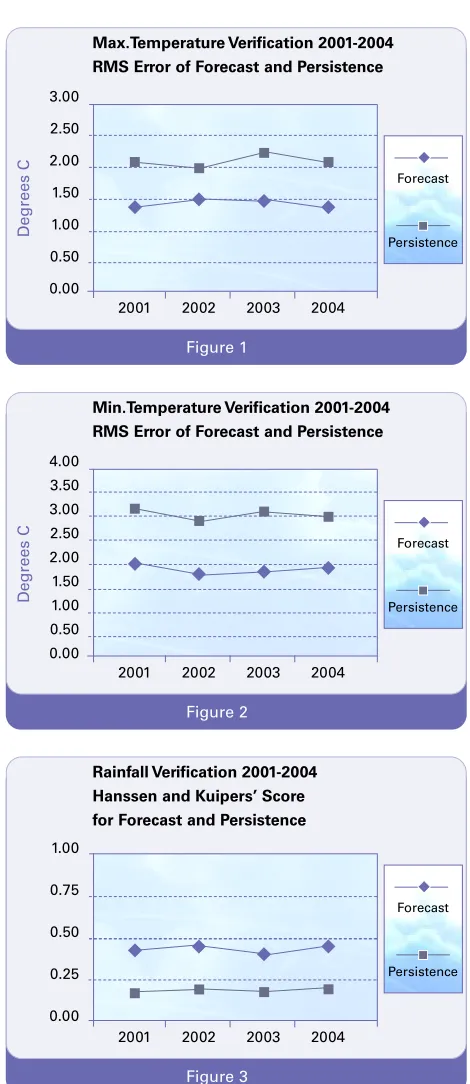
[image:26.595.301.536.192.734.2]Figures 1 and 2 show the mean annual Root Mean Square (RMS) errors for the maximum and minimum temperature forecasts for the years 2001 – 2004 (the smaller the RMS error, the better the forecast). Figure 3 shows the mean annual verification of rainfall amount by means of Hanssen and Kuipers' Score – this has a value of 1 for a perfect forecast, and zero for a random forecast, i.e. one lacking any skill. The Figures also show corresponding mean annual scores for persistence.
For 2004, the mean Root Mean Square (RMS) error for the maximum temperature forecast is about 1.4°C, and about 2.0°C for the minimum
temperature. For rainfall, the average value of the Hanssen and Kuipers' Score is 0.46. All these scores are similar to the corresponding values for
2001-2003.
An indication of the quality of the forecasts can be got by comparing the forecast scores with the values that would be obtained for a ‘standard’ forecast. Persistence is a commonly-used standard for verification purposes - i.e., a forecast that assumes that tomorrow’s weather will be the same as today’s. Figures 1 – 3 show that, as would be expected, the annual forecast scores for the years 2001-2004 are in all cases very substantially better than the persistence scores.
26
Appendix I – Forecast Accuracy
Max.Temperature Verification 2001-2004 RMS Error of Forecast and Persistence
Degrees C
3.00
2.50
2.00
1.50
1.00
0.50
0.00
2001 2002 2003 2004
Figure 1
Forecast
Persistence
Min.Temperature Verification 2001-2004 RMS Error of Forecast and Persistence
Degrees C
4.00
3.50
3.00
2.50
2.00
1.50
1.00
0.50
0.00
2001 2002 2003 2004
Figure 2
Forecast
Persistence
Rainfall Verification 2001-2004 Hanssen and Kuipers’ Score for Forecast and Persistence
1.00
0.75
0.50
0.25
0.00
2001 2002 2003 2004
Figure 3
Forecast
Numerical Weather Prediction
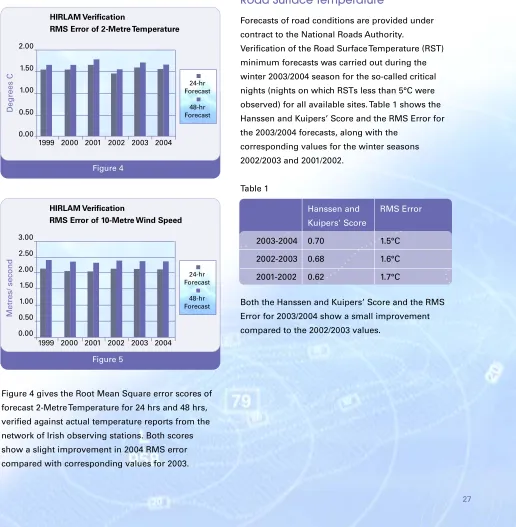
The evolution of the annual verification scores for the HIRLAM forecasts of 2-Metre Temperature and 10-Metre Wind Speed, from 1999 to 2004, is shown in Figures 4 and 5.
Figure 4 gives the Root Mean Square error scores of forecast 2-Metre Temperature for 24 hrs and 48 hrs, verified against actual temperature reports from the network of Irish observing stations. Both scores show a slight improvement in 2004 RMS error compared with corresponding values for 2003.
Figure 5 shows the Root Mean Square error scores of forecast 10-Metre Wind Speed for 24 hrs and 48 hrs. For the 24 hrs forecast the 2004 RMS error is the same as in 2003, while for the 48 hrs forecast the 2004 RMS error is marginally better.
Road Surface Temperature
Forecasts of road conditions are provided under contract to the National Roads Authority.
Verification of the Road Surface Temperature (RST) minimum forecasts was carried out during the winter 2003/2004 season for the so-called critical nights (nights on which RSTs less than 5°C were observed) for all available sites. Table 1 shows the Hanssen and Kuipers’ Score and the RMS Error for the 2003/2004 forecasts, along with the
corresponding values for the winter seasons 2002/2003 and 2001/2002.
Table 1
Both the Hanssen and Kuipers’ Score and the RMS Error for 2003/2004 show a small improvement compared to the 2002/2003 values.
27 Hanssen and RMS Error
Kuipers’ Score
2003-2004 0.70 1.5°C
2002-2003 0.68 1.6°C
2001-2002 0.62 1.7°C
HIRLAM Verification
RMS Error of 10-Metre Wind Speed
Metres/ second
3.00
2.50
2.00
1.50
1.00
0.50
0.00
1999 2000 2001 2002 2003 2004
Figure 5
24-hr Forecast
48-hr Forecast
HIRLAM Verification
RMS Error of 2-Metre Temperature
Degrees C
2.00
1.50
1.00
0.50
0.00
1999 2000 2001 2002 2003 2004
Figure 4
24-hr Forecast
[image:27.595.72.588.293.820.2]Air Temperature Forecasts
Early morning forecasts of maximum and minimum temperatures for Dublin and Cork, for the current day and the subsequent two days, are issued by General Forecasting Division. These forecasts are subsequently verified against observations at Dublin and Cork Airports.
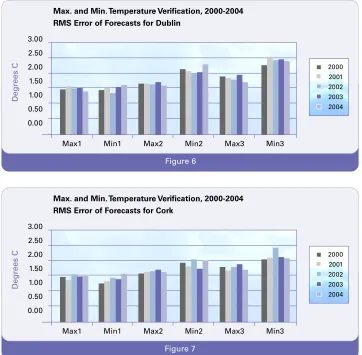
Figure 6 shows the annual RMS error scores for Dublin for the period 2000-2004 (Max1 = max. temperature on current day, Max2 = max. temperature on following day etc). Figure 7 shows the corresponding RMS error scores for Cork.
Generally speaking the 2004 RMS scores are comparable with those of 2003. The errors for Dublin show a small improvement in the maximum temperatures, while the minimum temperatures show a small disimprovement. The 2004 minimum temperatures for Cork similarly show a small disimprovement, but the errors for maximum temperatures are broadly the same as in 2003.
28
Max. and Min. Temperature Verification, 2000-2004 RMS Error of Forecasts for Dublin
Degrees C
3.00
2.50
2.00
1.50
1.00
0.50
0.00
[image:28.595.119.481.411.766.2]Max1 Min1 Max2 Min2 Max3 Min3
Figure 6
2000 2001 2002 2003 2004
Max. and Min. Temperature Verification, 2000-2004 RMS Error of Forecasts for Cork
Degrees C
3.00
2.50
2.00
1.50
1.00
0.50
0.00
Max1 Min1 Max2 Min2 Max3 Min3
Figure 7
Cushman, R. H., Dullin, H. R., Giacobbe, A., Holm, D. D., Joyeux, M., Lynch, P., Sadovskii, D. A. and Zhilinskii, B. I. 2004: The CO2 molecule as a quantum realization of the 1:1:2 resonant swing-spring with monodromy. Phys. Rev. Lett. 93, p.024302.
Keane, T. and Collins, J.F. (Editors): Climate, Weather and Irish Agriculture (2nd Edition) Dublin : AGMET, 2004.
Lynch, P. 2004: A Century of NWP: The View from Limerick. Weather 59, p331.
Lynch, P. and Houghton, C. 2004: Pulsation and Precession of the Resonant Swinging Spring. Physica D, 190, pp38-62.
McDonald, A., 2004: Transparent lateral boundary conditions for HIRLAM. The final shallow water tests and a first multi-level implementation. HIRLAM Technical Report 62, 26pp.
McDonald, A., 2004: Lateral boundary conditions for meso-scale models - some suggestions. HIRLAM Newsletter 45, pp42-48.
McDonald, A., 2004: Transparent lateral boundary conditions for baroclinic waves I: the foundations. Met Éireann Technical Note 60, 25pp.
The figures presented below are approximate and for information only. They do not form part of the official annual accounts of Met Éireann.
Income and Expenditure 2004/2003
2004 2003 2004 2003
e,000 e,000 e,000 e,000
Salaries and Related Expenses (A1) 13,992 13,619
Other Operating Expenses 2,506 2,495
Capital Expenditure 611 558
Contributions to International Organisations 2,979 2,694
Total 20,088 19,366
Receipts from Eurocontrol (Route Charges) 7,261 6,735 Receipts from Commercial & Cost Recovery Activities 1,501 1,398
Total Receipts 8,762 8,133
Net Cost of Operations 11,326 11,233
Some details of above
A1
Salaries 13,333 12,696
Overtime 489 724
Payment to Observers 109 103
Other Allowances 61 96
A2 (Travel & Subsistence) 201 245
A3 (Training/Merit Awards/Cleaning etc) 385 248
A4 (Communications & Post) 223 261
A5 (Computing Capital) 376 200
A5 (Computing Non-Capital) 536 620
A5 (Instrumentation Capital) 235 358
A5 (Instrumentation Non-Capital) 507 451
A6 (Maintenance/Energy) 604 572
A7 (Consultancy) 50 98
17,109 16,672
Some details of commercial/cost recovery receipts
Aviation 13 20
Climatological Information 172 188
General Forecasting 1,237 1,161
Miscellaneous 79 29
1,501 1,398
30
Met Éireann Headquarters
Glasnevin Hill Dublin 9, Ireland Tel: +353-1-806 4200 Fax: +353-1-806 4247 e-mail: [email protected]
web: www.met.ie
General Forecasting
Tel: +353-1-806 4255 Fax: +353-1-806 4275 e-mail:[email protected]
Climatology and Observations
Tel: +353-1-806 4260 Fax: +353-1-806 4216
e-mail:[email protected]
Commercial Division
Tel: +353-1-806 4244 Fax: +353-1-806 4247 e-mail:[email protected]
Met Éireann
Valentia Observatory
Cahirciveen Co. Kerry
Tel: +353-66-947 3460 Fax: +353-66-947 2442
Met Éireann
Dublin Airport
Co. Dublin
Tel: +353-1-812 0081 Fax: +353-1-844 4633
Met Éireann
Shannon Airport
Co Clare
Tel: +353-61-712 950 Fax: +353-61-712 962
Met Éireann
Cork Airport
Cork
Tel: +353-21-491 7750 Fax: +353-21-431 7405
Met Éireann
Connaught Airport
Knock Co. Mayo
Tel: +353-94-936 7368 Fax: +353-94-936 7390
32
AGMET Joint Working Group on Applied Agricultural Meteorology
ATOVS Advanced TIROS Operational Vertical Sounder
AWS Automatic Weather Station
BUFR Binary Universal Form for the Representation of meteorological data
C4I Community Climate Change Consortium for Ireland
CAFO Central Analysis and Forecast Office
CAIRDE Computerised Air Traffic Integrated Radar Display Equipment
DEHLG Department of the Environment, Heritage and Local Government
EARS EUMETSAT ATOVS Retransmission Service
ECMWF European Centre for Medium-Range Weather Forecasts
ECOMET European Co-operation in Meteorology
ECSN European Climate Support Network
EGOS European Group on Ocean Stations
ERTDI Environmental Research Technological Development and Innovation
EUCOS EUMETNET Composite Observing System
EUMETNET Network of European Meteorological Services
EUMETSAT European Organisation for the Exploitation of Meteorological Satellites
FIR Flight Information Region
HIRLAM High-Resolution Limited Area Model
ICAO International Civil Aviation Organisation
ICT Information and Communications Technology
INTRA Integrated Training (3rd-level work experience programme)
IT Information Technology
LAN Local Area Network
MIF Management Information Framework
MSG Meteosat Second Generation
NASA National Aeronautics and Space Administration
NOAA National Oceanic and Atmospheric Administration
NWP Numerical Weather Prediction
PMDS Performance Management and Development System
RAID Redundant Array of Independent Disks
RMDCN Regional Meteorological Data Communications Network
RMS Error Root Mean Square Error
RST Road Surface Temperature
SAF Satellite Application Facility
SBU Self-Briefing Unit
SES Single European Sky
SIGMET Information on occurrence of specified aviation weather phenomena
SMS Short Message Service
TAF Terminal Aerodrome Forecast
TUCSON The Unified Climate and Synoptic Observation Network
WAM Wave Forecast Model
WMO World Meteorological Organisation
Acknowledgements and photo credits
Gerard Hore
NASA Earth Observatory Irish Examiner
Met Éireann Staff