Deep Learning Architecture for Complex Word Identification
Dirk De Hertog ITEC, imec, KU Leuven
Ana¨ıs Tack
CENTAL, Univ. catholique de Louvain ITEC, imec, KU Leuven
F.R.S.-FNRS Research Fellow
Abstract
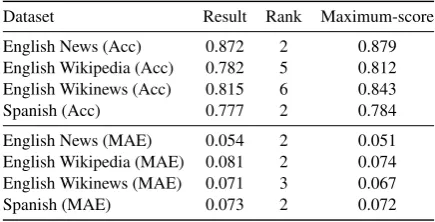
We describe a system for the CWI-task that in-cludes information on 5 aspects of the (com-plex) lexical item, namely distributional infor-mation of the item itself, morphological struc-ture, psychological measures, corpus-counts and topical information. We constructed a deep learning architecture that combines those features and apply it to the probabilistic and binary classification task for all English sets and Spanish. We achieved reasonable perfor-mance on all sets with best perforperfor-mances seen on the probabilistic task, particularly on the English news set (MAE 0.054 and F1-score of 0.872). An analysis of the results shows that reasonable performance can be achieved with a single architecture without any domain-specific tweaking of the parameter settings and that distributional features capture almost all of the information also found in hand-crafted features.
1 Introduction
In general, complex word identification (CWI) aims to identify words that are perceived as dif-ficult for a given target audience. As such, chil-dren (De Belder and Moens, 2010), foreign lan-guage learners (Paetzold and Specia, 2016c) and readers suffering from aphasia (Devlin and Tait,
1998), dyslexia (Rello et al.,2013) or autism spec-trum disorder (ˇStajner et al., 2017) will struggle with different words.
The goal of the current CWI shared task ( Yi-mam et al.,2018) is to predict which words can be difficult for a non-native speaker, based on annota-tions collected from a mixture of native and non-native speakers. The instructions for the English dataset are formulated so that the annotator marks the words he thinks are problematic for children, non-native speakers, or people with language dis-abilities.
Having such a diverse target audience requires a system that includes a variety of information at
different levels of linguistic description. We in-clude information that covers 5 aspects of the lexi-cal item at hand, namely distributional information of the item itself, morphological structure, psycho-logical measures, corpus-counts and topical infor-mation. With the exception of the psychological measures, all can be readily trained by an appro-priate neural network architecture and/or acquired from large-scale corpora.
We train a neural network to integrate said sources of information and apply it to the proba-bilistic and the binary complexity assessment for the three English datasets and the Spanish one.
2 Related Work
2.1 Complex Word Identification
The task of complex word identification has often been regarded as a critical first step for automatic lexical simplification (Shardlow, 2014). Indeed, erroneously identifying or failing to identify words as complex is likely to trigger important errors in the simplification pipeline. As a result, a grow-ing number of studies have been dedicated specif-ically to complex word identification and have fo-cused on developing accurate statistical learning methods and on collecting appropriate gold stan-dards (Paetzold and Specia,2016a;Yimam et al.,
2017a,b; ˇStajner et al.,2017)
Complex word identification has only relatively recently been framed as a machine learning (ML) problem (Zeng et al., 2005; Shardlow, 2013). Indeed, before any gold-standard datasets were made available, the early approaches to the iden-tification of complex words in a text included, on the one hand, readability measures determin-ing complex words based on word familiarity (Dale and Chall,1948) or on syllable count ( Gun-ning,1952;Mc Laughlin,1969) and, on the other hand, simplification methods which plainly con-sidered all words as complex and simplified
thing (Devlin and Tait,1998) or simplified words based on a threshold on word familiarity (Elhadad,
2006).
The SemEval-2016 shared task on complex word identification (described in detail inPaetzold and Specia, 2016a) was the first evaluation cam-paign which provided a gold-standard dataset as well as an extensive comparison of different ma-chine learning approaches for the task at hand. The submitted systems included different types of classifiers such as SVMs, random forests, maxi-mum entropy systems, ... which combined differ-ent types of features, ranging from linguistic infor-mation (on a lexical, morphological, semantic and syntactic level), over psycholinguistic measures to corpus-based information such as frequencies. The results on the shared task showed how en-semble methods (Paetzold and Specia,2016b) out-performed any other ML technique and neural ap-proaches in particular (Bingel et al.,2016). The task also showed however how a lack of anno-tation standards made it difficult for any ML-approach to model the rather inconsistent human assessment (Zampieri et al.,2017).
2.2 Deep Learning Architectures
The system we describe likewise inscribes itself in the ML-approach to CWI and draws inspira-tion from neural network literature in NLP. We adapt the architectures’ initial purposes and ap-ply it to the task at hand. Collobert et al. (2011) show how distributional information from words, called word embeddings, can be used in combina-tion with a neural network architecture to largely replace hand-crafted features for learning NLP-related tasks such as POS-tagging and NER. The embeddings capture fine-grained information cov-ering its linguistic behavior and the neural network model successfully teases out the relevant prop-erties from that representation for the given task. Character embeddings (Zhang et al.,2015;Zhang and LeCun,2015) take it one step further and also make it possible to encode and capture subword information in the modeling process.
3 Methods, Data, etc.
3.1 Data sources
The English datasets cover 3 informationally dense target domains for which to assess lex-ical complexity, namely news, Wikipedia and Wikipedia news. The Spanish dataset contains
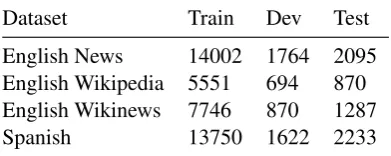
data taken from Spanish Wikipedia pages. Table 1 summarizes the number of training, development and test items for each dataset we used in the ex-periment. We combined training and development sets and used it as a single training set.
As a general domain corpus we use the COW-corpora (Sch¨afer, 2015; Sch¨afer and Bildhauer,
2012). The corpora are gathered online and cover a wide scope of topics. The English corpus con-tains well over 13 billion tokens, the Spanish one over 4 billion tokens.
We have at our disposal psychological mea-sures for English from the MRC Psycholinguistic Database (Wilson, 1988). Measures include age of acquistion, imageability, concreteness, familiar-ity and meaningfulness and covers 150837 words. The overlap between the training dataset is how-ever limited to approximately 1500 words.
[image:2.595.317.513.322.400.2]Dataset Train Dev Test English News 14002 1764 2095 English Wikipedia 5551 694 870 English Wikinews 7746 870 1287 Spanish 13750 1622 2233
Table 1: CWI training, development and test sets
3.2 Feature operationalization
Psychological measures Psychological mea-sures are used for the words found in the available dataset. Missing values were extrapolated based on findings that psychological measures correlate (inversely) to frequency. As such, less frequent words tend for instance to have a higher age of ac-quisition, and a lower imageability and concrete-ness rating. We therefore chose to respectively use third and first quartile values. In order to accom-modate the neural network architecture all values have been normalized by dividing by the maxi-mum value.
Frequency counts Frequency counts are calcu-lated from the general corpus for all experiments. To avoid skewness we perform a rank transforma-tion, with equal ranks being given the first encoun-tered rank, and normalize again by dividing by the highest rank.
Word length Word length is also determined.
initialize several of our input layers in the neural network. We use the gensim implementation of word2vec to construct a 300 dimensional embed-ding space, based on a window-size of 5 incluembed-ding words that reach a minimum frequency threshold of 20.
Character embeddings Character embeddings are trained on the train and development set of all target words. Each character is replaced by a 16-dimensional encoding which has been randomly initialized. Each word consists of a concatenation of its character representations.
3.3 Architecture
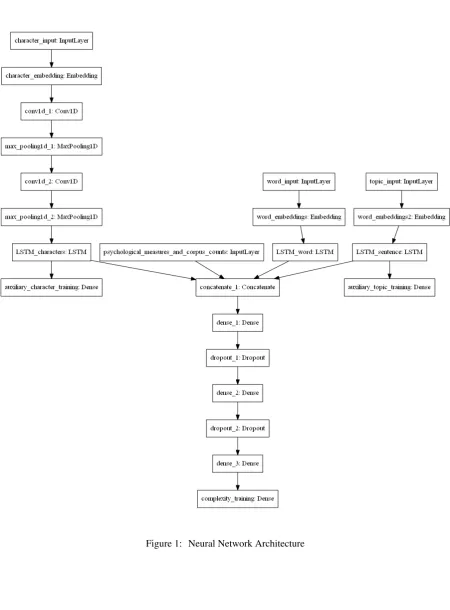
Figure 1 shows the general architecture for the CWI-task. The model has been constructed with the Keras deep learning library (Chollet et al.,
2015) with tensorflow-gpu as a backend. It in-cludes the 5 sources of information we discussed in the previous section/ which are used as features to represent information at the word and the sen-tence level. At the word level, we include engi-neered features (psychological measures, corpus-counts and word length) and distributional infor-mation (word and character embeddings). At the sentence level we concatenate embeddings to cap-ture topical information.
3.3.1 Input Layers
We include engineered features for the English dataset following the idea that they correlate with cognitive complexity. The features include psy-chological information, corpus-counts and word length. Corpus-counts measure familiarity and in-frequent words are attributed a higher degree of complexity. Word length then has been shown to be related to processing difficulties and is relevant for instance to determine which words pose prob-lems for persons with dyslexia.
Each target word is encoded by its word em-bedding, or in the case of word groups by their concatenated embeddings. The idea is that words with similar distributional patterns might have a comparable complexity. An LSTM layer with a dimensionality of 64 compacts the dimensionality of the representation.
Each target is also encoded as a sequence of its character embeddings. This input encoding is meant to capture morphological information as well as cues from letter sequences which might be perceived as difficult. The character embeddings
are trained through 2 convolutional layers (4 fil-ters, kernel size of 4, stride of 1) followed by max pooling (with a size of 2). An LSTM of size 64 is the final layer that directly encodes the character information.
The entiresentenceis encoded as a concatena-tion of word embeddings and serves as a sort of topical approximation using contextual cues. An LSTM of 128 finalizes the information captured in this layer.
3.3.2 Dense Layers
All inputs are then concatenated and run through a shallow 3 layered fully connected network (each consisting of 32 nodes) with a moderate dropout rate of 0.3. A final dense layer predicts the out-put. 2 auxiliary loss functions are provided to en-sure smooth training of the character and the topic model. We use binary cross-entropy as the loss function for the binary outcome task and mean squared error rate for the probabilistic one. We ap-plied the architecture to the English datasets and, with the exception of the psychological measures, also to the Spanish one.
4 Results
Dataset Result Rank Maximum-score English News (Acc) 0.872 2 0.879 English Wikipedia (Acc) 0.782 5 0.812 English Wikinews (Acc) 0.815 6 0.843 Spanish (Acc) 0.777 2 0.784 English News (MAE) 0.054 2 0.051 English Wikipedia (MAE) 0.081 2 0.074 English Wikinews (MAE) 0.071 3 0.067 Spanish (MAE) 0.073 2 0.072
Table 2: Results, Rank and Maximum scores for the CWI identification task
[image:3.595.308.526.429.540.2]Input Precision Non-complex Precision Complex Recall Non-complex Recall Complex
Character encoding (C) 0.876 0.757 0.839 0.809
Engineered features (E) 0.853 0.755 0.846 0.764
Word embeddings (W) 0.892 0.813 0.882 0.829
Sentences (S) 0.617 0 1 0
W + C 0.897 0.829 0.893 0.835
[image:5.595.74.528.66.162.2]W + C + E 0.902 0.825 0.888 0.845
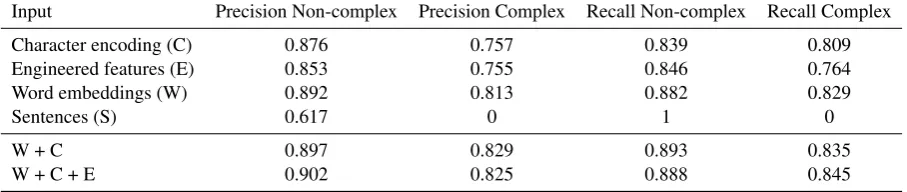
Table 3: Precision and Recall for different input layers
in the performance of the respective tasks. Using a wikipedia corpus will probably positively influ-ence the results for those particular sets. Yet, the inclusion of general corpus-information proves to be a valid alternative in lack of specialized cor-pora. The inclusion of the engineered features does not seem to affect the obtained scores much. Table 3 provides an overview of the relative contribution of each input layer to the final result for the English news dataset. The models were trained for 50 epochs. Considering each input layer separately, the word embeddings are the best estimator for the complexity task, followed closely by the character embeddings. Engineered features capture some information on the word’s complex-ity, yet not as much as the embedding layers. In-terestingly, sentence information does not outper-form the baseline.
The combination of input layers shows the rel-ative improvement that can be achieved by adding more information to the best performing input layer. The results indicate that combining in-formation only marginally improves performance. They also confirm that the engineered features in combination with the embeddings do not con-tribute much to the final score.
This leads to the following conclusions for the current dataset. First, complexity is best deter-mined by including focused information of the tar-get word itself. The inclusion of contextual, topi-cal information does not show any noticeable ad-vantage. Looking at the combination of input lay-ers, we can derive that the engineered features only add marginally different information from other input sources. This could be due to the lim-ited number of words that are actually covered by the psychological dataset, but it also implies that the information from the corpus-counts is indi-rectly captured by the embeddings and from the word length by the character encodings. It is a case in point for replacing manual feature
engineer-ing by word and character embeddengineer-ings. Based on these results we cannot conclude whether the word embeddings’ better performance over the charac-ter embeddings is due to pre-training.
5 Conclusion
Reasonable performance can be achieved with a single architecture including information from dif-ferent levels of linguistic description. Information derived from large scale corpora makes it possi-ble to include them as a starting point on which to build a general architecture that learns the ap-propriate weights for the specific problem, in our case, the CWI-task. Embeddings at the word and the character level seem to contain sufficient infor-mation to model the problem well.
Future work will include an exploration to find optimal hyperparameter settings to optimize the identification task. We will likewise explore whether pre-training the character embeddings on a larger corpus will put its performance on par with the pre-trained word embeddings. The latter would pave the way for a model with less training parameters and would significantly reduce com-plexity.
References
Joachim Bingel, Natalie Schluter, and H´ector Mart´ınez Alonso. 2016. CoastalCPH at SemEval-2016 Task 11: The importance of designing your Neural Net-works right. In Proceedings of the 10th Interna-tional Workshop on Semantic Evaluation (SemEval-2016), pages 1028–1033, San Diego, California. As-sociation for Computational Linguistics.
Franc¸ois Chollet et al. 2015. Keras. https:// keras.io.
Edgar Dale and Jeanne S. Chall. 1948. A Formula for Predicting Readability. Educational Research Bul-letin, 27(1):11–28.
Jan De Belder and Marie-Francine Moens. 2010. Text Simplification for Children. In Proceedings of the SIGIR workshop on accessible search systems, pages 19–26. ACM.
Siobhan Devlin and John Tait. 1998. The Use of a Psycholinguistic Database in the Simplification of Text for Aphasic Readers. In John Nerbonne, editor,
Linguistic Databases, number 77 in CSLI Lecture Notes, pages 161–173.
N. Elhadad. 2006. Comprehending technical texts: predicting and defining unfamiliar terms., Compre-hending Technical Texts: Predicting and Defining Unfamiliar Terms. AMIA Annual Symposium Pro-ceedings, AMIA Annual Symposium Proceedings, 2006:239, 239–243.
Robert Gunning. 1952. The Technique of Clear Writ-ing. McGraw-Hill, New York.
G. Harry Mc Laughlin. 1969. SMOG Grading—–a New Readability Formula. Journal of Reading, 12(8):639–646.
Gustavo Paetzold and Lucia Specia. 2016a. SemEval 2016 Task 11: Complex Word Identification. In
Proceedings of the 10th International Workshop on Semantic Evaluation (SemEval-2016), pages 560– 569, San Diego, California. Association for Com-putational Linguistics.
Gustavo Paetzold and Lucia Specia. 2016b. SV000gg at SemEval-2016 Task 11: Heavy Gauge Complex Word Identification with System Voting. In Pro-ceedings of the 10th International Workshop on Se-mantic Evaluation (SemEval-2016), pages 969–974, San Diego, California. Association for Computa-tional Linguistics.
Gustavo Henrique Paetzold and Lucia Specia. 2016c. Understanding the Lexical Simplification Needs of Non-Native Speakers of English. In Proceedings of COLING 2016, the 26th International Confer-ence on Computational Linguistics: Technical Pa-pers, pages 717–727, Osaka, Japan.
Luz Rello, Ricardo Baeza-Yates, Stefan Bott, and Ho-racio Saggion. 2013. Simplify or Help?: Text Simplification Strategies for People with Dyslexia. In Proceedings of the 10th International Cross-Disciplinary Conference on Web Accessibility, W4A ’13, pages 15:1–15:10, New York, NY, USA. ACM.
Roland Sch¨afer. 2015. Processing and querying large web corpora with the COW14 architecture. In Pro-ceedings of Challenges in the Management of Large Corpora 3 (CMLC-3), Lancaster. UCREL, IDS.
Roland Sch¨afer and Felix Bildhauer. 2012. Building Large Corpora from the Web Using a New Efficient
Tool ChainNo Title. InProceedings of the Eight In-ternational Conference on Language Resources and Evaluation (LREC’12), pages 486–493.
Matthew Shardlow. 2013. A Comparison of Tech-niques to Automatically Identify Complex Words. In51st Annual Meeting of the Association for Com-putational Linguistics Proceedings of the Student Research Workshop, pages 103–109, Sofia, Bul-garia. Association for Computational Linguistics.
Matthew Shardlow. 2014. Out in the Open: Finding and Categorising Errors in the Lexical Simplifica-tion Pipeline. InLREC 2014, pages 1583–1580. Eu-ropean Language Resources Association (ELRA).
Sanja ˇStajner, Victoria Yaneva, Ruslan Mitkov, and Simone Paolo Ponzetto. 2017. Effects of Lexi-cal Properties on Viewing Time per Word in Autis-tic and Neurotypical Readers. In Proceedings of the 12th Workshop on Innovative Use of NLP for Building Educational Applications, pages 271–281, Copenhagen, Denmark. Association for Computa-tional Linguistics.
Michael Wilson. 1988. MRC Psycholinguistic Database: Machine Usable Dictionary, version 2.00.
Behavior Research Methods, Instruments, & Com-puters, 20(1):6–10.
Seid Muhie Yimam, Chris Biemann, Shervin Mal-masi, Gustavo Paetzold, Lucia Specia, Sanja ˇStajner, Ana¨ıs Tack, and Marcos Zampieri. 2018. A Report on the Complex Word Identification Shared Task 2018. InProceedings of the 13th Workshop on In-novative Use of NLP for Building Educational Ap-plications, New Orleans, United States. Association for Computational Linguistics.
Seid Muhie Yimam, Sanja ˇStajner, Martin Riedl, and Chris Biemann. 2017a. CWIG3g2 - Complex Word Identification Task across Three Text Genres and Two User Groups. InProceedings of the Eighth In-ternational Joint Conference on Natural Language Processing (Volume 2: Short Papers), pages 401– 407, Taipei, Taiwan. Asian Federation of Natural Language Processing.
Seid Muhie Yimam, Sanja ˇStajner, Martin Riedl, and Chris Biemann. 2017b. Multilingual and Cross-Lingual Complex Word Identification. In Proceed-ings of Recent Advances in Natural Language Pro-cessing, pages 813–822, Varna, Bulgaria. Incoma Ltd. Shoumen, Bulgaria.
Qing Zeng, Eunjung Kim, Jon Crowell, and Tony Tse. 2005. A Text Corpora-Based Estimation of the Fa-miliarity of Health Terminology. InBiological and Medical Data Analysis, Lecture Notes in Computer Science, pages 184–192. Springer, Berlin, Heidel-berg.
Xiang Zhang and Yann LeCun. 2015. Text Under-standing from Scratch. arXiv:1502.01710 [cs]. ArXiv: 1502.01710.