Corpus of usage examples: What is it good for?
Timofey Arkhangelskiy
Universität Hamburg / Alexander von Humboldt Foundation [email protected]
Abstract
Lexicography and corpus studies of grammar have a long history of fruitful interaction. For the most part, however, this has been a one-way relationship. Lexicographers have exten-sively used corpora to identify previously un-detected word senses or find natural usage ex-amples; using lexicographic materials when conducting data-driven investigations of gram-mar, on the other hand, is hardly common-place. In this paper, I present a Beserman Ud-murt corpus made out of “artificial” dictionary examples. I argue that, although such a corpus can not be used for certain kinds of corpus-based research, it is nevertheless a very use-ful tool for writing a reference grammar of a language. This is particularly important in the case of underresourced endangered varieties, which Beserman is, because of the scarcity of available corpus data. The paper describes the process of developing the Beserman usage example corpus, explores its differences com-pared to traditional text corpora, and discusses how those can be beneficial for grammar re-search.
1 Introduction
Following a widely acknowledged idea that the language above the phonological level can be roughly split into lexicon and grammar, language documentation is divided into two interconnected subfields, lexicography and grammar studies. Cor-pora have been used since their advent in both these domains; one of the first studies of English based on the Brown corpus (Francis and Kuˇcera, 1982) contained frequency analysis for both words and parts of speech. It was recognized early on in the history of corpora that they are an excel-lent source of usage examples for both dictionar-ies and reference grammars. This gave rise to a data-driven approach to language documentation, which prescribes using only “real” examples taken
from corpora in descriptive work (Francis,1993). Corpora have become standard providers of dictio-nary examples, which can even be searched for au-tomatically (Kilgarriff et al.,2008). However, this approach can hardly be applied to underresourced endangered languages because it relies on large representative corpora, which are normally un-available for such languages. Grammatical stud-ies based on small spoken corpora with minimal help of additional elicitation are often possible and have been conducted, e.g. byKhanina (2017) for Enets or byKlumpp(2005) for Kamas. The same cannot be said about lexicography. While even small corpora are a valuable source of usage ex-amples for dictionaries, the lexicographer has to elicit examples for non-frequent or obsolete en-tries or word senses. These examples usually stay in the dictionary and are not used for any non-lexicographic research.
I argue that such elicited usage examples can be turned into a corpus, which can actually prove to be helpful for a variety of grammar studies, es-pecially in the absence of large “natural” corpora. An example of a feature that cannot be available in traditional corpora, but can appear in elicited ex-amples, is negative linguistic material. The paper describes a corpus of usage examples I developed for the documentation of Beserman Udmurt. It presents the data and the methods I used to develop the corpus. After that, its frequency characteristics are compared to those of traditional spoken cor-pora. Finally, its benefits and disadvantages for certain kinds of grammar research are discussed.
2 The data
North-Western Udmurtia, Russia. Having no official orthography, it remains almost entirely spoken. This, together with the fact that transmission to children has virtually stopped, makes it an endan-gered variety. It differs significantly from Stan-dard Udmurt in phonology, lexicon and grammar, which justifies the need for separate dictionaries and grammatical descriptions. The two existing grammatical descriptions, by Teplyashina (1970) andLyukina (2008), deal primarily with phonol-ogy and morphemics, leaving out grammatical se-mantics and syntax.
Beserman is the object of an ongoing documen-tation project, whose goal is to produce a dictio-nary and a reference grammar, accompanied by a spoken corpus. The dictionary, which nears completion, contains approximately 5500 entries, most of which have elaborate descriptions of word senses and phraseology, and illustrated with exam-ples. The annotated texts currently count about 103,000 words, which are split into two collec-tions, sound-aligned corpus (labeled further SpC) and not sound-aligned corpus.1
3 Development of the corpus
The Beserman usage example corpus (labeled fur-ther ExC) currently contains about 82,000 words in 14,000 sentences. Each usage example is aligned with its translation into Russian2and com-ments. The comments tier contains the informa-tion about the number of speakers the example was verified with, and remarks on possible mean-ings or context. The main source of examples for the corpus was the dictionary, however a small part (5% of the corpus) comes from grammati-cal questionnaires. The dictionary examples were collected using several different techniques. First, there are translations from Russian (often modi-fied by the speakers in order to be more informa-tive and better describe their culture). Second, many examples were generated by the speakers themselves, who were trained to do so by the lin-guists. Finally, some of the examples were
pro-1
Both the dictionary in its current version and the cor-pora are publicly accessible at http://beserman.ru
and http://multimedia-corpus.beserman.ru/ search.
2
Since the native speakers, including heritage speakers, are the primary target audience of the dictionary, and they are bilingual in Russian, the examples are translated into Rus-sian. Translation of the dictionary into English has started re-cently, but no English translations of examples are available at the moment.
duced by the linguists (none of who is a native Beserman speaker) and subsequently checked and corrected by the speakers. The development of the corpus included filtering and converting the source data, performing automatic morphological annota-tion, and indexing in a corpus platform with a web interface.
3.1 Data preparation
The dictionary is stored in a database created by the TLex dictionary editor, which allows export of the data to XML. The XML version of the dictio-nary was used as the source file for filtering and conversion.
The filtering included three steps. First, the Be-serman dictionary contains examples taken from the spoken corpus. Such examples had to be fil-tered out to avoid duplicate representation of the same data in the two corpora. Identifying such examples might be challenging because they are not consistently marked in the dictionary database, and because some of them were slightly changed (e.g. punctuation was added or personal data was removed). To find usage examples that come from the spoken corpus, each of them was compared to the sentences of the corpus. Before the com-parison, all sentences were transformed to lower-case, and all whitespaces were removed. If no ex-act matches were found, the Levenshtein distance to the corpus sentences of comparable length was measured. The cut-off parameters were obtained empirically to achieve a balance between preci-sion and recall. If a corpus sentence with a dis-tance ofmax(2, len/8)was found, wherelenis the length of the example in question, the exam-ple was discarded. Additionally, the “comment” field was checked. The example was discarded if it contained an explicit indication that it had been taken from a text.
Second part of the filtering involved deduplica-tion of examples. Deduplicadeduplica-tion was necessary because some usage examples appeared in multi-ple entries. In this case, their versions could have minor differences as well, e.g. because of typo corrections that were made in only one of them. Two sentences were considered identical if both their lowercase versions and their lowercase trans-lations had the Damerau–Levenshtein distance not greater thanlen/10.
have not been proofread or have not passed suf-ficient verification, which means checking with three speakers, as a rule. The goal of the third step of filtering was to include in the corpus only reli-able examples that do not require additional ver-ification. This was done using a combination of comments and available metadata. The examples from the sections that have been entirely proofread for publishing were all included. Examples from other sections were only included if they had indi-cation in the comment that they have been checked with at least two speakers. This excluded a consid-erable number of examples from the verbal part of the dictionary, which is under construction now. The total share of examples that come from the verbal part is currently just above 9%, despite the fact that verbal examples in the dictionary actually outnumber examples from all other parts taken to-gether. As a consequence, the total size of the corpus is likely to increase significantly after the verbal part has been finalized, probably reaching 150,000 words.
An important difference between a traditional corpus and a collection of usage examples is that the latter may contain negative examples, i.e. sen-tences which are considered ungrammatical by the speakers. About 9.5% of sentences in the Be-serman corpus of usage examples contain nega-tive material. Following linguistic tradition, the sentences or ungrammatical parts of sentences are marked with asterisks. Other gradations of gram-matical acceptability include ∗? (ungrammatical for most speakers) and??(marginal / ungrammat-ical for many speakers). Negative examples are identified by the converter based on the presence of such marks in their texts and by the metadata.
The resulting examples are stored as tab-delimited plain text files. Each file contains exam-ples from one dictionary entry or one grammatical questionnaire; positive and negative examples are kept in separate files. Each example is stored on a separate line and contains the original text, its Russian translation, and comments. Additionally, all filenames are listed in a tab-delimited file to-gether with their metadata.
3.2 Morphological annotation
A workflow used in the Beserman documenta-tion project prior to 2017 involved transcripdocumenta-tion of recordings for the spoken corpus in a simple text editor and manual annotation in SIL FLEX. That
workflow was abandoned, mainly because manual annotation required too much resources, given the amount of recorded data that had to be processed. The new workflow comprises transcription, trans-lation and alignment of recordings in ELAN, sub-sequent automatic morphological annotation and automatic disambiguation. Such an approach has been demonstrated to be well suited for process-ing spoken corpora of comparable size by Gersten-berger et al.(2017).
Developing a rule-based morphological ana-lyzer would be a time-consuming task in itself, which is why Waldenfels et al. (2014) and Ger-stenberger et al.(2017) advocate for transcribing in standard orthography and applying an analyzer for the standardized variety of the language. The Beserman case is different though because there already exists a digital dictionary. Using the dic-tionary XML as a source, I was able to produce a grammatical dictionary with the description of lemmata and inflection types. The dictionary was manually enhanced with additional information relevant for disambiguation, such as animacy for nouns or transitivity for verbs. Apart from that, several dozen frequent Russian borrowings, absent from the dictionary, were added to the list. Cou-pled with a formalized description of morphology, which I compiled manually, it became the basis for the automatic Beserman morphological analyzer. This analyzer is used for processing both new tran-scriptions in ELAN and usage examples.
3.3 Indexing
The annotated texts are uploaded to a server and indexed, after which they are available for search through a web interface using an open-source Tsakoprus corpus platform.3 The interface al-lows making simple and multiword queries. The queries may include constraints on word, lemma, part of speech, morphological tags, glosses, or any combinations. In word and lemma search, wild-cards and regular expressions are available. The search can produce a list of sentences or a list of words that conform to the query, together with some statistical data. The Russian translations are also morphologically analyzed and searchable. The interface is available in English and Russian, and several transliteration options are available for displaying the texts.
4 Differences from spoken corpora
For comparison, I will use the sound-aligned part of the Beserman spoken corpus (SpC), which was morphologically annotated and indexed the same way the Corpus of usage examples (ExC) was pro-cessed. At the moment, it contains about 38,000 words in monologues, natural dialogues and dia-logues recorded during referential communication experiments. To account for the difference in size, all frequencies will be presented in items per mil-lion (ipm).
Two obvious factors make ExC quite different from SpC frequency-wise. First, the former con-tains comparable amount of usage examples for both frequent and non-frequent words. As a con-sequence, it has a different frequency distribution of words and lemmata. Its lexical diversity, mea-sured as overall type/token ratio, is visibly higher than that of SpC (0.224 vs. 0.179), despite the fact that it is more than twice as large.
Second, elicited examples constitute a genre very different from natural narratives and dia-logues. For example, they contain a much smaller number of discourse particles or personal pro-nouns. Table1demonstrates how different the fre-quencies of certain lexical classes are in the two corpora.
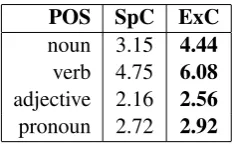
Additionally, there are more different forms at-tested for a single lemma on average in ExC than in SpC (Table 2). Although unequal size of the corpora being compared could play a role here, the
3https://bitbucket.org/tsakorpus/
tsakonian_corpus_platform/src
POS / Lexical class SpC ExC
noun 206K 400K
verb 213K 289K
adjective 52K 68K
[image:4.595.327.505.61.148.2]pronoun 177K 123K discourse ptcl. 72K 22K
Table 1: Frequencies (in ipm) of certain parts of speech and lexical classes in SpC and ExC.
POS SpC ExC
noun 3.15 4.44
verb 4.75 6.08
adjective 2.16 2.56
pronoun 2.72 2.92
Table 2: Average number of different forms per lemma for certain parts of speech in SpC and ExC.
difference could be explained at least in part by the fact that the lexicographers had a goal of providing each word with a handful of examples containing that word in different forms and in different syn-tactic positions.
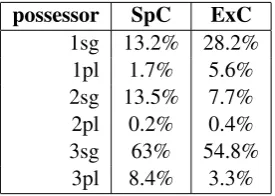
However, the analysis of value distributions of individual grammatical categories within a given part of speech reveals that they are usually not drastically different in the two corpora. Let us take nouns as an example. Nominal categories in Udmurt are case, number and possessiveness. Ta-ble34 shows the distribution of case forms in the two corpora (all 8 spatial cases were collated in the last row). Table 4 shows the distribution of number forms. Table5 shows the distribution of possessive suffixes.5
Case and number distributions only have mi-nor differences in SpC and ExC. Moreover, an analysis of combinations of case and number suf-fixes shows that the distributions of their combi-nations also look very much alike. Possessiveness presents a somewhat different picture. Although not entirely different from SpC, the distribution in ExC shows lower figures for 2sg, 3pl, and es-pecially 3sg, and higher ones for the first person possessors. Lower numbers for 3sg and 2sg have a straightforward explanation. Apart from being
4The numbers in each column add up to slightly more than 100% because of the remaining ambiguity.
[image:4.595.358.475.194.267.2]case SpC ExC
nominative / unmarked 60% 65.7% accusative (marked) 4.7% 9.9%
[image:5.595.342.490.61.118.2]dative 2% 1.2% genitive 1.8% 2.2% 2ndgenitive (ablative) 0.74% 1.6% instrumental 7% 4.7% caritive 0.025% 0.024% adverbial 0.25% 0.13% all spatial cases 24.6% 20%
Table 3: Share of different case forms for nouns in SpC and ExC.
number SpC ExC
[image:5.595.78.286.62.199.2]sg 94.6% 92.7% pl 5.4% 7.3%
Table 4: Share of different number forms for nouns in SpC and ExC.
possessor SpC ExC
1sg 13.2% 28.2% 1pl 1.7% 5.6% 2sg 13.5% 7.7% 2pl 0.2% 0.4% 3sg 63% 54.8%
3pl 8.4% 3.3%
Table 5: Share of different possessive forms for possessive-marked nouns in SpC and ExC.
used in the direct, possessive sense, these partic-ular suffixes have a range of “discourse”, non-possessive functions. This is also true for Stan-dard Udmurt (Winkler,2001) and other Uralic lan-guages (Simonenko, 2014). The 3sg possessive marks, among other things, contrastive topics and semi-activated topics that have to be reactivated in the discourse. The 2sg possessive is also used with non-possessive meanings, although less of-ten, only in dialogues and in other contexts than the 3sg. Its primary discourse function is mark-ing a new referent that is located physically or metaphorically in the domain of the addressee. Example1, taken from a dialogue, shows both suf-fixes in non-possessive functions:
(1) Vaj bring.IMP
so-ize=no
that-P.3SG.ACC=ADD
goz“@-de! rope-P.2SG.ACC
‘Bring me that rope as well!’
tense SpC ExC
[image:5.595.116.245.248.291.2]present 43.8% 39.4% past (direct) 30% 43.2% future 26.2% 17.4%
Table 6: Share of different tense forms for finite verbs in SpC and ExC.
The 3sg possessive on “that” marks contrast: another rope was discussed earlier in the conver-sation. The 2sg possessive on “rope” indicates that this particular rope has not been mentioned in the previous discourse and should be identified by the addressee. The rope is located next to the ad-dressee. That the direct possessive sense is ruled out here follows from the fact that the whole di-alogue happens on the speaker’s property, so the rope belongs to him, rather than to the addressee. Such “discourse” use of the possessives in elicited examples is quite rare because they normally re-quire a wider context to appear. A possible ex-planation for the lower 3pl figure in ExC is that it is often used when the plural possessor was men-tioned earlier and is recoverable from the context. A quick look at the distribution of verbal tenses in Table66 shows a picture similar to that of the possessives. The distributions are not wildly dif-ferent, but the past tense is clearly more frequent in ExC. This is expected because a lot of usage ex-amples, especially for obsolete words, contain in-formation about cultural practices connected to the item being described that are no longer followed. In this respect, the tense distribution in ExC re-sembles the one in the narratives, which usually describe past events.
5 Fitness for grammar studies
The way a corpus of usage examples is differ-ent from traditional corpora makes it unfit for some kinds of linguistic research. It cannot be used in any study that looks into long-range dis-course effects, requires a context or a conver-sation involving several participants. This in-cludes, for example, studies of discourse parti-cles, use of anaphoric pronouns, or information structure (topic/comment; given/new information, etc.). Similarly, it is useless for studies that rely on
[image:5.595.113.251.338.436.2]word or lemma frequency counts, or on type/token ratios, as those may differ significantly from tradi-tional corpora.
All downsides listed above are quite pre-dictable; in fact, it was hardly necessary to build a corpus of usage examples to arrive at those con-clusions. Whether such a corpus could be of any value in other kinds of linguistic research, is a less trivial question. The observations in Section 4 suggest that the answer to that question is posi-tive. While the Beserman corpus of usage exam-ples differs from the spoken corpus in the places where it could be predicted to differ, it is remark-able how statistically similar the two corpora are in all other respects. The relative frequencies of grammatical forms are only different (although not extremely different) if these forms convey deic-tic or discourse-related meanings. In other cases, the forms have very similar distributions. This means that corpora of examples in principle can be used in linguistic research that involves com-paring frequencies of certain grammatical forms or constructions, with necessary precautions.
Only research that involves comparing fre-quency counts or distributions of linguistic phe-nomena has been discussed so far. A lot of gram-mar studies, however, only or prigram-marily need the information about (un)grammaticality or produc-tivity of a certain phenomenon. It turns out that a corpus of usage examples could be actually su-perior to a traditional corpus of a comparable size for such studies. The reason for that is higher lex-ical diversity and more uniform frequency distri-bution of lemmata. This means that for any form or construction being studied, the researcher will see more differentcontexts involving it than in a traditional corpus, on average.
Let us take the approximative case as an exam-ple. This case, which has the marker-la´nin all Ud-murt varieties where it exists, marks the Ground in the approximate direction of which the Figure is moving. Although it is claimed to exist in liter-ary Udmurt by all existing grammars, corpus stud-ies reveal that it only functions as an unproduc-tive derivational suffix compatible with a handful of nominal, pronominal and adjectival stems. To learn whether it can be considered a productive case suffix in Beserman, its compatibility with a wider range of nouns should be established.
The approximative has similar relative frequen-cies in ExC and SpC: 1858 ipm and 1750 ipm,
re-spectively. In both corpora, the approximative was not a primary focus of investigation. The number of different contexts it is encountered in, however, is much higher in ExC. In SpC, there are 16 dif-ferent types that contain an approximative suffix, featuring 10 different stems. Only one of those stems (ul´ca ‘street’) does not attach the deriva-tional approximative suffix in Standard Udmurt. This is definitely insufficient to establish its pro-ductiveness in Beserman. ExC, however, contains 32 different types that belong to 25 different stems. Such a difference can hardly be ascribed to the larger size of ExC because the number of differ-ent types is expected to have slower-than-linear growth with respect to the corpus size, and the type/stem ratio is expected to go up rather than down. Out of these stems, at least 5 are incompat-ible with the approximative in Standard Udmurt, including reka ‘river’, korka ‘house’ and šund“@
‘sun’.7 Another 5 come from negative examples that highlight the incompatibility of the approxi-mative with certain inflected postpositions (rela-tional nouns). All this proves that it is most prob-ably a productive suffix, while outlining the limits of its productivity.
Comparison of the figures for the recessive suf-fix, which also was not the focus of investigation in either corpus, yields similar results. The reces-sive case, with a marker -la´sen, is the semantic opposite of the approximative and does not exist in the literary language even as a derivational suf-fix. In SpC, there are 7 different types that contain it. All of them have different lemmata, but again, only one of the types (k@tla´sen‘from the side of the belly’) suggests that they might not constitute a closed set of denominal adverbs. By contrast, ExC has 26 different types, containing 26 different stems, 4 out of which come from negative exam-ples.
The skewed distribution of parts of speech could be beneficial too. For example, there is a con-struction in Udmurt that involves juxtaposition of an unmarked nominal stem to another noun, e.g. t’ir n“@d‘axe handle’. It exists in other Uralic lan-guages and has been analyzed as compounding by Fejes(2005). However, its productivity, allowed
7
possessive relations and constraints on the depen-dent noun (animacy, referential status, etc.) vary significantly across Uralic languages and dialects. A detailed investigation of that construction would therefore require looking at a large number of in-stances featuring a variety of dependent nouns. A search for such a construction yields 77 dif-ferent dependent nouns in SpC (total frequency 7525 ipm) and 449 different nouns in ExC (total frequency 25132 ipm).8 In this case, the
tremen-dous increase in numbers stems from the increased share of nouns in ExC, rather than from an in-creased lexical diversity. Nouns are almost twice as likely to appear in ExC than in SpC. There-fore meeting a sequence of two nouns would be almost 4 times higher if they were generated inde-pendently. The independence condition does not hold for words in a sentence, of course, but the ob-served factor of 3.34 is still large enough to make the corpus of examples a more attractive tool for studying the juxtaposition construction.
Research questions that arise when writing a reference grammar mostly belong to the type dis-cussed above. Concise description of morpholog-ical and syntactic properties of an affix or a con-struction mostly require looking at a range of di-verse examples to determine their productivity and constraints. The three case studies above show that this is exactly the situation where a corpus of usage examples could outperform a similarly sized spoken corpus.
Apart from the aforementioned considerations, which would probably be valid for a corpus based on any comprehensive dictionary, there are spe-cific features of the Beserman usage example corpus that may become beneficial for research. Most importantly, it contains elicited examples from grammatical questionnaires, both positive and negative. Although their share is too small to reach any conclusions about their usefulness at the moment, this could be a first step to the reuse of elicited data in subsequent research. Currently, data collected through questionnaires is virtually always used only once. At best, the examples are archived to support the analysis based on them and ensure that the findings are reproducible; at worst, they are discarded and forgotten. Of course, each questionnaire is tailored to the particular research question of its author. However, it is probable that
8To avoid as much ambiguity as possible without manual filtering, the search was narrowed down to unambiguously annotated tokens.
if the corpus is large enough, it will contain exam-ples that could prove useful for the research ques-tions other than their author had in mind. Presence of negative material could partially reduce the gen-eral aversion to corpora that the linguists working in the generative paradigm tend to have. Availabil-ity of such corpora for multiple languages will also facilitate typologically oriented research on syn-tax, which otherwise relies on manual work with reference grammars and other secondary sources.
Finally, the Beserman corpus of usage exam-ples, as well as any corpus based on a bilingual dictionary, is in essence a parallel corpus. This could be used for both linguistic needs (see e.g. Volk et al.(2014) for the list of possibilities) and for developing or evaluating machine translation systems.
6 Conclusion
Having a comprehensive dictionary in a machine-readable form and a morphological analyzer al-lows one to create a corpus of usage examples rather quickly. Its size could be comparable to those of large spoken corpora, which tend to have a maximum of 150,000 tokens for unwritten en-dangered languages. Even if a spoken corpus is available, this is a significant addition. Some-times, however, dictionary examples could be the only large source of linguistic data, e.g. in the case of extinct languages. It is therefore impor-tant to know how the data of usage examples cor-responds to that of spoken texts, and for what kind of linguistic research they are suitable. An analy-sis of the Beserman corpus of usage examples re-veals that it can actually be used as a reliable tool in a wide range of research on grammar. Obvious limitations prevent its use in studies that involve word and lemma counts, discourse or information structure. However, outside of these areas, usage examples are quite similar to natural texts, which justifies use of such corpora. Increased lexical di-versity and more uniform word distributions make corpora of usage examples even more useful for some kinds of research than traditional corpora of similar size. Finally, such corpora can addition-ally contain data from questionnaires and negative material, which could facilitate their reuse.
Acknowledgements
Ud-murt and especially to Maria Usacheva. This re-search would have not been possible without their prolonged lexicographic work.
References
Eckhard Bick and Tino Didriksen. 2015. CG–3 - Be-yond Classical Constraint Grammar. In Proceed-ings of the 20th Nordic Conference of Computa-tional Linguistics (NODALIDA 2015), pages 31–39. Linköping University Electronic Press.
László Fejes. 2005. Összetett szavak finnugor nyelvek-ben [Compound words in Finno-Ugric languages]. PhD, Eötvös Loránd Tudományegyetem, Budapest.
Gill Francis. 1993. A corpus-driven approach to gram-mar: Principles, methods and examples. In Mona Baker, Gill Francis, and Elena Tognini-Bonelli, ed-itors, Text and technology: In honour of John Sin-clair, pages 137–156. John Benjamins, Amsterdam & Philadelphia.
W. Nelson Francis and Henry Kuˇcera. 1982. Frequency Analysis of English Usage: Lexicon and Grammar. Houghton Mifflin, Boston.
Ciprian Gerstenberger, Niko Partanen, and Michael Rießler. 2017. Instant annotations in ELAN cor-pora of spoken and written Komi, an endangered language of the Barents Sea region. InProceedings of the 2nd Workshop on the Use of Computational Methods in the Study of Endangered Languages, pages 57–66. Association for Computational Lin-guistics.
Valentin Kelmakov. 1998. Kratkij kurs udmurtskoj di-alektologii [Brief course of Udmurt dialectology]. Izdatel’stvo Udmurtskogo Universiteta, Izhevsk.
Olesya Khanina. 2017. Digital resources for Enets: A descriptive linguist’s view. Acta Linguistica Aca-demica, 64(3):417–433.
Adam Kilgarriff, Miloš Husák, Katy McAdam, Michael Rundell, and Pave Rychlý. 2008. GDEX: Automatically finding good dictionary examples in a corpus. InProceedings of the XIII EURALEX In-ternational Congress, pages 425–432, Barcelona.
Gerson Klumpp. 2005. Aspect markers grammatical-ized from verbs in Kamas. Acta Linguistica Hun-garica, 52(4):397–409.
Nadezhda Lyukina. 2008.Osobennosti jazyka balezin-skix i jukamenbalezin-skix besermjan [The peculiarities of the language of Balezino and Yukamenskoye Beser-mans]. PhD, Udmurt State University, Izhevsk.
Aleksandra Simonenko. 2014. Microvariation in Finno-Ugric possessive markers. InProceedings of the Forty-Third Annual Meeting of the North East Linguistic Society (NELS 43), volume 2, pages 127– 140.
Tamara Teplyashina. 1970. Jazyk besermjan [The lan-guage of the Beserman]. Nauka, Moscow.
Martin Volk, Johannes Graën, and Elena Callegaro. 2014. Innovations in Parallel Corpus Search Tools. InLREC 2014 Proceedings, pages 3172–3178.
Ruprecht von Waldenfels, Michael Daniel, and Nina Dobrushina. 2014. Why standard orthography? Building the Ustya River Basin corpus, an online corpus of a Russian dialect. InComputational Lin-guistics and Intellectual Technologies. Papers from the Annual International Conference "Dialogue", volume 13, pages 720–728.