SimCompass: Using Deep Learning Word Embeddings
to Assess Cross-level Similarity
Carmen Banea, Di Chen, Rada Mihalcea∗ University of Michigan
Ann Arbor, MI
Claire Cardie
Cornell University Ithaca, NY
Janyce Wiebe
University of Pittsburgh Pittsburgh, PA
Abstract
This article presents our team’s partici-pating system at SemEval-2014 Task 3. Using a meta-learning framework, we experiment with traditional knowledge-based metrics, as well as novel corpus-based measures corpus-based on deep learning paradigms, paired with varying degrees of context expansion. The framework en-abled us to reach the highest overall per-formance among all competing systems.
1 Introduction
Semantic textual similarity is one of the key components behind a multitude of natural lan-guage processing applications, such as informa-tion retrieval (Salton and Lesk, 1971), relevance feedback and text classification (Rocchio, 1971), word sense disambiguation (Lesk, 1986; Schutze, 1998), summarization (Salton et al., 1997; Lin and Hovy, 2003), automatic evaluation of machine translation (Papineni et al., 2002), plagiarism de-tection (Nawab et al., 2011), and more.
To date, semantic similarity research has pri-marily focused on comparing text snippets of simi-lar length (see the semantic textual simisimi-larity tasks organized during*Sem 2013(Agirre et al., 2013) and SemEval 2012 (Agirre et al., 2012)). Yet, as new challenges emerge, such as augmenting a knowledge-base with textual evidence, assessing similarity across different context granularities is gaining traction. The SemEval Cross-level seman-tic similarity task is aimed at this latter scenario, and is described in more details in the task paper (Jurgens et al., 2014).
∗{carmennb,chenditc,mihalcea}@umich.edu
This work is licensed under a Creative Commons At-tribution 4.0 International Licence. Page numbers and pro-ceedings footer are added by the organisers. Licence details: http://creativecommons.org/licenses/by/4.0/
2 Related Work
Over the past years, the research community has focused on computing semantic relatedness us-ing methods that are either knowledge-based or corpus-based. Knowledge-based methods derive a measure of relatedness by utilizing lexical re-sources and ontologies such as WordNet (Miller, 1995) or Roget (Rog, 1995) to measure defi-nitional overlap, term distance within a graph-ical taxonomy, or term depth in the taxonomy as a measure of specificity. There are many knowledge-based measures that were proposed in the past, e.g., (Leacock and Chodorow, 1998; Lesk, 1986; Resnik, 1995; Jiang and Conrath, 1997; Lin, 1998; Jarmasz and Szpakowicz, 2003; Hughes and Ramage, 2007).
On the other side, corpus-based measures such as Latent Semantic Analysis (LSA) (Landauer and Dumais, 1997), Explicit Semantic Analy-sis (ESA) (Gabrilovich and Markovitch, 2007), Salient Semantic Analysis (SSA) (Hassan and Mihalcea, 2011), Pointwise Mutual Informa-tion (PMI) (Church and Hanks, 1990), PMI-IR (Turney, 2001), Second Order PMI (Islam and Inkpen, 2006), Hyperspace Analogues to Lan-guage (Burgess et al., 1998) and distributional similarity (Lin, 1998) employ probabilistic ap-proaches to decode the semantics of words. They consist of unsupervised methods that utilize the contextual information and patterns observed in raw text to build semantic profiles of words. Un-like knowledge-based methods, which suffer from limited coverage, corpus-based measures are able to induce the similarity between any two words, as long as they appear in the corpus used for training.
3 System Description 3.1 Generic Features
Our system employs both knowledge and corpus-based measures as detailed below.
Knowledge-based features
Knowledge-based metrics were shown to provide high correlation scores with the goldstandard in text similarity tasks (Agirre et al., 2012; Agirre et al., 2013). We used three WordNet-based simi-larity measures that employ information content. We chose these metrics because they are able to incorporate external information derived from a large corpus: Resnik (Resnik, 1995) (RES), Lin (Lin, 1998) (LIN), and Jiang & Conrath (Jiang and Conrath, 1997) (JCN).
Corpus based features
Our corpus based features are derived from a deep learning vector space model that is able to “understand” word meaning without human in-put. Distributed word embeddings are learned us-ing a skip-gram recurrent neural net architecture running over a large raw corpus (Mikolov et al., 2013b; Mikolov et al., 2013a). A primary advan-tage of such a model is that, by breaking away from the typical n-gram model that sees individual units with no relationship to each other, it is able to generalize and produce word vectors that are simi-lar for related words, thus encoding linguistic reg-ularities and patterns (Mikolov et al., 2013b). For example, vec(Madrid)-vec(Spain)+vec(France) is closer to vec(Paris) than any other word vec-tor (Mikolov et al., 2013a). We used the pre-trained Google News word2vec model (W T V) built over a 100 billion words corpus, and con-taining 3 million 300-dimension vectors for words and phrases. The model is distributed with the word2vec toolkit.1
Since the methods outlined above provide similar-ity scores at the sense or word level, we derive text level metrics by employing two methods.
VectorSum. We add the vectors corresponding to
the non-stopwords tokens in bag of words (BOW)
AandB, resulting in vectorsVAandVB,
respec-tively. The assumption is that these vectors are able to capture the semantic meaning associated with the contexts, enabling us to gauge their relat-edness using cosine similarity.
Align. Given two BOW A and B as input, we
compare them using a word-alignment-based sim-ilarity measure (Mihalcea et al., 2006). We calcu-late the pairwise similarity between the words in A and B, and match each word in A with its most similar counterpart in B. For corpus-based
fea-1https://code.google.com/p/word2vec/
tures, the similarity measure represents the aver-age over these scores, while for knowledge-based measures, we consider the top 40% ranking pairs. We use the DKPro Similarity package (B¨ar et al., 2013) to compute knowledge-based metrics, and the word2vec implementation from the Gen-sim toolkit (Rehurek and Sojka, 2010).
3.2 Feature Variations
Since our system participated in all four lexical levels evaluations, we describe below the modifi-cations pertaining to each.
word2sense. At the word2sense level, we em-ploy both knowledge and corpus-based features. Since the information available in each pair is ex-tremely limited (only a word and a sense key) we infuse contextual information by drawing on WordNet (Miller, 1995). In WordNet, the sense of each word is encapsulated in a uniquely iden-tifiable synset, consisting of the definition (gloss), usage examples and its synonyms. We can derive three variations (where the wordand sense com-ponents are represented by BOW A and B, respec-tively):a) no expansion(A={word}, B={sense}),
b) expand right (R)(A={word}, B={sensegloss & example}), c) expand left (L) & right (R)
(A={wordglosses & examples}, B={sense gloss & example}). After applying the Align method, we obtain measures JNC, LIN, RES and
W T V1; VectorSum results inW T V2.
phrase2word. As this lexical level also suf-fers from low context, we adapt the above vari-ations, where the phrase and word components are represented by BOW A and BOW B, re-spectively. Thus, we have: a) no expan-sion (A={phrase}, B={word}), b) expand R
(A={phrase}, B={word glosses and examples}),
c) expand L & R (A={phrase glosses & exam-ples}, B={word glosses and examples}). We ex-tract the same measures as forword2sense.
sentence2phrase. For this variation, we use only corpus based measures; BOW A represents the
sentencecomponent, B, thephrase. Since there is sufficient context available, we follow theno ex-pansionvariation, and obtain metricsW T V1(by applying Align) andW T V2(using VectorSum).
a) no clustering. We use only corpus based mea-sures, where the paragraph represents BOW A, and thesentencerepresents BOW B. Then we ap-ply Align and VectorSum, resulting inW T V1and
W T V2, respectively.
b) paragraph centroids extraction. Since the longer text contains more information compared to the shorter one, we extractktopic vectors after K-means clustering the left context.2 These cen-troids are able to model topics permeating across sentences, and by comparing them with the word vectors pertaining to the short text, we seek to cap-ture how much of the information is covered in the shorter text. Each word is paired with the centroid that it is closest to, and the average is computed over these scores, resulting inW T V3.
c) sentence centroids extraction. Under a dif-ferent scenario, assuming that one sentence cov-ers only a few strongly expressed topics, unlike a paragraph that may digress and introduce unre-lated noise, we apply clustering on the short text. The centroids thus obtained are able to capture the essence of the sentence, so when compared to every word in the paragraph, we can gauge how much of the short text is reflected in the longer one. Each centroid is paired with the word that it is most similar to, and we average these scores, thus obtaining W T V4. In a way, methods b) and c) provide a macro, respectively micro view of how the topics are reflected across the two spans of text.
3.3 Meta-learning
The measures of similarity described above pro-vide a single score per each long text- short text
pair in the training and test data. These scores then become features for a meta-learner, which is able to optimize their impact on the prediction process. We experimented with multiple regression algo-rithms by conducting 10 fold cross-validation on the training data. The strongest performer across all lexical levels was Gaussian processes with a radial basis function (RBF) kernel. Gaussian pro-cesses regression is an efficient probabilistic pre-diction framework that assumes a Gaussian pro-cess prior on the unobservable (latent) functions and a likelihood function that accounts for noise. An individual classifier3was trained for each lex-ical level and applied to the test data sets.
2Implementation provided in the Scikit library (Pedregosa et al., 2011), wherekis set to 3.
3Implementation available in the WEKA machine learn-ing software (Hall et al., 2009) uslearn-ing the default parameters.
4 Evaluations & Discussion
Our system participated in all cross-level subtasks under the nameSimCompass, competing with 37 other systems developed by 20 teams.
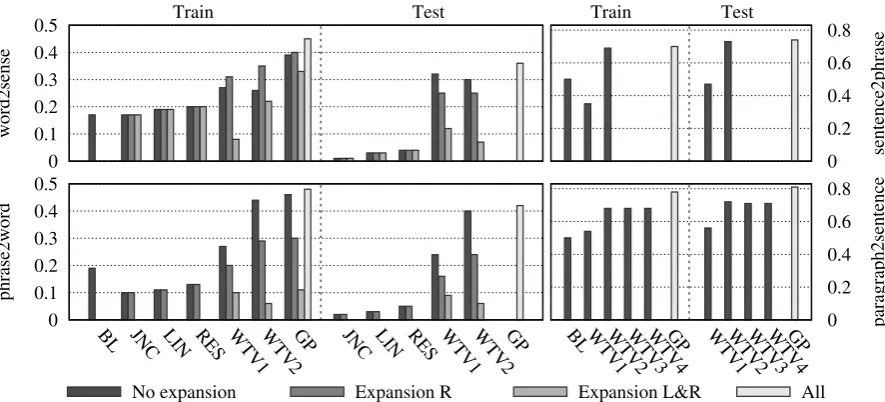
Figure 1 highlights the Pearson correlations at the four lexical levels between the gold standard and each similarity measure introduced in Section 3, as well as the predictions ensuing as a result of meta-learning. The left and right histograms in each subfigure present the scores obtained on the train and test data, respectively.
In the case of word2sense train data, we no-tice that expanding the context provides additional information and improves the correlation results. For corpus-based measures, the correlations are stronger when the expansion involves only the right side of the tuple, namely the sense. We notice an increase of 0.04 correlation points for WTV1 and 0.09 for WTV2. As soon as theword
is expanded as well, the context incorporates too much noise, and the correlation levels drop. In the case of knowledge-based measures, expanding the context does not seem to impact the results. However, these trends do not carry out to the test data, where the corpus-based features without ex-pansion reach a correlation higher than 0.3, while the knowledge-based features score significantly lower (by 0.16). Once all these measures are used as features in a meta learner (All) using Gaus-sian processes regression (GP), the correlation in-creases over the level attained by the best perform-ing individual feature, reachperform-ing 0.45 on the train data and 0.36 on the test data. SimCompass ranks second in this subtask’s evaluations, falling short of the leading system by 0.025 correlation points.
0 0.1 0.2 0.3 0.4 0.5
word2sense
Train Test
0 0.1 0.2 0.3 0.4 0.5
BL JNC LIN RES WTV1WTV2GP JNC LIN RES WTV1WTV2GP
phrase2word
No expansion Expansion R Expansion L&R All
0 0.2 0.4 0.6 0.8
sentence2phrase
Train Test
BL WTV1WTV2WTV3WTV4GP WTV1WTV2WTV3WTV4GP 0 0.2 0.4 0.6 0.8
[image:4.595.78.521.64.265.2]paragraph2sentence
Figure 1: Pearson correlation of individual measures on the train and test data sets. As these measures be-come features in a regression algorithm (GP), prediction correlations are included as well. BL represents the baseline computed by the organizers.
obtains the highest score among all competing sys-tems, surpassing the second best by 0.10.
Noticing that expansion is not helpful when suf-ficient context is available, for the next variations we use the original tuples. Also, due to the re-duced impact of knowledge-based features on the training outcome, we only focus on deep learning features (WTV1,WTV2,WTV3,WTV4).
Shifting to sentence2phrase, WTV2 (con-structed using VectorSum) is the top perform-ing feature, surpassperform-ing the baseline by 0.19, and attaining 0.69 and 0.73 on the train and test sets, respectively. Despite also considering a lower performing feature (WTV1), the meta-learner maintains high scores, surpassing the cor-relation achieved on the train data by 0.04 (from 0.70 to 0.74). In this variation, our system ranks fifth, at 0.035 from the top system.
For the paragraph2sentence variation, due to the availability of longer contexts, we introduce
WTV3andWTV4that are based on clustering the left and the right sides of the tuple, respectively.
WTV2fares slightly better thanWTV3andWTV4.
WTV1surpasses the baseline this time, leaving its mark on the decision process. When training the GP learner on all features, we obtain 0.78 correla-tion on the train data, and 0.81 on test data, 0.10 higher than those attained by the individual fea-tures alone. SimCompass ranks seventh in perfor-mance on this subtask, at 0.026 from the first.
Considering the overall system performance, SimCompass is remarkably versatile, ranking
among the top at each lexical level, and taking the first place in the SemEval Task 3 overall evalu-ation with respect to both Pearson (0.58 average correlation) and Spearman correlations.
5 Conclusion
We described SimCompass, the system we partic-ipated with at SemEval-2014 Task 3. Our exper-iments suggest that traditional knowledge-based features are cornered by novel corpus-based word meaning representations, such as word2vec, which emerge as efficient and strong performers under a variety of scenarios. We also explored whether context expansion is beneficial to the cross-level similarity task, and remarked that only when the context is particularly short, this enrichment is vi-able. However, in a meta-learning framework, the information permeating from a set of similarity measures exposed to varying context expansions can attain a higher performance than possible with individual signals. Overall, our system ranked first among 21 teams and 38 systems.
Acknowledgments
of the National Science Foundation or the Defense Advanced Research Projects Agency.
References
Eneko Agirre, Daniel Cer, Mona Diab, and Aitor Gonzalez-Agirre. 2012. SemEval-2012 Task 6: A pilot on semantic textual similarity. InProceedings of the 6th International Workshop on Semantic Eval-uation (SemEval 2012), in conjunction with the First Joint Conference on Lexical and Computational Se-mantics (*SEM 2012), Montreal, Canada.
Eneko Agirre, Daniel Cer, Mona Diab, Aitor Gonzalez-Agirre, and Weiwei Guo. 2013. *SEM 2013 Shared Task: Semantic Textual Similarity, including a Pi-lot on Typed-Similarity. InThe Second Joint Con-ference on Lexical and Computational Semantics (*SEM 2013).
Daniel B¨ar, Torsten Zesch, and Iryna Gurevych. 2013. DKPro Similarity: An open source framework for text similarity. In Proceedings of the 51st Annual Meeting of the Association for Computational Lin-guistics: System Demonstrations, pages 121–126, Sofia, Bulgaria.
Curt Burgess, Kay Livesay, and Kevin Lund. 1998. Explorations in context space: words, sentences, discourse. Discourse Processes, 25(2):211–257. Kenneth Church and Patrick Hanks. 1990. Word
as-sociation norms, mutual information, and lexicogra-phy. Computational Linguistics, 16(1):22–29. Evgeniy Gabrilovich and Shaul Markovitch. 2007.
Computing semantic relatedness using Wikipedia-based explicit semantic analysis. InProceedings of the 20th International Joint Conference on Artificial Intelligence, pages 1606–1611, Hyderabad, India. Mark Hall, Eibe Frank, Geoffrey Holmes, Bernhard
Pfahringer, Peter Reutemann, and Ian H. Witten. 2009. The WEKA Data Mining Software: An Up-date.SIGKDD Explorations, 11(1).
Samer Hassan and Rada Mihalcea. 2011. Measuring semantic relatedness using salient encyclopedic con-cepts. Artificial Intelligence, Special Issue.
Thad Hughes and Daniel Ramage. 2007. Lexical se-mantic knowledge with random graph walks. In
Proceedings of the Conference on Empirical Meth-ods in Natural Language Processing, Prague, Czech Republic.
Aminul Islam and Diana Zaiu Inkpen. 2006. Second order co-occurrence PMI for determining the seman-tic similarity of words. InProceedings of the Fifth Conference on Language Resources and Evaluation, volume 2, pages 1033–1038, Genoa, Italy, July. Mario Jarmasz and Stan Szpakowicz. 2003. Roget’s
thesaurus and semantic similarity. In Proceedings
of the conference on Recent Advances in Natural Language Processing RANLP-2003, Borovetz, Bul-garia, September.
Jay J. Jiang and David W. Conrath. 1997. Semantic similarity based on corpus statistics and lexical tax-onomy. InProceeding of the International Confer-ence Research on Computational Linguistics (RO-CLING X), Taiwan.
David Jurgens, Mohammad Taher Pilehvar, and Roberto Navigli. 2014. SemEval-2014 Task 3: Cross-Level Semantic Similarity. InProceedings of the 8th International Workshop on Semantic Evalu-ation (SemEval-2014), Dublin, Ireland.
Thomas K. Landauer and Susan T. Dumais. 1997. A solution to plato’s problem: The latent semantic analysis theory of acquisition, induction, and repre-sentation of knowledge. Psychological Review, 104. Claudia Leacock and Martin Chodorow. 1998. Com-bining local context and WordNet sense similarity for word sense identification. InWordNet, An Elec-tronic Lexical Database. The MIT Press.
Michael E. Lesk. 1986. Automatic sense disambigua-tion using machine readable dicdisambigua-tionaries: How to tell a pine cone from an ice cream cone. In Pro-ceedings of the SIGDOC Conference 1986, Toronto, June.
Chin-Yew Lin and Eduard Hovy. 2003. Auto-matic evaluation of summaries using n-gram co-occurrence statistics. InProceedings of Human Lan-guage Technology Conference (HLT-NAACL 2003), Edmonton, Canada, May.
Dekang Lin. 1998. An information-theoretic defini-tion of similarity. InProceedings of the Fifteenth In-ternational Conference on Machine Learning, pages 296–304, Madison, Wisconsin.
Rada Mihalcea, Courtney Corley, and Carlo Strappa-rava. 2006. Corpus-based and knowledge-based measures of text semantic similarity. InAmerican Association for Artificial Intelligence (AAAI-2006), Boston, MA.
Tomas Mikolov, Kai Chen, Greg Corrado, and Jeffrey Dean. 2013a. Distributed Representations of Words and Phrases and their Compositionality . InNIPS, pages 3111–3119.
Tomas Mikolov, Wen-tau Yih, and Geoffrey Zweig. 2013b. Linguistic regularities in continuous space word representations. InNAACL HLT, pages 746– 751, Atlanta, GA, USA.
George A. Miller. 1995. WordNet: a Lexical database for English. Communications of the Association for Computing Machinery, 38(11):39–41.
Notebook for PAN at CLEF 2011. InProceedings of the 5th International Workshop on Uncovering Plagiarism, Authorship, and Social Software Misuse (PAN 2011).
Kishore. Papineni, Salim Roukos, Todd Ward, and Wei-Jing Zhu. 2002. Bleu: A method for automatic evaluation of machine translation. InProceedings of the 40th Annual Meeting of the Association for Com-putational Linguistics, pages 311–318, Philadelphia, PA.
Fabian Pedregosa, Ga¨el Varoquaux, Alexandre Gram-fort, Vincent Michel, Bertrand Thirion, Olivier Grisel, Mathieu Blondel, Peter Prettenhofer, Ron Weiss, Vincent Dubourg, Jake Vanderplas, Alexan-dre Passos, David Cournapeau, Matthieu Brucher, Matthieu Perrot, and ´Edouard Duchesnay. 2011. Scikit-learn: Machine learning in Python. The Jour-nal of Machine Learning Research, 12:2825–2830. Radim Rehurek and Petr Sojka. 2010. Software
frame-work for topic modelling with large corpora. In Pro-ceedings of the LREC 2010 Workshop on New Chal-lenges for NLP Frameworks, pages 45–50, Valletta, Malta, May. ELRA.
Philip Resnik. 1995. Using information content to evaluate semantic similarity in a taxonomy. In Pro-ceedings of the 14th International Joint Conference on Artificial Intelligence, pages 448–453, Montreal, Quebec, Canada. Morgan Kaufmann Publishers Inc. J. Rocchio, 1971. Relevance feedback in information retrieval. Prentice Hall, Ing. Englewood Cliffs, New Jersey.
1995. Roget’s II: The New Thesaurus. Houghton Mif-flin.
Gerard Salton and Michael E. Lesk, 1971.The SMART Retrieval System: Experiments in Automatic Doc-ument Processing, chapter Computer evaluation of indexing and text processing. Prentice Hall, Ing. En-glewood Cliffs, New Jersey.
Gerard Salton, Amit Singhal, Mandar Mitra, and Chris Buckley. 1997. Automatic text structuring and sum-marization. Information Processing and Manage-ment, 2(32).
Hinrich Schutze. 1998. Automatic word sense dis-crimination. Computational Linguistics, 24(1):97– 124.