SemEval-2015 Task 8: SpaceEval
James Pustejovsky(1), Parisa Kordjamshidi(2,3), Marie-Francine Moens(2), Aaron Levine(1),Seth Dworman(1),Zachary Yocum(1)
(1)Brandeis University, Waltham, MA (2)Katholieke Universiteit Leuven, Belgium (3)University of Illinois, Urbana/Champaign, IL
{jamesp,zyocum,aclevine,sdworman}@brandeis.edu, [email protected], [email protected]
Abstract
Human languages exhibit a variety of strate-gies for communicating spatial information, including toponyms, spatial nominals, loca-tions that are described in relation to other lo-cations, and movements along paths. SpaceE-val is a combined information extraction and classification task with the goal of identify-ing and categorizidentify-ing such spatial information. In this paper, we describe the SpaceEval task, annotation schema, and corpora, and evalu-ate the performance of several supervised and semi-supervised machine learning systems de-veloped with the goal of automating this task.
1 Introduction
SpaceEval builds on the Spatial Role Labeling (SpRL) task introduced in SemEval 2012 (Kord-jamshidi et al., 2012) and used in SemEval 2013 (Kolomiyets et al., 2013). The base annotation scheme of the previous tasks was introduced in (Ko-rdjamshidi et al., 2010), with empirical practices in (Kordjamshidi et al., 2011; Kordjamshidi and Moens, 2015). While those previous tasks are similar in their goal, SpacEval adopts the annota-tion specificaannota-tion from ISOspace (Pustejovsky et al., 2011a; Moszkowicz and Pustejovsky, 2010; ISO/TC 37/SC 4/WG 2, 2014), a new standard for capturing spatial information. The SpRL in SemEval 2012 had a focus on the main roles oftrajectors, landmarks,
spatial indicators, and the links between these roles which formspatial relations. The formal semantics of the relations were considered at a course-grained level, consisting of three types: directional, regional (topological), and distal. The related annotated data, CLEF IAPR TC-12 Image Benchmark (Grubinger et
al., 2006), contained mostly static spatial relations. In SemEval 2013, the SpRL task was extended to the recognition of motion indicators and paths, which are applied to the more dynamic spatial relations. Accordingly, the data set was expanded and the text from the Degree Confluence Project (Jarrett, 2013) webpages were annotated.
SpaceEval extends the task in several dimensions, first by enriching the granularity of the semantics in both static and dynamic spatial configurations, and secondly by broadening the variety of annotated data and the domains considered. In SpaceEval the con-cept of place is distinguished from the concept of
spatial entity as a fundamental typing distinction. That is, the roles of trajector (figure) and landmark (ground) are roles that are assigned to spatial enti-ties and places when occurring in spatial relations. Places, however, are inherently typed as such, and remain places, regardless of what spatial roles they may occupy. Obviously, an individual may assume multiple role assignments, and in both ISOspace and SpRL this is assumed to be the case. However, be-cause SpRL focuses on role assignment, it does not introduce the general concept of spatial entity.
There are other differences in the relational schemas of SpRL and SpaceEval which can be eas-ily mapped to each other. For example, in SpRL the general concept of spatial relation is defined and the semantics of the relationship (e.g., direc-tional, regional) is added as an attribute of the re-lation while in SpceEval these semantics introduce new types of relations (e.g., QSLINK and OLINK).
In addition to the variations in relational schemas, there are some additional extensions in the SpaceE-val annotation. These include augmenting the main elements with more fine-grained attributes. These
attributes, in turn, impact the way the spatial seman-tics are interpreted. For example, the spatial entities are described with their dimensionality, form, etc. SpaceEval, also strongly highlights the concepts in-volved in dynamic spatial relations by introducing
movelink relations and motion tags for annotating motion verbs or nominal motion events and their category from the perspective of spatial semantics. These fine-grained annotations of all the relevant concepts that contribute to grasping spatial seman-tics makes this scheme and the accompanying cor-pus unique. The details of the task, including the an-notation schema, evaluation configurations, break-down of the sub-tasks, data set, participant systems, and evaluation results are described in the rest of the paper.
2 The Task
The goals of SpaceEval include identifying and clas-sifying items from an inventory of spatial concepts:
• Places: toponyms, geographic and geopolitical regions, locations.
• Spatial Entities: entities participating in spatial relations.
• Paths: routes, lines, turns, arcs.
• Topological relations: in, connected, discon-nected.
• Orientational relations: North, left, down, be-hind.
• Object properties: intrinsic orientation, dimen-sionality.
• Frames of reference: absolute, intrinsic, rela-tive.
• Motion: tracking objects through space over time.
Participants were offered three test configurations for this task.
Configuration 1 Only unannotated test data was provided.
Configuration 2 Manually annotated spatial ele-ments, without attributes, were provided.
Configuration 3 Manually annotated spatial ele-ments, with attributes, were provided.
The SpacEval task is broken down into the fol-lowing sub-tasks:
Spatial Elements (SE)
a. Identify spans of spatial elements includ-ing locations, paths, events and other spa-tial entities.
b. Classify spatial elements according to type: PATH(road, river, highway),PLACE
(mountain, village), MOTION (walk, fly), NONMOTION EVENT (sit, read), SPA -TIAL ENTITY (any entity in a spatial
re-lation).
c. Identify their attributes according to type.
Spatial Signal Identification (SS)
a. Identify spans of spatial signals (in, on, above).
b. Identify their attributes.
Motion Signal Identification (MI)
a. Identify spans of path-of-motion and manner-of-motion signals (arrive, leave, drive, walk).
b. Identify their attributes.
Motion Relation Identification (MoveLink)
a. Identify relations between motion-event triggers, motion signals, and motion-event participants (source, goal, landmark, path).
b. Identify their attributes.
Spatial Configuration Identification (QSLink)
a. Identify qualitative spatial relations be-tween spatial signals and spatial elements (connected, unconnected, part-of, etc.). b. Identify their attributes.
Spatial Orientation Identification (OLink)
a. Identify orientational relations between spatial signals and spatial elements (above, under, in front of, etc.).
b. Identify their attributes.
3 The SpaceBank Corpus
the American National Corpus (ANC) (Reppen et al., 2005), and entries retrieved from a travel we-blog, Ride for Climate (RFC) (Kroosma, 2012). The DCP documents are the same set as those annotated with Spatial Role Labeling (SpRL) for SemEval-2013 Task 3 (Kolomiyets et al., SemEval-2013), however, for this task, the DCP texts were re-annotated according to ISO-Space.
3.1 Annotation Schema
The annotation of spatial information in text in-volves at least the following: a PLACE tag (for
locations and regions participating in spatial rela-tions); a PATH tag (for paths and boundaries
be-tween regions); a SPATIAL ENTITY tag (for spatial
objects whose location changes over time); link tags (for topological relations, direction and orientation, frames of reference, and motion event participants); and signal tags (for spatial prepositions)1. ISO-Space has been designed to capture both spatial and spatio-temporal information as expressed in natural language texts (Pustejovsky et al., 2012). We have followed a strict methodology of specification devel-opment, as adopted by ISO TC37/SC4 and outlined in (Bunt, 2010) and (Ide and Romary, 2004), and as implemented with the development of ISO-TimeML (Pustejovsky et al., 2005) and others in the family of SemAF standards.
SpaceEval’s three link tags are as follows: 1. MOVELINK– for movement relations;
2. OLINK– orientation relations;
3. QSLINK– qualitative spatial relations;
QSLINKs are used in ISO-Space to capture
topo-logical relationships between tagged elements. The
relTypeattribute values come from an extension to the RCC8 set of relations that was first used
by SpatialML (Mani et al., 2010). The possible
RCC8+ values include theRCC8 values (Randell et
al., 1992), in addition to IN, a disjunction of TPP
and NTPP.
Orientation links describe non-topological rela-tionships. ASPATIAL SIGNALwith aDIRECTIONAL semantic typetriggers such a link. In contrast to topological spatial relations, OLINKrelations are
built around a specific frame of reference type and
1For more information, cf. (Pustejovsky et al., 2012).
a reference point. The referencePt value de-pends on theframe typeof the link. TheABSO -LUTEframe type stipulates that thereferencePt
is a cardinal direction. For INTRINSIC OLINKs,
the referencePt is the same identifier that is given in the landmark attribute. For OLINKs
with a RELATIVE frame of reference, the
identi-fier for the viewer should be provided as to the
referencePt.
The following samples from the RFC and ANC sub-corpora have been annotated with a subset of ISO-Space for the SpaceEval task2:
1. [Arrivingm1] [inms1] the [town of Juanjuipl1], near the [parkpl2], [Ise1] learned that my map had lied to me. <MOTION id=m1 extent=‘‘Arriving’’ motion type=PATH motion class=REACH motion sense=LITERAL>
<MOTION SIGNAL id=ms1 extent=‘‘in’’ motion signal type=PATH>
<PLACE id=pl1 extent=‘‘town of Juanjui’’ form=NAM countable=TRUE dimensionality=AREA>
<PLACE id=pl2 extent=‘‘park’’ form=NAM countable=TRUE dimensionality=AREA> <SPATIAL ENTITY id=se1 extent=‘‘I’’ form=NOM countable=TRUE
dimensionality=VOLUME> <MOVELINK id=mvl1 trigger=m1
goal=pl1 mover=se1 goal reached=TRUE motion signalID=ms1>
2. Just [south ofs1] [Ginzapl3] itself, as [youse2] [walkm2] [towardms2] the [baypl4], you see [ons2] your [leftpl5] the red [lanternsse4] and long [bannersse5] of the [Kabuki-zapl6]. . .
<SPATIAL SIGNAL id=s1 extent=‘‘south of’’ semantic type=DIRECTIONAL> <PLACE id=pl3 extent=‘‘Ginza’’ form=NAM countable=TRUE
dimensionality=AREA>
<SPATIAL ENTITY id=se2 extent=‘‘you’’ form=NOM countable=TRUE
dimensionality=VOLUME>
<MOTION id=m2 extent=‘‘walk’’ motion type=COMPOUND
motion class=REACH motion sense=LITERAL> <MOTION SIGNAL id=ms2 extent=‘‘toward’’ motion signal type=PATH>
<PLACE id=pl4 extent=‘‘bay’’ form=NAM countable=TRUE dimensionality=AREA> <PLACE id=pl5 extent=‘‘left’’ form=NAM countable=TRUE dimensionality=AREA> <SPATIAL ENTITY id=se4
extent=‘‘lanterns’’ form=NAM
countable=TRUE dimensionality=VOLUME> <SPATIAL ENTITY id=se5
extent=‘‘banners’’ form=NAM countable=TRUE mod=‘‘long’’ dimensionality=VOLUME>
<PLACE id=pl6 extent=‘‘Kabuki-za’’ form=NAM countable=TRUE
dimensionality=VOLUME> <OLINK id=ol1 trajector=m2 landmark=pl3 trigger=s1
frame type=ABSOLUTE referencePt=SOUTH projective=FALSE>
<MOVELINK id=mvl2 trigger=m2 mover=se2 goal=pl4 goal reached=NO motion signalID=ms2>
<QSLINK id=qsl1 trigger=s2
trajector=se5 landmark=pl5 relType=IN> <QSLINK id=qsl2 trigger=s2
trajector=se6 landmark=pl5 relType=IN>
Since SpaceEval is building on the SpRL shared tasks, we opted to retain the trajector and
landmark attributes for labeling the participants in QSLINK and OLINK relations. This is a
devia-tion from the ISO-Space (Pustejovsky et al., 2011b) standard, which specifies figure and ground
labels based on cognitive-semantic categories ex-plored in the semantics of motion and location by Leonard Talmy (Talmy, 1978; Talmy, 2000) and others. ISO-Space adopted the figure/ground
terminology to identify the potentially asymmetric roles played by participants within spatial relations. For MOVELINKs, however, we distinguish the
no-tion of afigure/trajectorwith the ISO-Space
moverattribute label.
3.2 Corpus Statistics
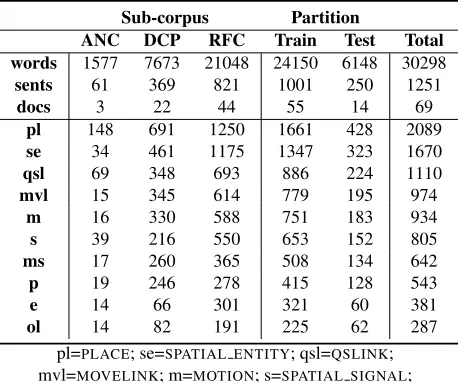
Table 1 includes corpus statistics broken down into the ANC, DCP, and RFC sub-corpora in addition to the train:test partition (∼3:1). The counts of docu-ment, sentence, and lexical tokens are tabulated as well as counts of each annotation tag type.
3.3 Annotation and Adjudication
All annotations for this task were of English lan-guage texts and all annotations were created and ad-judicated by native English speakers. Due to depen-dencies of link tag elements on extent tag elements, the annotation and adjudication tasks were broken down into the following phases:
Phase 1 Extent tag span and attribute annotation.
Sub-corpus Partition
ANC DCP RFC Train Test Total words 1577 7673 21048 24150 6148 30298
sents 61 369 821 1001 250 1251
docs 3 22 44 55 14 69
pl 148 691 1250 1661 428 2089
se 34 461 1175 1347 323 1670
qsl 69 348 693 886 224 1110
mvl 15 345 614 779 195 974
m 16 330 588 751 183 934
s 39 216 550 653 152 805
ms 17 260 365 508 134 642
p 19 246 278 415 128 543
e 14 66 301 321 60 381
ol 14 82 191 225 62 287
pl=PLACE; se=SPATIAL ENTITY; qsl=QSLINK;
mvl=MOVELINK; m=MOTION; s=SPATIAL SIGNAL;
ms=MOTION SIGNAL; p=PATH; e=NONMOTION EVENT;
[image:4.612.314.543.56.247.2]ol=OLINK
Table 1: Corpus Statistics
Phase 2 Extent tag adjudication.
Phase 3 Link tag argument and attribute annotation.
Phase 4 Link tag adjudication.
Phases 2 and 4 produced gold standards from an-notations in the preceding annotation phases. This annotation strategy ensured that the intermediate gold standard extent tag set was adjudicated before any link tag annotations were performed.
The annotation and adjudication effort was conducted at Brandeis University using Multi-document Annotation Environment (MAE) and Multi-annotator Adjudication Interface (MAI) (Stubbs, 2011). We used MAE to perform each phase of the annotation procedure and MAI to adjudicate and produce gold standard standoff annotations in XML format. In addition to the ISO-Space annotation tags and attributes, as a post-process, we also provided sentence and lexical tokenization as a separate standoff annotation layer in the XML data for the training and test sets.
Phase 3 in Table 2. The scores for extent tags and
MOVELINK indicate high agreement, however link
tag annotation was less consistent for the remaining link tags. Though theOLINKandQSLINKtag
agree-ment is better than chance, it is not high. We believe the lower agreement for these link tags reflects the complexity of the annotation task.
Extent Tags Link Tags
All Types MOVELINK OLINK QSLINK
0.85 0.91 0.39 0.33
Table 2: Overall Fleiss’sκScores
4 Evaluation
Participant systems were evaluated for each enumer-ated configuration as follows:
1 a. SE.a precision, recall, and F1.
b. SE.b precision, recall, and F1 for each type, and an overall precision, recall, and F1.
c. SE.c precision, recall, and F1 for each at-tribute, and an overall precision, recall, and F1.
d. MoveLink.a, QSLink.a, OLink.a preci-sion, recall, and F1.
e. MoveLink.b, QSLink.b, OLink.b preci-sion, recall, and F1 for each attribute, and an overall precision, recall, and F1. 2 a. SE.b and SE.c precision, recall, and F1 for
each type and its attributes, and an overall precision, recall, and F1.
b. MoveLink.a, QSLink.a, OLink.a preci-sion, recall, and F1.
c. MoveLink.b, QSLink.b, OLink.b preci-sion, recall, and F1 for each attribute, and an overall precision, recall, and F1. 3 a. MoveLink.a, QSLink.a, OLink.a
preci-sion, recall, and F1.
b. MoveLink.b, QSLink.b, OLink.b preci-sion, recall, and F1 for each attribute, and an overall precision, recall, and F1.
5 Submissions and Results
In this section we evaluate results from runs of five systems. Three systems were submitted by outside
groups including Honda Research Institute Japan (HRIJP-CRF-VW), Ixa Group in the University of the Basque Country (IXA), and University of Texas, Dallas (UTD)3. We also present results for two sys-tems developed internally at Brandeis University: a suite of logistic regression classifiers with minimal feature engineering intended as a performance base-line covering all sub-tasks in addition to a CRF sys-tem with more advanced features, but limited to sub-tasks 1a and 1b for Configuration 1.
BASELINE A suite of logistic regression models using Scikit-learn (Pedregosa et al., 2011) with simple bag-of-words and n-gram features.4 BRANDEIS-CRF A system using a conditional
random field (CRF) model (Okazaki, 2007) with features including Stanford POS and NER tags (Toutanova et al., 2003) (Finkel et al., 2005) in combination with Sparser (McDonald, 1996) tags.5
HRIJP-CRF-VW A system using a CRF model us-ing CoreNLP, (Mannus-ing et al., 2014), CRF-Suite (Okazaki, 2007) and Vowpal Wabbit (Langford et al., 2007) with lemmatization, POS, NER, GloVe word vector (Pennington et al., 2014) and dependency parse features.
IXA X-Space: A system using a binary sup-port vector machine model from SVM-light (Joachims, 1999) and a pipeline architecture using ClearNLP (Choi and Adviser-Palmer, 2012), OpenNLP (OpenNLP, 2014), and lever-aging computational linguistic resources in-cluding WordNet (Fellbaum, 1998), PropBank (Palmer et al., 2003) and the Predicate Matrix (de la Calle et al., 2014).
UTD A suite of 13 classifiers for classifying spatial roles and relations including classifiers for sta-tionary spatial relations and their participants in addition to classification of participants of mo-tion events and their attributes.
3UTD submitted three runs, however, after evaluating all the
data, all three runs achieved similar scores; the results reported here are for their third and final submitted run.
4These baseline classifiers were developed at Brandeis
Uni-versity by Aaron Levine and Zachary Yocum. Cf. Section 5.1 for full description.
5This system was developed at Brandeis University by Seth
5.1 Baseline
Our baseline classification system (BASE-LINE) consists of a suite of 47 classifiers built from Scikit-learn’s (Pedregosa et al., 2011)
sklearn.linear model logistic regression package. The system builds a collection of extent objects from the annotation and lexical tokeniza-tions provided in the SpaceEval XML distribution data. Each extent instance has attributes for further feature and label extraction: the target chunk used to form the extent instance; any annotation tag associated with the chunk; lists of all surrounding tokens in the sentence, split between tokens preced-ing the target and those followpreced-ing, and a pointer to the original annotation XML for the purposes of global feature extraction and generating new XML tags based on the eventual model predictions.
Some extent attributes are optional, depending on the sub-task. E.g., in sub-task 1a, no attributes are required since this sub-task is a simple classification task. For link tags, extent objects are instantiated using the text chunks associated with the extent tags that serve as the link trigger. After pre-processing, the system has a complete collection of extent in-stances for the corpus.
Subsequent to pre-processing, the extent data are further processed for label and feature extraction. The label and feature extractors were hand-tweaked for each sub-task:
• For extent tag identification, the label extractor checks if a given token occurs at the end of a chunk, and the feature extractors include capi-talization and POS tags.
• For classifying extent tag types, the feature extractors include the target chunk string, POS tag, and a seven-token context window (bounded by the sentence) centered on the tar-get token.
• For extent tag attribute classification, the only feature extracted was the text of the chunk as-sociated with the target tag.
• For link tag identification, a heuristic system was developed to select candidate extent tags for the trigger argument. The remaining argu-ments in the relation were identified by their distance and direction from the trigger. Fea-ture extractors for this process included the text
of the trigger chunk, a count of the tags in lo-cal context (the same sentence) before and after the trigger, and the types of the extent tags that occur in the context.
• For open-class link tag attributes, feature ex-tractors included the count of extent tags be-fore and after the trigger tag in the sentence. For closed-class link tag attributes feature ex-tractors were limited to the text of the trigger chunk and the trigger tag type.6
• For link tag arguments that take anIDREFas a value, a unique label function was created that extracts the offsets of the candidate extent tags in the same sentence as the trigger.
The label and feature vectors were maintained using the DictVectorizer from Scikit-learn’s
feature extractionmodule. To train the sys-tem, the vectors were used to fit the model to the training data. For decoding, the tag labels and at-tributes from the test data were discarded and the re-maining feature vectors were transformed into a hy-pothesis index based on the model, which was trans-lated to a final value using a codebook. The hypothe-ses were then written out to XML in accordance to the task DTD.
5.2 Brandeis CRF
In addition to the BASELINE system, we also devel-oped a more advanced pipeline (BRANDEIS-CRF) to automate the SpaceEval sub-tasks 1a and 1b us-ing a linear-chain conditional random field model using lexical, part-of-speech (POS), named-entity-recognition (NER), and semantic labels. We re-port overall F1 measures of0.83and0.77for tasks 1a and 1b, respectively, which are comparable to other top results (cf. Section 5.3). Our imple-mentation used the CRFSuite (Okazaki, 2007) open source package, which facilitated rapid training and model inspection. The hypotheses were written out to XML in accordance to the task DTD.
We used a small set of 9 core features, augmented with bigram contexts, resulting in a total of 27 fea-tures. These features consist of lexical, syntac-tic, and semantic information, many of which have
6We experimented with additional features for attribute
been applied successfully in a variety of informa-tion extracinforma-tion tasks (Fei Huang et al., 2014), such as named entity recognition (Vilain et al., 2009b) or coreference resolution (Fernandes et al., 2014). The complete set of features are outlined in Table 3.
Type Id Value
Lexical word[-1,0,1]isupper[-1,0,1] stringbinary wordlen[-1,0,1] ternary7
Syntactic pos[-1,0,1] POS tag Semantic ner[-1,0,1] NER tag
Sparser
CATEGORY[-1,0,1] Sparser category FORM[-1,0,1] Sparser form LCATEGORY[-1,0,1] Sparser category LFORM[-1,0,1] Sparser form
Table 3: BRANDEIS-CRF Features
For part-of-speech (POS) and named entity (NE) tags, we used the Stanford Log-linear Part-of-Speech Tagger (Toutanova et al., 2003) and the Stan-ford Named Entity Recognizer (Finkel et al., 2005). Additionally, we made use of Sparser (McDonald, 1996), a rule-based natural language parser in order to provide rich semantic features. Sparser parses un-structured text in cycles, where a variety of hand-written rules apply given the applications of pre-vious rules or the current parse of the text. After parsing, Sparser provides a set of edges, which pro-vide both semantic and syntactic information. For our purposes, we used the CATEGORY and FORM
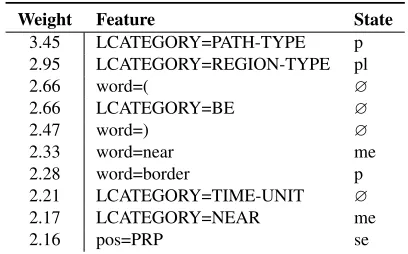
attributes of the resulting edges. Table 4 shows that the Sparser features can be informative for this task, as five of the top ten positive weights are from Sparser. As a disclaimer, we acknowledge that model weights are not always sufficient for deter-mining the most informative features (Vilain et al., 2009a).
However, there were several problems using Sparser. One issue is that Sparser performs its own internal tokenization and chunking, as it expects un-structured text as input, i.e. a string. To align the al-ready tokenized sentences with a Sparser parse, we used a matching algorithm that aligned a token with its corresponding Sparser edge. A second problem was that Sparser frequently fails on inputs, and the points of failure can be difficult to identify due to the interaction of its various phases and context based
7Token character length is≤5,(5..10],or>10.
Weight Feature State
3.45 LCATEGORY=PATH-TYPE p 2.95 LCATEGORY=REGION-TYPE pl
2.66 word=( ∅
2.66 LCATEGORY=BE ∅
2.47 word=) ∅
2.33 word=near me
2.28 word=border p
2.21 LCATEGORY=TIME-UNIT ∅
2.17 LCATEGORY=NEAR me
2.16 pos=PRP se
[image:7.612.324.528.54.181.2]p=PATH; pl=PLACE; me=MEASURE; se=SPATIAL ENTITY
Table 4: Top Ten Positive Feature Weights
rules. Thus, we were not able to getCATEGORYand
FORMfor all tokens. As a remedy, we included lo-calforms of these Sparser features (prefixed withL), which were collected by inputting tokens by them-selves to Sparser. This suggests that word lists could be very informative for this task.
5.3 Evaluation Results
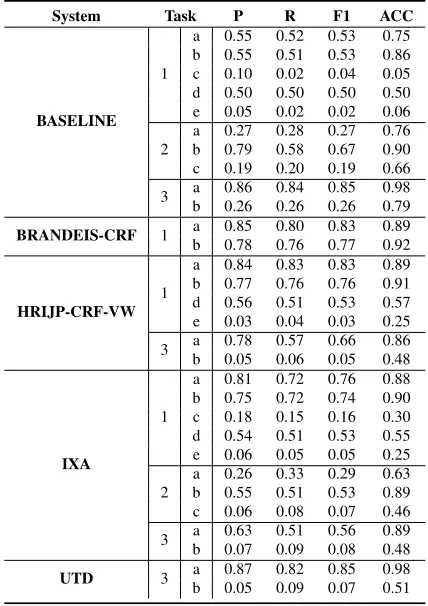
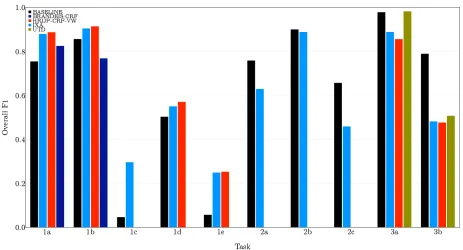
Table 5 shows mean precision (P), recall (R), F1, and accuracy (ACC) scores for each group for each evaluation configuration and sub-task that was at-tempted. The overall precision and recall measures we report are the arithmetic means of the precision and recall for each tag label or attribute in the cor-responding sub-task. The overall, macro-average F1 measures we report are the harmonic mean of the overall P and R. Accuracy is computed as the num-ber of correctly classified labels or attributes divided by the total number of labels or attributes in the gold standard. Overall accuracy and F1 are plotted in Ap-pendix A.
Not all groups attempted all of the evaluation con-figurations8. The HRIJP-CRF-VW system was eval-uated only for Configuration 1 tasks 1a, 1b, 1d, and 1e (not 1c), and Configuration 3 sub-tasks 3a and 3b. HRIJP-CRF-VW was not evaluated for Config-uration 2 since those sub-tasks were not attempted. The UTD submission only covered Configuration 3, thus was only evaluated for sub-tasks 3a and 3b.
8The IXA system was the only one to complete all
System Task P R F1 ACC
BASELINE
1
a 0.55 0.52 0.53 0.75 b 0.55 0.51 0.53 0.86 c 0.10 0.02 0.04 0.05 d 0.50 0.50 0.50 0.50 e 0.05 0.02 0.02 0.06
2 ba 0.270.79 0.280.58 0.270.67 0.760.90 c 0.19 0.20 0.19 0.66 3 ba 0.860.26 0.840.26 0.850.26 0.980.79
BRANDEIS-CRF 1 ba 0.850.78 0.800.76 0.830.77 0.890.92
HRIJP-CRF-VW 1
a 0.84 0.83 0.83 0.89 b 0.77 0.76 0.76 0.91 d 0.56 0.51 0.53 0.57 e 0.03 0.04 0.03 0.25 3 ba 0.780.05 0.570.06 0.660.05 0.860.48
IXA
1
a 0.81 0.72 0.76 0.88 b 0.75 0.72 0.74 0.90 c 0.18 0.15 0.16 0.30 d 0.54 0.51 0.53 0.55 e 0.06 0.05 0.05 0.25
2 ba 0.260.55 0.330.51 0.290.53 0.630.89 c 0.06 0.08 0.07 0.46 3 ba 0.630.07 0.510.09 0.560.08 0.890.48
[image:8.612.78.292.55.358.2]UTD 3 ba 0.870.05 0.820.09 0.850.07 0.980.51
Table 5: Overall Performance
6 Conclusion
It is clear from the participating system results that recognizing spatial entities as a sub-task is a fairly well-understood area, with reasonable per-formance. All systems using CRF models for recognizing places, paths, motion and non-motion events, and spatial entities performed well. Fur-thermore, MOVELINK recognition results were
ex-tremely promising, due to the general tendency for movement to be accompanied by recognizable clues. The overall poor performance for recognition of spa-tial relations between entities, on the other hand (QSLINKs andOLINKs) indicates that these are
dif-ficult relational identification tasks, reflected in the lower IAA scores for these relations as well.
For the next SpaceEval evaluation, we believe that a more focused task, possibly embedded within an application, would lower the barrier to entry in the competition. It would also permit us to use an extrin-sic evaluation for performance of the systems. We also hope to release the SpaceBank corpus through LDC later this year. This would enable the
commu-nity to become more familiar with the dataset and specification.
Acknowledgements
This research was supported by grants from NSF’s IIS-1017765 and NGA’s NURI HM1582-08-1-0018. We would like to acknowledge all the annotators and adjudicators who have contributed to the Space-Bank annotation effort, including Adam Berger, Alexander Elias, Alison Marqusee, April Dobkin, Benjamin Beaudett, Eric Benzschawel, Heather Friedman, Katie Glanbock, Keelan Armstrong, Kenyon Branan, Kiera Sarill, Lauren Weber, Martha Schwarz, Meital Singer, Rebecca Loewenstein-Harting, Sean Bethard, and Stephanie Grinley.
References
Harry Bunt. 2010. A methodology for designing seman-tic annotation languages exploiting syntacseman-tic-semanseman-tic iso-morphisms. InProceedings of ICGL 2010, Second International Conference on Global Interoperability
for Language Resources.
Jinho D Choi and Martha Adviser-Palmer. 2012. Op-timization of natural language processing components for robustness and scalability.
Maddalen L´opez de la Calle, Egoitz Laparra, and Ger-man Rigau. 2014. First steps towards a predicate ma-trix. InProceedings of the Global WordNet
Confer-ence (GWC 2014), Tartu, Estonia, January. GWA.
Arun Ahuja Fei Huang, Doug Downey, Yi Yang, Yuhong Guo, and Alexander Yates. 2014. Learning repre-sentations for weakly supervised natural language pro-cessing tasks. Computational Linguistics, 40:1(85-120).
Christiane Fellbaum, editor. 1998. Wordnet: an elec-tronic lexical database. MIT Press.
Eraldo Rezende Fernandes, C´ıcero Nogueira dos Santos, and Ruy Luiz Milidi´u. 2014. Latent trees for corefer-ence resolution. Computational Linguistics, 40:4(801-835).
Jenny Rose Finkel, Trond Grenager, and Christopher Manning. 2005. Incorporating non-local information into information extraction systems by gibbs sampling.
InProceedings of the 43rd Annual Meeting on
Associ-ation for ComputAssoci-ational Linguistics, pages 363–370.
Association for Computational Linguistics.
Nancy Ide and Laurent Romary. 2004. International standard for a linguistic annotation framework.
Nat-ural Language Engineering, 10(3-4):211–225.
Kiyong Lee ISO/TC 37/SC 4/WG 2, Project leaders: James Pustejovsky. 2014. Iso 24617-7:2014 language resource management - part 7: Spatial information (isospace). ISO/TC 37/SC 4/WG 2.
Alex Jarrett. 2013. The degree confluence project. Re-trieved August, 2013, http://www.confluence.org. Thorsten Joachims. 1999. Svmlight: Support
vec-tor machine. SVM-Light Support Vector Machine http://svmlight. joachims. org/, University of Dort-mund, 19(4).
Oleksandr Kolomiyets, Parisa Kordjamshidi, Steven Bethard, and Marie-Francine Moens. 2013. Semeval-2013 task 3: Spatial role labeling. In Second joint conference on lexical and computational semantics (* SEM), Volume 2: Proceedings of the seventh inter-national workshop on semantic evaluation (SemEval
2013), pages 255–266.
Parisa Kordjamshidi and Marie-Francine Moens. 2015. Global machine learning for spatial ontology popula-tion. Web Semantics: Science, Services and Agents on the World Wide Web, 30(0):3 – 21. Semantic Search. Parisa Kordjamshidi, Marie-Francine Moens, and
Mar-tijn van Otterlo. 2010. Spatial role labeling: task definition and annotation scheme. InProceedings of LREC 2010 - The sevent international conference on langauge resources and evaluation.
Parisa Kordjamshidi, Martijn van Otterlo, and Marie-Francine Moens. 2011. Spatial role labeling: towards extraction of spatial relations from natural language. ACM - Transactions on Speech and Language Process-ing, 8:1–36.
Parisa Kordjamshidi, Steven Bethard, and Marie-Francine Moens. 2012. Semeval-2012 task 3: Spatial role labeling. InProceedings of the First Joint Confer-ence on Lexical and Computational Semantics-Volume 1: Proceedings of the main conference and the shared task, and Volume 2: Proceedings of the Sixth
Interna-tional Workshop on Semantic Evaluation, pages 365–
373. Association for Computational Linguistics. David Kroosma. 2012. Ride for climate. Retrieved
September, 2012, http://rideforclimate.com/blog/. John Langford, L Li, and A Strehl. 2007.
Vowpal wabbit. URL https://github.
com/JohnLangford/vowpal wabbit/wiki.
Inderjeet Mani, Christy Doran, Dave Harris, Janet Hitze-man, Rob Quimby, Justin Richer, Ben Wellner, Scott Mardis, and Seamus Clancy. 2010. Spatialml: an-notation scheme, resources, and evaluation. Language
Resources and Evaluation, 44(3):263–280, September.
Christopher D. Manning, Mihai Surdeanu, John Bauer, Jenny Finkel, Steven J. Bethard, and David McClosky.
2014. The Stanford CoreNLP natural language pro-cessing toolkit. InProceedings of 52nd Annual Meet-ing of the Association for Computational LMeet-inguistics:
System Demonstrations, pages 55–60.
David McDonald. 1996. Internal and external evidence in the identification and semantic categorization of proper names. Corpus processing for lexical acqui-sition, pages 21–39.
Jessica L. Moszkowicz and James Pustejovsky. 2010. Iso-space: towards a spatial annotation framework for natural language. Processing Romanian in Multilin-gual, Interoperational and Scalable Environments. Naoaki Okazaki. 2007. Crfsuite: a fast implementation
of conditional random fields (crfs).
Apache OpenNLP. 2014. Apache software foundation. URL http://opennlp. apache. org.
Martha Palmer, Dan Gildea, and Paul Kingsbury. 2003. The proposition bank: an annotated corpus of semantic roles.Computational Linguistics.
Fabian Pedregosa, Ga¨el Varoquaux, Alexandre Gram-fort, Vincent Michel, Bertrand Thirion, Olivier Grisel, Mathieu Blondel, Peter Prettenhofer, Ron Weiss, Vin-cent Dubourg, et al. 2011. Scikit-learn: Machine learning in python. The Journal of Machine Learning
Research, 12:2825–2830.
Jeffrey Pennington, Richard Socher, and Christopher D Manning. 2014. Glove: Global vectors for word rep-resentation. Proceedings of the Empiricial Methods in
Natural Language Processing (EMNLP 2014), 12.
James Pustejovsky and Zachary Yocum. 2013. Captur-ing motion in iso-spacebank. InWorkshop on Interop-erable Semantic Annotation, page 25.
James Pustejovsky, Robert Knippen, Jessica Littman, and Roser Saur´ı. 2005. Temporal and event information in natural language text. Language Resources and Eval-uation, 39:123–164, May.
James Pustejovsky, Jessica L. Moszkowicz, and Marc Verhagen. 2011a. Iso-space: the annotation of spa-tial information in language. InProceedings of ISA-6: ACL-ISO International Workshop on Semantic Anno-tation, Oxford, England, January.
James Pustejovsky, Jessica L. Moszkowicz, and Marc Verhagen. 2011b. Iso-space: The annotation of spa-tial information in language. InProceedings of ISA-6: ACL-ISO International Workshop on Semantic Anno-tation, Oxford, England, January.
James Pustejovsky, Jessica Moszkowicz, and Marc Ver-hagen. 2012. A linguistically grounded annotation language for spatial information.TAL, 53(2).
David Randell, Zhan Cui, and Anthony Cohn. 1992. A spatial logic based on regions and connections. In Morgan Kaufmann, editor,Proceedings of the 3rd In-ternation Conference on Knowledge Representation
Randi Reppen, Nancy Ide, and Keith Suderman. 2005. American national corpus (anc). Linguistic Data Con-sortium, Philadelphia. Second release.
Amber Stubbs. 2011. Mae and mai: Lightweight an-notation and adjudication tools. InProceedings of the
5th Linguistic Annotation Workshop, pages 129–133.
Association for Computational Linguistics.
Kristina Toutanova, Dan Klein, Christopher D Manning, and Yoram Singer. 2003. Feature-rich part-of-speech tagging with a cyclic dependency network. In Pro-ceedings of the 2003 Conference of the North Ameri-can Chapter of the Association for Computational
Lin-guistics on Human Language Technology-Volume 1,
pages 173–180. Association for Computational Lin-guistics.
Marc Vilain, Jonathan Huggins, and Ben Wellner, 2009a. Proceedings of the Thirteenth Conference on
Compu-tational Natural Language Learning (CoNLL-2009),
chapter A simple feature-copying approach for long-distance dependencies, pages 192–200. Association for Computational Linguistics.
Marc Vilain, Jonathan Huggins, and Ben Wellner. 2009b. Sources of performance in crf transfer training: a busi-ness name-tagging case study. InProceedings of the
International Conference RANLP-2009, pages 465–
A. Performance Plots
[image:11.612.76.542.382.649.2]Figure 1: Overall Accuracy for All Sub-tasks