Semi-Automated Resolution of Inconsistency for a Harmonized
Multiword Expression and Dependency Parse Annotation
King Chan, Julian Brooke, and Timothy Baldwin
Department of Computing and Information Systems, The University of Melbourne
[email protected], [email protected], [email protected]
Abstract
This paper presents a methodology for identifying and resolving various kinds of inconsistency in the context of merg-ing dependency and multiword expression (MWE) annotations, to generate a depen-dency treebank with comprehensive MWE annotations. Candidates for correction are identified using a variety of heuristics, in-cluding an entirely novel one which iden-tifies violations of MWE constituency in the dependency tree, and resolved by ar-bitration with minimal human interven-tion. Using this technique, we identi-fied and corrected several hundred errors across both parse and MWE annotations, representing changes to a significant per-centage (well over 10%) of the MWE in-stances in the joint corpus.
1 Introduction
The availability of gold-standard annotations is important for the training and evaluation of a wide variety of NLP tasks, including the evaluation of dependency parsers (Buchholz and Marsi, 2006). In recent years, there has been a focus on multi-annotation of a single corpus, such as joint syn-tactic, semantic role, named entity, coreference and word sense annotation in Ontonotes (Hovy et al., 2006) or constituency, semantic role, dis-course, opinion, temporal, event and coreference (among others) annotation of the Manually Anno-tated Sub-Corpus of the ANC (Ide et al., 2010). As part of this, there has been an increased fo-cus on harmonizing and merging existing anno-tated data sets as a means of extending the scope of reference corpora (Ide and Suderman, 2007; De-clerck, 2008; Simi et al., 2015). This effort some-times presents an opportunity to fix conflicting an-notations, a worthwhile endeavour since even a
small number of errors in a gold-standard syntactic annotation can, for example, result in significant changes in downstream applications (Habash et al., 2007). This paper presents the results of a har-monization effort for the overlapping STREUSLE annotation (Schneider et al., 2014) of multiword expressions (“MWEs”: Baldwin and Kim (2010)) and dependency parse structure in the English Web Treebank (“EWT”: Bies et al. (2012)), with the long-term goal of building reliable resources for joint MWE/syntactic parsing (Constant and Nivre, 2016).
As part of merging these two sets of anno-tations, we use analysis of cross-annotation and type-level consistency to identify instances of po-tential annotation inconsistency, with an eye to im-proving the quality of the component and com-bined annotations. It is important to point out that our approach to identifying and handling inconsis-tencies does not involve re-annotating the corpus; instead we act as arbitrators, resolving inconsis-tency in only those cases where human interven-tion is necessary. Our three methods for identify-ing potentially problematic annotations are:
• a cross-annotation heuristic that identifies MWE tokens whose parse structure is incom-patible with the syntactic annotation of the MWE;
• a cross-type heuristic that identifiesn-grams with inconsistent token-level MWE annota-tions; and
• a cross-type, cross-annotation heuristic that identifies MWE types whose parse structure is inconsistent across its token occurrences. The first of these is specific to this harmonization process, and as far as we aware, entirely novel. The other two are adaptions of an approach to im-proving syntactic annotations proposed by Dick-inson and Meurers (2003). After applying these heuristics and reviewing the candidates, we iden-tified hundreds of errors in MWE annotation and
about a hundred errors in the original syntactic an-notations. We make available a tool that applies these fixes in the process of joining the two notations into a single harmonized, corrected an-notation, and release the harmonized annotations in the form of HAMSTER (the HArmonized Mul-tiword and Syntactic TreE Resource): https: //github.com/eltimster/HAMSTER.
2 Related Work
Our long-term goal is in building reliable re-sources for joint MWE/syntactic parsing. Explicit modelling of MWEs has been shown to improve parser accuracy (Nivre and Nilsson, 2004; Finkel and Manning, 2009; Korkontzelos and Manand-har, 2010; Green et al., 2013; Vincze et al., 2013; Candito and Constant, 2014; Constant and Nivre, 2016). Treatment of MWEs has typically involved parsing MWEs as single lexical units (Nivre and Nilsson, 2004; Eryi˘git et al., 2011; Aggeliki Fo-topoulou, 2014), however this flattened, “words with spaces” (Sag et al., 2002) approach is inflex-ible in its coverage of MWEs where components have some level of flexibility.
The English Web Treebank (Bies et al., 2012) represents a gold-standard annotation effort over informal web text. The original syntactic con-stituency annotation of the corpus was based on hand-correcting the output of the Stanford Parser (Manning et al., 2014); for our purposes we have converted this into a dependency parse using the Stanford Typed Dependency converter (de Marn-effe et al., 2006). We considered the use of the Universal Dependencies representation (Nivre et al., 2016), however we noted that several as-pects of that annotation (in particular the treat-ment of all prepositions as case markers depen-dent on their noun) make it inappropriate for joint MWE/syntactic parsing since it results in large numbers of MWEs that are non-contiguous in their syntactic structure (despite being contiguous at the token-level). As such, the Stanford Typed Depen-dencies are the representation which has the great-est currency for joint MWE/syntactic parsing work (Constant and Nivre, 2016).
The STREUSLE corpus (Schneider et al., 2014) is based entirely on the Reviews subset of the EWT, and comprises of 3,812 sentences repre-senting 55,579 tokens. The annotation was com-pleted by six linguists who were native English speakers. Every sentence was assessed by at least
two annotators, which resulted in an average inter-annotator F1 agreement of 0.7. The idiosyncratic nature of MWEs lends itself to challenges associ-ated with their interpretation, and this was read-ily acknowledged by those involved in the devel-opment of the STREUSLE corpus (Hollenstein et al., 2016). Two important aspects of the MWE an-notation are that it includes both contiguous and non-contiguous MWEs (e.g.check⇤out), and that it supports both weak and strong annotation; both of these are considered in scope for our inconsis-tency analysis. A variety of cues are employed to determine this associative strength. The primary factor relates to the degree in which the expres-sion is semantically opaque and/or morphosyn-tactically idiosyncratic. An example of a strong MWE would betop notch, as used in the sentence:
We stayed at a top notch hotel. The semantics of this expression are not immediately predictable from the meanings oftopandnotch. On the other hand, the expressionhighly recommendis consid-ered to be a weak expression as it is largely com-positional — one can highly recommend a prod-uct— as indicated by the presence of alternatives such asgreatly recommendwhich are also accept-able though less idiomatic. A total of 3,626 MWE instances were identified in STREUSLE, across 2,334 MWE types.
Other MWE-aware dependency treebanks in-clude the various UD treebanks (Nivre et al., 2016), the Prague Dependency Treebank (Bejˇcek et al., 2013), and others (Nivre and Nilsson, 2004; Eryi˘git et al., 2011; Candito and Constant, 2014). The representation of MWEs, and the scope of types covered by these treebanks, can vary signif-icantly. For example, the internal syntactic struc-ture may be flattened (Nivre and Nilsson, 2004), or in the case of Candito and Constant (2014), allow for distinctions in the granularity of syntactic rep-resentation for regular vs. irregular MWE types.
The identification of inconsistencies in anno-tation requires comparisons to be made between similar instances that are labeled differently. Boyd et al. (2007) employed an alignment-based ap-proach to assess differences in the annotation of
Mat-Deep tissue massage helps with pain in neck and shoulders
JJ NN NN VBZ IN NN IN NN CC NNS
amod
nn nsubj root
[image:3.595.119.477.64.127.2]prep pobj prep pobj cc conj
Figure 1: An example where the arc count heuristic is breached. Deep tissue has been labeled in the sentence here as an MWE in STREUSLE.Deepandtissueact as modifiers tomassage, a term that has not been included as part of the MWE.
subara, 2010). Dickinson and Meurers (2003) out-line various approaches for detecting inconsisten-cies in parse structure within treebanks.
In general, inconsistencies associated with MWE annotation fall under two categories: (1)
annotator error(i.e. false positives and false neg-atives); and (2) ambiguity associated with the as-sessment of hard cases. While annotation errors apply to situations where a correct label can be ap-plied but is not done so, hard cases are those where the correct label is inherently difficult to assign, and can be particularly relevant to certain classes of MWEs. For example, there may be consider-able differences in inter-annotator agreement as-sociated with assessing the relative transparency and associative strength of a non-fixed MWE.
3 Error Candidate Identification 3.1 MWE Syntactic Constituency Conflicts
The hypothesis that drives our first analysis is that for nearly all MWE types, the component words of the MWE should be syntactically connected, which is to say that every word is a dependent of another word in the MWE, except one word which connects the MWE to the rest of the sen-tence (or the root of the sensen-tence). We can realise this intuition by using an arc count heuristic: for each labeled MWE instance we count the number of incoming dependency arcs that are headed by a term outside the MWE, and if the count is greater than one, we flag it for manual analysis. Figure 1 gives an example where the arc count heuristic is breached since both terms of the MWEdeep tissue
act as modifiers to the head noun that sits outside the MWE.
3.2 MWE Type Inconsistency
Our second analysis involves first collecting a list of all MWE types in the STREUSLE corpus, cor-responding to lemmatizedn-grams, possibly with gaps. We then match these n-grams across the
same corpus, and flag any MWE type which has at least one inconsistency with regards to the an-notation. That is, we extract as candidates any MWE types where there were at least two occur-rences of the correspondingn-gram in the corpus that were incompatible with respect to their an-notation in STREUSLE, including discrepancies in weak/strong designation. For non-contiguous MWE types, matches containing up to 4 words of intervening context between the two parts of the MWE type were included as candidates for further assessment.
3.3 MWE Type Parse Inconsistency
The hypothesis that drives our third analysis is that we would generally expect the internal syn-tax of an MWE type to be consistent across all its instances.1 For each MWE type, we extracted
the internal dependency structure of all its labeled instances, and flagged for further assessment any type for which the parse structure varied between at least two of those instances. Note that although this analysis is aimed at fixing parse errors, it makes direct use of the MWE annotation provided by STREUSLE to greatly limit the scope of error candidates to those which are most relevant to our interest.
4 Error Arbitration
Error arbitration was carried out by the authors (all native English speakers with experience in MWE identification), with at least two authors looking at each error candidate in most instances, and for certain difficult cases, the final annotation be-ing based on discussion among all three authors. One advantage of our arbitration approach over a traditional token-based annotation was that we could enforce consistency across similar error
didates (e.g. disappointed with and happy with) and also investigate non-candidates to arrive at a consensus; where at all possible, our changes re-lied on precedents that already existed in the rele-vant annotation.
Arbitration for the MWE syntax conflicts usu-ally involved identifying an error in one of the two annotations, and in most cases this was relatively obvious. For instance, in the candidate . . . the usual lady called in sick hours earlier, called in sick was correctly labeled as an MWE, but the parse incorrectly includes sick as a dependent of
hours, rather thancalled in. An example of the op-posite case is. . . just to make the appointment . . ., wheremake thehad been labeled as an MWE, an obvious error which was caught by our arc count heuristic. There were cases where our arc count heuristic was breached due to what we would view as a general inadequacy in the syntactic annota-tion, but we decided not to effect a change be-cause the impact would be too far reaching; ex-amples of this were certain discourse markers (e.g.
as soon as), and infinitives (e.g.have to complete
where thetois considered a dependent of its verb rather than of the other term in the MWEhave to). The most interesting cases were a handful of non-contiguous MWEs where there was truly a discon-tinuity in the syntax between the two parts of the MWE, for instanceno amount of⇤can. This sug-gests a basic limitation in our heuristic, although the vast majority of MWEs did satisfy it.
For the two type-level arbitrations, there were cases of inconsistency upheld by real usage dif-ferences (e.g.a little housevs.a little tired). We identified clear differences in usage first, and di-vided the MWE types into sets, excluding from further analysis non-MWE usages of MWE type
n-grams. For each consistent usage of an MWE type, the default position was to prefer the major-ity annotation across the set of instances, except when there were other candidates that were essen-tially equivalent: for instance, if we had relied on majority annotation forjob⇤do(e.g.the job that he did) it would have been a different annotation thando ⇤job(e.g.do a good job), so we consid-ered these two together. We treated contiguous and non-contiguous versions of the same MWE type in the same manner.
In the MWE type consistency arbitration, for cases where majority rules did not provide a clear answer and there was no overwhelming evidence
for non-compositionality, we introduced a special internal label called hard. These correspond to cases where the usage is consistent and the incon-sistency seems to be a result of the difficulty of the annotation item (as discussed earlier in Sec-tion 2), which extended also to our arbitraSec-tion. Rather than enforce a specific annotation without strong evidence, or allow the inconsistency to re-main when there is no usage justification for it, the corpus merging and correction tool gives the user the option to treathardannotated MWEs in vary-ing ways: the annotation may be kept unchanged, removed, converted to weak, or covered to hard
for the purpose of excluding it from evaluation. Examples of hard cases include go back, go in, more than, talk to, speak to, thanks guys, not that great, pleased with, have ⇤option, get⇤ answer, fix⇤problem. On a per capita basis, inconsisten-cies are more common for non-contiguous MWEs relative to their contiguous counterparts, and we suspect that this is partially due to their tendency to be weaker, in addition to the challenges in-volved in correctly discerning the two parts, which are sometimes at a significant distance from each other.
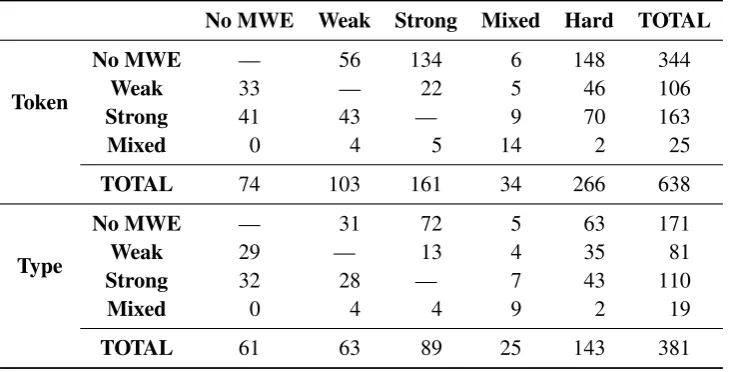
Table 1 provides a summary of changes to MWE annotation at the MWE type and token lev-els. Mixedrefer to MWEs that are heterogeneous in the associative strength between terms in the MWE (between weak and strong). Most of the changes in Table 1 (98% of the types) were the result of our type consistency analysis. Al-most half of the changes involved the use of the
hardlabel, but even excluding these (since only some of these annotations required actual changes in the final version of the corpus) our changes in-volve over 10% of the MWE tokens in the cor-pus, and thus represent a significant improvement to the STREUSLE annotation.
No MWE Weak Strong Mixed Hard TOTAL
Token
No MWE — 56 134 6 148 344
Weak 33 — 22 5 46 106
Strong 41 43 — 9 70 163
Mixed 0 4 5 14 2 25
TOTAL 74 103 161 34 266 638
Type
No MWE — 31 72 5 63 171
Weak 29 — 13 4 35 81
Strong 32 28 — 7 43 110
Mixed 0 4 4 9 2 19
[image:5.595.118.487.63.249.2]TOTAL 61 63 89 25 143 381
Table 1: Summary of changes to MWE annotation at the MWE type and token level
5 Discussion
Our three heuristics are useful because they iden-tify potential errors with a high degree of preci-sion. For the MWE type consistency analysis 77% of candidate types were problematic, and for parse type consistency, 79%. For the arc count heuristic, 45% of candidate types were ultimately changed: as mentioned earlier, some of the breaches in-volved systematic issues with annotation schema that we felt uncomfortable changing in isolation. By bringing these candidate instances to our at-tention, we were able to better focus our manual analysis effort, including in some cases looking across multiple related types, or even searching for specialist knowledge which could resolve ambigu-ities: for instance, in the example shown in Fig-ure 1, though a layperson without reference ma-terial may be unsure whether it istissue or mas-sagewhich is considered to bedeep, a quick on-line search indicates that the original EWT syntax is in error (deepmodifiestissue).
However, it would be an overstatement to claim to have fixed all (or even almost all) the errors in the corpus. For instance, our type consistency heuristics only work when there are multiple in-stances of the same type, yet it is worth noting that 82% of the MWE types in the corpus are rep-resented by a singleton instance. Our arc count heuristic can identify issues with singletons, but its scope is fairly limited. We cannot possibly iden-tify missing annotations for types that were not an-notated at least once. We might also miss certain kinds of systematic annotation errors, for instance those mentioned in De Smedt et al. (2015), though
that work focused on the use ofmwedependency labels which are barely used in the EWT, one of the reasons a resource like STREUSLE is so use-ful.
6 Conclusion
We have proposed a methodology for merging multiword expression and dependency parse anno-tations, to generate HAMSTER: a gold-standard MWE-annotated dependency treebank with high consistency. The heuristics used to enforce con-sistency operate at the type- and cross-annotation level, and affected well over 10% of the MWEs in the new resource.
References
Voula Giouli Aggeliki Fotopoulou, Stella Markantona-tou. 2014. Encoding MWEs in a conceptual lexi-con. InProceedings of the 10th Workshop on Multi-word Expressions (MWE 2014).
Timothy Baldwin and Su Nam Kim. 2010. Multi-word expressions. In Nitin Indurkhya and Fred J. Damerau, editors, Handbook of Natural Language Processing, Second Edition. CRC Press, Taylor and Francis Group, Boca Raton, FL.
Eduard Bejˇcek, Eva Hajiˇcov´a, Jan Hajiˇc, Pavl´ına J´ınov´a, V´aclava Kettnerov´a, Veronika Kol´aˇrov´a, Marie Mikulov´a, Jiˇr´ı M´ırovsk`y, Anna Nedoluzhko, Jarmila Panevov´a, et al. 2013. Prague dependency treebank 3.0.
Adriane Boyd, Markus Dickinson, and Detmar Meur-ers. 2007. Increasing the recall of corpus annotation error detection. In Proceedings of the Sixth Work-shop on Treebanks and Linguistic Theories (TLT 2007), Bergen, Norway.
Sabine Buchholz and Erwin Marsi. 2006. Conll-x shared task on multilingual dependency parsing. In Proceedings of the Tenth Conference on Computa-tional Natural Language Learning, CoNLL-X ’06, pages 149–164, Stroudsburg, PA, USA. Association for Computational Linguistics.
Marie Candito and Matthieu Constant. 2014. Strate-gies for contiguous multiword expression analysis and dependency parsing. InThe 52nd Annual Meet-ing of the Association for Computational LMeet-inguistics (ACl ’14).
Matthieu Constant and Joakim Nivre. 2016. A transition-based system for joint lexical and syntac-tic analysis. Inthe 54th Annual Meeting of the As-sociation for Computational Linguistics (ACL ’16), pages 161–171.
Marie-Catherine de Marneffe, Bill MacCartney, and Christopher D. Manning. 2006. Generating typed dependency parses from phrase structure parses. In Proceedings of the 5th International Conference on Language Resources and Evaluation (LREC ’06), Genova, Italy.
Koenraad De Smedt, Victoria Ros´en, and Paul Meurer. 2015. Studying consistency in ud treebanks with iness-search. In Proceedings of the Fourteenth Workshop on Treebanks and Linguistic Theories (TLT14), pages 258–267.
Thierry Declerck. 2008. A framework for standard-ized syntactic annotation. In Proceedings of the 2008 Language Resource and Evaluation Confer-ence (LREC 08).
Markus Dickinson and W. Detmar Meurers. 2003. De-tecting inconsistencies in treebanks. InProceedings of the Second Workshop on Treebanks and Linguistic Theories (TLT 2003).
G¨uls¸en Eryi˘git, Tugay ˙Ilbay, and Ozan Arkan Can. 2011. Multiword expressions in statistical depen-dency parsing. InProceedings of the Second Work-shop on Statistical Parsing of Morphologically Rich Languages, SPMRL ’11, pages 45–55, Stroudsburg, PA, USA. Association for Computational Linguis-tics.
Eleazar Eskin. 2000. Detecting errors within a cor-pus using anomaly detection. In Proceedings of the 1st North American Chapter of the Association for Computational Linguistics Conference, NAACL 2000, pages 148–153, Stroudsburg, PA, USA. Asso-ciation for Computational Linguistics.
Jenny Rose Finkel and Christopher D. Manning. 2009. Joint parsing and named entity recognition. In Pro-ceedings of Human Language Technologies: The
2009 Annual Conference of the North American Chapter of the Association for Computational Lin-guistics, NAACL ’09, pages 326–334, Stroudsburg, PA, USA. Association for Computational Linguis-tics.
Spence Green, Marie-Catherine de Marneffe, and Christopher D. Manning. 2013. Parsing models for identifying multiword expressions. Computational Linguistics, 39(1):195–227, March.
Nizar Habash, Ryan Gabbard, Owen Rambow, Seth Kulick, and Mitchell P Marcus. 2007. Determining case in arabic: Learning complex linguistic behav-ior requires complex linguistic features. In EMNLP-CoNLL, pages 1084–1092.
Nora Hollenstein, Nathan Schneider, and Bonnie Web-ber. 2016. Inconsistency detection in semantic an-notation. InProceedings of the 2016 Langauage Re-sources and Evaluation Conference (LREC ’16). Eduard Hovy, Mitchell Marcus, Martha Palmer,
Lance Ramshaw, and Ralph Weischedel. 2006. OntoNotes: The 90% solution. In Proceedings of the Main Conference on Human Language Technol-ogy Conference of the North American Chapter of the Association of Computational Linguistics, pages 57–60, New York City, USA.
Nancy Ide and Keith Suderman. 2007. Graf: A graph-based format for linguistic annotations. In Proceed-ings of the Linguistic Annotation Workshop, LAW ’07, pages 1–8, Stroudsburg, PA, USA. Association for Computational Linguistics.
Nancy Ide, Collin Baker, Christiane Fellbaum, and Re-becca Passonneau. 2010. The manually annotated sub-corpus: A community resource for and by the people. pages 68–73.
Yoshihide Kato and Shigeki Matsubara. 2010. Cor-recting errors in a treebank based on synchronous tree substitution grammar. In Proceedings of the ACL 2010 Conference Short Papers, pages 74–79. Association for Computational Linguistics.
Ioannis Korkontzelos and Suresh Manandhar. 2010. Can recognising multiword expressions improve shallow parsing? In Human Language Technolo-gies: The 2010 Annual Conference of the North American Chapter of the Association for Com-putational Linguistics, HLT ’10, pages 636–644, Stroudsburg, PA, USA. Association for Computa-tional Linguistics.
Hrafn Loftsson. 2009. Correcting a pos-tagged corpus using three complementary methods. In Proceed-ings of the 12th Conference of the European Chap-ter of the Association for Computational Linguistics, pages 523–531. Association for Computational Lin-guistics.
networks. InInternational Conference on Artificial Neural Networks, pages 1185–1192. Springer. Christopher D. Manning, Mihai Surdeanu, John Bauer,
Jenny Finkel, Steven J. Bethard, and David Mc-Closky. 2014. The Stanford CoreNLP natural lan-guage processing toolkit. In Proceedings of 52nd Annual Meeting of the Association for Computa-tional Linguistics: System Demonstrations, pages 55–60.
Joakim Nivre and Jens Nilsson. 2004. Multiword units in syntactic parsing. InMethodologies and Evalua-tion of Multiword Units in Real-World ApplicaEvalua-tions (MEMURA).
Joakim Nivre, Marie-Catherine de Marneffe, Filip Gin-ter, Yoav Goldberg, Jan Hajic, et al. 2016. Univer-sal dependencies v1: A multilingual treebank col-lection.
Ivan A. Sag, Timothy Baldwin, Francis Bond, Ann Copestake, and Dan Flickinger. 2002. Multiword expressions: A pain in the neck for NLP. In Pro-ceedings of the 3rd International Conference on In-telligent Text Processing and Computational Lin-guistics (CICLing ’02).
Nathan Schneider, Spencer Onuffer, Nora Kazour, Emily Danchik, Michael T. Mordowanec, Henrietta Conrad, and Noah A. Smith. 2014. Comprehensive annotation of multiword expressions in a social web corpus. In Proceedings of the Ninth International Conference on Language Resources and Evaluation, pages 455–461, Reykjav´ık, Iceland.
Maria Simi, Simonetta Montemagni, and Cristina Bosco. 2015. Harmonizing and merging italian treebanks: Towards a merged italian dependency treebank and beyond. In Harmonization and De-velopment of Resources and Tools for Italian Natu-ral Language Processing within the PARLI Project, pages 3–23.
Tylman Ule and Kiril Simov. 2004. Unexpected pro-ductions may well be errors. InProceedings of the 2004 Language Resources and Evaluation Confer-ence (LREC ’04).